

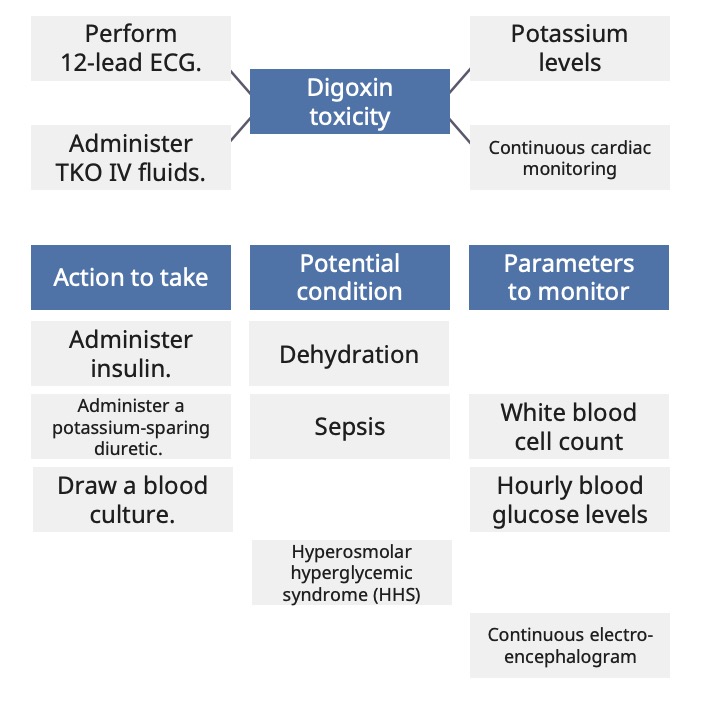
| Action to take | Potential condition | Parameters to monitor |
|---|---|---|
| Administer insulin. | Dehydration | Potassium levels |
| Administer a potassium-sparing diuretic. | Sepsis | White blood cell count |
| Draw a blood culture. | Digoxin toxicity | Hourly blood glucose levels |
| Perform 12-lead ECG. | Hyperosmolar hyperglycemic syndrome (HHS) | Continuous cardiac monitoring |
| Administer TKO IV fluids. | Continuous electro-encephalogram |
An older adult client is brought to the emergency department (ED) by a family member who says the client “seems confused and has had nausea and vomiting all day.”
| Vital sign | Findings |
| Temperature, axillary | 97.7 °F (36.5 °C) |
| Blood pressure | 84/60 mm Hg |
| Pulse | 48 beats/min, irregular |
| Respiratory rate | 12 breaths/min |
| Pulse oximeter reading | 92% on R/A |
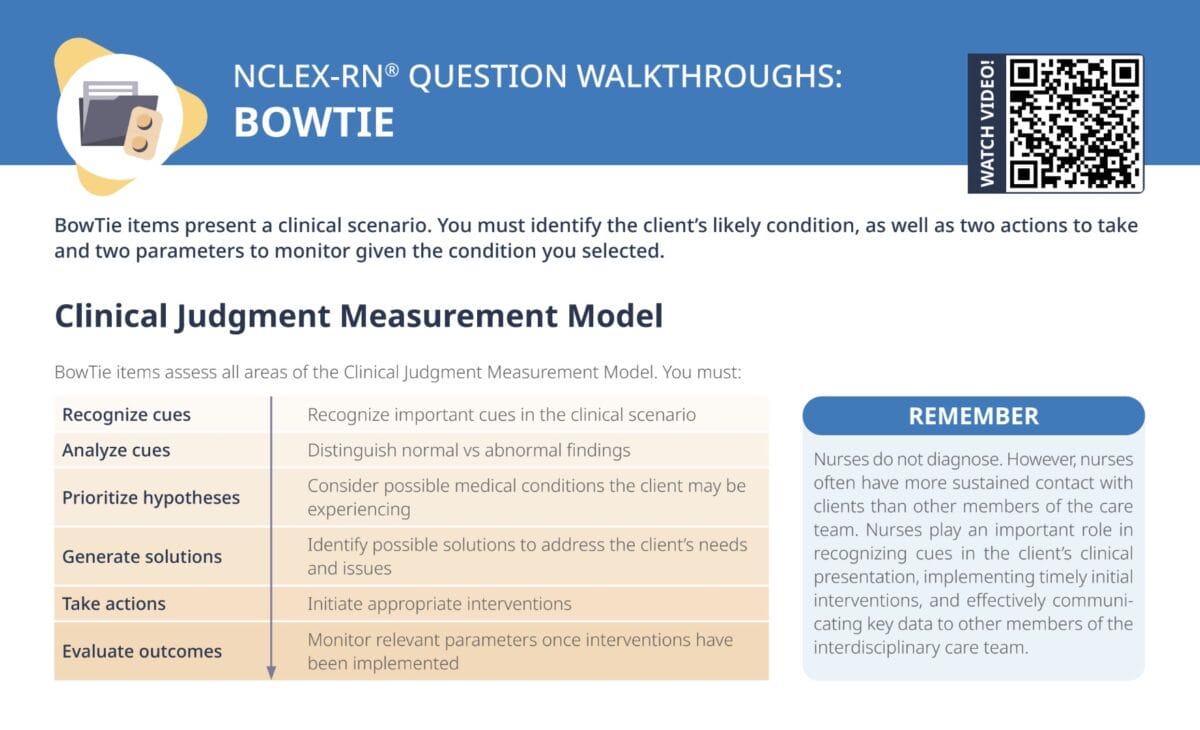
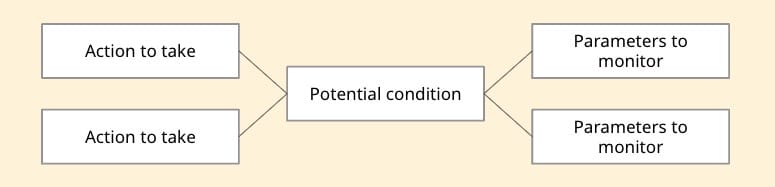
In a BowTie NGN question, the central knot of the “bowtie” represents a specific client scenario or a clinical problem. This is where the question starts. From this central point, the question tests two aspects:
The Bowtie format is designed to mimic the decision-making process in real-world nursing. It tests a student’s ability to not only recall factual knowledge but also apply critical thinking and problem-solving skills to client care situations.
Given a choice of items, the student has to drag-and-drop choices into the bowtie shape that presents the correct nursing assessment, judgment, and course of action for the question.
You won’t have these pictures on the NCLEX, so you will need to focus your mind by picturing the clients as real people who are experiencing real situations. Try to refrain from making up more of the “story” than is being presented. By focusing on a real scenario, you’re going to make better and safer decisions, and therefore have a better chance of selecting the correct answer.

The first thing to ask yourself when presented with a client/patient: Is what they are experiencing normal or abnormal? → Since we cannot ask if this is usual for the older adult client or not, we assume since it is presented to us as a client report, it is probably not a regular occurrence for this person. Nausea and vomiting definitely is not normal. At this time, we have no clue as to what the cause could be. Let’s look at the information that is presented in the tabs.
The most effective way to get the information needed from the tabs is to go through each tab slowly and thoroughly once; then go back and summarize each one: “What is the biggest problem here?” Make sure you take your time to think through your judgments and thoughts of the tabs. Don’t rush, it will only scatter your thoughts and make you have to check back and click around more often. Make notes if it helps.
Assessments: The client stated that “everything looks yellow” and “my heart feels like it’s skipping.” Both findings, an affected vision and an indication that the client does not have a normal sinus rhythm, are considered abnormal, so we should take note of them as indicators for what the problem could be.
The client is additionally described as looking “visibly drowsy,” barely being able to keep their eyes open.
Medical history:
Recent changes should always be given special attention since they could be related to what the client is currently experiencing.
Tip: Drug names in NCLEX questions can ring alarm bells for some students and make the question feel more challenging. Even if you have no idea what that drug is – stay with the question and look for cues you can judge!
As usual: Always judge each value according to your standard if it is normal or abnormal.
Taking an axillary temperature may sound a bit unusual, but it should not distract you from what the question is actually asking. Just take the value you get and judge it. Don’t waste your time and energy on questioning the methods of hypothetical nurses in the questions.
Remember that the NCLEX world works “by the book:” In the real world, a perfect blood pressure of 120/80 and a pulse between 60–100 as the perfect values might not be as realistic, but this is your baseline for judging the values here.
Overall, while this client might not be an immediate emergency, their vital signs give reason for concern. The blood pressure is really low, the heart rate is too low and irregular. This client should be monitored closely.
It is often recommended that “respiratory is always the priority,” and that is correct. This patient is at 92% though, which we should keep a close eye on, but we can continue examining the big picture and the other values for now.
Before tackling the drag-and-drop, revise in your head which findings you gathered from the scenario and the tabs: “Older adult (elderly) client brought in by family is confused and vomiting; is super drowsy, sees yellow, and has a slow, irregular heart rate. Blood pressure is really low; history includes heart failure and diabetes type 2. He’s taking a diuretic, a cardiac glycoside, and something for blood glucose.”
Basic rule: You always start left-to-right. Do not scan everything at once; you will only get overwhelmed.
Two out of the five options will be correct, since we have room for 2 items from this column in the bowtie schematic. The three to eliminate don’t need to be 100% wrong! Choose by selecting the 2 with the highest priority.
When deciding between two options, let your judgment be guided by what is the safest? Would it be safer to administer insulin without knowing the client’s blood glucose, or to establish an open IV access? Phrasing it this way makes it pretty clear: the IV access is our second correct action from this column, and can be ready for IV fluid administration. Draw this one into the bowtie graph.
Only one of the four mentioned conditions will be correct – an advantage of the NCLEX compared to real life where multiple diagnoses are common.
So, digoxin toxicity remains as the most likely condition that affects the client.
Two out of the five given parameters are relevant and important to monitor for this client.
Having decided on our choices for the actions to take and the potential condition, we can build on that to rationalize the parameters we need to monitor.
So, the two that we would drag up into the bowtie layout are potassium and continuous cardiac monitoring.
If you work in healthcare already, you might say “But we would always get a variety of values, certainly white blood cell count too, etc,” and you would be correct. But the NCLEX does not ask for real-life practice, but for the highest priority or most relevant values for the presented scenario.
Typical NCLEX! Lots of students know this frustration well. Here’s what to remember:
The test is looking to find out if you are safe in practice. Do you recognize what is the highest priority or the biggest risk or emergency you should follow up on?