

Nursing Knowledge
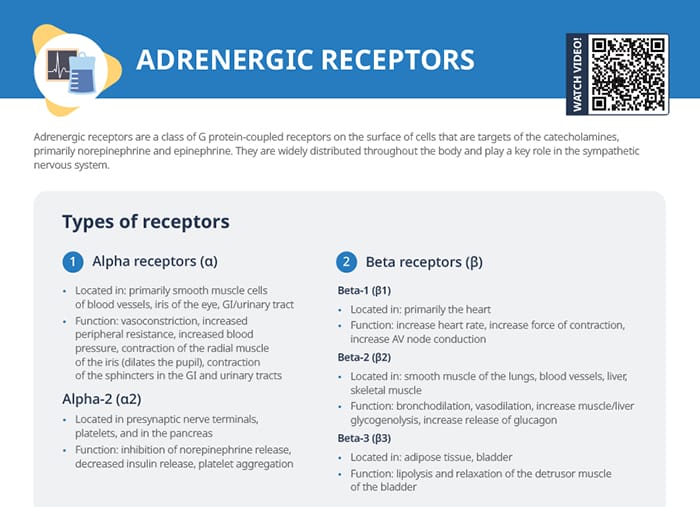
Adrenergic receptors are a class of G protein-coupled receptors on the surface of cells that are targets of the catecholamines, primarily norepinephrine and epinephrine. They are widely distributed throughout the body and play a key role in the sympathetic nervous system.
Alpha-1 receptors (α1) are primarily located in the smooth muscle cells of blood vessels, the iris of the eye, and the GI/urinary tract.
Functions:
Alpha-2 receptors (α2) are primarily located in presynaptic nerve terminals, platelets, and in the pancreas.
Functions:
Beta-1 (β1) receptors are primarily located in the heart.
Functions:
Beta-2 (β2) receptors are primarily located in the smooth muscle of the lungs, blood vessels, liver, and skeletal muscle.
Functions:
Beta-3 (β3) receptors are primarily located in adipose tissue and the bladder.
Their function is lipolysis and relaxation of the detrusor muscle of the bladder.
Alpha agonists promote the effect of α receptors. Examples:
Nursing interventions include monitoring blood pressure and watching for signs of excessive vasoconstriction or vasodilation.
Alpha antagonists counter the effect of α receptors. Examples:
Nursing interventions include monitoring blood pressure and watching for signs of excessive vasoconstriction or vasodilation.
Alpha agonists promote the effect of β receptors. Examples:
Nursing interventions include monitoring heart rate and blood pressure and assessing for hyperglycemia.
Alpha antagonists counter the effect of β receptors. Examples:
Nursing interventions include:
RELATED TOPIC:
Free Download
Master the topic with a unique study combination of a concise summary paired with video lectures.
Your free account gives you access to:
or