

Nursing Knowledge
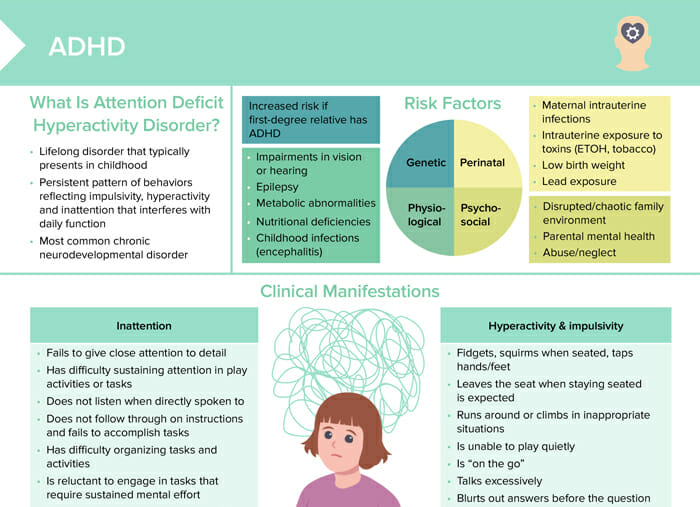
ADHD is the most common neurodevelopmental disorder. It is characterized by a persistent pattern of behaviors reflecting impulsivity, hyperactivity, and inattention that interferes with daily function. ADHD typically presents in childhood and is a lifelong disorder.
Overall, state estimates for ADHD diagnoses in children between 3 and 17 years vary from 6% to 16%.
Boys are generally more likely to be diagnosed (13%) than girls (6%).
Non-Hispanic Black and White children are more often diagnosed with ADHD (12% and 10%, respectively) than Hispanic (8%) or Asian children (3%).
ADHD in adults often manifests differently than in children. Adults may not exhibit overt hyperactivity as children often do. Instead, they may experience:
ADHD is typically diagnosed by psychiatrists, psychologists, or neurologists who have undergone specialized training in diagnosing and treating mental health disorders. In some cases, primary care physicians who are well versed in adult ADHD may also make a diagnosis. The diagnostic process usually involves a thorough medical evaluation, mental health screening, and the use of ADHD-specific rating scales.
As a nurse, you can recognize ADHD in your clients by noticing the signs and symptoms, in addition to understanding their medical and psychiatric history, and refer your suspicions and concerns to the qualified responsible healthcare provider.
Testing for ADHD often involves several steps:
Remember, it’s critical to have these assessments conducted by a professional qualified in diagnosing ADHD.
Risk factors associated with ADHD include:
The three main subtypes are:
Clinical manifestations of ADHD can be categorized into signs of inattention and signs of hyperactivity and impulsivity.
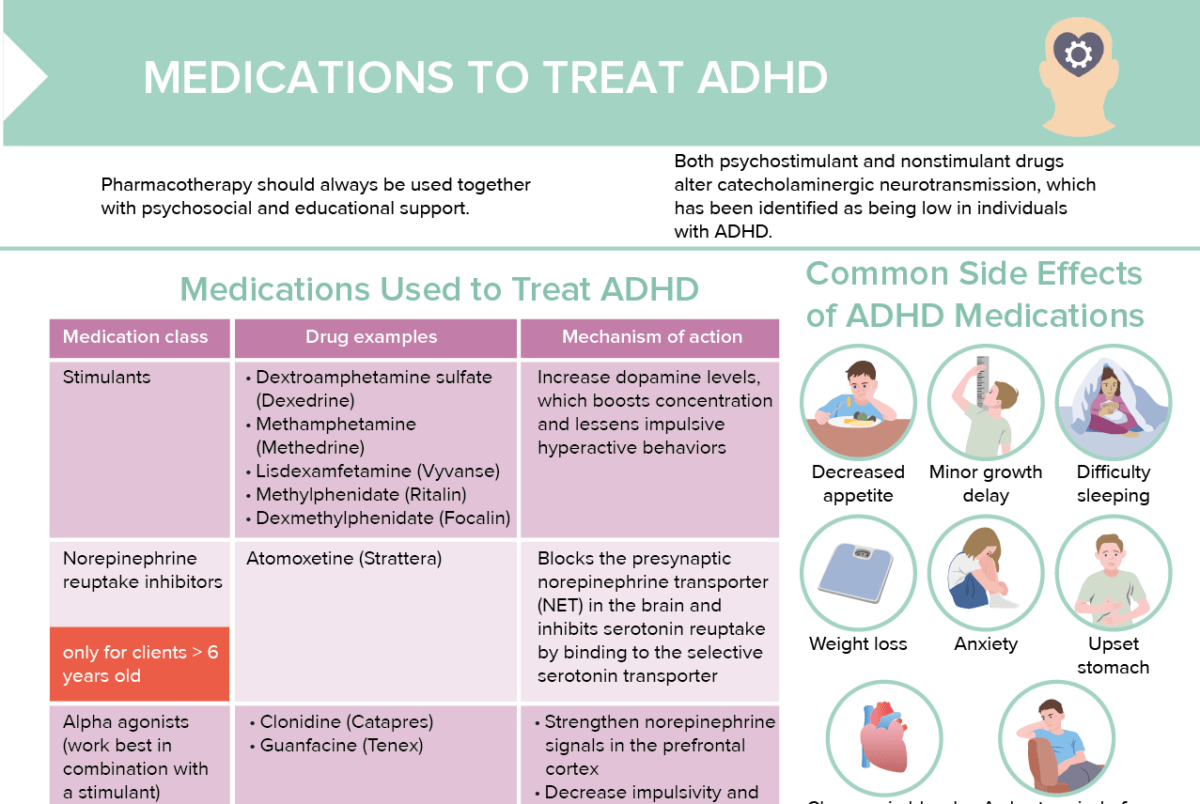
Non-pharmacologic treatments for ADHD include:
Read more about ADHD medications here →
ADD (Attention Deficit Disorder) and ADHD (Attention-Deficit/Hyperactivity Disorder) are often used interchangeably, but there is a distinction.
Originally, ADD was used to describe people who have trouble focusing but do not display hyperactivity. On the other hand, ADHD was used to describe people who are hyperactive as well as inattentive.
However, since the 1994 edition of the DSM, all forms of the disorder, including those without hyperactivity, are officially known as “ADHD” with three subtypes: predominantly inattentive, predominantly hyperactive-impulsive, and combined.
So, in contemporary usage, ADD is generally considered an outdated term and is encompassed within the broader diagnosis of ADHD, predominantly inattentive type.
ADHD and bipolar disorder can co-occur, but the exact prevalence can vary. Research has found that up to about 20% of people with bipolar disorder also have ADHD. Conversely, around 5–20% of those with ADHD also have bipolar disorder. These rates are significantly higher than in the general population.
Both conditions share some symptoms like impulsivity and mood instability, making the diagnostic process more complex. Any suspicion of co-occurrence should be evaluated by a qualified healthcare provider for proper diagnosis and treatment.
RELATED TOPIC:
Free Download
Master the topic with a unique study combination of a concise summary paired with video lectures.
Your free account gives you access to:
or