Interpreting ABGs accurately is a crucial skill for nurses to recognize respiratory or metabolic acid-base disorders. Find a comprehensive guide to arterial blood gas (ABG) interpretation below. It covers the normal ABG values, compensatory mechanisms, and the pH scale to diagnose respiratory and metabolic acid-base imbalances. Learn how to interpret ABGs in five easy steps!
Arterial blood gases (ABGs) are a set of measurements obtained from an arterial blood sample, often taken from the radial artery in the wrist, but sometimes from the femoral or brachial artery. This test is typically ordered for clients who are critically ill or have a respiratory disease.
ABGs provide important information about the following:
Oxygenation of the blood
How well carbon dioxide is being eliminated from the body
Acid-base balance: whether blood is too acidic or too alkaline
What is ABG interpretation?
ABG interpretation is the process of analyzing arterial blood gas values to diagnose respiratory and metabolic acid-base imbalances.
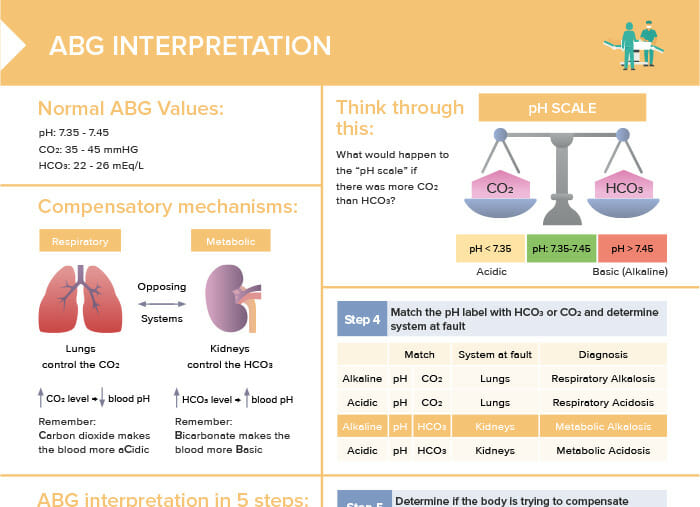
What are the normal ABG values for pH, CO2, and HCO3?
The normal ABG values are:
pH: 7.35–7.45
CO2: 35–45 mm Hg
HCO3: 22–26 mEq/L
How can you use the pH scale to diagnose respiratory and metabolic acid-base imbalances?
You can use the pH scale to match opposing systems (respiratory vs metabolic) and diagnose the system at fault based on whether the pH, CO2, or HCO3 levels are in or out of their normal ranges.
What is Kussmaul breathing?
Kussmaul breathing is a deep, rapid breathing pattern that occurs in response to extreme acidosis by blowing off CO2.
What are compensatory mechanisms for respiratory and metabolic acidosis and alkalosis?
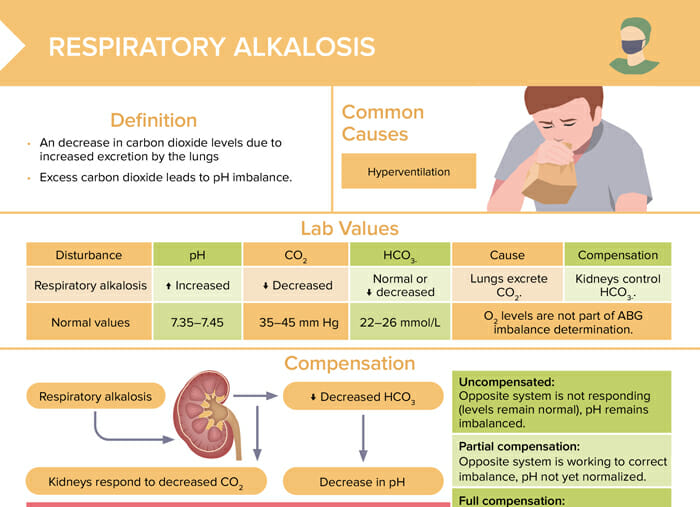
The compensatory mechanisms for respiratory acidosis/alkalosis involve changes in renal bicarbonate reabsorption/excretion.
Those for metabolic acidosis/alkalosis involve changes in respiratory rate/depth to adjust CO2 levels.
How to interpret an ABG in 5 steps
Check the pH level: If the pH is high, it indicates alkalosis, while a low pH indicates acidosis.
Check the CO2 level: If the CO2 level is high, it indicates acidosis, while a low CO2 level indicates alkalosis.
Check the HCO3 level: If the HCO3 level is high, it indicates alkalosis, while a low HCO3 level indicates acidosis.
Determine if compensation is occurring: If both CO2 and HCO3 levels are abnormal in the same direction as pH (either all high or all low), then compensation is not occurring. However, if one of them is normal while the other is abnormal in the opposite direction of pH (one high and one low), then compensation is occurring.
Identify the underlying cause of any imbalances: Based on which system (respiratory or metabolic) has caused the imbalance and whether compensation has occurred or not, you can identify the underlying cause of any imbalances and diagnose respiratory or metabolic acid-base disorders accordingly.