Effective communication in nursing is fundamental for high-quality patient care. It encompasses verbal and non-verbal interactions between nurses, patients, and the broader healthcare team, facilitating accurate assessments, empathetic patient support, and efficient care coordination. Keep reading for a collection of the most important types and techniques of communication.
Last updated: January 20, 2026
RELATED STUDY SHEET
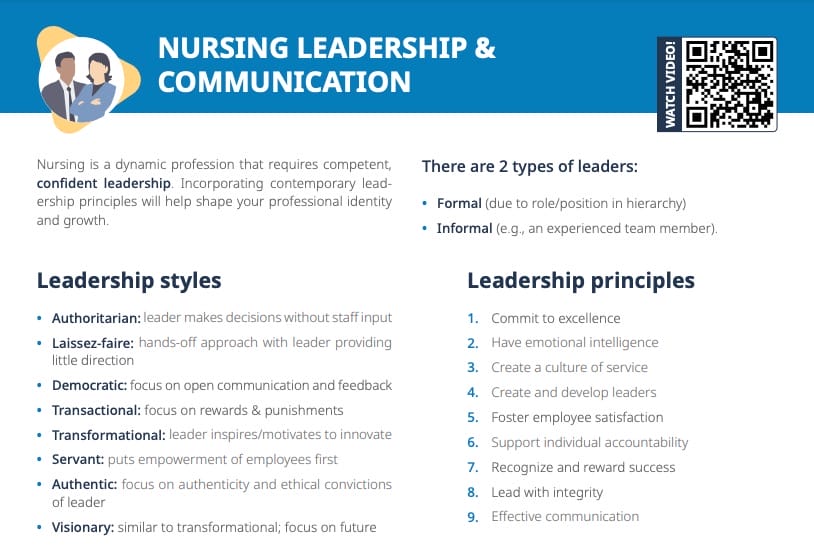
Communication is an essential leadership skill for nurses. Recap the leadership styles, principles, and skills with this study sheet.
Communication is a process by which meaning is assigned to the needs, feelings, perceptions, and interpretation of what is brought to our awareness.
Forms of communication
Communication can be verbal (spoken or written word) or nonverbal (includes appearance, body language, gestures); and symbolic (e.g., art, music). The term metacommunication refers to situations when the verbal and nonverbal language may not match, and conclusions are drawn from both verbal and nonverbal expressions (e.g., a patient stating a body part does not hurt, but flinches intensely when touched).
Communication in nursing
Communication in nursing practice is a critical skill for all nurses with clients, families, and their health care team members.
Effective communication:
Helps prevent errors
Creates better patient outcomes
Makes for better patient experience
There are lots of different types of communication you may encounter in your nursing team, the most notable being aggressive, passive, and assertive. Other types of communication refer to specific communication skills and techniques that are needed in nursing practice for specific situations, like therapeutic communication.
Professional communication
Regardless of the situation and other communication styles employed, there are basic requirements and tips regarding communication style that are part of a professional presentation and image to your patients as a healthcare professional. Examples include:
Professional appearance
Using names when addressing people
Being honest
Controlling one’s behavior (e.g., never yelling aggressively)
Being courteous
What is assertive communication?
Assertive communication means expressing your point of view in a way that is clear and direct while still respecting others. It means taking responsibility for your own behaviors and emotions.
Benefits of assertive communication
Minimizes conflict
Helps control anger by providing clear understanding
Requested needs are understood and met better
Assertive communication techniques
State your point of view or request clearly
Mind your tone and volume of voice
Make sure your body language matches
Don’t exaggerate (e.g., “never,” “always”)
Use “I statements”
Assertion vs aggression
With aggression, you are forcing your needs or opinions on others, sometimes even with shouting or bullying behaviors. Aggressive communication can damage self esteem as well as relationships. In assertion, you’re using clear but respectful expressions of your needs while also considering others’ needs and often reaching compromise.
Assertive vs passive communication
Passive communication means putting your needs last and not speaking up, maybe even letting yourself be ignored or actively undermining your opinions. An example would be saying “Well only if you really want to do that, if not I’ll get it done…”
What is group communication?
To achieve positive outcomes for patients and families, a collective effort of individuals participating in teams, groups, and meetings in the healthcare facility is indispensable.
Stages of group development
There are 4 stages of group development:
Forming phase: positive atmosphere, potential anxiety, leader role very important, figuring out responsibilities
Storming phase: pushing against boundaries, conflicts arise
Norming phase: differences get resolved, authority respected, potential socializing
Performing phase: hard work without friction, structures and processes work well
Strategies for effective group communication
TeamSTEPS:
Evidence-based training program
Goal: eliminate medical errors related to ineffective communication
5 key principles: team structure, communication, leadership, situation monitoring, mutual support
Shared mini-model within the team; promotes employee satisfaction
Tips for communication with interdisciplinary teams
Be proactive: Some conflicts between teams (e.g., floor nurses and lab) arise from negligence in communication and making assumptions.
Ask yourself questions about other teams’ situation, goals, and needs:
What is the other team actually doing, and how are they trying to do their job?
What is the impact the work of the other team has?
What are their greatest challenges – and how can you help?
Educate yourself: Understanding the entire process of the patient experience can heavily impact our ability to effectively work together.
Chaplin
Pharmacist
Therapists
Charge nurse
Healthcare providers
Case managers
Nutritionists
Respiratory therapist
Etc.
What is therapeutic communication?
Therapeutic communication is a communication style or skill that is applied not between nursing colleagues or the healthcare team, but with patients who you are in a therapeutic relationship with.
Therapeutic communication is defined as the face-to-face process of interacting that focuses on and prioritizes advancing the physical and emotional well–being of a patient.
Challenges and barriers in therapeutic communication
Developmental age of the patient (e.g., babies only can cry) or level of consciousness
Emotional state, medication effects (sedation) or high levels of stress
Nature of the relationship (e.g., seeing nurse as authority can be detrimental to opening up)
Cultural differences
Examples of non-therapeutic communication
Shutting someone down
Making someone hurry
Giving advice
Approving or disapproving (scolding)
Persistent questioning
Assuming and interpreting
Therapeutic communication techniques
Active listening: actually comprehending rather than just hearing
Silence: enduring silence to open up space for the client to keep talking
(Re-) focusing: gently redirecting the conversation to the topic
Open-ended questions: give space for more constructive answers than just yes or no
Clarification: repeating back
Exploring: go deeper on topic that was mentioned
Summarizing: highlighting key take-aways
Nursing tips to remember about therapeutic communication
“A therapeutic relationship is not a social one!” Rather than going both ways like a friendship would, in a therapeutic relationship, the healthcare team member keeps the spotlight on the patient at all times.
Silence can be helpful and needs practice to endure.
If a situation with a patient is making you uncomfortable and you feel like you cannot engage in professional therapeutic communication, it is important to step back and allow the person the right to speak to someone who can.