Domina Conceptos Médicos

Estudia para la escuela de medicina y tus examenes con Lecturio.

Tuberculosis

La tuberculosis (TB) es una enfermedad infecciosa causada por bacterias del complejo Mycobacterium tuberculosis. Las bacterias generalmente atacan los pulmones, pero también pueden dañar otras partes del cuerpo. Aproximadamente el 30% de las personas a nivel mundial están infectadas con este patógeno, y la mayoría alberga una infección latente. La tuberculosis se propaga por el aire cuando una persona con infección pulmonar activa tose o estornuda. M. tuberculosis es una bacteria ácido-alcohol resistente de crecimiento lento que puede sobrevivir en los macrófagos, lo que permite una infección latente que puede permanecer asintomática durante décadas, representando un desafío para el diagnóstico, la terapia y la prevención. El diagnóstico se establece con la prueba cutánea de la tuberculina, el cultivo de esputo y la imagenología pulmonar. El pilar del tratamiento son los medicamentos antimicobacterianos.

Last updated: Mar 25, 2022

Editorial responsibility: Stanley Oiseth, Lindsay Jones, Evelin Maza

Descripción General

Definición

La tuberculosis Tuberculosis Tuberculosis (TB) is an infectious disease caused by Mycobacterium tuberculosis complex bacteria. The bacteria usually attack the lungs but can also damage other parts of the body. Approximately 30% of people around the world are infected with this pathogen, with the majority harboring a latent infection. Tuberculosis spreads through the air when a person with active pulmonary infection coughs or sneezes. Tuberculosis ( TB TB Tuberculosis (TB) is an infectious disease caused by Mycobacterium tuberculosis complex bacteria. The bacteria usually attack the lungs but can also damage other parts of the body. Approximately 30% of people around the world are infected with this pathogen, with the majority harboring a latent infection. Tuberculosis spreads through the air when a person with active pulmonary infection coughs or sneezes. Tuberculosis) es una enfermedad infecciosa que afecta a los LOS Neisseria pulmones y, en EN Erythema nodosum is an immune-mediated panniculitis (inflammation of the subcutaneous fat) caused by a type IV (delayed-type) hypersensitivity reaction. It commonly manifests in young women as tender, erythematous nodules on the shins. Erythema Nodosum ocasiones, a otros órganos. La tuberculosis Tuberculosis Tuberculosis (TB) is an infectious disease caused by Mycobacterium tuberculosis complex bacteria. The bacteria usually attack the lungs but can also damage other parts of the body. Approximately 30% of people around the world are infected with this pathogen, with the majority harboring a latent infection. Tuberculosis spreads through the air when a person with active pulmonary infection coughs or sneezes. Tuberculosis es causada por las bacterias del complejo Mycobacterium tuberculosis Mycobacterium tuberculosis Tuberculosis (TB) is an infectious disease caused by Mycobacterium tuberculosis complex bacteria. The bacteria usually attack the lungs but can also damage other parts of the body. Approximately 30% of people around the world are infected with this pathogen, with the majority harboring a latent infection. Tuberculosis spreads through the air when a person with active pulmonary infection coughs or sneezes. Tuberculosis.
Epidemiología

  • La TB TB Tuberculosis (TB) is an infectious disease caused by Mycobacterium tuberculosis complex bacteria. The bacteria usually attack the lungs but can also damage other parts of the body. Approximately 30% of people around the world are infected with this pathogen, with the majority harboring a latent infection. Tuberculosis spreads through the air when a person with active pulmonary infection coughs or sneezes. Tuberculosis es la enfermedad infecciosa más mortal del mundo, con aproximadamente 1,4 millones de muertes al AL Amyloidosis año.
  • El 30% de la población mundial está infectada con TB TB Tuberculosis (TB) is an infectious disease caused by Mycobacterium tuberculosis complex bacteria. The bacteria usually attack the lungs but can also damage other parts of the body. Approximately 30% of people around the world are infected with this pathogen, with the majority harboring a latent infection. Tuberculosis spreads through the air when a person with active pulmonary infection coughs or sneezes. Tuberculosis.
  • El 10% de las personas infectadas desarrollarán la forma activa de la enfermedad.
  • En EN Erythema nodosum is an immune-mediated panniculitis (inflammation of the subcutaneous fat) caused by a type IV (delayed-type) hypersensitivity reaction. It commonly manifests in young women as tender, erythematous nodules on the shins. Erythema Nodosum 2019, 10 millones de personas contrajeron TB TB Tuberculosis (TB) is an infectious disease caused by Mycobacterium tuberculosis complex bacteria. The bacteria usually attack the lungs but can also damage other parts of the body. Approximately 30% of people around the world are infected with this pathogen, with the majority harboring a latent infection. Tuberculosis spreads through the air when a person with active pulmonary infection coughs or sneezes. Tuberculosis.
  • La TB TB Tuberculosis (TB) is an infectious disease caused by Mycobacterium tuberculosis complex bacteria. The bacteria usually attack the lungs but can also damage other parts of the body. Approximately 30% of people around the world are infected with this pathogen, with the majority harboring a latent infection. Tuberculosis spreads through the air when a person with active pulmonary infection coughs or sneezes. Tuberculosis es la principal causa de muerte en EN Erythema nodosum is an immune-mediated panniculitis (inflammation of the subcutaneous fat) caused by a type IV (delayed-type) hypersensitivity reaction. It commonly manifests in young women as tender, erythematous nodules on the shins. Erythema Nodosum pacientes con el virus Virus Viruses are infectious, obligate intracellular parasites composed of a nucleic acid core surrounded by a protein capsid. Viruses can be either naked (non-enveloped) or enveloped. The classification of viruses is complex and based on many factors, including type and structure of the nucleoid and capsid, the presence of an envelope, the replication cycle, and the host range. Virology de la inmunodeficiencia humana (VIH).
  • Incidencia: 2,7 por cada 100 000 habitantes en EN Erythema nodosum is an immune-mediated panniculitis (inflammation of the subcutaneous fat) caused by a type IV (delayed-type) hypersensitivity reaction. It commonly manifests in young women as tender, erythematous nodules on the shins. Erythema Nodosum Estados Unidos (2019)
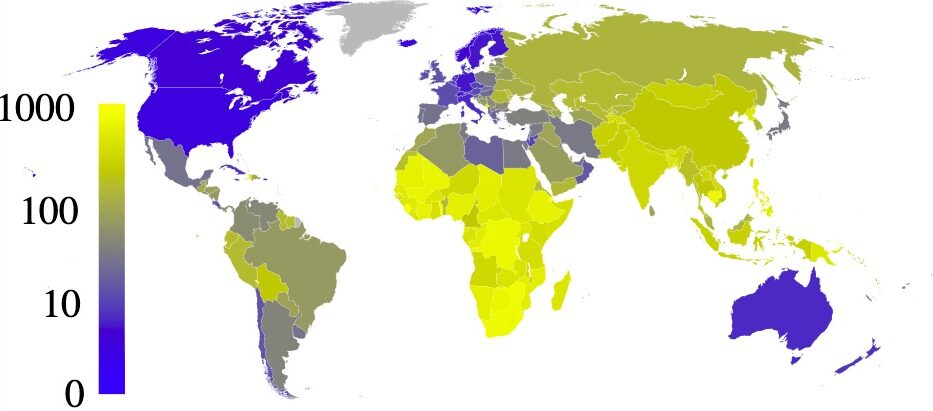
  • Regiones con mayor incidencia de TB TB Tuberculosis (TB) is an infectious disease caused by Mycobacterium tuberculosis complex bacteria. The bacteria usually attack the lungs but can also damage other parts of the body. Approximately 30% of people around the world are infected with this pathogen, with the majority harboring a latent infection. Tuberculosis spreads through the air when a person with active pulmonary infection coughs or sneezes. Tuberculosis:
  • Factores de riesgo:
    • Pacientes institucionalizados
    • Uso de drogas intravenosas
    • VIH u otra inmunodeficiencia
    • Viajar a regiones de alto riesgo
Prevalencia de la tuberculosis

Prevalencia estimada de tuberculosis por cada 100 000 habitantes en 2007, por país

Imagen: “Estimated prevalence of tuberculosis” por Eubulides. Licencia: Dominio Público

Fisiopatología

Agente etiológico

El complejo M. tuberculosis Tuberculosis Tuberculosis (TB) is an infectious disease caused by Mycobacterium tuberculosis complex bacteria. The bacteria usually attack the lungs but can also damage other parts of the body. Approximately 30% of people around the world are infected with this pathogen, with the majority harboring a latent infection. Tuberculosis spreads through the air when a person with active pulmonary infection coughs or sneezes. Tuberculosis es un grupo de especies que pueden causar TB TB Tuberculosis (TB) is an infectious disease caused by Mycobacterium tuberculosis complex bacteria. The bacteria usually attack the lungs but can also damage other parts of the body. Approximately 30% of people around the world are infected with this pathogen, with the majority harboring a latent infection. Tuberculosis spreads through the air when a person with active pulmonary infection coughs or sneezes. Tuberculosis en EN Erythema nodosum is an immune-mediated panniculitis (inflammation of the subcutaneous fat) caused by a type IV (delayed-type) hypersensitivity reaction. It commonly manifests in young women as tender, erythematous nodules on the shins. Erythema Nodosum humanos u otros animales.

Especies clave:

  • M. tuberculosis Tuberculosis Tuberculosis (TB) is an infectious disease caused by Mycobacterium tuberculosis complex bacteria. The bacteria usually attack the lungs but can also damage other parts of the body. Approximately 30% of people around the world are infected with this pathogen, with the majority harboring a latent infection. Tuberculosis spreads through the air when a person with active pulmonary infection coughs or sneezes. Tuberculosis
  • M. bovis
  • M. africanum
  • M. microti
  • M. canetti

Caracteristicas:

  • Ácido-alcohol resistencia:
    • Propiedad conferida por el ácido micólico
    • No destiñe con ácido-alcohol después de haber sido teñido con colorantes de anilina.
  • Tinción de Gram:
    • Por lo general, no puede penetrar la pared celular cerosa de las bacterias del complejo Mycobacterium tuberculosis Mycobacterium tuberculosis Tuberculosis (TB) is an infectious disease caused by Mycobacterium tuberculosis complex bacteria. The bacteria usually attack the lungs but can also damage other parts of the body. Approximately 30% of people around the world are infected with this pathogen, with the majority harboring a latent infection. Tuberculosis spreads through the air when a person with active pulmonary infection coughs or sneezes. Tuberculosis
    • Lo más común es que no produzcan manchas o resultados variables.
  • Crecimiento lento
  • Aerobios obligados
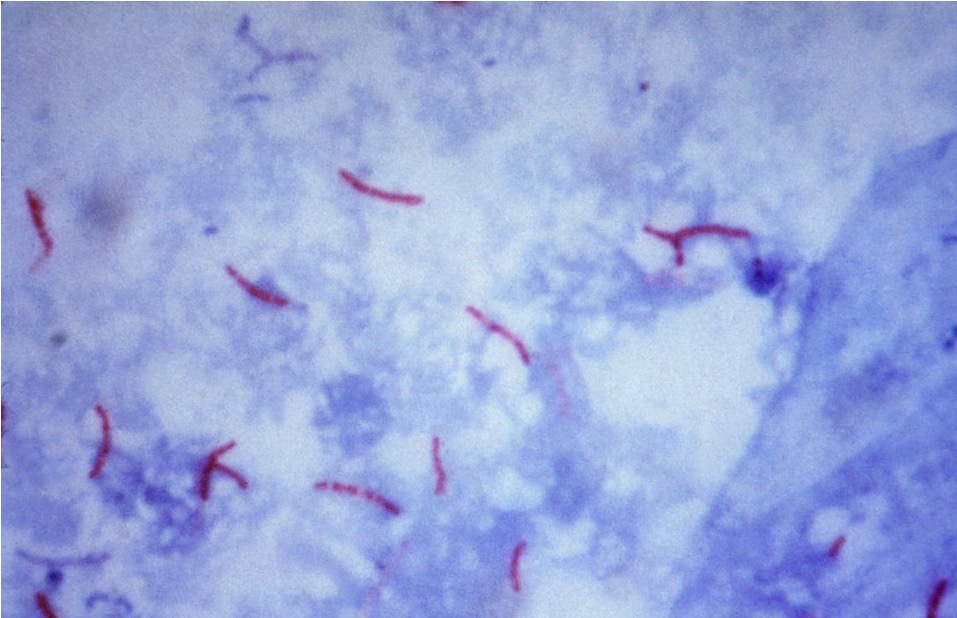
Tinción acidorresistente de Mycobacterium tuberculosis

Tinción ácido-alcohol resistente de M. tuberculosis

Imagen: “Mycobacterium tuberculosis bacteria” por CDC/Dr. George P. Kubica. Licencia: Dominio Público

Factores de virulencia:

  • Envoltura celular:
    • Constituyente principal: ácido micólico
    • El ácido micólico se une a los LOS Neisseria glicolípidos.
    • Los LOS Neisseria glicolípidos son responsables de la “formación de cordones” en EN Erythema nodosum is an immune-mediated panniculitis (inflammation of the subcutaneous fat) caused by a type IV (delayed-type) hypersensitivity reaction. It commonly manifests in young women as tender, erythematous nodules on the shins. Erythema Nodosum el microscopio (corresponde en EN Erythema nodosum is an immune-mediated panniculitis (inflammation of the subcutaneous fat) caused by a type IV (delayed-type) hypersensitivity reaction. It commonly manifests in young women as tender, erythematous nodules on the shins. Erythema Nodosum gran medida a la formación de granulomas Granulomas A relatively small nodular inflammatory lesion containing grouped mononuclear phagocytes, caused by infectious and noninfectious agents. Sarcoidosis).
  • Catalasa-peroxidasa: resiste la respuesta oxidativa de la célula huésped
  • Sulfátidos y dimicolato de trehalosa: desencadenan toxicidad
  • Lipoarabinomanano: induce a las citoquinas

Transmisión:

  • Exclusivamente aérea
  • De pacientes con TB TB Tuberculosis (TB) is an infectious disease caused by Mycobacterium tuberculosis complex bacteria. The bacteria usually attack the lungs but can also damage other parts of the body. Approximately 30% of people around the world are infected with this pathogen, with the majority harboring a latent infection. Tuberculosis spreads through the air when a person with active pulmonary infection coughs or sneezes. Tuberculosis activa

Patogénesis

  • El primer paso es la inhalación de gotículas.
  • Las gotículas se depositan en EN Erythema nodosum is an immune-mediated panniculitis (inflammation of the subcutaneous fat) caused by a type IV (delayed-type) hypersensitivity reaction. It commonly manifests in young women as tender, erythematous nodules on the shins. Erythema Nodosum los LOS Neisseria pulmones.
  • 3 resultados posibles:
    • Eliminación de bacterias
    • Enfermedad activa primaria
    • Infección latente (la enfermedad clínica puede ocurrir muchos años después)

Enfermedad activa primaria:

  • Proliferación de bacterias dentro de los LOS Neisseria macrófagos alveolares.
  • Las citoquinas producidas por los LOS Neisseria macrófagos atraen a otras células fagocíticas.
  • Se forma un tubérculo (estructura granulomatosa).
  • El tubérculo se expande hacia el parénquima pulmonar → complejo de Ghon
  • Luego, las bacterias pueden propagarse a los LOS Neisseria ganglios linfáticos que drenan el tejido → linfadenopatía
  • Complejo de Ghon + linfadenopatía/calcificación → Complejo de Ranke
  • Si las células inmunitarias no controlan la propagación, puede producirse bacteriemia con siembra de otros órganos → TB TB Tuberculosis (TB) is an infectious disease caused by Mycobacterium tuberculosis complex bacteria. The bacteria usually attack the lungs but can also damage other parts of the body. Approximately 30% of people around the world are infected with this pathogen, with the majority harboring a latent infection. Tuberculosis spreads through the air when a person with active pulmonary infection coughs or sneezes. Tuberculosis miliar
  • Cuando las bacterias erosionan las vías respiratorias ( granulomas Granulomas A relatively small nodular inflammatory lesion containing grouped mononuclear phagocytes, caused by infectious and noninfectious agents. Sarcoidosis caseificantes), el paciente se vuelve contagioso.
  • La infección puede progresar a un estadio crónico con episodios de curación y posterior cicatrización de las lesiones.
  • La erradicación espontánea es rara.

Infección latente:

  • El riesgo de reactivación durante la vida es de 5%–10%.
  • La inmunosupresión es un factor definitivo en EN Erythema nodosum is an immune-mediated panniculitis (inflammation of the subcutaneous fat) caused by a type IV (delayed-type) hypersensitivity reaction. It commonly manifests in young women as tender, erythematous nodules on the shins. Erythema Nodosum la reactivación.
  • Factores de riesgo:
    • VIH
    • Enfermedad renal
    • Diabetes Diabetes Diabetes mellitus (DM) is a metabolic disease characterized by hyperglycemia and dysfunction of the regulation of glucose metabolism by insulin. Type 1 DM is diagnosed mostly in children and young adults as the result of autoimmune destruction of β cells in the pancreas and the resulting lack of insulin. Type 2 DM has a significant association with obesity and is characterized by insulin resistance. Diabetes Mellitus
    • Esteroides
    • Linfoma
    • Edad avanzada
    • Tabaquismo

Presentación Clínica

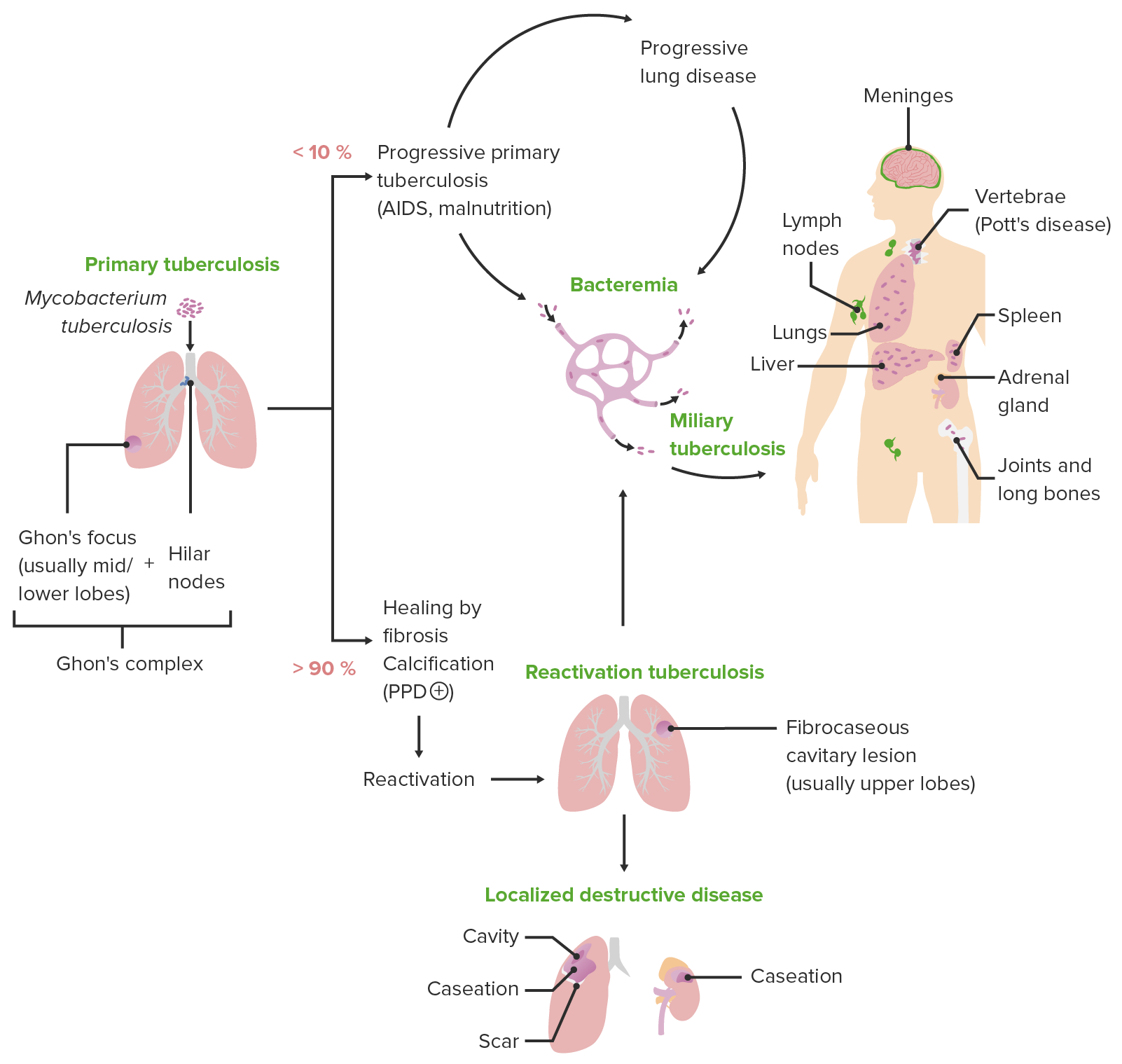
presentación clínica de la tuberculosis

Diagrama esquemático que representa las diversas presentaciones clínicas de la tuberculosis junto con los mecanismos patológicos característicos de cada presentación

Imagen por Lecturio. Licencia: CC BY-NC-SA 4.0
TB TB Tuberculosis (TB) is an infectious disease caused by Mycobacterium tuberculosis complex bacteria. The bacteria usually attack the lungs but can also damage other parts of the body. Approximately 30% of people around the world are infected with this pathogen, with the majority harboring a latent infection. Tuberculosis spreads through the air when a person with active pulmonary infection coughs or sneezes. Tuberculosis primaria

  • La enfermedad primaria sintomática solo se desarrolla en EN Erythema nodosum is an immune-mediated panniculitis (inflammation of the subcutaneous fat) caused by a type IV (delayed-type) hypersensitivity reaction. It commonly manifests in young women as tender, erythematous nodules on the shins. Erythema Nodosum alrededor del 10% de las personas infectadas.
  • Fiebre:
    • Síntoma más común
    • Mayormente baja, pero puede ser de hasta 39°C (102,2°F)
    • Dura hasta 10 semanas, pero en EN Erythema nodosum is an immune-mediated panniculitis (inflammation of the subcutaneous fat) caused by a type IV (delayed-type) hypersensitivity reaction. It commonly manifests in young women as tender, erythematous nodules on the shins. Erythema Nodosum promedio de 14–21 días
  • Dolor Dolor Inflammation torácico pleurítico (puede o no estar asociado con derrame)
  • Dolor Dolor Inflammation retroesternal/interescapular (debido a linfadenopatía bronquial)
  • Tos TOS Thoracic outlet syndrome (TOS) is a broad term used for a spectrum of syndromes related to the general region of the thoracic outlet, which involves the compression or irritation of elements of the brachial plexus, subclavian artery, or subclavian vein. Thoracic Outlet Syndrome
  • Fatiga
  • Artralgia
  • Faringitis

Reactivación de la TB TB Tuberculosis (TB) is an infectious disease caused by Mycobacterium tuberculosis complex bacteria. The bacteria usually attack the lungs but can also damage other parts of the body. Approximately 30% of people around the world are infected with this pathogen, with the majority harboring a latent infection. Tuberculosis spreads through the air when a person with active pulmonary infection coughs or sneezes. Tuberculosis

  • Los LOS Neisseria segmentos apicales de los LOS Neisseria lóbulos superiores y los LOS Neisseria segmentos superiores de los LOS Neisseria lóbulos inferiores son los LOS Neisseria más afectados, probablemente debido a:
    • Aumento de la tensión de oxígeno
    • Drenaje linfático deficiente
  • El inicio de los LOS Neisseria síntomas es gradual; pueden pasar desapercibidos durante 2–3 años
    • Fiebre:
      • Primero baja, empeorando conforme avanza la enfermedad
      • Clásicamente diurna: picos por la tarde, afebril por la noche y en EN Erythema nodosum is an immune-mediated panniculitis (inflammation of the subcutaneous fat) caused by a type IV (delayed-type) hypersensitivity reaction. It commonly manifests in young women as tender, erythematous nodules on the shins. Erythema Nodosum la madrugada
    • Sudoración nocturna
    • Tos TOS Thoracic outlet syndrome (TOS) is a broad term used for a spectrum of syndromes related to the general region of the thoracic outlet, which involves the compression or irritation of elements of the brachial plexus, subclavian artery, or subclavian vein. Thoracic Outlet Syndrome:
      • Primero leve, empeora gradualmente
      • Inicialmente solo por las mañanas.
      • Se vuelve más productiva (esputo amarillo verdoso) a medida que avanza la enfermedad
      • Tos TOS Thoracic outlet syndrome (TOS) is a broad term used for a spectrum of syndromes related to the general region of the thoracic outlet, which involves the compression or irritation of elements of the brachial plexus, subclavian artery, or subclavian vein. Thoracic Outlet Syndrome nocturna y hemoptisis: enfermedad avanzada
    • El neumotórax o los LOS Neisseria derrames pueden presentarse con disnea (raro).
    • Anorexia Anorexia The lack or loss of appetite accompanied by an aversion to food and the inability to eat. It is the defining characteristic of the disorder anorexia nervosa. Anorexia Nervosa, emaciación, malestar
    • Úlceras en EN Erythema nodosum is an immune-mediated panniculitis (inflammation of the subcutaneous fat) caused by a type IV (delayed-type) hypersensitivity reaction. It commonly manifests in young women as tender, erythematous nodules on the shins. Erythema Nodosum boca, lengua, laringe y esófago: se debe a las secreciones expectoradas, que están infectadas

TB TB Tuberculosis (TB) is an infectious disease caused by Mycobacterium tuberculosis complex bacteria. The bacteria usually attack the lungs but can also damage other parts of the body. Approximately 30% of people around the world are infected with this pathogen, with the majority harboring a latent infection. Tuberculosis spreads through the air when a person with active pulmonary infection coughs or sneezes. Tuberculosis extrapulmonar y miliar

  • Puede desarrollarse en EN Erythema nodosum is an immune-mediated panniculitis (inflammation of the subcutaneous fat) caused by a type IV (delayed-type) hypersensitivity reaction. It commonly manifests in young women as tender, erythematous nodules on the shins. Erythema Nodosum el curso de la enfermedad primaria o durante una reactivación.
  • Hasta en EN Erythema nodosum is an immune-mediated panniculitis (inflammation of the subcutaneous fat) caused by a type IV (delayed-type) hypersensitivity reaction. It commonly manifests in young women as tender, erythematous nodules on the shins. Erythema Nodosum el 15%–20% de los LOS Neisseria casos activos
  • Más común en EN Erythema nodosum is an immune-mediated panniculitis (inflammation of the subcutaneous fat) caused by a type IV (delayed-type) hypersensitivity reaction. It commonly manifests in young women as tender, erythematous nodules on the shins. Erythema Nodosum niños y personas inmunocomprometidas
  • Manifestaciones extrapulmonares (pueden afectar cualquier sistema de órganos):
    • Pleuritis Pleuritis Pleuritis, also known as pleurisy, is an inflammation of the visceral and parietal layers of the pleural membranes of the lungs. The condition can be primary or secondary and results in sudden, sharp, and intense chest pain on inhalation and exhalation. Pleuritis tuberculosa
    • Insuficiencia de la glándula suprarrenal
    • Meningitis Meningitis Meningitis is inflammation of the meninges, the protective membranes of the brain, and spinal cord. The causes of meningitis are varied, with the most common being bacterial or viral infection. The classic presentation of meningitis is a triad of fever, altered mental status, and nuchal rigidity. Meningitis
    • Espondilitis tuberculosa (enfermedad de Pott, infección por TB TB Tuberculosis (TB) is an infectious disease caused by Mycobacterium tuberculosis complex bacteria. The bacteria usually attack the lungs but can also damage other parts of the body. Approximately 30% of people around the world are infected with this pathogen, with the majority harboring a latent infection. Tuberculosis spreads through the air when a person with active pulmonary infection coughs or sneezes. Tuberculosis en EN Erythema nodosum is an immune-mediated panniculitis (inflammation of the subcutaneous fat) caused by a type IV (delayed-type) hypersensitivity reaction. It commonly manifests in young women as tender, erythematous nodules on the shins. Erythema Nodosum > 1 vértebra)
    • Pericarditis Pericarditis Pericarditis is an inflammation of the pericardium, often with fluid accumulation. It can be caused by infection (often viral), myocardial infarction, drugs, malignancies, metabolic disorders, autoimmune disorders, or trauma. Acute, subacute, and chronic forms exist. Pericarditis constrictiva
    • Lupus vulgar (nódulos de color marrón rojizo que suelen aparecer en EN Erythema nodosum is an immune-mediated panniculitis (inflammation of the subcutaneous fat) caused by a type IV (delayed-type) hypersensitivity reaction. It commonly manifests in young women as tender, erythematous nodules on the shins. Erythema Nodosum la cara alrededor de la nariz, los LOS Neisseria párpados, los LOS Neisseria labios, las mejillas, las orejas y el cuello)
    • Escrófula (linfadenitis cervical)
    • Piuria estéril
  • TB TB Tuberculosis (TB) is an infectious disease caused by Mycobacterium tuberculosis complex bacteria. The bacteria usually attack the lungs but can also damage other parts of the body. Approximately 30% of people around the world are infected with this pathogen, with the majority harboring a latent infection. Tuberculosis spreads through the air when a person with active pulmonary infection coughs or sneezes. Tuberculosis miliar:
    • Propagación masiva de la infección a través de la sangre y los LOS Neisseria vasos linfáticos
    • Pequeñas lesiones granulomatosas a través de múltiples órganos.

Diagnóstico

Antecedentes

  • Viajes a zonas endémicas
  • Exposición a personas con infección activa conocida o sospechada
  • VIH u otras inmunodeficiencias
  • Trabajador sanitario
  • Vivir en EN Erythema nodosum is an immune-mediated panniculitis (inflammation of the subcutaneous fat) caused by a type IV (delayed-type) hypersensitivity reaction. It commonly manifests in young women as tender, erythematous nodules on the shins. Erythema Nodosum un albergue para personas sin hogar o en EN Erythema nodosum is an immune-mediated panniculitis (inflammation of the subcutaneous fat) caused by a type IV (delayed-type) hypersensitivity reaction. It commonly manifests in young women as tender, erythematous nodules on the shins. Erythema Nodosum una institución correccional

Examen físico

  • Los LOS Neisseria hallazgos suelen ser inespecíficos.
  • Pulmonares:
    • Matidez a la percusión (derrames)
    • Crepitantes a la auscultación
    • Sonidos respiratorios distantes y huecos
  • Extrapulmonares (depende de la afectación orgánica):
    • Linfadenopatía cervical
    • Hepatomegalia/esplenomegalia
    • Ascitis, ictericia
    • Meningismo, alteración del estado mental
    • Cambios en EN Erythema nodosum is an immune-mediated panniculitis (inflammation of the subcutaneous fat) caused by a type IV (delayed-type) hypersensitivity reaction. It commonly manifests in young women as tender, erythematous nodules on the shins. Erythema Nodosum la piel (lupus vulgar)

Imagenología

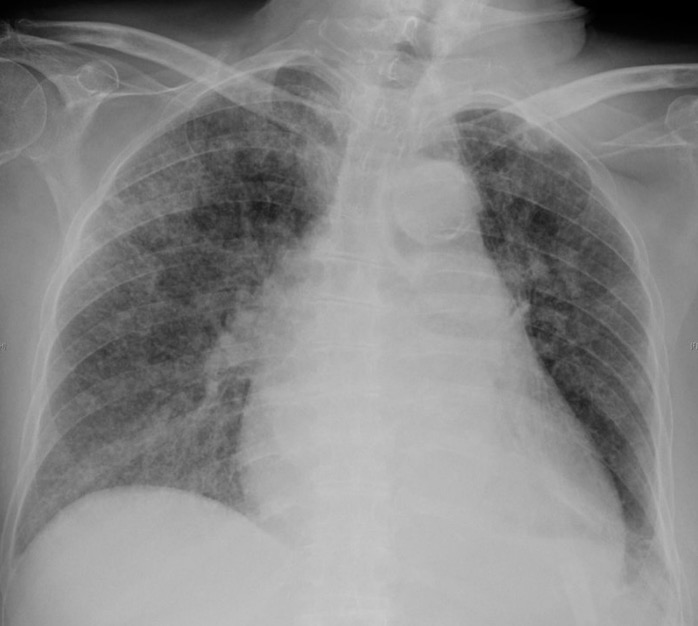
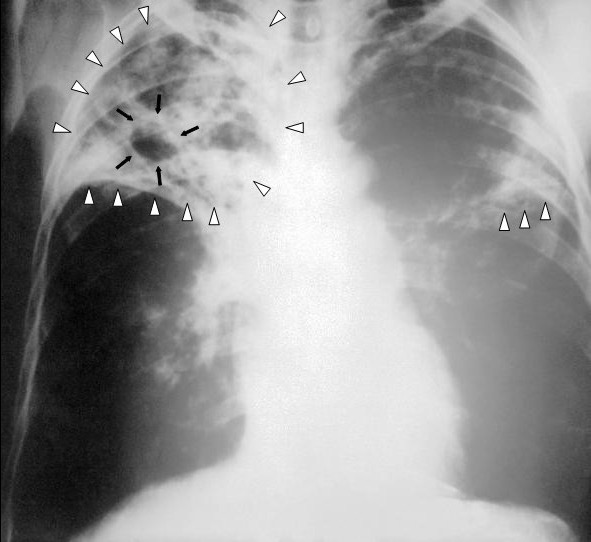
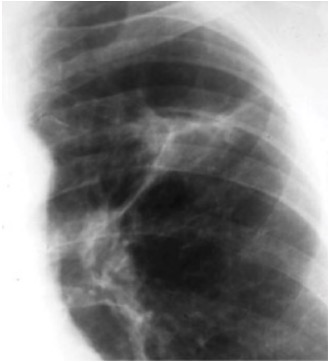
  • Radiografía de tórax:
    • Puede ser normal en EN Erythema nodosum is an immune-mediated panniculitis (inflammation of the subcutaneous fat) caused by a type IV (delayed-type) hypersensitivity reaction. It commonly manifests in young women as tender, erythematous nodules on the shins. Erythema Nodosum la TB TB Tuberculosis (TB) is an infectious disease caused by Mycobacterium tuberculosis complex bacteria. The bacteria usually attack the lungs but can also damage other parts of the body. Approximately 30% of people around the world are infected with this pathogen, with the majority harboring a latent infection. Tuberculosis spreads through the air when a person with active pulmonary infection coughs or sneezes. Tuberculosis primaria
    • Linfadenopatía hiliar
    • Complejo de Ghon: ganglios linfáticos hiliares agrandados + sombra local
    • Foco de Assmann: infiltración infraclavicular
    • Derrame pleural
    • Reactivación de la TB TB Tuberculosis (TB) is an infectious disease caused by Mycobacterium tuberculosis complex bacteria. The bacteria usually attack the lungs but can also damage other parts of the body. Approximately 30% of people around the world are infected with this pathogen, with the majority harboring a latent infection. Tuberculosis spreads through the air when a person with active pulmonary infection coughs or sneezes. Tuberculosis:
      • Focos de Simon (pequeña cicatriz calcificada de la infección primaria)
      • Infiltrados en EN Erythema nodosum is an immune-mediated panniculitis (inflammation of the subcutaneous fat) caused by a type IV (delayed-type) hypersensitivity reaction. It commonly manifests in young women as tender, erythematous nodules on the shins. Erythema Nodosum los LOS Neisseria segmentos apicales y en EN Erythema nodosum is an immune-mediated panniculitis (inflammation of the subcutaneous fat) caused by a type IV (delayed-type) hypersensitivity reaction. It commonly manifests in young women as tender, erythematous nodules on the shins. Erythema Nodosum los LOS Neisseria segmentos superiores de los LOS Neisseria lóbulos inferiores.
      • Cavidades con niveles hidroaéreos
  • Tomografía computarizada (TC):
    • Más sensible que la radiografía simple
    • Se usa si la radiografía de tórax no es específica o si se considera un diagnóstico alternativo

Identificación de laboratorio

  • Esputo:
    • 3 muestras, al AL Amyloidosis menos 1 en EN Erythema nodosum is an immune-mediated panniculitis (inflammation of the subcutaneous fat) caused by a type IV (delayed-type) hypersensitivity reaction. It commonly manifests in young women as tender, erythematous nodules on the shins. Erythema Nodosum la madrugada
    • Frotis para bacilos ácido-alcohol resistentes
    • Cultivo de micobacterias
    • Prueba de amplificación de ácidos nucleicos
  • Cultivo de micobacterias en EN Erythema nodosum is an immune-mediated panniculitis (inflammation of the subcutaneous fat) caused by a type IV (delayed-type) hypersensitivity reaction. It commonly manifests in young women as tender, erythematous nodules on the shins. Erythema Nodosum sangre u orina: en EN Erythema nodosum is an immune-mediated panniculitis (inflammation of the subcutaneous fat) caused by a type IV (delayed-type) hypersensitivity reaction. It commonly manifests in young women as tender, erythematous nodules on the shins. Erythema Nodosum pacientes con VIH o inmunocomprometidos
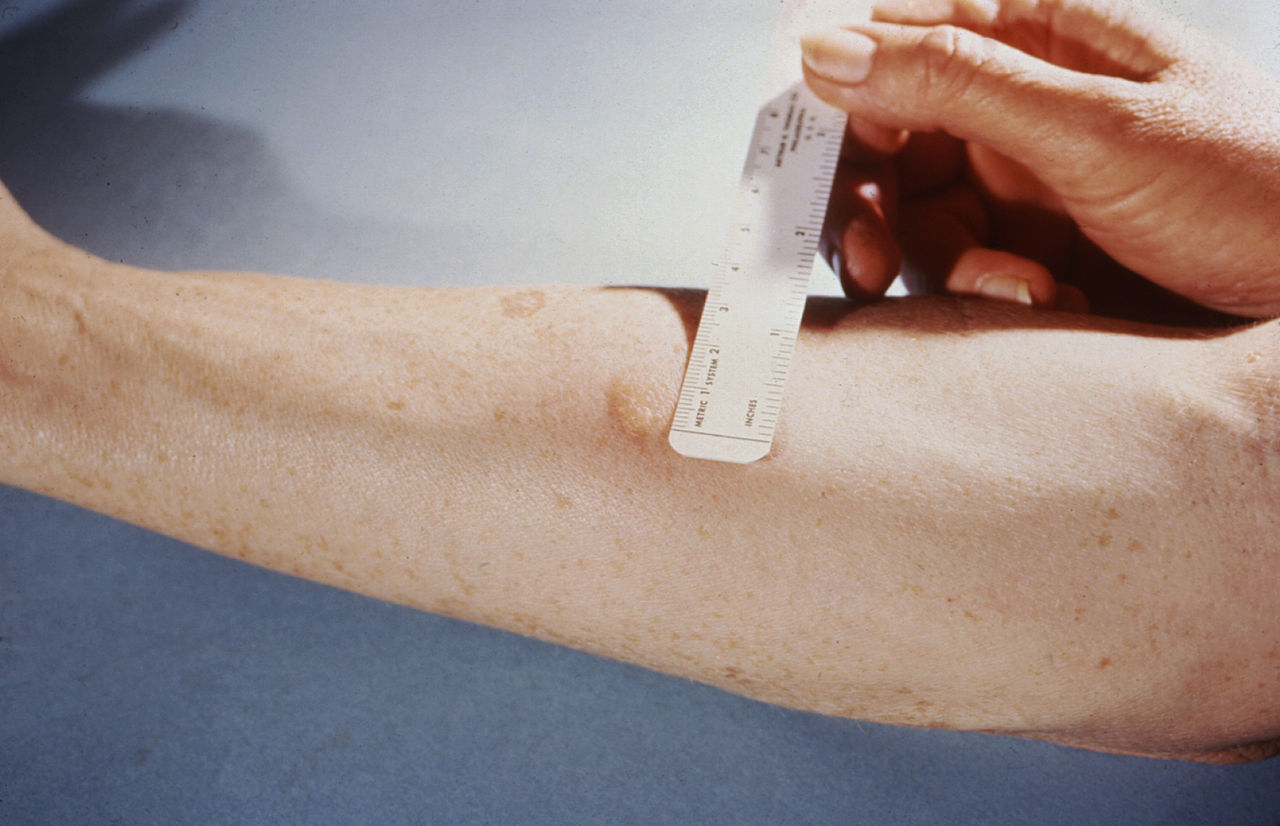
  • Prueba cutánea de la tuberculina ((TST, por sus siglas en EN Erythema nodosum is an immune-mediated panniculitis (inflammation of the subcutaneous fat) caused by a type IV (delayed-type) hypersensitivity reaction. It commonly manifests in young women as tender, erythematous nodules on the shins. Erythema Nodosum inglés); derivado proteico purificado (PPD, por sus siglas en EN Erythema nodosum is an immune-mediated panniculitis (inflammation of the subcutaneous fat) caused by a type IV (delayed-type) hypersensitivity reaction. It commonly manifests in young women as tender, erythematous nodules on the shins. Erythema Nodosum inglés) o prueba de Mantoux)):
    • Inyección intradérmica de antígenos de la tuberculina
    • Puede detectar infección activa o latente
    • Se mide el área de induración en EN Erythema nodosum is an immune-mediated panniculitis (inflammation of the subcutaneous fat) caused by a type IV (delayed-type) hypersensitivity reaction. It commonly manifests in young women as tender, erythematous nodules on the shins. Erythema Nodosum 48–72 horas; es positivo si:
      • > 5 mm en EN Erythema nodosum is an immune-mediated panniculitis (inflammation of the subcutaneous fat) caused by a type IV (delayed-type) hypersensitivity reaction. It commonly manifests in young women as tender, erythematous nodules on the shins. Erythema Nodosum pacientes con VIH, con inmunosupresión o con contacto reciente con TB TB Tuberculosis (TB) is an infectious disease caused by Mycobacterium tuberculosis complex bacteria. The bacteria usually attack the lungs but can also damage other parts of the body. Approximately 30% of people around the world are infected with this pathogen, with the majority harboring a latent infection. Tuberculosis spreads through the air when a person with active pulmonary infection coughs or sneezes. Tuberculosis
      • > 10 mm en EN Erythema nodosum is an immune-mediated panniculitis (inflammation of the subcutaneous fat) caused by a type IV (delayed-type) hypersensitivity reaction. It commonly manifests in young women as tender, erythematous nodules on the shins. Erythema Nodosum pacientes de países de alto riesgo, usuarios de drogas IV, personal médico y de laboratorio
      • > 15 mm en EN Erythema nodosum is an immune-mediated panniculitis (inflammation of the subcutaneous fat) caused by a type IV (delayed-type) hypersensitivity reaction. It commonly manifests in young women as tender, erythematous nodules on the shins. Erythema Nodosum pacientes sin factores de riesgo conocidos de TB TB Tuberculosis (TB) is an infectious disease caused by Mycobacterium tuberculosis complex bacteria. The bacteria usually attack the lungs but can also damage other parts of the body. Approximately 30% of people around the world are infected with this pathogen, with the majority harboring a latent infection. Tuberculosis spreads through the air when a person with active pulmonary infection coughs or sneezes. Tuberculosis
  • Ensayo de liberación de interferón-y ( IGRA IGRA The assay of interferon-gamma released from lymphocytes after their exposure to a specific test antigen, to check for immunologic memory resulting from a previous exposure to the antigen. The amount of interferon-gamma released is usually assayed by an enzyme-linked immunosorbent assay. Tuberculosis): sin distinción entre TB TB Tuberculosis (TB) is an infectious disease caused by Mycobacterium tuberculosis complex bacteria. The bacteria usually attack the lungs but can also damage other parts of the body. Approximately 30% of people around the world are infected with this pathogen, with the majority harboring a latent infection. Tuberculosis spreads through the air when a person with active pulmonary infection coughs or sneezes. Tuberculosis activa e inactiva

Tratamiento

Tratamiento farmacológico

  • El pilar del tratamiento son los LOS Neisseria medicamentos antimicobacterianos.
  • Usualmente 2 fases de tratamiento: intensiva y de estabilización
  • Se prefiere la terapia de observación directa (DOT):
    • Se administran medicamentos a los LOS Neisseria pacientes.
    • La administración por parte de los LOS Neisseria proveedores de atención médica garantiza el cumplimiento y la correcta administración.

Resumen de los LOS Neisseria regímenes antituberculosos

Tabla: Regímenes de tratamiento de la tuberculosis Tuberculosis Tuberculosis (TB) is an infectious disease caused by Mycobacterium tuberculosis complex bacteria. The bacteria usually attack the lungs but can also damage other parts of the body. Approximately 30% of people around the world are infected with this pathogen, with the majority harboring a latent infection. Tuberculosis spreads through the air when a person with active pulmonary infection coughs or sneezes. Tuberculosis
Fase inicial Fase de estabilización
TB TB Tuberculosis (TB) is an infectious disease caused by Mycobacterium tuberculosis complex bacteria. The bacteria usually attack the lungs but can also damage other parts of the body. Approximately 30% of people around the world are infected with this pathogen, with the majority harboring a latent infection. Tuberculosis spreads through the air when a person with active pulmonary infection coughs or sneezes. Tuberculosis activa
  • Aislamiento durante 4–6 semanas
  • 2 meses de RIPE:
    • R – Rifampicina (RIF)
    • I – Isoniazida (INH)
    • P – Pirazinamida ( PZA PZA A pyrazine that is used therapeutically as an antitubercular agent. Antimycobacterial Drugs)
    • E – Etambutol (EMB)
  • 4 meses de:
    • INH
    • RIF
  • Monitoreo del esputo durante 2 años.
TB TB Tuberculosis (TB) is an infectious disease caused by Mycobacterium tuberculosis complex bacteria. The bacteria usually attack the lungs but can also damage other parts of the body. Approximately 30% of people around the world are infected with this pathogen, with the majority harboring a latent infection. Tuberculosis spreads through the air when a person with active pulmonary infection coughs or sneezes. Tuberculosis latente Opciones de tratamiento:
  • RIF por 4 meses
  • INH durante 6–9 meses
  • INH + RIF durante 3 meses
  • INH + rifapentina (RPT) durante 3 meses

Prevención

  • Detección de la TST para personas con alto riesgo
  • Aislamiento de individuos con infección pulmonar activa
  • Vacuna BCG BCG An active immunizing agent and a viable avirulent attenuated strain of Mycobacterium bovis, which confers immunity to mycobacterial infections. It is used also in immunotherapy of neoplasms due to its stimulation of antibodies and non-specific immunity. Cancer Immunotherapy (bacilo de Calmette-Guérin):
    • Una forma no virulenta de M. bovis utilizada como vacuna viva para proporcionar inmunidad activa contra formas graves de TB TB Tuberculosis (TB) is an infectious disease caused by Mycobacterium tuberculosis complex bacteria. The bacteria usually attack the lungs but can also damage other parts of the body. Approximately 30% of people around the world are infected with this pathogen, with the majority harboring a latent infection. Tuberculosis spreads through the air when a person with active pulmonary infection coughs or sneezes. Tuberculosis
    • No recomendada como vacuna universal en EN Erythema nodosum is an immune-mediated panniculitis (inflammation of the subcutaneous fat) caused by a type IV (delayed-type) hypersensitivity reaction. It commonly manifests in young women as tender, erythematous nodules on the shins. Erythema Nodosum países con baja carga de TB TB Tuberculosis (TB) is an infectious disease caused by Mycobacterium tuberculosis complex bacteria. The bacteria usually attack the lungs but can also damage other parts of the body. Approximately 30% of people around the world are infected with this pathogen, with the majority harboring a latent infection. Tuberculosis spreads through the air when a person with active pulmonary infection coughs or sneezes. Tuberculosis
    • Puede considerarse para algunas personas con alto riesgo de exposición: bebés y adolescentes < 16 años de edad en EN Erythema nodosum is an immune-mediated panniculitis (inflammation of the subcutaneous fat) caused by a type IV (delayed-type) hypersensitivity reaction. It commonly manifests in young women as tender, erythematous nodules on the shins. Erythema Nodosum un país de alta incidencia
    • Un 70%–80% de efectividad contra las formas más graves de TB TB Tuberculosis (TB) is an infectious disease caused by Mycobacterium tuberculosis complex bacteria. The bacteria usually attack the lungs but can also damage other parts of the body. Approximately 30% of people around the world are infected with this pathogen, with the majority harboring a latent infection. Tuberculosis spreads through the air when a person with active pulmonary infection coughs or sneezes. Tuberculosis ( TB TB Tuberculosis (TB) is an infectious disease caused by Mycobacterium tuberculosis complex bacteria. The bacteria usually attack the lungs but can also damage other parts of the body. Approximately 30% of people around the world are infected with this pathogen, with the majority harboring a latent infection. Tuberculosis spreads through the air when a person with active pulmonary infection coughs or sneezes. Tuberculosis miliar, meningitis Meningitis Meningitis is inflammation of the meninges, the protective membranes of the brain, and spinal cord. The causes of meningitis are varied, with the most common being bacterial or viral infection. The classic presentation of meningitis is a triad of fever, altered mental status, and nuchal rigidity. Meningitis tuberculosa)
    • Efecto reducido contra la TB TB Tuberculosis (TB) is an infectious disease caused by Mycobacterium tuberculosis complex bacteria. The bacteria usually attack the lungs but can also damage other parts of the body. Approximately 30% of people around the world are infected with this pathogen, with the majority harboring a latent infection. Tuberculosis spreads through the air when a person with active pulmonary infection coughs or sneezes. Tuberculosis respiratoria
    • Sin pruebas de eficacia en EN Erythema nodosum is an immune-mediated panniculitis (inflammation of the subcutaneous fat) caused by a type IV (delayed-type) hypersensitivity reaction. It commonly manifests in young women as tender, erythematous nodules on the shins. Erythema Nodosum adultos > 35 años
    • Contraindicado en EN Erythema nodosum is an immune-mediated panniculitis (inflammation of the subcutaneous fat) caused by a type IV (delayed-type) hypersensitivity reaction. It commonly manifests in young women as tender, erythematous nodules on the shins. Erythema Nodosum reacciones positivas a la tuberculina, SIDA o inmunosupresión
    • La administración de la vacuna dará como resultado una TST positiva.

Pronóstico

  • El tratamiento con medicamentos antimicobacterianos tiene un 85% de éxito a nivel mundial.
  • Tasa de mortalidad del 15% a nivel mundial
  • La tasa de fracaso del tratamiento o recaída en EN Erythema nodosum is an immune-mediated panniculitis (inflammation of the subcutaneous fat) caused by a type IV (delayed-type) hypersensitivity reaction. It commonly manifests in young women as tender, erythematous nodules on the shins. Erythema Nodosum los LOS Neisseria Estados Unidos es del 2,5%–5%

Diagnóstico Diferencial

  • Bronquitis crónica: un tipo de enfermedad pulmonar obstructiva crónica (EPOC) que involucra la inflamación de las vías respiratorias, lo que provoca tos TOS Thoracic outlet syndrome (TOS) is a broad term used for a spectrum of syndromes related to the general region of the thoracic outlet, which involves the compression or irritation of elements of the brachial plexus, subclavian artery, or subclavian vein. Thoracic Outlet Syndrome productiva por > 3 meses en EN Erythema nodosum is an immune-mediated panniculitis (inflammation of the subcutaneous fat) caused by a type IV (delayed-type) hypersensitivity reaction. It commonly manifests in young women as tender, erythematous nodules on the shins. Erythema Nodosum un año durante > 2 años consecutivos. El diagnóstico se establece mediante los LOS Neisseria antecedentes, el examen físico y las pruebas de función pulmonar. El tratamiento consiste en EN Erythema nodosum is an immune-mediated panniculitis (inflammation of the subcutaneous fat) caused by a type IV (delayed-type) hypersensitivity reaction. It commonly manifests in young women as tender, erythematous nodules on the shins. Erythema Nodosum broncodilatadores y esteroides.
  • Neumonía atípica: una forma de infección pulmonar que normalmente tiene un inicio y progresión lentos y se presenta con tos TOS Thoracic outlet syndrome (TOS) is a broad term used for a spectrum of syndromes related to the general region of the thoracic outlet, which involves the compression or irritation of elements of the brachial plexus, subclavian artery, or subclavian vein. Thoracic Outlet Syndrome seca no productiva y síntomas extrapulmonares como fatiga, malestar general y cefaleas. El diagnóstico se realiza a partir de los LOS Neisseria antecedentes, el examen físico y la imagenología torácica. La neumonía atípica generalmente se trata con antibióticos.
  • Infección por el complejo M. avium: una condición característica del SIDA. El complejo Mycobacterium avium Mycobacterium avium A bacterium causing tuberculosis in domestic fowl and other birds. In pigs, it may cause localized and sometimes disseminated disease. The organism occurs occasionally in sheep and cattle. It should be distinguished from the m. avium complex, which infects primarily humans. Mycobacterium es una infección oportunista causada por especies de micobacterias no tuberculosas que típicamente afecta a pacientes inmunocomprometidos. Se manifiesta con fiebre, sudores nocturnos, pérdida de peso, dolor Dolor Inflammation abdominal y diarrea. El tratamiento incluye antibióticos (macrólidos y etambutol).
  • Micosis pulmonares: enfermedades micóticas generalmente debidas a patógenos oportunistas que infectan a pacientes con inmunodeficiencias; incluye candidiasis Candidiasis Candida is a genus of dimorphic, opportunistic fungi. Candida albicans is part of the normal human flora and is the most common cause of candidiasis. The clinical presentation varies and can include localized mucocutaneous infections (e.g., oropharyngeal, esophageal, intertriginous, and vulvovaginal candidiasis) and invasive disease (e.g., candidemia, intraabdominal abscess, pericarditis, and meningitis). Candida/Candidiasis, criptococosis y aspergilosis. Los LOS Neisseria síntomas pueden incluir tos TOS Thoracic outlet syndrome (TOS) is a broad term used for a spectrum of syndromes related to the general region of the thoracic outlet, which involves the compression or irritation of elements of the brachial plexus, subclavian artery, or subclavian vein. Thoracic Outlet Syndrome, hemoptisis, disnea, fiebre, pérdida de peso y fatiga. El diagnóstico se realiza mediante la imagenología y el examen histológico. El tratamiento consiste en EN Erythema nodosum is an immune-mediated panniculitis (inflammation of the subcutaneous fat) caused by a type IV (delayed-type) hypersensitivity reaction. It commonly manifests in young women as tender, erythematous nodules on the shins. Erythema Nodosum medicamentos antimicóticos sistémicos.
  • Carcinoma bronquial: un tipo de cáncer de pulmón que surge dentro de las vías respiratorias principales. Frecuentemente, se presenta con tos TOS Thoracic outlet syndrome (TOS) is a broad term used for a spectrum of syndromes related to the general region of the thoracic outlet, which involves the compression or irritation of elements of the brachial plexus, subclavian artery, or subclavian vein. Thoracic Outlet Syndrome, hemoptisis y síntomas constitucionales. El diagnóstico se establece mediante la imagenología y la biopsia. El tratamiento depende del estadio e incluye resección quirúrgica, radiación adyuvante y quimioterapia.
  • Enfermedades granulomatosas:
    • Sarcoidosis Sarcoidosis Sarcoidosis is a multisystem inflammatory disease that causes noncaseating granulomas. The exact etiology is unknown. Sarcoidosis usually affects the lungs and thoracic lymph nodes, but it can also affect almost every system in the body, including the skin, heart, and eyes, most commonly. Sarcoidosis: una enfermedad inflamatoria crónica caracterizada por la formación de granulomas Granulomas A relatively small nodular inflammatory lesion containing grouped mononuclear phagocytes, caused by infectious and noninfectious agents. Sarcoidosis no caseificantes, típicamente en EN Erythema nodosum is an immune-mediated panniculitis (inflammation of the subcutaneous fat) caused by a type IV (delayed-type) hypersensitivity reaction. It commonly manifests in young women as tender, erythematous nodules on the shins. Erythema Nodosum los LOS Neisseria pulmones y, con menos frecuencia, en EN Erythema nodosum is an immune-mediated panniculitis (inflammation of the subcutaneous fat) caused by a type IV (delayed-type) hypersensitivity reaction. It commonly manifests in young women as tender, erythematous nodules on the shins. Erythema Nodosum el hígado, los LOS Neisseria ojos y la piel. La sarcoidosis Sarcoidosis Sarcoidosis is a multisystem inflammatory disease that causes noncaseating granulomas. The exact etiology is unknown. Sarcoidosis usually affects the lungs and thoracic lymph nodes, but it can also affect almost every system in the body, including the skin, heart, and eyes, most commonly. Sarcoidosis pulmonar se presenta con tos TOS Thoracic outlet syndrome (TOS) is a broad term used for a spectrum of syndromes related to the general region of the thoracic outlet, which involves the compression or irritation of elements of the brachial plexus, subclavian artery, or subclavian vein. Thoracic Outlet Syndrome, disnea, dolor Dolor Inflammation torácico y síntomas constitucionales. El diagnóstico definitivo se establece por histología. Algunos casos son autolimitados, mientras que otros se tratan con esteroides y medicamentos inmunosupresores.
    • Neumoconiosis: enfermedad profesional que consiste en EN Erythema nodosum is an immune-mediated panniculitis (inflammation of the subcutaneous fat) caused by a type IV (delayed-type) hypersensitivity reaction. It commonly manifests in young women as tender, erythematous nodules on the shins. Erythema Nodosum un grupo de enfermedades pulmonares intersticiales restrictivas causadas por la inhalación de polvo tóxico. Se presenta con tos TOS Thoracic outlet syndrome (TOS) is a broad term used for a spectrum of syndromes related to the general region of the thoracic outlet, which involves the compression or irritation of elements of the brachial plexus, subclavian artery, or subclavian vein. Thoracic Outlet Syndrome y disnea progresiva. Se diagnostica por imagenología e histología. El tratamiento es en EN Erythema nodosum is an immune-mediated panniculitis (inflammation of the subcutaneous fat) caused by a type IV (delayed-type) hypersensitivity reaction. It commonly manifests in young women as tender, erythematous nodules on the shins. Erythema Nodosum gran medida de soporte.
    • Histoplasmosis Histoplasmosis Histoplasmosis is an infection caused by Histoplasma capsulatum, a dimorphic fungus. Transmission is through inhalation, and exposure to soils containing bird or bat droppings increases the risk of infection. Most infections are asymptomatic; however, immunocompromised individuals generally develop acute pulmonary infection, chronic infection, or even disseminated disease. Histoplasma/Histoplasmosis: una infección causada por el hongo Histoplasma capsulatum Histoplasma capsulatum Histoplasma/Histoplasmosis. Se presenta con síntomas de neumonía. También puede causar una infección sistémica difusa en EN Erythema nodosum is an immune-mediated panniculitis (inflammation of the subcutaneous fat) caused by a type IV (delayed-type) hypersensitivity reaction. It commonly manifests in young women as tender, erythematous nodules on the shins. Erythema Nodosum personas inmunodeprimidas. El diagnóstico se establece histológicamente. El tratamiento consiste en EN Erythema nodosum is an immune-mediated panniculitis (inflammation of the subcutaneous fat) caused by a type IV (delayed-type) hypersensitivity reaction. It commonly manifests in young women as tender, erythematous nodules on the shins. Erythema Nodosum medicamentos antimicóticos.

Referencias

  1. Fordham von Reyn C. (2020). Vaccines for prevention of tuberculosis. Retrieved January 14, 2021, from https://www.uptodate.com/contents/vaccines-for-prevention-of-tuberculosis
  2. Pozniak A. (2019). Clinical manifestations and complications of pulmonary tuberculosis. Retrieved January 13, 2021, from https://www.uptodate.com/contents/clinical-manifestations-and-complications-of-pulmonary-tuberculosis
  3. Riley L.W. (2019). Tuberculosis: Natural history, microbiology, and pathogenesis. Retrieved January 13, 2021, from https://www.uptodate.com/contents/tuberculosis-natural-history-microbiology-and-pathogenesis
  4. Sterling, T. (2020). Treatment of drug-susceptible pulmonary tuberculosis in HIV-uninfected adults. Retrieved January 14, 2021, from https://www.uptodate.com/contents/treatment-of-drug-susceptible-pulmonary-tuberculosis-in-hiv-uninfected-adults
  5. Tuberculosis (TB). Centers for Disease Control and Prevention. Retrieved January 13, 2021, from https://www.cdc.gov/tb/index.html

¡Crea tu cuenta gratis o inicia una sesión para seguir leyendo!

Regístrate ahora y obtén acceso gratuito a Lecturio con páginas de concepto, videos médicos y cuestionarios para tu educación médica.

User Reviews

Que tengas una sesión de estudio alegre y navideña 🎁 Ahorra 50% en todos los planes >>

Details