Domina Conceptos Médicos

Estudia para la escuela de medicina y tus examenes con Lecturio.

Síndrome y Tumores Carcinoides

Los LOS Neisseria tumores carcinoides son tumores neuroendocrinos pequeños, bien diferenciados y de crecimiento lento. El síndrome carcinoide describe los LOS Neisseria signos y síntomas asociados a la producción no regulada de hormonas vasoactivas por parte de los LOS Neisseria tumores neuroendocrinos. Los LOS Neisseria tumores carcinoides se encuentran con mayor frecuencia en EN Erythema nodosum is an immune-mediated panniculitis (inflammation of the subcutaneous fat) caused by a type IV (delayed-type) hypersensitivity reaction. It commonly manifests in young women as tender, erythematous nodules on the shins. Erythema Nodosum el tracto gastrointestinal y broncopulmonar. Las sustancias vasoactivas producidas por los LOS Neisseria tumores neuroendocrinos del tracto gastrointestinal no causan el síndrome carcinoide hasta que los LOS Neisseria tumores hacen metástasis hepáticas. Los LOS Neisseria síntomas del síndrome carcinoide incluyen rubor Rubor Inflammation, diarrea y sibilancias. El tratamiento consiste principalmente en EN Erythema nodosum is an immune-mediated panniculitis (inflammation of the subcutaneous fat) caused by a type IV (delayed-type) hypersensitivity reaction. It commonly manifests in young women as tender, erythematous nodules on the shins. Erythema Nodosum la resección quirúrgica del tumor Tumor Inflammation y la terapia con análogos de la somatostatina. El pronóstico depende de la localización del tumor Tumor Inflammation, la agresividad y la carga general de la enfermedad.

Last updated: Dec 15, 2025

Editorial responsibility: Stanley Oiseth, Lindsay Jones, Evelin Maza

Descripción General

Definición

El tumor Tumor Inflammation carcinoide es un tumor Tumor Inflammation neuroendocrino que surge de las células enterocromafines, normalmente en EN Erythema nodosum is an immune-mediated panniculitis (inflammation of the subcutaneous fat) caused by a type IV (delayed-type) hypersensitivity reaction. It commonly manifests in young women as tender, erythematous nodules on the shins. Erythema Nodosum el tracto gastrointestinal y broncopulmonar.

Epidemiología

  • Raro, pero de incidencia creciente, probablemente debido a mejoras en EN Erythema nodosum is an immune-mediated panniculitis (inflammation of the subcutaneous fat) caused by a type IV (delayed-type) hypersensitivity reaction. It commonly manifests in young women as tender, erythematous nodules on the shins. Erythema Nodosum la detección
  • La incidencia anual reportada es del 4,7/100 000.
  • Los LOS Neisseria pacientes negros tienen una tasa de incidencia anual más alta que los LOS Neisseria blancos.
  • Se presenta en EN Erythema nodosum is an immune-mediated panniculitis (inflammation of the subcutaneous fat) caused by a type IV (delayed-type) hypersensitivity reaction. It commonly manifests in young women as tender, erythematous nodules on the shins. Erythema Nodosum todos los LOS Neisseria grupos de edad; mayor incidencia en EN Erythema nodosum is an immune-mediated panniculitis (inflammation of the subcutaneous fat) caused by a type IV (delayed-type) hypersensitivity reaction. It commonly manifests in young women as tender, erythematous nodules on the shins. Erythema Nodosum los LOS Neisseria ancianos (50–70 años)
  • No hay un claro predominio de género
  • El síndrome carcinoide se produce en EN Erythema nodosum is an immune-mediated panniculitis (inflammation of the subcutaneous fat) caused by a type IV (delayed-type) hypersensitivity reaction. It commonly manifests in young women as tender, erythematous nodules on the shins. Erythema Nodosum aproximadamente el 5% de los LOS Neisseria tumores carcinoides

Etiología

  • Se desconoce la causa exacta.
  • Se han identificado varios factores de riesgo:
    • Genética:
      • Aproximadamente el 10% de los LOS Neisseria tumores carcinoides gastrointestinales están asociados a la neoplasia endocrina múltiple tipo 1 (NEM1).
      • Otras asociaciones: neurofibromatosis tipo 1, síndrome de Von-Hippel-Lindau, complejo de esclerosis tuberosa
    • Raza:
      • Los LOS Neisseria tumores carcinoides gastrointestinales son más comunes en EN Erythema nodosum is an immune-mediated panniculitis (inflammation of the subcutaneous fat) caused by a type IV (delayed-type) hypersensitivity reaction. It commonly manifests in young women as tender, erythematous nodules on the shins. Erythema Nodosum las personas de raza negra.
      • Los LOS Neisseria tumores carcinoides pulmonares son más frecuentes en EN Erythema nodosum is an immune-mediated panniculitis (inflammation of the subcutaneous fat) caused by a type IV (delayed-type) hypersensitivity reaction. It commonly manifests in young women as tender, erythematous nodules on the shins. Erythema Nodosum las personas de raza blanca.
    • Anemia Anemia Anemia is a condition in which individuals have low Hb levels, which can arise from various causes. Anemia is accompanied by a reduced number of RBCs and may manifest with fatigue, shortness of breath, pallor, and weakness. Subtypes are classified by the size of RBCs, chronicity, and etiology. Anemia: Overview and Types perniciosa: tumores carcinoides estomacales

Mnemotecnia

La regla de los LOS Neisseria 1/3 puede utilizarse para recordar las características de los LOS Neisseria tumores carcinoides:

  • 1/3 de los LOS Neisseria tumores carcinoides hacen metástasis.
  • 1/3 de los LOS Neisseria tumores carcinoides presentan una 2da malignidad.
  • 1/3 de los LOS Neisseria tumores carcinoides son múltiples.

Fisiopatología

Tumores carcinoides

Comportamiento biológico:

  • Son tumores indolentes de bajo grado
  • Son parte del espectro de los LOS Neisseria tumores neuroendocrinos, que van desde los LOS Neisseria de bajo grado e intermedio (carcinoides) hasta los LOS Neisseria de alto grado (cáncer de pulmón de células pequeñas)

Clasificación basada en EN Erythema nodosum is an immune-mediated panniculitis (inflammation of the subcutaneous fat) caused by a type IV (delayed-type) hypersensitivity reaction. It commonly manifests in young women as tender, erythematous nodules on the shins. Erythema Nodosum el origen embrionario:
  • Tumores carcinoides del intestino anterior:
    • Estómago:
      • Tipo 1: (70%–80%): asociado a la gastritis Gastritis Gastritis refers to inflammation of the gastric mucosa. Gastritis may occur suddenly (acute gastritis) or slowly over time (chronic gastritis). Gastritis may be asymptomatic or with symptoms, including burning abdominal pain (which either worsens or improves with eating), dyspepsia, nausea, and vomiting. Gastritis atrófica crónica
      • Tipo 2: asociado al AL Amyloidosis síndrome de Zollinger-Ellison y al AL Amyloidosis NEM1
      • Tipo 3: esporádico (es el tipo más agresivo)
    • Bronquial
  • Intestino medio (90% de todos los LOS Neisseria tumores carcinoides gastrointestinales):
    • Yeyunoileal
    • Apéndice:
      • El tumor Tumor Inflammation apendicular más común
      • Descubierto incidentalmente en EN Erythema nodosum is an immune-mediated panniculitis (inflammation of the subcutaneous fat) caused by a type IV (delayed-type) hypersensitivity reaction. It commonly manifests in young women as tender, erythematous nodules on the shins. Erythema Nodosum 1/300 de apendicectomías
  • Intestino posterior:
    • Colon Colon The large intestines constitute the last portion of the digestive system. The large intestine consists of the cecum, appendix, colon (with ascending, transverse, descending, and sigmoid segments), rectum, and anal canal. The primary function of the colon is to remove water and compact the stool prior to expulsion from the body via the rectum and anal canal. Colon, Cecum, and Appendix: Anatomy
    • Recto
    • Tracto genitourinario (muy raro)
  • Otros sitios poco comunes:
    • Ovario
    • Hígado
    • Vesícula biliar
    • Conducto cístico
    • Timo
    • Oído medio

Síndrome carcinoide

  • Los LOS Neisseria tumores carcinoides a veces segregan varias sustancias:
    • Carcinoides gástricos: histamina
    • Carcinoides pulmonares/bronquiales:
      • Serotonina
      • Gastrina
      • Hormona adrenocorticotropa
      • Histamina
  • El síndrome carcinoide clásico se asocia a tumores del intestino medio con metástasis hepáticas:
    • Asociado principalmente a la producción de serotonina
    • La serotonina se produce a partir del triptófano y se convierte en EN Erythema nodosum is an immune-mediated panniculitis (inflammation of the subcutaneous fat) caused by a type IV (delayed-type) hypersensitivity reaction. It commonly manifests in young women as tender, erythematous nodules on the shins. Erythema Nodosum el cuerpo en EN Erythema nodosum is an immune-mediated panniculitis (inflammation of the subcutaneous fat) caused by a type IV (delayed-type) hypersensitivity reaction. It commonly manifests in young women as tender, erythematous nodules on the shins. Erythema Nodosum ácido 5-hidroxiindolacético
    • Efectos de la serotonina:
      • Vasodilatación
      • ↑ Agregación plaquetaria
    • No aparecen síntomas mientras el tumor Tumor Inflammation esté confinado en EN Erythema nodosum is an immune-mediated panniculitis (inflammation of the subcutaneous fat) caused by a type IV (delayed-type) hypersensitivity reaction. It commonly manifests in young women as tender, erythematous nodules on the shins. Erythema Nodosum el intestino, ya que la serotonina es metabolizada por el hígado.
  • Otras sustancias que contribuyen a los LOS Neisseria síntomas clínicos:
    • Histamina
    • Calicreína
    • Taquicininas
    • Prostaglandinas

Presentación Clínica

Síntomas del tumor Tumor Inflammation primario

  • Muchos individuos son asintomáticos y se descubren incidentalmente en EN Erythema nodosum is an immune-mediated panniculitis (inflammation of the subcutaneous fat) caused by a type IV (delayed-type) hypersensitivity reaction. It commonly manifests in young women as tender, erythematous nodules on the shins. Erythema Nodosum imagenología.
  • La presentación depende de la ubicación:
    • Gástrico: asintomático, descubierto en EN Erythema nodosum is an immune-mediated panniculitis (inflammation of the subcutaneous fat) caused by a type IV (delayed-type) hypersensitivity reaction. It commonly manifests in young women as tender, erythematous nodules on the shins. Erythema Nodosum la endoscopia
    • Intestino delgado:
      • Asintomático
      • Dolor Dolor Inflammation abdominal inespecífico
      • Obstrucción/intususcepción del intestino delgado
    • Apéndice:
      • Usualmente asintomático
      • Más comúnmente descubierto incidentalmente durante una apendicectomía
    • Colon Colon The large intestines constitute the last portion of the digestive system. The large intestine consists of the cecum, appendix, colon (with ascending, transverse, descending, and sigmoid segments), rectum, and anal canal. The primary function of the colon is to remove water and compact the stool prior to expulsion from the body via the rectum and anal canal. Colon, Cecum, and Appendix: Anatomy:
      • Asintomático hasta que crece (> 5 cm)
      • Síntomas similares a los LOS Neisseria del cáncer de colon Colon The large intestines constitute the last portion of the digestive system. The large intestine consists of the cecum, appendix, colon (with ascending, transverse, descending, and sigmoid segments), rectum, and anal canal. The primary function of the colon is to remove water and compact the stool prior to expulsion from the body via the rectum and anal canal. Colon, Cecum, and Appendix: Anatomy cuando están presentes ( dolor Dolor Inflammation, hemorragia, obstrucción)
    • Recto:
      • Mayormente asintomáticos
      • Rara vez causan hemorragia rectal, dolor Dolor Inflammation, cambio en EN Erythema nodosum is an immune-mediated panniculitis (inflammation of the subcutaneous fat) caused by a type IV (delayed-type) hypersensitivity reaction. It commonly manifests in young women as tender, erythematous nodules on the shins. Erythema Nodosum los LOS Neisseria hábitos intestinales

Síndrome carcinoide

  • Los LOS Neisseria síntomas específicos dependen de las sustancias que producen.
  • Los LOS Neisseria tumores del intestino posterior en EN Erythema nodosum is an immune-mediated panniculitis (inflammation of the subcutaneous fat) caused by a type IV (delayed-type) hypersensitivity reaction. It commonly manifests in young women as tender, erythematous nodules on the shins. Erythema Nodosum su mayoría no son secretores.
  • Síndrome carcinoide típico:
    • Carcinoides metastásicos del intestino delgado y del apéndice
    • Síntomas:
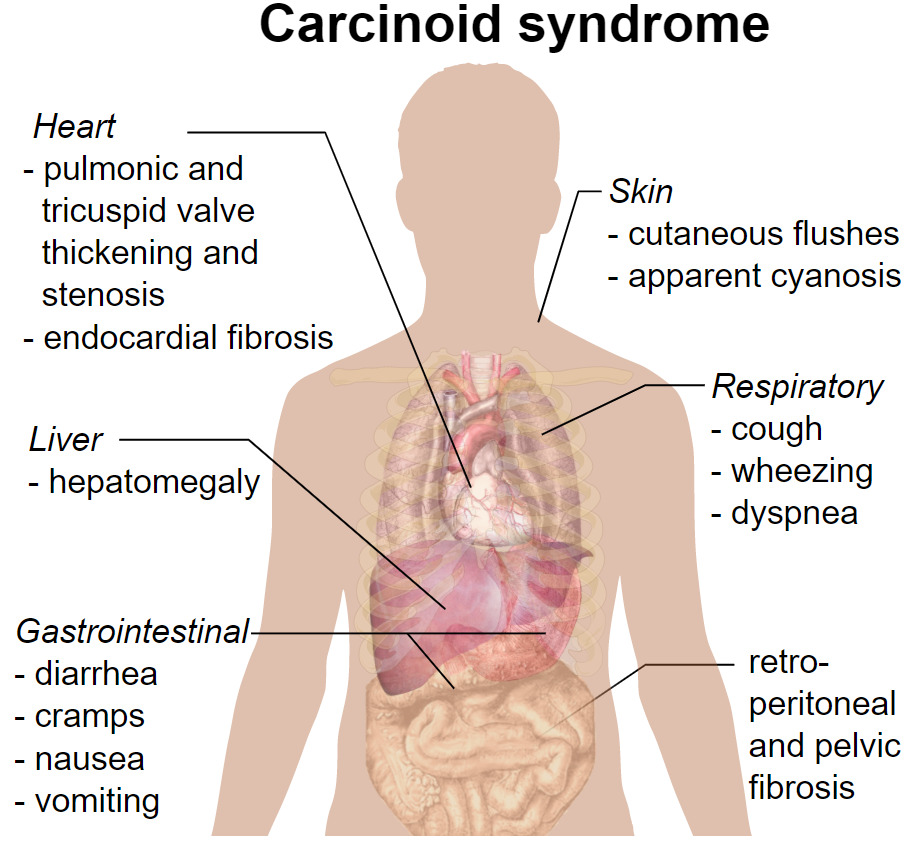
      • Rubor Rubor Inflammation episódico de la piel (85% de los LOS Neisseria pacientes)
      • Telangiectasia Telangiectasia Permanent dilation of preexisting blood vessels creating small focal red lesions, most commonly in the skin or mucous membranes. It is characterized by the prominence of skin blood vessels, such as vascular spiders. Chronic Venous Insufficiency venosa (hallazgo tardío)
      • Diarrea
      • Broncoespasmo
      • Lesiones valvulares cardíacas (depósitos de tejido fibroso)
      • Fibrosis Fibrosis Any pathological condition where fibrous connective tissue invades any organ, usually as a consequence of inflammation or other injury. Bronchiolitis Obliterans retroperitoneal Retroperitoneal Peritoneum: Anatomy
      • Pérdida de masa muscular
      • Deficiencia de niacina (por desviación de la síntesis del triptófano a la síntesis de serotonina)
  • Síndromesatípicos (variantes):
    • Tumores gástricos:
      • Asociado a la secreción de histamina
      • Rubor Rubor Inflammation en EN Erythema nodosum is an immune-mediated panniculitis (inflammation of the subcutaneous fat) caused by a type IV (delayed-type) hypersensitivity reaction. It commonly manifests in young women as tender, erythematous nodules on the shins. Erythema Nodosum parches bien delimitados con prurito
    • Tumores pulmonares/bronquiales:
      • Mediador específico poco claro, posiblemente histamina
      • Rubores severos y prolongados
      • Desorientación/ansiedad
      • Temblores
      • Edema Edema Edema is a condition in which excess serous fluid accumulates in the body cavity or interstitial space of connective tissues. Edema is a symptom observed in several medical conditions. It can be categorized into 2 types, namely, peripheral (in the extremities) and internal (in an organ or body cavity). Edema periorbital Periorbital Orbital and Preseptal Cellulitis
      • Lagrimación/salivación
      • Hipotensión/taquicardia
      • Diarrea
      • Asma ASMA Autoimmune Hepatitis/disnea
      • Edema Edema Edema is a condition in which excess serous fluid accumulates in the body cavity or interstitial space of connective tissues. Edema is a symptom observed in several medical conditions. It can be categorized into 2 types, namely, peripheral (in the extremities) and internal (in an organ or body cavity). Edema
      • Oliguria Oliguria Decreased urine output that is below the normal range. Oliguria can be defined as urine output of less than or equal to 0. 5 or 1 ml/kg/hr depending on the age. Renal Potassium Regulation
  • Crisis carcinoide:
    • Forma rara de síndrome carcinoide que amenaza la vida
    • Liberación masiva de compuestos bioactivos
    • Activado por:
Presentación clínica del síndrome carcinoide

Presentación clínica del síndrome carcinoide

Imagen: “Carcinoid syndrome presentation” por Mikael Häggström. Licencia: CC0 1.0, editada por Lecturio.
Diagnóstico

Antecedentes

  • Diarrea crónica y severa
  • Rubores
  • Antecedentes familiares/presencia de enfermedades genéticas (NEM1, síndrome de Von-Hippel-Lindau, NF1 NF1 Neurofibromatosis type 1 (NF1), also known as phakomatosis, is a neurocutaneous disorder that is most commonly of autosomal dominant inheritance due to mutations in the NF1 gene. Neurofibromatosis type 1 presents a range of clinical manifestations with the most prominent features being various pigmented skin lesions called café au lait macules (CALMs), neurofibromas, freckling of the inguinal and axillary regions, and iris hamartomas. Neurofibromatosis Type 1)

Estudios de laboratorio

  • Orina de 24 horas para determinar el ácido 5-hidroxiindolacético:
    • Alrededor del 90% de sensibilidad y especificidad para los LOS Neisseria tumores del intestino medio productores de serotonina
    • No capta los LOS Neisseria tumores del intestino anterior o posterior, ya que rara vez producen serotonina
  • Niveles de cromogranina A en EN Erythema nodosum is an immune-mediated panniculitis (inflammation of the subcutaneous fat) caused by a type IV (delayed-type) hypersensitivity reaction. It commonly manifests in young women as tender, erythematous nodules on the shins. Erythema Nodosum plasma Plasma The residual portion of blood that is left after removal of blood cells by centrifugation without prior blood coagulation. Transfusion Products:
    • Niveles elevados se asocian a tumores carcinoides
    • Baja especificidad
    • No debe utilizarse como prueba de tamizaje inicial
    • Puede utilizarse como marcador tumoral en EN Erythema nodosum is an immune-mediated panniculitis (inflammation of the subcutaneous fat) caused by a type IV (delayed-type) hypersensitivity reaction. It commonly manifests in young women as tender, erythematous nodules on the shins. Erythema Nodosum pacientes con un diagnóstico establecido
  • Serotonina en EN Erythema nodosum is an immune-mediated panniculitis (inflammation of the subcutaneous fat) caused by a type IV (delayed-type) hypersensitivity reaction. It commonly manifests in young women as tender, erythematous nodules on the shins. Erythema Nodosum sangre: alta tasa de falsos positivos
  • Niveles de ácido 5-hidroxiindolacético en EN Erythema nodosum is an immune-mediated panniculitis (inflammation of the subcutaneous fat) caused by a type IV (delayed-type) hypersensitivity reaction. It commonly manifests in young women as tender, erythematous nodules on the shins. Erythema Nodosum sangre:
    • Prueba relativamente nueva
    • Necesita ser validada

Imagenología

  • TC de abdomen contrastada:
    • Útil en EN Erythema nodosum is an immune-mediated panniculitis (inflammation of the subcutaneous fat) caused by a type IV (delayed-type) hypersensitivity reaction. It commonly manifests in young women as tender, erythematous nodules on the shins. Erythema Nodosum la detección de metástasis hepáticas
    • Los LOS Neisseria carcinoides del intestino delgado y del apéndice suelen ser pequeños y pueden no detectarse.
    • Los LOS Neisseria carcinoides de colon Colon The large intestines constitute the last portion of the digestive system. The large intestine consists of the cecum, appendix, colon (with ascending, transverse, descending, and sigmoid segments), rectum, and anal canal. The primary function of the colon is to remove water and compact the stool prior to expulsion from the body via the rectum and anal canal. Colon, Cecum, and Appendix: Anatomy pueden verse, pero no pueden distinguirse de otros tumores de colon Colon The large intestines constitute the last portion of the digestive system. The large intestine consists of the cecum, appendix, colon (with ascending, transverse, descending, and sigmoid segments), rectum, and anal canal. The primary function of the colon is to remove water and compact the stool prior to expulsion from the body via the rectum and anal canal. Colon, Cecum, and Appendix: Anatomy.
  • RM: es más sensible que la TC para la detección de metástasis hepáticas
  • Gammagrafía de receptores de somatostatina:
    • La mayoría de los LOS Neisseria carcinoides expresan receptores de somatostatina.
    • Imágenes de todo el cuerpo
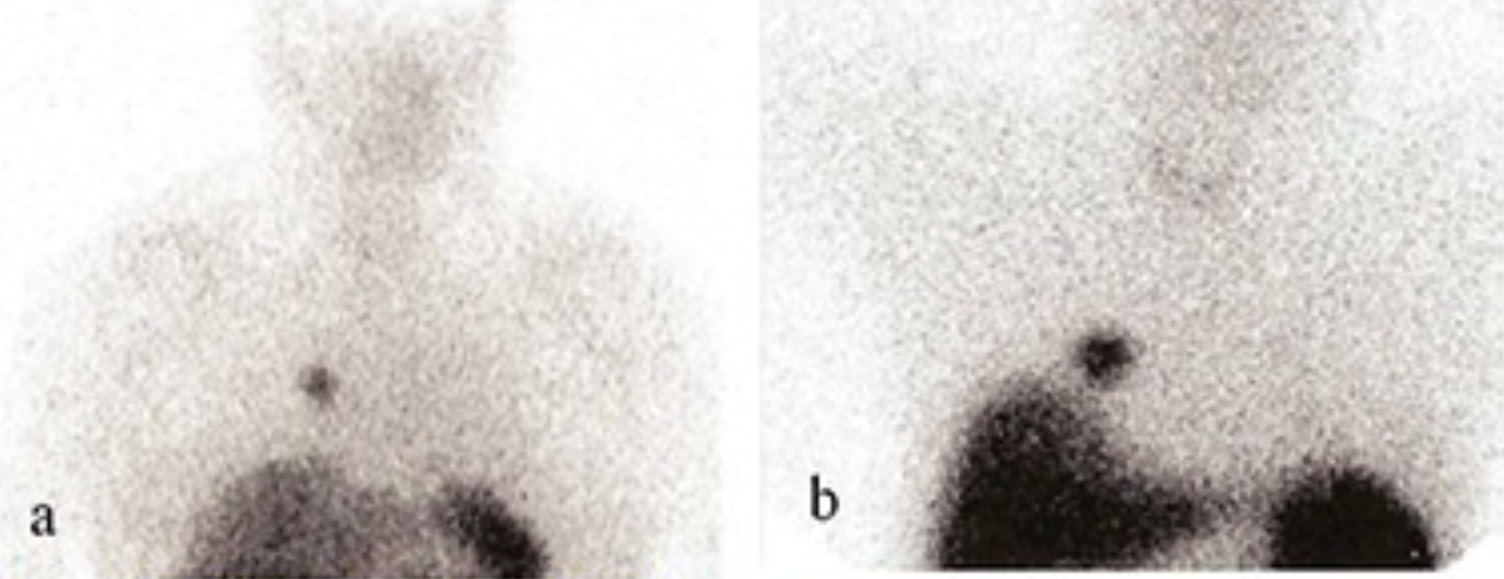
Gammagrafía de receptores de somatostatina en carcinoides pulmonares

Gammagrafía de receptores de somatostatina en tumores carcinoides pulmonares:
La mayoría de los tumores carcinoides expresan receptores de somatostatina. Mediante la gammagrafía, se puede realizar una exploración detallada de todo el cuerpo para identificar las masas.
Imagen: “The value of somatostatin receptor imaging with In-111 octreotide and/or Ga-68 DOTATATE in localizing ectopic adrenocorticotropic hormone-producing tumors” por Özkan ZG, Kuyumcu S, Balköse D, Ozkan B, Aksakal N, Yılmaz E, Sanlı Y, Türkmen C, Aral F, Adalet I. Licencia: CC BY 2.5, editada por Lecturio.

Endoscopia con biopsia

  • Se deben realizar endoscopias superiores e inferiores si se detecta una lesión carcinoide metastásica pero no se ha HA Hemolytic anemia (HA) is the term given to a large group of anemias that are caused by the premature destruction/hemolysis of circulating red blood cells (RBCs). Hemolysis can occur within (intravascular hemolysis) or outside the blood vessels (extravascular hemolysis). Hemolytic Anemia identificado la masa primaria.
  • Broncoscopia para lesiones pulmonares/bronquiales (puede pasar por alto tumores periféricos)

Tratamiento

Tumores primarios

La resección quirúrgica es el tratamiento definitivo para los LOS Neisseria tumores no metastásicos.

  • Intestino delgado: resección del segmento afectado y del mesenterio
  • Apéndice:
    • Apendicectomía simple para tumores < 2 cm confinados al AL Amyloidosis apéndice
    • Hemicolectomía derecha:
  • Colon Colon The large intestines constitute the last portion of the digestive system. The large intestine consists of the cecum, appendix, colon (with ascending, transverse, descending, and sigmoid segments), rectum, and anal canal. The primary function of the colon is to remove water and compact the stool prior to expulsion from the body via the rectum and anal canal. Colon, Cecum, and Appendix: Anatomy: colectomía parcial con linfadenectomía similar a la del adenocarcinoma de colon Colon The large intestines constitute the last portion of the digestive system. The large intestine consists of the cecum, appendix, colon (with ascending, transverse, descending, and sigmoid segments), rectum, and anal canal. The primary function of the colon is to remove water and compact the stool prior to expulsion from the body via the rectum and anal canal. Colon, Cecum, and Appendix: Anatomy
  • Recto:
    • La escisión endoscópica suele ser factible para los LOS Neisseria tumores pequeños
    • Se requiere una resección anterior baja o abdominoperineal para los LOS Neisseria tumores > 2 cm o con invasión de la muscularis propria
  • Estómago:
    • Tipos 1 y 2:
      • La resección endoscópica es adecuada para tumores < 2 cm
      • Seguido de vigilancia endoscópica cada 6-12 meses
    • Tipo 3: resección en EN Erythema nodosum is an immune-mediated panniculitis (inflammation of the subcutaneous fat) caused by a type IV (delayed-type) hypersensitivity reaction. It commonly manifests in young women as tender, erythematous nodules on the shins. Erythema Nodosum cuña con linfadenectomía es lo generalmente recomendado
  • Pulmón/bronquial: resección quirúrgica

Síndrome carcinoide y enfermedad metastásica

El tratamiento médico del síndrome carcinoide se centra en EN Erythema nodosum is an immune-mediated panniculitis (inflammation of the subcutaneous fat) caused by a type IV (delayed-type) hypersensitivity reaction. It commonly manifests in young women as tender, erythematous nodules on the shins. Erythema Nodosum el uso de análogos de la somatostatina para inhibir la secreción de serotonina.
  • Terapia con análogos de la somatostatina:
    • Alrededor del 80% de los LOS Neisseria tumores carcinoides gastrointestinales expresan receptores de somatostatina
    • Octreotida y lanreotida:
      • Se unen a los LOS Neisseria receptores de la somatostatina
      • Inhiben la liberación de serotonina
      • Proporcionan un alivio sintomático (50%–70% de los LOS Neisseria pacientes) e inhiben la proliferación de las células tumorales
  • Terapia adicional para los LOS Neisseria síntomas refractarios:
    • Telotristat: inhibidor del triptófano hidroxilasa (disminuye la producción de serotonina)
    • Interferón
    • Medicamentos antidiarreicos (loperamida, difenoxilato-atropina)
  • Resección hepática:
    • Puede ser curativo para las lesiones hepáticas resecables
    • También puede servir como tratamiento paliativo del síndrome carcinoide
    • Se realiza si se puede resecar/eliminar más del 90% del tumor Tumor Inflammation
  • Embolización transarterial hepática: para la enfermedad hepática dominante no resecable
  • Terapia con radionúclidos receptores de péptidos: para tumores progresivos, irresecables o metastásicos con receptores de somatostatina positivos.
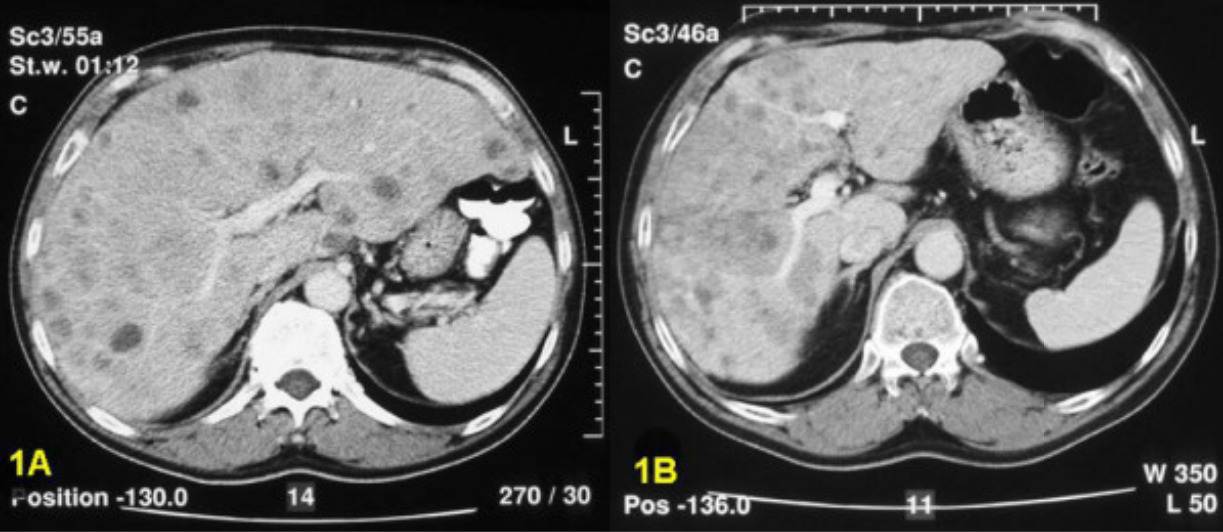
TAC de múltiples lesiones carcinoides metastásicas

Tomografía computarizada que muestra múltiples lesiones carcinoides metastásicas del hígado antes de la embolización de la arteria hepática (1A) y después (reducción significativa del volumen total del hígado y confluencia de las metástasis (1B))

Imagen: “Local treatment in unresectable hepatic metastases of carcinoid tumors: Experiences with hepatic artery embolization and radiofrequency ablation” por Meij V, Zuetenhorst JM, van Hillegersberg R, Kröger R, Prevoo W, van Coevorden F, Taal BG. Licencia: CC BY 2.0

Pronóstico

  • Depende de la localización del tumor Tumor Inflammation, el estadio, el grado histológico y la carga tumoral global
  • Los LOS Neisseria tumores del intestino medio tienden a metastatizar más que los LOS Neisseria del intestino anterior y posterior; sin embargo, una vez metastatizados, los LOS Neisseria tumores tienden a progresar lentamente.
  • Supervivencia global a 5 años: del 41.8% ( colon Colon The large intestines constitute the last portion of the digestive system. The large intestine consists of the cecum, appendix, colon (with ascending, transverse, descending, and sigmoid segments), rectum, and anal canal. The primary function of the colon is to remove water and compact the stool prior to expulsion from the body via the rectum and anal canal. Colon, Cecum, and Appendix: Anatomy) al AL Amyloidosis 78% (recto)
  • Supervivencia a 5 años con enfermedad metastásica:
    • La más baja para el colon Colon The large intestines constitute the last portion of the digestive system. The large intestine consists of the cecum, appendix, colon (with ascending, transverse, descending, and sigmoid segments), rectum, and anal canal. The primary function of the colon is to remove water and compact the stool prior to expulsion from the body via the rectum and anal canal. Colon, Cecum, and Appendix: Anatomy: 4.1%
    • La más alta para el intestino delgado: 32.4%

Diagnóstico Diferencial

  • Gastrinoma Gastrinoma A gastrinoma is a tumor that secretes excessive levels of the hormone gastrin and is responsible for Zollinger-Ellison syndrome (ZES). Gastrinomas are frequently associated with multiple endocrine neoplasia 1 (MEN 1) and can arise from the pancreas, stomach, duodenum, jejunum, and/or even from the lymph nodes. Gastrinoma: tumor Tumor Inflammation que segrega gastrina y que provoca el síndrome de Zollinger-Ellison. Los LOS Neisseria tumores pueden surgir del páncreas, el estómago, el duodeno, el yeyuno y/o incluso los LOS Neisseria ganglios linfáticos y pueden ser malignos, con metástasis hepática y los LOS Neisseria ganglios linfáticos regionales. Los LOS Neisseria síntomas incluyen úlceras pépticas refractarias y diarrea. El diagnóstico se establece a partir de los LOS Neisseria niveles de gastrina en EN Erythema nodosum is an immune-mediated panniculitis (inflammation of the subcutaneous fat) caused by a type IV (delayed-type) hypersensitivity reaction. It commonly manifests in young women as tender, erythematous nodules on the shins. Erythema Nodosum ayunas. El tratamiento incluye la resección quirúrgica y el tratamiento de los LOS Neisseria sintomas.
  • VIPoma VIPoma A VIPoma is a rare neuroendocrine tumor arising primarily in the pancreas that releases large amounts of vasoactive intestinal polypeptide (VIP). This process leads to chronic watery diarrhea with concomitant hypokalemia and dehydration, as well as wheezing and flushing (known as Verner-Morrison or WDHA syndrome). VIPoma: 3er tumor Tumor Inflammation neuroendocrino del páncreas más frecuente (después del insulinoma Insulinoma A benign tumor of the pancreatic beta cells. Insulinoma secretes excess insulin resulting in hypoglycemia. Pancreatic Neuroendocrine Tumors (PanNETs) y el gastrinoma Gastrinoma A gastrinoma is a tumor that secretes excessive levels of the hormone gastrin and is responsible for Zollinger-Ellison syndrome (ZES). Gastrinomas are frequently associated with multiple endocrine neoplasia 1 (MEN 1) and can arise from the pancreas, stomach, duodenum, jejunum, and/or even from the lymph nodes. Gastrinoma). Los LOS Neisseria VIPomas se asocian a la NEM1 y liberan grandes cantidades de péptido intestinal vasoactivo, que provoca diarrea crónica y rubores.
  • Enfermedad celíaca: es un síndrome de malabsorción, que también se conoce como enteropatía sensible al AL Amyloidosis gluten Gluten Prolamins in the endosperm of seeds from the triticeae tribe which includes species of wheat; barley; and rye. Celiac Disease o esprue no tropical. La enfermedad celíaca se presenta con diarrea crónica y pérdida de peso. El diagnóstico se establece histológicamente. El pilar del tratamiento es una dieta sin gluten Gluten Prolamins in the endosperm of seeds from the triticeae tribe which includes species of wheat; barley; and rye. Celiac Disease.
  • Síndrome del intestino irritable: enfermedad que afecta al AL Amyloidosis colon Colon The large intestines constitute the last portion of the digestive system. The large intestine consists of the cecum, appendix, colon (with ascending, transverse, descending, and sigmoid segments), rectum, and anal canal. The primary function of the colon is to remove water and compact the stool prior to expulsion from the body via the rectum and anal canal. Colon, Cecum, and Appendix: Anatomy. Otras terminologías son intestino espástico, colon Colon The large intestines constitute the last portion of the digestive system. The large intestine consists of the cecum, appendix, colon (with ascending, transverse, descending, and sigmoid segments), rectum, and anal canal. The primary function of the colon is to remove water and compact the stool prior to expulsion from the body via the rectum and anal canal. Colon, Cecum, and Appendix: Anatomy nervioso y colon Colon The large intestines constitute the last portion of the digestive system. The large intestine consists of the cecum, appendix, colon (with ascending, transverse, descending, and sigmoid segments), rectum, and anal canal. The primary function of the colon is to remove water and compact the stool prior to expulsion from the body via the rectum and anal canal. Colon, Cecum, and Appendix: Anatomy espástico. No se observan alteraciones celulares/anatómicas (e.g., los LOS Neisseria hallazgos histológicos parecen normales). El síndrome del intestino irritable suele presentarse con diarrea y estreñimiento alternados, y suele ser un diagnóstico de exclusión.

Referencias

  1. Strosberg, J. R., & Gangi, A. (2024). Staging, treatment, and surveillance of localized well-differentiated gastrointestinal neuroendocrine tumors. UpToDate. Retrieved July 28, 2025, from https://www.uptodate.com/contents/staging-treatment-and-surveillance-of-localized-well-differentiated-gastrointestinal-neuroendocrine-tumors
  2. Strosberg, J.R. (2024). Clinical features of carcinoid syndrome. Retrieved July 28, 2025, from https://www.uptodate.com/contents/clinical-features-of-carcinoid-syndrome
  3. Strosberg, J.R. (2024). Treatment of the carcinoid syndrome. Retrieved July 28, 2025, from https://www.uptodate.com/contents/treatment-of-the-carcinoid-syndrome
  4. Strosberg, J.R. (2025). Clinical characteristics of well-differentiated neuroendocrine (carcinoid) tumors arising in the gastrointestinal and genitourinary tracts. Retrieved July 28, 2025, from https://www.uptodate.com/contents/clinical-characteristics-of-well-differentiated-neuroendocrine-carcinoid-tumors-arising-in-the-gastrointestinal-and-genitourinary-tracts
  5. Tebbi, C.K. (2024). Carcinoid tumor. Retrieved July 28, 2025, from https://emedicine.medscape.com/article/986050-overview
  6. Santacroce, L. (2024). Malignant carcinoid syndrome. Retrieved July 28, 2025, from https://emedicine.medscape.com/article/282515-overview
  7. Tapia Rico, G., Li, M., Pavlakis, N., Cehic, G., & Price, T. J. (2018). Prevention and management of carcinoid crises in patients with high-risk neuroendocrine tumours undergoing peptide receptor radionuclide therapy (PRRT): Literature review and case series from two Australian tertiary medical institutions. Cancer Treatment Reviews, 66, 1–6. https://doi.org/10.1016/j.ctrv.2018.03.002

¡Crea tu cuenta gratis o inicia una sesión para seguir leyendo!

Regístrate ahora y obtén acceso gratuito a Lecturio con páginas de concepto, videos médicos y cuestionarios para tu educación médica.

User Reviews

Que tengas una sesión de estudio alegre y navideña 🎁 Ahorra 50% en todos los planes >>

Details