Domina Conceptos Médicos

Estudia para la escuela de medicina y tus examenes con Lecturio.

Síndrome Nefrítico en Niños

El síndrome nefrítico es una afección renal con signos y síntomas producidos por la inflamación de los LOS Neisseria glomérulos (glomerulonefritis) y el aumento de la permeabilidad de las barreras glomerulares. Las características definitorias incluyen hematuria Hematuria Presence of blood in the urine. Renal Cell Carcinoma, proteinuria Proteinuria The presence of proteins in the urine, an indicator of kidney diseases. Nephrotic Syndrome in Children (pero por debajo del rango nefrótico), cilindros de eritrocitos con eritrocitos dismórficos en EN Erythema nodosum is an immune-mediated panniculitis (inflammation of the subcutaneous fat) caused by a type IV (delayed-type) hypersensitivity reaction. It commonly manifests in young women as tender, erythematous nodules on the shins. Erythema Nodosum la microscopía de orina y aumento de la creatinina sérica. Las causas pueden ser genéticas, autoinmunes, idiopáticas o postinfecciosas. La causa más común es la glomerulonefritis aguda post-estreptocócica. Los LOS Neisseria hallazgos clínicos generales incluyen edema Edema Edema is a condition in which excess serous fluid accumulates in the body cavity or interstitial space of connective tissues. Edema is a symptom observed in several medical conditions. It can be categorized into 2 types, namely, peripheral (in the extremities) and internal (in an organ or body cavity). Edema, hipertensión y oliguria Oliguria Decreased urine output that is below the normal range. Oliguria can be defined as urine output of less than or equal to 0. 5 or 1 ml/kg/hr depending on the age. Renal Potassium Regulation. El diagnóstico se realiza a partir de los LOS Neisseria antecedentes, el examen físico y los LOS Neisseria estudios de laboratorio. A veces es necesaria una biopsia renal para establecer la causa subyacente. Puede haber un cuadro nefrítico-nefrótico combinado, especialmente en EN Erythema nodosum is an immune-mediated panniculitis (inflammation of the subcutaneous fat) caused by a type IV (delayed-type) hypersensitivity reaction. It commonly manifests in young women as tender, erythematous nodules on the shins. Erythema Nodosum la presentación crónica. El tratamiento y el pronóstico dependen de la causa y la gravedad.

Last updated: Dec 15, 2025

Editorial responsibility: Stanley Oiseth, Lindsay Jones, Evelin Maza

Descripción General

Definición

El síndrome nefrítico se define como una enfermedad renal causada por la inflamación y la lesión inmunomediada de los LOS Neisseria glomérulos con características clásicas de:

  • Hematuria Hematuria Presence of blood in the urine. Renal Cell Carcinoma
  • Proteinuria Proteinuria The presence of proteins in the urine, an indicator of kidney diseases. Nephrotic Syndrome in Children (rango subnefrótico)
  • Hipertensión
  • Eritrocitos en EN Erythema nodosum is an immune-mediated panniculitis (inflammation of the subcutaneous fat) caused by a type IV (delayed-type) hypersensitivity reaction. It commonly manifests in young women as tender, erythematous nodules on the shins. Erythema Nodosum la orina
  • Edema Edema Edema is a condition in which excess serous fluid accumulates in the body cavity or interstitial space of connective tissues. Edema is a symptom observed in several medical conditions. It can be categorized into 2 types, namely, peripheral (in the extremities) and internal (in an organ or body cavity). Edema

Epidemiología

  • Glomerulonefritis aguda post-estreptocócica:
    • Es la glomerulonefritis más común en EN Erythema nodosum is an immune-mediated panniculitis (inflammation of the subcutaneous fat) caused by a type IV (delayed-type) hypersensitivity reaction. It commonly manifests in young women as tender, erythematous nodules on the shins. Erythema Nodosum los LOS Neisseria niños
    • A nivel mundial:
      • > 400 000 casos al AL Amyloidosis año
      • 5 000 muertes anuales
      • Más común en EN Erythema nodosum is an immune-mediated panniculitis (inflammation of the subcutaneous fat) caused by a type IV (delayed-type) hypersensitivity reaction. It commonly manifests in young women as tender, erythematous nodules on the shins. Erythema Nodosum los LOS Neisseria países en EN Erythema nodosum is an immune-mediated panniculitis (inflammation of the subcutaneous fat) caused by a type IV (delayed-type) hypersensitivity reaction. It commonly manifests in young women as tender, erythematous nodules on the shins. Erythema Nodosum desarrollo
    • Más común entre los LOS Neisseria 2 y los LOS Neisseria 15 años de edad
  • La demografía afectada depende de la causa:
    • Nefritis en EN Erythema nodosum is an immune-mediated panniculitis (inflammation of the subcutaneous fat) caused by a type IV (delayed-type) hypersensitivity reaction. It commonly manifests in young women as tender, erythematous nodules on the shins. Erythema Nodosum la púrpura de Henoch-Schönlein:
      • Suele afectar a niños < 10 años de edad
      • Prevalencia ligeramente superior en EN Erythema nodosum is an immune-mediated panniculitis (inflammation of the subcutaneous fat) caused by a type IV (delayed-type) hypersensitivity reaction. It commonly manifests in young women as tender, erythematous nodules on the shins. Erythema Nodosum los LOS Neisseria varones
    • La nefritis lúpica es más frecuente en EN Erythema nodosum is an immune-mediated panniculitis (inflammation of the subcutaneous fat) caused by a type IV (delayed-type) hypersensitivity reaction. It commonly manifests in young women as tender, erythematous nodules on the shins. Erythema Nodosum las niñas.
    • El síndrome de Alport afecta predominantemente a los LOS Neisseria varones.

Etiología

Causas primarias (renales) del síndrome nefrítico en EN Erythema nodosum is an immune-mediated panniculitis (inflammation of the subcutaneous fat) caused by a type IV (delayed-type) hypersensitivity reaction. It commonly manifests in young women as tender, erythematous nodules on the shins. Erythema Nodosum niños:

  • Nefropatía IgA IgA Represents 15-20% of the human serum immunoglobulins, mostly as the 4-chain polymer in humans or dimer in other mammals. Secretory iga is the main immunoglobulin in secretions. Immunoglobulins: Types and Functions (enfermedad de Berger)
  • Glomerulonefritis membranoproliferativa (el síndrome nefrótico a menudo también está presente)
  • Glomerulonefritis idiopática en EN Erythema nodosum is an immune-mediated panniculitis (inflammation of the subcutaneous fat) caused by a type IV (delayed-type) hypersensitivity reaction. It commonly manifests in young women as tender, erythematous nodules on the shins. Erythema Nodosum media luna (glomerulonefritis rápidamente progresiva)
  • Anticuerpos anti-membrana basal glomerular o enfermedad de Goodpasture (rara en EN Erythema nodosum is an immune-mediated panniculitis (inflammation of the subcutaneous fat) caused by a type IV (delayed-type) hypersensitivity reaction. It commonly manifests in young women as tender, erythematous nodules on the shins. Erythema Nodosum niños)

Causas secundarias de síndrome nefrítico en EN Erythema nodosum is an immune-mediated panniculitis (inflammation of the subcutaneous fat) caused by a type IV (delayed-type) hypersensitivity reaction. It commonly manifests in young women as tender, erythematous nodules on the shins. Erythema Nodosum niños:

  • Glomerulonefritis post-infecciosa:
    • Glomerulonefritis post-estreptocócica
    • Puede ocurrir con otras infecciones bacterianas (e.g., Staphylococcus aureus Staphylococcus aureus Potentially pathogenic bacteria found in nasal membranes, skin, hair follicles, and perineum of warm-blooded animals. They may cause a wide range of infections and intoxications. Brain Abscess), virales (e.g., rubéola) y parasitarias (e.g., Toxoplasma Toxoplasma Toxoplasmosis is an infectious disease caused by Toxoplasma gondii, an obligate intracellular protozoan parasite. Felines are the definitive host, but transmission to humans can occur through contact with cat feces or the consumption of contaminated foods. The clinical presentation and complications depend on the host’s immune status. Toxoplasma/Toxoplasmosis gondii)
  • Vasculitis Vasculitis Inflammation of any one of the blood vessels, including the arteries; veins; and rest of the vasculature system in the body. Systemic Lupus Erythematosus IgA IgA Represents 15-20% of the human serum immunoglobulins, mostly as the 4-chain polymer in humans or dimer in other mammals. Secretory iga is the main immunoglobulin in secretions. Immunoglobulins: Types and Functions (Púrpura de Henoch-Schönlein)
  • Síndrome de Alport
  • Nefritis lúpica
  • Granulomatosis con poliangítis
  • Nefritis asociada a endocarditis Endocarditis Endocarditis is an inflammatory disease involving the inner lining (endometrium) of the heart, most commonly affecting the cardiac valves. Both infectious and noninfectious etiologies lead to vegetations on the valve leaflets. Patients may present with nonspecific symptoms such as fever and fatigue. Endocarditis infecciosa

Fisiopatología

  • Lesión inflamatoria inmunomediada en EN Erythema nodosum is an immune-mediated panniculitis (inflammation of the subcutaneous fat) caused by a type IV (delayed-type) hypersensitivity reaction. It commonly manifests in young women as tender, erythematous nodules on the shins. Erythema Nodosum los LOS Neisseria glomérulos que provoca daños en EN Erythema nodosum is an immune-mediated panniculitis (inflammation of the subcutaneous fat) caused by a type IV (delayed-type) hypersensitivity reaction. It commonly manifests in young women as tender, erythematous nodules on the shins. Erythema Nodosum la membrana de la célula basal, ya sea por:
    • Inmunoglobulinas que se unen directamente a antígenos específicos dentro de los LOS Neisseria glomérulos (e.g., enfermedad de Goodpasture: antígeno de la base glomerular)
    • Complejos inmunitarios (antígeno-anticuerpo) depositados en EN Erythema nodosum is an immune-mediated panniculitis (inflammation of the subcutaneous fat) caused by a type IV (delayed-type) hypersensitivity reaction. It commonly manifests in young women as tender, erythematous nodules on the shins. Erythema Nodosum los LOS Neisseria glomérulos (e.g., glomerulonefritis postinfecciosa/estreptocócica)
  • Se desencadena una cascada inflamatoria mediada por el sistema inmune, que conduce a:
    • Activación del sistema del complemento
    • Activación de los LOS Neisseria leucocitos
  • Efectos inflamatorios medidados por el sistema inmune:
    • Daño de la membrana de la célula basal: deterioro de las barreras glomerulares
    • Hematuria Hematuria Presence of blood in the urine. Renal Cell Carcinoma: por fuga de eritrocitos, cilindros de eritrocitos
    • Proteinuria Proteinuria The presence of proteins in the urine, an indicator of kidney diseases. Nephrotic Syndrome in Children: por fuga de proteínas
    • Hipertensión: por retención de sal y agua, con producción de renina
    • Edema Edema Edema is a condition in which excess serous fluid accumulates in the body cavity or interstitial space of connective tissues. Edema is a symptom observed in several medical conditions. It can be categorized into 2 types, namely, peripheral (in the extremities) and internal (in an organ or body cavity). Edema: por la proteinuria Proteinuria The presence of proteins in the urine, an indicator of kidney diseases. Nephrotic Syndrome in Children, con retención de sal y agua
    • Oliguria Oliguria Decreased urine output that is below the normal range. Oliguria can be defined as urine output of less than or equal to 0. 5 or 1 ml/kg/hr depending on the age. Renal Potassium Regulation: disminución de la filtración glomerular
  • Los LOS Neisseria modificadores genéticos desempeñan un papel en EN Erythema nodosum is an immune-mediated panniculitis (inflammation of the subcutaneous fat) caused by a type IV (delayed-type) hypersensitivity reaction. It commonly manifests in young women as tender, erythematous nodules on the shins. Erythema Nodosum la patogénesis de algunos síndromes nefríticos.

Presentación Clínica

Signos y síntomas

  • Glomerulonefritis aguda:
    • Hematuria Hematuria Presence of blood in the urine. Renal Cell Carcinoma macroscópica de aparición repentina
    • Edema Edema Edema is a condition in which excess serous fluid accumulates in the body cavity or interstitial space of connective tissues. Edema is a symptom observed in several medical conditions. It can be categorized into 2 types, namely, peripheral (in the extremities) and internal (in an organ or body cavity). Edema (generalmente edema Edema Edema is a condition in which excess serous fluid accumulates in the body cavity or interstitial space of connective tissues. Edema is a symptom observed in several medical conditions. It can be categorized into 2 types, namely, peripheral (in the extremities) and internal (in an organ or body cavity). Edema leve de las extremidades inferiores o periorbitario)
    • Oliguria Oliguria Decreased urine output that is below the normal range. Oliguria can be defined as urine output of less than or equal to 0. 5 or 1 ml/kg/hr depending on the age. Renal Potassium Regulation
    • Hipertensión
    • Matidez abdominal o sensibilidad aumentada en EN Erythema nodosum is an immune-mediated panniculitis (inflammation of the subcutaneous fat) caused by a type IV (delayed-type) hypersensitivity reaction. It commonly manifests in young women as tender, erythematous nodules on the shins. Erythema Nodosum los LOS Neisseria flancos
    • Fiebre (alrededor del 50% de las veces en EN Erythema nodosum is an immune-mediated panniculitis (inflammation of the subcutaneous fat) caused by a type IV (delayed-type) hypersensitivity reaction. It commonly manifests in young women as tender, erythematous nodules on the shins. Erythema Nodosum la glomerulonefritis aguda postestreptocócica)
  • Glomerulonefritis crónica:
    • Puede ser asintomática y detectada incidentalmente en EN Erythema nodosum is an immune-mediated panniculitis (inflammation of the subcutaneous fat) caused by a type IV (delayed-type) hypersensitivity reaction. It commonly manifests in young women as tender, erythematous nodules on the shins. Erythema Nodosum un análisis de orina rutinario
    • Hipertensión
    • Puede tener características de síndrome nefrótico o de síndrome nefrítico-nefrótico mixto
  • Glomerulonefritis rápidamente progresiva:
    • Progresión relativamente más rápida que la glomerulonefritis aguda en EN Erythema nodosum is an immune-mediated panniculitis (inflammation of the subcutaneous fat) caused by a type IV (delayed-type) hypersensitivity reaction. It commonly manifests in young women as tender, erythematous nodules on the shins. Erythema Nodosum días o semanas
    • Raro en EN Erythema nodosum is an immune-mediated panniculitis (inflammation of the subcutaneous fat) caused by a type IV (delayed-type) hypersensitivity reaction. It commonly manifests in young women as tender, erythematous nodules on the shins. Erythema Nodosum los LOS Neisseria niños
  • Hematuria Hematuria Presence of blood in the urine. Renal Cell Carcinoma macroscópica recurrente:
    • Puede observarse en EN Erythema nodosum is an immune-mediated panniculitis (inflammation of the subcutaneous fat) caused by a type IV (delayed-type) hypersensitivity reaction. It commonly manifests in young women as tender, erythematous nodules on the shins. Erythema Nodosum la nefropatía IgA IgA Represents 15-20% of the human serum immunoglobulins, mostly as the 4-chain polymer in humans or dimer in other mammals. Secretory iga is the main immunoglobulin in secretions. Immunoglobulins: Types and Functions entre 12–72 horas después de una infección respiratoria superior leve
    • También puede observarse en EN Erythema nodosum is an immune-mediated panniculitis (inflammation of the subcutaneous fat) caused by a type IV (delayed-type) hypersensitivity reaction. It commonly manifests in young women as tender, erythematous nodules on the shins. Erythema Nodosum el síndrome de Alport
Muestra de orina con hematuria

Muestra de orina con hematuria: orina oscura o de color té

Imagen: “hematuria” por omicsonline.org. Licencia: CC BY 4.0

Examen físico

  • Edema Edema Edema is a condition in which excess serous fluid accumulates in the body cavity or interstitial space of connective tissues. Edema is a symptom observed in several medical conditions. It can be categorized into 2 types, namely, peripheral (in the extremities) and internal (in an organ or body cavity). Edema leve en EN Erythema nodosum is an immune-mediated panniculitis (inflammation of the subcutaneous fat) caused by a type IV (delayed-type) hypersensitivity reaction. It commonly manifests in young women as tender, erythematous nodules on the shins. Erythema Nodosum las extremidades inferiores
  • Edema Edema Edema is a condition in which excess serous fluid accumulates in the body cavity or interstitial space of connective tissues. Edema is a symptom observed in several medical conditions. It can be categorized into 2 types, namely, peripheral (in the extremities) and internal (in an organ or body cavity). Edema periorbital Periorbital Orbital and Preseptal Cellulitis
  • Edema Edema Edema is a condition in which excess serous fluid accumulates in the body cavity or interstitial space of connective tissues. Edema is a symptom observed in several medical conditions. It can be categorized into 2 types, namely, peripheral (in the extremities) and internal (in an organ or body cavity). Edema escrotal
  • Dolor Dolor Inflammation abdominal o de costado
  • Erupción purpúrica palpable observada en EN Erythema nodosum is an immune-mediated panniculitis (inflammation of the subcutaneous fat) caused by a type IV (delayed-type) hypersensitivity reaction. It commonly manifests in young women as tender, erythematous nodules on the shins. Erythema Nodosum la púrpura de Henoch-Schönlein con distribución desde las extremidades inferiores hasta las nalgas
Henoch-Schönlein purpura

Caso grave de vasculitis IgA o púrpura de Henoch-Schönlein:
Se observa púrpura palpable en el pie, la pierna y el brazo del niño.

Imagen: “More severe case of HSP on child’s foot” por Okwikikim. Licencia: Dominio Público

Complicaciones

Los LOS Neisseria pacientes también pueden presentar manifestaciones de enfermedad grave:

  • Superposición con el síndrome nefrótico o progresión hacia el mismo
  • Encefalopatía hipertensiva
  • Enfermedad renal terminal
  • Enfermedad renal crónica (ERC)

Diagnóstico

Enfoque diagnóstico

Los LOS Neisseria hallazgos clínicos son específicos de las causas subyacentes.

Estudios de laboratorio:

  • Análisis de orina:
    • Análisis de orina y microscopía de orina: hematuria Hematuria Presence of blood in the urine. Renal Cell Carcinoma con eritrocitos dismórficos y/o cilindros de eritrocitos
    • Proteinuria Proteinuria The presence of proteins in the urine, an indicator of kidney diseases. Nephrotic Syndrome in Children > 150 mg/día pero < 3,5 g/día en EN Erythema nodosum is an immune-mediated panniculitis (inflammation of the subcutaneous fat) caused by a type IV (delayed-type) hypersensitivity reaction. It commonly manifests in young women as tender, erythematous nodules on the shins. Erythema Nodosum niños mayores y adolescentes
    • Proteinuria Proteinuria The presence of proteins in the urine, an indicator of kidney diseases. Nephrotic Syndrome in Children definida entre 4 y 40 mg/m²/hora en EN Erythema nodosum is an immune-mediated panniculitis (inflammation of the subcutaneous fat) caused by a type IV (delayed-type) hypersensitivity reaction. It commonly manifests in young women as tender, erythematous nodules on the shins. Erythema Nodosum bebés y niños pequeños
    • También se observa piuria estéril
  • Función renal:
    • Nitrógeno de urea Urea A compound formed in the liver from ammonia produced by the deamination of amino acids. It is the principal end product of protein catabolism and constitutes about one half of the total urinary solids. Urea Cycle (BUN, por sus siglas en EN Erythema nodosum is an immune-mediated panniculitis (inflammation of the subcutaneous fat) caused by a type IV (delayed-type) hypersensitivity reaction. It commonly manifests in young women as tender, erythematous nodules on the shins. Erythema Nodosum inglés) elevado
    • Creatinina sérica elevada
    • Relación BUN/creatinina > 15
  • Niveles del complemento: dependen de la causa subyacente de la nefritis

Imagenología (ultrasonido renal):

  • Detecta otras causas de hematuria Hematuria Presence of blood in the urine. Renal Cell Carcinoma (e.g., cálculos)
  • Muestra cambios renales, especialmente para la enfermedad de larga duración

Pruebas específicas dependiendo de la enfermedad:

  • Glomerulonefritis aguda postestreptocócica:
    • Niveles elevados de antiestreptolisina-O
    • Anticuerpos anti-DNasa B elevados
    • Disminución del complemento sérico C3 debido al AL Amyloidosis consumo
  • Lupus eritematoso sistémico:
    • Anticuerpos antinucleares (ANA)
    • Anti-DNA de doble cadena
  • Poliangeitis granulomatosa:
    • Autoanticuerpos citoplasmáticos antineutrófilos
    • Evaluación pulmonar y sinusal con TC
  • Enfermedad de anticuerpos anti-membrana basal glomerular (Goodpasture):
    • Autoanticuerpos citoplasmáticos antineutrófilos
    • Anticuerpos anti-membrana basal glomerular
    • Examen pulmonar por síntomas de hemoptisis o disnea
  • Glomerulonefritis membrano proliferativa: Al AL Amyloidosis tratarse de un diagnóstico patológico con múltiples etiologías posibles, la evaluación depende de la presentación e incluye el VIH y la hepatitis B Hepatitis B Hepatitis B virus (HBV) is a partially double-stranded DNA virus, which belongs to the Orthohepadnavirus genus and the Hepadnaviridae family. Most individuals with acute HBV infection are asymptomatic or have mild, self-limiting symptoms. Chronic infection can be asymptomatic or create hepatic inflammation, leading to liver cirrhosis and hepatocellular carcinoma (HCC). Hepatitis B Virus y C.

Diferenciación de la enfermedad glomerular

  • Los LOS Neisseria síndromes nefríticos y nefróticos son presentaciones comunes de enfermedades glomerulares, que pueden ser un desafío diagnóstico.
  • El síndrome nefrítico se caracteriza por la inflamación glomerular, mientras que el tipo nefrótico presenta una alteración de las paredes capilares glomerulares que provoca un aumento de la permeabilidad.
  • Hay hallazgos que se superponen, como la proteinuria Proteinuria The presence of proteins in the urine, an indicator of kidney diseases. Nephrotic Syndrome in Children y el edema Edema Edema is a condition in which excess serous fluid accumulates in the body cavity or interstitial space of connective tissues. Edema is a symptom observed in several medical conditions. It can be categorized into 2 types, namely, peripheral (in the extremities) and internal (in an organ or body cavity). Edema, pero el grado difiere.
  • Además, algunas enfermedades presentan un cuadro mixto: síndrome nefrítico-nefrótico
  • El conocimiento de las diferencias ayuda a llegar a los LOS Neisseria posibles diagnósticos.
Tabla: Diferencias entre el síndrome nefrótico y el nefrítico
Síndrome nefrótico Síndrome nefrítico
Edema Edema Edema is a condition in which excess serous fluid accumulates in the body cavity or interstitial space of connective tissues. Edema is a symptom observed in several medical conditions. It can be categorized into 2 types, namely, peripheral (in the extremities) and internal (in an organ or body cavity). Edema ++++ ++
Presión arterial Normal/elevado Elevado
Proteinuria Proteinuria The presence of proteins in the urine, an indicator of kidney diseases. Nephrotic Syndrome in Children ++++ ++
Hematuria Hematuria Presence of blood in the urine. Renal Cell Carcinoma – o microscópico +++
Otras características
  • Hipoalbuminemia
  • Hiperlipidemia
  • Hipercoagulabilidad
  • Cilindros de eritrocitos
  • Piuria estéril

Biopsia renal

  • Para confirmar el diagnóstico
  • Para determinar la extensión de la lesión renal y ayudar a dirigir la terapia
  • Los LOS Neisseria rasgos característicos pueden verse en EN Erythema nodosum is an immune-mediated panniculitis (inflammation of the subcutaneous fat) caused by a type IV (delayed-type) hypersensitivity reaction. It commonly manifests in young women as tender, erythematous nodules on the shins. Erythema Nodosum la histopatología utilizando:
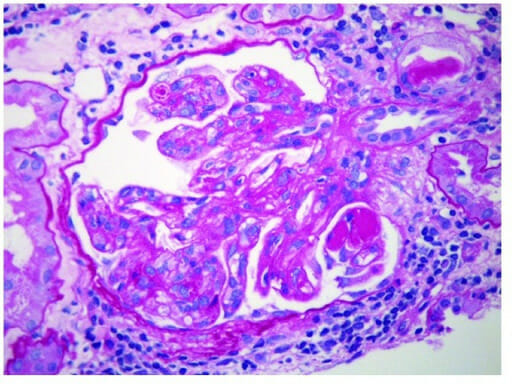
    • Microscopía de luz: puede no ser específica, con el mismo patrón morfológico para varias enfermedades
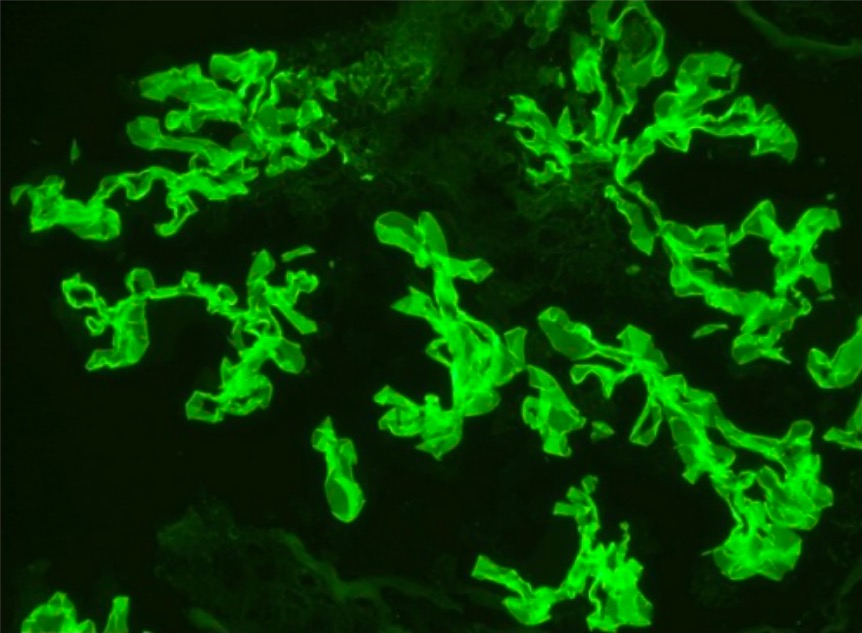
    • Microscopía de inmunofluorescencia: demuestra la deposición y el patrón de complejos inmunes, que pueden ser específicos de la enfermedad
    • Microscopía electrónica: puede ser una herramienta útil de confirmación
Tabla: Resumen de los LOS Neisseria resultados de laboratorio y biopsia de los LOS Neisseria síndromes nefríticos específicos
Síndrome nefrítico Estudios de laboratorio y adicionales Resultados de la biopsia renal
Glomerulonefritis aguda post-estreptocócica
  • Antiestreptolisina-O
  • Anti-DNasa B
  • ↓ C3
  • ML: proliferación endocapilar, infiltrados leucocitarios
  • IF: Depósitos de C3 e IgG, patrón de “cielo estrellado” Depósito de C3
  • ME: “jorobas” subepiteliales con densidad de electrones
Glomerulonefritis membranoproliferativa (un patrón de lesión glomerular, no una enfermedad específica; tiene los LOS Neisseria tipos I-III) ↓ C3
  • Ml: hipercelularidad mesangial, proliferación endocapilar, aspecto de doble contorno/”pista de tranvía” de GBM
  • IF:
    • I: IgG IgG The major immunoglobulin isotype class in normal human serum. There are several isotype subclasses of igg, for example, igg1, igg2a, and igg2b. Hypersensitivity Pneumonitis, C3, C1q, C4
    • II: C3
    • III: C3
  • ME:
    • I: depósitos subendoteliales
    • II: depósitos densos
    • III: depósitos subepiteliales y subendoteliales
Glomerulonefritis lúpica
  • ANA
  • Anti-dsDNA
  • ↓ C3
  • IF: Se puede ver IgG, IgA, IgM, C3, C1q; se conoce como depósito “completo”.
  • ME: inclusiones tubuloreticulares, depósitos subendoteliales
Nefropatía por IgA IgA Represents 15-20% of the human serum immunoglobulins, mostly as the 4-chain polymer in humans or dimer in other mammals. Secretory iga is the main immunoglobulin in secretions. Immunoglobulins: Types and Functions C3 Normal
  • ML: hipercelularidad mesangial
  • IF: depósitos mesangiales de IgA IgA Represents 15-20% of the human serum immunoglobulins, mostly as the 4-chain polymer in humans or dimer in other mammals. Secretory iga is the main immunoglobulin in secretions. Immunoglobulins: Types and Functions
  • EM: depósitos densos mesangiales
Vasculitis Vasculitis Inflammation of any one of the blood vessels, including the arteries; veins; and rest of the vasculature system in the body. Systemic Lupus Erythematosus HSP HSP Henoch-Schönlein purpura (HSP), also known as immunoglobulin A vasculitis, is an autoimmune small-vessel vasculitis that typically presents as a tetrad of abdominal pain, arthralgia, hematuria, and purpuric rash. Henoch-Schönlein Purpura/ IgA IgA Represents 15-20% of the human serum immunoglobulins, mostly as the 4-chain polymer in humans or dimer in other mammals. Secretory iga is the main immunoglobulin in secretions. Immunoglobulins: Types and Functions
  • C3 Normal
  • Biopsia de piel: muestra IgA IgA Represents 15-20% of the human serum immunoglobulins, mostly as the 4-chain polymer in humans or dimer in other mammals. Secretory iga is the main immunoglobulin in secretions. Immunoglobulins: Types and Functions
  • ML: proliferación mesangial
  • IF: depósitos mesangiales de IgA IgA Represents 15-20% of the human serum immunoglobulins, mostly as the 4-chain polymer in humans or dimer in other mammals. Secretory iga is the main immunoglobulin in secretions. Immunoglobulins: Types and Functions
  • ME: depósitos densos de electrones en EN Erythema nodosum is an immune-mediated panniculitis (inflammation of the subcutaneous fat) caused by a type IV (delayed-type) hypersensitivity reaction. It commonly manifests in young women as tender, erythematous nodules on the shins. Erythema Nodosum el mesangio
Síndrome de Alport (Glomerulonefritis hereditaria) Biopsia de piel: Ab monoclonal contra la cadena alfa-5 (IV) (la proteína está ausente) ME: Separación de la membrana basal glomerular, aspecto de tejido de cesta
Glomerulonefritis rápidamente progresiva (denota una lesión glomerular grave, pero tiene diferentes etiologías) Depende de la causa subyacente Histología más común: formación de semilunas en EN Erythema nodosum is an immune-mediated panniculitis (inflammation of the subcutaneous fat) caused by a type IV (delayed-type) hypersensitivity reaction. It commonly manifests in young women as tender, erythematous nodules on the shins. Erythema Nodosum los LOS Neisseria glomérulos
Ac: anticuerpo
Ig: inmunoglobulina
ML: microscopía de luz
IF: inmunofluorescencia
ME: microscopía electrónica

Related videos

Tratamiento

El tratamiento depende de la causa y la gravedad.

  • Enfoque inicial: Tratar la causa subyacente.
  • En EN Erythema nodosum is an immune-mediated panniculitis (inflammation of the subcutaneous fat) caused by a type IV (delayed-type) hypersensitivity reaction. It commonly manifests in young women as tender, erythematous nodules on the shins. Erythema Nodosum los LOS Neisseria casos en EN Erythema nodosum is an immune-mediated panniculitis (inflammation of the subcutaneous fat) caused by a type IV (delayed-type) hypersensitivity reaction. It commonly manifests in young women as tender, erythematous nodules on the shins. Erythema Nodosum los LOS Neisseria que la función renal está preservada (e.g., nefropatía, IgA IgA Represents 15-20% of the human serum immunoglobulins, mostly as the 4-chain polymer in humans or dimer in other mammals. Secretory iga is the main immunoglobulin in secretions. Immunoglobulins: Types and Functions) o la enfermedad se autorresuelve (e.g., glomerulonefritis aguda, postestreptocócica), se realiza un seguimiento y no es necesaria ninguna otra intervención.
  • Tratar las infecciones estreptocócicas de la garganta o de la piel que den positivo en EN Erythema nodosum is an immune-mediated panniculitis (inflammation of the subcutaneous fat) caused by a type IV (delayed-type) hypersensitivity reaction. It commonly manifests in young women as tender, erythematous nodules on the shins. Erythema Nodosum el cultivo para eliminar el reservorio.
  • Tratamiento sintomático:
    • Insuficiencia renal:
      • Tratamiento de apoyo e hidratación adecuada
      • Controlar la progresión.
    • Hipertensión:
      • Restricción de sal/fluido
      • Antihipertensivos para la hipertensión arterial crónica persistente
    • Edema Edema Edema is a condition in which excess serous fluid accumulates in the body cavity or interstitial space of connective tissues. Edema is a symptom observed in several medical conditions. It can be categorized into 2 types, namely, peripheral (in the extremities) and internal (in an organ or body cavity). Edema: restricción de sal y líquidos +/- diuréticos
  • Corticosteroides y/o medicamentos inmunosupresores si están indicados (e.g., nefritis lúpica)
  • En EN Erythema nodosum is an immune-mediated panniculitis (inflammation of the subcutaneous fat) caused by a type IV (delayed-type) hypersensitivity reaction. It commonly manifests in young women as tender, erythematous nodules on the shins. Erythema Nodosum caso de insuficiencia renal grave o insuficiencia renal: terapia de sustitución renal (e.g., hemodiálisis, trasplante renal)

Relevancia Clínica

  • Lupus eritematoso sistémico: afección crónica autoinmune e inflamatoria que provoca el depósito de inmunocomplejos en EN Erythema nodosum is an immune-mediated panniculitis (inflammation of the subcutaneous fat) caused by a type IV (delayed-type) hypersensitivity reaction. It commonly manifests in young women as tender, erythematous nodules on the shins. Erythema Nodosum los LOS Neisseria órganos, lo que da lugar a manifestaciones sistémicas. La deposición de inmunocomplejos en EN Erythema nodosum is an immune-mediated panniculitis (inflammation of the subcutaneous fat) caused by a type IV (delayed-type) hypersensitivity reaction. It commonly manifests in young women as tender, erythematous nodules on the shins. Erythema Nodosum el glomérulo conduce a la nefritis lúpica. Esta condición es más común en EN Erythema nodosum is an immune-mediated panniculitis (inflammation of the subcutaneous fat) caused by a type IV (delayed-type) hypersensitivity reaction. It commonly manifests in young women as tender, erythematous nodules on the shins. Erythema Nodosum las mujeres asiáticas y afroamericanas. La lesión renal puede ser de leve a progresiva glomerulonefritis. El diagnóstico se realiza con una biopsia renal.
  • Glomerulonefritis post-estreptocócica: es la causa más frecuente de síndrome nefrítico en EN Erythema nodosum is an immune-mediated panniculitis (inflammation of the subcutaneous fat) caused by a type IV (delayed-type) hypersensitivity reaction. It commonly manifests in young women as tender, erythematous nodules on the shins. Erythema Nodosum los LOS Neisseria niños, y está precedida por una infección por estreptococos beta-hemolíticos del grupo A de la garganta o de la piel. La biopsia renal no suele ser necesaria para establecer el diagnóstico. La afección suele ser autolimitada.
  • Nefropatía IgA IgA Represents 15-20% of the human serum immunoglobulins, mostly as the 4-chain polymer in humans or dimer in other mammals. Secretory iga is the main immunoglobulin in secretions. Immunoglobulins: Types and Functions: también conocida como enfermedad de Berger. Se presenta como hematuria Hematuria Presence of blood in the urine. Renal Cell Carcinoma macroscópica o microscópica poco después de la aparición de los LOS Neisseria síntomas de las infecciones urinarias. La enfermedad se caracteriza por el depósito de IgA IgA Represents 15-20% of the human serum immunoglobulins, mostly as the 4-chain polymer in humans or dimer in other mammals. Secretory iga is the main immunoglobulin in secretions. Immunoglobulins: Types and Functions en EN Erythema nodosum is an immune-mediated panniculitis (inflammation of the subcutaneous fat) caused by a type IV (delayed-type) hypersensitivity reaction. It commonly manifests in young women as tender, erythematous nodules on the shins. Erythema Nodosum el mesangio. La enfermedad de Berger es la causa más frecuente de glomerulonefritis primaria en EN Erythema nodosum is an immune-mediated panniculitis (inflammation of the subcutaneous fat) caused by a type IV (delayed-type) hypersensitivity reaction. It commonly manifests in young women as tender, erythematous nodules on the shins. Erythema Nodosum la mayoría de los LOS Neisseria países desarrollados.
  • Púrpura de Henoch-Schönlein: también conocida como vasculitis Vasculitis Inflammation of any one of the blood vessels, including the arteries; veins; and rest of the vasculature system in the body. Systemic Lupus Erythematosus IgA IgA Represents 15-20% of the human serum immunoglobulins, mostly as the 4-chain polymer in humans or dimer in other mammals. Secretory iga is the main immunoglobulin in secretions. Immunoglobulins: Types and Functions. Los LOS Neisseria rasgos clínicos incluyen una erupción característica, artralgias, dolor Dolor Inflammation abdominal y nefritis. La afección puede ser desencadenada por una infección de las vías respiratorias superiores o del tracto gastrointestinal. Suele darse en EN Erythema nodosum is an immune-mediated panniculitis (inflammation of the subcutaneous fat) caused by a type IV (delayed-type) hypersensitivity reaction. It commonly manifests in young women as tender, erythematous nodules on the shins. Erythema Nodosum niños < 10 años.
  • Granulomatosis con poliangeitis: Esta afección se encuentra dentro de los LOS Neisseria trastornos autoinmunes asociados a los LOS Neisseria autoanticuerpos citoplasmáticos antineutrófilos, que se caracterizan por la inflamación de los LOS Neisseria vasos pequeños y la formación de granulomas Granulomas A relatively small nodular inflammatory lesion containing grouped mononuclear phagocytes, caused by infectious and noninfectious agents. Sarcoidosis. La granulomatosis con poliangeitis se asocia a una glomerulonefritis pauci-inmune semilunar. La zona del oído, la nariz y la garganta, junto con las vías respiratorias, también se ven afectadas.
  • Síndrome de Alport: también conocido como nefritis hereditaria. El síndrome de Alport es una enfermedad genética que suele estar ligada al AL Amyloidosis cromosoma X y que engloba la enfermedad glomerular, la pérdida auditiva neurosensorial y los LOS Neisseria hallazgos oculares anormales. Las variantes genéticas afectan a las cadenas alfa del colágeno IV que se encuentran en EN Erythema nodosum is an immune-mediated panniculitis (inflammation of the subcutaneous fat) caused by a type IV (delayed-type) hypersensitivity reaction. It commonly manifests in young women as tender, erythematous nodules on the shins. Erythema Nodosum los LOS Neisseria órganos diana afectados (membrana basal del riñón, cóclea y ojo).

Referencias

  1. Chang, A., Laszik, Z. (2020). The Kidney. En Kumar, V., Abbas, A., Aster, J. y Robbins, S. Robbins y Cotran. Pathologic Basis of Disease (10ª Ed., pp. 895-930). Elsevier, Inc.
  2. Floege, J., y Feehally, J. (2019). Introduction to glomerular disease: Clinical presentations. En Feehally, John, DM, FRCP, Floege, Jürgen, MD, FERA, Tonelli, Marcello, MD, SM, MSc, FRCPC & R. J. Johnson MD (Eds.), Comprehensive clinical nephrology (pp. 18-198). https://www.clinicalkey.es/#!/content/3-s2.0-B9780323479097000159
  3. Flores, F. X. (2020). Isolated glomerular diseases associated with recurrent gross hematuria. En R. M. Kliegman MD et al. (Eds.), Nelson textbook of pediatrics (pp. 272-2728.e1). https://www.clinicalkey.es/#!/content/3-s2.0-B978032352950100537X
  4. Landry, D. W., y Bazari, H. (2017). Aproximación al paciente con enfermedad renal. En L. Goldman MD, & A. I. Schafer MD (Eds.), Goldman-Cecil. tratado de medicina interna (pp. 728-736). https://www.clinicalkey.es/#!/content/3-s2.0-B9788491130338001142
  5. Lewis, J. B., & Neilson, E. G. (2018). Enfermedades glomerulares. En J. L. Jameson, A. S. Fauci, D. L. Kasper, S. L. Hauser, D. L. Longo & J. Loscalzo (Eds.), Harrison’s principles of internal medicine, 20e. New York, NY: McGraw-Hill Education. accessmedicine.mhmedical.com/content.aspx?aid=1156520317
  6. Kehr, K. Acute Glomerular Diseases in Children. openurologyandnephrologyjournal.com/VOLUME/8/PAGE/104/FULLTEXT/
  7. Niaudet, P. Overview of the pathogenesis and causes of glomerulonephritis in children. Retrieved February 16, 2021, from https://www.uptodate.com/contents/overview-of-the-pathogenesis-and-causes-of-glomerulonephritis-in-children
  8. O’Brien, D. Overview of nephritic syndrome. Retrieved February 25, 2021, from https://www.merckmanuals.com/professional/genitourinary-disorders/glomerular-disorders/overview-of-nephritic-syndrome

¡Crea tu cuenta gratis o inicia una sesión para seguir leyendo!

Regístrate ahora y obtén acceso gratuito a Lecturio con páginas de concepto, videos médicos y cuestionarios para tu educación médica.

User Reviews

Que tengas una sesión de estudio alegre y navideña 🎁 Ahorra 50% en todos los planes >>

Details