Domina Conceptos Médicos

Estudia para la escuela de medicina y tus examenes con Lecturio.

Síndrome de Shock Tóxico

El síndrome de shock Shock Shock is a life-threatening condition associated with impaired circulation that results in tissue hypoxia. The different types of shock are based on the underlying cause: distributive (↑ cardiac output (CO), ↓ systemic vascular resistance (SVR)), cardiogenic (↓ CO, ↑ SVR), hypovolemic (↓ CO, ↑ SVR), obstructive (↓ CO), and mixed. Types of Shock tóxico es una enfermedad aguda multisistémica causada por las bacterias productoras de toxinas, Staphylococcus aureus Staphylococcus aureus Potentially pathogenic bacteria found in nasal membranes, skin, hair follicles, and perineum of warm-blooded animals. They may cause a wide range of infections and intoxications. Brain Abscess y Streptococcus Streptococcus Streptococcus is one of the two medically important genera of gram-positive cocci, the other being Staphylococcus. Streptococci are identified as different species on blood agar on the basis of their hemolytic pattern and sensitivity to optochin and bacitracin. There are many pathogenic species of streptococci, including S. pyogenes, S. agalactiae, S. pneumoniae, and the viridans streptococci. Streptococcus pyogenes. El síndrome de shock Shock Shock is a life-threatening condition associated with impaired circulation that results in tissue hypoxia. The different types of shock are based on the underlying cause: distributive (↑ cardiac output (CO), ↓ systemic vascular resistance (SVR)), cardiogenic (↓ CO, ↑ SVR), hypovolemic (↓ CO, ↑ SVR), obstructive (↓ CO), and mixed. Types of Shock tóxico estafilocócico es más frecuente y se asocia a los LOS Neisseria tampones y al AL Amyloidosis taponamiento nasal. El síndrome de shock Shock Shock is a life-threatening condition associated with impaired circulation that results in tissue hypoxia. The different types of shock are based on the underlying cause: distributive (↑ cardiac output (CO), ↓ systemic vascular resistance (SVR)), cardiogenic (↓ CO, ↑ SVR), hypovolemic (↓ CO, ↑ SVR), obstructive (↓ CO), and mixed. Types of Shock tóxico estreptocócico suele deberse a infecciones invasivas por estreptococos del grupo A, como la bacteriemia y la fascitis necrosante, y tiene una tasa de mortalidad más elevada. Los LOS Neisseria pacientes se presentan con fiebre, taquicardia, hipotensión, una erupción eritematosa y evidencia de disfunción orgánica multisistémica. El diagnóstico se basa en EN Erythema nodosum is an immune-mediated panniculitis (inflammation of the subcutaneous fat) caused by a type IV (delayed-type) hypersensitivity reaction. It commonly manifests in young women as tender, erythematous nodules on the shins. Erythema Nodosum los LOS Neisseria datos clínicos, de laboratorio y de cultivos. El tratamiento implica la reanimación con líquidos intravenosos, antibióticos, soporte vasopresor e identificación y tratamiento del posible foco infeccioso.

Last updated: Dec 15, 2025

Editorial responsibility: Stanley Oiseth, Lindsay Jones, Evelin Maza

Epidemiología y Etiología

Epidemiología

  • Síndrome de shock Shock Shock is a life-threatening condition associated with impaired circulation that results in tissue hypoxia. The different types of shock are based on the underlying cause: distributive (↑ cardiac output (CO), ↓ systemic vascular resistance (SVR)), cardiogenic (↓ CO, ↑ SVR), hypovolemic (↓ CO, ↑ SVR), obstructive (↓ CO), and mixed. Types of Shock tóxico estafilocócico:
    • Más común que el síndrome de shock Shock Shock is a life-threatening condition associated with impaired circulation that results in tissue hypoxia. The different types of shock are based on the underlying cause: distributive (↑ cardiac output (CO), ↓ systemic vascular resistance (SVR)), cardiogenic (↓ CO, ↑ SVR), hypovolemic (↓ CO, ↑ SVR), obstructive (↓ CO), and mixed. Types of Shock tóxico estreptocócico
    • Incidencia: 6–7 casos por cada 100 000 personas al AL Amyloidosis año
      • La mitad está asociada a la menstruación.
      • La incidencia disminuyó con el retiro de los LOS Neisseria tampones altamente absorbentes.
    • Más común en EN Erythema nodosum is an immune-mediated panniculitis (inflammation of the subcutaneous fat) caused by a type IV (delayed-type) hypersensitivity reaction. It commonly manifests in young women as tender, erythematous nodules on the shins. Erythema Nodosum mujeres
    • Mortalidad: 1,8%.
  • Síndrome de shock Shock Shock is a life-threatening condition associated with impaired circulation that results in tissue hypoxia. The different types of shock are based on the underlying cause: distributive (↑ cardiac output (CO), ↓ systemic vascular resistance (SVR)), cardiogenic (↓ CO, ↑ SVR), hypovolemic (↓ CO, ↑ SVR), obstructive (↓ CO), and mixed. Types of Shock tóxico estreptocócico:
    • Incidencia: 4 casos por cada 100 000 personas al AL Amyloidosis año
    • Se desarrolla en EN Erythema nodosum is an immune-mediated panniculitis (inflammation of the subcutaneous fat) caused by a type IV (delayed-type) hypersensitivity reaction. It commonly manifests in young women as tender, erythematous nodules on the shins. Erythema Nodosum hasta ⅓ de los LOS Neisseria pacientes con infecciones invasivas por Streptococcus Streptococcus Streptococcus is one of the two medically important genera of gram-positive cocci, the other being Staphylococcus. Streptococci are identified as different species on blood agar on the basis of their hemolytic pattern and sensitivity to optochin and bacitracin. There are many pathogenic species of streptococci, including S. pyogenes, S. agalactiae, S. pneumoniae, and the viridans streptococci. Streptococcus del grupo A
      • Bacteriemia por S. pyogenes
      • Fascitis necrosante
    • Mortalidad: 30%–79%.

Etiología

El síndrome de shock Shock Shock is a life-threatening condition associated with impaired circulation that results in tissue hypoxia. The different types of shock are based on the underlying cause: distributive (↑ cardiac output (CO), ↓ systemic vascular resistance (SVR)), cardiogenic (↓ CO, ↑ SVR), hypovolemic (↓ CO, ↑ SVR), obstructive (↓ CO), and mixed. Types of Shock tóxico es una enfermedad aguda y multisistémica causada por bacterias productoras de toxinas:

  • Staphylococcus aureus Staphylococcus aureus Potentially pathogenic bacteria found in nasal membranes, skin, hair follicles, and perineum of warm-blooded animals. They may cause a wide range of infections and intoxications. Brain Abscess
  • Streptococcus Streptococcus Streptococcus is one of the two medically important genera of gram-positive cocci, the other being Staphylococcus. Streptococci are identified as different species on blood agar on the basis of their hemolytic pattern and sensitivity to optochin and bacitracin. There are many pathogenic species of streptococci, including S. pyogenes, S. agalactiae, S. pneumoniae, and the viridans streptococci. Streptococcus pyogenes (estreptococo del grupo A)

Factores de riesgo:

  • Síndrome de shock Shock Shock is a life-threatening condition associated with impaired circulation that results in tissue hypoxia. The different types of shock are based on the underlying cause: distributive (↑ cardiac output (CO), ↓ systemic vascular resistance (SVR)), cardiogenic (↓ CO, ↑ SVR), hypovolemic (↓ CO, ↑ SVR), obstructive (↓ CO), and mixed. Types of Shock tóxico estafilocócico:
    • Uso de tampones de forma prolongada o muy absorbentes
    • Colonización vaginal con S. aureus S. aureus Potentially pathogenic bacteria found in nasal membranes, skin, hair follicles, and perineum of warm-blooded animals. They may cause a wide range of infections and intoxications. Staphylococcus productor de toxinas
    • Taponamiento nasal
    • Infecciones de heridas quirúrgicas y postparto
  • Síndrome de shock Shock Shock is a life-threatening condition associated with impaired circulation that results in tissue hypoxia. The different types of shock are based on the underlying cause: distributive (↑ cardiac output (CO), ↓ systemic vascular resistance (SVR)), cardiogenic (↓ CO, ↑ SVR), hypovolemic (↓ CO, ↑ SVR), obstructive (↓ CO), and mixed. Types of Shock tóxico estreptocócico:
    • En EN Erythema nodosum is an immune-mediated panniculitis (inflammation of the subcutaneous fat) caused by a type IV (delayed-type) hypersensitivity reaction. It commonly manifests in young women as tender, erythematous nodules on the shins. Erythema Nodosum el 45% de los LOS Neisseria pacientes no se encuentra ningún sitio de entrada.
    • Traumatismos menores
    • Procedimientos quirúrgicos
    • Infecciones virales (e.g., varicela, influenza Influenza Influenza viruses are members of the Orthomyxoviridae family and the causative organisms of influenza, a highly contagious febrile respiratory disease. There are 3 primary influenza viruses (A, B, and C) and various subtypes, which are classified based on their virulent surface antigens, hemagglutinin (HA) and neuraminidase (NA). Influenza typically presents with a fever, myalgia, headache, and symptoms of an upper respiratory infection. Influenza Viruses/Influenza)

Fisiopatología

  • El síndrome de shock Shock Shock is a life-threatening condition associated with impaired circulation that results in tissue hypoxia. The different types of shock are based on the underlying cause: distributive (↑ cardiac output (CO), ↓ systemic vascular resistance (SVR)), cardiogenic (↓ CO, ↑ SVR), hypovolemic (↓ CO, ↑ SVR), obstructive (↓ CO), and mixed. Types of Shock tóxico es un trastorno inmunomediado causado por un superantígeno:
    • S. aureus S. aureus Potentially pathogenic bacteria found in nasal membranes, skin, hair follicles, and perineum of warm-blooded animals. They may cause a wide range of infections and intoxications. Staphylococcus:
      • Toxina del síndrome de shock Shock Shock is a life-threatening condition associated with impaired circulation that results in tissue hypoxia. The different types of shock are based on the underlying cause: distributive (↑ cardiac output (CO), ↓ systemic vascular resistance (SVR)), cardiogenic (↓ CO, ↑ SVR), hypovolemic (↓ CO, ↑ SVR), obstructive (↓ CO), and mixed. Types of Shock tóxico tipo 1
      • Enterotoxina B
    • Estreptococo del grupo A: exotoxinas pirogénicas estreptocócicas A y C
  • El superantígeno se une al AL Amyloidosis complejo mayor de histocompatibilidad (CMH) de clase II en EN Erythema nodosum is an immune-mediated panniculitis (inflammation of the subcutaneous fat) caused by a type IV (delayed-type) hypersensitivity reaction. It commonly manifests in young women as tender, erythematous nodules on the shins. Erythema Nodosum las células presentadoras de antígenos.
  • El CMH de las células presentadoras de antígenos se entrecruza con la región β del receptor Receptor Receptors are proteins located either on the surface of or within a cell that can bind to signaling molecules known as ligands (e.g., hormones) and cause some type of response within the cell. Receptors de linfocitos T.
  • Estimula la activación de los LOS Neisseria linfocitos T y una liberación exagerada de citoquinas
  • Da lugar a una respuesta inflamatoria excesiva con fuga capilar sistémica ( shock Shock Shock is a life-threatening condition associated with impaired circulation that results in tissue hypoxia. The different types of shock are based on the underlying cause: distributive (↑ cardiac output (CO), ↓ systemic vascular resistance (SVR)), cardiogenic (↓ CO, ↑ SVR), hypovolemic (↓ CO, ↑ SVR), obstructive (↓ CO), and mixed. Types of Shock) y daño a los LOS Neisseria órganos

Presentación Clínica

Tanto el síndrome de shock Shock Shock is a life-threatening condition associated with impaired circulation that results in tissue hypoxia. The different types of shock are based on the underlying cause: distributive (↑ cardiac output (CO), ↓ systemic vascular resistance (SVR)), cardiogenic (↓ CO, ↑ SVR), hypovolemic (↓ CO, ↑ SVR), obstructive (↓ CO), and mixed. Types of Shock tóxico estafilocócico como el estreptocócico se presentan de forma similar, con una rápida aparición de signos y síntomas ( en EN Erythema nodosum is an immune-mediated panniculitis (inflammation of the subcutaneous fat) caused by a type IV (delayed-type) hypersensitivity reaction. It commonly manifests in young women as tender, erythematous nodules on the shins. Erythema Nodosum cuestión de horas).
Signos y síntomas generales

  • Síntomas:
    • Fiebre y escalofríos
    • Hipotensión ortostática
    • Síncope
    • Náuseas y vómitos
    • Dolor Dolor Inflammation abdominal
    • Diarrea acuosa
    • Mialgias
  • Signos vitales:
    • Temperatura:
      • ≥ 38,9°C (102°F)
      • También puede observarse hipotermia.
    • Hipotensión (presión arterial sistólica ≤ 90 mm Hg): generalmente no responde a la reanimación con líquidos intravenosos

Afectación multiorgánica

  • Cutánea:
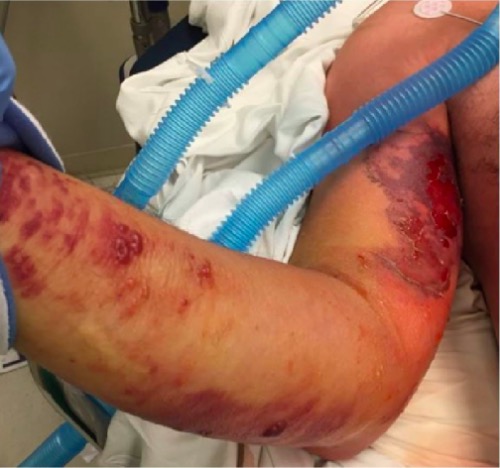
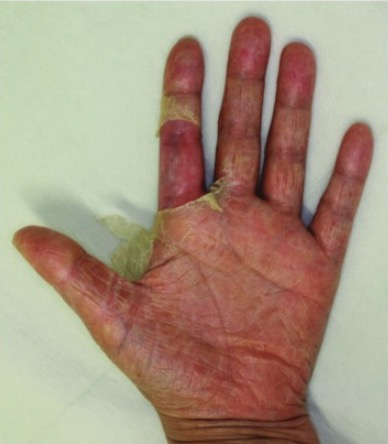
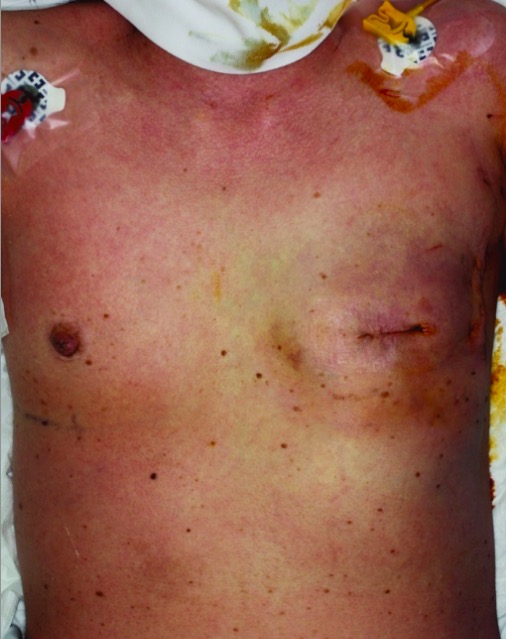
    • Eritrodermia macular difusa (similar a una quemadura solar)
    • Descamación 1–2 semanas después
    • Cianosis
    • Edema Edema Edema is a condition in which excess serous fluid accumulates in the body cavity or interstitial space of connective tissues. Edema is a symptom observed in several medical conditions. It can be categorized into 2 types, namely, peripheral (in the extremities) and internal (in an organ or body cavity). Edema sin fóvea en EN Erythema nodosum is an immune-mediated panniculitis (inflammation of the subcutaneous fat) caused by a type IV (delayed-type) hypersensitivity reaction. It commonly manifests in young women as tender, erythematous nodules on the shins. Erythema Nodosum las extremidades
    • Síndrome de shock Shock Shock is a life-threatening condition associated with impaired circulation that results in tissue hypoxia. The different types of shock are based on the underlying cause: distributive (↑ cardiac output (CO), ↓ systemic vascular resistance (SVR)), cardiogenic (↓ CO, ↑ SVR), hypovolemic (↓ CO, ↑ SVR), obstructive (↓ CO), and mixed. Types of Shock tóxico estreptocócico:
      • Dolor Dolor Inflammation localizado y aumento de volumen en EN Erythema nodosum is an immune-mediated panniculitis (inflammation of the subcutaneous fat) caused by a type IV (delayed-type) hypersensitivity reaction. It commonly manifests in young women as tender, erythematous nodules on the shins. Erythema Nodosum una zona de traumatismo o infección
      • Debe evaluarse la presencia de fascitis necrosante (eritema rápidamente progresivo, edema Edema Edema is a condition in which excess serous fluid accumulates in the body cavity or interstitial space of connective tissues. Edema is a symptom observed in several medical conditions. It can be categorized into 2 types, namely, peripheral (in the extremities) and internal (in an organ or body cavity). Edema, dolor Dolor Inflammation, crepitación, ampollas cutáneas, necrosis Necrosis The death of cells in an organ or tissue due to disease, injury or failure of the blood supply. Ischemic Cell Damage o equimosis)
  • Membranas mucosas:
    • Hemorragia conjuntival o escleral
    • Hiperemia vaginal
    • Hiperemia de la mucosa orofaríngea
    • Ulceraciones superficiales o ampollas
  • Respiratoria:
    • Síndrome de dificultad respiratoria aguda
    • Derrames pleurales
    • Edema Edema Edema is a condition in which excess serous fluid accumulates in the body cavity or interstitial space of connective tissues. Edema is a symptom observed in several medical conditions. It can be categorized into 2 types, namely, peripheral (in the extremities) and internal (in an organ or body cavity). Edema pulmonar
  • Hepática: disfunción hepática
  • Hematológica: coagulación intravascular diseminada (CID)
  • Renal: insuficiencia renal
  • Neurológica:
    • Cefalea
    • Encefalopatía:
      • Somnolencia
      • Confusión
      • Irritabilidad
      • Alucinaciones

Diagnóstico

Análisis de laboratorio

  • Hemocultivos y cultivo de heridas:
    • El aislamiento de S. aureus S. aureus Potentially pathogenic bacteria found in nasal membranes, skin, hair follicles, and perineum of warm-blooded animals. They may cause a wide range of infections and intoxications. Staphylococcus no es necesario para el diagnóstico del síndrome de shock Shock Shock is a life-threatening condition associated with impaired circulation that results in tissue hypoxia. The different types of shock are based on the underlying cause: distributive (↑ cardiac output (CO), ↓ systemic vascular resistance (SVR)), cardiogenic (↓ CO, ↑ SVR), hypovolemic (↓ CO, ↑ SVR), obstructive (↓ CO), and mixed. Types of Shock tóxico estafilocócico.
    • El aislamiento del estreptococo del grupo A se utiliza para confirmar el diagnóstico de síndrome de shock Shock Shock is a life-threatening condition associated with impaired circulation that results in tissue hypoxia. The different types of shock are based on the underlying cause: distributive (↑ cardiac output (CO), ↓ systemic vascular resistance (SVR)), cardiogenic (↓ CO, ↑ SVR), hypovolemic (↓ CO, ↑ SVR), obstructive (↓ CO), and mixed. Types of Shock tóxico estreptocócico.
  • Hemograma:
    • Leucopenia o leucocitosis con desviación a la izquierda
    • Anemia Anemia Anemia is a condition in which individuals have low Hb levels, which can arise from various causes. Anemia is accompanied by a reduced number of RBCs and may manifest with fatigue, shortness of breath, pallor, and weakness. Subtypes are classified by the size of RBCs, chronicity, and etiology. Anemia: Overview and Types
    • Trombocitopenia
  • Perfil metabólico básico:
    • ↑ Nitrógeno ureico en EN Erythema nodosum is an immune-mediated panniculitis (inflammation of the subcutaneous fat) caused by a type IV (delayed-type) hypersensitivity reaction. It commonly manifests in young women as tender, erythematous nodules on the shins. Erythema Nodosum sangre y creatinina
    • ↓ Sodio, calcio y fósforo
  • Pruebas de función hepática:
    • ↑ Aspartato aminotransferasa, alanina aminotransferasa, bilirrubina total
    • ↓ Albúmina
  • ↑ Creatina fosfoquinasa
  • Estudios de coagulación para evaluar la CID

Estudios adicionales

  • Punción lumbar en EN Erythema nodosum is an immune-mediated panniculitis (inflammation of the subcutaneous fat) caused by a type IV (delayed-type) hypersensitivity reaction. It commonly manifests in young women as tender, erythematous nodules on the shins. Erythema Nodosum pacientes con fiebre y alteración del estado mental para descartar meningitis Meningitis Meningitis is inflammation of the meninges, the protective membranes of the brain, and spinal cord. The causes of meningitis are varied, with the most common being bacterial or viral infection. The classic presentation of meningitis is a triad of fever, altered mental status, and nuchal rigidity. Meningitis
  • Radiografía de tórax para evaluar el síndrome de dificultad respiratoria aguda en EN Erythema nodosum is an immune-mediated panniculitis (inflammation of the subcutaneous fat) caused by a type IV (delayed-type) hypersensitivity reaction. It commonly manifests in young women as tender, erythematous nodules on the shins. Erythema Nodosum pacientes con dificultad respiratoria
  • Tomografía computarizada (TC) o resonancia magnética (RM) de tejidos blandos para localizar los LOS Neisseria focos de infección

Criterios clínicos

Según el Centers for Disease Control and Prevention, se utilizan los LOS Neisseria siguientes criterios para definir el síndrome de shock Shock Shock is a life-threatening condition associated with impaired circulation that results in tissue hypoxia. The different types of shock are based on the underlying cause: distributive (↑ cardiac output (CO), ↓ systemic vascular resistance (SVR)), cardiogenic (↓ CO, ↑ SVR), hypovolemic (↓ CO, ↑ SVR), obstructive (↓ CO), and mixed. Types of Shock tóxico:

Síndrome de shock Shock Shock is a life-threatening condition associated with impaired circulation that results in tissue hypoxia. The different types of shock are based on the underlying cause: distributive (↑ cardiac output (CO), ↓ systemic vascular resistance (SVR)), cardiogenic (↓ CO, ↑ SVR), hypovolemic (↓ CO, ↑ SVR), obstructive (↓ CO), and mixed. Types of Shock tóxico estafilocócico:

  • Fiebre ≥ 38,9°C (102°F)
  • Erupción macular difusa
  • Descamación 1–2 semanas después de la aparición de la erupción
  • Hipotensión severa
  • Disfunción multiorgánica (≥ 3 de los LOS Neisseria siguientes):
    • Renal: ↑ nitrógeno ureico en EN Erythema nodosum is an immune-mediated panniculitis (inflammation of the subcutaneous fat) caused by a type IV (delayed-type) hypersensitivity reaction. It commonly manifests in young women as tender, erythematous nodules on the shins. Erythema Nodosum sangre o creatinina
    • Hepática: ↑ aspartato aminotransferasa, alanina aminotransferasa o bilirrubina total
    • Gastrointestinal: vómitos o diarrea
    • Muscular: mialgia severa o ↑ creatina fosfoquinasa
    • Membranas mucosas: hiperemia vaginal, orofaríngea o conjuntival
    • Hematológica: trombocitopenia
    • Sistema nervioso central: alterado, confundido, desorientado o sin respuesta
  • Hemocultivos o cultivo de líquido cefalorraquídeo negativos (excepto S. aureus S. aureus Potentially pathogenic bacteria found in nasal membranes, skin, hair follicles, and perineum of warm-blooded animals. They may cause a wide range of infections and intoxications. Staphylococcus)
  • Pruebas negativas para la fiebre maculosa de las Montañas Rocosas, el sarampión o la leptospirosis Leptospirosis Leptospira is a spiral or question mark-shaped, gram-negative spirochete with hook-shaped ends. The major clinical species is Leptospira interrogans, which causes a mild flu-like illness in a majority of cases. The manifestations are biphasic, with Leptospira found in the blood initially. Leptospira/Leptospirosis

Síndrome de shock Shock Shock is a life-threatening condition associated with impaired circulation that results in tissue hypoxia. The different types of shock are based on the underlying cause: distributive (↑ cardiac output (CO), ↓ systemic vascular resistance (SVR)), cardiogenic (↓ CO, ↑ SVR), hypovolemic (↓ CO, ↑ SVR), obstructive (↓ CO), and mixed. Types of Shock tóxico estreptocócico

  • Hipotensión
  • Disfunción multiorgánica (≥ 2 de los LOS Neisseria siguientes):
    • Respiratoria: síndrome de dificultad respiratoria aguda o derrames pleurales con hipoalbuminemia
    • Cutánea: erupción eritematosa que puede descamar, necrosis Necrosis The death of cells in an organ or tissue due to disease, injury or failure of the blood supply. Ischemic Cell Damage de tejidos blandos, gangrena o fascitis necrosante
    • Renal: ↑ creatinina
    • Hepática: ↑ aspartato aminotransferasa, alanina aminotransferasa o bilirrubina total
    • Hematológica: trombocitopenia o CID
  • Aislamiento del estreptococo del grupo A de un sitio normalmente estéril

Tratamiento

  • Tratamiento en EN Erythema nodosum is an immune-mediated panniculitis (inflammation of the subcutaneous fat) caused by a type IV (delayed-type) hypersensitivity reaction. It commonly manifests in young women as tender, erythematous nodules on the shins. Erythema Nodosum cuidados intensivos:
    • Reanimación con líquidos intravenosos
    • Antibióticos:
      • Clindamicina (suprime la producción de toxinas)
      • Más vancomicina
      • Más piperacilina-tazobactam, cefepima o meropenem Meropenem A thienamycin derivative antibacterial agent that is more stable to renal dehydropeptidase I than imipenem, but does not need to be given with an enzyme inhibitor such as cilastatin. It is used in the treatment of bacterial infections, including infections in immunocompromised patients. Carbapenems and Aztreonam
      • El régimen debe adaptarse una vez que se disponga de los LOS Neisseria resultados del cultivo.
    • Soporte vasopresor
    • Soporte ventilatorio para pacientes con síndrome de dificultad respiratoria aguda
    • Puede ser necesaria la hemodiálisis en EN Erythema nodosum is an immune-mediated panniculitis (inflammation of the subcutaneous fat) caused by a type IV (delayed-type) hypersensitivity reaction. It commonly manifests in young women as tender, erythematous nodules on the shins. Erythema Nodosum caso de insuficiencia renal.
    • Inmunoglobulina intravenosa:
      • Puede utilizarse en EN Erythema nodosum is an immune-mediated panniculitis (inflammation of the subcutaneous fat) caused by a type IV (delayed-type) hypersensitivity reaction. It commonly manifests in young women as tender, erythematous nodules on the shins. Erythema Nodosum casos graves
      • Favorable en EN Erythema nodosum is an immune-mediated panniculitis (inflammation of the subcutaneous fat) caused by a type IV (delayed-type) hypersensitivity reaction. It commonly manifests in young women as tender, erythematous nodules on the shins. Erythema Nodosum el síndrome de shock Shock Shock is a life-threatening condition associated with impaired circulation that results in tissue hypoxia. The different types of shock are based on the underlying cause: distributive (↑ cardiac output (CO), ↓ systemic vascular resistance (SVR)), cardiogenic (↓ CO, ↑ SVR), hypovolemic (↓ CO, ↑ SVR), obstructive (↓ CO), and mixed. Types of Shock tóxico estreptocócico
  • Buscar la causa:
    • Tampones retenidos
    • Evidencia de infecciones de tejidos blandos o fascitis necrosante
  • Control del foco de origen:
    • Irrigación de heridas quirúrgicas
    • Desbridamiento del tejido desvitalizado
    • Irrigación de sitios potencialmente colonizados (e.g., senos nasales, vagina Vagina The vagina is the female genital canal, extending from the vulva externally to the cervix uteri internally. The structures have sexual, reproductive, and urinary functions and a rich blood supply, mainly arising from the internal iliac artery. Vagina, Vulva, and Pelvic Floor: Anatomy)

Diagnóstico Diferencial

  • Shock Shock Shock is a life-threatening condition associated with impaired circulation that results in tissue hypoxia. The different types of shock are based on the underlying cause: distributive (↑ cardiac output (CO), ↓ systemic vascular resistance (SVR)), cardiogenic (↓ CO, ↑ SVR), hypovolemic (↓ CO, ↑ SVR), obstructive (↓ CO), and mixed. Types of Shock séptico: disfunción orgánica resultante de una respuesta sistémica desregulada del huésped a una infección (generalmente bacteriana), que provoca vasodilatación, fuga vascular y depleción de volumen. Los LOS Neisseria pacientes suelen presentar fiebre, taquicardia, taquipnea, hipotensión que responde a los LOS Neisseria líquidos y alteración mental. El reconocimiento rápido es esencial, y combina la presentación clínica con información que justifica la infección. El tratamiento requiere una reanimación agresiva con líquidos intravenosos, vasopresores y antibióticos.
  • Síndrome de Stevens-Johnsons: reacción de hipersensibilidad cutánea, inmunomediada, que suele ser desencadenada por medicamentos, incluidos los LOS Neisseria antiepilépticos y los LOS Neisseria antibióticos. El síndrome de Stevens-Johnson se desarrolla en EN Erythema nodosum is an immune-mediated panniculitis (inflammation of the subcutaneous fat) caused by a type IV (delayed-type) hypersensitivity reaction. It commonly manifests in young women as tender, erythematous nodules on the shins. Erythema Nodosum un espectro con la necrólisis epidérmica tóxica (NET) basado en EN Erythema nodosum is an immune-mediated panniculitis (inflammation of the subcutaneous fat) caused by a type IV (delayed-type) hypersensitivity reaction. It commonly manifests in young women as tender, erythematous nodules on the shins. Erythema Nodosum la cantidad de superficie corporal afectada. Los LOS Neisseria pacientes presentarán un pródromo de tipo gripal, seguido de ampollas cutáneas y descamación en EN Erythema nodosum is an immune-mediated panniculitis (inflammation of the subcutaneous fat) caused by a type IV (delayed-type) hypersensitivity reaction. It commonly manifests in young women as tender, erythematous nodules on the shins. Erythema Nodosum la cara, el tórax y las mucosas. El diagnóstico es clínico. Se requiere el retiro inmediato del agente causal y el tratamiento es en EN Erythema nodosum is an immune-mediated panniculitis (inflammation of the subcutaneous fat) caused by a type IV (delayed-type) hypersensitivity reaction. It commonly manifests in young women as tender, erythematous nodules on the shins. Erythema Nodosum gran medida de soporte.
  • Meningitis Meningitis Meningitis is inflammation of the meninges, the protective membranes of the brain, and spinal cord. The causes of meningitis are varied, with the most common being bacterial or viral infection. The classic presentation of meningitis is a triad of fever, altered mental status, and nuchal rigidity. Meningitis meningocócica: infección bacteriana de las meninges Meninges The brain and the spinal cord are enveloped by 3 overlapping layers of connective tissue called the meninges. The layers are, from the most external layer to the most internal layer, the dura mater, arachnoid mater, and pia mater. Between these layers are 3 potential spaces called the epidural, subdural, and subarachnoid spaces. Meninges: Anatomy y del espacio subaracnoideo, causada por Neisseria meningitidis Neisseria meningitidis A species of gram-negative, aerobic bacteria. It is a commensal and pathogen only of humans, and can be carried asymptomatically in the nasopharynx. When found in cerebrospinal fluid it is the causative agent of cerebrospinal meningitis. It is also found in venereal discharges and blood. There are at least 13 serogroups based on antigenic differences in the capsular polysaccharides; the ones causing most meningitis infections being a, b, c, y, and w-135. Each serogroup can be further classified by serotype, serosubtype, and immunotype. Neisseria. Los LOS Neisseria pacientes presentan síntomas insidiosamente progresivos, como fiebre, cefalea, fotofobia, malestar, rigidez nucal y una erupción petequial o purpúrica. El diagnóstico se basa en EN Erythema nodosum is an immune-mediated panniculitis (inflammation of the subcutaneous fat) caused by a type IV (delayed-type) hypersensitivity reaction. It commonly manifests in young women as tender, erythematous nodules on the shins. Erythema Nodosum el análisis del líquido cefalorraquídeo y en EN Erythema nodosum is an immune-mediated panniculitis (inflammation of the subcutaneous fat) caused by a type IV (delayed-type) hypersensitivity reaction. It commonly manifests in young women as tender, erythematous nodules on the shins. Erythema Nodosum los LOS Neisseria cultivos. El tratamiento incluye antibióticos y corticosteroides.
  • Fiebre maculosa de las Montañas Rocosas: enfermedad causada por Rickettsia rickettsii Rickettsia rickettsii A species of gram-negative, aerobic bacteria that is the etiologic agent of rocky mountain spotted fever. Its cells are slightly smaller and more uniform in size than those of rickettsia prowazekii. Rickettsia que cursa con fiebre, fatiga, cefalea y erupción tras la picadura de una garrapata. La erupción comienza en EN Erythema nodosum is an immune-mediated panniculitis (inflammation of the subcutaneous fat) caused by a type IV (delayed-type) hypersensitivity reaction. It commonly manifests in young women as tender, erythematous nodules on the shins. Erythema Nodosum las extremidades distales y se extiende centralmente. El diagnóstico se realiza basándose en EN Erythema nodosum is an immune-mediated panniculitis (inflammation of the subcutaneous fat) caused by a type IV (delayed-type) hypersensitivity reaction. It commonly manifests in young women as tender, erythematous nodules on the shins. Erythema Nodosum las características clínicas, la biopsia de la erupción y las pruebas serológicas. El tratamiento consiste en EN Erythema nodosum is an immune-mediated panniculitis (inflammation of the subcutaneous fat) caused by a type IV (delayed-type) hypersensitivity reaction. It commonly manifests in young women as tender, erythematous nodules on the shins. Erythema Nodosum la administración de antibióticos, incluyendo la doxiciclina.
  • Leptospirosis Leptospirosis Leptospira is a spiral or question mark-shaped, gram-negative spirochete with hook-shaped ends. The major clinical species is Leptospira interrogans, which causes a mild flu-like illness in a majority of cases. The manifestations are biphasic, with Leptospira found in the blood initially. Leptospira/Leptospirosis: una enfermedad zoonótica causada por Leptospira Leptospira Leptospira is a spiral or question mark-shaped, gram-negative spirochete with hook-shaped ends. The disease, leptospirosis, is a zoonosis, infecting animals. Rodents are the most important reservoir. Bacteria shed in the urine of rodents and other animals can be transmitted to humans via contaminated water. Leptospira/Leptospirosis. Los LOS Neisseria roedores son el reservorio más importante. Los LOS Neisseria síntomas pueden incluir una enfermedad similar a la gripe y una erupción. La enfermedad sistémica ocurre en EN Erythema nodosum is an immune-mediated panniculitis (inflammation of the subcutaneous fat) caused by a type IV (delayed-type) hypersensitivity reaction. It commonly manifests in young women as tender, erythematous nodules on the shins. Erythema Nodosum una minoría de pacientes, e incluye hemorragia, insuficiencia renal e ictericia. El diagnóstico se realiza con serología y microscopía de campo oscuro. El tratamiento es principalmente con penicilina.
  • Sarampión: infección viral muy contagiosa causada por un paramixovirus que se presenta con fiebre, tos TOS Thoracic outlet syndrome (TOS) is a broad term used for a spectrum of syndromes related to the general region of the thoracic outlet, which involves the compression or irritation of elements of the brachial plexus, subclavian artery, or subclavian vein. Thoracic Outlet Syndrome, coriza, conjuntivitis y una erupción maculopapular Maculopapular Dermatologic Examination que acaba descamándose. El diagnóstico es clínico y se apoya en EN Erythema nodosum is an immune-mediated panniculitis (inflammation of the subcutaneous fat) caused by a type IV (delayed-type) hypersensitivity reaction. It commonly manifests in young women as tender, erythematous nodules on the shins. Erythema Nodosum pruebas serológicas. El tratamiento implica el aislamiento y el tratamiento de soporte.

Referencias

  1. Chu, V.H. (2025). Staphylococcal toxic shock syndrome. In Baron, E.L. (Ed.), Uptodate. Retrieved April 11, 2025, from https://www.uptodate.com/contents/staphylococcal-toxic-shock-syndrome
  2. Stevens, D.L. (2025). Invasive group A streptococcal infection and toxic shock syndrome. Epidemiology, clinical manifestations, and diagnosis. In Baron, E.L. (Ed.), Uptodate. Retrieved April 11, 2025, from https://www.uptodate.com/contents/invasive-group-a-streptococcal-infection-and-toxic-shock-syndrome-epidemiology-clinical-manifestations-and-diagnosis
  3. Stevens, D.L. (2025). Invasive group A streptococcal infection and toxic shock syndrome: Treatment and prevention. In Baron, E.L. (Ed.), Uptodate. Retrieved April 11, 2025, from https://www.uptodate.com/contents/invasive-group-a-streptococcal-infection-and-toxic-shock-syndrome-treatment-and-prevention
  4. Centers for Disease Control and Prevention. (2021). Toxic shock syndrome (other than streptococcal) (TSS) 2011 case definition. https://ndc.services.cdc.gov/case-definitions/toxic-shock-syndrome-2011/
  5. Centers for Disease Control and Prevention. (2021). Streptococcal toxic shock syndrome (STSS) (Streptococcus pyogenes) 2010 case definition. https://ndc.services.cdc.gov/case-definitions/streptococcal-toxic-shock-syndrome-2010/
  6. DeVries, A.S., Lesher, L., Schlievert, P.M., Rogers, T., Villaume, L.G., Danila, R., & Lynfield, R. (2011). Staphylococcal toxic shock syndrome 2000-2006: Epidemiology, clinical features, and molecular characteristics. PloS one, 6(8), e22997. https://doi.org/10.1371/journal.pone.0022997
  7. Bush, L.M., & Vazquez-Pertejo, M.T. (2023). Toxic shock syndrome (TSS). [online] MSD Manual Professional Version. Retrieved April 11, 2025, from https://www.merckmanuals.com/professional/infectious-diseases/gram-positive-cocci/toxic-shock-syndrome-tss
  8. Venkataraman, R., & Sharma, S. (2025). Toxic shock syndrome. In Pinsky, M.R. (Ed.), Medscape. Retrieved April 11, 2025, from https://emedicine.medscape.com/article/169177-overview
  9. Ameda, K., Yamada, Y., Uehara, Y., Ohno, T., Hoya, M., Oda, H., & Mishima, M. (2021). Group A streptococcal toxic shock syndrome after a routine gynecological procedure. Case Reports in Obstetrics and Gynecology, 2021, Article 9980015. https://doi.org/10.1155/2021/9980015

¡Crea tu cuenta gratis o inicia una sesión para seguir leyendo!

Regístrate ahora y obtén acceso gratuito a Lecturio con páginas de concepto, videos médicos y cuestionarios para tu educación médica.

User Reviews

Que tengas una sesión de estudio alegre y navideña 🎁 Ahorra 50% en todos los planes >>

Details