Domina Conceptos Médicos

Estudia para la escuela de medicina y tus examenes con Lecturio.

Sarcoidosis

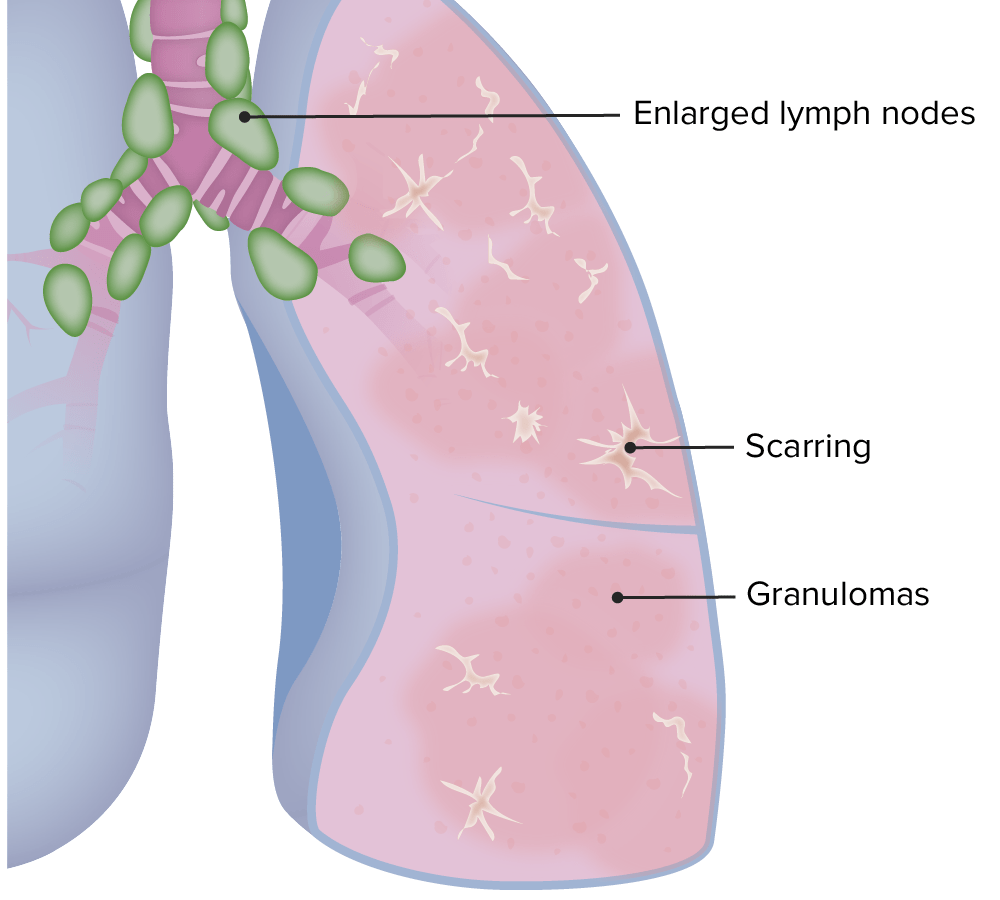
La sarcoidosis Sarcoidosis Sarcoidosis is a multisystem inflammatory disease that causes noncaseating granulomas. The exact etiology is unknown. Sarcoidosis usually affects the lungs and thoracic lymph nodes, but it can also affect almost every system in the body, including the skin, heart, and eyes, most commonly. Sarcoidosis es una enfermedad inflamatoria multisistémica que provoca granulomas Granulomas A relatively small nodular inflammatory lesion containing grouped mononuclear phagocytes, caused by infectious and noninfectious agents. Sarcoidosis no caseificantes. La etiología exacta es desconocida. La sarcoidosis Sarcoidosis Sarcoidosis is a multisystem inflammatory disease that causes noncaseating granulomas. The exact etiology is unknown. Sarcoidosis usually affects the lungs and thoracic lymph nodes, but it can also affect almost every system in the body, including the skin, heart, and eyes, most commonly. Sarcoidosis suele afectar a los LOS Neisseria pulmones y a los LOS Neisseria ganglios linfáticos torácicos, pero también puede afectar a casi todos los LOS Neisseria sistemas del cuerpo, incluidos la piel, el corazón y los LOS Neisseria ojos, comúnmente. De forma aguda, la sarcoidosis Sarcoidosis Sarcoidosis is a multisystem inflammatory disease that causes noncaseating granulomas. The exact etiology is unknown. Sarcoidosis usually affects the lungs and thoracic lymph nodes, but it can also affect almost every system in the body, including the skin, heart, and eyes, most commonly. Sarcoidosis se presenta con linfadenopatía, fiebre, malestar general, dolores articulares, una paniculitis en EN Erythema nodosum is an immune-mediated panniculitis (inflammation of the subcutaneous fat) caused by a type IV (delayed-type) hypersensitivity reaction. It commonly manifests in young women as tender, erythematous nodules on the shins. Erythema Nodosum las espinillas conocida como eritema nodoso y, ocasionalmente, tos TOS Thoracic outlet syndrome (TOS) is a broad term used for a spectrum of syndromes related to the general region of the thoracic outlet, which involves the compression or irritation of elements of the brachial plexus, subclavian artery, or subclavian vein. Thoracic Outlet Syndrome y dificultad respiratoria. La sarcoidosis Sarcoidosis Sarcoidosis is a multisystem inflammatory disease that causes noncaseating granulomas. The exact etiology is unknown. Sarcoidosis usually affects the lungs and thoracic lymph nodes, but it can also affect almost every system in the body, including the skin, heart, and eyes, most commonly. Sarcoidosis pulmonar crónica se presenta con una aparición insidiosa de disnea, tos TOS Thoracic outlet syndrome (TOS) is a broad term used for a spectrum of syndromes related to the general region of the thoracic outlet, which involves the compression or irritation of elements of the brachial plexus, subclavian artery, or subclavian vein. Thoracic Outlet Syndrome, dolor Dolor Inflammation torácico y una variedad de otros síntomas que dependen de los LOS Neisseria sistemas de órganos afectados. El diagnóstico suele requerir una biopsia de los LOS Neisseria granulomas Granulomas A relatively small nodular inflammatory lesion containing grouped mononuclear phagocytes, caused by infectious and noninfectious agents. Sarcoidosis. El tratamiento incluye la observación, AINE, glucocorticoides y, potencialmente, uno de los LOS Neisseria diversos agentes ahorradores de esteroides. La sarcoidosis Sarcoidosis Sarcoidosis is a multisystem inflammatory disease that causes noncaseating granulomas. The exact etiology is unknown. Sarcoidosis usually affects the lungs and thoracic lymph nodes, but it can also affect almost every system in the body, including the skin, heart, and eyes, most commonly. Sarcoidosis aguda suele ser autolimitada con un pronóstico excelente, pero la sarcoidosis Sarcoidosis Sarcoidosis is a multisystem inflammatory disease that causes noncaseating granulomas. The exact etiology is unknown. Sarcoidosis usually affects the lungs and thoracic lymph nodes, but it can also affect almost every system in the body, including the skin, heart, and eyes, most commonly. Sarcoidosis crónica puede provocar una fibrosis Fibrosis Any pathological condition where fibrous connective tissue invades any organ, usually as a consequence of inflammation or other injury. Bronchiolitis Obliterans pulmonar grave.

Last updated: Dec 15, 2025

Editorial responsibility: Stanley Oiseth, Lindsay Jones, Evelin Maza

Descripción General

Definición

La sarcoidosis Sarcoidosis Sarcoidosis is a multisystem inflammatory disease that causes noncaseating granulomas. The exact etiology is unknown. Sarcoidosis usually affects the lungs and thoracic lymph nodes, but it can also affect almost every system in the body, including the skin, heart, and eyes, most commonly. Sarcoidosis es una enfermedad inflamatoria multisistémica que se caracteriza por la formación de granulomas Granulomas A relatively small nodular inflammatory lesion containing grouped mononuclear phagocytes, caused by infectious and noninfectious agents. Sarcoidosis no caseificantes causados probablemente por una reacción inmunitaria celular de etiología desconocida.

La sarcoidosis Sarcoidosis Sarcoidosis is a multisystem inflammatory disease that causes noncaseating granulomas. The exact etiology is unknown. Sarcoidosis usually affects the lungs and thoracic lymph nodes, but it can also affect almost every system in the body, including the skin, heart, and eyes, most commonly. Sarcoidosis pulmonar es una enfermedad pulmonar intersticial restrictiva con formación de granulomas Granulomas A relatively small nodular inflammatory lesion containing grouped mononuclear phagocytes, caused by infectious and noninfectious agents. Sarcoidosis en EN Erythema nodosum is an immune-mediated panniculitis (inflammation of the subcutaneous fat) caused by a type IV (delayed-type) hypersensitivity reaction. It commonly manifests in young women as tender, erythematous nodules on the shins. Erythema Nodosum:

  • Pulmones (90% de los LOS Neisseria pacientes)
  • Ganglios linfáticos torácicos (hiliares y mediastínicos)

La sarcoidosis Sarcoidosis Sarcoidosis is a multisystem inflammatory disease that causes noncaseating granulomas. The exact etiology is unknown. Sarcoidosis usually affects the lungs and thoracic lymph nodes, but it can also affect almost every system in the body, including the skin, heart, and eyes, most commonly. Sarcoidosis extrapulmonar se caracteriza por la formación de granulomas Granulomas A relatively small nodular inflammatory lesion containing grouped mononuclear phagocytes, caused by infectious and noninfectious agents. Sarcoidosis en EN Erythema nodosum is an immune-mediated panniculitis (inflammation of the subcutaneous fat) caused by a type IV (delayed-type) hypersensitivity reaction. It commonly manifests in young women as tender, erythematous nodules on the shins. Erythema Nodosum:

  • Ojos
  • Piel
  • Articulaciones
  • Corazón
  • Riñones
  • Sistema nervioso central y periférico
  • Glándulas exocrinas

La sarcoidosis Sarcoidosis Sarcoidosis is a multisystem inflammatory disease that causes noncaseating granulomas. The exact etiology is unknown. Sarcoidosis usually affects the lungs and thoracic lymph nodes, but it can also affect almost every system in the body, including the skin, heart, and eyes, most commonly. Sarcoidosis puede ser aguda o crónica:
  • Síndrome de Löfgren: presentación aguda de la sarcoidosis Sarcoidosis Sarcoidosis is a multisystem inflammatory disease that causes noncaseating granulomas. The exact etiology is unknown. Sarcoidosis usually affects the lungs and thoracic lymph nodes, but it can also affect almost every system in the body, including the skin, heart, and eyes, most commonly. Sarcoidosis que dura de semanas a meses:
    • Suele resolverse espontáneamente sin tratamiento
    • Típicamente en EN Erythema nodosum is an immune-mediated panniculitis (inflammation of the subcutaneous fat) caused by a type IV (delayed-type) hypersensitivity reaction. It commonly manifests in young women as tender, erythematous nodules on the shins. Erythema Nodosum adultos jóvenes
  • Enfermedad crónica: inicio insidioso, a menudo progresivo; puede tener períodos de mejoría y recaídas
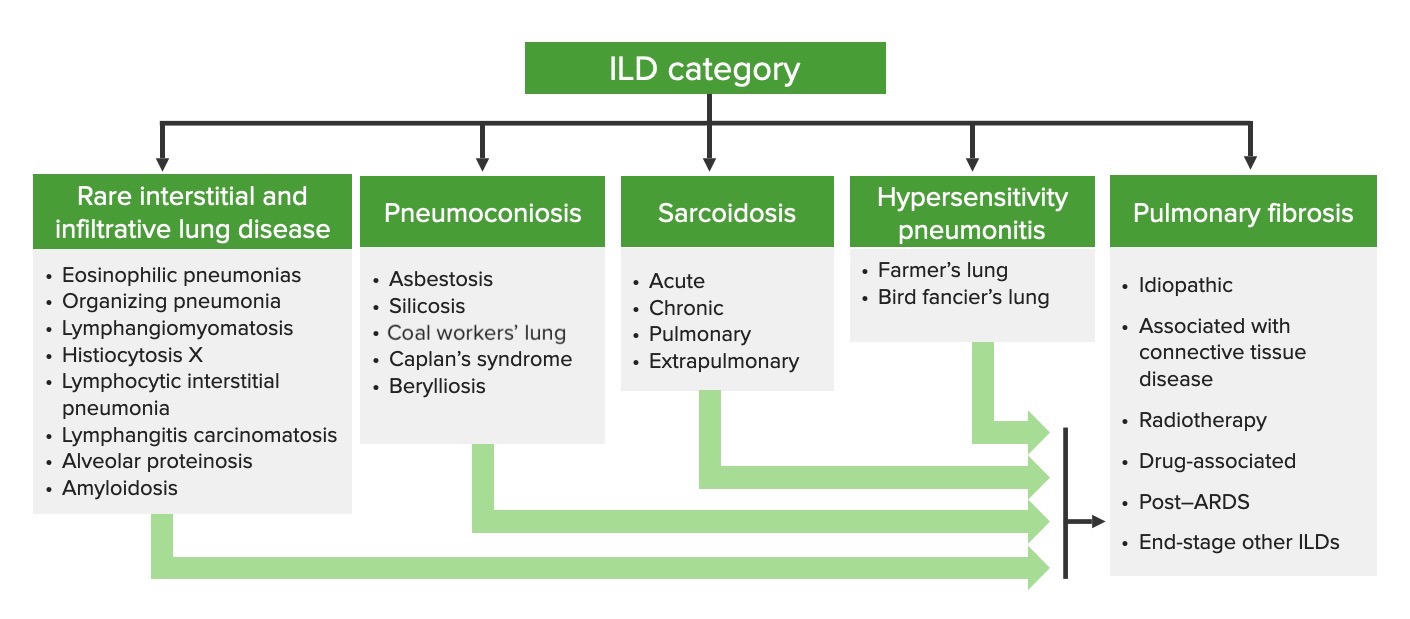
Clasificación de la enfermedad pulmonar intersticial

Categorización de las enfermedades pulmonares intersticiales
ILD: enfermedad pulmonar intersticial (por sus siglas en inglés)

Imagen por Lecturio.

Epidemiología

  • Una de las enfermedades pulmonares intersticiales más comunes
  • Prevalencia estimada en EN Erythema nodosum is an immune-mediated panniculitis (inflammation of the subcutaneous fat) caused by a type IV (delayed-type) hypersensitivity reaction. It commonly manifests in young women as tender, erythematous nodules on the shins. Erythema Nodosum Estados Unidos:
    • ~140 cada 100 000 en EN Erythema nodosum is an immune-mediated panniculitis (inflammation of the subcutaneous fat) caused by a type IV (delayed-type) hypersensitivity reaction. It commonly manifests in young women as tender, erythematous nodules on the shins. Erythema Nodosum afroamericanos
    • ~40 cada 100 000 en EN Erythema nodosum is an immune-mediated panniculitis (inflammation of the subcutaneous fat) caused by a type IV (delayed-type) hypersensitivity reaction. It commonly manifests in young women as tender, erythematous nodules on the shins. Erythema Nodosum caucásicos
  • Edad de inicio:
    • La incidencia es mayor a los LOS Neisseria 20–40 años de edad.
    • Segundo pico de incidencia para las mujeres entre los LOS Neisseria 45 y 65 años
  • Predisposición de sexo: mujeres > hombres
  • Predisposición racial/étnica: Afroamericanos > otras razas
  • La mayoría de los LOS Neisseria casos son esporádicos, pero alrededor del 5% son familiares.

Etiología

La etiología es indeterminada, pero lo más probable es que sea multifactorial.

Teoría: Un agente infeccioso o ambiental desencadena una respuesta inmunitaria inflamatoria mediada por células en EN Erythema nodosum is an immune-mediated panniculitis (inflammation of the subcutaneous fat) caused by a type IV (delayed-type) hypersensitivity reaction. It commonly manifests in young women as tender, erythematous nodules on the shins. Erythema Nodosum un huésped genéticamente susceptible, lo que conduce a la formación de granulomas Granulomas A relatively small nodular inflammatory lesion containing grouped mononuclear phagocytes, caused by infectious and noninfectious agents. Sarcoidosis.

Posibles exposiciones desencadenantes:

  • Inhalación de talco, aluminio, berilio o circonio
  • Exposición al AL Amyloidosis polvo y escombros del World Trade Center derrumbado tras el 11-S
  • Agentes infecciosos:
    • Mycobacterium tuberculosis Mycobacterium tuberculosis Tuberculosis (TB) is an infectious disease caused by Mycobacterium tuberculosis complex bacteria. The bacteria usually attack the lungs but can also damage other parts of the body. Approximately 30% of people around the world are infected with this pathogen, with the majority harboring a latent infection. Tuberculosis spreads through the air when a person with active pulmonary infection coughs or sneezes. Tuberculosis
    • Cutibacterium (antes Propionibacterium Propionibacterium A genus of gram-positive, rod-shaped bacteria whose cells occur singly, in pairs or short chains, in V or y configurations, or in clumps resembling letters of the chinese alphabet. Its organisms are found in cheese and dairy products as well as on human skin and can occasionally cause soft tissue infections. Dog and Cat Bites) acnes

Predisposiciones genéticas:

  • Antígenos del complejo mayor de histocompatibilidad, especialmente los LOS Neisseria alelos HLA-DR:
    • HLA-DRB1*1101
    • HLA-DQB1*0201
  • Posible asociación con variantes de la ECA
  • Hay estudios en EN Erythema nodosum is an immune-mediated panniculitis (inflammation of the subcutaneous fat) caused by a type IV (delayed-type) hypersensitivity reaction. It commonly manifests in young women as tender, erythematous nodules on the shins. Erythema Nodosum curso investigando las redes de genes Genes A category of nucleic acid sequences that function as units of heredity and which code for the basic instructions for the development, reproduction, and maintenance of organisms. DNA Types and Structure

Fisiopatología

La sarcoidosis Sarcoidosis Sarcoidosis is a multisystem inflammatory disease that causes noncaseating granulomas. The exact etiology is unknown. Sarcoidosis usually affects the lungs and thoracic lymph nodes, but it can also affect almost every system in the body, including the skin, heart, and eyes, most commonly. Sarcoidosis es el resultado de una reacción inmunitaria celular.
  • Fagocitosis de un nuevo antígeno por parte de las células presentadoras de antígeno (e.g., macrófagos y células dendríticas)
  • Los LOS Neisseria macrófagos activados presentan el antígeno a los LOS Neisseria linfocitos T colaboradores a través del complejo HLA-CD4.
  • Los LOS Neisseria linfocitos T activados y los LOS Neisseria macrófagos liberan mediadores inflamatorios (respuesta Th1 Th1 A subset of helper-inducer T-lymphocytes which synthesize and secrete interleukin-2; interferon-gamma; and interleukin-12. Due to their ability to kill antigen-presenting cells and their lymphokine-mediated effector activity, th1 cells are associated with vigorous delayed-type hypersensitivity reactions. T cells: Types and Functions):
    • Interleucina 2 (IL-2)
    • Interferón gamma
    • Factor de necrosis Necrosis The death of cells in an organ or tissue due to disease, injury or failure of the blood supply. Ischemic Cell Damage tumoral
    • Otras citocinas y quimioquinas
  • Los LOS Neisseria mediadores inflamatorios hacen que los LOS Neisseria macrófagos se fusionen en EN Erythema nodosum is an immune-mediated panniculitis (inflammation of the subcutaneous fat) caused by a type IV (delayed-type) hypersensitivity reaction. It commonly manifests in young women as tender, erythematous nodules on the shins. Erythema Nodosum células gigantes multinucleadas.
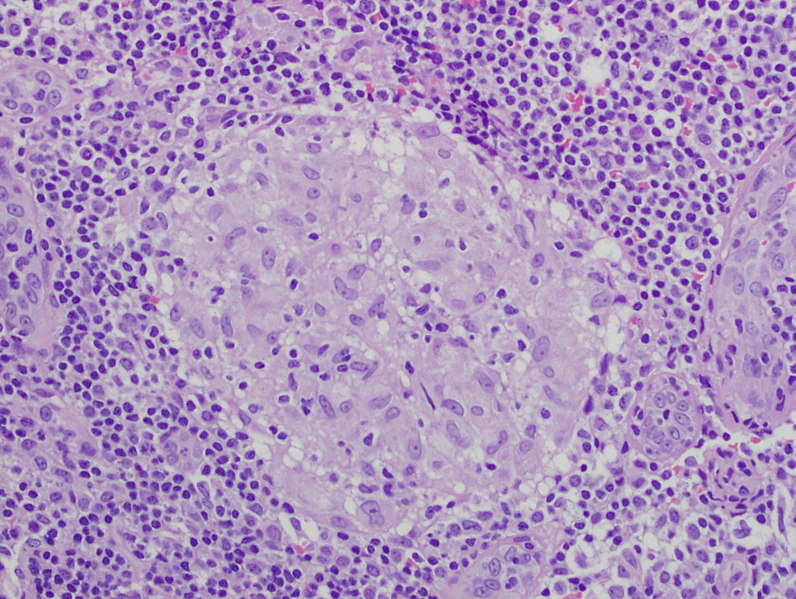
  • Al AL Amyloidosis no poder destruir los LOS Neisseria antígenos, las células gigantes multinucleadas los LOS Neisseria amurallan → formación de granulomas Granulomas A relatively small nodular inflammatory lesion containing grouped mononuclear phagocytes, caused by infectious and noninfectious agents. Sarcoidosis no caseificantes
  • Los LOS Neisseria fibroblastos son reclutados y rodean los LOS Neisseria granulomas Granulomas A relatively small nodular inflammatory lesion containing grouped mononuclear phagocytes, caused by infectious and noninfectious agents. Sarcoidosis.
  • Los LOS Neisseria granulomas Granulomas A relatively small nodular inflammatory lesion containing grouped mononuclear phagocytes, caused by infectious and noninfectious agents. Sarcoidosis pueden evolucionar hacia la fibrosis Fibrosis Any pathological condition where fibrous connective tissue invades any organ, usually as a consequence of inflammation or other injury. Bronchiolitis Obliterans; el mecanismo es poco conocido.
Granuloma

Granuloma no caseificante

Imagen: “Granuloma 20x” por Mutleysmith. Licencia: Dominio Público

Presentación Clínica

La sarcoidosis Sarcoidosis Sarcoidosis is a multisystem inflammatory disease that causes noncaseating granulomas. The exact etiology is unknown. Sarcoidosis usually affects the lungs and thoracic lymph nodes, but it can also affect almost every system in the body, including the skin, heart, and eyes, most commonly. Sarcoidosis suele progresar lentamente, con pocos síntomas en EN Erythema nodosum is an immune-mediated panniculitis (inflammation of the subcutaneous fat) caused by a type IV (delayed-type) hypersensitivity reaction. It commonly manifests in young women as tender, erythematous nodules on the shins. Erythema Nodosum un principio. Los LOS Neisseria síntomas aparecen a medida que un número creciente de granulomas Granulomas A relatively small nodular inflammatory lesion containing grouped mononuclear phagocytes, caused by infectious and noninfectious agents. Sarcoidosis empieza a afectar al AL Amyloidosis funcionamiento de los LOS Neisseria órganos.

Manifestaciones clínicas de la sarcoidosis Sarcoidosis Sarcoidosis is a multisystem inflammatory disease that causes noncaseating granulomas. The exact etiology is unknown. Sarcoidosis usually affects the lungs and thoracic lymph nodes, but it can also affect almost every system in the body, including the skin, heart, and eyes, most commonly. Sarcoidosis por sistema
Sistema Presentación clínica de la sarcoidosis Sarcoidosis Sarcoidosis is a multisystem inflammatory disease that causes noncaseating granulomas. The exact etiology is unknown. Sarcoidosis usually affects the lungs and thoracic lymph nodes, but it can also affect almost every system in the body, including the skin, heart, and eyes, most commonly. Sarcoidosis
Síntomas sistémicos (típicamente en EN Erythema nodosum is an immune-mediated panniculitis (inflammation of the subcutaneous fat) caused by a type IV (delayed-type) hypersensitivity reaction. It commonly manifests in young women as tender, erythematous nodules on the shins. Erythema Nodosum presentaciones agudas)
  • Fiebre
  • Mialgias
  • Pérdida de peso
  • Fatiga y agotamiento
Pulmonar
  • Dolor Dolor Inflammation torácico
  • Tos TOS Thoracic outlet syndrome (TOS) is a broad term used for a spectrum of syndromes related to the general region of the thoracic outlet, which involves the compression or irritation of elements of the brachial plexus, subclavian artery, or subclavian vein. Thoracic Outlet Syndrome seca
  • Disnea de esfuerzo
  • Complicaciones graves: hipertensión pulmonar o cor pulmonale Cor Pulmonale Cor pulmonale is right ventricular (RV) dysfunction caused by lung disease that results in pulmonary artery hypertension. The most common cause of cor pulmonale is chronic obstructive pulmonary disease. Dyspnea is the usual presenting symptom. Cor Pulmonale (como consecuencia de la fibrosis Fibrosis Any pathological condition where fibrous connective tissue invades any organ, usually as a consequence of inflammation or other injury. Bronchiolitis Obliterans pulmonar)
Linfático
  • Linfadenopatía intratorácica
    • Hiliar y mediastinal
    • Afectación bilateral (diferencia la sarcoidosis Sarcoidosis Sarcoidosis is a multisystem inflammatory disease that causes noncaseating granulomas. The exact etiology is unknown. Sarcoidosis usually affects the lungs and thoracic lymph nodes, but it can also affect almost every system in the body, including the skin, heart, and eyes, most commonly. Sarcoidosis de la tuberculosis Tuberculosis Tuberculosis (TB) is an infectious disease caused by Mycobacterium tuberculosis complex bacteria. The bacteria usually attack the lungs but can also damage other parts of the body. Approximately 30% of people around the world are infected with this pathogen, with the majority harboring a latent infection. Tuberculosis spreads through the air when a person with active pulmonary infection coughs or sneezes. Tuberculosis y la malignidad)
  • Agrandamiento de los LOS Neisseria ganglios linfáticos periféricos
Ocular
  • Uveítis (más común)
  • Los LOS Neisseria granulomas Granulomas A relatively small nodular inflammatory lesion containing grouped mononuclear phagocytes, caused by infectious and noninfectious agents. Sarcoidosis pueden afectar:
    • Órbita
    • Segmentos anterior y posterior del ojo
    • Conjuntiva
    • Glándulas lagrimales
    • Músculos extraoculares
    • Párpados
  • Los LOS Neisseria síntomas incluyen ojo seco, visión borrosa, fotofobia, enrojecimiento y dolor Dolor Inflammation.
Cutáneo
  • Eritema nodoso:
    • Una paniculitis (inflamación de la grasa subcutánea)
    • Nódulos inflamatorios dolorosos, generalmente en EN Erythema nodosum is an immune-mediated panniculitis (inflammation of the subcutaneous fat) caused by a type IV (delayed-type) hypersensitivity reaction. It commonly manifests in young women as tender, erythematous nodules on the shins. Erythema Nodosum las espinillas
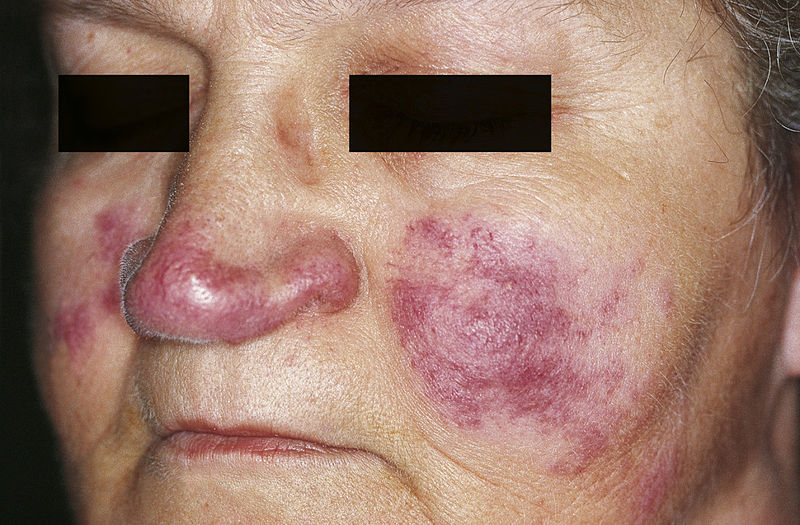
  • Lupus pernio Pernio Recurrent localized itching, swelling and painful erythema on the fingers, toes or ears, produced by exposure to cold. Frostbite:
    • Pápulas, placas y nódulos violáceos o eritematosos indurados
    • Principalmente en EN Erythema nodosum is an immune-mediated panniculitis (inflammation of the subcutaneous fat) caused by a type IV (delayed-type) hypersensitivity reaction. It commonly manifests in young women as tender, erythematous nodules on the shins. Erythema Nodosum la cara: nariz, mejillas, mentón y orejas
    • Acompañado de una importante formación de cicatrices
Musculoesquelético
  • Poliartritis ( dolor Dolor Inflammation e inflamación de las articulaciones)
  • Miositis granulomatosa
Cardíaco
  • Arritmia cardíaca con ↑ riesgo de muerte súbita cardíaca
  • Defectos de conducción (bloqueo cardíaco)
  • Insuficiencia cardíaca
  • Miocardiopatía restrictiva
Sistema nervioso
  • Meningitis Meningitis Meningitis is inflammation of the meninges, the protective membranes of the brain, and spinal cord. The causes of meningitis are varied, with the most common being bacterial or viral infection. The classic presentation of meningitis is a triad of fever, altered mental status, and nuchal rigidity. Meningitis linfocítica
  • Parálisis facial (parálisis del nervio craneal)
  • Disfunción hipotálamo-hipofisaria:
    • Diabetes Diabetes Diabetes mellitus (DM) is a metabolic disease characterized by hyperglycemia and dysfunction of the regulation of glucose metabolism by insulin. Type 1 DM is diagnosed mostly in children and young adults as the result of autoimmune destruction of β cells in the pancreas and the resulting lack of insulin. Type 2 DM has a significant association with obesity and is characterized by insulin resistance. Diabetes Mellitus insípida
    • Hipopituitarismo
    • Amenorrea
  • Afectación de la médula espinal
  • Neuropatías periféricas
Otros sitios potenciales de afectación
  • Vías respiratorias superiores: laringe, faringe, narinas y senos paranasales
  • Riñón
  • Hígado y bazo
  • Tracto gastrointestinal
  • Glándulas exocrinas: parótidas y salivales

Síndrome de Löfgren

Una presentación aguda de sarcoidosis Sarcoidosis Sarcoidosis is a multisystem inflammatory disease that causes noncaseating granulomas. The exact etiology is unknown. Sarcoidosis usually affects the lungs and thoracic lymph nodes, but it can also affect almost every system in the body, including the skin, heart, and eyes, most commonly. Sarcoidosis con una tríada clásica de síntomas:

  • Eritema nodoso
  • Adenopatía hiliar
  • Poliartralgia migratoria

Diagnóstico

El diagnóstico de la sarcoidosis Sarcoidosis Sarcoidosis is a multisystem inflammatory disease that causes noncaseating granulomas. The exact etiology is unknown. Sarcoidosis usually affects the lungs and thoracic lymph nodes, but it can also affect almost every system in the body, including the skin, heart, and eyes, most commonly. Sarcoidosis suele requerir:
  1. Manifestaciones clínicas y radiológicas compatibles
  2. Granulomas Granulomas A relatively small nodular inflammatory lesion containing grouped mononuclear phagocytes, caused by infectious and noninfectious agents. Sarcoidosis no caseificantes en EN Erythema nodosum is an immune-mediated panniculitis (inflammation of the subcutaneous fat) caused by a type IV (delayed-type) hypersensitivity reaction. It commonly manifests in young women as tender, erythematous nodules on the shins. Erythema Nodosum la patología
  3. Exclusión de otras condiciones

Imagenología

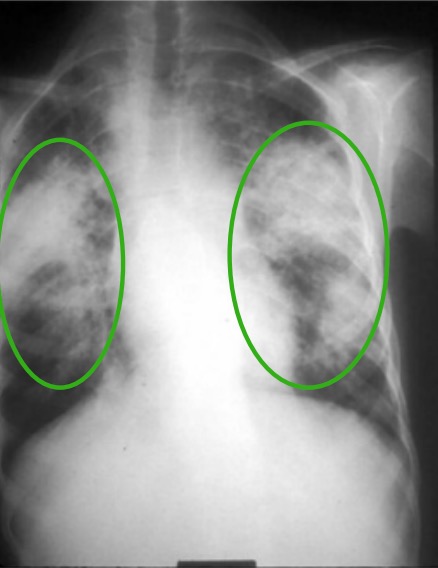
  • Radiografía de tórax:
    • Mejor prueba inicial
    • Hallazgos:
      • Linfadenopatía hiliar bilateral (hallazgo clásico)
      • Infiltrados reticulonodulares bilaterales (a menudo en EN Erythema nodosum is an immune-mediated panniculitis (inflammation of the subcutaneous fat) caused by a type IV (delayed-type) hypersensitivity reaction. It commonly manifests in young women as tender, erythematous nodules on the shins. Erythema Nodosum los LOS Neisseria lóbulos superiores)
      • Patrón en EN Erythema nodosum is an immune-mediated panniculitis (inflammation of the subcutaneous fat) caused by a type IV (delayed-type) hypersensitivity reaction. It commonly manifests in young women as tender, erythematous nodules on the shins. Erythema Nodosum panal de abeja (enfermedad terminal)
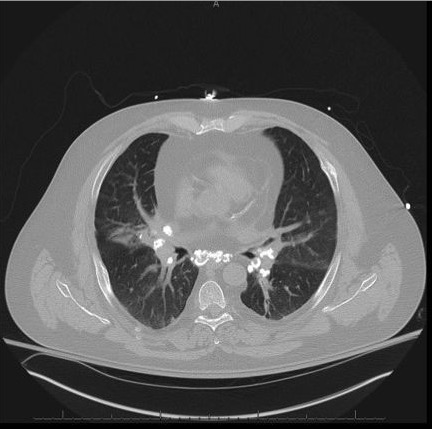
  • TC de alta resolución:
    • Mayor sensibilidad que la radiografía
    • Indicaciones:
      • Confirmar los LOS Neisseria hallazgos de las radiografías sospechosas
      • Evaluación adicional de los LOS Neisseria pulmones en EN Erythema nodosum is an immune-mediated panniculitis (inflammation of the subcutaneous fat) caused by a type IV (delayed-type) hypersensitivity reaction. It commonly manifests in young women as tender, erythematous nodules on the shins. Erythema Nodosum pacientes con síntomas pulmonares pero con radiografías normales
    • Hallazgos:
      • Linfadenopatía hiliar y mediastínica bilateral
      • Pequeños nódulos parenquimatosos centrolobulillares
      • Predominio de cambios en EN Erythema nodosum is an immune-mediated panniculitis (inflammation of the subcutaneous fat) caused by a type IV (delayed-type) hypersensitivity reaction. It commonly manifests in young women as tender, erythematous nodules on the shins. Erythema Nodosum el parénquima pulmonar en EN Erythema nodosum is an immune-mediated panniculitis (inflammation of the subcutaneous fat) caused by a type IV (delayed-type) hypersensitivity reaction. It commonly manifests in young women as tender, erythematous nodules on the shins. Erythema Nodosum la zona media-superior
      • Nodularidad fina
      • Opacificación en EN Erythema nodosum is an immune-mediated panniculitis (inflammation of the subcutaneous fat) caused by a type IV (delayed-type) hypersensitivity reaction. It commonly manifests in young women as tender, erythematous nodules on the shins. Erythema Nodosum vidrio esmerilado
      • Fibrosis Fibrosis Any pathological condition where fibrous connective tissue invades any organ, usually as a consequence of inflammation or other injury. Bronchiolitis Obliterans con distorsión pulmonar y bronquiectasias por tracción

Broncoscopia

  • Lavado broncoalveolar:
    • Obtenido principalmente para excluir diagnósticos alternativos (e.g., infecciones, malignidad)
    • La linfocitosis ≥ 25% sugiere un proceso granulomatoso.
    • Hallazgos consistentes con sarcoidosis Sarcoidosis Sarcoidosis is a multisystem inflammatory disease that causes noncaseating granulomas. The exact etiology is unknown. Sarcoidosis usually affects the lungs and thoracic lymph nodes, but it can also affect almost every system in the body, including the skin, heart, and eyes, most commonly. Sarcoidosis pulmonar:
      • ↓ Linfocitos CD8
      • ↑ Linfocitos CD4, linfocitos T activados y células secretoras de IgG IgG The major immunoglobulin isotype class in normal human serum. There are several isotype subclasses of igg, for example, igg1, igg2a, and igg2b. Hypersensitivity Pneumonitis
      • ↑ Relación CD4:CD8 > 4:1
  • Permite una toma de muestras de tejido pulmonar menos invasiva:
    • Biopsia endobronquial
    • Biopsia pulmonar transbronquial
    • Aspiración transbronquial con aguja

Biopsia

  • Estándar de oro para el diagnóstico
  • Se toma la biopsia del sitio afectado más accesible (e.g., lesiones de piel).
  • Las biopsias de pulmón pueden obtenerse mediante broncoscopia o quirúrgicamente (más invasivas).
  • Hallazgo clave: granulomas Granulomas A relatively small nodular inflammatory lesion containing grouped mononuclear phagocytes, caused by infectious and noninfectious agents. Sarcoidosis no caseificantes bien definidos
    • No caseificante: no hay necrosis Necrosis The death of cells in an organ or tissue due to disease, injury or failure of the blood supply. Ischemic Cell Damage central
    • Células gigantes multinucleadas
  • Otros hallazgos histopatológicos:
    • Cuerpos asteroides
    • Cuerpos de Schaumann

Espirometría

Se obtiene para evaluar la gravedad de la afectación respiratoria y controlar la enfermedad; es menos útil para establecer realmente el diagnóstico

  • La sarcoidosis Sarcoidosis Sarcoidosis is a multisystem inflammatory disease that causes noncaseating granulomas. The exact etiology is unknown. Sarcoidosis usually affects the lungs and thoracic lymph nodes, but it can also affect almost every system in the body, including the skin, heart, and eyes, most commonly. Sarcoidosis suele mostrar un patrón restrictivo:
    • ↓ Capacidad vital forzada (CVF; volumen total exhalado forzado)
    • ↓ Capacidad pulmonar total (CPT; volumen total en EN Erythema nodosum is an immune-mediated panniculitis (inflammation of the subcutaneous fat) caused by a type IV (delayed-type) hypersensitivity reaction. It commonly manifests in young women as tender, erythematous nodules on the shins. Erythema Nodosum los LOS Neisseria pulmones al AL Amyloidosis final de una inspiración máxima)
    • ↓ Distensibilidad ( los LOS Neisseria pulmones tienen dificultad para expandirse)
  • Los LOS Neisseria patrones mixtos restrictivos/obstructivos también son posibles en EN Erythema nodosum is an immune-mediated panniculitis (inflammation of the subcutaneous fat) caused by a type IV (delayed-type) hypersensitivity reaction. It commonly manifests in young women as tender, erythematous nodules on the shins. Erythema Nodosum la enfermedad grave:
    • Los LOS Neisseria patrones mixtos tienen hallazgos tanto restrictivos como obstructivos.
    • Hallazgos obstructivos:
      • ↓ Cociente del volumen espiratorio forzado en EN Erythema nodosum is an immune-mediated panniculitis (inflammation of the subcutaneous fat) caused by a type IV (delayed-type) hypersensitivity reaction. It commonly manifests in young women as tender, erythematous nodules on the shins. Erythema Nodosum 1 segundo (VEF1):CVF
      • ↓ Flujo de aire (las vías respiratorias están parcialmente obstruidas por la inflamación y la fibrosis Fibrosis Any pathological condition where fibrous connective tissue invades any organ, usually as a consequence of inflammation or other injury. Bronchiolitis Obliterans)
  • Deterioro de la difusión de gases a través de la membrana alveolar: ↓ capacidad de difusión pulmonar del monóxido de carbono

Otras pruebas

  • Electrocardiografía: para evaluar la afectación cardíaca
  • Examen oftalmológico: para evaluar la afectación ocular
  • Prueba cutánea de la tuberculina: para descartar tuberculosis Tuberculosis Tuberculosis (TB) is an infectious disease caused by Mycobacterium tuberculosis complex bacteria. The bacteria usually attack the lungs but can also damage other parts of the body. Approximately 30% of people around the world are infected with this pathogen, with the majority harboring a latent infection. Tuberculosis spreads through the air when a person with active pulmonary infection coughs or sneezes. Tuberculosis
  • Otras pruebas guiadas por la presentación clínica

Pruebas de laboratorio

Estas pruebas son importantes para evaluar y monitorizar el alcance de la enfermedad, más que para establecer el diagnóstico. Los LOS Neisseria siguientes hallazgos se observan a menudo en EN Erythema nodosum is an immune-mediated panniculitis (inflammation of the subcutaneous fat) caused by a type IV (delayed-type) hypersensitivity reaction. It commonly manifests in young women as tender, erythematous nodules on the shins. Erythema Nodosum la sarcoidosis Sarcoidosis Sarcoidosis is a multisystem inflammatory disease that causes noncaseating granulomas. The exact etiology is unknown. Sarcoidosis usually affects the lungs and thoracic lymph nodes, but it can also affect almost every system in the body, including the skin, heart, and eyes, most commonly. Sarcoidosis.

  • Hemograma
    • Leucopenia
    • Linfopenia
    • Anemia Anemia Anemia is a condition in which individuals have low Hb levels, which can arise from various causes. Anemia is accompanied by a reduced number of RBCs and may manifest with fatigue, shortness of breath, pallor, and weakness. Subtypes are classified by the size of RBCs, chronicity, and etiology. Anemia: Overview and Types (poco común)
  • Panel metabólico completo:
    • Hipercalcemia
    • ↑ Pruebas de función hepática si hay afectación hepática
    • ↑ (BUN, por sus siglas en EN Erythema nodosum is an immune-mediated panniculitis (inflammation of the subcutaneous fat) caused by a type IV (delayed-type) hypersensitivity reaction. It commonly manifests in young women as tender, erythematous nodules on the shins. Erythema Nodosum inglés) y creatinina si hay afectación renal.
  • Análisis de orina:
    • Hipercalciuria
  • Marcadores inflamatorios:
    • ↑ VES
    • PCR PCR Polymerase chain reaction (PCR) is a technique that amplifies DNA fragments exponentially for analysis. The process is highly specific, allowing for the targeting of specific genomic sequences, even with minuscule sample amounts. The PCR cycles multiple times through 3 phases: denaturation of the template DNA, annealing of a specific primer to the individual DNA strands, and synthesis/elongation of new DNA molecules. Polymerase Chain Reaction (PCR)
  • Otros:
    • ↑ Enzima convertidora de angiotensina
    • IgG IgG The major immunoglobulin isotype class in normal human serum. There are several isotype subclasses of igg, for example, igg1, igg2a, and igg2b. Hypersensitivity Pneumonitis

Estadificación

Tabla: Esquema de estadificación según la presencia o ausencia de linfadenopatía hiliar bilateral y por la presencia o ausencia de infiltrados pulmonares
Estadio Radiografía de tórax Síntomas Frecuencia
0 Solo enfermedad extrapulmonar Ninguno 10%
1 Solo LHB Ninguno o tos TOS Thoracic outlet syndrome (TOS) is a broad term used for a spectrum of syndromes related to the general region of the thoracic outlet, which involves the compression or irritation of elements of the brachial plexus, subclavian artery, or subclavian vein. Thoracic Outlet Syndrome leve 50%
2 LHB más infiltrados parenquimatosos Ninguno, disnea o tos TOS Thoracic outlet syndrome (TOS) is a broad term used for a spectrum of syndromes related to the general region of the thoracic outlet, which involves the compression or irritation of elements of the brachial plexus, subclavian artery, or subclavian vein. Thoracic Outlet Syndrome 25%
3 Solo infiltrados parenquimatosos Disnea 10%
4 Fibrosis Fibrosis Any pathological condition where fibrous connective tissue invades any organ, usually as a consequence of inflammation or other injury. Bronchiolitis Obliterans pulmonar avanzada Disnea 5%
LHB: linfadenopatía hiliar bilateral

Tratamiento

El tratamiento se basa en EN Erythema nodosum is an immune-mediated panniculitis (inflammation of the subcutaneous fat) caused by a type IV (delayed-type) hypersensitivity reaction. It commonly manifests in young women as tender, erythematous nodules on the shins. Erythema Nodosum el estadio y la localización de la enfermedad e incluye:

  • Observación:
    • Indicado en EN Erythema nodosum is an immune-mediated panniculitis (inflammation of the subcutaneous fat) caused by a type IV (delayed-type) hypersensitivity reaction. It commonly manifests in young women as tender, erythematous nodules on the shins. Erythema Nodosum pacientes con altas tasas de resolución espontánea:
      • Sarcoidosis Sarcoidosis Sarcoidosis is a multisystem inflammatory disease that causes noncaseating granulomas. The exact etiology is unknown. Sarcoidosis usually affects the lungs and thoracic lymph nodes, but it can also affect almost every system in the body, including the skin, heart, and eyes, most commonly. Sarcoidosis aguda
      • Sarcoidosis Sarcoidosis Sarcoidosis is a multisystem inflammatory disease that causes noncaseating granulomas. The exact etiology is unknown. Sarcoidosis usually affects the lungs and thoracic lymph nodes, but it can also affect almost every system in the body, including the skin, heart, and eyes, most commonly. Sarcoidosis crónica en EN Erythema nodosum is an immune-mediated panniculitis (inflammation of the subcutaneous fat) caused by a type IV (delayed-type) hypersensitivity reaction. It commonly manifests in young women as tender, erythematous nodules on the shins. Erythema Nodosum estadio 1
    • AINE para el tratamiento del dolor Dolor Inflammation si es necesario
  • Corticosteroides: tratamiento de 1era línea en EN Erythema nodosum is an immune-mediated panniculitis (inflammation of the subcutaneous fat) caused by a type IV (delayed-type) hypersensitivity reaction. It commonly manifests in young women as tender, erythematous nodules on the shins. Erythema Nodosum pacientes con:
    • Enfermedad en EN Erythema nodosum is an immune-mediated panniculitis (inflammation of the subcutaneous fat) caused by a type IV (delayed-type) hypersensitivity reaction. It commonly manifests in young women as tender, erythematous nodules on the shins. Erythema Nodosum estadio ≥ 2 con restricción simultánea de la función pulmonar
    • Insuficiencia renal (hipercalcemia e hiperuricemia)
    • Afectación extrapulmonar
    • Síntomas sistémicos graves
    • Artritis grave (síndrome de Löfgren)
    • Síntomas localizados, incluyendo uveítis y lesiones cutáneas → administración local
  • Agentes ahorradores de esteroides: Tratamiento de 2da línea:
    • Azatioprina
    • Metotrexato
    • Micofenolato
    • Hidroxicloroquina
    • Leflunomida
    • Infliximab Infliximab A chimeric monoclonal antibody to tnf-alpha that is used in the treatment of rheumatoid arthritis; ankylosing spondylitis; psoriatic arthritis and Crohn’s disease. Disease-Modifying Antirheumatic Drugs (DMARDs) (agente anti-TNF)
  • Trasplante de pulmón: en EN Erythema nodosum is an immune-mediated panniculitis (inflammation of the subcutaneous fat) caused by a type IV (delayed-type) hypersensitivity reaction. It commonly manifests in young women as tender, erythematous nodules on the shins. Erythema Nodosum casos de fibrosis Fibrosis Any pathological condition where fibrous connective tissue invades any organ, usually as a consequence of inflammation or other injury. Bronchiolitis Obliterans pulmonar avanzada

Pronóstico

Tabla: Tasas de remisión
Estadio Tasa de remisión
0
1 90%
2 70%
3 20%
4 < 5%

Diagnóstico Diferencial

  • Neumoconiosis: enfermedad ocupacional que consiste en EN Erythema nodosum is an immune-mediated panniculitis (inflammation of the subcutaneous fat) caused by a type IV (delayed-type) hypersensitivity reaction. It commonly manifests in young women as tender, erythematous nodules on the shins. Erythema Nodosum un grupo de enfermedades pulmonares intersticiales restrictivas causadas por la inhalación de polvos tóxicos, como la sílice, el asbesto, el berilio y otros: La neumoconiosis se presenta con tos TOS Thoracic outlet syndrome (TOS) is a broad term used for a spectrum of syndromes related to the general region of the thoracic outlet, which involves the compression or irritation of elements of the brachial plexus, subclavian artery, or subclavian vein. Thoracic Outlet Syndrome y disnea progresiva. El diagnóstico se realiza mediante los LOS Neisseria antecedentes ocupacionales, la imagenología y la histología. El tratamiento es mayoritariamente de soporte.
  • Histoplasmosis Histoplasmosis Histoplasmosis is an infection caused by Histoplasma capsulatum, a dimorphic fungus. Transmission is through inhalation, and exposure to soils containing bird or bat droppings increases the risk of infection. Most infections are asymptomatic; however, immunocompromised individuals generally develop acute pulmonary infection, chronic infection, or even disseminated disease. Histoplasma/Histoplasmosis: infección causada por el hongo Histoplasma capsulatum Histoplasma capsulatum Histoplasma/Histoplasmosis: la histoplasmosis Histoplasmosis Histoplasmosis is an infection caused by Histoplasma capsulatum, a dimorphic fungus. Transmission is through inhalation, and exposure to soils containing bird or bat droppings increases the risk of infection. Most infections are asymptomatic; however, immunocompromised individuals generally develop acute pulmonary infection, chronic infection, or even disseminated disease. Histoplasma/Histoplasmosis se presenta con síntomas de neumonía, como fiebre, cefalea, mialgias, tos TOS Thoracic outlet syndrome (TOS) is a broad term used for a spectrum of syndromes related to the general region of the thoracic outlet, which involves the compression or irritation of elements of the brachial plexus, subclavian artery, or subclavian vein. Thoracic Outlet Syndrome y dolor Dolor Inflammation torácico que se desarrollan entre 2–4 semanas después de la exposición. En EN Erythema nodosum is an immune-mediated panniculitis (inflammation of the subcutaneous fat) caused by a type IV (delayed-type) hypersensitivity reaction. It commonly manifests in young women as tender, erythematous nodules on the shins. Erythema Nodosum personas inmunodeprimidas, la infección puede ser mortal. Tanto la sarcoidosis Sarcoidosis Sarcoidosis is a multisystem inflammatory disease that causes noncaseating granulomas. The exact etiology is unknown. Sarcoidosis usually affects the lungs and thoracic lymph nodes, but it can also affect almost every system in the body, including the skin, heart, and eyes, most commonly. Sarcoidosis como la histoplasmosis Histoplasmosis Histoplasmosis is an infection caused by Histoplasma capsulatum, a dimorphic fungus. Transmission is through inhalation, and exposure to soils containing bird or bat droppings increases the risk of infection. Most infections are asymptomatic; however, immunocompromised individuals generally develop acute pulmonary infection, chronic infection, or even disseminated disease. Histoplasma/Histoplasmosis pueden causar infiltrados pulmonares, linfadenopatía mediastínica y eritema nodoso. La histoplasmosis Histoplasmosis Histoplasmosis is an infection caused by Histoplasma capsulatum, a dimorphic fungus. Transmission is through inhalation, and exposure to soils containing bird or bat droppings increases the risk of infection. Most infections are asymptomatic; however, immunocompromised individuals generally develop acute pulmonary infection, chronic infection, or even disseminated disease. Histoplasma/Histoplasmosis tiende a formar granulomas Granulomas A relatively small nodular inflammatory lesion containing grouped mononuclear phagocytes, caused by infectious and noninfectious agents. Sarcoidosis caseosos, mientras que la sarcoidosis Sarcoidosis Sarcoidosis is a multisystem inflammatory disease that causes noncaseating granulomas. The exact etiology is unknown. Sarcoidosis usually affects the lungs and thoracic lymph nodes, but it can also affect almost every system in the body, including the skin, heart, and eyes, most commonly. Sarcoidosis provoca granulomas Granulomas A relatively small nodular inflammatory lesion containing grouped mononuclear phagocytes, caused by infectious and noninfectious agents. Sarcoidosis no caseosos. El tratamiento consiste en EN Erythema nodosum is an immune-mediated panniculitis (inflammation of the subcutaneous fat) caused by a type IV (delayed-type) hypersensitivity reaction. It commonly manifests in young women as tender, erythematous nodules on the shins. Erythema Nodosum medicamentos antifúngicos.
  • Tuberculosis Tuberculosis Tuberculosis (TB) is an infectious disease caused by Mycobacterium tuberculosis complex bacteria. The bacteria usually attack the lungs but can also damage other parts of the body. Approximately 30% of people around the world are infected with this pathogen, with the majority harboring a latent infection. Tuberculosis spreads through the air when a person with active pulmonary infection coughs or sneezes. Tuberculosis: enfermedad causada por Mycobacterium tuberculosis Mycobacterium tuberculosis Tuberculosis (TB) is an infectious disease caused by Mycobacterium tuberculosis complex bacteria. The bacteria usually attack the lungs but can also damage other parts of the body. Approximately 30% of people around the world are infected with this pathogen, with the majority harboring a latent infection. Tuberculosis spreads through the air when a person with active pulmonary infection coughs or sneezes. Tuberculosis: La bacteria Bacteria Bacteria are prokaryotic single-celled microorganisms that are metabolically active and divide by binary fission. Some of these organisms play a significant role in the pathogenesis of diseases. Bacteriology suele atacar los LOS Neisseria pulmones, pero también puede dañar otras partes del cuerpo. La tuberculosis Tuberculosis Tuberculosis (TB) is an infectious disease caused by Mycobacterium tuberculosis complex bacteria. The bacteria usually attack the lungs but can also damage other parts of the body. Approximately 30% of people around the world are infected with this pathogen, with the majority harboring a latent infection. Tuberculosis spreads through the air when a person with active pulmonary infection coughs or sneezes. Tuberculosis se presenta con una tos TOS Thoracic outlet syndrome (TOS) is a broad term used for a spectrum of syndromes related to the general region of the thoracic outlet, which involves the compression or irritation of elements of the brachial plexus, subclavian artery, or subclavian vein. Thoracic Outlet Syndrome crónica con hemoptisis. El diagnóstico se realiza con una prueba cutánea de la tuberculina, cultivos de esputo e imagenología pulmonar. Las biopsias muestran granulomas Granulomas A relatively small nodular inflammatory lesion containing grouped mononuclear phagocytes, caused by infectious and noninfectious agents. Sarcoidosis caseificantes ( necrosis Necrosis The death of cells in an organ or tissue due to disease, injury or failure of the blood supply. Ischemic Cell Damage central), mientras que los LOS Neisseria granulomas Granulomas A relatively small nodular inflammatory lesion containing grouped mononuclear phagocytes, caused by infectious and noninfectious agents. Sarcoidosis de la sarcoidosis Sarcoidosis Sarcoidosis is a multisystem inflammatory disease that causes noncaseating granulomas. The exact etiology is unknown. Sarcoidosis usually affects the lungs and thoracic lymph nodes, but it can also affect almost every system in the body, including the skin, heart, and eyes, most commonly. Sarcoidosis son no caseificantes. El tratamiento es con medicamentos antituberculosos.
  • Fibrosis Fibrosis Any pathological condition where fibrous connective tissue invades any organ, usually as a consequence of inflammation or other injury. Bronchiolitis Obliterans pulmonar idiopática: enfermedad pulmonar intersticial, caracterizada por una fibrosis Fibrosis Any pathological condition where fibrous connective tissue invades any organ, usually as a consequence of inflammation or other injury. Bronchiolitis Obliterans pulmonar irreversible y un deterioro de la función pulmonar: La fibrosis Fibrosis Any pathological condition where fibrous connective tissue invades any organ, usually as a consequence of inflammation or other injury. Bronchiolitis Obliterans pulmonar idiopática se presenta con disnea de esfuerzo, tos TOS Thoracic outlet syndrome (TOS) is a broad term used for a spectrum of syndromes related to the general region of the thoracic outlet, which involves the compression or irritation of elements of the brachial plexus, subclavian artery, or subclavian vein. Thoracic Outlet Syndrome seca persistente y fatiga. El diagnóstico se realiza mediante una radiografía de tórax o una TC, junto con pruebas de función pulmonar. El tratamiento es de soporte, junto con la terapia dirigida a la causa subyacente.
  • Linfoma: cánceres que se originan en EN Erythema nodosum is an immune-mediated panniculitis (inflammation of the subcutaneous fat) caused by a type IV (delayed-type) hypersensitivity reaction. It commonly manifests in young women as tender, erythematous nodules on the shins. Erythema Nodosum los LOS Neisseria linfocitos, incluidos los LOS Neisseria linfocitos B, los LOS Neisseria linfocitos T y las células asesinas naturales: Los LOS Neisseria linfomas suelen presentarse con signos constitucionales y/o linfadenopatía indolora. Al AL Amyloidosis igual que en EN Erythema nodosum is an immune-mediated panniculitis (inflammation of the subcutaneous fat) caused by a type IV (delayed-type) hypersensitivity reaction. It commonly manifests in young women as tender, erythematous nodules on the shins. Erythema Nodosum la sarcoidosis Sarcoidosis Sarcoidosis is a multisystem inflammatory disease that causes noncaseating granulomas. The exact etiology is unknown. Sarcoidosis usually affects the lungs and thoracic lymph nodes, but it can also affect almost every system in the body, including the skin, heart, and eyes, most commonly. Sarcoidosis, los LOS Neisseria hallazgos imagenológicos pueden incluir linfadenopatía torácica. El tratamiento se basa en EN Erythema nodosum is an immune-mediated panniculitis (inflammation of the subcutaneous fat) caused by a type IV (delayed-type) hypersensitivity reaction. It commonly manifests in young women as tender, erythematous nodules on the shins. Erythema Nodosum el estadio específico y el tipo de cáncer, y suele ser quimioterapia.

Referencias

  1. King T (2025). Clinical manifestations and diagnosis of pulmonary sarcoidosis. UpToDate. Retrieved August 1, 2025, from https://www.uptodate.com/contents/clinical-manifestations-and-diagnosis-of-pulmonary-sarcoidosis
  2. Kamanger N (2025). Sarcoidosis. Emedicine. Retrieved August 1, 2025, from https://emedicine.medscape.com/article/301914-overview
  3. Jameson, J, Fauci A, Kasper S, Hauser D, Jameson J, Loscalzo J (2018). Harrison’s Principles of Internal Medicine (20th ed., vol. 2. chapter 390). 
  4. Fontenot A, King T (2025). Pathology and pathogenesis of sarcoidosis. In Hollingsworth H (Ed.). UpToDate. Retrieved August 1, 2025, from https://www.uptodate.com/contents/pathology-and-pathogenesis-of-sarcoidosis
  5. Culver, D. A. (2024). Overview of extrapulmonary manifestations of sarcoidosis. UpToDate. Retrieved August 1, 2025, from https://www.uptodate.com/contents/overview-of-extrapulmonary-manifestations-of-sarcoidosis
  6. Culver, D. A. (2025). Treatment of pulmonary sarcoidosis refractory to initial therapy.. UpToDate. Retrieved August 1, 2025, from https://www.uptodate.com/contents/treatment-of-pulmonary-sarcoidosis-refractory-to-initial-therapy
  7. Shah, N., & Mitra, A. (2021). Gastrointestinal and hepatic sarcoidosis: A review article. Clinical Liver Disease, 17(4), 301–307. https://doi.org/10.1002/cld.1055

¡Crea tu cuenta gratis o inicia una sesión para seguir leyendo!

Regístrate ahora y obtén acceso gratuito a Lecturio con páginas de concepto, videos médicos y cuestionarios para tu educación médica.

User Reviews

Que tengas una sesión de estudio alegre y navideña 🎁 Ahorra 50% en todos los planes >>

Details