La hipersensibilidad tipo II, también conocida como hipersensibilidad citotóxica mediada por anticuerpos, está causada por anticuerpos de inmunoglobulina G (IgGIgGThe major immunoglobulin isotype class in normal human serum. There are several isotype subclasses of igg, for example, igg1, igg2a, and igg2b.Hypersensitivity Pneumonitis) e inmunoglobulina M (IgMIgMA class of immunoglobulin bearing mu chains (immunoglobulin mu-chains). Igm can fix complement. The name comes from its high molecular weight and originally being called a macroglobulin.Immunoglobulins: Types and Functions) dirigidos contra antígenos de células o materiales extracelulares. La reacción da lugar a procesos citotóxicos enENErythema nodosum is an immune-mediated panniculitis (inflammation of the subcutaneous fat) caused by a type IV (delayed-type) hypersensitivity reaction. It commonly manifests in young women as tender, erythematous nodules on the shins.Erythema NodosumlosLOSNeisseria que intervienen losLOSNeisseria anticuerpos y el sistema del complemento. La interferencia con el funcionamiento normal de las células, generando una disfunción estimulante o inhibitoria, es otro mecanismo que se produce. El antígeno incitante puede ser intrínseco o formar parte de la célula huésped. LosLOSNeisseria antígenos extrínsecos, como hemoderivados o medicamentos, pueden provocar una reacción similar. Para el diagnóstico, se utilizan pruebas de laboratorio y procedimientos invasivos, dependiendo del sistema afectado. El tratamiento de la enfermedad resultante vaVAVentilation: Mechanics of Breathing desde cuidados de soporte hasta antibióticos, medicamentos inmunosupresores y cirugía.
Una respuesta “hiper” o exagerada a lo que deberían considerarse antígenos ambientales inofensivos
LosLOSNeisseria tipos I, II y III son reacciones inmediatas que se producen enENErythema nodosum is an immune-mediated panniculitis (inflammation of the subcutaneous fat) caused by a type IV (delayed-type) hypersensitivity reaction. It commonly manifests in young women as tender, erythematous nodules on the shins.Erythema Nodosum un plazo de 24 horas.
La reacción de tipo IV se desarrolla durante varios días.
Reacción de hipersensibilidad tipo II
Reacción de hipersensibilidad mediada por anticuerpos de inmunoglobulina M (IgMIgMA class of immunoglobulin bearing mu chains (immunoglobulin mu-chains). Igm can fix complement. The name comes from its high molecular weight and originally being called a macroglobulin.Immunoglobulins: Types and Functions) e IgGIgGThe major immunoglobulin isotype class in normal human serum. There are several isotype subclasses of igg, for example, igg1, igg2a, and igg2b.Hypersensitivity Pneumonitis que se unen a:
Antígenos intrínsecos enENErythema nodosum is an immune-mediated panniculitis (inflammation of the subcutaneous fat) caused by a type IV (delayed-type) hypersensitivity reaction. It commonly manifests in young women as tender, erythematous nodules on the shins.Erythema Nodosum las superficies celulares (e.g., eritrocitos) o materiales extracelulares (e.g., membrana basal)
El complejo anticuerpo-antígeno conduce a procesos que resultan enENErythema nodosum is an immune-mediated panniculitis (inflammation of the subcutaneous fat) caused by a type IV (delayed-type) hypersensitivity reaction. It commonly manifests in young women as tender, erythematous nodules on the shins.Erythema Nodosum lisis celular, daño y/o disfunción tisular.
LosLOSNeisseria siguientes mecanismos se desencadenan por la unión de losLOSNeisseria complejos anticuerpo-antígeno:
Complemento: proteínas grandes y distintas que participan enENErythema nodosum is an immune-mediated panniculitis (inflammation of the subcutaneous fat) caused by a type IV (delayed-type) hypersensitivity reaction. It commonly manifests in young women as tender, erythematous nodules on the shins.Erythema Nodosum una cascada enzimática secuencial para la defensa del huésped
LosLOSNeisseria números de complemento (C1-4) no indican el orden de activación, sino que reflejan el orden enENErythema nodosum is an immune-mediated panniculitis (inflammation of the subcutaneous fat) caused by a type IV (delayed-type) hypersensitivity reaction. It commonly manifests in young women as tender, erythematous nodules on the shins.Erythema Nodosum el que fueron descubiertos.
Las vías a partir de C1 son movilizadas por complejos anticuerpo-antígeno → C3 → escindido a C3a y C3b → C3b escinde C5 a C5a y C5b
C3a, C4a,y C5a:
Mediadores de la inflamación = anafilatoxinas
Degranulación de mastocitos y basófilos
El C5a también provoca quimiotaxis de neutrófilos.
C5b y C6, C7, C8, C9:
Complejo de ataque de membrana
Se adhiere a la membrana celular y crea canales permeables a losLOSNeisseria iones que provocan cambios osmóticos y lisis celular
C3b:
Una opsonina (marca losLOSNeisseria antígenos para su eliminación por losLOSNeisseria fagocitos = opsonización) que media la fagocitosis de las células diana
Ejemplos: reacción transfusional, anemiaAnemiaAnemia is a condition in which individuals have low Hb levels, which can arise from various causes. Anemia is accompanied by a reduced number of RBCs and may manifest with fatigue, shortness of breath, pallor, and weakness. Subtypes are classified by the size of RBCs, chronicity, and etiology. Anemia: Overview and Types hemolítica autoinmune
Citotoxicidad mediada por células dependientes de anticuerpos
LosLOSNeisseria anticuerpos, u opsoninas, unen sus sitios de unión a antígeno a losLOSNeisseria antígenosy losLOSNeisseria marcan para su fagocitosis.
Si losLOSNeisseria complejos antígeno-anticuerpo son demasiado grandes para ser fagocitados, se reclutan células efectoras portadoras de receptores FcFcCrystallizable fragments composed of the carboxy-terminal halves of both immunoglobulin heavy chains linked to each other by disulfide bonds. Fc fragments contain the carboxy-terminal parts of the heavy chain constant regions that are responsible for the effector functions of an immunoglobulin (complement fixation, binding to the cell membrane via fc receptors, and placental transport). This fragment can be obtained by digestion of immunoglobulins with the proteolytic enzyme papain.Immunoglobulins: Types and Functions, principalmente linfocitos asesinos naturales.
LosLOSNeisserialinfocitos asesinos naturales se unen alALAmyloidosisreceptorReceptorReceptors are proteins located either on the surface of or within a cell that can bind to signaling molecules known as ligands (e.g., hormones) and cause some type of response within the cell.ReceptorsFcFcCrystallizable fragments composed of the carboxy-terminal halves of both immunoglobulin heavy chains linked to each other by disulfide bonds. Fc fragments contain the carboxy-terminal parts of the heavy chain constant regions that are responsible for the effector functions of an immunoglobulin (complement fixation, binding to the cell membrane via fc receptors, and placental transport). This fragment can be obtained by digestion of immunoglobulins with the proteolytic enzyme papain.Immunoglobulins: Types and Functions del anticuerpo→ liberan gránulos tóxicos enENErythema nodosum is an immune-mediated panniculitis (inflammation of the subcutaneous fat) caused by a type IV (delayed-type) hypersensitivity reaction. It commonly manifests in young women as tender, erythematous nodules on the shins.Erythema Nodosum las células → perforina y granzimas perforan la membrana → lisis celular
Ejemplos: rechazo de trasplante, reacción inmune contra una neoplasia
LosLOSNeisseria autoanticuerpos se unen a receptores de superficie celular para producir una activación/bloqueo anormal del proceso de señalización.
Ejemplos:
Miastenia gravis (losLOSNeisseria anticuerpos provocan el bloqueo del receptorReceptorReceptors are proteins located either on the surface of or within a cell that can bind to signaling molecules known as ligands (e.g., hormones) and cause some type of response within the cell.Receptors de acetilcolina)
Enfermedad de Graves (losLOSNeisseria anticuerpos provocan la estimulación del receptorReceptorReceptors are proteins located either on the surface of or within a cell that can bind to signaling molecules known as ligands (e.g., hormones) and cause some type of response within the cell.Receptors de la hormona estimulante de la tiroides (TSH, por sus siglas enENErythema nodosum is an immune-mediated panniculitis (inflammation of the subcutaneous fat) caused by a type IV (delayed-type) hypersensitivity reaction. It commonly manifests in young women as tender, erythematous nodules on the shins.Erythema Nodosum inglés))
AnemiaAnemiaAnemia is a condition in which individuals have low Hb levels, which can arise from various causes. Anemia is accompanied by a reduced number of RBCs and may manifest with fatigue, shortness of breath, pallor, and weakness. Subtypes are classified by the size of RBCs, chronicity, and etiology. Anemia: Overview and Types perniciosa (anticuerpos contra el factor intrínseco)
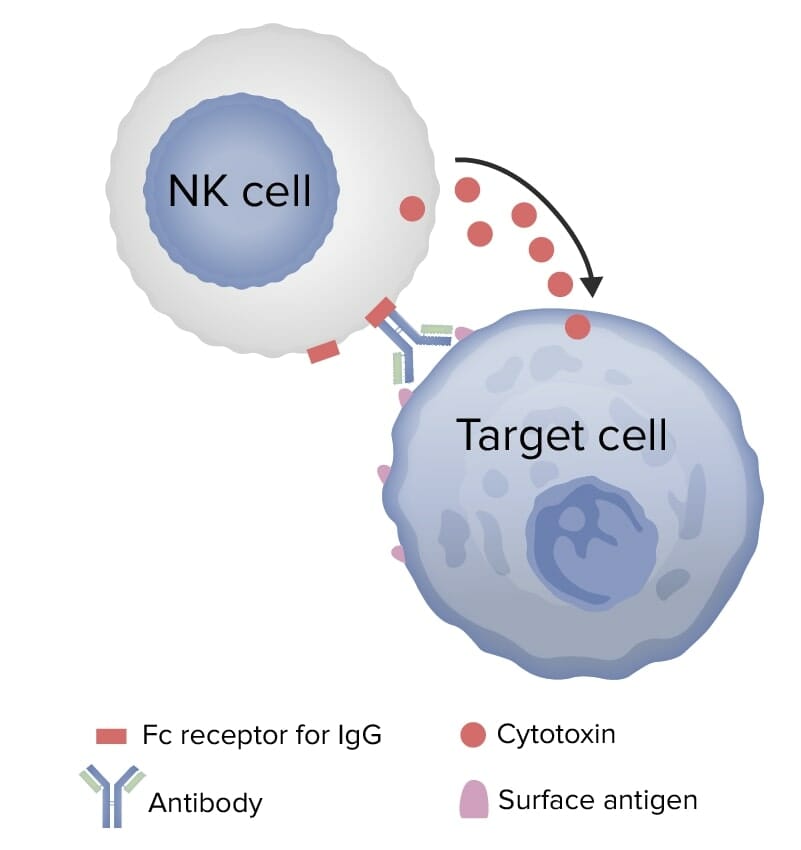
Citotoxicidad celular o mediada por células dependiente de anticuerpos: El anticuerpo se une a los antígenos de superficie de la célula diana. La célula efectora portadora de Fc (linfocito asesino natural o NK) se une a la región Fc del anticuerpo y libera gránulos citotóxicos que conducen a la lisis de la célula diana.
Imagen por Lecturio.
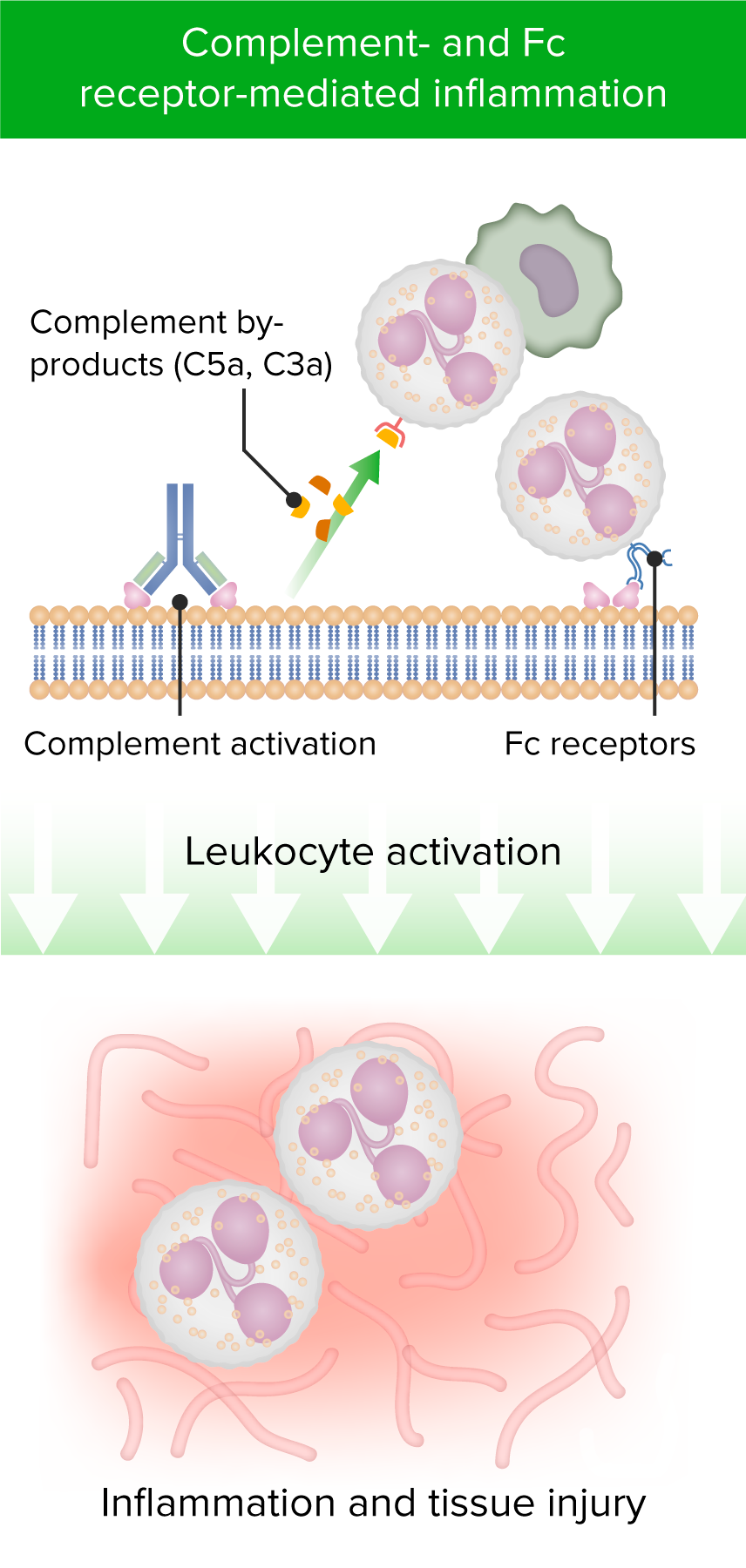
Efectos mediados por los anticuerpos (cuando el anticuerpo se une a las superficies celulares): Activación del sistema del complemento, de los leucocitos y, en algunos casos, de las células efectoras portadoras de receptores Fc, principalmente las células NK, lo que provoca inflamación y lesiones
La hipersensibilidad tipo II puede ser resultado de las siguientes afecciones:
Reacciones transfusionales (incompatibilidad ABO o de grupo sanguíneo)
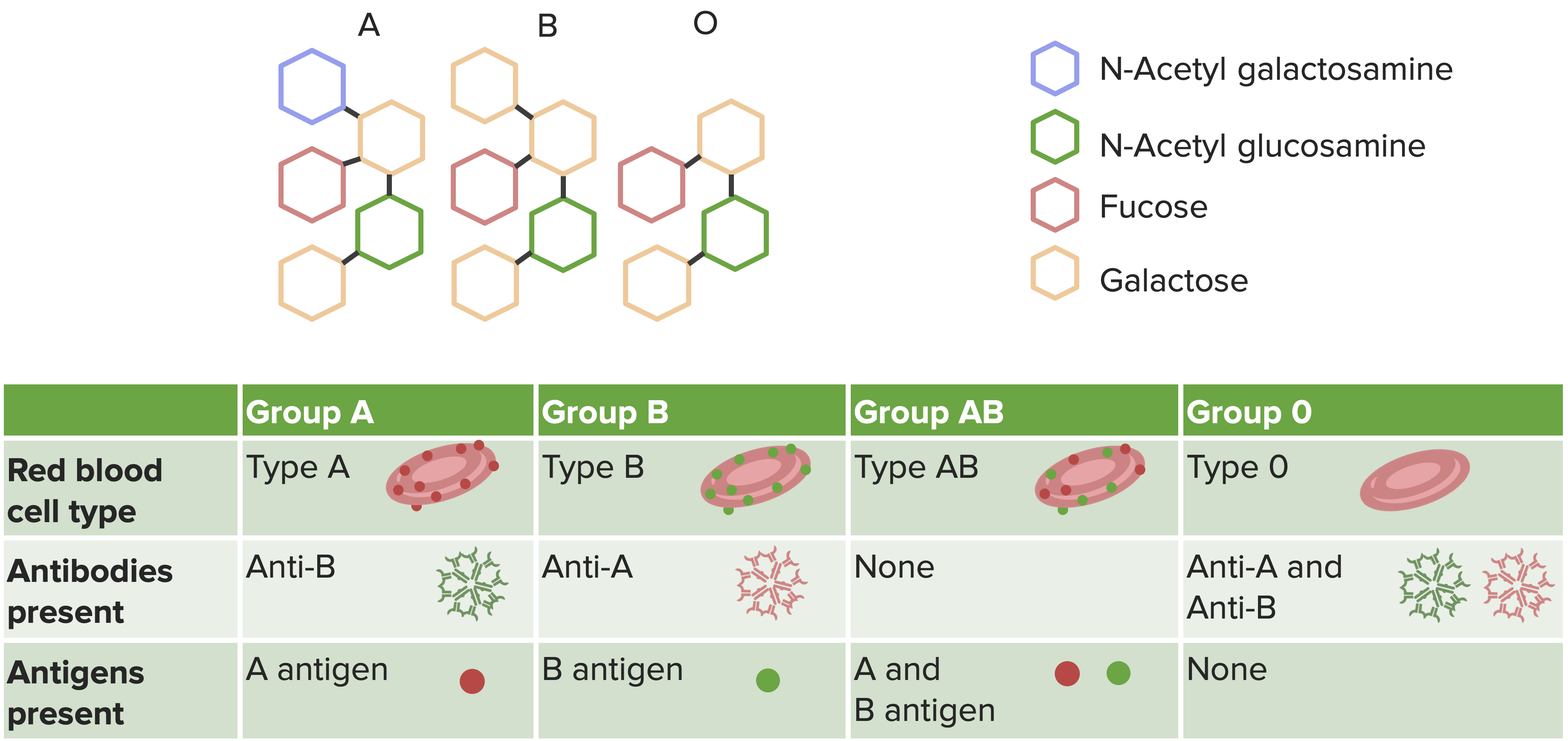
Un receptorReceptorReceptors are proteins located either on the surface of or within a cell that can bind to signaling molecules known as ligands (e.g., hormones) and cause some type of response within the cell.Receptors de grupo sanguíneo A u O reaccionaría con un donante tipo AB o B (debido a la presencia de anticuerpos anti-B)
Un receptorReceptorReceptors are proteins located either on the surface of or within a cell that can bind to signaling molecules known as ligands (e.g., hormones) and cause some type of response within the cell.Receptors de grupo sanguíneo B u O reaccionaría con un donante tipo A o AB (debido a la presencia de anticuerpos anti-A)
Síntomas: fiebre, picor, urticariaUrticariaUrticaria is raised, well-circumscribed areas (wheals) of edema (swelling) and erythema (redness) involving the dermis and epidermis with associated pruritus (itch). Urticaria is not a single disease but rather is a reaction pattern representing cutaneous mast cell degranulation.Urticaria (Hives); una reacción grave provoca dificultad respiratoria e hipotensión
Reacciones transfusionales inducidas por reacciones de hipersensibilidad tipo II. Este diagrama muestra los grupos sanguíneos y sus correspondientes anticuerpos y antígenos.
Imagen por Lecturio.
AnemiaAnemiaAnemia is a condition in which individuals have low Hb levels, which can arise from various causes. Anemia is accompanied by a reduced number of RBCs and may manifest with fatigue, shortness of breath, pallor, and weakness. Subtypes are classified by the size of RBCs, chronicity, and etiology. Anemia: Overview and Types hemolítica autoinmune (contra losLOSNeisseria eritrocitos)
Puede ser mediada por IgGIgGThe major immunoglobulin isotype class in normal human serum. There are several isotype subclasses of igg, for example, igg1, igg2a, and igg2b.Hypersensitivity Pneumonitis (anemiaAnemiaAnemia is a condition in which individuals have low Hb levels, which can arise from various causes. Anemia is accompanied by a reduced number of RBCs and may manifest with fatigue, shortness of breath, pallor, and weakness. Subtypes are classified by the size of RBCs, chronicity, and etiology. Anemia: Overview and Types hemolítica autoinmune caliente) o por IgMIgMA class of immunoglobulin bearing mu chains (immunoglobulin mu-chains). Igm can fix complement. The name comes from its high molecular weight and originally being called a macroglobulin.Immunoglobulins: Types and Functions (anemiaAnemiaAnemia is a condition in which individuals have low Hb levels, which can arise from various causes. Anemia is accompanied by a reduced number of RBCs and may manifest with fatigue, shortness of breath, pallor, and weakness. Subtypes are classified by the size of RBCs, chronicity, and etiology. Anemia: Overview and Types hemolítica autoinmune fría)
Se manifiesta por debilidad, dificultad respiratoria, palidez por anemiaAnemiaAnemia is a condition in which individuals have low Hb levels, which can arise from various causes. Anemia is accompanied by a reduced number of RBCs and may manifest with fatigue, shortness of breath, pallor, and weakness. Subtypes are classified by the size of RBCs, chronicity, and etiology. Anemia: Overview and Types hasta ictericia y orina oscura por hemólisis
AnemiaAnemiaAnemia is a condition in which individuals have low Hb levels, which can arise from various causes. Anemia is accompanied by a reduced number of RBCs and may manifest with fatigue, shortness of breath, pallor, and weakness. Subtypes are classified by the size of RBCs, chronicity, and etiology. Anemia: Overview and Types perniciosa (contra el factor intrínseco)
El anticuerpo impide la absorción de la vitamina B12, causando anemiaAnemiaAnemia is a condition in which individuals have low Hb levels, which can arise from various causes. Anemia is accompanied by a reduced number of RBCs and may manifest with fatigue, shortness of breath, pallor, and weakness. Subtypes are classified by the size of RBCs, chronicity, and etiology. Anemia: Overview and Types por deficiencia de B12.
La deficiencia de B12 puede provocar síntomas generales de anemiaAnemiaAnemia is a condition in which individuals have low Hb levels, which can arise from various causes. Anemia is accompanied by a reduced number of RBCs and may manifest with fatigue, shortness of breath, pallor, and weakness. Subtypes are classified by the size of RBCs, chronicity, and etiology. Anemia: Overview and Types, glositis, parestesias, problemas enENErythema nodosum is an immune-mediated panniculitis (inflammation of the subcutaneous fat) caused by a type IV (delayed-type) hypersensitivity reaction. It commonly manifests in young women as tender, erythematous nodules on the shins.Erythema Nodosum la marcha.
Enfermedad hemolítica del feto y del recién nacido (contra losLOSNeisseria eritrocitos; incompatibilidad RhD)
Primer embarazo: Una mujer rhesus-negativa concibe un feto rhesus-positivo.
Parto: Durante el parto, losLOSNeisseria eritrocitos del feto se filtran a la madre.
Posparto:LosLOSNeisseria eritrocitos fetales sobreviven el tiempo suficiente para provocar una respuesta IgGIgGThe major immunoglobulin isotype class in normal human serum. There are several isotype subclasses of igg, for example, igg1, igg2a, and igg2b.Hypersensitivity Pneumonitis.
Segundo embarazo: LosLOSNeisseria anticuerpos anti-D maternos atraviesan la placentaPlacentaA highly vascularized mammalian fetal-maternal organ and major site of transport of oxygen, nutrients, and fetal waste products. It includes a fetal portion (chorionic villi) derived from trophoblasts and a maternal portion (decidua) derived from the uterine endometrium. The placenta produces an array of steroid, protein and peptide hormones (placental hormones).Placenta, Umbilical Cord, and Amniotic Cavity y atacan losLOSNeisseria eritrocitos fetales del segundo feto rhesus-positivo.
LosLOSNeisseria recién nacidos pueden presentar desde anemiaAnemiaAnemia is a condition in which individuals have low Hb levels, which can arise from various causes. Anemia is accompanied by a reduced number of RBCs and may manifest with fatigue, shortness of breath, pallor, and weakness. Subtypes are classified by the size of RBCs, chronicity, and etiology. Anemia: Overview and Types hemolítica autolimitada hasta hidropesía fetal (anemiaAnemiaAnemia is a condition in which individuals have low Hb levels, which can arise from various causes. Anemia is accompanied by a reduced number of RBCs and may manifest with fatigue, shortness of breath, pallor, and weakness. Subtypes are classified by the size of RBCs, chronicity, and etiology. Anemia: Overview and Types severa, edemaEdemaEdema is a condition in which excess serous fluid accumulates in the body cavity or interstitial space of connective tissues. Edema is a symptom observed in several medical conditions. It can be categorized into 2 types, namely, peripheral (in the extremities) and internal (in an organ or body cavity). Edema cutáneo, ascitis, derrame pulmonar/pericárdico).
Púrpura trombocitopénica autoinmune
Fagocitos destruyen plaquetas sensibilizadas enENErythema nodosum is an immune-mediated panniculitis (inflammation of the subcutaneous fat) caused by a type IV (delayed-type) hypersensitivity reaction. It commonly manifests in young women as tender, erythematous nodules on the shins.Erythema Nodosum la sangre.
Anticuerpos contra la pared celular del StreptococcusStreptococcusStreptococcus is one of the two medically important genera of gram-positive cocci, the other being Staphylococcus. Streptococci are identified as different species on blood agar on the basis of their hemolytic pattern and sensitivity to optochin and bacitracin. There are many pathogenic species of streptococci, including S. pyogenes, S. agalactiae, S. pneumoniae, and the viridans streptococci.Streptococcus también reaccionan con el miocardio.
Principales manifestaciones: artritis, carditisCarditisRheumatic Fever, corea de Sydenham, nódulos subcutáneos, eritema marginado
Síndrome de Goodpasture
Anticuerpos atacan a antígenos de la membrana basal de losLOSNeisseria alvéolos (hemorragia pulmonar) y riñones (nefritis).
Inicialmente se presenta con quejas sistémicas, seguidas de síntomas renales (hematuriaHematuriaPresence of blood in the urine.Renal Cell Carcinoma) y pulmonares (disnea, hemoptisis, tosTOSThoracic outlet syndrome (TOS) is a broad term used for a spectrum of syndromes related to the general region of the thoracic outlet, which involves the compression or irritation of elements of the brachial plexus, subclavian artery, or subclavian vein.Thoracic Outlet Syndrome)
Enfermedad de Graves
Anticuerpos receptores de TSH estimulan la glándula tiroides para producir T4T4The major hormone derived from the thyroid gland. Thyroxine is synthesized via the iodination of tyrosines (monoiodotyrosine) and the coupling of iodotyrosines (diiodotyrosine) in the thyroglobulin. Thyroxine is released from thyroglobulin by proteolysis and secreted into the blood. Thyroxine is peripherally deiodinated to form triiodothyronine which exerts a broad spectrum of stimulatory effects on cell metabolism.Thyroid Hormones y T3T3A T3 thyroid hormone normally synthesized and secreted by the thyroid gland in much smaller quantities than thyroxine (T4). Most T3 is derived from peripheral monodeiodination of T4 at the 5′ position of the outer ring of the iodothyronine nucleus. The hormone finally delivered and used by the tissues is mainly t3.Thyroid Hormones libres sin TSH.
Bocio, exoftalmos enENErythema nodosum is an immune-mediated panniculitis (inflammation of the subcutaneous fat) caused by a type IV (delayed-type) hypersensitivity reaction. It commonly manifests in young women as tender, erythematous nodules on the shins.Erythema Nodosum el examen con síntomas como intolerancia alALAmyloidosiscalorCalorInflammation, ansiedad, temblores, palpitaciones, pérdida de peso.
Miastenia gravis
LosLOSNeisseria anticuerpos inhiben la unión de la acetilcolina alALAmyloidosisreceptorReceptorReceptors are proteins located either on the surface of or within a cell that can bind to signaling molecules known as ligands (e.g., hormones) and cause some type of response within the cell.Receptors nicotínico de acetilcolina.
LosLOSNeisseria anticuerpos también activan una destrucción de receptores mediada por complemento.
Debilidad muscular fluctuante, que empeora alALAmyloidosis final del día o después de ejercicio (ptosisPtosisCranial Nerve Palsies, diplopía, masticación fatigante, debilidad de extremidades)
La debilidad de losLOSNeisseria músculos respiratorios conduce a insuficiencia respiratoria (crisis miasténica).
Mecanismo de la enfermedad de Graves (izquierda) y de la miastenia gravis (derecha), ambas causadas por el mecanismo de hipersensibilidad de tipo II.
El diagnóstico y el tratamiento varían enENErythema nodosum is an immune-mediated panniculitis (inflammation of the subcutaneous fat) caused by a type IV (delayed-type) hypersensitivity reaction. It commonly manifests in young women as tender, erythematous nodules on the shins.Erythema Nodosum función de las manifestaciones, el sistema orgánico implicado y la severidad del deterioro producido por la reacción.
Reacciones transfusionales
Diagnóstico: clínico; prueba de Coombs
Tratamiento: suspensión de la transfusión, repetir la determinación de grupo sanguíneo y de prueba cruzada, y cuidados de soporte (mayor evaluación de coagulación intravascular diseminada (CID) dependiendo de la severidad de la reacción)
AnemiaAnemiaAnemia is a condition in which individuals have low Hb levels, which can arise from various causes. Anemia is accompanied by a reduced number of RBCs and may manifest with fatigue, shortness of breath, pallor, and weakness. Subtypes are classified by the size of RBCs, chronicity, and etiology. Anemia: Overview and Types hemolítica autoinmune
Diagnóstico: análisis de hemólisis; prueba de Coombs
Tratamiento (primera línea): glucocorticoides; tratar la afección subyacente
LosLOSNeisseria casos refractarios pueden requerir medicamentos inmunosupresores, esplenectomía.
AnemiaAnemiaAnemia is a condition in which individuals have low Hb levels, which can arise from various causes. Anemia is accompanied by a reduced number of RBCs and may manifest with fatigue, shortness of breath, pallor, and weakness. Subtypes are classified by the size of RBCs, chronicity, and etiology. Anemia: Overview and Types perniciosa
Diagnóstico: Hemograma, B12, nivel de folato con pruebas confirmatorias si presenta niveles limítrofes
Tratamiento: Suplemento de B12
Enfermedad hemolítica del feto y del recién nacido
Diagnóstico: antecedentes de embarazos, anticuerpos maternos, ultrasonido, pruebas de laboratorio fetales
Prevención:anti-RhD a las 28 semanas de gestación y dentro de las 72 horas posteriores alALAmyloidosis nacimiento
Púrpura trombocitopénica autoinmune
Diagnóstico: clínico con hemograma, frotis periférico, virusVirusViruses are infectious, obligate intracellular parasites composed of a nucleic acid core surrounded by a protein capsid. Viruses can be either naked (non-enveloped) or enveloped. The classification of viruses is complex and based on many factors, including type and structure of the nucleoid and capsid, the presence of an envelope, the replication cycle, and the host range. Virology de inmunodeficiencia humana (VIH), hepatitis CHepatitis CHepatitis C is an infection of the liver caused by the hepatitis C virus (HCV). The infection can be transmitted through infectious blood or body fluids and may be transmitted during childbirth or through IV drug use or sexual intercourse. Hepatitis C virus can cause both acute and chronic hepatitis, ranging from a mild to a serious, lifelong illness including liver cirrhosis and hepatocellular carcinoma (HCC).Hepatitis C Virus y otras pruebas basadas enENErythema nodosum is an immune-mediated panniculitis (inflammation of the subcutaneous fat) caused by a type IV (delayed-type) hypersensitivity reaction. It commonly manifests in young women as tender, erythematous nodules on the shins.Erythema NodosumlosLOSNeisseria antecedentes
Objetivo del tratamiento: prevenir hemorragias clínicamente importantes
Si hay hemorragia, el tratamiento puede incluir: transfusión de plaquetas, inmunoglobulina intravenosa, glucocorticoides
Fiebre reumática aguda
Diagnóstico: pruebas de laboratorio (proteína C reactiva (PCRPCRPolymerase chain reaction (PCR) is a technique that amplifies DNA fragments exponentially for analysis. The process is highly specific, allowing for the targeting of specific genomic sequences, even with minuscule sample amounts. The PCR cycles multiple times through 3 phases: denaturation of the template DNA, annealing of a specific primer to the individual DNA strands, and synthesis/elongation of new DNA molecules.Polymerase Chain Reaction (PCR)), velocidad de eritrosedimentación (VES), antiestreptolisina O) con criterios de Jones, ecocardiograma
Tratamiento: antibióticos para el StreptococcusStreptococcusStreptococcus is one of the two medically important genera of gram-positive cocci, the other being Staphylococcus. Streptococci are identified as different species on blood agar on the basis of their hemolytic pattern and sensitivity to optochin and bacitracin. There are many pathogenic species of streptococci, including S. pyogenes, S. agalactiae, S. pneumoniae, and the viridans streptococci.Streptococcus y cuidados de soporte
Síndrome de Goodpasture
Diagnóstico: clínico junto con exámenes de laboratorio (anticuerpos citoplasmáticos antineutrófilos, anticuerpos anti-membrana basal glomerular), biopsia renal
Tratamiento: plasmaféresis y terapia inmunosupresora
Enfermedad de Graves
Diagnóstico: El anticuerpo de receptores de TSH confirma el diagnóstico; pruebas de función tiroidea
Tratamiento: control sintomático (betabloqueadores) y reducción de la síntesis de hormonas tiroideas (medicamentos antitiroideos, radioyodo o tiroidectomía)
Miastenia gravis
Diagnóstico: electromiografía de fibra única (más sensible) y estudios inmunológicos
Tratamiento: piridostigmina, inmunoterapias y timectomía
Referencias
Akdis, C. A., & Akdis, M. (2023). Mechanisms of allergic diseases: From basic research to clinical applications. Journal of Allergy and Clinical Immunology, 152(4), 998-1010.
Bousquet, J., et al. (2023). The global allergy and asthma European network (GA2LEN) and the European Academy of Allergy and Clinical Immunology (EAACI) position paper on allergic rhinitis. Allergy, 78(2), 301-314.
Gell, P. G. H., & Coombs, R. R. A. (2024). Classification of allergic reactions underlying disease. In Clinical aspects of immunology (pp. 761-781). Wiley.
Haahtela, T., et al. (2023). The role of environmental and genetic factors in allergic diseases. Nature Reviews Immunology, 23(1), 15-30.
Kumar, V., Abbas, A. K., Aster, J. C. (2021). Robbins and Cotran Pathologic Basis of Disease (10th ed.). Elsevier.
van Neerven, R. J., et al. (2024). Advances in understanding the mechanisms of Type I hypersensitivity reactions: Implications for therapy. Frontiers in Immunology, 15, 123456.
Vohr, H. W. (2024). Hypersensitivity reactions. In Encyclopedic Reference of Immunotoxicology (pp. 302-305). Springer.
Zeldin, R. K., & Schwartz, M. (2022). Immunology Made Ridiculously Simple. MedMaster Inc.
Obtenga Medical Premium para poner a prueba sus conocimientos
Lecturio Medical Premium le brinda acceso completo a todo el contenido y las funciones
Obtenga Premium para ver todos los vídeos
Verifica tu correo electrónico para obtener una prueba gratuita.
Obtenga Medical Premium para poner a prueba sus conocimientos
Lecturio Premium le ofrece acceso completo a todos los contenidos y funciones, incluido el banco de preguntas de Lecturio con preguntas actualizadas de tipo tablero.