Domina Conceptos Médicos

Estudia para la escuela de medicina y tus examenes con Lecturio.

Quemaduras

Una quemadura es un tipo de lesión en la piel y tejidos más profundos causada por exposición a calor, electricidad, productos químicos, fricción o a la radiación. Las quemaduras se clasifican según su profundidad en superficiales, de espesor parcial (superficiales o profundas) y de espesor total (términos que han sustituido en gran medida a los "grados" numéricos, aunque el término "cuarto grado" se utiliza de forma variable Variable Variables represent information about something that can change. The design of the measurement scales, or of the methods for obtaining information, will determine the data gathered and the characteristics of that data. As a result, a variable can be qualitative or quantitative, and may be further classified into subgroups. Types of Variables para indicar quemaduras de espesor total con afectación de estructuras más profundas). El tratamiento depende en EN Erythema nodosum is an immune-mediated panniculitis (inflammation of the subcutaneous fat) caused by a type IV (delayed-type) hypersensitivity reaction. It commonly manifests in young women as tender, erythematous nodules on the shins. Erythema Nodosum gran medida de la extensión de la superficie afectada y de la profundidad de las quemaduras. El tratamiento incluye la reanimación con líquidos, la analgesia Analgesia Methods of pain relief that may be used with or in place of analgesics. Anesthesiology: History and Basic Concepts adecuada y el cuidado apropiado de las heridas con el objetivo de prevenir las infecciones oportunistas.

Last updated: Dec 15, 2025

Editorial responsibility: Stanley Oiseth, Lindsay Jones, Evelin Maza

Descripción General

Definición

Las quemaduras son lesiones traumáticas agudas de la piel o del tejido subyacente causadas por la exposición a energía térmica, productos químicos, descargas eléctricas o radiación.

Epidemiología

  • La incidencia de las lesiones relacionadas con incendios a nivel mundial es de 1,1 por cada 100 000:
    • 85 000 visitas a la sala de emergencias/año en EN Erythema nodosum is an immune-mediated panniculitis (inflammation of the subcutaneous fat) caused by a type IV (delayed-type) hypersensitivity reaction. It commonly manifests in young women as tender, erythematous nodules on the shins. Erythema Nodosum Estados Unidos
    • La mayoría son menores, solo en EN Erythema nodosum is an immune-mediated panniculitis (inflammation of the subcutaneous fat) caused by a type IV (delayed-type) hypersensitivity reaction. It commonly manifests in young women as tender, erythematous nodules on the shins. Erythema Nodosum el 2% se afecta más del 40% de la superficie corporal total (SCT).
  • Causa 34 000 muertes/año:
    • La mortalidad está directamente correlacionada con el % de superficie quemada
    • ½ de los LOS Neisseria pacientes con quemaduras del 60%–70% de la superficie corporal mueren.
  • Diferente etiología en EN Erythema nodosum is an immune-mediated panniculitis (inflammation of the subcutaneous fat) caused by a type IV (delayed-type) hypersensitivity reaction. It commonly manifests in young women as tender, erythematous nodules on the shins. Erythema Nodosum función de la edad:
    • La escaldadura con líquidos calientes es más frecuente en EN Erythema nodosum is an immune-mediated panniculitis (inflammation of the subcutaneous fat) caused by a type IV (delayed-type) hypersensitivity reaction. It commonly manifests in young women as tender, erythematous nodules on the shins. Erythema Nodosum los LOS Neisseria niños
    • Las quemaduras por llamas son más frecuentes en EN Erythema nodosum is an immune-mediated panniculitis (inflammation of the subcutaneous fat) caused by a type IV (delayed-type) hypersensitivity reaction. It commonly manifests in young women as tender, erythematous nodules on the shins. Erythema Nodosum los LOS Neisseria adultos

Etiología

Clasificación

Las quemaduras se describen utilizando dos identificadores: grado y severidad:

  1. Grado: profundidad de la quemadura en EN Erythema nodosum is an immune-mediated panniculitis (inflammation of the subcutaneous fat) caused by a type IV (delayed-type) hypersensitivity reaction. It commonly manifests in young women as tender, erythematous nodules on the shins. Erythema Nodosum el cuerpo
  2. Gravedad: % de la SCT quemada

Grados de quemaduras térmicas

Tabla: Grados de quemaduras térmicas
Grado de quemadura Características Síntomas Cicatrización
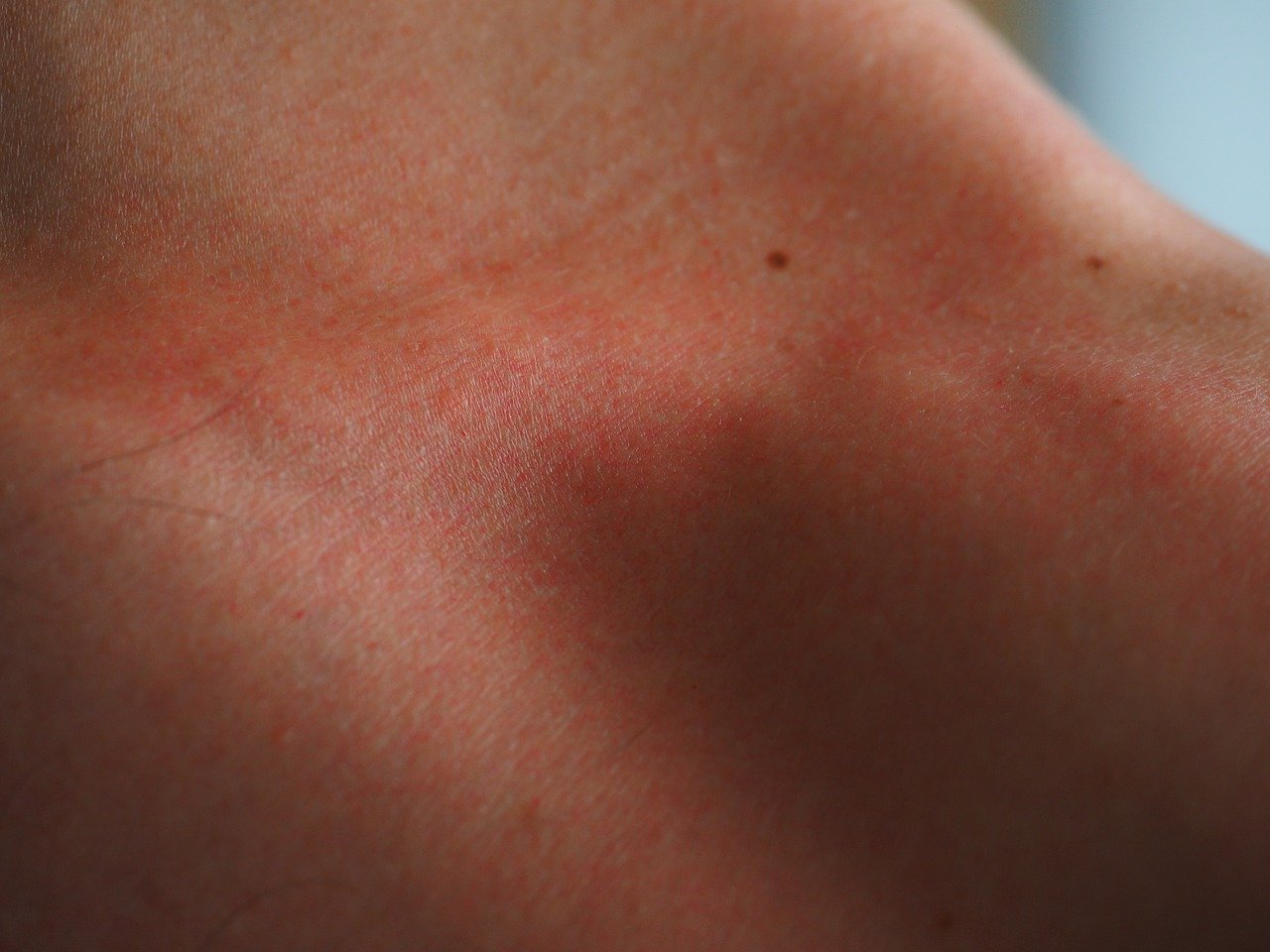
Quemadura superficial (1er grado)
  • Limitada a la epidermis Epidermis The external, nonvascular layer of the skin. It is made up, from within outward, of five layers of epithelium: (1) basal layer (stratum basale epidermidis); (2) spinous layer (stratum spinosum epidermidis); (3) granular layer (stratum granulosum epidermidis); (4) clear layer (stratum lucidum epidermidis); and (5) horny layer (stratum corneum epidermidis). Skin: Structure and Functions
  • No hay destrucción de la piel
  • Hiperemia (rojo), blanquea con la presión
  • Edema Edema Edema is a condition in which excess serous fluid accumulates in the body cavity or interstitial space of connective tissues. Edema is a symptom observed in several medical conditions. It can be categorized into 2 types, namely, peripheral (in the extremities) and internal (in an organ or body cavity). Edema
Prurito a dolor Dolor Inflammation
  • Sin cicatrices
  • Recuperación espontánea
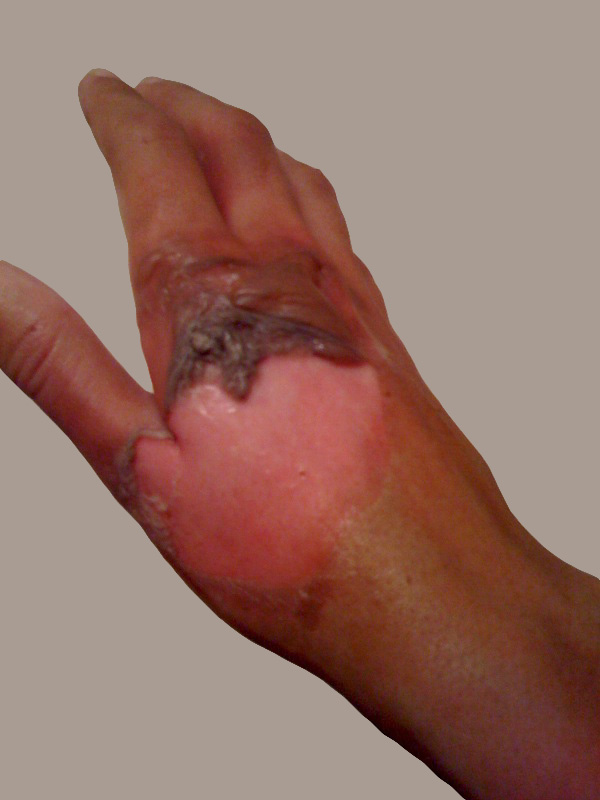
Quemaduras parciales superficiales (2do grado)
  • Limitada a la epidermis Epidermis The external, nonvascular layer of the skin. It is made up, from within outward, of five layers of epithelium: (1) basal layer (stratum basale epidermidis); (2) spinous layer (stratum spinosum epidermidis); (3) granular layer (stratum granulosum epidermidis); (4) clear layer (stratum lucidum epidermidis); and (5) horny layer (stratum corneum epidermidis). Skin: Structure and Functions
  • Hiperemia
  • Lecho de la herida húmedo
  • Sensibilidad intacta
  • Ampollas
Dolor Dolor Inflammation severo
  • Generalmente sin cicatrices
  • Recuperación espontánea
Quemaduras superficiales profundas (2do grado)
  • Daño a la epidermis Epidermis The external, nonvascular layer of the skin. It is made up, from within outward, of five layers of epithelium: (1) basal layer (stratum basale epidermidis); (2) spinous layer (stratum spinosum epidermidis); (3) granular layer (stratum granulosum epidermidis); (4) clear layer (stratum lucidum epidermidis); and (5) horny layer (stratum corneum epidermidis). Skin: Structure and Functions y dermis Dermis A layer of vascularized connective tissue underneath the epidermis. The surface of the dermis contains innervated papillae. Embedded in or beneath the dermis are sweat glands; hair follicles; and sebaceous glands. Skin: Structure and Functions
  • Lecho de la herida seco
  • Zonas brillantes y enrojecidas
Dolor Dolor Inflammation severo Recuperación parcial con formación de cicatrices
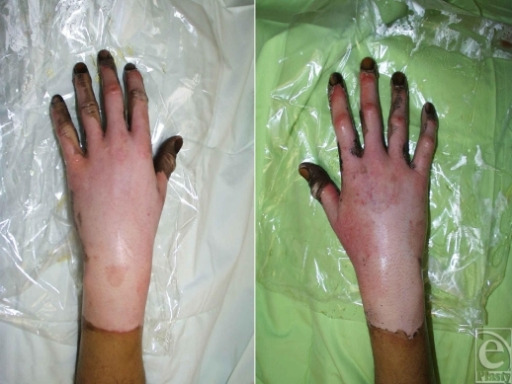
Quemaduras de espesor total (3er grado)
  • Daños en EN Erythema nodosum is an immune-mediated panniculitis (inflammation of the subcutaneous fat) caused by a type IV (delayed-type) hypersensitivity reaction. It commonly manifests in young women as tender, erythematous nodules on the shins. Erythema Nodosum todas las capas de la piel, incluida la fascia Fascia Layers of connective tissue of variable thickness. The superficial fascia is found immediately below the skin; the deep fascia invests muscles, nerves, and other organs. Cellulitis superficial
  • Coloración gris-blanca de la piel
  • Sin ampollas
Indolora porque las terminaciones nerviosas han sido destruidas
  • Regeneración de la piel ya no es posible
  • Necesidad de escisión e injerto
Quemaduras de espesor total/escaras (4to grado)
  • Afecta a músculos, tendones o huesos
  • Aspecto de cuero
  • Carbonización de los LOS Neisseria tejidos
Sin dolor Dolor Inflammation
  • La regeneración de la piel ya no es posible
  • Necesidad de escisión e injerto

Gravedad de las quemaduras

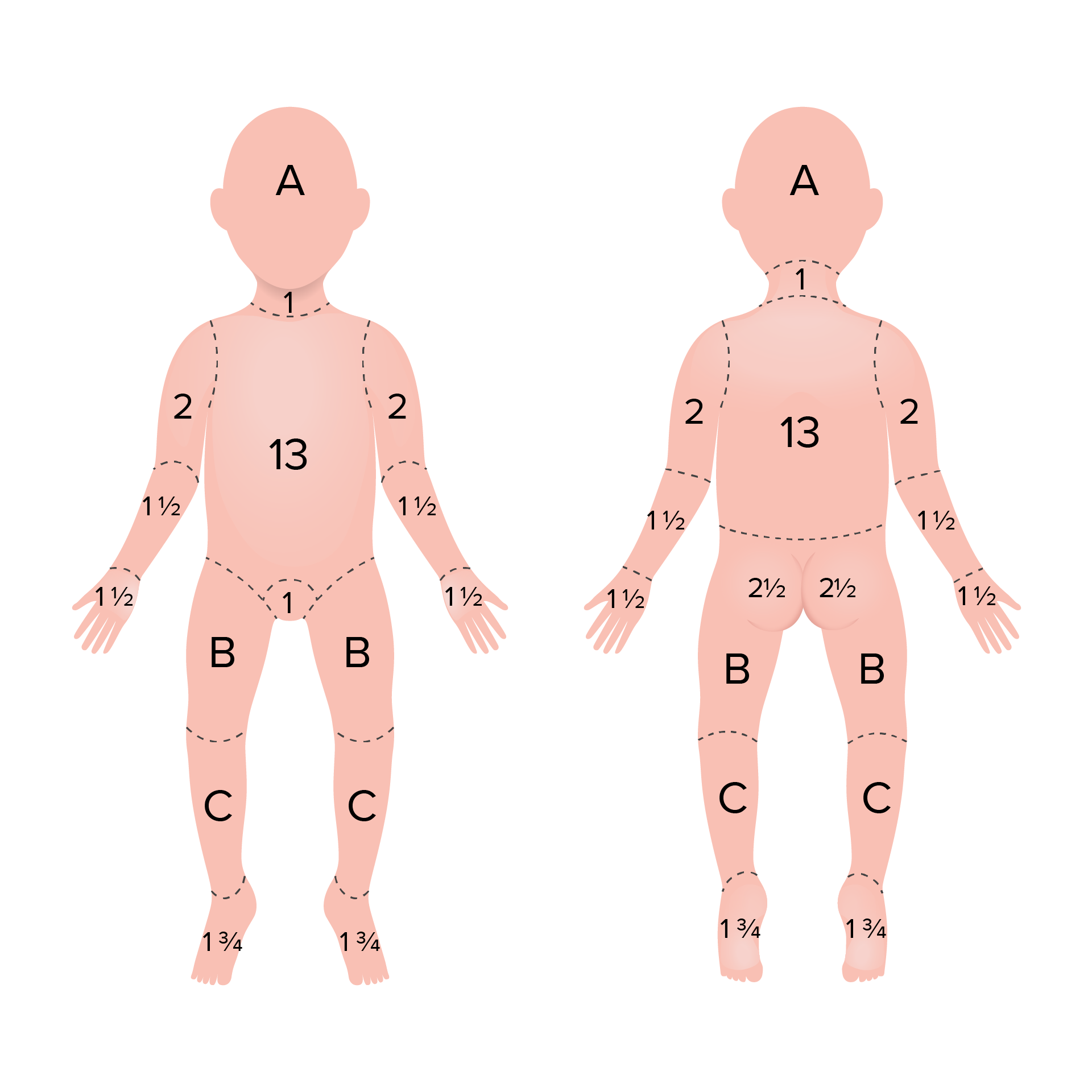
Para determinar la gravedad de la quemadura, calcule el porcentaje de SCT lesionada:
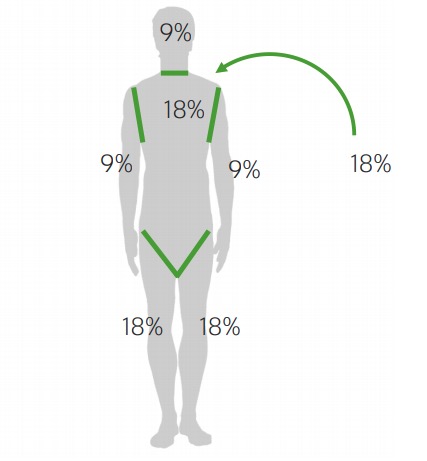
  • La palma de un paciente (incluidos los LOS Neisseria dedos) representa aproximadamente el 1 % de la SCT.
  • Utilizar la regla de los LOS Neisseria 9 en EN Erythema nodosum is an immune-mediated panniculitis (inflammation of the subcutaneous fat) caused by a type IV (delayed-type) hypersensitivity reaction. It commonly manifests in young women as tender, erythematous nodules on the shins. Erythema Nodosum adolescentes y adultos.
  • Para niños, utilice una tabla ajustada por edad (p. ej., Lund y Browder).
Tabla: Clasificación de la severidad de las quemaduras en EN Erythema nodosum is an immune-mediated panniculitis (inflammation of the subcutaneous fat) caused by a type IV (delayed-type) hypersensitivity reaction. It commonly manifests in young women as tender, erythematous nodules on the shins. Erythema Nodosum leves, moderadas y graves
Leve Moderado Severo
Niños < 5% SCT 5%–10% SCT > 10% SCT
Adulto < 10% SCT 10%–20% SCT > 20% SCT
Ancianos < 5% SCT 5%–10% SCT > 10% SCT
Completo < 2% espesor completo 2%–5% espesor completo, alto voltaje, inhalación, circunferencial, comorbilidad > 5% espesor completo, alto voltaje, inhalación, circunferencial, comorbilidad
Disposición Ambulatorio Admisión Unidad de quemados

Quemaduras Térmicas

Fisiopatología

Las quemaduras se producen por el contacto directo con:

  • Llamas
  • Objetos calientes
  • Vapor
  • Agua caliente

La piel tiene una baja conductividad térmica, por lo que la mayoría de las quemaduras térmicas sólo afectan a la epidermis Epidermis The external, nonvascular layer of the skin. It is made up, from within outward, of five layers of epithelium: (1) basal layer (stratum basale epidermidis); (2) spinous layer (stratum spinosum epidermidis); (3) granular layer (stratum granulosum epidermidis); (4) clear layer (stratum lucidum epidermidis); and (5) horny layer (stratum corneum epidermidis). Skin: Structure and Functions.

Las áreas lesionadas pueden subdividirse en EN Erythema nodosum is an immune-mediated panniculitis (inflammation of the subcutaneous fat) caused by a type IV (delayed-type) hypersensitivity reaction. It commonly manifests in young women as tender, erythematous nodules on the shins. Erythema Nodosum 3 zonas, como una diana:

  1. Zona de coagulación y necrosis Necrosis The death of cells in an organ or tissue due to disease, injury or failure of the blood supply. Ischemic Cell Damage:
    • Zona interior
    • Muerte y daño celular irreversible
  2. Zona de isquemia:
    • Disminución de la circulación
    • El tejido puede evolucionar hacia la necrosis Necrosis The death of cells in an organ or tissue due to disease, injury or failure of the blood supply. Ischemic Cell Damage.
  3. Zona de hiperemia:
    • Vasodilatación
    • Suele sanar sin complicaciones a largo plazo

Tratamiento

  • Evaluación de la vía aérea, la respiración y la circulación (ABC, por sus siglas en EN Erythema nodosum is an immune-mediated panniculitis (inflammation of the subcutaneous fat) caused by a type IV (delayed-type) hypersensitivity reaction. It commonly manifests in young women as tender, erythematous nodules on the shins. Erythema Nodosum inglés)
  • Administrar oxígeno de alto flujo a través de una máscara de no reinhalación y mantener la saturación > 92%.
  • Considerar la intubación endotraqueal temprana ante evidencia de compromiso de la vía aérea o pulmonar debido al AL Amyloidosis fuego:
    • Signos de lesión por inhalación:
      • Hollín alrededor de la boca
      • Estridor (sonido inspiratorio agudo porque el aire es forzado a través de una abertura muy estrecha)
      • Quemaduras en EN Erythema nodosum is an immune-mediated panniculitis (inflammation of the subcutaneous fat) caused by a type IV (delayed-type) hypersensitivity reaction. It commonly manifests in young women as tender, erythematous nodules on the shins. Erythema Nodosum la cara (pérdida de las cejas, inflamación orofaríngea, ampollas o depósitos de carbón, esputo carbonoso)
      • Nivel de carboxihemoglobina > 10%.
      • Vello nasal chamuscado
    • Hipoxemia a pesar de O2 al AL Amyloidosis 100%
    • Dificultad/insuficiencia respiratoria
    • Disminución en EN Erythema nodosum is an immune-mediated panniculitis (inflammation of the subcutaneous fat) caused by a type IV (delayed-type) hypersensitivity reaction. It commonly manifests in young women as tender, erythematous nodules on the shins. Erythema Nodosum la escala de coma Coma Coma is defined as a deep state of unarousable unresponsiveness, characterized by a score of 3 points on the GCS. A comatose state can be caused by a multitude of conditions, making the precise epidemiology and prognosis of coma difficult to determine. Coma de Glasgow ( GCS GCS A scale that assesses the response to stimuli in patients with craniocerebral injuries. The parameters are eye opening, motor response, and verbal response. Coma, por sus siglas en EN Erythema nodosum is an immune-mediated panniculitis (inflammation of the subcutaneous fat) caused by a type IV (delayed-type) hypersensitivity reaction. It commonly manifests in young women as tender, erythematous nodules on the shins. Erythema Nodosum inglés)
  • Reanimación con líquidos:
    • La prevención de la hipovolemia y la hipoperfusión tisular es el objetivo principal.
    • Establezca siempre dos vías intravenosas de gran calibre.
    • Utilice Ringer lactato y la fórmula de Parkland para quemaduras de espesor parcial y total (normalmente ≥ 20 % de SCT en EN Erythema nodosum is an immune-mediated panniculitis (inflammation of the subcutaneous fat) caused by a type IV (delayed-type) hypersensitivity reaction. It commonly manifests in young women as tender, erythematous nodules on the shins. Erythema Nodosum adultos): volumen = 4 ml × peso corporal (kg) × % de SCT:
      • Administrar la mitad en EN Erythema nodosum is an immune-mediated panniculitis (inflammation of the subcutaneous fat) caused by a type IV (delayed-type) hypersensitivity reaction. It commonly manifests in young women as tender, erythematous nodules on the shins. Erythema Nodosum las primeras 8 horas desde la quemadura y el resto durante las siguientes 16 horas.
      • Ejemplo: un hombre de 70 kg sufre quemaduras profundas de espesor parcial en EN Erythema nodosum is an immune-mediated panniculitis (inflammation of the subcutaneous fat) caused by a type IV (delayed-type) hypersensitivity reaction. It commonly manifests in young women as tender, erythematous nodules on the shins. Erythema Nodosum toda la pierna izquierda. Volumen IV = 4 mL x 70 kg x 18 SCT = 5.040 mL.
  • No se recomiendan los LOS Neisseria antibióticos profilácticos sistémicos en EN Erythema nodosum is an immune-mediated panniculitis (inflammation of the subcutaneous fat) caused by a type IV (delayed-type) hypersensitivity reaction. It commonly manifests in young women as tender, erythematous nodules on the shins. Erythema Nodosum las quemaduras agudas porque no reducen el riesgo de infección y se asocian con una mayor mortalidad.

Tratamiento de quemaduras superficiales

El tratamiento de las quemaduras superficiales consiste en EN Erythema nodosum is an immune-mediated panniculitis (inflammation of the subcutaneous fat) caused by a type IV (delayed-type) hypersensitivity reaction. It commonly manifests in young women as tender, erythematous nodules on the shins. Erythema Nodosum la administración de antiinflamatorios no esteroideos (AINE) y compresas frías para el dolor Dolor Inflammation.

Tratamiento de quemaduras de espesor parcial:

  • Limpiar y cubrir con apósitos
  • Antibióticos tópicos
  • Medicamentos para el dolor Dolor Inflammation (AINE, paracetamol paracetamol Acetaminophen is an over-the-counter nonopioid analgesic and antipyretic medication and the most commonly used analgesic worldwide. Despite the widespread use of acetaminophen, its mechanism of action is not entirely understood. Acetaminophen)

Manejo de quemaduras de espesor total:

  • Agentes antimicrobianos tópicos (antibióticos sistémicos solo en EN Erythema nodosum is an immune-mediated panniculitis (inflammation of the subcutaneous fat) caused by a type IV (delayed-type) hypersensitivity reaction. It commonly manifests in young women as tender, erythematous nodules on the shins. Erythema Nodosum caso de infección o sepsis Sepsis Systemic inflammatory response syndrome with a proven or suspected infectious etiology. When sepsis is associated with organ dysfunction distant from the site of infection, it is called severe sepsis. When sepsis is accompanied by hypotension despite adequate fluid infusion, it is called septic shock. Sepsis and Septic Shock)
  • Líquidos intravenosos agresivos
  • Los LOS Neisseria resultados son mejores en EN Erythema nodosum is an immune-mediated panniculitis (inflammation of the subcutaneous fat) caused by a type IV (delayed-type) hypersensitivity reaction. It commonly manifests in young women as tender, erythematous nodules on the shins. Erythema Nodosum los LOS Neisseria centros certificados en EN Erythema nodosum is an immune-mediated panniculitis (inflammation of the subcutaneous fat) caused by a type IV (delayed-type) hypersensitivity reaction. It commonly manifests in young women as tender, erythematous nodules on the shins. Erythema Nodosum quemaduras.
  • Normalmente se requiere escisión e injerto.

Posibles complicaciones

  • Intoxicación por monóxido de carbono:
    • Puede observarse en EN Erythema nodosum is an immune-mediated panniculitis (inflammation of the subcutaneous fat) caused by a type IV (delayed-type) hypersensitivity reaction. It commonly manifests in young women as tender, erythematous nodules on the shins. Erythema Nodosum pacientes que han estado en EN Erythema nodosum is an immune-mediated panniculitis (inflammation of the subcutaneous fat) caused by a type IV (delayed-type) hypersensitivity reaction. It commonly manifests in young women as tender, erythematous nodules on the shins. Erythema Nodosum incendios
    • Causa asfixia celular al AL Amyloidosis desplazar el O2 de la hemoglobina
    • Signos y síntomas:
      • Carboxihemoglobina elevada
      • La saturación de oxígeno no es fiable para descartar la toxicidad por CO, utilice un cooxímetro.
    • Tratamiento:
      • Tratamiento de 1ra línea: O2 al AL Amyloidosis 100% (mediante máscara o tubo endotraqueal)
      • Considerar el oxígeno hiperbárico si la carboxihemoglobina > 25%, cambios en EN Erythema nodosum is an immune-mediated panniculitis (inflammation of the subcutaneous fat) caused by a type IV (delayed-type) hypersensitivity reaction. It commonly manifests in young women as tender, erythematous nodules on the shins. Erythema Nodosum el sistema nervioso central (SNC) ( coma Coma Coma is defined as a deep state of unarousable unresponsiveness, characterized by a score of 3 points on the GCS. A comatose state can be caused by a multitude of conditions, making the precise epidemiology and prognosis of coma difficult to determine. Coma, alteración del estado mental, convulsiones), isquemia cardíaca, disritmia.
  • Envenenamiento por cianuro:
    • Complicación letal en EN Erythema nodosum is an immune-mediated panniculitis (inflammation of the subcutaneous fat) caused by a type IV (delayed-type) hypersensitivity reaction. It commonly manifests in young women as tender, erythematous nodules on the shins. Erythema Nodosum algunos incendios en EN Erythema nodosum is an immune-mediated panniculitis (inflammation of the subcutaneous fat) caused by a type IV (delayed-type) hypersensitivity reaction. It commonly manifests in young women as tender, erythematous nodules on the shins. Erythema Nodosum espacios cerrados
    • Se forma cuando los LOS Neisseria plásticos se queman
    • Exposición por inhalación
    • Signos y síntomas: Sospechar en EN Erythema nodosum is an immune-mediated panniculitis (inflammation of the subcutaneous fat) caused by a type IV (delayed-type) hypersensitivity reaction. It commonly manifests in young women as tender, erythematous nodules on the shins. Erythema Nodosum cualquier paciente quemado con acidosis Acidosis A pathologic condition of acid accumulation or depletion of base in the body. The two main types are respiratory acidosis and metabolic acidosis, due to metabolic acid build up. Respiratory Acidosis láctica.
    • Tratamiento: tratar con tiosulfato de sodio, nitritos, e hidroxicobalamina
  • Sepsis Sepsis Systemic inflammatory response syndrome with a proven or suspected infectious etiology. When sepsis is associated with organ dysfunction distant from the site of infection, it is called severe sepsis. When sepsis is accompanied by hypotension despite adequate fluid infusion, it is called septic shock. Sepsis and Septic Shock:
    • Pacientes con quemaduras de gran superficie con alto riesgo de infección grave
    • Signos y síntomas:
      • Temperatura < 36,5°C (97,7°F) o > 39°C (102,2°F)
      • Taquicardia, taquipnea
      • Hipotensión refractaria (presión arterial sistólica < 90 mm Hg)
      • Oliguria Oliguria Decreased urine output that is below the normal range. Oliguria can be defined as urine output of less than or equal to 0. 5 or 1 ml/kg/hr depending on the age. Renal Potassium Regulation
      • Hiperglucemia inexplicable
      • Trombocitopenia
      • Cambios en EN Erythema nodosum is an immune-mediated panniculitis (inflammation of the subcutaneous fat) caused by a type IV (delayed-type) hypersensitivity reaction. It commonly manifests in young women as tender, erythematous nodules on the shins. Erythema Nodosum el estado mental
    • Tratamiento:
      • El diagnóstico requiere un cultivo de la herida y una biopsia (para determinar la profundidad de la invasión del tejido).
      • Los LOS Neisseria microorganismos causantes suelen ser bacterias gramnegativas
      • El tratamiento consiste en EN Erythema nodosum is an immune-mediated panniculitis (inflammation of the subcutaneous fat) caused by a type IV (delayed-type) hypersensitivity reaction. It commonly manifests in young women as tender, erythematous nodules on the shins. Erythema Nodosum antibióticos intravenosos empíricos de amplio espectro.
  • Síndrome de dificultad respiratoria aguda:
    • Daño pulmonar intersticial difuso
    • Causado por:
      • Daño directo por inhalación de calor Calor Inflammation
      • Grandes volúmenes de líquido administrados a pacientes con quemaduras importantes
    • Signos y síntomas:
      • Empeoramiento de la hipoxia
      • Empeoramiento de la radiografía de tórax con infiltrados
    • Tratamiento:
      • Monitorizar el estado respiratorio.
      • Intubar si es necesario.

Otros Tipos de Quemaduras

Quemaduras eléctricas

  • Fisiopatología:
    • Los LOS Neisseria tejidos del cuerpo son malos conductores.
    • La energía eléctrica se convierte en EN Erythema nodosum is an immune-mediated panniculitis (inflammation of the subcutaneous fat) caused by a type IV (delayed-type) hypersensitivity reaction. It commonly manifests in young women as tender, erythematous nodules on the shins. Erythema Nodosum energía térmica.
  • Síntomas:
    • Térmicas:
      • Quemaduras locales
      • Pueden producirse lesiones en EN Erythema nodosum is an immune-mediated panniculitis (inflammation of the subcutaneous fat) caused by a type IV (delayed-type) hypersensitivity reaction. It commonly manifests in young women as tender, erythematous nodules on the shins. Erythema Nodosum la piel a la entrada y salida de la corriente.
    • Eléctricas:
      • Arritmia cardíaca (fibrilación ventricular) y paro cardíaco
      • Lesiones musculares que provocan contracciones musculares
      • Lesiones del SNC con alteraciones de la conciencia
    • La severidad depende de:
      • Voltaje: bajo < 1 000 V versus alto > 1 000 V
      • Relámpagos
      • Duración de la exposición
      • Humedad y conductividad de la piel
  • Tratamiento:
    • Evaluación ABC
    • Acceso intravenoso, monitorización cardíaca y medición de la saturación de oxígeno
    • Tratar quemaduras menores con antibióticos tópicos y apósitos.
    • Las quemaduras más graves pueden requerir cirugía o injertos de piel.
    • Las quemaduras graves en EN Erythema nodosum is an immune-mediated panniculitis (inflammation of the subcutaneous fat) caused by a type IV (delayed-type) hypersensitivity reaction. It commonly manifests in young women as tender, erythematous nodules on the shins. Erythema Nodosum brazos, piernas o manos pueden requerir un tratamiento quirúrgico agresivo para eliminar el músculo dañado o incluso la amputación.

Quemaduras químicas (ácidos y álcalis)

  • Fisiopatología:
    • Daños en EN Erythema nodosum is an immune-mediated panniculitis (inflammation of the subcutaneous fat) caused by a type IV (delayed-type) hypersensitivity reaction. It commonly manifests in young women as tender, erythematous nodules on the shins. Erythema Nodosum los LOS Neisseria tejidos causados por:
      • Alteración del pH pH The quantitative measurement of the acidity or basicity of a solution. Acid-Base Balance
      • Efectos tóxicos directos en EN Erythema nodosum is an immune-mediated panniculitis (inflammation of the subcutaneous fat) caused by a type IV (delayed-type) hypersensitivity reaction. It commonly manifests in young women as tender, erythematous nodules on the shins. Erythema Nodosum los LOS Neisseria procesos metabólicos
    • Cantidad de daño determinada por:
      • Naturaleza de la sustancia química (por ejemplo, ácida o básica)
      • Concentración
      • Duración de la exposición
      • Un pH pH The quantitative measurement of the acidity or basicity of a solution. Acid-Base Balance más extremo = una lesión más grave
  • Tratamiento:
    • Remover el producto químico:
      • Lavar la piel bajo agua corriente durante 10–20 minutos (excepto en EN Erythema nodosum is an immune-mediated panniculitis (inflammation of the subcutaneous fat) caused by a type IV (delayed-type) hypersensitivity reaction. It commonly manifests in young women as tender, erythematous nodules on the shins. Erythema Nodosum casos de cal seca, fenoles y metales elementales).
      • En EN Erythema nodosum is an immune-mediated panniculitis (inflammation of the subcutaneous fat) caused by a type IV (delayed-type) hypersensitivity reaction. It commonly manifests in young women as tender, erythematous nodules on the shins. Erythema Nodosum caso de contacto químico con los LOS Neisseria ojos, enjuagarlos continuamente durante >20 minutos.
    • Considerar tratamiento de los LOS Neisseria efectos de la absorción sistémica de los LOS Neisseria productos químicos.
    • Las quemaduras químicas casi siempre requieren hospitalización:
      • Difícil de eliminar el 100% de la sustancia química
      • Continúa dañando el tejido lentamente

Quemaduras por radiación

  • Definición: daño causado por la radiación ionizante (el ejemplo más común es la quemadura solar)
  • Fisiopatología: La profundidad y la gravedad de la lesión dependen del tipo de radiación, la distancia a la fuente y la duración de la exposición:
    • Las partículas 𝝰 no pueden penetrar mucho, dañando las capas superiores de la piel.
    • Las partículas 𝛃 penetran más (> 1 pulgada o 2,54 cm), por lo general lesionan las capas más profundas de la piel.
    • La radiación 𝛄 penetra más (> 1 pie o 30 cm) y provoca una lesión tisular más profunda y un síndrome de radiación agudo.
    • La radiación de neutrones puede causar daños graves en EN Erythema nodosum is an immune-mediated panniculitis (inflammation of the subcutaneous fat) caused by a type IV (delayed-type) hypersensitivity reaction. It commonly manifests in young women as tender, erythematous nodules on the shins. Erythema Nodosum los LOS Neisseria tejidos.
  • Alcance del daño cutáneo en EN Erythema nodosum is an immune-mediated panniculitis (inflammation of the subcutaneous fat) caused by a type IV (delayed-type) hypersensitivity reaction. It commonly manifests in young women as tender, erythematous nodules on the shins. Erythema Nodosum función de la dosis de radiación:
    • ≥ 3 Gray (Gy): pérdida de cabello
    • ≥ 6 Gy: eritema
    • > 10 Gy: descamación seca
    • > 15 Gy: descamación húmeda
    • > 20 Gy: muerte celular
  • Tratamiento:
    • Descontaminación y protección del personal sanitario frente a las radiaciones
    • El tratamiento de las quemaduras por radiación es similar al AL Amyloidosis de las quemaduras térmicas.

Referencias

  1. Orgill, D. P. (2024). Assessment and classification of burn injury. UpToDate. Retrieved October 27, 2025, from https://www.uptodate.com/contents/assessment-and-classification-of-burn-injury
  2. Brent J. (2013). Water-based solutions are the best decontaminating fluids for dermal corrosive exposures: a mini review. Clinical toxicology (Philadelphia, Pa.)51(8), 731–736. https://doi.org/10.3109/15563650.2013.838628
  3. Barnett, G. C., West, C. M., Dunning, A. M., Elliott, R. M., Coles, C. E., Pharoah, P. D., & Burnet, N. G. (2009). Normal tissue reactions to radiotherapy: towards tailoring treatment dose by genotype. Nature Reviews Cancer9(2), 134–142. https://doi.org/10.1038/nrc2587
  4. Coeytaux, K., Bey, E., Christensen, D., Glassman, E. S., Murdock, B., & Doucet, C. (2015). Reported radiation overexposure accidents worldwide, 1980-2013: a systematic review. PloS one10(3), e0118709. https://doi.org/10.1371/journal.pone.0118709

¡Crea tu cuenta gratis o inicia una sesión para seguir leyendo!

Regístrate ahora y obtén acceso gratuito a Lecturio con páginas de concepto, videos médicos y cuestionarios para tu educación médica.

User Reviews

Que tengas una sesión de estudio alegre y navideña 🎁 Ahorra 50% en todos los planes >>

Details