Domina Conceptos Médicos

Estudia para la escuela de medicina y tus examenes con Lecturio.

Perforación Esofágica

La ruptura o perforación esofágica es un defecto transmural que se produce en EN Erythema nodosum is an immune-mediated panniculitis (inflammation of the subcutaneous fat) caused by a type IV (delayed-type) hypersensitivity reaction. It commonly manifests in young women as tender, erythematous nodules on the shins. Erythema Nodosum el esófago, exponiendo el mediastino al AL Amyloidosis contenido gastrointestinal. La causa más común de perforación esofágica es el traumatismo iatrogénico por instrumentación o procedimientos quirúrgicos. La perforación también puede deberse a la ingesta de un cuerpo extraño o a un traumatismo no iatrogénico producido por vómitos excesivos. La perforación esofágica se presenta con dolor Dolor Inflammation torácico subesternal que puede tener un inicio repentino o insidioso. El diagnóstico puede realizarse mediante una tomografía computarizada de tórax y cuello, una radiografía de tórax o un esofagograma. El tratamiento suele incluir la reparación quirúrgica del defecto esofágico transmural. Sin embargo, el tratamiento conservador también puede considerarse para un paciente hemodinámicamente estable con un defecto pequeño. La principal complicación de la perforación esofágica es la mediastinitis Mediastinitis Mediastinitis refers to an infection or inflammation involving the mediastinum (a region in the thoracic cavity containing the heart, thymus gland, portions of the esophagus, and trachea). Acute mediastinitis can be caused by bacterial infection due to direct contamination, hematogenous or lymphatic spread, or extension of infection from nearby structures. Mediastinitis aguda. La tasa de mortalidad puede oscilar entre el 10%–50%.

Last updated: Dec 15, 2025

Editorial responsibility: Stanley Oiseth, Lindsay Jones, Evelin Maza

Descripción General

Definición

La perforación esofágica, también llamada ruptura esofágica, es un defecto transmural de la pared esofágica que expone el mediastino al AL Amyloidosis contenido gastrointestinal.

Epidemiología

  • Incidencia en EN Erythema nodosum is an immune-mediated panniculitis (inflammation of the subcutaneous fat) caused by a type IV (delayed-type) hypersensitivity reaction. It commonly manifests in young women as tender, erythematous nodules on the shins. Erythema Nodosum relación con las causas:
    • La mayoría de los LOS Neisseria casos están asociados a procedimientos invasivos (e.g., endoscopia o cirugía).
    • Lesiones penetrantes > lesiones contusas
  • Edad > 65 años: ↑ riesgo de perforación por instrumentación
  • La predilección varía según la etiología:
    • Ruptura esofágica espontánea o síndrome de Boerhaave: más frecuente en EN Erythema nodosum is an immune-mediated panniculitis (inflammation of the subcutaneous fat) caused by a type IV (delayed-type) hypersensitivity reaction. It commonly manifests in young women as tender, erythematous nodules on the shins. Erythema Nodosum hombres (2:1)
    • No hay diferencias en EN Erythema nodosum is an immune-mediated panniculitis (inflammation of the subcutaneous fat) caused by a type IV (delayed-type) hypersensitivity reaction. It commonly manifests in young women as tender, erythematous nodules on the shins. Erythema Nodosum la predilección por el sexo en EN Erythema nodosum is an immune-mediated panniculitis (inflammation of the subcutaneous fat) caused by a type IV (delayed-type) hypersensitivity reaction. It commonly manifests in young women as tender, erythematous nodules on the shins. Erythema Nodosum cuanto a la perforación iatrogénica
  • Tasa de mortalidad:
    • Oscila entre 10%–50%
    • El retraso en EN Erythema nodosum is an immune-mediated panniculitis (inflammation of the subcutaneous fat) caused by a type IV (delayed-type) hypersensitivity reaction. It commonly manifests in young women as tender, erythematous nodules on the shins. Erythema Nodosum el diagnóstico y el tratamiento contribuye a una mayor mortalidad.

Etiología

  • Perforación esofágica iatrogénica
  • Perforación esofágica no iatrogénica:
    • Ingestión de cáusticos
    • Ruptura espontánea (síndrome de Boerhaave)
    • Ingestión de cuerpos extraños
    • Traumatismo penetrante o contundente
    • Malignidad esofágica o mediastínica
    • Enfermedades intrínsecas del esófago:
      • Enfermedad de Crohn
      • Esofagitis por medicamentos
      • Esofagitis infecciosa
      • Esofagitis eosinofílica

Fisiopatología

La patogénesis de la perforación esofágica depende de la causa.
  • Iatrogénica:
    • La causa más común de ruptura esofágica
    • Endoscopia superior y/o dilatación:
      • La perforación o el cizallamiento pueden dañar accidentalmente la pared esofágica.
      • Más común en EN Erythema nodosum is an immune-mediated panniculitis (inflammation of the subcutaneous fat) caused by a type IV (delayed-type) hypersensitivity reaction. It commonly manifests in young women as tender, erythematous nodules on the shins. Erythema Nodosum la unión faringoesofágica
    • Cirugía esofágica: la perforación es más frecuente en EN Erythema nodosum is an immune-mediated panniculitis (inflammation of the subcutaneous fat) caused by a type IV (delayed-type) hypersensitivity reaction. It commonly manifests in young women as tender, erythematous nodules on the shins. Erythema Nodosum el esófago abdominal o inferior
  • Ingestión de cuerpo extraño o material cáustico:
    • Las soluciones ácidas o básicas pueden provocar reacciones térmicas que dañan la mucosa esofágica.
    • Soluciones básicas: más perjudiciales para la mucosa esofágica que las soluciones ácidas
    • Los LOS Neisseria cuerpos extraños afilados (e.g., huesos impactados) pueden dañar mecánicamente el esófago.
  • Traumáticas:
    • Traumatismo penetrante (herida de bala: causa más común en EN Erythema nodosum is an immune-mediated panniculitis (inflammation of the subcutaneous fat) caused by a type IV (delayed-type) hypersensitivity reaction. It commonly manifests in young women as tender, erythematous nodules on the shins. Erythema Nodosum Estados Unidos)
    • Traumatismos contusos (e.g., una caída desde una gran altura o un accidente de tráfico)
  • Malignidad:
    • Carcinoma esofágico endofítico
    • La linfadenopatía mediastínica, en EN Erythema nodosum is an immune-mediated panniculitis (inflammation of the subcutaneous fat) caused by a type IV (delayed-type) hypersensitivity reaction. It commonly manifests in young women as tender, erythematous nodules on the shins. Erythema Nodosum casos de malignidad metastásica, también puede erosionar el esófago.
  • Infección:
    • La etiología infecciosa puede dar lugar a úlceras esofágicas que conducen a la perforación.
    • Ejemplos:
      • Esofagitis viral (e.g., virus Virus Viruses are infectious, obligate intracellular parasites composed of a nucleic acid core surrounded by a protein capsid. Viruses can be either naked (non-enveloped) or enveloped. The classification of viruses is complex and based on many factors, including type and structure of the nucleoid and capsid, the presence of an envelope, the replication cycle, and the host range. Virology del herpes simple, citomegalovirus)
      • Esofagitis fúngica (e.g., candidiasis Candidiasis Candida is a genus of dimorphic, opportunistic fungi. Candida albicans is part of the normal human flora and is the most common cause of candidiasis. The clinical presentation varies and can include localized mucocutaneous infections (e.g., oropharyngeal, esophageal, intertriginous, and vulvovaginal candidiasis) and invasive disease (e.g., candidemia, intraabdominal abscess, pericarditis, and meningitis). Candida/Candidiasis)
      • Tuberculosis Tuberculosis Tuberculosis (TB) is an infectious disease caused by Mycobacterium tuberculosis complex bacteria. The bacteria usually attack the lungs but can also damage other parts of the body. Approximately 30% of people around the world are infected with this pathogen, with the majority harboring a latent infection. Tuberculosis spreads through the air when a person with active pulmonary infection coughs or sneezes. Tuberculosis
  • Síndrome de Boerhaave:
    • Un aumento repentino de la presión intraluminal en EN Erythema nodosum is an immune-mediated panniculitis (inflammation of the subcutaneous fat) caused by a type IV (delayed-type) hypersensitivity reaction. It commonly manifests in young women as tender, erythematous nodules on the shins. Erythema Nodosum el esófago, unido a una presión intratorácica negativa, puede provocar la ruptura.
    • La presión intratorácica puede aumentar por:
      • Arcadas y vómitos forzados (e.g., después del consumo excesivo de alcohol)
      • Vómitos autoinducidos en EN Erythema nodosum is an immune-mediated panniculitis (inflammation of the subcutaneous fat) caused by a type IV (delayed-type) hypersensitivity reaction. It commonly manifests in young women as tender, erythematous nodules on the shins. Erythema Nodosum la bulimia Bulimia Eating an excess amount of food in a short period of time, as seen in the disorder of bulimia nervosa. It is caused by an abnormal craving for food, or insatiable hunger also known as ‘ox hunger’. Bulimia Nervosa nerviosa o la anorexia Anorexia The lack or loss of appetite accompanied by an aversion to food and the inability to eat. It is the defining characteristic of the disorder anorexia nervosa. Anorexia Nervosa nerviosa
      • Parto
      • Levantamiento de pesas
      • Tos TOS Thoracic outlet syndrome (TOS) is a broad term used for a spectrum of syndromes related to the general region of the thoracic outlet, which involves the compression or irritation of elements of the brachial plexus, subclavian artery, or subclavian vein. Thoracic Outlet Syndrome persistente
    • Más frecuente en EN Erythema nodosum is an immune-mediated panniculitis (inflammation of the subcutaneous fat) caused by a type IV (delayed-type) hypersensitivity reaction. It commonly manifests in young women as tender, erythematous nodules on the shins. Erythema Nodosum la cara posterolateral del esófago inferior/distal
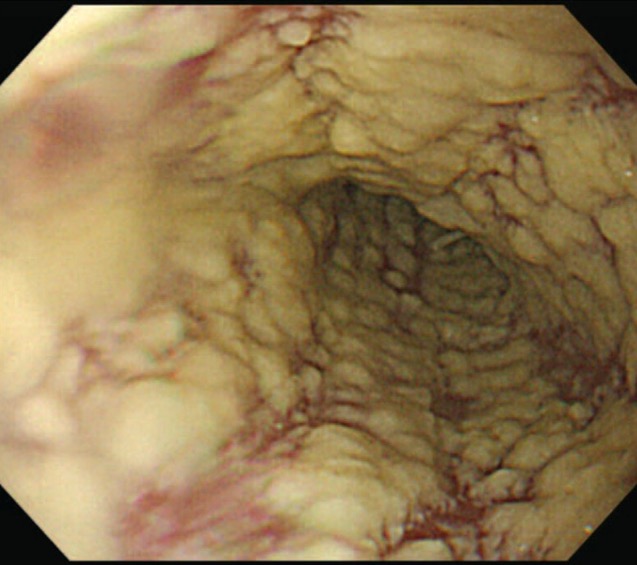
Esofagitis por cándida

Esofagitis por Candida con placas blanco-amarillentas

Imagen: “Esophagogastroduodenoscopy” por Department of Medicine (C-HH), and Institute of Traditional Medicine, School of Medicine, National Yang-Ming University, Taipei, Taiwan. Licencia: CC BY 4.0

Presentación Clínica

Características clínicas

Antecedentes:

  • Endoscopia o cirugía cerca del esófago en EN Erythema nodosum is an immune-mediated panniculitis (inflammation of the subcutaneous fat) caused by a type IV (delayed-type) hypersensitivity reaction. It commonly manifests in young women as tender, erythematous nodules on the shins. Erythema Nodosum las últimas 24 horas
  • Afecciones asociadas: malignidad, radioterapia, estenosis
  • Vómitos y arcadas severas
  • Ingestión de cáusticos o cuerpos extraños
  • Lesión traumática
  • Factores de riesgo de la esofagitis infecciosa

Manifestaciones:

Hallazgos al AL Amyloidosis examen físico:
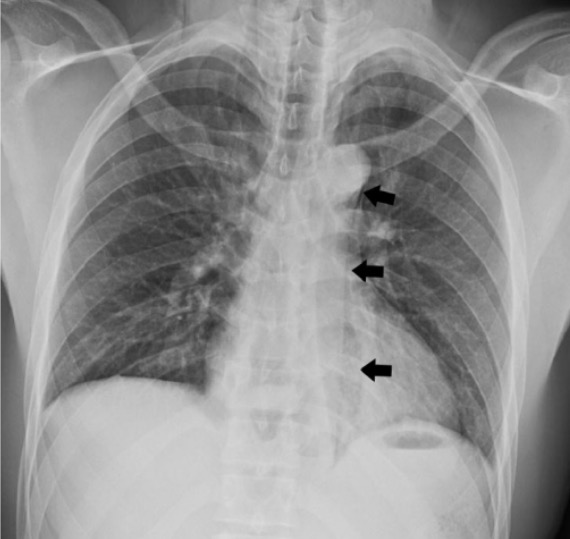
  • Taquipnea
  • Taquicardia
  • Crepitación en EN Erythema nodosum is an immune-mediated panniculitis (inflammation of the subcutaneous fat) caused by a type IV (delayed-type) hypersensitivity reaction. It commonly manifests in young women as tender, erythematous nodules on the shins. Erythema Nodosum la pared torácica (por enfisema subcutáneo)
  • Signo de Hamman:
    • Crujido mediastínico sobre el precordio sincronizado con los LOS Neisseria latidos del corazón
    • Por el enfisema mediastínico
  • Reducción de los LOS Neisseria ruidos respiratorios en EN Erythema nodosum is an immune-mediated panniculitis (inflammation of the subcutaneous fat) caused by a type IV (delayed-type) hypersensitivity reaction. It commonly manifests in young women as tender, erythematous nodules on the shins. Erythema Nodosum el lado de la perforación
  • Dolor Dolor Inflammation abdominal ( en EN Erythema nodosum is an immune-mediated panniculitis (inflammation of the subcutaneous fat) caused by a type IV (delayed-type) hypersensitivity reaction. It commonly manifests in young women as tender, erythematous nodules on the shins. Erythema Nodosum la perforación esofágica inferior)
  • En EN Erythema nodosum is an immune-mediated panniculitis (inflammation of the subcutaneous fat) caused by a type IV (delayed-type) hypersensitivity reaction. It commonly manifests in young women as tender, erythematous nodules on the shins. Erythema Nodosum caso de presentación grave y/o tardía: fiebre, hipotensión

Complicaciones

  • Mediastinitis Mediastinitis Mediastinitis refers to an infection or inflammation involving the mediastinum (a region in the thoracic cavity containing the heart, thymus gland, portions of the esophagus, and trachea). Acute mediastinitis can be caused by bacterial infection due to direct contamination, hematogenous or lymphatic spread, or extension of infection from nearby structures. Mediastinitis aguda:
    • Inflamación aguda de los LOS Neisseria tejidos mediastínicos debido a la propagación mediastínica de la flora esofágica y orofaríngea
    • Se presenta con dolor Dolor Inflammation torácico retroesternal intenso, fiebre, taquipnea, taquicardia o shock Shock Shock is a life-threatening condition associated with impaired circulation that results in tissue hypoxia. The different types of shock are based on the underlying cause: distributive (↑ cardiac output (CO), ↓ systemic vascular resistance (SVR)), cardiogenic (↓ CO, ↑ SVR), hypovolemic (↓ CO, ↑ SVR), obstructive (↓ CO), and mixed. Types of Shock séptico
  • La sepsis Sepsis Systemic inflammatory response syndrome with a proven or suspected infectious etiology. When sepsis is associated with organ dysfunction distant from the site of infection, it is called severe sepsis. When sepsis is accompanied by hypotension despite adequate fluid infusion, it is called septic shock. Sepsis and Septic Shock puede desarrollarse en EN Erythema nodosum is an immune-mediated panniculitis (inflammation of the subcutaneous fat) caused by a type IV (delayed-type) hypersensitivity reaction. It commonly manifests in young women as tender, erythematous nodules on the shins. Erythema Nodosum casos de presentación tardía.
  • Pleuritis Pleuritis Pleuritis, also known as pleurisy, is an inflammation of the visceral and parietal layers of the pleural membranes of the lungs. The condition can be primary or secondary and results in sudden, sharp, and intense chest pain on inhalation and exhalation. Pleuritis
  • Pericarditis Pericarditis Pericarditis is an inflammation of the pericardium, often with fluid accumulation. It can be caused by infection (often viral), myocardial infarction, drugs, malignancies, metabolic disorders, autoimmune disorders, or trauma. Acute, subacute, and chronic forms exist. Pericarditis
  • Empiema: acumulación de pus en EN Erythema nodosum is an immune-mediated panniculitis (inflammation of the subcutaneous fat) caused by a type IV (delayed-type) hypersensitivity reaction. It commonly manifests in young women as tender, erythematous nodules on the shins. Erythema Nodosum la cavidad pleural

Diagnóstico

  • Radiografía cervical:
    • Se realiza cuando se sospecha una perforación esofágica cervical
    • Hallazgo(s): enfisema subcutáneo
  • Radiografía de tórax:
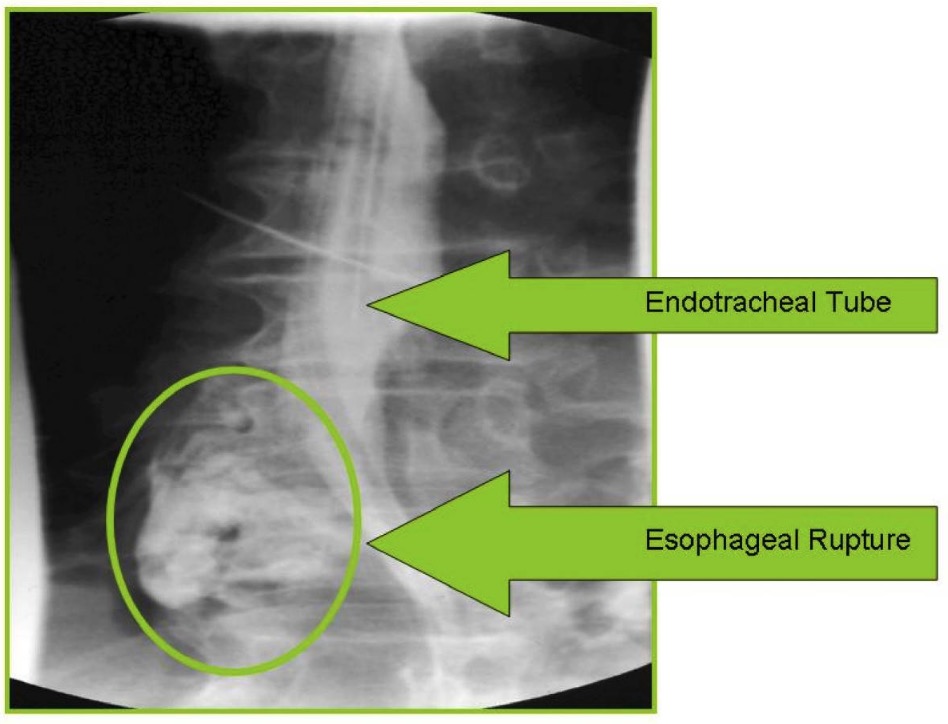
    • Se realiza cuando se sospecha una perforación esofágica torácica o intraabdominal
    • Hallazgo(s):
      • Neumomediastino
      • Neumopericardio
      • Hidroneumotórax
      • Mediastino ensanchado
      • Aire subdiafragmático
  • Esofagografía con contraste:
    • Diagnóstico
    • Utilice un contraste hidrosoluble ( Gastrografin Gastrografin Computed Tomography (CT)):
      • Para el estudio inicial
      • Hallazgo: fuga de contraste del esófago al AL Amyloidosis mediastino
    • Bario:
      • No se utiliza inicialmente debido al AL Amyloidosis riesgo de desarrollar una mediastinitis Mediastinitis Mediastinitis refers to an infection or inflammation involving the mediastinum (a region in the thoracic cavity containing the heart, thymus gland, portions of the esophagus, and trachea). Acute mediastinitis can be caused by bacterial infection due to direct contamination, hematogenous or lymphatic spread, or extension of infection from nearby structures. Mediastinitis aguda
      • Se utiliza si el estudio hidrosoluble es negativo (ya que el bario demuestra efectivamente las pequeñas perforaciones)
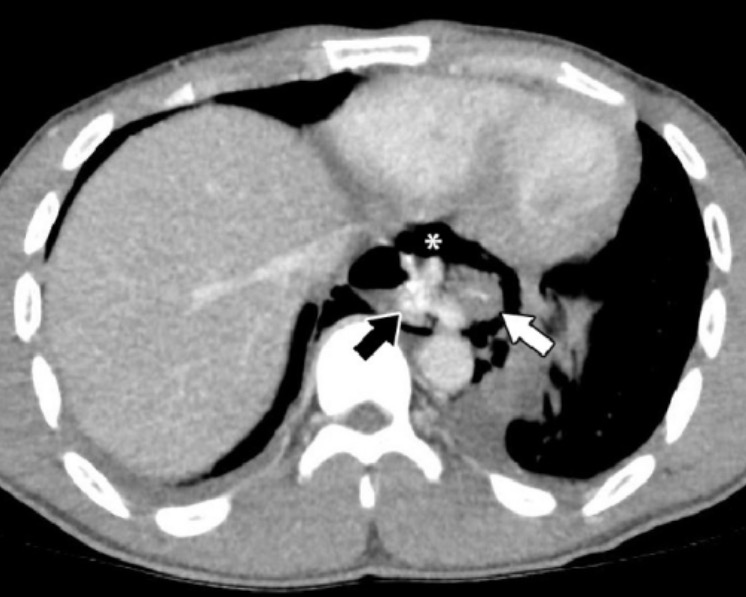
  • TC de tórax:
    • Se realiza cuando:
      • La radiografía de tórax o la esofagografía no son concluyentes
      • El paciente está inestable
    • Hallazgo(s):
      • Engrosamiento de la pared del esófago
      • Neumomediastino
      • Neumopericardio
      • Neumotórax
      • Mediastino ensanchado
  • Endoscopia superior:
    • Se realiza cuando:
      • La ubicación de la perforación no está clara
      • La TC no es concluyente
    • Se debe realizar con cuidado, ya que la insuflación de aire puede provocar la extensión de la perforación.

Tratamiento

Estabilización

Abordaje inicial:

  • Evaluación ABCDE ( en EN Erythema nodosum is an immune-mediated panniculitis (inflammation of the subcutaneous fat) caused by a type IV (delayed-type) hypersensitivity reaction. It commonly manifests in young women as tender, erythematous nodules on the shins. Erythema Nodosum inglés):
    • A Airway Airway ABCDE Assessment (vía aérea): Asegurar la permeabilidad de la vía aérea.
    • B – Breathing (respiración): Asegúrese de que se produce una ventilación adecuada.
    • C Circulation Circulation The movement of the blood as it is pumped through the cardiovascular system. ABCDE Assessment (circulación): Medir la presión arterial y el pulso, y administrar líquidos intravenosos.
    • D Disability Disability Determination of the degree of a physical, mental, or emotional handicap. The diagnosis is applied to legal qualification for benefits and income under disability insurance and to eligibility for social security and workman’s compensation benefits. ABCDE Assessment (discapacidad): Realizar un examen neurológico básico.
    • E – Exposure (exposición): Buscar lesiones y asegurar el entorno.
  • Nada por vía oral
  • Antibióticos intravenosos de amplio espectro
  • Analgésicos intravenosos
  • Inhibidor de la bomba de protones por vía intravenosa
  • Nutrición parenteral

Obtenga una interconsulta quirúrgica (incluyendo cirugía cardiotorácica), ya que incluso los LOS Neisseria pacientes estables pueden deteriorarse y requerir cirugía.

Intervención adicional determinada por:

  • Tamaño y ubicación de la perforación
  • Comorbilidades

Tratamiento no quirúrgico

  • Indicaciones:
    • El paciente está estable sin signos de sepsis Sepsis Systemic inflammatory response syndrome with a proven or suspected infectious etiology. When sepsis is associated with organ dysfunction distant from the site of infection, it is called severe sepsis. When sepsis is accompanied by hypotension despite adequate fluid infusion, it is called septic shock. Sepsis and Septic Shock.
    • La perforación está contenida:
      • Dentro del cuello O
      • Entre la pleura Pleura The pleura is a serous membrane that lines the walls of the thoracic cavity and the surface of the lungs. This structure of mesodermal origin covers both lungs, the mediastinum, the thoracic surface of the diaphragm, and the inner part of the thoracic cage. The pleura is divided into a visceral pleura and parietal pleura. Pleura: Anatomy pulmonar visceral y el mediastino
    • El lugar de la perforación se encuentra fuera del abdomen.
    • No se trata de una neoplasia u obstrucción
    • El contraste drena de vuelta hacia el esófago.
    • La esofagografía con contraste está disponible para la evaluación de seguimiento.
    • Un cirujano torácico experto está fácilmente disponible.
  • Monitoreo de cuidados intensivos
  • Cualquier signo de sepsis Sepsis Systemic inflammatory response syndrome with a proven or suspected infectious etiology. When sepsis is associated with organ dysfunction distant from the site of infection, it is called severe sepsis. When sepsis is accompanied by hypotension despite adequate fluid infusion, it is called septic shock. Sepsis and Septic Shock o de deterioro → cirugía inmediata

Tratamiento quirúrgico

Indicaciones:

  • El paciente está hemodinámicamente inestable.
  • Paciente con perforación esofágica intraabdominal
  • Paciente con malignidad esofágica
  • Complicaciones respiratorias

Procedimiento:

  • Reparación quirúrgica de la perforación (estándar de atención)
  • Stent esofágico: puede utilizarse en EN Erythema nodosum is an immune-mediated panniculitis (inflammation of the subcutaneous fat) caused by a type IV (delayed-type) hypersensitivity reaction. It commonly manifests in young women as tender, erythematous nodules on the shins. Erythema Nodosum pacientes seleccionados (con comorbilidades graves y/o que no pueden ser operados)
  • Aplicación de clips endoscópicos: una opción en EN Erythema nodosum is an immune-mediated panniculitis (inflammation of the subcutaneous fat) caused by a type IV (delayed-type) hypersensitivity reaction. It commonly manifests in young women as tender, erythematous nodules on the shins. Erythema Nodosum perforaciones pequeñas que pueden corregirse con una tensión mínima
  • La esofagectomía se utiliza como último recurso.
Esofagotomía

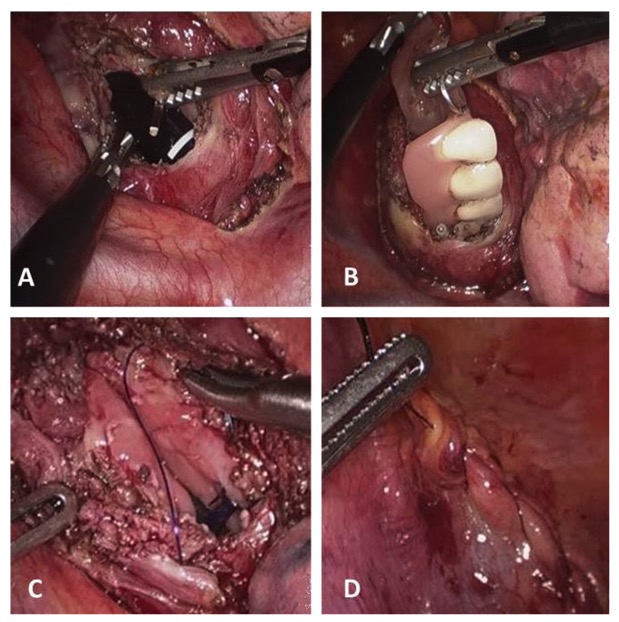
Perforación esofágica por cuerpo extraño (prótesis dental):
A: esofagotomía
B: extracción de la prótesis dental
C y D: sutura de la pared esofágica y de la pleura mediastínica

Imagen: “Thoracoscopic removal of dental prosthesis” por Department of Biomedical Sciences for Health, Division of General Surgery, University of Milano Medical School, IRCCS Policlinico San Donato, Via Morandi 30, 20097, San Donato Milanese, (Milano), Italy. Licencia: CC BY 2.0

Diagnóstico Diferencial

  • Síndrome de Mallory-Weiss: una laceración longitudinal superficial de la mucosa y/o submucosa esofágica en EN Erythema nodosum is an immune-mediated panniculitis (inflammation of the subcutaneous fat) caused by a type IV (delayed-type) hypersensitivity reaction. It commonly manifests in young women as tender, erythematous nodules on the shins. Erythema Nodosum la unión gastroesofágica. Al AL Amyloidosis igual que en EN Erythema nodosum is an immune-mediated panniculitis (inflammation of the subcutaneous fat) caused by a type IV (delayed-type) hypersensitivity reaction. It commonly manifests in young women as tender, erythematous nodules on the shins. Erythema Nodosum el caso de la perforación esofágica, la afección puede ser causada por un aumento de la presión intratorácica (e.g., por vómitos). La afección se presenta con hematemesis Hematemesis Vomiting of blood that is either fresh bright red, or older ‘coffee-ground’ in character. It generally indicates bleeding of the upper gastrointestinal tract. Mallory-Weiss Syndrome (Mallory-Weiss Tear). El diagnóstico es principalmente clínico y el tratamiento es de soporte, con líquidos y analgésicos intravenosos.
  • Espasmo esofágico: también se presenta con disfagia a sólidos y líquidos, pero se asocia a la aparición repentina de dolor Dolor Inflammation torácico que no está relacionado con el esfuerzo. Dos tipos de esta afección son el espasmo esofágico distal y el esófago hipercontráctil ( en EN Erythema nodosum is an immune-mediated panniculitis (inflammation of the subcutaneous fat) caused by a type IV (delayed-type) hypersensitivity reaction. It commonly manifests in young women as tender, erythematous nodules on the shins. Erythema Nodosum martillo neumático). La manometría muestra contracciones esofágicas características con una relajación normal de la unión esofagogástrica. El tratamiento implica resolver la enfermedad por reflujo (si está presente) y una prueba con bloqueadores de los LOS Neisseria canales de calcio.
  • Enfermedad por reflujo gastroesofágico (ERGE): síntomas de acidez y regurgitación causados por el reflujo del contenido del estómago. Generalmente, el paciente se queja de un dolor Dolor Inflammation epigástrico urente que se irradia hacia el tórax con un sabor agrio o metálico en EN Erythema nodosum is an immune-mediated panniculitis (inflammation of the subcutaneous fat) caused by a type IV (delayed-type) hypersensitivity reaction. It commonly manifests in young women as tender, erythematous nodules on the shins. Erythema Nodosum la boca. La enfermedad se debe a una relajación inadecuada del esfínter esofágico inferior. Los LOS Neisseria inhibidores de la bomba de protones se utilizan para controlar los LOS Neisseria síntomas de la ERGE.

Referencias

  1. Mueller, D. K. (2024). Esophageal rupture. In M. C. Mancini (Ed.), Medscape. Retrieved June 17, 2025, from https://emedicine.medscape.com/article/425410-overview
  2. Roy, P. K. (2018). Boerhaave syndrome. In P. O. Katz (Ed.), Medscape. Retrieved June 17, 2025, from https://emedicine.medscape.com/article/171683-overview
  3. Raymond, D. P. (2025). Overview of esophageal injury due to blunt or penetrating trauma in adults. In E. M. Bulger (Ed.), UpToDate. UpToDate, Inc. Retrieved June 17, 2025, from https://www.uptodate.com/contents/overview-of-esophageal-injury-due-to-blunt-or-penetrating-trauma-in-adults
  4. Raymond, D. P. (2024). Esophageal perforation. In B. F. Louie (Ed.), UpToDate. UpToDate, Inc. Retrieved June 17, 2025, from https://www.uptodate.com/contents/esophageal-perforation
  5. Triadafilopoulos, G. (2025). Spontaneous esophageal rupture (Boerhaave syndrome). In J. Thomas Lamont (Ed.), UpToDate. UpToDate, Inc. Retrieved June 17, 2025, from https://www.uptodate.com/contents/spontaneous-esophageal-rupture-boerhaave-syndrome

¡Crea tu cuenta gratis o inicia una sesión para seguir leyendo!

Regístrate ahora y obtén acceso gratuito a Lecturio con páginas de concepto, videos médicos y cuestionarios para tu educación médica.

User Reviews

Que tengas una sesión de estudio alegre y navideña 🎁 Ahorra 50% en todos los planes >>

Details