
Neisseria Neisseria Neisseria is a genus of bacteria commonly present on mucosal surfaces. Several species exist, but only 2 are pathogenic to humans: N. gonorrhoeae and N. meningitidis. Neisseria species are non-motile, gram-negative diplococci most commonly isolated on modified Thayer-Martin (MTM) agar. Neisseria es un género de bacterias comúnmente presentes en EN Erythema nodosum is an immune-mediated panniculitis (inflammation of the subcutaneous fat) caused by a type IV (delayed-type) hypersensitivity reaction. It commonly manifests in young women as tender, erythematous nodules on the shins. Erythema Nodosum las superficies mucosas. Existen varias especies, pero solo 2 son patógenas para los LOS Neisseria humanos: N. gonorrhoeae N. gonorrhoeae A species of gram-negative, aerobic bacteria primarily found in purulent venereal discharges. It is the causative agent of gonorrhea. Neisseria y N. meningitidis N. meningitidis A species of gram-negative, aerobic bacteria. It is a commensal and pathogen only of humans, and can be carried asymptomatically in the nasopharynx. When found in cerebrospinal fluid it is the causative agent of cerebrospinal meningitis. It is also found in venereal discharges and blood. There are at least 13 serogroups based on antigenic differences in the capsular polysaccharides; the ones causing most meningitis infections being a, b, c, y, and w-135. Each serogroup can be further classified by serotype, serosubtype, and immunotype. Neisseria. Las especies de Neisseria Neisseria Neisseria is a genus of bacteria commonly present on mucosal surfaces. Several species exist, but only 2 are pathogenic to humans: N. gonorrhoeae and N. meningitidis. Neisseria species are non-motile, gram-negative diplococci most commonly isolated on modified Thayer-Martin (MTM) agar. Neisseria son diplococos gramnegativos no móviles que se aíslan con mayor frecuencia en EN Erythema nodosum is an immune-mediated panniculitis (inflammation of the subcutaneous fat) caused by a type IV (delayed-type) hypersensitivity reaction. It commonly manifests in young women as tender, erythematous nodules on the shins. Erythema Nodosum agar Thayer-Martin modificado. Estos patógenos tienen muchos factores de virulencia, que incluyen fimbrias, proteínas de envoltura de lipooligosacáridos, una cápsula de polisacáridos (exclusiva de N. meningitidis N. meningitidis A species of gram-negative, aerobic bacteria. It is a commensal and pathogen only of humans, and can be carried asymptomatically in the nasopharynx. When found in cerebrospinal fluid it is the causative agent of cerebrospinal meningitis. It is also found in venereal discharges and blood. There are at least 13 serogroups based on antigenic differences in the capsular polysaccharides; the ones causing most meningitis infections being a, b, c, y, and w-135. Each serogroup can be further classified by serotype, serosubtype, and immunotype. Neisseria) y proteasa IgA IgA Represents 15-20% of the human serum immunoglobulins, mostly as the 4-chain polymer in humans or dimer in other mammals. Secretory iga is the main immunoglobulin in secretions. Immunoglobulins: Types and Functions. Las infecciones gonocócicas se transmiten por vía sexual o perinatal e incluyen gonorrea, enfermedad inflamatoria pélvica, artritis séptica y conjuntivitis neonatal. Las infecciones meningocócicas se transmiten a través de las secreciones respiratorias y orales. Con mayor frecuencia causan meningococemia con hemorragias petequiales y meningitis Meningitis Meningitis is inflammation of the meninges, the protective membranes of the brain, and spinal cord. The causes of meningitis are varied, with the most common being bacterial or viral infection. The classic presentation of meningitis is a triad of fever, altered mental status, and nuchal rigidity. Meningitis.
Last updated: Dec 30, 2024
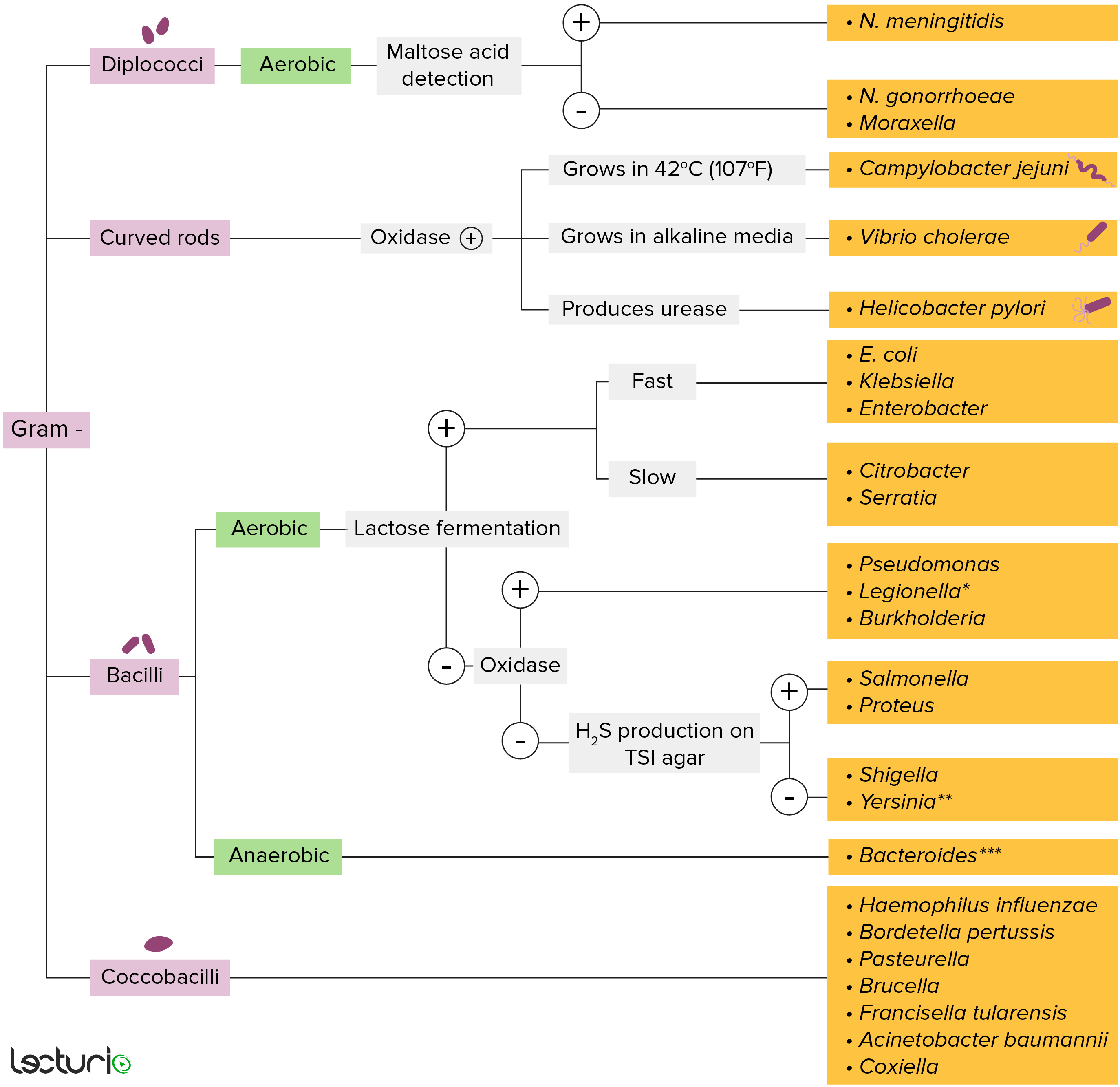
Bacterias gram-negativas:
La mayoría de las bacterias se pueden clasificar de acuerdo con un procedimiento de laboratorio llamado tinción de Gram.
Las bacterias con paredes celulares que tienen una capa delgada de peptidoglicano no retienen la tinción de cristal violeta utilizada en la tinción de Gram. Sin embargo, estas bacterias retienen la contratinción de safranina y, por lo tanto, se tiñen de color rojo rosado en la mancha, lo que las convierte en gram negativas. Estas bacterias pueden clasificarse además según su morfología (diplococos, bastoncillos curvos, bacilos y cocobacilos) y su capacidad para crecer en presencia de oxígeno (aeróbicos frente a anaeróbicos). Las bacterias se pueden identificar de manera más estrecha cultivándolas en medios específicos (agar triple azúcar hierro (TSI, por sus siglas en inglés)) donde se pueden identificar sus enzimas (ureasa, oxidasa) y se puede probar su capacidad para fermentar lactosa.
* Se tiñe mal en la tinción de Gram
** Bastón pleomórfico/cocobacilo
*** Requiere medios de transporte especiales
| N. meningitidis N. meningitidis A species of gram-negative, aerobic bacteria. It is a commensal and pathogen only of humans, and can be carried asymptomatically in the nasopharynx. When found in cerebrospinal fluid it is the causative agent of cerebrospinal meningitis. It is also found in venereal discharges and blood. There are at least 13 serogroups based on antigenic differences in the capsular polysaccharides; the ones causing most meningitis infections being a, b, c, y, and w-135. Each serogroup can be further classified by serotype, serosubtype, and immunotype. Neisseria | N. gonorrhoeae N. gonorrhoeae A species of gram-negative, aerobic bacteria primarily found in purulent venereal discharges. It is the causative agent of gonorrhea. Neisseria |
|---|---|
| Encapsulado (cápsula de polisacárido) | No encapsulado |
| Fermenta maltosa y glucosa. | Fermenta solo glucosa |
| Coloniza la nasofaringe | Coloniza la mucosa genital |
| Rara vez tiene plásmidos | La mayoría tiene plásmidos |
Factores generales de virulencia:
Mecanismos para evadir el reconocimiento inmunológico:
Mecanismos de resistencia a los LOS Neisseria antimicrobianos:

Patogenia de N. gonorrhoeae.
La bacteria se adhiere al epitelio de la mucosa (1) donde compite con la microbiota y coloniza para invadir el epitelio (2). Se liberan peptidoglicanos, LOS y OMV (3), activando la señalización de TLR y NOD en células epiteliales, macrófagos y células dendríticas (4). Esto conduce a la producción de citocinas y quimiocinas (5) que provocan un exudado purulento rico en neutrófilos y la fagocitosis de las bacterias dañinas (6). Dado que N. gonorrhoeae tiene mecanismos de defensa que resisten la muerte, los neutrófilos cargados de bacterias también pueden actuar como agentes de transmisión a otro huésped (7).
Clave de abreviatura seleccionada:
LOS: lipooligosacárido
OMV: vesículas de la membrana externa
TLR: receptor tipo toll
NOD : proteína que contiene el dominio de oligomerización de unión a nucleótidos
| Tipo de presentación | Características clínicas |
|---|---|
| Gonorrea (infección gonocócica aguda; comúnmente conocida como “el aplauso”) |
|
| Enfermedad pélvica inflamatoria (EPI) |
|
| Conjuntivitis neonatal (oftalmopatía gonocócica neonatal) |
|
| Infección gonocócica diseminada |
|
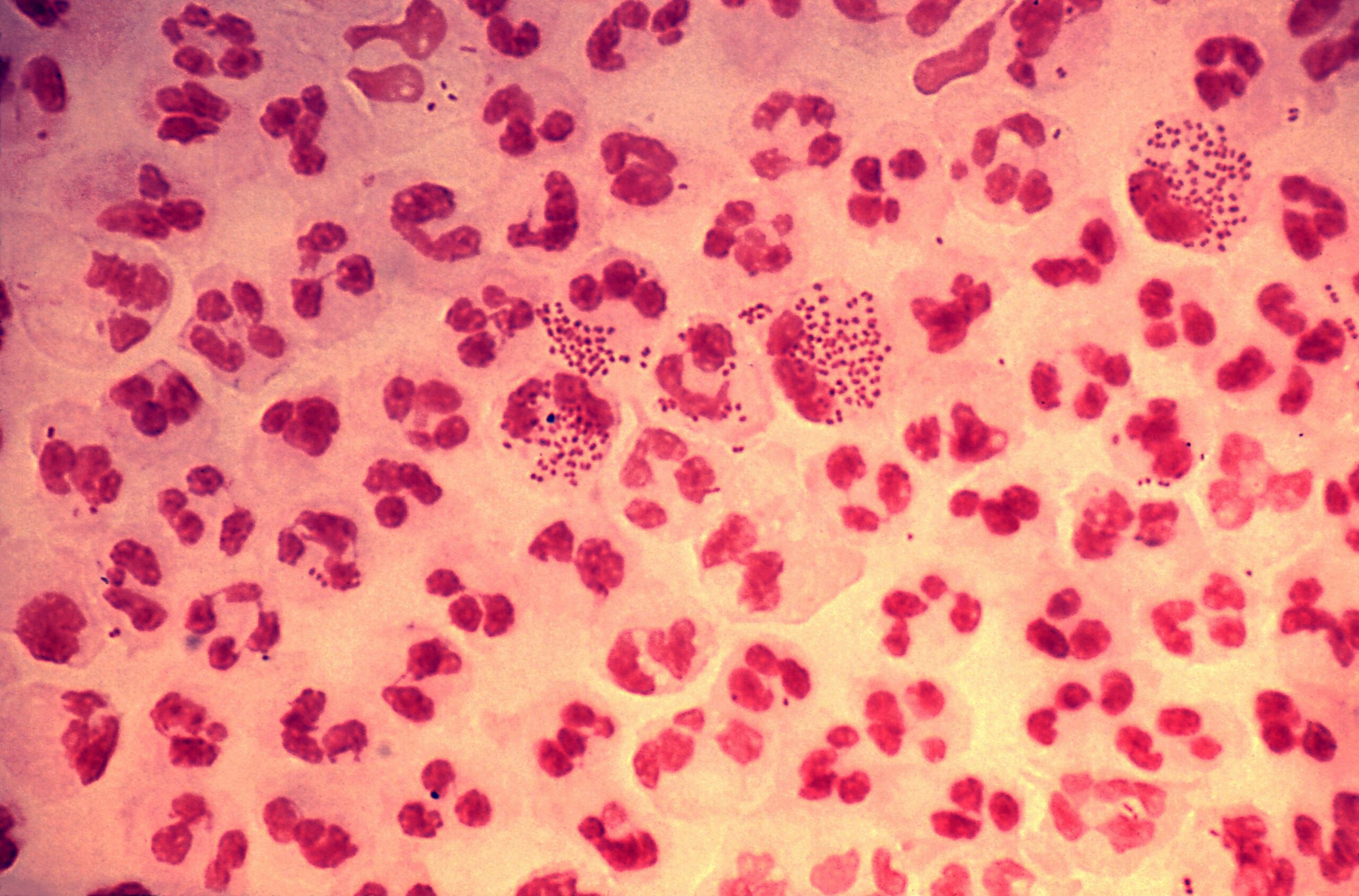
N. gonorrhoeae son diplococos gramnegativos que provocan una marcada respuesta neutrofílica, como se ve en esta imagen, con varios neutrófilos que contienen muchas bacterias fagocitadas.
Imagen: “Gonorrhea Neisseria gonorrhoeae” por Joe Miller. Licencia: CC0Factores virulentos:
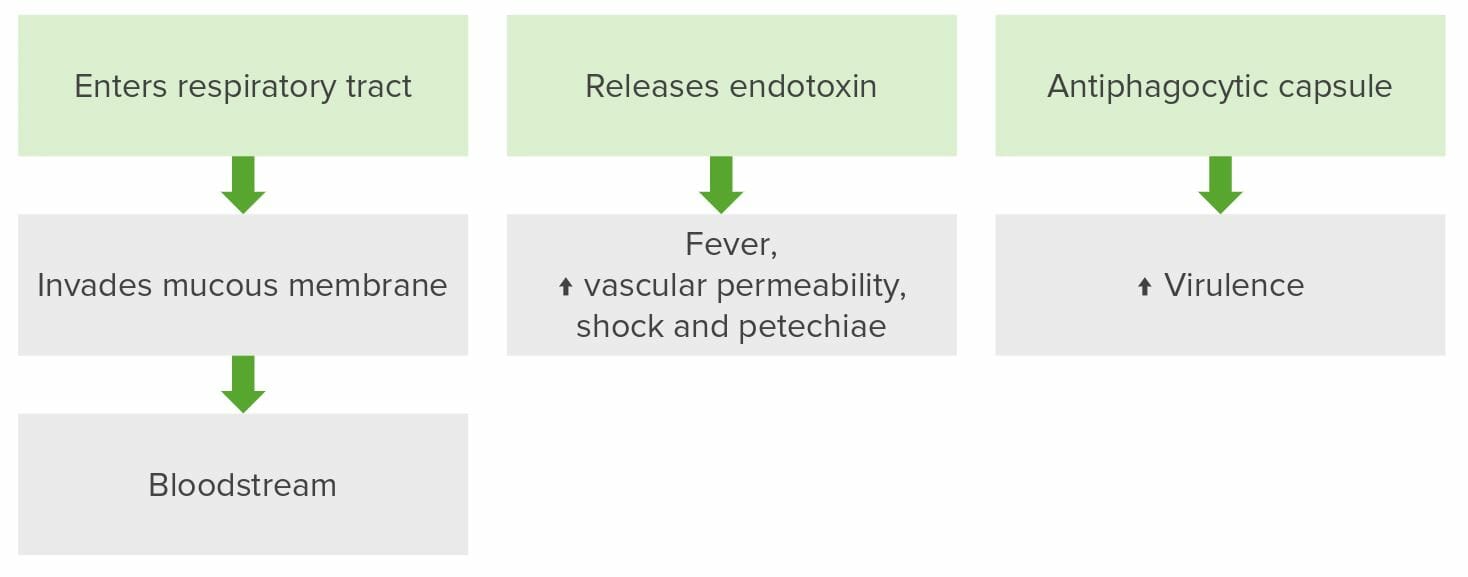
Patogénesis de N. meningitidis:
Las bacterias ingresan al sistema respiratorio para invadir las membranas mucosas y luego ingresan al torrente sanguíneo. En la sangre, se produce la proliferación y el patógeno libera endotoxina, lo que provoca fiebre, aumento de la permeabilidad vascular, shock y petequias. La cápsula antifagocítica permite al patógeno evadir la destrucción por parte del sistema inmunitario.
Patogénesis:
| Tipo de presentación | Características clínicas |
|---|---|
| Meningitis Meningitis Meningitis is inflammation of the meninges, the protective membranes of the brain, and spinal cord. The causes of meningitis are varied, with the most common being bacterial or viral infection. The classic presentation of meningitis is a triad of fever, altered mental status, and nuchal rigidity. Meningitis |
|
| Meningococcemia Meningococcemia Terminal Complement Pathway Deficiency (septicemia meningocócica) |
Meningococcemia
Meningococcemia
Terminal Complement Pathway Deficiency aguda:
Meningococcemia Meningococcemia Terminal Complement Pathway Deficiency crónica:
|
| Síndrome de Waterhouse-Friderichse |
|
| Otras presentaciones |
IdentificaciónPrevenciónLa prevención se realiza mediante la vacuna antimeningocócica conjugada de polisacáridos tetravalente: ReferenciasDetails |