Domina Conceptos Médicos

Estudia para la escuela de medicina y tus examenes con Lecturio.

Inflamación

La inflamación es un complejo conjunto de respuestas a infecciones y lesiones que involucran a los LOS Neisseria leucocitos como principales mediadores celulares en EN Erythema nodosum is an immune-mediated panniculitis (inflammation of the subcutaneous fat) caused by a type IV (delayed-type) hypersensitivity reaction. It commonly manifests in young women as tender, erythematous nodules on the shins. Erythema Nodosum la defensa del cuerpo contra organismos patógenos. La inflamación también se considera una respuesta a la lesión tisular en EN Erythema nodosum is an immune-mediated panniculitis (inflammation of the subcutaneous fat) caused by a type IV (delayed-type) hypersensitivity reaction. It commonly manifests in young women as tender, erythematous nodules on the shins. Erythema Nodosum el proceso de cicatrización de heridas. Los LOS Neisseria 5 signos cardinales de la inflamación son dolor Dolor Inflammation, calor Calor Inflammation, eritema, edema Edema Edema is a condition in which excess serous fluid accumulates in the body cavity or interstitial space of connective tissues. Edema is a symptom observed in several medical conditions. It can be categorized into 2 types, namely, peripheral (in the extremities) and internal (in an organ or body cavity). Edema y pérdida de función. La principal respuesta celular involucra a los LOS Neisseria neutrófilos y macrófagos para fagocitar y lisar el organismo dañino o reparar el tejido necrosado después de la lesión. La inflamación puede ser patológica si se prolonga o cuando los LOS Neisseria procesos normales crean una respuesta excesiva (como en EN Erythema nodosum is an immune-mediated panniculitis (inflammation of the subcutaneous fat) caused by a type IV (delayed-type) hypersensitivity reaction. It commonly manifests in young women as tender, erythematous nodules on the shins. Erythema Nodosum la aterosclerosis). Existen múltiples mediadores de la inflamación que se superponen con la inmunidad innata cuando responden a estímulos nocivos. La inflamación puede volverse crónica, dando como resultado la formación de granulomas Granulomas A relatively small nodular inflammatory lesion containing grouped mononuclear phagocytes, caused by infectious and noninfectious agents. Sarcoidosis, daño tisular y la pérdida de la función de los LOS Neisseria órganos.

Last updated: Dec 15, 2025

Editorial responsibility: Stanley Oiseth, Lindsay Jones, Evelin Maza

Introducción y Signos Clásicos

La inflamación es un conjunto complejo de respuestas a infecciones y lesiones, que involucra a los LOS Neisseria leucocitos como los LOS Neisseria principales mediadores celulares en EN Erythema nodosum is an immune-mediated panniculitis (inflammation of the subcutaneous fat) caused by a type IV (delayed-type) hypersensitivity reaction. It commonly manifests in young women as tender, erythematous nodules on the shins. Erythema Nodosum la defensa del cuerpo contra organismos patógenos. La inflamación también se considera una respuesta a la lesión tisular en EN Erythema nodosum is an immune-mediated panniculitis (inflammation of the subcutaneous fat) caused by a type IV (delayed-type) hypersensitivity reaction. It commonly manifests in young women as tender, erythematous nodules on the shins. Erythema Nodosum el proceso de cicatrización de heridas.

Respuestas inflamatorias

Tipos:

  • Fisiológicas (e.g., cicatrización de heridas, localización de infecciones)
  • Patológicas (e.g., malignidad, inflamación crónica)

Desencadenantes de la inflamación aguda:

  • Infecciones/toxinas microbianas:
    • Bacterianas (principalmente)
    • Virales
    • Fúngicas
    • Parasitarias
  • Lesión física o química:
    • Lesión térmica
    • Radiación
    • Productos químicos ambientales
  • Cuerpos extraños:
    • Astillas
    • Tierra, vidrio u óxido en EN Erythema nodosum is an immune-mediated panniculitis (inflammation of the subcutaneous fat) caused by a type IV (delayed-type) hypersensitivity reaction. It commonly manifests in young women as tender, erythematous nodules on the shins. Erythema Nodosum una herida
    • Suturas quirúrgicas
  • Tejido necrótico debido a isquemia o traumatismo
  • Trombo
  • Ácido úrico (procedente de la descomposición del ADN en EN Erythema nodosum is an immune-mediated panniculitis (inflammation of the subcutaneous fat) caused by a type IV (delayed-type) hypersensitivity reaction. It commonly manifests in young women as tender, erythematous nodules on the shins. Erythema Nodosum las células)
  • Mediadores de mastocitos, macrófagos y fibroblastos

Características de la inflamación aguda:

  • Instauración inmediata (minutos)
  • Corta duración: se resuelve en EN Erythema nodosum is an immune-mediated panniculitis (inflammation of the subcutaneous fat) caused by a type IV (delayed-type) hypersensitivity reaction. It commonly manifests in young women as tender, erythematous nodules on the shins. Erythema Nodosum días
  • Signos y síntomas clásicos
  • Respuesta primaria de los LOS Neisseria neutrófilos:
    • Eliminar patógenos y células/tejidos necróticos
    • Puente a la inmunidad innata
    • Iniciar la reparación tisular
    • Liberar proteasas que pueden dañar los LOS Neisseria tejidos normales

Características de la inflamación crónica:

  • Instauración lenta (días)
  • Larga duración: meses o años
  • Signos o síntomas más específicos
  • Los LOS Neisseria monocitos en EN Erythema nodosum is an immune-mediated panniculitis (inflammation of the subcutaneous fat) caused by a type IV (delayed-type) hypersensitivity reaction. It commonly manifests in young women as tender, erythematous nodules on the shins. Erythema Nodosum la circulación se convierten en EN Erythema nodosum is an immune-mediated panniculitis (inflammation of the subcutaneous fat) caused by a type IV (delayed-type) hypersensitivity reaction. It commonly manifests in young women as tender, erythematous nodules on the shins. Erythema Nodosum macrófagos en EN Erythema nodosum is an immune-mediated panniculitis (inflammation of the subcutaneous fat) caused by a type IV (delayed-type) hypersensitivity reaction. It commonly manifests in young women as tender, erythematous nodules on the shins. Erythema Nodosum los LOS Neisseria tejidos → degradan los LOS Neisseria desechos y organizan la curación versus la cicatrización

Inflamación innata:

  • Tiene controles y equilibrios proinflamatorios y antiinflamatorios
  • Tiene potencial para causar daño
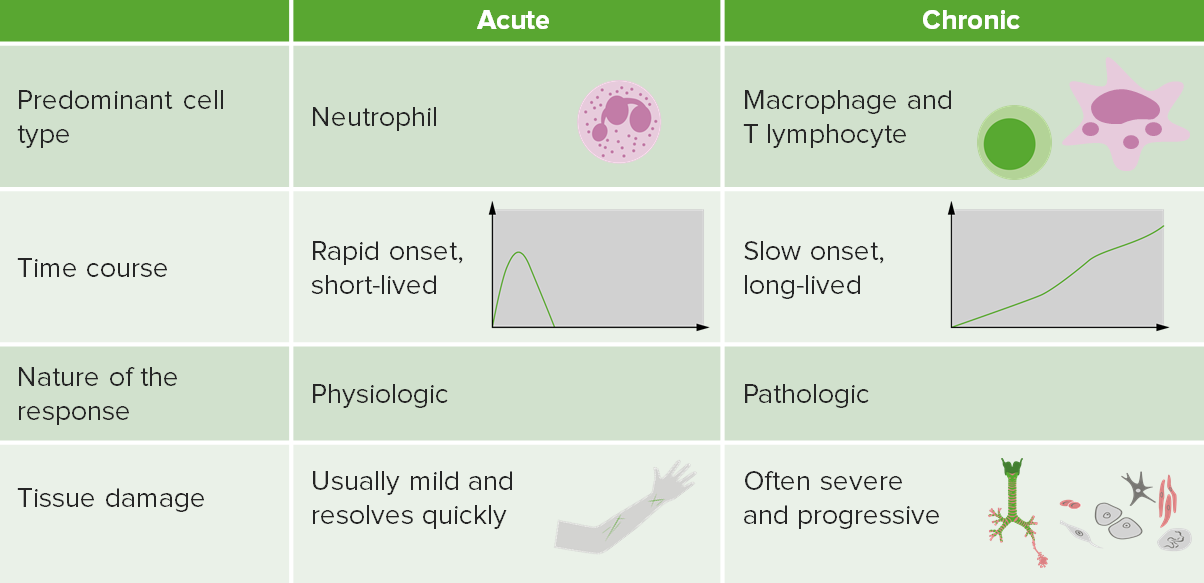
Contraste de inflamación aguda y crónica

Contraste de inflamación aguda y crónica

Imagen por Lecturio.
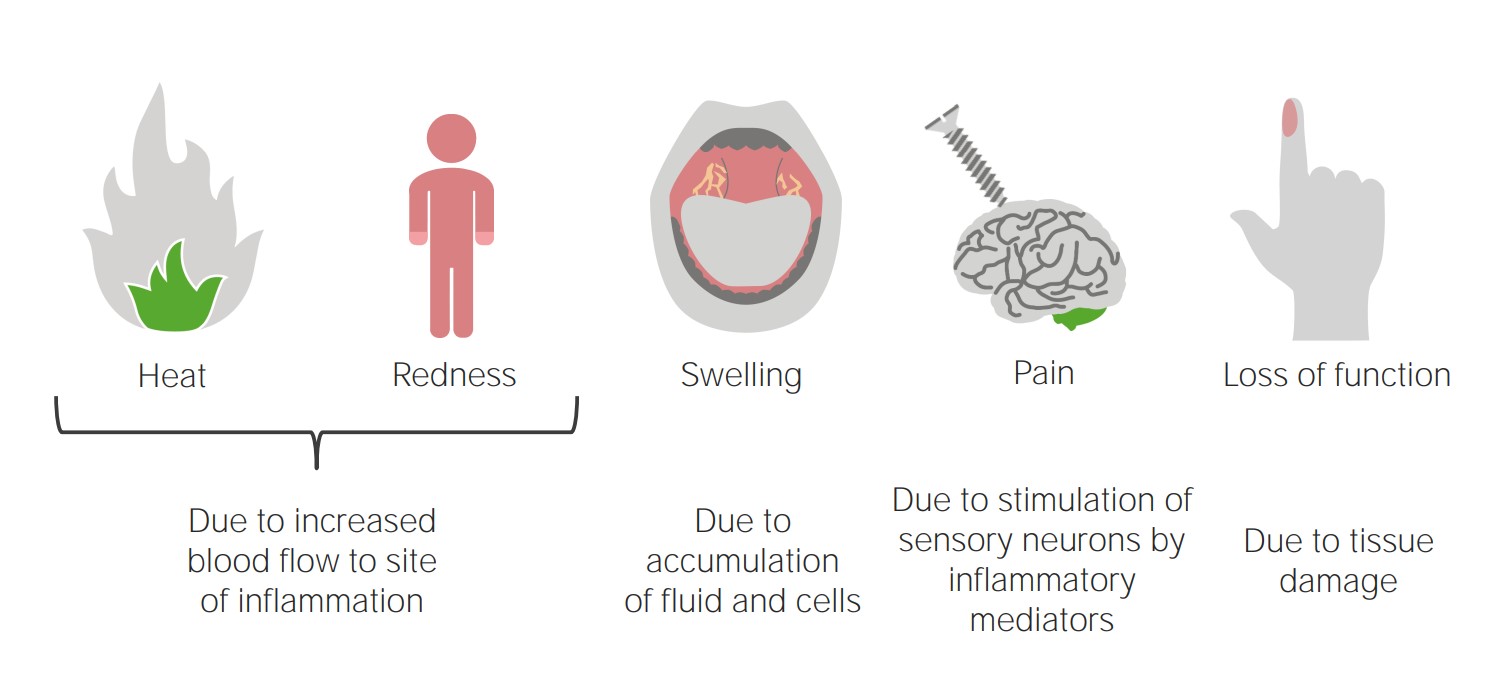
Signos clásicos (términos en EN Erythema nodosum is an immune-mediated panniculitis (inflammation of the subcutaneous fat) caused by a type IV (delayed-type) hypersensitivity reaction. It commonly manifests in young women as tender, erythematous nodules on the shins. Erythema Nodosum latín)

  • Rubor Rubor Inflammation (eritema): debido al AL Amyloidosis ↑ flujo sanguíneo y acumulación en EN Erythema nodosum is an immune-mediated panniculitis (inflammation of the subcutaneous fat) caused by a type IV (delayed-type) hypersensitivity reaction. It commonly manifests in young women as tender, erythematous nodules on the shins. Erythema Nodosum el punto de lesión o inflamación
  • Calor Calor Inflammation ( calor Calor Inflammation): debido a una combinación de flujo sanguíneo y reacción local
  • Tumor Tumor Inflammation ( edema Edema Edema is a condition in which excess serous fluid accumulates in the body cavity or interstitial space of connective tissues. Edema is a symptom observed in several medical conditions. It can be categorized into 2 types, namely, peripheral (in the extremities) and internal (in an organ or body cavity). Edema): por mediadores inflamatorios → ↑ extravasación de líquido → edema Edema Edema is a condition in which excess serous fluid accumulates in the body cavity or interstitial space of connective tissues. Edema is a symptom observed in several medical conditions. It can be categorized into 2 types, namely, peripheral (in the extremities) and internal (in an organ or body cavity). Edema
  • Dolor Dolor Inflammation ( dolor Dolor Inflammation): mediado por citoquinas, bradiquinina y prostaglandinas
  • Functio laesa Functio Laesa Inflammation (pérdida de función): resulta del daño tisular
Respuesta inflamatoria aguda

Respuesta inflamatoria aguda

Imagen por Lecturio.

Mediadores de la Inflamación

Existen múltiples mediadores de la inflamación que llevan a las células inflamatorias hacia los LOS Neisseria sitios de lesión y se superponen con la inmunidad innata cuando responden a estímulos dañinos.

Respuesta celular primaria (leucocitos)

  • Neutrófilos
  • Macrófagos y monocitos
  • Mastocitos y basófilos

Mediadores de la inflamación

  • Proteínas de fase aguda (e.g., PCR PCR Polymerase chain reaction (PCR) is a technique that amplifies DNA fragments exponentially for analysis. The process is highly specific, allowing for the targeting of specific genomic sequences, even with minuscule sample amounts. The PCR cycles multiple times through 3 phases: denaturation of the template DNA, annealing of a specific primer to the individual DNA strands, and synthesis/elongation of new DNA molecules. Polymerase Chain Reaction (PCR))
  • Citoquinas: proteínas de señalización liberadas por las células inmunitarias
    • Interleuquinas:
      • Proinflamatorios: IL-1β, IL-6, IL-8, interferón ( IFN IFN Interferon (IFN) is a cytokine with antiviral properties (it interferes with viral infections) and various roles in immunoregulation. The different types are type I IFN (IFN-ɑ and IFN-β), type II IFN (IFN-ɣ), and type III IFN (IFN-ƛ). Interferons)-γ
      • Antiinflamatorios: IL-4, IL-10, IL-13
    • Factor de necrosis Necrosis The death of cells in an organ or tissue due to disease, injury or failure of the blood supply. Ischemic Cell Damage tumoral ( TNF TNF Tumor necrosis factor (TNF) is a major cytokine, released primarily by macrophages in response to stimuli. The presence of microbial products and dead cells and injury are among the stimulating factors. This protein belongs to the TNF superfamily, a group of ligands and receptors performing functions in inflammatory response, morphogenesis, and cell proliferation. Tumor Necrosis Factor (TNF), por sus siglas en EN Erythema nodosum is an immune-mediated panniculitis (inflammation of the subcutaneous fat) caused by a type IV (delayed-type) hypersensitivity reaction. It commonly manifests in young women as tender, erythematous nodules on the shins. Erythema Nodosum inglés)
  • Especies reactivas de oxígeno
  • Factor activador de plaquetas:
    • Hecho de fosfolípidos de membrana
    • Provoca vasodilatación, ↑ permeabilidad vascular y activación plaquetaria
    • También es una citoquina
  • Metabolitos del ácido araquidónico:
    • Prostaglandinas → vasodilatación; aumento de la permeabilidad vascular
    • Prostaciclina (prostaglandina I2) → vasodilatación; inhibe la agregación plaquetaria
    • Tromboxano A2 → vasoconstricción; promueve la agregación plaquetaria (efecto opuesto de la prostaciclina)
    • Leucotrienos (proinflamatorios) → vasoconstricción, broncoespasmo, ↑ permeabilidad vascular

Reactantes de fase aguda

  • Bajo la influencia de las citoquinas (IL-6), los LOS Neisseria hepatocitos producen reactantes de fase aguda.
  • Se producen > 30 reactantes de fase aguda.
  • Se emplean como marcadores de laboratorio de inflamación aguda
Tabla: Reactantes de fase aguda selectos
Reactante Función
PCR PCR Polymerase chain reaction (PCR) is a technique that amplifies DNA fragments exponentially for analysis. The process is highly specific, allowing for the targeting of specific genomic sequences, even with minuscule sample amounts. The PCR cycles multiple times through 3 phases: denaturation of the template DNA, annealing of a specific primer to the individual DNA strands, and synthesis/elongation of new DNA molecules. Polymerase Chain Reaction (PCR)
  • Activa la cascada del complemento → promueve la fagocitosis
  • Sensible, pero inespecífico
  • ↑ Dentro de las 12 horas posteriores al AL Amyloidosis inicio
  • Vida media: 24 horas
VES
  • La velocidad a la que los LOS Neisseria eritrocitos se depositan en EN Erythema nodosum is an immune-mediated panniculitis (inflammation of the subcutaneous fat) caused by a type IV (delayed-type) hypersensitivity reaction. It commonly manifests in young women as tender, erythematous nodules on the shins. Erythema Nodosum el fondo de un tubo delgado
  • La velocidad ↑ cuando hay proteínas inflamatorias
  • Inespecífico
Haptoglobina
  • Se une al AL Amyloidosis hierro para ↓ disponibilidad para patógenos
  • Elimina el hemo libre de la hemólisis (el hemo es un oxidante → daño celular)
SAA Provoca el reclutamiento de células inmunitarias en EN Erythema nodosum is an immune-mediated panniculitis (inflammation of the subcutaneous fat) caused by a type IV (delayed-type) hypersensitivity reaction. It commonly manifests in young women as tender, erythematous nodules on the shins. Erythema Nodosum el sitio de la inflamación.
VES: velocidad de eritrosedimentación
SAA: amiloide sérico A (en inglés)

Fisiología de la Inflamación Aguda

Proceso general

  • Reconocimiento de la lesión → fase de respuesta vascular → fase de respuesta celular (reclutamiento de neutrófilos, fagocitosis y eliminación, liberación de mediadores) → inflamación del tejido
  • Líneas de defensa:
    • 1ra: los LOS Neisseria macrófagos residentes comienzan la fagocitosis.
    • 2da: extravasación de neutrófilos inducida por quimioquinas
    • 3ra: extravasación de monocitos → macrófagos tisulares (fagocitosis)
    • 4ta: ↑ producción de células por la médula ósea

Reconocimiento de la lesión tisular

  • Daño tisular → estimula patrones moleculares asociados a patógenos
  • Los LOS Neisseria neutrófilos migran en EN Erythema nodosum is an immune-mediated panniculitis (inflammation of the subcutaneous fat) caused by a type IV (delayed-type) hypersensitivity reaction. It commonly manifests in young women as tender, erythematous nodules on the shins. Erythema Nodosum respuesta a la infección y luego reconocen estas moléculas:
    • Patrones moleculares asociados a patógenos (de patógenos como bacterias):
      • ARN de doble cadena
      • Islas no metiladas de ADN (que se encuentran en EN Erythema nodosum is an immune-mediated panniculitis (inflammation of the subcutaneous fat) caused by a type IV (delayed-type) hypersensitivity reaction. It commonly manifests in young women as tender, erythematous nodules on the shins. Erythema Nodosum bacterias, no en EN Erythema nodosum is an immune-mediated panniculitis (inflammation of the subcutaneous fat) caused by a type IV (delayed-type) hypersensitivity reaction. It commonly manifests in young women as tender, erythematous nodules on the shins. Erythema Nodosum humanos)
      • Lipopolisacáridos
      • Manosa
      • Fosforilcolina
    • Patrones moleculares asociados al AL Amyloidosis daño:
      • Encontrado en EN Erythema nodosum is an immune-mediated panniculitis (inflammation of the subcutaneous fat) caused by a type IV (delayed-type) hypersensitivity reaction. It commonly manifests in young women as tender, erythematous nodules on the shins. Erythema Nodosum tejido muerto; los LOS Neisseria neutrófilos responden para degradarlo
      • Parte del sistema de defensa del huésped
      • También puede promover respuestas inflamatorias patológicas en EN Erythema nodosum is an immune-mediated panniculitis (inflammation of the subcutaneous fat) caused by a type IV (delayed-type) hypersensitivity reaction. It commonly manifests in young women as tender, erythematous nodules on the shins. Erythema Nodosum enfermedades inflamatorias crónicas (e.g., artritis reumatoide, lupus eritematoso sistémico, aterosclerosis, enfermedad de Alzheimer y cáncer)
    • Opsoninas: proteínas que inducen la fagocitosis
      • IgG IgG The major immunoglobulin isotype class in normal human serum. There are several isotype subclasses of igg, for example, igg1, igg2a, and igg2b. Hypersensitivity Pneumonitis
      • Fragmentos de complemento
    • Receptores de reconocimiento de patrones:
      • Receptor Receptor Receptors are proteins located either on the surface of or within a cell that can bind to signaling molecules known as ligands (e.g., hormones) and cause some type of response within the cell. Receptors tipo Toll: expresado en EN Erythema nodosum is an immune-mediated panniculitis (inflammation of the subcutaneous fat) caused by a type IV (delayed-type) hypersensitivity reaction. It commonly manifests in young women as tender, erythematous nodules on the shins. Erythema Nodosum células centinela como los LOS Neisseria macrófagos
      • Pentraxinas: proteínas involucradas en EN Erythema nodosum is an immune-mediated panniculitis (inflammation of the subcutaneous fat) caused by a type IV (delayed-type) hypersensitivity reaction. It commonly manifests in young women as tender, erythematous nodules on the shins. Erythema Nodosum las respuestas inmunológicas, incluida la PCR PCR Polymerase chain reaction (PCR) is a technique that amplifies DNA fragments exponentially for analysis. The process is highly specific, allowing for the targeting of specific genomic sequences, even with minuscule sample amounts. The PCR cycles multiple times through 3 phases: denaturation of the template DNA, annealing of a specific primer to the individual DNA strands, and synthesis/elongation of new DNA molecules. Polymerase Chain Reaction (PCR) y el amiloide sérico
    • Receptores inmunes: receptores Fc Fc Crystallizable fragments composed of the carboxy-terminal halves of both immunoglobulin heavy chains linked to each other by disulfide bonds. Fc fragments contain the carboxy-terminal parts of the heavy chain constant regions that are responsible for the effector functions of an immunoglobulin (complement fixation, binding to the cell membrane via fc receptors, and placental transport). This fragment can be obtained by digestion of immunoglobulins with the proteolytic enzyme papain. Immunoglobulins: Types and Functions, receptores del complemento
  • Patrones moleculares asociados a patógenos y patrones moleculares asociados al AL Amyloidosis daño → activan citoquinas y quimioquinas proinflamatorias →
    • Las células endoteliales de los LOS Neisseria vasos sanguíneos liberan prostaglandinas y óxido nítrico.
    • Los LOS Neisseria mastocitos y los LOS Neisseria basófilos liberan histamina.
    • Las plaquetas liberan prostaglandinas y serotonina.

Fase de respuesta vascular

Vasodilatación:

  • Aporta más flujo sanguíneo al AL Amyloidosis tejido
  • Permite la entrega de células y mediadores al AL Amyloidosis tejido lesionado para la respuesta
  • Mediadores de la respuesta vascular:
    • Desgranulación de mastocitos → liberación de histamina → relajación del músculo liso (vasodilatación) → ↑ flujo sanguíneo
    • Óxido nítrico (sintetizado por endotelio y macrófagos) → vasodilatación → ↑ flujo sanguíneo
    • Eicosanoides (prostaglandinas y leucotrienos): también causan vasodilatación

Mayor permeabilidad:

  • Provoca desplazamiento del líquido extracelular
  • Disminuye el flujo sanguíneo y permite el reclutamiento celular
  • Deposita mediadores circulantes en EN Erythema nodosum is an immune-mediated panniculitis (inflammation of the subcutaneous fat) caused by a type IV (delayed-type) hypersensitivity reaction. It commonly manifests in young women as tender, erythematous nodules on the shins. Erythema Nodosum el lugar de la lesión
  • Respuesta temprana ( en EN Erythema nodosum is an immune-mediated panniculitis (inflammation of the subcutaneous fat) caused by a type IV (delayed-type) hypersensitivity reaction. It commonly manifests in young women as tender, erythematous nodules on the shins. Erythema Nodosum minutos) → lesión endotelial directa e impulsada por:
    • Histamina
    • Bradiquinina
    • Leucotrienos
  • La respuesta tardía (horas más tarde) es por daño mediado por leucocitos a través de:
    • Citoquinas:
      • IL-1
      • TNF TNF Tumor necrosis factor (TNF) is a major cytokine, released primarily by macrophages in response to stimuli. The presence of microbial products and dead cells and injury are among the stimulating factors. This protein belongs to the TNF superfamily, a group of ligands and receptors performing functions in inflammatory response, morphogenesis, and cell proliferation. Tumor Necrosis Factor (TNF)
    • Especies reactivas de oxígeno
    • Prostaglandinas
  • El edema Edema Edema is a condition in which excess serous fluid accumulates in the body cavity or interstitial space of connective tissues. Edema is a symptom observed in several medical conditions. It can be categorized into 2 types, namely, peripheral (in the extremities) and internal (in an organ or body cavity). Edema se observa debido a:
    • ↑ Permeabilidad endotelial
    • Daño endotelial
    • Vasodilatación y estasis

La liberación celular de sustancias químicas provoca:

  • Vasoconstricción transitoria debida a la contracción de las células endoteliales
  • Seguido de retracción de células endoteliales → vasodilatación
  • ↑ Permeabilidad vascular → exudación de líquido y células en EN Erythema nodosum is an immune-mediated panniculitis (inflammation of the subcutaneous fat) caused by a type IV (delayed-type) hypersensitivity reaction. It commonly manifests in young women as tender, erythematous nodules on the shins. Erythema Nodosum el tejido → desplazamiento de líquido

Fase de respuesta celular

Reclutamiento de neutrófilos:

  • Sustancias quimiotácticas:
    • N-formil metionina ( en EN Erythema nodosum is an immune-mediated panniculitis (inflammation of the subcutaneous fat) caused by a type IV (delayed-type) hypersensitivity reaction. It commonly manifests in young women as tender, erythematous nodules on the shins. Erythema Nodosum las paredes celulares bacterianas)
    • Leucotrieno B4
    • Complemento C5a
    • Factor activador de plaquetas
    • Quimioquinas:
      • Activan las integrinas leucocitarias
      • Atraen leucocitos para salir del torrente sanguíneo
      • Activan funciones antimicrobianas
  • Rodamiento y adhesión:
    • Las células endoteliales expresan selectina E y selectina P bajo la influencia de TNF TNF Tumor necrosis factor (TNF) is a major cytokine, released primarily by macrophages in response to stimuli. The presence of microbial products and dead cells and injury are among the stimulating factors. This protein belongs to the TNF superfamily, a group of ligands and receptors performing functions in inflammatory response, morphogenesis, and cell proliferation. Tumor Necrosis Factor (TNF) e IL-1 →
    • Se une a la glicoproteína sialil-Lewis X en EN Erythema nodosum is an immune-mediated panniculitis (inflammation of the subcutaneous fat) caused by a type IV (delayed-type) hypersensitivity reaction. It commonly manifests in young women as tender, erythematous nodules on the shins. Erythema Nodosum los LOS Neisseria neutrófilos →
    • Las células endoteliales expresan la molécula de adhesión intercelular 1 (ICAM-1, por sus siglas en EN Erythema nodosum is an immune-mediated panniculitis (inflammation of the subcutaneous fat) caused by a type IV (delayed-type) hypersensitivity reaction. It commonly manifests in young women as tender, erythematous nodules on the shins. Erythema Nodosum inglés; una glicoproteína también conocida como CD54) y las quimioquinas activan las integrinas en EN Erythema nodosum is an immune-mediated panniculitis (inflammation of the subcutaneous fat) caused by a type IV (delayed-type) hypersensitivity reaction. It commonly manifests in young women as tender, erythematous nodules on the shins. Erythema Nodosum los LOS Neisseria neutrófilos →
    • Activación y adhesión del neutrófilo
  • Transmigración:
    • Quimiotaxis: neutrófilos activados por quimioquinas
    • Diapédesis (también conocida como extravasación de leucocitos): los LOS Neisseria neutrófilos se mueven al AL Amyloidosis sitio de la inflamación

Fagocitosis y eliminación:

  • Los LOS Neisseria neutrófilos han transmigrado →
  • Fagocitosis: los LOS Neisseria neutrófilos se unen a los LOS Neisseria receptores de reconocimiento de patrones → la membrana se envuelve y engulle al AL Amyloidosis microorganismo →
  • Eliminación por leucocitos → destrucción de los LOS Neisseria microorganismos engullidos por:
    • Explosión oxidativa: las especies reactivas de oxígeno eliminan a los LOS Neisseria patógenos.
    • Las proteasas lisosomales degradan a los LOS Neisseria patógenos.
  • Vía del complemento → muerte celular por formación de un complejo de ataque a la membrana
    • Definición de complemento:
      • Una colección de proteínas circulantes del hígado y proteínas sintetizadas por macrófagos
      • Una cascada de activación desencadenada por complejos antígeno-anticuerpo, polisacáridos bacterianos, agregación de IgA IgA Represents 15-20% of the human serum immunoglobulins, mostly as the 4-chain polymer in humans or dimer in other mammals. Secretory iga is the main immunoglobulin in secretions. Immunoglobulins: Types and Functions
    • Los LOS Neisseria fragmentos de complemento activados causan:
      • Vasodilatación
      • ↑ Permeabilidad
      • Adhesión leucocitaria
      • Quimiotaxis
      • Activación de neutrófilos
    • Los LOS Neisseria fragmentos del complemento son proinflamatorios:
      • C3a y C5a son potentes agentes quimiotácticos (reclutan y activan neutrófilos).
      • C3b induce la opsonización (reconociendo y apuntando a las partículas invasoras para la fagocitosis) → los LOS Neisseria neutrófilos y los LOS Neisseria macrófagos se unen y matan a los LOS Neisseria patógenos
      • C3b y la escisión de otros factores del complemento forman un complejo de ataque a la membrana → lisis de microbios

Liberación de mediadores:

  • Estímulos inflamatorios sobre fosfolípidos de membrana → cascada de metabolitos del ácido araquidónico:
    • La vía COX es proinflamatoria y produce:
      • Prostaglandinas → vasodilatación, ↑ permeabilidad vascular
      • Prostaglandina I2 → vasodilatación, inhibe la agregación plaquetaria
      • Tromboxano A2 → vasoconstricción, promueve la agregación plaquetaria (efecto opuesto de la prostaciclina)
    • La vía de la lipoxigenasa produce:
      • Leucotrienos (proinflamatorios) → vasoconstricción, broncoespasmo, ↑ permeabilidad vascular
      • Lipoxinas (antiinflamatorias) → inhiben la adhesión y la quimiotaxis de los LOS Neisseria neutrófilos
  • Especies reactivas de oxígeno: implicados en EN Erythema nodosum is an immune-mediated panniculitis (inflammation of the subcutaneous fat) caused by a type IV (delayed-type) hypersensitivity reaction. It commonly manifests in young women as tender, erythematous nodules on the shins. Erythema Nodosum la eliminación por parte de leucocitos
  • Factor activador de plaquetas: las plaquetas activadas desencadenan cascadas de quininas y factores de coagulación → dolor Dolor Inflammation y coagulación
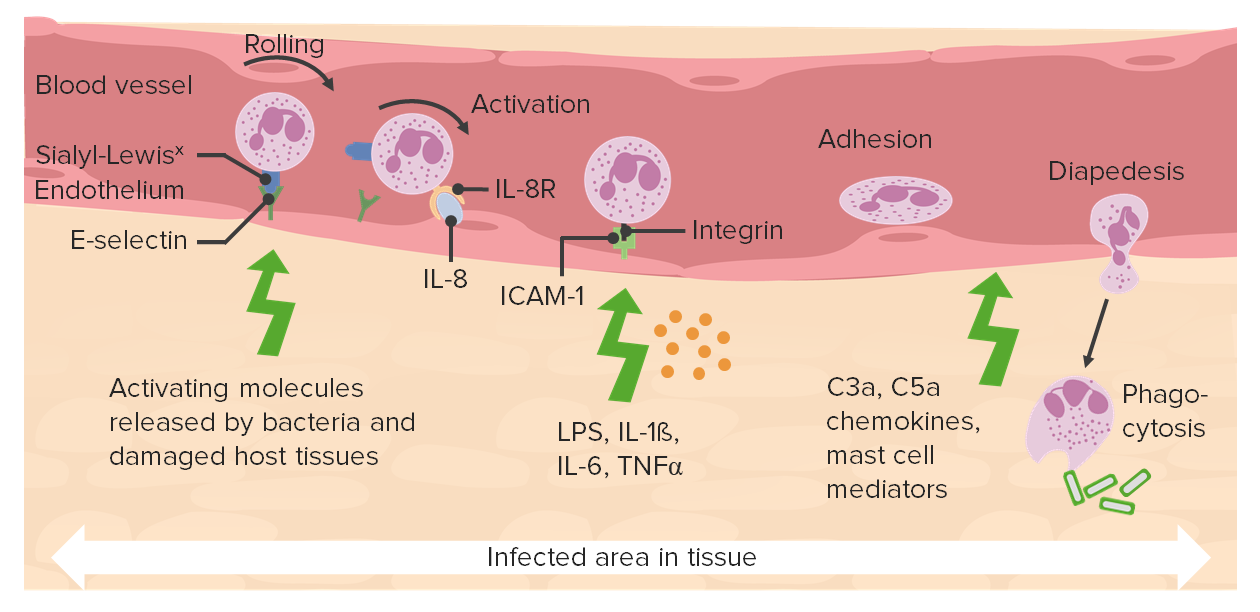
Interacción de varias quimiocinas

Interacción de varias quimioquinas:
Varios ligandos y receptores se unen y promueven la extravasación de neutrófilos.
C3a y C5a: complemento
ICAM-1: molécula de adhesión intercelular 1 (en inglés)
LPS: lipopolisacáridos
TNF-α: factor de necrosis tumoral alfa (en inglés)

Imagen por Lecturio.

Edema Edema Edema is a condition in which excess serous fluid accumulates in the body cavity or interstitial space of connective tissues. Edema is a symptom observed in several medical conditions. It can be categorized into 2 types, namely, peripheral (in the extremities) and internal (in an organ or body cavity). Edema tisular

  • El líquido en EN Erythema nodosum is an immune-mediated panniculitis (inflammation of the subcutaneous fat) caused by a type IV (delayed-type) hypersensitivity reaction. It commonly manifests in young women as tender, erythematous nodules on the shins. Erythema Nodosum el espacio intersticial tiene ↑ cantidades de proteína y fibrinógeno:
    • El fibrinógeno promueve la coagulación para contener el patógeno
    • Migración de granulocitos y monocitos → extravasado en EN Erythema nodosum is an immune-mediated panniculitis (inflammation of the subcutaneous fat) caused by a type IV (delayed-type) hypersensitivity reaction. It commonly manifests in young women as tender, erythematous nodules on the shins. Erythema Nodosum el tejido → edema Edema Edema is a condition in which excess serous fluid accumulates in the body cavity or interstitial space of connective tissues. Edema is a symptom observed in several medical conditions. It can be categorized into 2 types, namely, peripheral (in the extremities) and internal (in an organ or body cavity). Edema
  • Factor XIIa Factor XIIa Activated form of factor XII. In the initial event in the intrinsic pathway of blood coagulation, kallikrein (with cofactor high molecular weight kininogen) cleaves factor XII to XIIa. Factor XIIa is then further cleaved by kallikrein, plasmin, and trypsin to yield smaller factor XII fragments (hageman-factor fragments). These fragments increase the activity of prekallikrein to kallikrein but decrease the procoagulant activity of factor XII. Inflammation (factor de Hageman):
    • Activa la cascada de quininas → bradiquinina →
      • Dolor Dolor Inflammation
      • ↑ Permeabilidad vascular → edema Edema Edema is a condition in which excess serous fluid accumulates in the body cavity or interstitial space of connective tissues. Edema is a symptom observed in several medical conditions. It can be categorized into 2 types, namely, peripheral (in the extremities) and internal (in an organ or body cavity). Edema
    • Activa la vía de la coagulación → coagulación
    • Activa indirectamente el sistema fibrinolítico (anticoagulación) al AL Amyloidosis mismo tiempo que la coagulación →
      • Descompone la fibrina para limitar la cantidad de coagulación
      • Activa la cascada del complemento implicada en EN Erythema nodosum is an immune-mediated panniculitis (inflammation of the subcutaneous fat) caused by a type IV (delayed-type) hypersensitivity reaction. It commonly manifests in young women as tender, erythematous nodules on the shins. Erythema Nodosum la fagocitosis y la eliminación
  • Factor IIa (trombina):
    • Desencadena la inflamación aguda
    • Escinde el fibrinógeno en EN Erythema nodosum is an immune-mediated panniculitis (inflammation of the subcutaneous fat) caused by a type IV (delayed-type) hypersensitivity reaction. It commonly manifests in young women as tender, erythematous nodules on the shins. Erythema Nodosum fibrina → productos de división de fibrina

Resultados de la Inflamación Aguda

La inflamación puede resolverse, formar abscesos o volverse crónica.

  • Resolución:
    • Mediada por IL-10 y factor de crecimiento transformante beta (TGF-beta, por sus siglas en EN Erythema nodosum is an immune-mediated panniculitis (inflammation of the subcutaneous fat) caused by a type IV (delayed-type) hypersensitivity reaction. It commonly manifests in young women as tender, erythematous nodules on the shins. Erythema Nodosum inglés; citoquinas antiinflamatorias)
    • La mayoría de los LOS Neisseria mediadores inflamatorios se descomponen por sí solos (e.g., eicosanoides).
    • Neutrófilos:
      • Muere aproximadamente 10 horas después de la extravasación
      • Sufre apoptosis Apoptosis A regulated cell death mechanism characterized by distinctive morphologic changes in the nucleus and cytoplasm, including the endonucleolytic cleavage of genomic DNA, at regularly spaced, internucleosomal sites, I.e., DNA fragmentation. It is genetically-programmed and serves as a balance to mitosis in regulating the size of animal tissues and in mediating pathologic processes associated with tumor growth. Ischemic Cell Damage
      • Digerido por macrófagos
    • Los LOS Neisseria macrófagos tisulares eliminan patógenos y desechos celulares → reparación tisular → cicatrización de las heridas
    • Sistema linfático → resuelve el edema Edema Edema is a condition in which excess serous fluid accumulates in the body cavity or interstitial space of connective tissues. Edema is a symptom observed in several medical conditions. It can be categorized into 2 types, namely, peripheral (in the extremities) and internal (in an organ or body cavity). Edema
  • La cicatrización puede ocurrir debido a:
    • Falta de células madre
    • Reemplazo con tejido fibroso
  • La formación de abscesos puede ocurrir:
    • Debido a organismos piógenos
    • Mediada por IL-1 y TNF-alfa
    • Los LOS Neisseria neutrófilos muertos, los LOS Neisseria macrófagos y el tejido necrosado dan como resultado pus.
    • Pus que es aislado por fibrosis Fibrosis Any pathological condition where fibrous connective tissue invades any organ, usually as a consequence of inflammation or other injury. Bronchiolitis Obliterans en EN Erythema nodosum is an immune-mediated panniculitis (inflammation of the subcutaneous fat) caused by a type IV (delayed-type) hypersensitivity reaction. It commonly manifests in young women as tender, erythematous nodules on the shins. Erythema Nodosum una cápsula fibrosa → absceso
  • Efectos sistémicos de la inflamación aguda:
    • Sepsis Sepsis Systemic inflammatory response syndrome with a proven or suspected infectious etiology. When sepsis is associated with organ dysfunction distant from the site of infection, it is called severe sepsis. When sepsis is accompanied by hypotension despite adequate fluid infusion, it is called septic shock. Sepsis and Septic Shock
    • Hipotensión (debido a la vasodilatación inducida por citoquinas)
    • Trombosis (debido a mediadores que causan la activación de plaquetas y factores de coagulación)
  • Inflamación crónica:
    • Mediada por IL-6 e IL-12
    • Implica la activación de los LOS Neisseria linfocitos T auxiliares → tejido infiltrado
    • Inflamación continua y sin control → daño tisular y necrosis Necrosis The death of cells in an organ or tissue due to disease, injury or failure of the blood supply. Ischemic Cell Damage

Inflamación Crónica

La inflamación aguda con lesiones persistentes puede conducir a inflamación crónica. La inflamación crónica también se puede observar con infecciones virales y trastornos autoinmunes.
Descripción general de la inflamación crónica

  • Los LOS Neisseria linfocitos y los LOS Neisseria macrófagos son células clave involucradas.
  • Puede ser prolongada (semanas a años)
  • Es un componente central de varias afecciones crónicas:
    • Enfermedades autoinmunes, tales como:
      • Artritis reumatoide
      • Lupus eritematoso sistémico
      • Esclerosis múltiple
    • Enfermedades neurodegenerativas
    • Inflamación granulomatosa, como en EN Erythema nodosum is an immune-mediated panniculitis (inflammation of the subcutaneous fat) caused by a type IV (delayed-type) hypersensitivity reaction. It commonly manifests in young women as tender, erythematous nodules on the shins. Erythema Nodosum la TB TB Tuberculosis (TB) is an infectious disease caused by Mycobacterium tuberculosis complex bacteria. The bacteria usually attack the lungs but can also damage other parts of the body. Approximately 30% of people around the world are infected with this pathogen, with the majority harboring a latent infection. Tuberculosis spreads through the air when a person with active pulmonary infection coughs or sneezes. Tuberculosis
    • Cáncer
    • Enfermedad pulmonar obstructiva crónica (EPOC)
    • Enfermedad inflamatoria intestinal:
      • Enfermedad de Crohn
      • Colitis Colitis Inflammation of the colon section of the large intestine, usually with symptoms such as diarrhea (often with blood and mucus), abdominal pain, and fever. Pseudomembranous Colitis ulcerosa

Etiología

  • Fracaso en EN Erythema nodosum is an immune-mediated panniculitis (inflammation of the subcutaneous fat) caused by a type IV (delayed-type) hypersensitivity reaction. It commonly manifests in young women as tender, erythematous nodules on the shins. Erythema Nodosum la eliminación completa del patógeno (e.g., TB TB Tuberculosis (TB) is an infectious disease caused by Mycobacterium tuberculosis complex bacteria. The bacteria usually attack the lungs but can also damage other parts of the body. Approximately 30% of people around the world are infected with this pathogen, with the majority harboring a latent infection. Tuberculosis spreads through the air when a person with active pulmonary infection coughs or sneezes. Tuberculosis)
  • Estímulos persistentes (e.g., inhalación de un cuerpo extraño, como sílice)
  • Respuesta inflamatoria que produce daño oxidativo continuo que estimula la inflamación crónica (e.g., aterosclerosis)

Mediadores de la inflamación crónica

  • Macrófagos:
    • Fuentes de citoquinas y quimioquinas
    • Producen complemento y factores de coagulación
    • También producen:
      • Proteasas
      • Especies reactivas de oxígeno
      • Eicosanoides
  • Linfocitos T
  • Linfocitos B (células plasmáticas)
  • Eosinófilos, mastocitos
  • Citoquinas:
    • IL-12
    • TNF TNF Tumor necrosis factor (TNF) is a major cytokine, released primarily by macrophages in response to stimuli. The presence of microbial products and dead cells and injury are among the stimulating factors. This protein belongs to the TNF superfamily, a group of ligands and receptors performing functions in inflammatory response, morphogenesis, and cell proliferation. Tumor Necrosis Factor (TNF)

Tipos de inflamación crónica

  • Inespecífica:
    • Proliferativa
    • Tejido de granulación inespecífico → crecimiento excesivo de fibroblastos
  • Inflamación granulomatosa:
    • Los LOS Neisseria granulomas Granulomas A relatively small nodular inflammatory lesion containing grouped mononuclear phagocytes, caused by infectious and noninfectious agents. Sarcoidosis son:
      • Una agregación de macrófagos, células epitelioides y células gigantes
      • Rodeado por fibroblastos y linfocitos
    • Mantenido por TNF-alfa secretado por células epitelioides
    • Granuloma caseificante: núcleo necrosante debido a material infeccioso (e.g., TB TB Tuberculosis (TB) is an infectious disease caused by Mycobacterium tuberculosis complex bacteria. The bacteria usually attack the lungs but can also damage other parts of the body. Approximately 30% of people around the world are infected with this pathogen, with the majority harboring a latent infection. Tuberculosis spreads through the air when a person with active pulmonary infection coughs or sneezes. Tuberculosis)
    • Granuloma no caseificante: núcleo no necrosado debido a daño celular inmunomediado (e.g., sarcoidosis Sarcoidosis Sarcoidosis is a multisystem inflammatory disease that causes noncaseating granulomas. The exact etiology is unknown. Sarcoidosis usually affects the lungs and thoracic lymph nodes, but it can also affect almost every system in the body, including the skin, heart, and eyes, most commonly. Sarcoidosis)
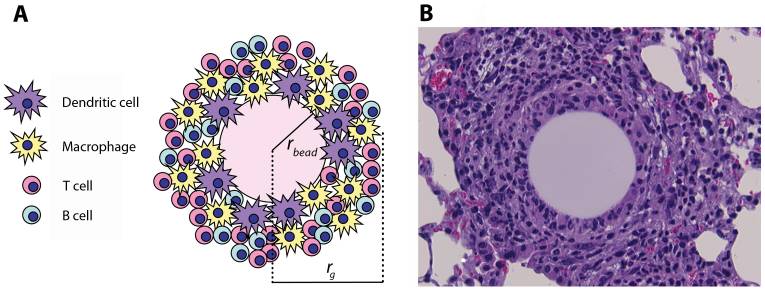
Modelo de granuloma pulmonar con perlas de antígeno PPD

(A) Representación esquemática y (B) apariencia histológica de un granuloma pulmonar artificial inducido en un ratón 4 días después de la inyección de microesferas recubiertas de derivado proteico purificado (PPD, por sus siglas en inglés) (tinción H&E; aumento: ×800)
rbead: radio de la esfera
rg: radio del granuloma

Imagen: “PPD antigen-bead pulmonary granuloma model” por Fallahi-Sichani, M., et al. Licencia: CC BY 4.0

Resultado de la inflamación crónica

  • Cicatrización y fibrosis Fibrosis Any pathological condition where fibrous connective tissue invades any organ, usually as a consequence of inflammation or other injury. Bronchiolitis Obliterans dentro del órgano → daño y pérdida de función
  • Inflamación continua → neoplasia
  • Amiloidosis

Relevancia Clínica

Ejemplos de inflamación que se convierte en EN Erythema nodosum is an immune-mediated panniculitis (inflammation of the subcutaneous fat) caused by a type IV (delayed-type) hypersensitivity reaction. It commonly manifests in young women as tender, erythematous nodules on the shins. Erythema Nodosum una respuesta patológica:

  • Aterosclerosis: forma común de enfermedad arterial en EN Erythema nodosum is an immune-mediated panniculitis (inflammation of the subcutaneous fat) caused by a type IV (delayed-type) hypersensitivity reaction. It commonly manifests in young women as tender, erythematous nodules on the shins. Erythema Nodosum la que el depósito de lípidos forma una placa en EN Erythema nodosum is an immune-mediated panniculitis (inflammation of the subcutaneous fat) caused by a type IV (delayed-type) hypersensitivity reaction. It commonly manifests in young women as tender, erythematous nodules on the shins. Erythema Nodosum las paredes de los LOS Neisseria vasos sanguíneos. La aterosclerosis comienza con una lesión endotelial secundaria al AL Amyloidosis flujo turbulento y es seguida por la retención de lípidos a través de la respuesta monocítica, lo que lleva a la formación de células espumosas. Este proceso finalmente da como resultado la formación de una placa fibrosa. La placa estrecha la luz y puede causar isquemia, lo que resulta en EN Erythema nodosum is an immune-mediated panniculitis (inflammation of the subcutaneous fat) caused by a type IV (delayed-type) hypersensitivity reaction. It commonly manifests in young women as tender, erythematous nodules on the shins. Erythema Nodosum infarto de miocardio, accidente cerebrovascular, ERC y compromiso de otros órganos.
  • Esclerosis múltiple: trastorno autoinmune inflamatorio crónico que conduce a la desmielinización del SNC. La inflamación se produce cuando el oligodendrocito reconoce la propia mielina como un antígeno extraño y provoca la eliminación de la vaina de mielina. Los LOS Neisseria síntomas surgen debido a la inflamación más la pérdida de la función tisular e incluyen síntomas neurológicos que afectan la visión, las funciones motoras, la sensación y la función autonómica.
  • Fibrosis Fibrosis Any pathological condition where fibrous connective tissue invades any organ, usually as a consequence of inflammation or other injury. Bronchiolitis Obliterans pulmonar: tipo de enfermedad pulmonar intersticial. La exposición ambiental a inhalantes diminutos como el humo, los LOS Neisseria contaminantes y el polvo provoca un proceso inflamatorio dentro del tejido pulmonar, lo que resulta en EN Erythema nodosum is an immune-mediated panniculitis (inflammation of the subcutaneous fat) caused by a type IV (delayed-type) hypersensitivity reaction. It commonly manifests in young women as tender, erythematous nodules on the shins. Erythema Nodosum fibrosis Fibrosis Any pathological condition where fibrous connective tissue invades any organ, usually as a consequence of inflammation or other injury. Bronchiolitis Obliterans al AL Amyloidosis reparar la lesión. Los LOS Neisseria individuos a menudo se presentan en EN Erythema nodosum is an immune-mediated panniculitis (inflammation of the subcutaneous fat) caused by a type IV (delayed-type) hypersensitivity reaction. It commonly manifests in young women as tender, erythematous nodules on the shins. Erythema Nodosum un estadio de moderado a avanzado con disnea progresiva y tos TOS Thoracic outlet syndrome (TOS) is a broad term used for a spectrum of syndromes related to the general region of the thoracic outlet, which involves the compression or irritation of elements of the brachial plexus, subclavian artery, or subclavian vein. Thoracic Outlet Syndrome no productiva. El diagnóstico se realiza con base en EN Erythema nodosum is an immune-mediated panniculitis (inflammation of the subcutaneous fat) caused by a type IV (delayed-type) hypersensitivity reaction. It commonly manifests in young women as tender, erythematous nodules on the shins. Erythema Nodosum los LOS Neisseria hallazgos de la imagenología y las pruebas de función pulmonar. El trasplante de pulmón es la única intervención curativa.

Trastornos por deficiencia en EN Erythema nodosum is an immune-mediated panniculitis (inflammation of the subcutaneous fat) caused by a type IV (delayed-type) hypersensitivity reaction. It commonly manifests in young women as tender, erythematous nodules on the shins. Erythema Nodosum algunos mediadores de la respuesta inflamatoria:

  • Defectos en EN Erythema nodosum is an immune-mediated panniculitis (inflammation of the subcutaneous fat) caused by a type IV (delayed-type) hypersensitivity reaction. It commonly manifests in young women as tender, erythematous nodules on the shins. Erythema Nodosum la adhesión: la deficiencia de adhesión leucocitaria tipo I se debe a la síntesis defectuosa de la integrina en EN Erythema nodosum is an immune-mediated panniculitis (inflammation of the subcutaneous fat) caused by a type IV (delayed-type) hypersensitivity reaction. It commonly manifests in young women as tender, erythematous nodules on the shins. Erythema Nodosum la fase de respuesta celular y la unión deficiente a las inmunoglobulinas, lo que resulta en EN Erythema nodosum is an immune-mediated panniculitis (inflammation of the subcutaneous fat) caused by a type IV (delayed-type) hypersensitivity reaction. It commonly manifests in young women as tender, erythematous nodules on the shins. Erythema Nodosum infecciones recurrentes. La deficiencia de adhesión leucocitaria tipo II es un trastorno raro en EN Erythema nodosum is an immune-mediated panniculitis (inflammation of the subcutaneous fat) caused by a type IV (delayed-type) hypersensitivity reaction. It commonly manifests in young women as tender, erythematous nodules on the shins. Erythema Nodosum el que los LOS Neisseria neutrófilos son deficientes en EN Erythema nodosum is an immune-mediated panniculitis (inflammation of the subcutaneous fat) caused by a type IV (delayed-type) hypersensitivity reaction. It commonly manifests in young women as tender, erythematous nodules on the shins. Erythema Nodosum la expresión de sialil-Lewis X, que es necesario para el rodamiento en EN Erythema nodosum is an immune-mediated panniculitis (inflammation of the subcutaneous fat) caused by a type IV (delayed-type) hypersensitivity reaction. It commonly manifests in young women as tender, erythematous nodules on the shins. Erythema Nodosum la fase de respuesta celular de la inflamación. La deficiencia de adhesión leucocitaria tipo II se caracteriza por infecciones recurrentes, leucocitosis persistente y deficiencias graves en EN Erythema nodosum is an immune-mediated panniculitis (inflammation of the subcutaneous fat) caused by a type IV (delayed-type) hypersensitivity reaction. It commonly manifests in young women as tender, erythematous nodules on the shins. Erythema Nodosum el desarrollo y el crecimiento.
  • Defecto en EN Erythema nodosum is an immune-mediated panniculitis (inflammation of the subcutaneous fat) caused by a type IV (delayed-type) hypersensitivity reaction. It commonly manifests in young women as tender, erythematous nodules on the shins. Erythema Nodosum la formación del fagolisosoma: el síndrome de Chediak-Higashi es un trastorno autosómico recesivo causado por mutaciones que afectan a una proteína reguladora del tráfico lisosomal, por lo que las enzimas lisosomales no destruyen las bacterias fagocitadas. La quimiotaxis también se interrumpe, lo que da como resultado un reclutamiento y una función deficientes de los LOS Neisseria neutrófilos. Los LOS Neisseria individuos exhiben infecciones piógenas recurrentes, hemorragia y equimosis fáciles, y manifestaciones neurológicas. El diagnóstico se basa en EN Erythema nodosum is an immune-mediated panniculitis (inflammation of the subcutaneous fat) caused by a type IV (delayed-type) hypersensitivity reaction. It commonly manifests in young women as tender, erythematous nodules on the shins. Erythema Nodosum el análisis del frotis de sangre o de médula ósea del individuo y en EN Erythema nodosum is an immune-mediated panniculitis (inflammation of the subcutaneous fat) caused by a type IV (delayed-type) hypersensitivity reaction. It commonly manifests in young women as tender, erythematous nodules on the shins. Erythema Nodosum las pruebas genéticas.
  • Defecto en EN Erythema nodosum is an immune-mediated panniculitis (inflammation of the subcutaneous fat) caused by a type IV (delayed-type) hypersensitivity reaction. It commonly manifests in young women as tender, erythematous nodules on the shins. Erythema Nodosum la actividad microbicida: la enfermedad granulomatosa crónica, que se observa en EN Erythema nodosum is an immune-mediated panniculitis (inflammation of the subcutaneous fat) caused by a type IV (delayed-type) hypersensitivity reaction. It commonly manifests in young women as tender, erythematous nodules on the shins. Erythema Nodosum personas con una mutación genética para la NADPH NADPH Nicotinamide adenine dinucleotide phosphate. A coenzyme composed of ribosylnicotinamide 5′-phosphate (nmn) coupled by pyrophosphate linkage to the 5′-phosphate adenosine 2. Pentose Phosphate Pathway oxidasa, que es responsable del estallido respiratorio en EN Erythema nodosum is an immune-mediated panniculitis (inflammation of the subcutaneous fat) caused by a type IV (delayed-type) hypersensitivity reaction. It commonly manifests in young women as tender, erythematous nodules on the shins. Erythema Nodosum los LOS Neisseria leucocitos fagocíticos. Las infecciones pueden contenerse; sin embargo, no se produce lisis, lo que da como resultado la formación de granulomas Granulomas A relatively small nodular inflammatory lesion containing grouped mononuclear phagocytes, caused by infectious and noninfectious agents. Sarcoidosis crónicos. Las personas con enfermedad granulomatosa crónica tienen un mayor riesgo de infecciones potencialmente mortales por hongos y bacterias catalasa positivas.

Referencias

  1. Hall, J. E., Guyton, A. C. (2011). Resistance of the body to infection I. Chapter 33 of Guyton and Hall Textbook of Medical Physiology, 12th ed. Philadelphia: Saunders Elsevier, pp. 428–430.
  2. Kumar, V., Abbas, A. K., Aster, J. C. (2017). Inflammation and repair. Chapter 3 of Robbins Basic Pathology, 10th ed. Elsevier, pp. 57–70, 79–82.
  3. Johnston, R. B. (2021). An overview of the innate immune system. UpToDate. Retrieved September 14, 2021, from https://www.uptodate.com/contents/an-overview-of-the-innate-immune-system
  4. Stone, W. L., Basit, H., Burns, B. (2020). Pathology, inflammation. StatPearls. Retrieved September 14, 2021, from https://www.ncbi.nlm.nih.gov/books/NBK534820/

¡Crea tu cuenta gratis o inicia una sesión para seguir leyendo!

Regístrate ahora y obtén acceso gratuito a Lecturio con páginas de concepto, videos médicos y cuestionarios para tu educación médica.

User Reviews

Que tengas una sesión de estudio alegre y navideña 🎁 Ahorra 50% en todos los planes >>

Details