
Domina Conceptos Médicos

Estudia para la escuela de medicina y tus examenes con Lecturio.

Hipogonadismo

El hipogonadismo es una condición caracterizada por una producción reducida o nula de hormonas sexuales por parte de los LOS Neisseria testículos o los LOS Neisseria ovarios. El hipogonadismo puede ser consecuencia de una falla primaria (hipergonadotrópica) o secundaria (hipogonadotrópica). El hipogonadismo hipergonadotrópico ocurre cuando las gónadas no producen hormonas sexuales, y el hipogonadismo hipogonadotrópico resulta de fallos en EN Erythema nodosum is an immune-mediated panniculitis (inflammation of the subcutaneous fat) caused by a type IV (delayed-type) hypersensitivity reaction. It commonly manifests in young women as tender, erythematous nodules on the shins. Erythema Nodosum el eje hipotálamo–hipófisis–gónadas. Los LOS Neisseria síntomas incluyen infertilidad, mayor riesgo de osteoporosis Osteoporosis Osteoporosis refers to a decrease in bone mass and density leading to an increased number of fractures. There are 2 forms of osteoporosis: primary, which is commonly postmenopausal or senile; and secondary, which is a manifestation of immobilization, underlying medical disorders, or long-term use of certain medications. Osteoporosis, disfunción eréctil, disminución de la libido y regresión (o ausencia) de los LOS Neisseria caracteres sexuales secundarios. El diagnóstico se basa en EN Erythema nodosum is an immune-mediated panniculitis (inflammation of the subcutaneous fat) caused by a type IV (delayed-type) hypersensitivity reaction. It commonly manifests in young women as tender, erythematous nodules on the shins. Erythema Nodosum los LOS Neisseria antecedentes clínicos, el examen físico, la medición de los LOS Neisseria niveles hormonales y la evaluación de la etiología subyacente. El tratamiento es con terapia de reemplazo hormonal.

Last updated: Dec 15, 2025

Editorial responsibility: Stanley Oiseth, Lindsay Jones, Evelin Maza

Descripción General

Definición

El hipogonadismo es una condición en EN Erythema nodosum is an immune-mediated panniculitis (inflammation of the subcutaneous fat) caused by a type IV (delayed-type) hypersensitivity reaction. It commonly manifests in young women as tender, erythematous nodules on the shins. Erythema Nodosum la que hay una disminución de la producción de hormonas sexuales por los LOS Neisseria testículos o los LOS Neisseria ovarios.
Etiología

  • Hipogonadismo hipergonadotrópico (hipogonadismo primario) en EN Erythema nodosum is an immune-mediated panniculitis (inflammation of the subcutaneous fat) caused by a type IV (delayed-type) hypersensitivity reaction. It commonly manifests in young women as tender, erythematous nodules on the shins. Erythema Nodosum varones:
    • Síndrome de Klinefelter
    • Criptorquidia
    • Tratamiento previo de quimioterapia o radioterapia
    • Anorquia bilateral congénita
    • Traumatismo testicular
    • Gonadectomía
    • Defectos en EN Erythema nodosum is an immune-mediated panniculitis (inflammation of the subcutaneous fat) caused by a type IV (delayed-type) hypersensitivity reaction. It commonly manifests in young women as tender, erythematous nodules on the shins. Erythema Nodosum la determinación testicular: disgenesia gonadal
    • Síndrome de Sertoli solo
    • Resistencia a la hormona luteinizante ( LH LH A major gonadotropin secreted by the adenohypophysis. Luteinizing hormone regulates steroid production by the interstitial cells of the testis and the ovary. The preovulatory luteinizing hormone surge in females induces ovulation, and subsequent luteinization of the follicle. Luteinizing hormone consists of two noncovalently linked subunits, alpha and beta. Within a species, the alpha subunit is common in the three pituitary glycoprotein hormones (TSH, LH, and FSH), but the beta subunit is unique and confers its biological specificity. Menstrual Cycle, por sus siglas en EN Erythema nodosum is an immune-mediated panniculitis (inflammation of the subcutaneous fat) caused by a type IV (delayed-type) hypersensitivity reaction. It commonly manifests in young women as tender, erythematous nodules on the shins. Erythema Nodosum inglés)
    • Virus Virus Viruses are infectious, obligate intracellular parasites composed of a nucleic acid core surrounded by a protein capsid. Viruses can be either naked (non-enveloped) or enveloped. The classification of viruses is complex and based on many factors, including type and structure of the nucleoid and capsid, the presence of an envelope, the replication cycle, and the host range. Virology de la papera
    • Trastornos de la síntesis de andrógenos:
      • Deficiencia de 17β-hidroxilasa deshidrogenada
      • Deficiencia de 5α-reductasa
      • Deficiencia de 17-hidroxilasa
  • Hipogonadismo hipergonadotrópico (hipogonadismo primario) en EN Erythema nodosum is an immune-mediated panniculitis (inflammation of the subcutaneous fat) caused by a type IV (delayed-type) hypersensitivity reaction. It commonly manifests in young women as tender, erythematous nodules on the shins. Erythema Nodosum mujeres:
    • Síndrome de Turner
    • Disgenesia gonadal XX y XY
    • Insuficiencia ovárica primaria
    • Ooforitis autoinmune
    • Galactosemia Galactosemia Galactosemia is a disorder caused by defects in galactose metabolism. Galactosemia is an inherited, autosomal-recessive condition, which results in inadequate galactose processing and high blood levels of monosaccharide. The rare disorder often presents in infants with symptoms of lethargy, nausea, vomiting, diarrhea, and jaundice. Galactosemia
    • Mutaciones del gen del receptor Receptor Receptors are proteins located either on the surface of or within a cell that can bind to signaling molecules known as ligands (e.g., hormones) and cause some type of response within the cell. Receptors de la hormona foliculoestimulante ( FSH FSH A major gonadotropin secreted by the adenohypophysis. Follicle-stimulating hormone stimulates gametogenesis and the supporting cells such as the ovarian granulosa cells, the testicular sertoli cells, and leydig cells. Fsh consists of two noncovalently linked subunits, alpha and beta. Within a species, the alpha subunit is common in the three pituitary glycoprotein hormones (TSH, LH, and FSH), but the beta subunit is unique and confers its biological specificity. Menstrual Cycle, por sus siglas en EN Erythema nodosum is an immune-mediated panniculitis (inflammation of the subcutaneous fat) caused by a type IV (delayed-type) hypersensitivity reaction. It commonly manifests in young women as tender, erythematous nodules on the shins. Erythema Nodosum inglés)
    • Resistencia a la LH LH A major gonadotropin secreted by the adenohypophysis. Luteinizing hormone regulates steroid production by the interstitial cells of the testis and the ovary. The preovulatory luteinizing hormone surge in females induces ovulation, and subsequent luteinization of the follicle. Luteinizing hormone consists of two noncovalently linked subunits, alpha and beta. Within a species, the alpha subunit is common in the three pituitary glycoprotein hormones (TSH, LH, and FSH), but the beta subunit is unique and confers its biological specificity. Menstrual Cycle o a la gonadotropina coriónica humana (hCG, por sus siglas en EN Erythema nodosum is an immune-mediated panniculitis (inflammation of the subcutaneous fat) caused by a type IV (delayed-type) hypersensitivity reaction. It commonly manifests in young women as tender, erythematous nodules on the shins. Erythema Nodosum inglés)
    • Síndrome de Noonan
    • Tratamiento previo de quimioterapia o radioterapia
  • Hipogonadismo hipogonadotrópico (hipogonadismo secundario): alteración del eje hormonal del hipotálamo o de la hipófisis
    • Sarcoidosis Sarcoidosis Sarcoidosis is a multisystem inflammatory disease that causes noncaseating granulomas. The exact etiology is unknown. Sarcoidosis usually affects the lungs and thoracic lymph nodes, but it can also affect almost every system in the body, including the skin, heart, and eyes, most commonly. Sarcoidosis
    • Hemocromatosis
    • Tuberculosis Tuberculosis Tuberculosis (TB) is an infectious disease caused by Mycobacterium tuberculosis complex bacteria. The bacteria usually attack the lungs but can also damage other parts of the body. Approximately 30% of people around the world are infected with this pathogen, with the majority harboring a latent infection. Tuberculosis spreads through the air when a person with active pulmonary infection coughs or sneezes. Tuberculosis
    • Medicamentos:
      • Analgésicos opiáceos
      • Glucocorticoides
      • Leuprolide Leuprolide A potent synthetic long-acting agonist of gonadotropin-releasing hormone that regulates the synthesis and release of pituitary gonadotropins, luteinizing hormone and follicle stimulating hormone. Antiestrogens
    • Tumores hipotalámicos o hipofisarios (adenoma hipofisario)
    • Trastornos congénitos:
      • Síndrome de Kallmann
      • Síndrome de Prader-Willi
      • Síndrome de Angelman
      • Enfermedad de Gaucher
    • Otros trastornos:
      • Trastornos alimentarios
      • Hipogonadismo inducido por el ejercicio
      • Hiperprolactinemia
      • Síndrome de Cushing
      • VIH/SIDA
      • Obesidad mórbida
      • Diabetes Diabetes Diabetes mellitus (DM) is a metabolic disease characterized by hyperglycemia and dysfunction of the regulation of glucose metabolism by insulin. Type 1 DM is diagnosed mostly in children and young adults as the result of autoimmune destruction of β cells in the pancreas and the resulting lack of insulin. Type 2 DM has a significant association with obesity and is characterized by insulin resistance. Diabetes Mellitus mellitus tipo 2

Epidemiología

  • El hipogonadismo puede aparecer a cualquier edad.
  • A menudo no es reportado
  • Hipogonadismo primario:
    • La causa más común en EN Erythema nodosum is an immune-mediated panniculitis (inflammation of the subcutaneous fat) caused by a type IV (delayed-type) hypersensitivity reaction. It commonly manifests in young women as tender, erythematous nodules on the shins. Erythema Nodosum las mujeres es el síndrome de Turner (incidencia: 1 de cada 2 000–2 500 nacidos vivos).
    • La causa más común en EN Erythema nodosum is an immune-mediated panniculitis (inflammation of the subcutaneous fat) caused by a type IV (delayed-type) hypersensitivity reaction. It commonly manifests in young women as tender, erythematous nodules on the shins. Erythema Nodosum los LOS Neisseria hombres es el síndrome de Klinefelter (incidencia: 1 de cada 600 nacidos vivos).
    • Hombres > mujeres (porque la incidencia del síndrome de Klinefelter > la incidencia del síndrome de Turner)
  • Hipogonadismo secundario:
    • Menos común que el hipogonadismo primario
    • Incidencia: 1 de cada 10 000–86 000 personas
    • Hombres = mujeres
    • El síndrome de Kallmann causa aproximadamente ⅔ de los LOS Neisseria casos congénitos.

Fisiopatología

Fisiología normal

  • Las gónadas forman parte del eje hipotálamo–hipófisis–gónadas, que funciona como un circuito de retroalimentación negativa:
    • Un generador de impulsos hipotalámico en EN Erythema nodosum is an immune-mediated panniculitis (inflammation of the subcutaneous fat) caused by a type IV (delayed-type) hypersensitivity reaction. It commonly manifests in young women as tender, erythematous nodules on the shins. Erythema Nodosum el núcleo arqueado → libera la hormona liberadora de gonadotropina en EN Erythema nodosum is an immune-mediated panniculitis (inflammation of the subcutaneous fat) caused by a type IV (delayed-type) hypersensitivity reaction. It commonly manifests in young women as tender, erythematous nodules on the shins. Erythema Nodosum el sistema portal hipotalámico–hipofisario
    • La hipófisis anterior segrega FSH FSH A major gonadotropin secreted by the adenohypophysis. Follicle-stimulating hormone stimulates gametogenesis and the supporting cells such as the ovarian granulosa cells, the testicular sertoli cells, and leydig cells. Fsh consists of two noncovalently linked subunits, alpha and beta. Within a species, the alpha subunit is common in the three pituitary glycoprotein hormones (TSH, LH, and FSH), but the beta subunit is unique and confers its biological specificity. Menstrual Cycle y LH LH A major gonadotropin secreted by the adenohypophysis. Luteinizing hormone regulates steroid production by the interstitial cells of the testis and the ovary. The preovulatory luteinizing hormone surge in females induces ovulation, and subsequent luteinization of the follicle. Luteinizing hormone consists of two noncovalently linked subunits, alpha and beta. Within a species, the alpha subunit is common in the three pituitary glycoprotein hormones (TSH, LH, and FSH), but the beta subunit is unique and confers its biological specificity. Menstrual Cycle → estimula la actividad gonadal → producción de hormonas sexuales (e.g., testosterona, estrógeno)
    • ↑ Hormonas gonadales → ↓ secreción de FSH FSH A major gonadotropin secreted by the adenohypophysis. Follicle-stimulating hormone stimulates gametogenesis and the supporting cells such as the ovarian granulosa cells, the testicular sertoli cells, and leydig cells. Fsh consists of two noncovalently linked subunits, alpha and beta. Within a species, the alpha subunit is common in the three pituitary glycoprotein hormones (TSH, LH, and FSH), but the beta subunit is unique and confers its biological specificity. Menstrual Cycle y LH LH A major gonadotropin secreted by the adenohypophysis. Luteinizing hormone regulates steroid production by the interstitial cells of the testis and the ovary. The preovulatory luteinizing hormone surge in females induces ovulation, and subsequent luteinization of the follicle. Luteinizing hormone consists of two noncovalently linked subunits, alpha and beta. Within a species, the alpha subunit is common in the three pituitary glycoprotein hormones (TSH, LH, and FSH), but the beta subunit is unique and confers its biological specificity. Menstrual Cycle a nivel hipofisario → completa un circuito de retroalimentación.
  • En EN Erythema nodosum is an immune-mediated panniculitis (inflammation of the subcutaneous fat) caused by a type IV (delayed-type) hypersensitivity reaction. It commonly manifests in young women as tender, erythematous nodules on the shins. Erythema Nodosum los LOS Neisseria hombres (testículos):
    • LH LH A major gonadotropin secreted by the adenohypophysis. Luteinizing hormone regulates steroid production by the interstitial cells of the testis and the ovary. The preovulatory luteinizing hormone surge in females induces ovulation, and subsequent luteinization of the follicle. Luteinizing hormone consists of two noncovalently linked subunits, alpha and beta. Within a species, the alpha subunit is common in the three pituitary glycoprotein hormones (TSH, LH, and FSH), but the beta subunit is unique and confers its biological specificity. Menstrual Cycle → Las células de Leydig secretan testosterona.
    • FSH FSH A major gonadotropin secreted by the adenohypophysis. Follicle-stimulating hormone stimulates gametogenesis and the supporting cells such as the ovarian granulosa cells, the testicular sertoli cells, and leydig cells. Fsh consists of two noncovalently linked subunits, alpha and beta. Within a species, the alpha subunit is common in the three pituitary glycoprotein hormones (TSH, LH, and FSH), but the beta subunit is unique and confers its biological specificity. Menstrual Cycle → crecimiento tubular
  • En EN Erythema nodosum is an immune-mediated panniculitis (inflammation of the subcutaneous fat) caused by a type IV (delayed-type) hypersensitivity reaction. It commonly manifests in young women as tender, erythematous nodules on the shins. Erythema Nodosum las mujeres (ovarios):
    • LH LH A major gonadotropin secreted by the adenohypophysis. Luteinizing hormone regulates steroid production by the interstitial cells of the testis and the ovary. The preovulatory luteinizing hormone surge in females induces ovulation, and subsequent luteinization of the follicle. Luteinizing hormone consists of two noncovalently linked subunits, alpha and beta. Within a species, the alpha subunit is common in the three pituitary glycoprotein hormones (TSH, LH, and FSH), but the beta subunit is unique and confers its biological specificity. Menstrual Cycle → células de la teca e intersticiales → producen progestinas y andrógenos
    • FSH FSH A major gonadotropin secreted by the adenohypophysis. Follicle-stimulating hormone stimulates gametogenesis and the supporting cells such as the ovarian granulosa cells, the testicular sertoli cells, and leydig cells. Fsh consists of two noncovalently linked subunits, alpha and beta. Within a species, the alpha subunit is common in the three pituitary glycoprotein hormones (TSH, LH, and FSH), but the beta subunit is unique and confers its biological specificity. Menstrual Cycle → células de la granulosa → esteroides precursores del estrógeno
Resumen del eje hipotálamo-hipófisis-ovario

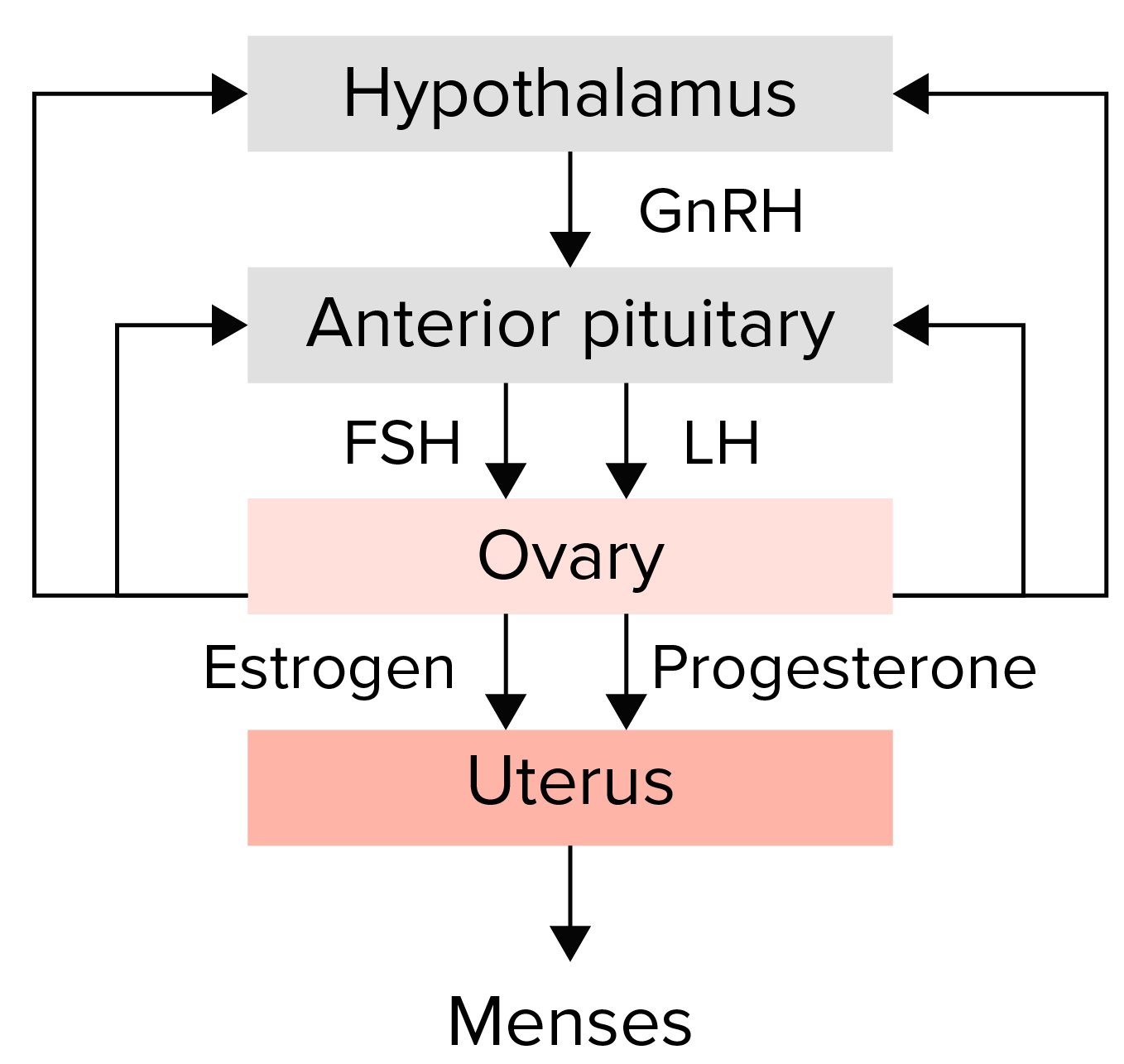
Resumen del eje hipotálamo–hipófisis–ovario:
El hipotálamo secreta la hormona liberadora de gonadotropinas, que estimula a la hipófisis anterior para que libere las hormonas gonadotropinas foliculoestimulante (FSH) y luteinizante (LH). A continuación, las gonadotropinas estimulan al ovario para que produzca estrógenos y progesterona, que a su vez provocan el crecimiento y la maduración del endometrio. Cualquier alteración en esta vía podría conducir a la amenorrea.

Imagen por Lecturio. Licencia: CC BY-NC-SA 4.0

Hipogonadismo

El hipogonadismo se produce si el eje hipotálamo–hipofisario–gonadal se interrumpe a cualquier nivel.
  • Primario (hipogonadismo hipergonadotrópico):
    • La gónada no produce una cantidad de esteroides sexuales suficiente para suprimir la LH LH A major gonadotropin secreted by the adenohypophysis. Luteinizing hormone regulates steroid production by the interstitial cells of the testis and the ovary. The preovulatory luteinizing hormone surge in females induces ovulation, and subsequent luteinization of the follicle. Luteinizing hormone consists of two noncovalently linked subunits, alpha and beta. Within a species, the alpha subunit is common in the three pituitary glycoprotein hormones (TSH, LH, and FSH), but the beta subunit is unique and confers its biological specificity. Menstrual Cycle y la FSH FSH A major gonadotropin secreted by the adenohypophysis. Follicle-stimulating hormone stimulates gametogenesis and the supporting cells such as the ovarian granulosa cells, the testicular sertoli cells, and leydig cells. Fsh consists of two noncovalently linked subunits, alpha and beta. Within a species, the alpha subunit is common in the three pituitary glycoprotein hormones (TSH, LH, and FSH), but the beta subunit is unique and confers its biological specificity. Menstrual Cycle.
    • Niveles hormonales: ↑ LH LH A major gonadotropin secreted by the adenohypophysis. Luteinizing hormone regulates steroid production by the interstitial cells of the testis and the ovary. The preovulatory luteinizing hormone surge in females induces ovulation, and subsequent luteinization of the follicle. Luteinizing hormone consists of two noncovalently linked subunits, alpha and beta. Within a species, the alpha subunit is common in the three pituitary glycoprotein hormones (TSH, LH, and FSH), but the beta subunit is unique and confers its biological specificity. Menstrual Cycle y FSH FSH A major gonadotropin secreted by the adenohypophysis. Follicle-stimulating hormone stimulates gametogenesis and the supporting cells such as the ovarian granulosa cells, the testicular sertoli cells, and leydig cells. Fsh consists of two noncovalently linked subunits, alpha and beta. Within a species, the alpha subunit is common in the three pituitary glycoprotein hormones (TSH, LH, and FSH), but the beta subunit is unique and confers its biological specificity. Menstrual Cycle (por falta de retroalimentación), ↓ hormona sexual.
  • Secundario (hipogonadismo hipogonadotrópico):
    • Ocurre por:
      • Fallo del generador de impulsos hipotalámicos de hormona liberadora de gonadotropinas, o
      • Incapacidad de la hipófisis para responder segregando LH LH A major gonadotropin secreted by the adenohypophysis. Luteinizing hormone regulates steroid production by the interstitial cells of the testis and the ovary. The preovulatory luteinizing hormone surge in females induces ovulation, and subsequent luteinization of the follicle. Luteinizing hormone consists of two noncovalently linked subunits, alpha and beta. Within a species, the alpha subunit is common in the three pituitary glycoprotein hormones (TSH, LH, and FSH), but the beta subunit is unique and confers its biological specificity. Menstrual Cycle y FSH FSH A major gonadotropin secreted by the adenohypophysis. Follicle-stimulating hormone stimulates gametogenesis and the supporting cells such as the ovarian granulosa cells, the testicular sertoli cells, and leydig cells. Fsh consists of two noncovalently linked subunits, alpha and beta. Within a species, the alpha subunit is common in the three pituitary glycoprotein hormones (TSH, LH, and FSH), but the beta subunit is unique and confers its biological specificity. Menstrual Cycle
    • Niveles hormonales: ↓ hormona liberadora de gonadotropinas, LH LH A major gonadotropin secreted by the adenohypophysis. Luteinizing hormone regulates steroid production by the interstitial cells of the testis and the ovary. The preovulatory luteinizing hormone surge in females induces ovulation, and subsequent luteinization of the follicle. Luteinizing hormone consists of two noncovalently linked subunits, alpha and beta. Within a species, the alpha subunit is common in the three pituitary glycoprotein hormones (TSH, LH, and FSH), but the beta subunit is unique and confers its biological specificity. Menstrual Cycle, FSH FSH A major gonadotropin secreted by the adenohypophysis. Follicle-stimulating hormone stimulates gametogenesis and the supporting cells such as the ovarian granulosa cells, the testicular sertoli cells, and leydig cells. Fsh consists of two noncovalently linked subunits, alpha and beta. Within a species, the alpha subunit is common in the three pituitary glycoprotein hormones (TSH, LH, and FSH), but the beta subunit is unique and confers its biological specificity. Menstrual Cycle y hormonas sexuales
    • Lo más habitual es que se causado por malformaciones en EN Erythema nodosum is an immune-mediated panniculitis (inflammation of the subcutaneous fat) caused by a type IV (delayed-type) hypersensitivity reaction. It commonly manifests in young women as tender, erythematous nodules on the shins. Erythema Nodosum el desarrollo de la hipófisis o a lesiones de la misma adquiridas.
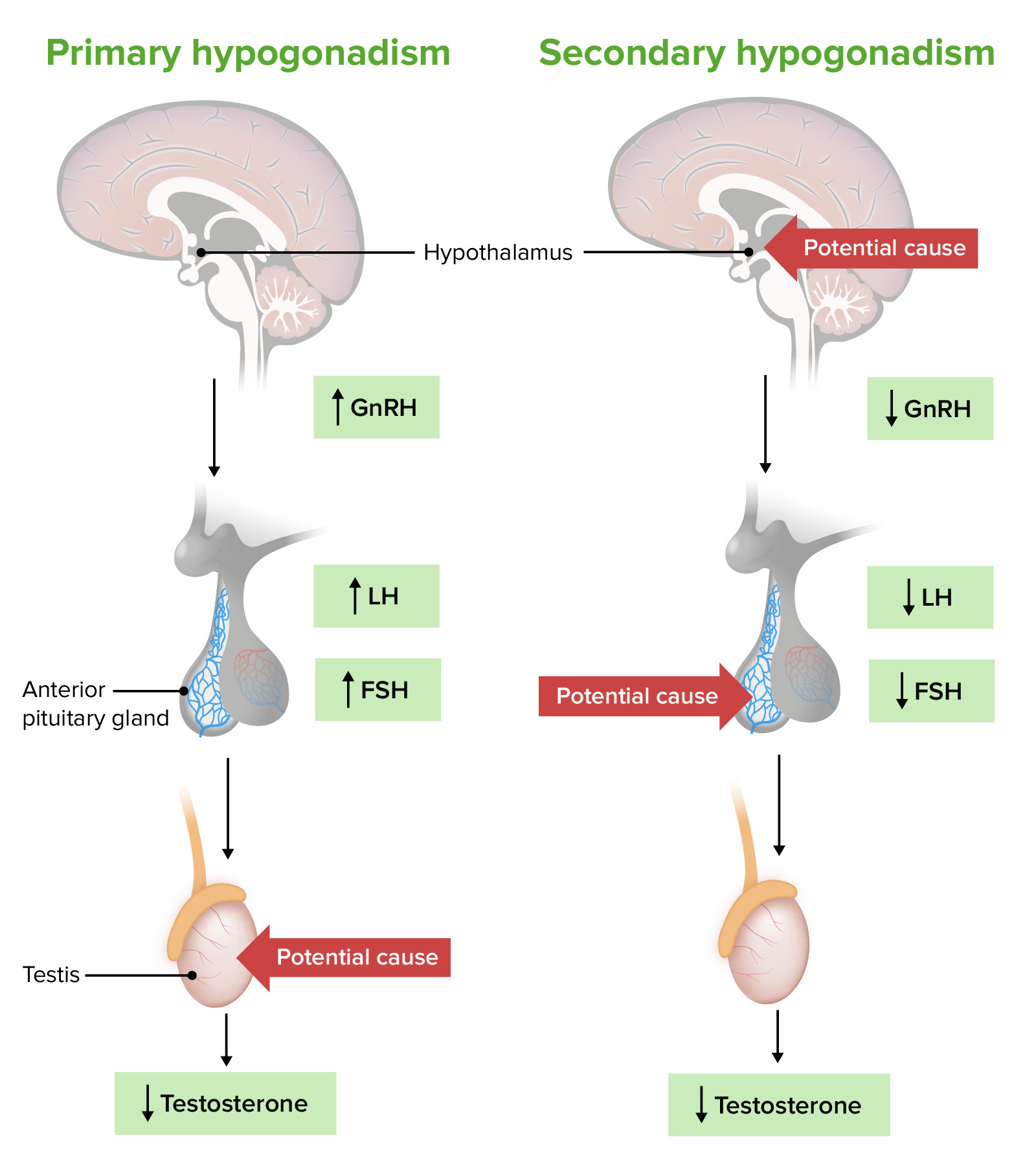
Patogénesis del hipogonadismo primario frente al secundario

Patogénesis del hipogonadismo primario frente al secundario:
El hipogonadismo primario es el resultado de un problema en los testículos (o en los ovarios), que provoca una disminución de la producción de hormonas sexuales a pesar de los niveles adecuados (o elevados) de la hormona liberadora de gonadotropina, la hormona luteinizante (LH) y la hormona foliculoestimulante (FSH).
En el hipogonadismo secundario, un problema en el hipotálamo o la hipófisis provoca una disminución de la hormona liberadora de gonadotropina, la LH y la FSH, lo que da lugar a una menor producción de hormonas sexuales (a pesar de que los testículos o los ovarios sean normales).

Imagen por Lecturio. Licencia: CC BY-NC-SA 4.0

Related videos

Presentación Clínica

La presentación clínica varía según la edad de inicio y el sexo.

Presentación en EN Erythema nodosum is an immune-mediated panniculitis (inflammation of the subcutaneous fat) caused by a type IV (delayed-type) hypersensitivity reaction. It commonly manifests in young women as tender, erythematous nodules on the shins. Erythema Nodosum los LOS Neisseria hombres

  • Hombres prepúberes:
    • Eunucoidismo
    • Vello corporal escaso
    • Ausencia o regresión de los LOS Neisseria caracteres sexuales secundarios
    • La voz no se profundiza
    • Desarrollo deficiente de la masa muscular esquelética
    • Retraso en EN Erythema nodosum is an immune-mediated panniculitis (inflammation of the subcutaneous fat) caused by a type IV (delayed-type) hypersensitivity reaction. It commonly manifests in young women as tender, erythematous nodules on the shins. Erythema Nodosum el cierre epifisario → brazos y piernas largos
  • Hombres pospúberes:
    • Falta de energía
    • ↓ Libido
    • Disfunción eréctil
    • Depresión
    • ↓ Masa muscular
    • ↓ Vello corporal
    • ↓ Masa ósea
    • Ginecomastia (más probable en EN Erythema nodosum is an immune-mediated panniculitis (inflammation of the subcutaneous fat) caused by a type IV (delayed-type) hypersensitivity reaction. It commonly manifests in young women as tender, erythematous nodules on the shins. Erythema Nodosum el hipogonadismo primario)
    • Infertilidad (↓ número de espermatozoides)

Presentación en EN Erythema nodosum is an immune-mediated panniculitis (inflammation of the subcutaneous fat) caused by a type IV (delayed-type) hypersensitivity reaction. It commonly manifests in young women as tender, erythematous nodules on the shins. Erythema Nodosum mujeres

  • Mujeres prepúberes:
    • Falla en EN Erythema nodosum is an immune-mediated panniculitis (inflammation of the subcutaneous fat) caused by a type IV (delayed-type) hypersensitivity reaction. It commonly manifests in young women as tender, erythematous nodules on the shins. Erythema Nodosum el progreso de la pubertad
    • Ausencia o regresión de los LOS Neisseria caracteres sexuales secundarios
    • Amenorrea primaria
  • Mujeres pospúberes:
    • Amenorrea secundaria
    • Infertilidad
    • Fatiga
    • ↓ Libido

Diagnóstico y Tratamiento

Evaluación de laboratorio

Hombres:

  • Pruebas iniciales:
    • ↓ Testosterona sérica:
      • Momento óptimo: por la mañana (debido a la variación diurna)
      • Si es anormal, debe volver a medirse en EN Erythema nodosum is an immune-mediated panniculitis (inflammation of the subcutaneous fat) caused by a type IV (delayed-type) hypersensitivity reaction. It commonly manifests in young women as tender, erythematous nodules on the shins. Erythema Nodosum 1–2 ocasiones distintas.
    • Los LOS Neisseria niveles de FSH FSH A major gonadotropin secreted by the adenohypophysis. Follicle-stimulating hormone stimulates gametogenesis and the supporting cells such as the ovarian granulosa cells, the testicular sertoli cells, and leydig cells. Fsh consists of two noncovalently linked subunits, alpha and beta. Within a species, the alpha subunit is common in the three pituitary glycoprotein hormones (TSH, LH, and FSH), but the beta subunit is unique and confers its biological specificity. Menstrual Cycle y LH LH A major gonadotropin secreted by the adenohypophysis. Luteinizing hormone regulates steroid production by the interstitial cells of the testis and the ovary. The preovulatory luteinizing hormone surge in females induces ovulation, and subsequent luteinization of the follicle. Luteinizing hormone consists of two noncovalently linked subunits, alpha and beta. Within a species, the alpha subunit is common in the three pituitary glycoprotein hormones (TSH, LH, and FSH), but the beta subunit is unique and confers its biological specificity. Menstrual Cycle permiten diferenciar entre hipogonadismo primario y secundario:
      • Aumento: hipogonadismo primario
      • Disminución: hipogonadismo secundario
  • Si se trata de hipogonadismo primario:
    • ¿Se conoce la etiología (e.g., quimioterapia, antecedentes de orquitis por paperas)?
    • Si no es así → análisis del cariotipo
  • Si le preocupa el hipogonadismo secundario:
    • Prolactina
    • Función tiroidea
    • Cortisol Cortisol Glucocorticoids matutino
    • Niveles de hierro y ferritina
    • Pruebas genéticas
  • Evaluación de la fertilidad: análisis de semen

Mujeres:

  • Empieza siempre con una prueba de embarazo en EN Erythema nodosum is an immune-mediated panniculitis (inflammation of the subcutaneous fat) caused by a type IV (delayed-type) hypersensitivity reaction. It commonly manifests in young women as tender, erythematous nodules on the shins. Erythema Nodosum orina o una prueba cualitativa de hCG para descartar el embarazo.
  • FSH FSH A major gonadotropin secreted by the adenohypophysis. Follicle-stimulating hormone stimulates gametogenesis and the supporting cells such as the ovarian granulosa cells, the testicular sertoli cells, and leydig cells. Fsh consists of two noncovalently linked subunits, alpha and beta. Within a species, the alpha subunit is common in the three pituitary glycoprotein hormones (TSH, LH, and FSH), but the beta subunit is unique and confers its biological specificity. Menstrual Cycle, LH LH A major gonadotropin secreted by the adenohypophysis. Luteinizing hormone regulates steroid production by the interstitial cells of the testis and the ovary. The preovulatory luteinizing hormone surge in females induces ovulation, and subsequent luteinization of the follicle. Luteinizing hormone consists of two noncovalently linked subunits, alpha and beta. Within a species, the alpha subunit is common in the three pituitary glycoprotein hormones (TSH, LH, and FSH), but the beta subunit is unique and confers its biological specificity. Menstrual Cycle y estradiol Estradiol The 17-beta-isomer of estradiol, an aromatized C18 steroid with hydroxyl group at 3-beta- and 17-beta-position. Estradiol-17-beta is the most potent form of mammalian estrogenic steroids. Noncontraceptive Estrogen and Progestins:
    • FSH FSH A major gonadotropin secreted by the adenohypophysis. Follicle-stimulating hormone stimulates gametogenesis and the supporting cells such as the ovarian granulosa cells, the testicular sertoli cells, and leydig cells. Fsh consists of two noncovalently linked subunits, alpha and beta. Within a species, the alpha subunit is common in the three pituitary glycoprotein hormones (TSH, LH, and FSH), but the beta subunit is unique and confers its biological specificity. Menstrual Cycle y LH LH A major gonadotropin secreted by the adenohypophysis. Luteinizing hormone regulates steroid production by the interstitial cells of the testis and the ovary. The preovulatory luteinizing hormone surge in females induces ovulation, and subsequent luteinization of the follicle. Luteinizing hormone consists of two noncovalently linked subunits, alpha and beta. Within a species, the alpha subunit is common in the three pituitary glycoprotein hormones (TSH, LH, and FSH), but the beta subunit is unique and confers its biological specificity. Menstrual Cycle, ↓ estradiol Estradiol The 17-beta-isomer of estradiol, an aromatized C18 steroid with hydroxyl group at 3-beta- and 17-beta-position. Estradiol-17-beta is the most potent form of mammalian estrogenic steroids. Noncontraceptive Estrogen and Progestins: hipogonadismo primario
    • FSH FSH A major gonadotropin secreted by the adenohypophysis. Follicle-stimulating hormone stimulates gametogenesis and the supporting cells such as the ovarian granulosa cells, the testicular sertoli cells, and leydig cells. Fsh consists of two noncovalently linked subunits, alpha and beta. Within a species, the alpha subunit is common in the three pituitary glycoprotein hormones (TSH, LH, and FSH), but the beta subunit is unique and confers its biological specificity. Menstrual Cycle y LH LH A major gonadotropin secreted by the adenohypophysis. Luteinizing hormone regulates steroid production by the interstitial cells of the testis and the ovary. The preovulatory luteinizing hormone surge in females induces ovulation, and subsequent luteinization of the follicle. Luteinizing hormone consists of two noncovalently linked subunits, alpha and beta. Within a species, the alpha subunit is common in the three pituitary glycoprotein hormones (TSH, LH, and FSH), but the beta subunit is unique and confers its biological specificity. Menstrual Cycle, ↓ estradiol Estradiol The 17-beta-isomer of estradiol, an aromatized C18 steroid with hydroxyl group at 3-beta- and 17-beta-position. Estradiol-17-beta is the most potent form of mammalian estrogenic steroids. Noncontraceptive Estrogen and Progestins: hipogonadismo secundario
  • La evaluación de la etiología es similar a la de los LOS Neisseria hombres.

Imagenología

  • Se debe considerar la posibilidad de realizar una RM del cerebro:
    • Anomalías hormonales hipofisarias (e.g., hiperprolactinemia)
    • Defectos del campo visual
    • Anomalías neurológicas
  • RM de la pelvis Pelvis The pelvis consists of the bony pelvic girdle, the muscular and ligamentous pelvic floor, and the pelvic cavity, which contains viscera, vessels, and multiple nerves and muscles. The pelvic girdle, composed of 2 “hip” bones and the sacrum, is a ring-like bony structure of the axial skeleton that links the vertebral column with the lower extremities. Pelvis: Anatomy o ultrasonido de los LOS Neisseria ovarios en EN Erythema nodosum is an immune-mediated panniculitis (inflammation of the subcutaneous fat) caused by a type IV (delayed-type) hypersensitivity reaction. It commonly manifests in young women as tender, erythematous nodules on the shins. Erythema Nodosum las mujeres con riesgo de agenesia
  • Ultrasonido testicular para:
    • Sospecha de antecedentes de orquitis por paperas
    • Desarrollo anormal de los LOS Neisseria testículos

Tratamiento

  • La causa subyacente debe ser tratada.
  • Terapia de reemplazo hormonal con los LOS Neisseria objetivos de:
    • Promover el desarrollo y mantener los LOS Neisseria caracteres sexuales secundarios con una función sexual normal
    • Construir y mantener una masa ósea y muscular normal
    • Ayudar a una adecuada adaptación psicosocial
  • En EN Erythema nodosum is an immune-mediated panniculitis (inflammation of the subcutaneous fat) caused by a type IV (delayed-type) hypersensitivity reaction. It commonly manifests in young women as tender, erythematous nodules on the shins. Erythema Nodosum los LOS Neisseria hombres: sustitución de testosterona
  • En EN Erythema nodosum is an immune-mediated panniculitis (inflammation of the subcutaneous fat) caused by a type IV (delayed-type) hypersensitivity reaction. It commonly manifests in young women as tender, erythematous nodules on the shins. Erythema Nodosum las mujeres: sustitución de estrógenos
  • El tratamiento con hormona liberadora de gonadotropinas pulsátil ayuda a la fertilidad en EN Erythema nodosum is an immune-mediated panniculitis (inflammation of the subcutaneous fat) caused by a type IV (delayed-type) hypersensitivity reaction. It commonly manifests in young women as tender, erythematous nodules on the shins. Erythema Nodosum el hipogonadismo hipogonadotrópico.

Relevancia Clínica

  • Síndrome de Klinefelter: aneuploidia cromosómica que se caracteriza por la presencia de ≥ 1 cromosoma X adicional en EN Erythema nodosum is an immune-mediated panniculitis (inflammation of the subcutaneous fat) caused by a type IV (delayed-type) hypersensitivity reaction. It commonly manifests in young women as tender, erythematous nodules on the shins. Erythema Nodosum un cariotipo masculino, lo que suele dar lugar al AL Amyloidosis cariotipo 47, XXY XXY Klinefelter syndrome is a chromosomal aneuploidy characterized by the presence of 1 or more extra X chromosomes in a male karyotype, most commonly leading to karyotype 47,XXY. Klinefelter syndrome is associated with decreased levels of testosterone and is the most common cause of congenital hypogonadism. Klinefelter Syndrome. Los LOS Neisseria pacientes se presentan como hombres altos y fenotípicos, con testículos pequeños, disminución del vello corporal, ginecomastia e infertilidad. El tratamiento consiste en EN Erythema nodosum is an immune-mediated panniculitis (inflammation of the subcutaneous fat) caused by a type IV (delayed-type) hypersensitivity reaction. It commonly manifests in young women as tender, erythematous nodules on the shins. Erythema Nodosum una terapia de reemplazo de testosterona de por vida.
  • Criptorquidia: una de las anomalías congénitas más frecuentes en EN Erythema nodosum is an immune-mediated panniculitis (inflammation of the subcutaneous fat) caused by a type IV (delayed-type) hypersensitivity reaction. It commonly manifests in young women as tender, erythematous nodules on the shins. Erythema Nodosum los LOS Neisseria niños pequeños. Normalmente, esta condición asintomática se presenta durante un examen rutinario del niño sano, en EN Erythema nodosum is an immune-mediated panniculitis (inflammation of the subcutaneous fat) caused by a type IV (delayed-type) hypersensitivity reaction. It commonly manifests in young women as tender, erythematous nodules on the shins. Erythema Nodosum el que uno o ambos testículos no son palpables en EN Erythema nodosum is an immune-mediated panniculitis (inflammation of the subcutaneous fat) caused by a type IV (delayed-type) hypersensitivity reaction. It commonly manifests in young women as tender, erythematous nodules on the shins. Erythema Nodosum el escroto. Si el testículo es palpable, pero no en EN Erythema nodosum is an immune-mediated panniculitis (inflammation of the subcutaneous fat) caused by a type IV (delayed-type) hypersensitivity reaction. It commonly manifests in young women as tender, erythematous nodules on the shins. Erythema Nodosum la localización intraescrotal dependiente, el tratamiento consiste en EN Erythema nodosum is an immune-mediated panniculitis (inflammation of the subcutaneous fat) caused by a type IV (delayed-type) hypersensitivity reaction. It commonly manifests in young women as tender, erythematous nodules on the shins. Erythema Nodosum una orquiopexia (llevar el testículo al AL Amyloidosis escroto).
  • Adenomas hipofisarios: tumores que se desarrollan en EN Erythema nodosum is an immune-mediated panniculitis (inflammation of the subcutaneous fat) caused by a type IV (delayed-type) hypersensitivity reaction. It commonly manifests in young women as tender, erythematous nodules on the shins. Erythema Nodosum el lóbulo anterior de la hipófisis. Los LOS Neisseria adenomas no funcionales o no secretores no secretan hormonas, pero comprimen el tejido hipofisario circundante, lo que provoca hipopituitarismo. Los LOS Neisseria adenomas secretores secretan diversas hormonas en EN Erythema nodosum is an immune-mediated panniculitis (inflammation of the subcutaneous fat) caused by a type IV (delayed-type) hypersensitivity reaction. It commonly manifests in young women as tender, erythematous nodules on the shins. Erythema Nodosum función del tipo de célula del que proceden, lo que provoca un hiperpituitarismo. El diagnóstico se confirma con imagenología. El tratamiento depende del tipo de adenoma, pero puede incluir la resección quirúrgica, la radiación y los LOS Neisseria agonistas de dopamina.
  • Virus Virus Viruses are infectious, obligate intracellular parasites composed of a nucleic acid core surrounded by a protein capsid. Viruses can be either naked (non-enveloped) or enveloped. The classification of viruses is complex and based on many factors, including type and structure of the nucleoid and capsid, the presence of an envelope, the replication cycle, and the host range. Virology de la parotiditis: causado por un virus Virus Viruses are infectious, obligate intracellular parasites composed of a nucleic acid core surrounded by a protein capsid. Viruses can be either naked (non-enveloped) or enveloped. The classification of viruses is complex and based on many factors, including type and structure of the nucleoid and capsid, the presence of an envelope, the replication cycle, and the host range. Virology de ARN de sentido negativo, lineal y monocatenario de la familia Paramyxoviridae Paramyxoviridae A family of spherical viruses, of the order mononegavirales, somewhat larger than the orthomyxoviruses, and containing single-stranded RNA. Subfamilies include paramyxoviridae and pneumovirinae. Respiratory Syncytial Virus. La papera se manifiestan inicialmente con fiebre, dolor Dolor Inflammation muscular, cefalea, falta de apetito, sensación de malestar general y parotitis Parotitis Inflammation of the parotid gland. Mumps Virus/Mumps. Entre las complicaciones se encuentran la meningitis Meningitis Meningitis is inflammation of the meninges, the protective membranes of the brain, and spinal cord. The causes of meningitis are varied, with the most common being bacterial or viral infection. The classic presentation of meningitis is a triad of fever, altered mental status, and nuchal rigidity. Meningitis, la pancreatitis Pancreatitis Inflammation of the pancreas. Pancreatitis is classified as acute unless there are computed tomographic or endoscopic retrograde cholangiopancreatographic findings of chronic pancreatitis. The two most common forms of acute pancreatitis are alcoholic pancreatitis and gallstone pancreatitis. Acute Pancreatitis, la sordera y la inflamación testicular, que puede provocar infertilidad. La infección se trata con cuidados de soporte y se puede prevenir con la vacunación.
  • Síndrome de Turner: condición genética que afecta a las mujeres, en EN Erythema nodosum is an immune-mediated panniculitis (inflammation of the subcutaneous fat) caused by a type IV (delayed-type) hypersensitivity reaction. It commonly manifests in young women as tender, erythematous nodules on the shins. Erythema Nodosum la que falta parcial o totalmente un cromosoma X. El resultado clásico es el cariotipo 45,X0 con un fenotipo femenino. El aspecto característico es el de baja estatura, cuello alado, tórax ancho, pezones muy espaciados, amenorrea y edema Edema Edema is a condition in which excess serous fluid accumulates in the body cavity or interstitial space of connective tissues. Edema is a symptom observed in several medical conditions. It can be categorized into 2 types, namely, peripheral (in the extremities) and internal (in an organ or body cavity). Edema periférico de manos y pies. Las pruebas genéticas confirman el diagnóstico. El tratamiento consiste en EN Erythema nodosum is an immune-mediated panniculitis (inflammation of the subcutaneous fat) caused by a type IV (delayed-type) hypersensitivity reaction. It commonly manifests in young women as tender, erythematous nodules on the shins. Erythema Nodosum una terapia de reemplazo hormonal.

Referencias

  1. Vogiatzi, M. (2024). Hypogonadism treatment & management. Medscape. Retrieved October 12, 2025, from https://emedicine.medscape.com/article/922038-treatment#d7
  2. Snyder, P. (2025). Clinical features and diagnosis of male hypogonadism. UpToDate. Retrieved October 12, 2025, from https://www.uptodate.com/contents/clinical-features-and-diagnosis-of-male-hypogonadism
  3. Snyder, P. (2024). Causes of primary hypogonadism in males. UpToDate. Retrieved October 12, 2025, from https://www.uptodate.com/contents/causes-of-primary-hypogonadism-in-males
  4. Snyder, P. J. (2024). Causes of secondary (hypogonadotropic) hypogonadism in males. In K. A. Martin (Ed.), UpToDate. Retrieved October 12, 2025, from https://www.uptodate.com/contents/causes-of-secondary-hypogonadotropic-hypogonadism-in-males
  5. Welt, C., Barbieri, R. (2024). Evaluation and management of primary amenorrhea. UpToDate. Retrieved October 12, 2025, from https://www.uptodate.com/contents/evaluation-and-management-of-primary-amenorrhea
  6. Welt, C., Barbieri, R. (2023). Epidemiology and causes of secondary amenorrhea. UpToDate. Retrieved October 12, 2025, from https://www.uptodate.com/contents/epidemiology-and-causes-of-secondary-amenorrhea
  7. Jimbo, M. (2025, April). Male hypogonadism. MSD Manual Professional Version. Retrieved October 12, 2025, from https://www.msdmanuals.com/professional/genitourinary-disorders/male-reproductive-endocrinology-and-related-disorders/male-hypogonadism
  8. Sizar, O., Schwartz, J. (2024). Hypogonadism. StatPearls. Retrieved October 12, 2025, from https://www.ncbi.nlm.nih.gov/books/NBK532933/

¡Crea tu cuenta gratis o inicia una sesión para seguir leyendo!

Regístrate ahora y obtén acceso gratuito a Lecturio con páginas de concepto, videos médicos y cuestionarios para tu educación médica.

User Reviews

Que tengas una sesión de estudio alegre y navideña 🎁 Ahorra 50% en todos los planes >>

Details