Domina Conceptos Médicos

Estudia para la escuela de medicina y tus examenes con Lecturio.

Glomerulonefritis Postinfecciosa

La glomerulonefritis postestreptocócica es un tipo de nefritis clásicamente causada por una infección previa por estreptococo beta-hemolítico del grupo A. La presentación clínica de la glomerulonefritis postestreptocócica puede variar desde hematuria Hematuria Presence of blood in the urine. Renal Cell Carcinoma microscópica hasta el síndrome nefrítico agudo completo, que se caracteriza por orina de color rojo a marrón, proteinuria Proteinuria The presence of proteins in the urine, an indicator of kidney diseases. Nephrotic Syndrome in Children, edema Edema Edema is a condition in which excess serous fluid accumulates in the body cavity or interstitial space of connective tissues. Edema is a symptom observed in several medical conditions. It can be categorized into 2 types, namely, peripheral (in the extremities) and internal (in an organ or body cavity). Edema e insuficiencia renal aguda. El diagnóstico se basa en EN Erythema nodosum is an immune-mediated panniculitis (inflammation of the subcutaneous fat) caused by a type IV (delayed-type) hypersensitivity reaction. It commonly manifests in young women as tender, erythematous nodules on the shins. Erythema Nodosum los LOS Neisseria hallazgos clínicos en EN Erythema nodosum is an immune-mediated panniculitis (inflammation of the subcutaneous fat) caused by a type IV (delayed-type) hypersensitivity reaction. It commonly manifests in young women as tender, erythematous nodules on the shins. Erythema Nodosum el contexto de una infección reciente por estreptococo beta-hemolítico del grupo A. El manejo es de soporte e implica el tratamiento de las manifestaciones clínicas. El pronóstico es generalmente favorable (especialmente en EN Erythema nodosum is an immune-mediated panniculitis (inflammation of the subcutaneous fat) caused by a type IV (delayed-type) hypersensitivity reaction. It commonly manifests in young women as tender, erythematous nodules on the shins. Erythema Nodosum niños), típicamente con resolución espontánea.

Last updated: Dec 15, 2025
Editorial responsibility: Stanley Oiseth, Lindsay Jones, Evelin Maza

Descripción General

Definición

  • La glomerulonefritis postinfecciosa se ha HA Hemolytic anemia (HA) is the term given to a large group of anemias that are caused by the premature destruction/hemolysis of circulating red blood cells (RBCs). Hemolysis can occur within (intravascular hemolysis) or outside the blood vessels (extravascular hemolysis). Hemolytic Anemia referido tradicionalmente a la glomerulonefritis postestreptocócica, que es una secuela tardía, mediada inmunológicamente, de la faringitis clínica o de las infecciones cutáneas causadas por estreptococo del grupo A.
  • En EN Erythema nodosum is an immune-mediated panniculitis (inflammation of the subcutaneous fat) caused by a type IV (delayed-type) hypersensitivity reaction. It commonly manifests in young women as tender, erythematous nodules on the shins. Erythema Nodosum los LOS Neisseria países desarrollados y en EN Erythema nodosum is an immune-mediated panniculitis (inflammation of the subcutaneous fat) caused by a type IV (delayed-type) hypersensitivity reaction. It commonly manifests in young women as tender, erythematous nodules on the shins. Erythema Nodosum los LOS Neisseria individuos de mayor edad, la glomerulonefritis postinfecciosa se observa con mayor frecuencia tras una infección por Staphylococcus Staphylococcus Staphylococcus is a medically important genera of Gram-positive, aerobic cocci. These bacteria form clusters resembling grapes on culture plates. Staphylococci are ubiquitous for humans, and many strains compose the normal skin flora. Staphylococcus y puede aparecer después de infecciones por una variedad de diferentes bacterias o virus Virus Viruses are infectious, obligate intracellular parasites composed of a nucleic acid core surrounded by a protein capsid. Viruses can be either naked (non-enveloped) or enveloped. The classification of viruses is complex and based on many factors, including type and structure of the nucleoid and capsid, the presence of an envelope, the replication cycle, and the host range. Virology.

Epidemiología

  • Edad de presentación
    • Niños entre 5 y 12 años
    • Adultos mayores de 60 años
  • La causa más común de nefritis aguda en EN Erythema nodosum is an immune-mediated panniculitis (inflammation of the subcutaneous fat) caused by a type IV (delayed-type) hypersensitivity reaction. It commonly manifests in young women as tender, erythematous nodules on the shins. Erythema Nodosum todo el mundo, especialmente en EN Erythema nodosum is an immune-mediated panniculitis (inflammation of the subcutaneous fat) caused by a type IV (delayed-type) hypersensitivity reaction. It commonly manifests in young women as tender, erythematous nodules on the shins. Erythema Nodosum los LOS Neisseria países en EN Erythema nodosum is an immune-mediated panniculitis (inflammation of the subcutaneous fat) caused by a type IV (delayed-type) hypersensitivity reaction. It commonly manifests in young women as tender, erythematous nodules on the shins. Erythema Nodosum desarrollo
  • 470 000 nuevos casos al AL Amyloidosis año
  • Incidencia anual de 9,5 a 28,5 por 100 000 personas

Fisiopatología

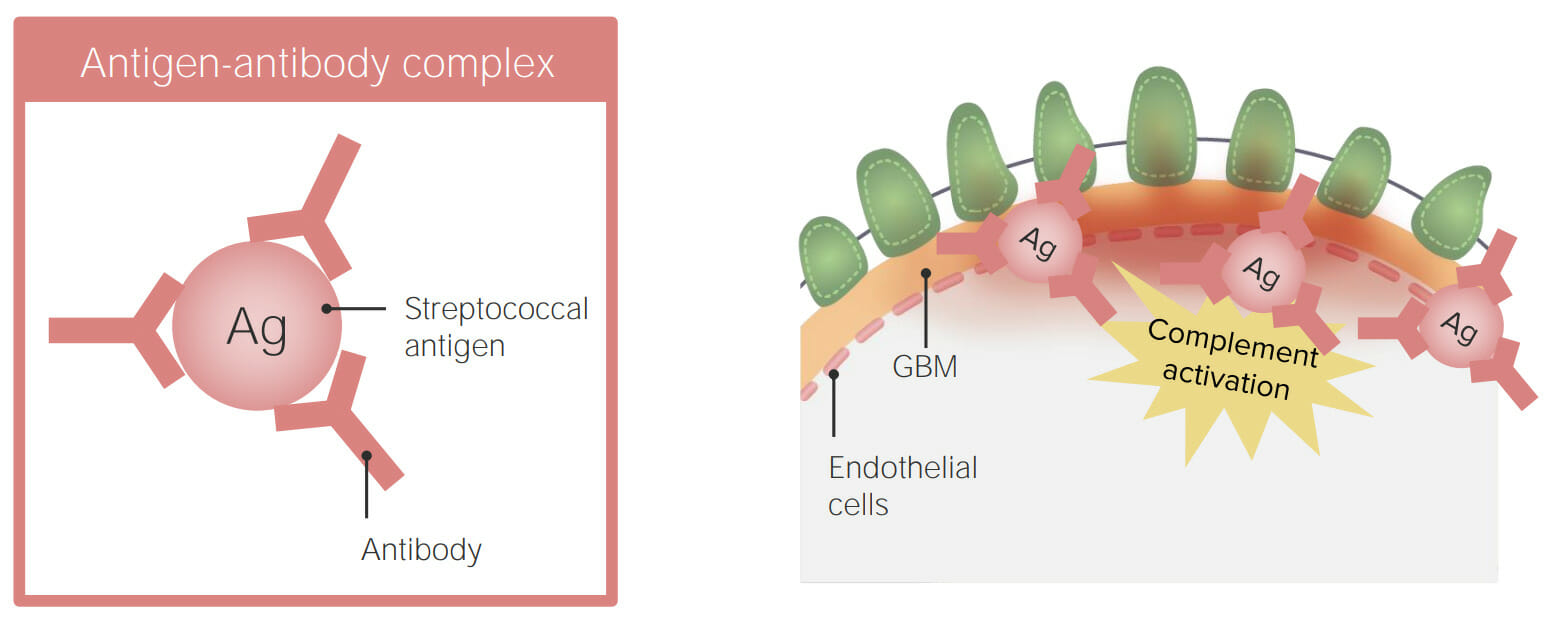
  • Las cepas nefritógenas específicas del estreptococo beta-hemolítico del grupo A (u otros patógenos) pueden provocar el depósito de complejos inmunes circulantes en EN Erythema nodosum is an immune-mediated panniculitis (inflammation of the subcutaneous fat) caused by a type IV (delayed-type) hypersensitivity reaction. It commonly manifests in young women as tender, erythematous nodules on the shins. Erythema Nodosum la membrana basal glomerular.
  • Desencadena la activación del complemento y la inflamación a través de la vía alternativa de activación del complemento (reacción de hipersensibilidad tipo III).
Suspected pathophysiology of postinfectious glomerulonephritis

Sospecha de fisiopatología de la glomerulonefritis postinfecciosa: depósito de inmunocomplejos en la membrana basal glomerular

Imagen por Lecturio.

Presentación Clínica

  • Glomerulonefritis postestreptocócica: Suele aparecer 1-6 semanas después de la infección previa por estreptococo beta-hemolítico del grupo A.
    • Faringitis estreptocócica
    • Fiebre escarlatina
    • Impétigo
  • Glomerulonefritis postinfecciosa asociada a estafilococos (normalmente una infección concurrente):
    • Endocarditis Endocarditis Endocarditis is an inflammatory disease involving the inner lining (endometrium) of the heart, most commonly affecting the cardiac valves. Both infectious and noninfectious etiologies lead to vegetations on the valve leaflets. Patients may present with nonspecific symptoms such as fever and fatigue. Endocarditis
    • Infecciones cutáneas: úlceras, celulitis
    • Osteomielitis
    • Neumonía
  • La presentación varía:
    • Hematuria Hematuria Presence of blood in the urine. Renal Cell Carcinoma microscópica asintomática (más común)
    • Síndrome nefrítico agudo
      • Hematuria Hematuria Presence of blood in the urine. Renal Cell Carcinoma
      • Proteinuria Proteinuria The presence of proteins in the urine, an indicator of kidney diseases. Nephrotic Syndrome in Children
      • Orina de color té
      • Edema Edema Edema is a condition in which excess serous fluid accumulates in the body cavity or interstitial space of connective tissues. Edema is a symptom observed in several medical conditions. It can be categorized into 2 types, namely, peripheral (in the extremities) and internal (in an organ or body cavity). Edema
      • Oliguria Oliguria Decreased urine output that is below the normal range. Oliguria can be defined as urine output of less than or equal to 0. 5 or 1 ml/kg/hr depending on the age. Renal Potassium Regulation
      • Hipertensión
      • Creatinina sérica elevada
    • Se observa glomerulonefritis rápidamente progresiva en EN Erythema nodosum is an immune-mediated panniculitis (inflammation of the subcutaneous fat) caused by a type IV (delayed-type) hypersensitivity reaction. It commonly manifests in young women as tender, erythematous nodules on the shins. Erythema Nodosum el 0,5% de los LOS Neisseria casos.

Diagnóstico

Antecedentes del paciente:

  • Faringitis reciente
  • Infección cutánea reciente
  • Infección concurrente con Staphylococcus Staphylococcus Staphylococcus is a medically important genera of Gram-positive, aerobic cocci. These bacteria form clusters resembling grapes on culture plates. Staphylococci are ubiquitous for humans, and many strains compose the normal skin flora. Staphylococcus

Hallazgos del examen físico:

  • Hipertensión
  • Edema Edema Edema is a condition in which excess serous fluid accumulates in the body cavity or interstitial space of connective tissues. Edema is a symptom observed in several medical conditions. It can be categorized into 2 types, namely, peripheral (in the extremities) and internal (in an organ or body cavity). Edema
  • Oliguria Oliguria Decreased urine output that is below the normal range. Oliguria can be defined as urine output of less than or equal to 0. 5 or 1 ml/kg/hr depending on the age. Renal Potassium Regulation

Hallazgos de laboratorio:

  • Cultivo de garganta o piel positivo reciente para infección por estreptococo del grupo A
  • Pruebas serológicas (prueba de estreptozima) para:
    • Antiestreptolisina-O después de una infección faríngea
    • Antihialuronidasa (AHase)
    • Antinicotinamida-adenina dinucleotidasa (Anti-NAD)
    • Antiestreptoquinasa (ASKase) después de una infección cutánea
    • Anti-DNasa B después de una infección cutánea
  • Si solo se usa el título de antiestreptolisina-O para hacer tamizaje para estreptococo del grupo A, puede ser falsamente negativo.
  • Análisis de orina
  • Otras pruebas
    • ↑ BUN y creatinina
    • ↓ C3 y CH50 CH50 Terminal Complement Pathway Deficiency
    • C2 y C4 habitualmente normales, pueden estar disminuidos en EN Erythema nodosum is an immune-mediated panniculitis (inflammation of the subcutaneous fat) caused by a type IV (delayed-type) hypersensitivity reaction. It commonly manifests in young women as tender, erythematous nodules on the shins. Erythema Nodosum algunos casos.

Biopsia renal:

  • Indicada si existe insuficiencia renal significativa que requiera diálisis
  • Si se consideran otros diagnósticos además de glomerulonefritis postestreptocócica (e.g., adultos, posibles casos de glomerulonefritis asociada a estafilococos, otros síntomas)
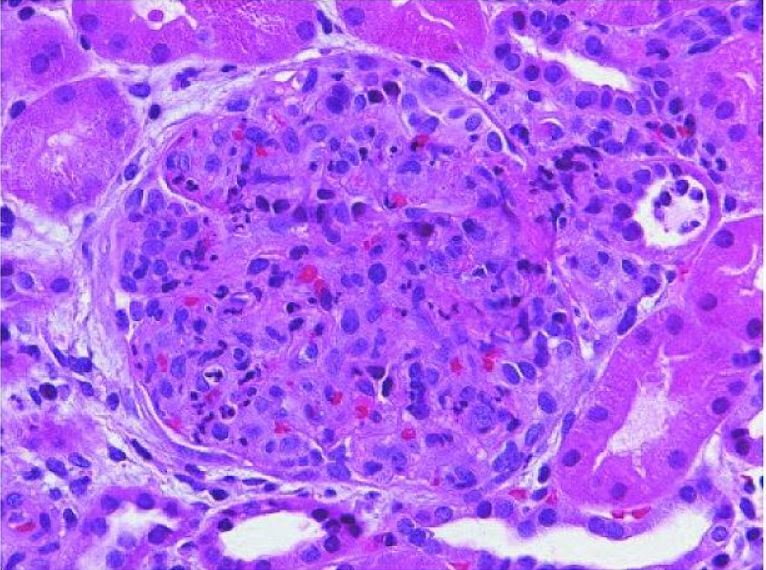
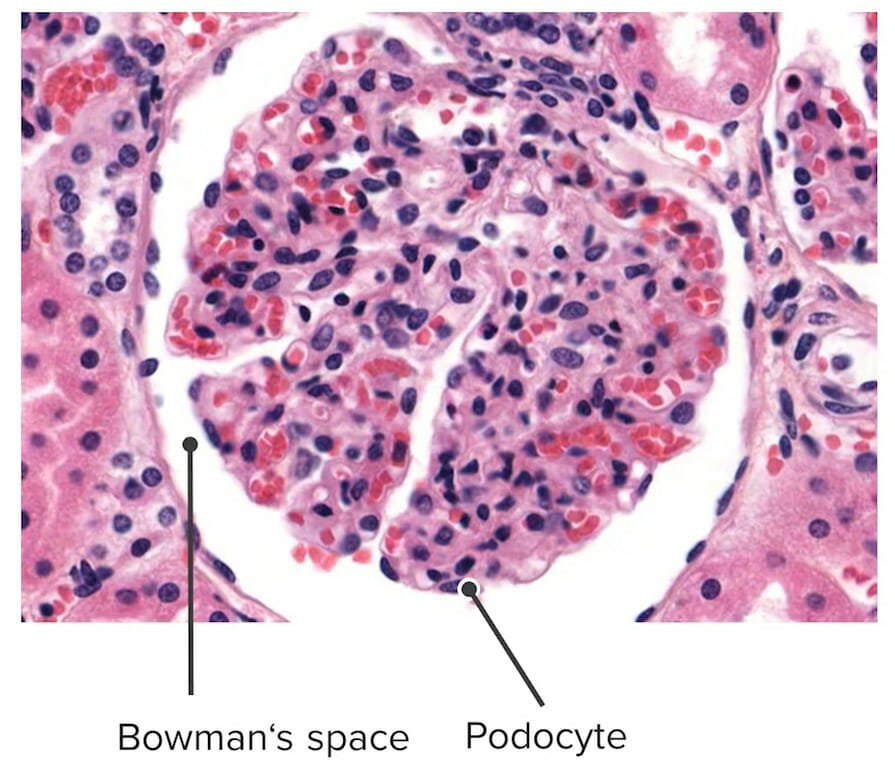
  • Microscopía de luz
    • Proliferación endocapilar difusa
    • Infiltración leucocitaria (neutrofílica)
  • Microscopio de electrones
    • Depósitos de inmunocomplejos principalmente subepiteliales, grandes, con forma de joroba
    • Depósitos subendoteliales más pequeños en EN Erythema nodosum is an immune-mediated panniculitis (inflammation of the subcutaneous fat) caused by a type IV (delayed-type) hypersensitivity reaction. It commonly manifests in young women as tender, erythematous nodules on the shins. Erythema Nodosum las primeras etapas de la enfermedad
  • Microscopio fluorescente
    • Depósitos granulares de IgG IgG The major immunoglobulin isotype class in normal human serum. There are several isotype subclasses of igg, for example, igg1, igg2a, and igg2b. Hypersensitivity Pneumonitis y C3 en EN Erythema nodosum is an immune-mediated panniculitis (inflammation of the subcutaneous fat) caused by a type IV (delayed-type) hypersensitivity reaction. It commonly manifests in young women as tender, erythematous nodules on the shins. Erythema Nodosum la membrana basal glomerular y mesangio
    • IgA IgA Represents 15-20% of the human serum immunoglobulins, mostly as the 4-chain polymer in humans or dimer in other mammals. Secretory iga is the main immunoglobulin in secretions. Immunoglobulins: Types and Functions granular es más común en EN Erythema nodosum is an immune-mediated panniculitis (inflammation of the subcutaneous fat) caused by a type IV (delayed-type) hypersensitivity reaction. It commonly manifests in young women as tender, erythematous nodules on the shins. Erythema Nodosum glomerulonefritis asociada a Staphylococcus Staphylococcus Staphylococcus is a medically important genera of Gram-positive, aerobic cocci. These bacteria form clusters resembling grapes on culture plates. Staphylococci are ubiquitous for humans, and many strains compose the normal skin flora. Staphylococcus.

Tratamiento

Tratamiento

  • Cuidados de soporte
  • Antibióticos si la infección bacteriana todavía está presente en EN Erythema nodosum is an immune-mediated panniculitis (inflammation of the subcutaneous fat) caused by a type IV (delayed-type) hypersensitivity reaction. It commonly manifests in young women as tender, erythematous nodules on the shins. Erythema Nodosum el momento del diagnóstico (e.g., para infecciones por estreptococos)
    • Penicilina
    • Eritromicina si es alérgico a la penicilina
    • Un macrólido (p. ej., azitromicina) o clindamicina si el paciente es alérgico a la penicilina.
  • Tratar la hipertensión y/o el edema Edema Edema is a condition in which excess serous fluid accumulates in the body cavity or interstitial space of connective tissues. Edema is a symptom observed in several medical conditions. It can be categorized into 2 types, namely, peripheral (in the extremities) and internal (in an organ or body cavity). Edema
    • Diuréticos de asa ASA Anterior Cord Syndrome (e.g., furosemida)
    • Restricción de sodio y agua
    • Inhibidores del sistema renina-angiotensina (IECA, ARA) para individuos que desarrollan enfermedad renal crónica
  • Para encefalopatía hipertensiva (rara)
    • Nifedipina oral
    • Nicardipina parenteral
  • Indicaciones de diálisis:
    • Sobrecarga de líquidos que no responde o tarda en EN Erythema nodosum is an immune-mediated panniculitis (inflammation of the subcutaneous fat) caused by a type IV (delayed-type) hypersensitivity reaction. It commonly manifests in young women as tender, erythematous nodules on the shins. Erythema Nodosum responder a los LOS Neisseria diuréticos y las medidas de soporte
    • Complicaciones de sobrecarga de líquidos, incluyendo:
      • Edema Edema Edema is a condition in which excess serous fluid accumulates in the body cavity or interstitial space of connective tissues. Edema is a symptom observed in several medical conditions. It can be categorized into 2 types, namely, peripheral (in the extremities) and internal (in an organ or body cavity). Edema pulmonar
      • Insuficiencia cardíaca
      • Hipertensión refractaria
    • Evidencia de compromiso grave de la función renal (creatinina en EN Erythema nodosum is an immune-mediated panniculitis (inflammation of the subcutaneous fat) caused by a type IV (delayed-type) hypersensitivity reaction. It commonly manifests in young women as tender, erythematous nodules on the shins. Erythema Nodosum rápido aumento)
    • Hiperpotasemia > 6,5 mEq/L
    • Uremia Uremia A clinical syndrome associated with the retention of renal waste products or uremic toxins in the blood. It is usually the result of renal insufficiency. Most uremic toxins are end products of protein or nitrogen catabolism, such as urea or creatinine. Severe uremia can lead to multiple organ dysfunctions with a constellation of symptoms. Acute Kidney Injury con BUN de 89–100 mgdL

Pronóstico

  • Por lo general, los LOS Neisseria síntomas se resuelven rápidamente.
    • La diuresis generalmente inicia dentro de 1 semana.
    • La hematuria Hematuria Presence of blood in the urine. Renal Cell Carcinoma generalmente se resuelve en EN Erythema nodosum is an immune-mediated panniculitis (inflammation of the subcutaneous fat) caused by a type IV (delayed-type) hypersensitivity reaction. It commonly manifests in young women as tender, erythematous nodules on the shins. Erythema Nodosum 3 a 6 meses.
    • La proteinuria Proteinuria The presence of proteins in the urine, an indicator of kidney diseases. Nephrotic Syndrome in Children generalmente se resuelve en EN Erythema nodosum is an immune-mediated panniculitis (inflammation of the subcutaneous fat) caused by a type IV (delayed-type) hypersensitivity reaction. It commonly manifests in young women as tender, erythematous nodules on the shins. Erythema Nodosum menos de 3 meses.
    • Los LOS Neisseria niños tienen un 95% de recuperación completa.
    • Los LOS Neisseria adultos tienen menos probabilidades de tener una recuperación completa, especialmente con nefropatía preexistente (e.g, diabetes Diabetes Diabetes mellitus (DM) is a metabolic disease characterized by hyperglycemia and dysfunction of the regulation of glucose metabolism by insulin. Type 1 DM is diagnosed mostly in children and young adults as the result of autoimmune destruction of β cells in the pancreas and the resulting lack of insulin. Type 2 DM has a significant association with obesity and is characterized by insulin resistance. Diabetes Mellitus, hipertensión).
  • Los LOS Neisseria episodios recurrentes son raros.
  • Algunos pacientes (generalmente adultos) progresan a glomerulonefritis rápidamente progresiva.
    • Desarrollan hipertensión.
    • Proteinuria Proteinuria The presence of proteins in the urine, an indicator of kidney diseases. Nephrotic Syndrome in Children recurrente
    • Insuficiencia renal hasta 10–40 años después del diagnóstico

Diagnóstico Diferencial

  • Glomerulonefropatía C3: tiene una presentación clínica que puede ser indistinguible de la glomerulonefritis postestreptocócica. La condición también se presenta con hematuria Hematuria Presence of blood in the urine. Renal Cell Carcinoma, hipertensión, proteinuria Proteinuria The presence of proteins in the urine, an indicator of kidney diseases. Nephrotic Syndrome in Children e hipocomplementemia, y puede estar precedida por una infección de las vías respiratorias superiores. A diferencia de la glomerulonefritis postestreptocócica, los LOS Neisseria pacientes con glomerulonefropatía C3 tienen anomalías urinarias persistentes e hipocomplementemia más allá de 4-6 semanas, y en EN Erythema nodosum is an immune-mediated panniculitis (inflammation of the subcutaneous fat) caused by a type IV (delayed-type) hypersensitivity reaction. It commonly manifests in young women as tender, erythematous nodules on the shins. Erythema Nodosum ocasiones tienen una mayor elevación de la creatinina sérica.
  • Nefropatía por IgA IgA Represents 15-20% of the human serum immunoglobulins, mostly as the 4-chain polymer in humans or dimer in other mammals. Secretory iga is the main immunoglobulin in secretions. Immunoglobulins: Types and Functions: se presenta con glomerulonefritis después de una infección previa de las vías respiratorias superiores, como puede ocurrir con la glomerulonefritis postestreptocócica. Sin embargo, generalmente hay un tiempo más corto entre la infección y el síndrome nefrítico (menos de 5 días) que con la glomerulonefritis postestreptocócica. La nefropatía por IgA IgA Represents 15-20% of the human serum immunoglobulins, mostly as the 4-chain polymer in humans or dimer in other mammals. Secretory iga is the main immunoglobulin in secretions. Immunoglobulins: Types and Functions puede ser recurrente y los LOS Neisseria pacientes pueden tener episodios anteriores de hematuria Hematuria Presence of blood in the urine. Renal Cell Carcinoma macroscópica. El tratamiento se realiza con IECA o ARA II, tratamiento con estatinas para la hiperlipidemia y tratamiento inmunosupresor. Los LOS Neisseria pacientes que progresan a una enfermedad renal en EN Erythema nodosum is an immune-mediated panniculitis (inflammation of the subcutaneous fat) caused by a type IV (delayed-type) hypersensitivity reaction. It commonly manifests in young women as tender, erythematous nodules on the shins. Erythema Nodosum etapa terminal pueden tratarse con diálisis o trasplante.
  • Causas secundarias de glomerulonefritis: se puede observar con nefritis lúpica y púrpura de Henoch-Schönlein. Estas enfermedades tienen manifestaciones extrarrenales específicas del proceso patológico. La púrpura de Henoch-Schönlein no tiene hipocomplementemia. La nefritis lúpica presenta reducciones tanto en EN Erythema nodosum is an immune-mediated panniculitis (inflammation of the subcutaneous fat) caused by a type IV (delayed-type) hypersensitivity reaction. It commonly manifests in young women as tender, erythematous nodules on the shins. Erythema Nodosum el C3 como en EN Erythema nodosum is an immune-mediated panniculitis (inflammation of the subcutaneous fat) caused by a type IV (delayed-type) hypersensitivity reaction. It commonly manifests in young women as tender, erythematous nodules on the shins. Erythema Nodosum C4, mientras que este último suele ser normal en EN Erythema nodosum is an immune-mediated panniculitis (inflammation of the subcutaneous fat) caused by a type IV (delayed-type) hypersensitivity reaction. It commonly manifests in young women as tender, erythematous nodules on the shins. Erythema Nodosum la glomerulonefritis postestreptocócica. El diagnóstico se realiza mediante biopsia renal. El tratamiento se realiza con IECA o ARA II, tratamiento con estatinas para la hiperlipidemia, anticoagulación y tratamiento inmunosupresor.

Referencias

  1. Kumar V, Abbas AK, Aster JC. (2015). Robbins & Cotran Pathologic Basis of Disease. Elsevier Saunders.
  2. Lewis JB & Neilson EG. (2018). Glomerular diseases. In Jameson J., et al. (Eds.). Harrison’s Principles of Internal Medicine, (20th ed.). https://accessmedicine-mhmedical-com.aucmed.idm.oclc.org/content.aspx?bookid=2129&sectionid=192281295
  3. Niaudet P. (2023). Poststreptococcal glomerulonephritis. UpToDate. Retrieved July 26, 2025, from https://www.uptodate.com/contents/poststreptococcal-glomerulonephritis
  4. Rodriguez-Iturbe B & Haas M. (2016). Post-streptococcal glomerulonephritis. https://www.ncbi.nlm.nih.gov/books/NBK333429/
  5. Nasr, SH, Radhakrishnan, J, D’Agati, VD. (2024). Staphylococcus-associated glomerulonephritis. UpToDate. Retrieved July 26, 2025, from https://www.uptodate.com/contents/staphylococcus-associated-glomerulonephritis-in-adults

¡Crea tu cuenta gratis o inicia una sesión para seguir leyendo!

Regístrate ahora y obtén acceso gratuito a Lecturio con páginas de concepto, videos médicos y cuestionarios para tu educación médica.

User Reviews

Que tengas una sesión de estudio alegre y navideña 🎁 Ahorra 50% en todos los planes >>

Details