Domina Conceptos Médicos

Estudia para la escuela de medicina y tus examenes con Lecturio.

Cáncer de Páncreas Exocrino

El cáncer de páncreas, que consiste principalmente en EN Erythema nodosum is an immune-mediated panniculitis (inflammation of the subcutaneous fat) caused by a type IV (delayed-type) hypersensitivity reaction. It commonly manifests in young women as tender, erythematous nodules on the shins. Erythema Nodosum un adenocarcinoma ductal pancreático, surge de las células ductales del páncreas exocrino y es la cuarta causa de muerte relacionada con el cáncer en EN Erythema nodosum is an immune-mediated panniculitis (inflammation of the subcutaneous fat) caused by a type IV (delayed-type) hypersensitivity reaction. It commonly manifests in young women as tender, erythematous nodules on the shins. Erythema Nodosum los LOS Neisseria Estados Unidos. El cáncer de páncreas tiene la tasa de mortalidad más alta entre los LOS Neisseria principales cánceres, con una tasa de supervivencia a 5 años de solo 8%–10%. La presentación clínica incluye síntomas de dolor Dolor Inflammation abdominal, ictericia y pérdida de peso. El diagnóstico se realiza mediante TC, RM y ultrasonido endoscópico. El tratamiento mediante resección quirúrgica, generalmente con quimioterapia neoadyuvante o adyuvante, proporciona la única posibilidad de curación en EN Erythema nodosum is an immune-mediated panniculitis (inflammation of the subcutaneous fat) caused by a type IV (delayed-type) hypersensitivity reaction. It commonly manifests in young women as tender, erythematous nodules on the shins. Erythema Nodosum el 15%–20% de los LOS Neisseria pacientes que tienen enfermedad resecable en EN Erythema nodosum is an immune-mediated panniculitis (inflammation of the subcutaneous fat) caused by a type IV (delayed-type) hypersensitivity reaction. It commonly manifests in young women as tender, erythematous nodules on the shins. Erythema Nodosum el momento del diagnóstico. Otros tumores malignos poco frecuentes que surgen del páncreas exocrino son el carcinoma de células acinares y el pancreatoblastoma.

Last updated: Dec 15, 2025

Editorial responsibility: Stanley Oiseth, Lindsay Jones, Evelin Maza

Descripción General

Clasificación

  • El 95% proceden del páncreas exocrino; la mayoría son adenocarcinomas ductales pancreáticos invasivos:
    • Surgen de las células epiteliales ductales
    • La tasa de mortalidad más alta de todos los LOS Neisseria cánceres importantes
    • 10%–15% están asociados a síndromes hereditarios.
  • El 1% de las neoplasias del páncreas exocrino son carcinomas acinares:
    • Surgen de las células acinares
    • Pueden producir triptasa y lipasa → necrosis Necrosis The death of cells in an organ or tissue due to disease, injury or failure of the blood supply. Ischemic Cell Damage grasa metastásica
  • < 1% de las neoplasias del páncreas exocrino son pancreatoblastomas (malignos):
    • Principalmente en EN Erythema nodosum is an immune-mediated panniculitis (inflammation of the subcutaneous fat) caused by a type IV (delayed-type) hypersensitivity reaction. It commonly manifests in young women as tender, erythematous nodules on the shins. Erythema Nodosum niños
    • Muestran una diferenciación tisular diversa

Epidemiología

  • 4ta causa de muerte relacionada con el cáncer en EN Erythema nodosum is an immune-mediated panniculitis (inflammation of the subcutaneous fat) caused by a type IV (delayed-type) hypersensitivity reaction. It commonly manifests in young women as tender, erythematous nodules on the shins. Erythema Nodosum Estados Unidos
  • Pobre tasa de supervivencia: Solo 15%–20% de los LOS Neisseria pacientes son candidatos a la cirugía debido a su presentación tardía.
    • La tasa de supervivencia a 5 años es del 30% si los LOS Neisseria ganglios son negativos.
    • La tasa de supervivencia a 5 años es del 10% si los LOS Neisseria ganglios son positivos en EN Erythema nodosum is an immune-mediated panniculitis (inflammation of the subcutaneous fat) caused by a type IV (delayed-type) hypersensitivity reaction. It commonly manifests in young women as tender, erythematous nodules on the shins. Erythema Nodosum el momento de la cirugía.
  • Incidencia: 3,2% de todos los LOS Neisseria nuevos casos de cáncer y 7,2% de todas las muertes por cáncer
  • 11ma causa de muerte a nivel mundial
  • Grupo de edad más frecuente en EN Erythema nodosum is an immune-mediated panniculitis (inflammation of the subcutaneous fat) caused by a type IV (delayed-type) hypersensitivity reaction. It commonly manifests in young women as tender, erythematous nodules on the shins. Erythema Nodosum el momento del diagnóstico: 65–74 años
  • Disparidades de género/etnia: hombres > mujeres; negros > blancos

Etiología

  • Factores de riesgo no hereditarios:
    • Tabaquismo: mayor factor de riesgo, causante del 30% de los LOS Neisseria casos
    • Edad avanzada: 70 años es la edad promedio en EN Erythema nodosum is an immune-mediated panniculitis (inflammation of the subcutaneous fat) caused by a type IV (delayed-type) hypersensitivity reaction. It commonly manifests in young women as tender, erythematous nodules on the shins. Erythema Nodosum el momento del diagnóstico.
    • Pancreatitis Pancreatitis Inflammation of the pancreas. Pancreatitis is classified as acute unless there are computed tomographic or endoscopic retrograde cholangiopancreatographic findings of chronic pancreatitis. The two most common forms of acute pancreatitis are alcoholic pancreatitis and gallstone pancreatitis. Acute Pancreatitis crónica
    • Diabetes Diabetes Diabetes mellitus (DM) is a metabolic disease characterized by hyperglycemia and dysfunction of the regulation of glucose metabolism by insulin. Type 1 DM is diagnosed mostly in children and young adults as the result of autoimmune destruction of β cells in the pancreas and the resulting lack of insulin. Type 2 DM has a significant association with obesity and is characterized by insulin resistance. Diabetes Mellitus mellitus (el adenocarcinoma ductal pancreático, también puede causar diabetes Diabetes Diabetes mellitus (DM) is a metabolic disease characterized by hyperglycemia and dysfunction of the regulation of glucose metabolism by insulin. Type 1 DM is diagnosed mostly in children and young adults as the result of autoimmune destruction of β cells in the pancreas and the resulting lack of insulin. Type 2 DM has a significant association with obesity and is characterized by insulin resistance. Diabetes Mellitus mellitus)
    • Obesidad
    • Inactividad física
    • Dieta:
      • Comer carne asada bien hecha
      • Tomar bebidas carbonatadas azucaradas
    • Sexo masculino
    • Ascendencia africana
    • Débil asociación entre la infección por Helicobacter pylori Helicobacter pylori A spiral bacterium active as a human gastric pathogen. It is a gram-negative, urease-positive, curved or slightly spiral organism initially isolated in 1982 from patients with lesions of gastritis or peptic ulcers in Western Australia. Helicobacter pylori was originally classified in the genus campylobacter, but RNA sequencing, cellular fatty acid profiles, growth patterns, and other taxonomic characteristics indicate that the micro-organism should be included in the genus Helicobacter. It has been officially transferred to Helicobacter gen. Helicobacter y el cáncer de páncreas
  • Disminución del riesgo de adenocarcinoma ductal pancreático: alto consumo de frutas y verduras
  • Factores hereditarios/genéticos en EN Erythema nodosum is an immune-mediated panniculitis (inflammation of the subcutaneous fat) caused by a type IV (delayed-type) hypersensitivity reaction. It commonly manifests in young women as tender, erythematous nodules on the shins. Erythema Nodosum 10%–15% de todos los LOS Neisseria cánceres de páncreas:
Tabla: Factores hereditarios/genéticos del cáncer de páncreas exocrino
Factores hereditarios/genéticos Mutaciones en EN Erythema nodosum is an immune-mediated panniculitis (inflammation of the subcutaneous fat) caused by a type IV (delayed-type) hypersensitivity reaction. It commonly manifests in young women as tender, erythematous nodules on the shins. Erythema Nodosum la línea germinal Máximo aumento del riesgo a lo largo de la vida (aproximado)
Síndrome de Peutz-Jeghers STKII 132
Pancreatitis Pancreatitis Inflammation of the pancreas. Pancreatitis is classified as acute unless there are computed tomographic or endoscopic retrograde cholangiopancreatographic findings of chronic pancreatitis. The two most common forms of acute pancreatitis are alcoholic pancreatitis and gallstone pancreatitis. Acute Pancreatitis hereditaria PRSS1, otros 53
Melanoma Melanoma Melanoma is a malignant tumor arising from melanocytes, the melanin-producing cells of the epidermis. These tumors are most common in fair-skinned individuals with a history of excessive sun exposure and sunburns. Melanoma familiar con nevos atípicos múltiples p16/CDKN2A 38
Antecedentes familiares (aumenta con el número de familiares de 1er grado y con cáncer < 55 años) Desconocido 32
Síndrome de Lynch Genes Genes A category of nucleic acid sequences that function as units of heredity and which code for the basic instructions for the development, reproduction, and maintenance of organisms. DNA Types and Structure reparadores de desajustes de ADN 30
Cáncer de mama/ovario familiar BRCA2 10
Cáncer de mama familiar, otros PALB2 6
Ataxia-telangiectasia Ataxia-telangiectasia Ataxia-telangiectasia, also known as Louis-Bar syndrome, is a neurocutaneous syndrome, which involves multiple systems but mainly affects the neurological system. Ataxia-telangiectasia is an autosomal recessive genetic disorder caused by a mutation in the ATM gene (ATM serine/threonine kinase or the ataxia-telangiectasia mutated gene). Ataxia-telangiectasia Ataxia Ataxia Impairment of the ability to perform smoothly coordinated voluntary movements. This condition may affect the limbs, trunk, eyes, pharynx, larynx, and other structures. Ataxia may result from impaired sensory or motor function. Sensory ataxia may result from posterior column injury or peripheral nerve diseases. Motor ataxia may be associated with cerebellar diseases; cerebral cortex diseases; thalamic diseases; basal ganglia diseases; injury to the red nucleus; and other conditions. Ataxia-telangiectasia telangiectasia Telangiectasia Permanent dilation of preexisting blood vessels creating small focal red lesions, most commonly in the skin or mucous membranes. It is characterized by the prominence of skin blood vessels, such as vascular spiders. Chronic Venous Insufficiency mutado Aún no se ha HA Hemolytic anemia (HA) is the term given to a large group of anemias that are caused by the premature destruction/hemolysis of circulating red blood cells (RBCs). Hemolysis can occur within (intravascular hemolysis) or outside the blood vessels (extravascular hemolysis). Hemolytic Anemia establecido
Células endocrinas y células acinares exocrinas en el páncreas

El páncreas tiene muchas funciones, llevadas a cabo por las células endocrinas de los islotes de Langerhans y las células acinares exocrinas. El cáncer de páncreas puede surgir de cualquiera de ellos y alterar cualquiera de sus funciones.

Imagen: “2424 Exocrine and Endocrine Pancreas” por OpenStax College. Licencia: CC BY 3.0
Precursores y Patología

Precursores del adenocarcinoma ductal pancreático

  • La neoplasia intraepitelial pancreática precede al AL Amyloidosis 90% de los LOS Neisseria adenocarcinomas ductales pancreáticos:
    • El acortamiento de telómeros se produce en EN Erythema nodosum is an immune-mediated panniculitis (inflammation of the subcutaneous fat) caused by a type IV (delayed-type) hypersensitivity reaction. It commonly manifests in young women as tender, erythematous nodules on the shins. Erythema Nodosum las células de los LOS Neisseria ductos pequeños.
    • Las mutaciones del oncogén KRAS en EN Erythema nodosum is an immune-mediated panniculitis (inflammation of the subcutaneous fat) caused by a type IV (delayed-type) hypersensitivity reaction. It commonly manifests in young women as tender, erythematous nodules on the shins. Erythema Nodosum > 90% se acumulan y hacen la transición a adenocarcinoma ductal pancreático invasivo.
  • Neoplasias quísticas mucinosas:
    • El 30% se asocia a un adenocarcinoma ductal pancreático invasivo
    • 95% en EN Erythema nodosum is an immune-mediated panniculitis (inflammation of the subcutaneous fat) caused by a type IV (delayed-type) hypersensitivity reaction. It commonly manifests in young women as tender, erythematous nodules on the shins. Erythema Nodosum la mujer
    • Se encuentra en EN Erythema nodosum is an immune-mediated panniculitis (inflammation of the subcutaneous fat) caused by a type IV (delayed-type) hypersensitivity reaction. It commonly manifests in young women as tender, erythematous nodules on the shins. Erythema Nodosum la cola del páncreas
    • Estroma de tipo ovárico
  • Neoplasias papilares mucinosas intraductales:
    • Afectan sobre todo a los LOS Neisseria conductos principales más grandes de la cabeza del páncreas
    • Hombres > mujeres
    • Multifocal Multifocal Retinoblastoma en EN Erythema nodosum is an immune-mediated panniculitis (inflammation of the subcutaneous fat) caused by a type IV (delayed-type) hypersensitivity reaction. It commonly manifests in young women as tender, erythematous nodules on the shins. Erythema Nodosum un 20%.
    • Mutaciones del protooncogen GNAS en EN Erythema nodosum is an immune-mediated panniculitis (inflammation of the subcutaneous fat) caused by a type IV (delayed-type) hypersensitivity reaction. It commonly manifests in young women as tender, erythematous nodules on the shins. Erythema Nodosum el 75%.

Patología

  • Frecuencias según sitio:
    • 60% cabeza del páncreas
    • 15% cuerpo
    • 5% cola
    • 20% páncreas completo
  • Patología microscópica: los LOS Neisseria adenocarcinomas que incrementan el epitelio ductal normal tienen una invasión extrema en EN Erythema nodosum is an immune-mediated panniculitis (inflammation of the subcutaneous fat) caused by a type IV (delayed-type) hypersensitivity reaction. It commonly manifests in young women as tender, erythematous nodules on the shins. Erythema Nodosum los LOS Neisseria tejidos y órganos peripancreáticos, el peritoneo, los LOS Neisseria espacios perineurales y los LOS Neisseria vasos sanguíneos.
  • Patología macroscópica:
    • Los LOS Neisseria adenocarcinomas tienen la capacidad de provocar una intensa respuesta fibrosa (desmoplásica).
    • Masas duras, estrelladas, blanco-grisáceas, poco definidas
    • Si está en EN Erythema nodosum is an immune-mediated panniculitis (inflammation of the subcutaneous fat) caused by a type IV (delayed-type) hypersensitivity reaction. It commonly manifests in young women as tender, erythematous nodules on the shins. Erythema Nodosum la cabeza del páncreas: 50% obstruirá el conducto biliar común distal → ictericia obstructiva dolorosa
  • Metástasis:
    • Ganglios linfáticos
    • Hígado
    • Pulmones
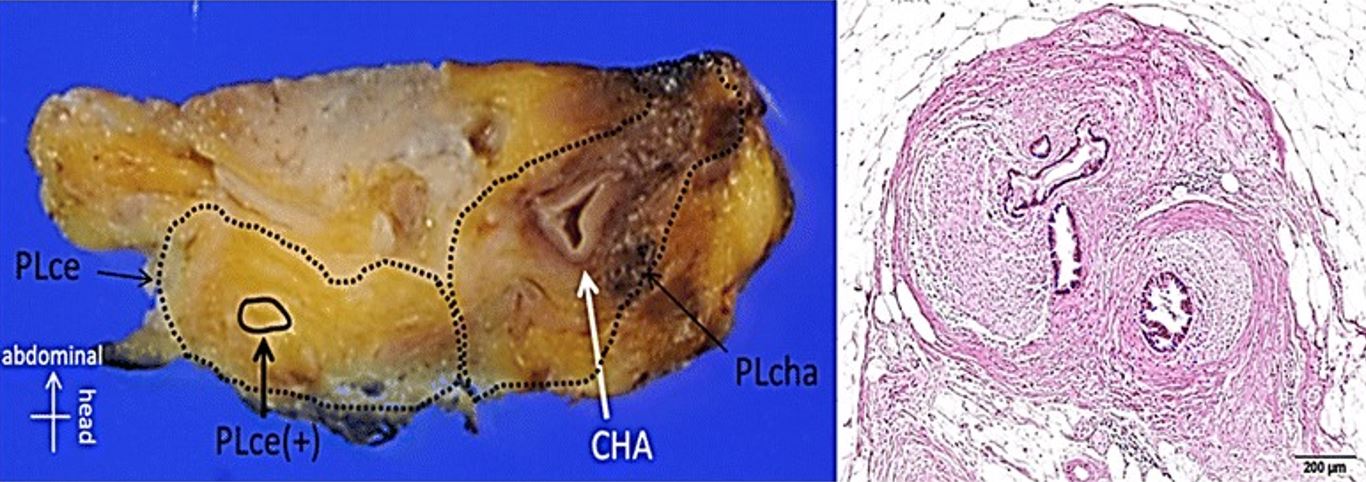
Muestra quirúrgica de carcinoma pancreático no resecable y tinción de H&E

Imagen de la izquierda: muestra quirúrgica de un carcinoma pancreático inicialmente irresecable tras la quimiorradioterapia
Imagen de la derecha: La tinción de H&E mostró células cancerosas residuales presentes en el área rodeada por la línea discontinua.

Imagen: “Histopathological mapping on the macroscopic section at the plexus around the CA” por Takano H, Tsuchikawa T, Nakamura T, Okamura K, Shichinohe T, Hirano S. Licencia: CC BY 4.0

Presentación Clínica

El cáncer de páncreas suele descubrirse tarde debido a la posición retroperitoneal Retroperitoneal Peritoneum: Anatomy del páncreas.

  • Si el cáncer está en EN Erythema nodosum is an immune-mediated panniculitis (inflammation of the subcutaneous fat) caused by a type IV (delayed-type) hypersensitivity reaction. It commonly manifests in young women as tender, erythematous nodules on the shins. Erythema Nodosum la cabeza del páncreas, puede causar:
    • Ictericia obstructiva indolora:
      • Debida a la obstrucción del conducto biliar común
      • Asociada a prurito y heces de color claro
    • Signo de Courvoisier: vesícula biliar agrandada, palpable y no dolorosa
  • Si el cáncer está en EN Erythema nodosum is an immune-mediated panniculitis (inflammation of the subcutaneous fat) caused by a type IV (delayed-type) hypersensitivity reaction. It commonly manifests in young women as tender, erythematous nodules on the shins. Erythema Nodosum el cuerpo y la cola, puede causar la obstrucción de la vena esplénica, lo que lleva a:
    • Esplenomegalia
    • Varices gástricas y esofágicas por hipertensión portal izquierda
    • Hemorragia gastrointestinal
  • Dolor Dolor Inflammation:
    • Severo
    • En EN Erythema nodosum is an immune-mediated panniculitis (inflammation of the subcutaneous fat) caused by a type IV (delayed-type) hypersensitivity reaction. It commonly manifests in young women as tender, erythematous nodules on the shins. Erythema Nodosum la parte superior del abdomen con irradiación a la espalda
    • Síntoma tardío
  • Estado hipercoagulable:
    • 30%–50% de los LOS Neisseria adenocarcinomas ductales pancreáticos, en EN Erythema nodosum is an immune-mediated panniculitis (inflammation of the subcutaneous fat) caused by a type IV (delayed-type) hypersensitivity reaction. It commonly manifests in young women as tender, erythematous nodules on the shins. Erythema Nodosum comparación con el 10% de todos los LOS Neisseria cánceres, debido a:
      • Factores activadores de las plaquetas
      • Procoagulantes del carcinoma
      • Productos necróticos
    • Puede causar tromboflebitis superficial migratoria (síndrome de Trousseau de malignidad = trastorno de hipercoagulación asociado al AL Amyloidosis cáncer)
    • También puede causar trombosis venosa profunda (TVP) → émbolos pulmonares (causa frecuente de muerte)
  • Síntomas de enfermedad avanzada:
    • Pérdida de peso
    • Anorexia Anorexia The lack or loss of appetite accompanied by an aversion to food and the inability to eat. It is the defining characteristic of the disorder anorexia nervosa. Anorexia Nervosa
    • Malestar generalizado
    • Diabetes Diabetes Diabetes mellitus (DM) is a metabolic disease characterized by hyperglycemia and dysfunction of the regulation of glucose metabolism by insulin. Type 1 DM is diagnosed mostly in children and young adults as the result of autoimmune destruction of β cells in the pancreas and the resulting lack of insulin. Type 2 DM has a significant association with obesity and is characterized by insulin resistance. Diabetes Mellitus mellitus pancreatógena
    • Malabsorción: debido a la insuficiencia exocrina pancreática → distensión abdominal, gases, heces grasientas.
    • Nódulo de Virchow: nódulo supraclavicular palpable (generalmente en EN Erythema nodosum is an immune-mediated panniculitis (inflammation of the subcutaneous fat) caused by a type IV (delayed-type) hypersensitivity reaction. It commonly manifests in young women as tender, erythematous nodules on the shins. Erythema Nodosum el lado izquierdo)
    • Nódulo de la hermana Mary Joseph: nódulo metastásico periumbilical

Diagnóstico

El diagnóstico por imagenología y la biopsia están indicados para los LOS Neisseria pacientes con sospecha de adenocarcinoma ductal pancreático ( dolor Dolor Inflammation, pérdida de peso, ictericia).
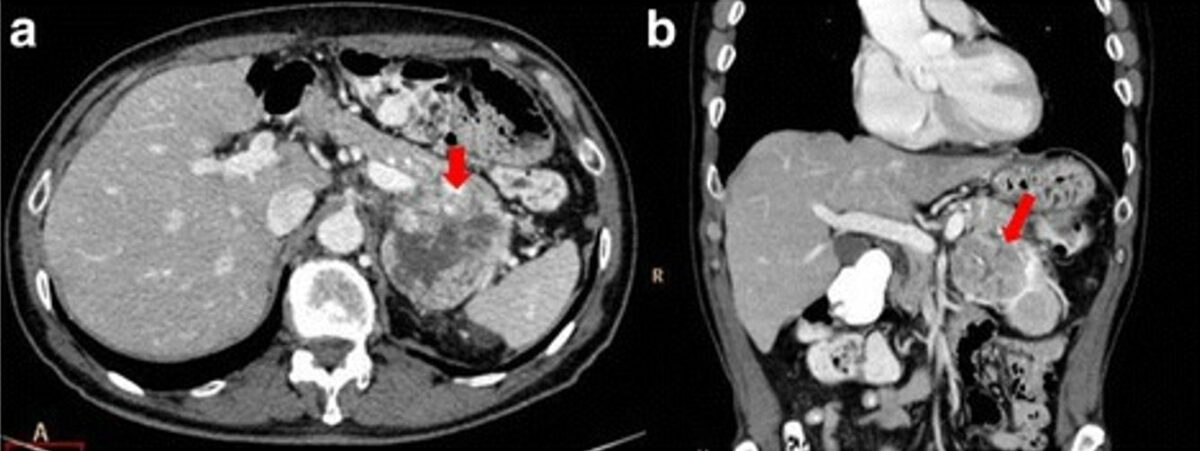
  • Imagen: TC multifásico con protocolo de cáncer de páncreas
    • Si se encuentra una lesión masiva en EN Erythema nodosum is an immune-mediated panniculitis (inflammation of the subcutaneous fat) caused by a type IV (delayed-type) hypersensitivity reaction. It commonly manifests in young women as tender, erythematous nodules on the shins. Erythema Nodosum el páncreas → evaluar si hay enfermedad metastásica mediante tomografía por emisión de positrones ( PET PET An imaging technique that combines a positron-emission tomography (PET) scanner and a ct X ray scanner. This establishes a precise anatomic localization in the same session. Nuclear Imaging) y/o TC multifásica de tórax y pelvis Pelvis The pelvis consists of the bony pelvic girdle, the muscular and ligamentous pelvic floor, and the pelvic cavity, which contains viscera, vessels, and multiple nerves and muscles. The pelvic girdle, composed of 2 “hip” bones and the sacrum, is a ring-like bony structure of the axial skeleton that links the vertebral column with the lower extremities. Pelvis: Anatomy.
    • Si no se identifica lesión masiva ni enfermedad metastásica → realizar colangiopancreatografía retrógrada endoscópica (CPRE) o colangiopancreatografía por RM (CPRM):
      • Si se observa masa o estenosis de la vía biliar → biopsia
      • Si no se identifica ninguna lesión → seguimiento clínico
  • Biopsia:
    • El diagnóstico histológico es necesario para que las pruebas moleculares guíen la terapia.
    • Se pueden realizar biopsias con aguja gruesa de un tumor Tumor Inflammation en EN Erythema nodosum is an immune-mediated panniculitis (inflammation of the subcutaneous fat) caused by a type IV (delayed-type) hypersensitivity reaction. It commonly manifests in young women as tender, erythematous nodules on the shins. Erythema Nodosum el páncreas:
      • Por ultrasonido endoscópico
      • Por biopsia del tumor Tumor Inflammation en EN Erythema nodosum is an immune-mediated panniculitis (inflammation of the subcutaneous fat) caused by a type IV (delayed-type) hypersensitivity reaction. It commonly manifests in young women as tender, erythematous nodules on the shins. Erythema Nodosum el ganglio linfático, el hígado u otro sitio metastásico
    • Los LOS Neisseria marcadores tumorales séricos sirven para seguir la evolución de los LOS Neisseria pacientes, no para el tamizaje, excepto para aquellos con riesgo hereditario:
      • CA19-9 CA19-9 Sialylated lewis(a) blood group carbohydrate antigen found in many adenocarcinomas of the digestive tract, especially pancreatic tumors. Serum Tumor Markers
      • CEA CEA A glycoprotein that is secreted into the luminal surface of the epithelia in the gastrointestinal tract. It is found in the feces and pancreaticobiliary secretions and is used to monitor the response to colon cancer treatment. Serum Tumor Markers
      • CA CA Condylomata acuminata are a clinical manifestation of genital HPV infection. Condylomata acuminata are described as raised, pearly, flesh-colored, papular, cauliflower-like lesions seen in the anogenital region that may cause itching, pain, or bleeding. Condylomata Acuminata (Genital Warts) 125
  • Estadificación clínica:
    • Sistema TNM de la American Joint Commission on Cancer
    • Algunos médicos aconsejan realizar una laparoscopia antes de la cirugía definitiva para descartar directamente enfermedad metastásica.

Tratamiento y Pronóstico

Aproximadamente 80%–85% de los LOS Neisseria tumores de adenocarcinoma ductal pancreático son irresecables en EN Erythema nodosum is an immune-mediated panniculitis (inflammation of the subcutaneous fat) caused by a type IV (delayed-type) hypersensitivity reaction. It commonly manifests in young women as tender, erythematous nodules on the shins. Erythema Nodosum el momento de su presentación.
  • Tasa de supervivencia global a 5 años: 8%–10%
  • Enfermedad resecable quirúrgicamente: sin invasión de vasos ni enfermedad metastásica
    • Aproximadamente 15%–20% de los LOS Neisseria pacientes diagnosticados de adenocarcinoma ductal pancreático son candidatos para cirugía.
    • El procedimiento depende de la ubicación:
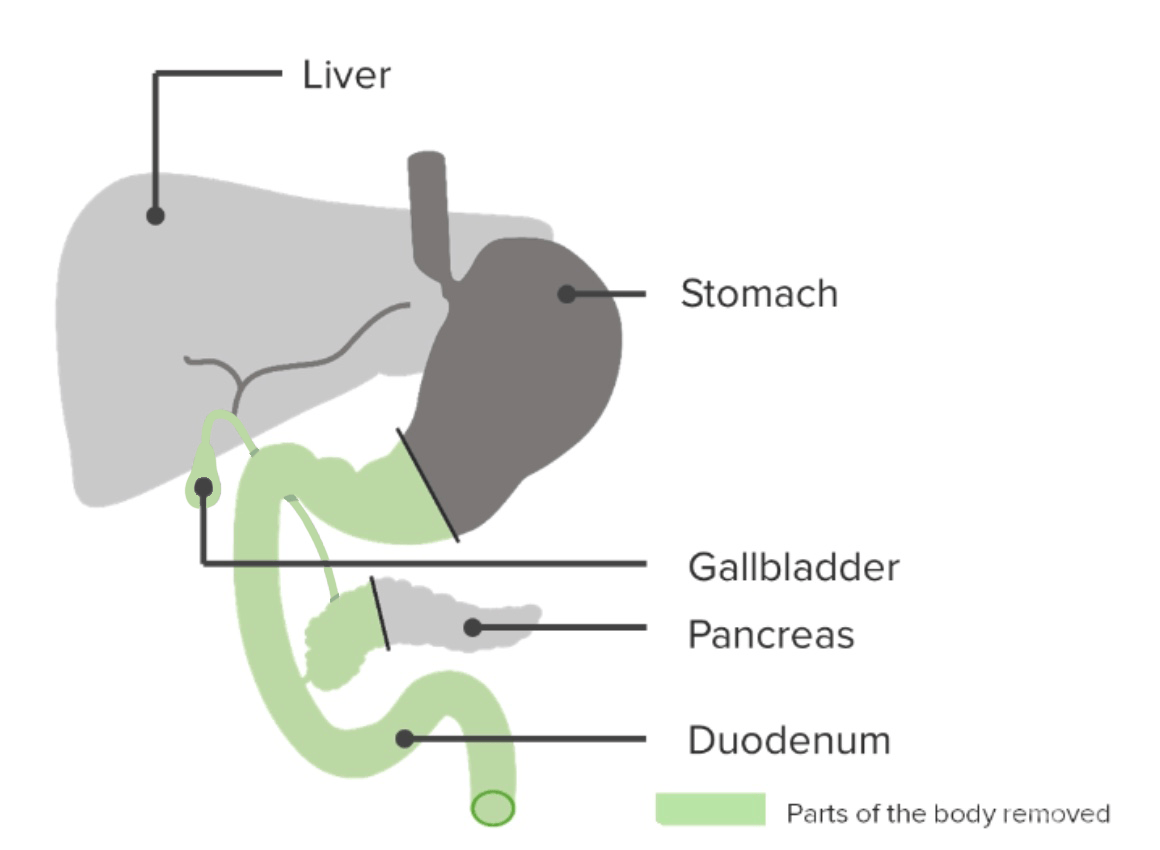
      • Cabeza o el proceso uncinado → pancreaticoduodenectomía conservadora de píloro
      • Cuerpo o cola → pancreatectomía distal
    • Quimioterapia neoadyuvante o adyuvante
    • Mediana de supervivencia: 18–23 meses
  • Enfermedad localmente avanzada: vasos afectados pero sin metástasis a distancia
    • Quimioterapia sola o quimiorradioterapia
    • Mediana de supervivencia: 6–10 meses
  • Enfermedad metastásica a distancia:
    • Quimioterapia sistémica
    • Mediana de supervivencia: 8–13 meses
  • Agentes quimioterapéuticos y otros posibles factores que influyen en EN Erythema nodosum is an immune-mediated panniculitis (inflammation of the subcutaneous fat) caused by a type IV (delayed-type) hypersensitivity reaction. It commonly manifests in young women as tender, erythematous nodules on the shins. Erythema Nodosum la supervivencia:
    • Las tasas de respuesta suelen ser inferiores al AL Amyloidosis 20%.
    • Tratamiento de 1ra línea: FOLFIRINOX (leucovorina, fluorouracilo, irinotecán y oxaliplatino)
    • Agentes individuales más activos: gemcitabina y 5-fluorouracilo
    • Se requiere pruebas moleculares para detectar alteraciones genómicas procesables para introducir terapias dirigidas en EN Erythema nodosum is an immune-mediated panniculitis (inflammation of the subcutaneous fat) caused by a type IV (delayed-type) hypersensitivity reaction. It commonly manifests in young women as tender, erythematous nodules on the shins. Erythema Nodosum ensayos clínicos:
      • Inestabilidad de microsatélites/deficiencia de reparación de desajustes
      • Mutaciones del BRCA
      • Fusiones del gen NTRK
  • Cuidados paliativos para la enfermedad irresecable:
    • Si hay ictericia y la esperanza de vida es > 6–7 meses:
      • Colocación endoscópica de un stent en EN Erythema nodosum is an immune-mediated panniculitis (inflammation of the subcutaneous fat) caused by a type IV (delayed-type) hypersensitivity reaction. It commonly manifests in young women as tender, erythematous nodules on the shins. Erythema Nodosum el conducto biliar
      • Posible bypass quirúrgico debido a las complicaciones asociadas a los LOS Neisseria stents
    • Control del dolor Dolor Inflammation:
      • Analgésicos, generalmente opioides
      • Bloqueo esplácnico (celíaco) si es necesario
    • Prurito que no se alivia con el stent o el bypass: colestiramina oral
    • Suplemento de enzimas pancreáticas: según sea necesario si hay insuficiencia exocrina
    • Diabetes Diabetes Diabetes mellitus (DM) is a metabolic disease characterized by hyperglycemia and dysfunction of the regulation of glucose metabolism by insulin. Type 1 DM is diagnosed mostly in children and young adults as the result of autoimmune destruction of β cells in the pancreas and the resulting lack of insulin. Type 2 DM has a significant association with obesity and is characterized by insulin resistance. Diabetes Mellitus mellitus: tratar para controlar la hiperglicemia
    • Prevención en EN Erythema nodosum is an immune-mediated panniculitis (inflammation of the subcutaneous fat) caused by a type IV (delayed-type) hypersensitivity reaction. It commonly manifests in young women as tender, erythematous nodules on the shins. Erythema Nodosum aquellos con tipos hereditarios de adenocarcinoma ductal pancreático:
      • Vigilancia anual mediante ultrasonido abdominal o resonancia magnética
      • Niveles séricos de CA19-9 CA19-9 Sialylated lewis(a) blood group carbohydrate antigen found in many adenocarcinomas of the digestive tract, especially pancreatic tumors. Serum Tumor Markers
Whipple procedure- Pancreaticoduodenectomy

Procedimiento de Whipple: pancreaticoduodenectomía

Imagen por Lecturio. Licencia: CC BY-NC-SA 4.0

Diagnóstico Diferencial

  • Carcinoma de células acinares: tumor Tumor Inflammation primario maligno poco frecuente de las glándulas exocrinas que produce enzimas exocrinas como la tripsina y la lipasa. Las enzimas pueden causar un síndrome de necrosis Necrosis The death of cells in an organ or tissue due to disease, injury or failure of the blood supply. Ischemic Cell Damage grasa metastásica debido a la liberación de lipasa en EN Erythema nodosum is an immune-mediated panniculitis (inflammation of the subcutaneous fat) caused by a type IV (delayed-type) hypersensitivity reaction. It commonly manifests in young women as tender, erythematous nodules on the shins. Erythema Nodosum la circulación. Este tipo de tumores malignos pueden aparecer en EN Erythema nodosum is an immune-mediated panniculitis (inflammation of the subcutaneous fat) caused by a type IV (delayed-type) hypersensitivity reaction. It commonly manifests in young women as tender, erythematous nodules on the shins. Erythema Nodosum niños, y su pronóstico es mejor que el del adenocarcinoma ductal pancreático.
  • Pancreatoblastoma: un tumor Tumor Inflammation primario maligno poco frecuente de las glándulas exocrinas que se observa sobre todo en EN Erythema nodosum is an immune-mediated panniculitis (inflammation of the subcutaneous fat) caused by a type IV (delayed-type) hypersensitivity reaction. It commonly manifests in young women as tender, erythematous nodules on the shins. Erythema Nodosum los LOS Neisseria niños. La histología muestra múltiples líneas de diferenciación (acinar, ductal, mesenquimal, neuroendocrina) y nidos escamoides mezclados con células acinares. El pronóstico es relativamente bueno.
  • Tumores neuroendocrinos pancreáticos ( PanNETs PanNETs Pancreatic neuroendocrine tumors (PanNETs) arise from the endocrine pancreas (islet cells) and represent 2%-5% of primary pancreatic neoplasms; the other 95%-98% of pancreatic neoplasms are from the exocrine pancreas. The majority of PanNETs are nonfunctional (50%-75%), while others that are functional may be benign or malignant. Pancreatic Neuroendocrine Tumors (PanNETs), tumores de células de los LOS Neisseria islotes): surgen del páncreas endocrino. Los LOS Neisseria tumores neuroendocrinos pancreáticos representan el 2% de todas las neoplasias pancreáticas y se parecen a los LOS Neisseria tumores neuroendocrinos de otras partes del tracto alimentario. Los LOS Neisseria tumores pueden ser únicos o múltiples y benignos o malignos, pueden producir hormonas pancreáticas (e.g., insulina, glucagón, gastrina, otras) o no ser funcionales.
  • Ictericia obstructiva dolorosa: suele estar relacionada con cálculos biliares con infección de las vías biliares y fiebre, mientras que la ictericia obstructiva indolora suele estar relacionada con un tumor Tumor Inflammation en EN Erythema nodosum is an immune-mediated panniculitis (inflammation of the subcutaneous fat) caused by a type IV (delayed-type) hypersensitivity reaction. It commonly manifests in young women as tender, erythematous nodules on the shins. Erythema Nodosum la cabeza del páncreas, al AL Amyloidosis menos al AL Amyloidosis principio de su evolución.
  • Pancreatitis Pancreatitis Inflammation of the pancreas. Pancreatitis is classified as acute unless there are computed tomographic or endoscopic retrograde cholangiopancreatographic findings of chronic pancreatitis. The two most common forms of acute pancreatitis are alcoholic pancreatitis and gallstone pancreatitis. Acute Pancreatitis crónica: puede presentarse con síntomas similares a los LOS Neisseria del adenocarcinoma ductal pancreático, aunque el adenocarcinoma ductal pancreático puede estar asociado a la pancreatitis Pancreatitis Inflammation of the pancreas. Pancreatitis is classified as acute unless there are computed tomographic or endoscopic retrograde cholangiopancreatographic findings of chronic pancreatitis. The two most common forms of acute pancreatitis are alcoholic pancreatitis and gallstone pancreatitis. Acute Pancreatitis. Los LOS Neisseria hallazgos clínico-radiológicos ayudan al AL Amyloidosis diagnóstico, pero puede ser necesario un ultrasonido endoscópico con biopsia con aguja gruesa.
  • Metástasis en EN Erythema nodosum is an immune-mediated panniculitis (inflammation of the subcutaneous fat) caused by a type IV (delayed-type) hypersensitivity reaction. It commonly manifests in young women as tender, erythematous nodules on the shins. Erythema Nodosum el páncreas: puede presentarse con características clínicas y radiográficas similares a las del cáncer de páncreas. Las metástasis suelen ser múltiples en EN Erythema nodosum is an immune-mediated panniculitis (inflammation of the subcutaneous fat) caused by a type IV (delayed-type) hypersensitivity reaction. It commonly manifests in young women as tender, erythematous nodules on the shins. Erythema Nodosum todo el cuerpo, y el sitio primario suele ser conocido o se debe a cáncer de pulmón primario. Si el diagnóstico es incierto, puede ser necesario un ultrasonido endoscópico con biopsia.
  • Quiste congénito: quiste unilocular de paredes finas debido al AL Amyloidosis desarrollo anómalo del conducto pancreático. Los LOS Neisseria tamaños van desde el microscópico hasta los LOS Neisseria 5 cm. Los LOS Neisseria quistes congénitos están revestidos de epitelio cuboidal o aplanado y llenos de líquido seroso claro. Los LOS Neisseria quistes pueden ser esporádicos o formar parte de enfermedades hereditarias como la poliquistosis renal autosómica dominante y la enfermedad de Von Hippel-Lindau.
  • Quiste pancreático neoplásico: quiste revestido de epitelio que está lleno de líquido seroso o mucinoso y que puede simular un adenocarcinoma ductal pancreático. El 30% de los LOS Neisseria quistes mucinosos se asocian con el adenocarcinoma ductal pancreático. El diagnóstico se realiza mediante ultrasonido endoscópico con aspiración con aguja fina.

Referencias

  1. Maitra, A. (2020). In Kumar, V, Abbas, AK., & Aster, JC (Eds.), Robbins & Cotran Pathologic Basis of Disease. 10th ed. pp. 890–893, and 1112–1114. Elsevier.
  2. Fernandez-del Castillo, C, & Jimenez, RE. (2021). Clinical manifestations, diagnosis, and staging of exocrine pancreatic cancer. UpToDate. Retrieved July 18, 2021, from https://www.uptodate.com/contents/clinical-manifestations-diagnosis-and-staging-of-exocrine-pancreatic-cancer
  3. Von Hoff, DD. (2018). Pancreatic Cancer. In Jameson, J.L., et al. (Ed.), Harrison’s Principles of Internal Medicine 20th ed. Vol 1. pp. 591–595. McGraw-Hill Education. https://accessmedicine.mhmedical.com/content.aspx?bookid=2129&sectionid=192016042
  4. Nguyen, M. (2021). Pancreatic cancer. In MSD Manual Professional Edition. Retrieved July 18, 2021, from https://www.msdmanuals.com/professional/gastrointestinal-disorders/tumors-of-the-gastrointestinal-tract/pancreatic-cancer

¡Crea tu cuenta gratis o inicia una sesión para seguir leyendo!

Regístrate ahora y obtén acceso gratuito a Lecturio con páginas de concepto, videos médicos y cuestionarios para tu educación médica.

User Reviews

Que tengas una sesión de estudio alegre y navideña 🎁 Ahorra 50% en todos los planes >>

Details