

Nursing Knowledge
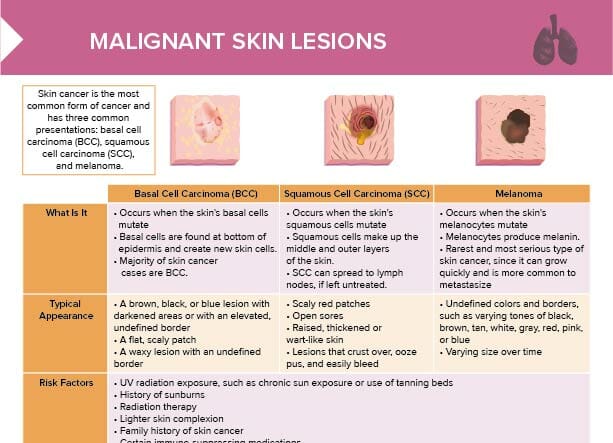
Skin cancer is the most common form of cancer and has three common presentations: basal cell carcinoma (BCC), squamous cell carcinoma (SCC), and melanoma.
Risk factors for developing skin cancer include:
Note: Arsenic exposure is a risk factor for BCC and SCC, but not melanoma.
The ABCDE of melanoma is a mnemonic used to help remember the key clinical features to look for when examining moles or other skin lesions for signs of melanoma. Each letter represents a characteristic that might indicate a mole is abnormal:
If a mole or lesion displays any of these ABCDE characteristics, it doesn’t automatically mean it’s cancerous, but it should be checked by a healthcare professional.
Basal cell carcinoma occurs when the skin’s basal cells mutate (found at the bottom of the epidermis, creating new skin cells). This is the most common form of skin cancer.
Basal cell carcinoma typically presents as a brown, black, or blue lesion with darkened areas or with an elevated, undefined border, a flat, scaly patch, or a waxy lesion with an undefined border.
Squamous cell carcinoma occurs when the skin’s squamous cells mutate (middle and outer layers of the skin). It can spread to lymph nodes, if left untreated.
Squamous cell carcinoma can present as scaly red patches, open sores, raised, thickened, or wart-like skin, or lesions that crust over, ooze pus, and bleed easily.
Melanoma occurs when the skin’s melanocytes mutate (the cells that produce melanin). It is the rarest and most serious type of skin cancer, since it can grow quickly and is more common to metastasize.
Melanoma can present as lesions with undefined colors and borders, such as varying tones of black, brown, tan, white, gray, red, pink, or blue. Its size varies over time.
The different types of skin cancer have significantly varying growth rates.
Basal cell carcinoma typically grows slowly over months or years, rarely spreading to surrounding tissues. Squamous cell carcinoma typically grows over weeks or months, but can grow more rapidly in some cases. Melanoma has a variable growth rate, but is the most aggressive form and early detection is crucial to avoid spreading to other parts of the body.
Yes, cancer can cause itchy skin (pruritus). Itching can be a symptom of certain types of cancer or can be related to cancer treatment.
Skin cancer lesions can be itchy, Hodgkin, Non-Hodgkin lymphomas and other cancers can present with itching, and cancer treatments like chemotherapy drugs can have itching as a side effect.
RELATED TOPIC:
Free Download
Master the topic with a unique study combination of a concise summary paired with video lectures.
Your free account gives you access to:
or