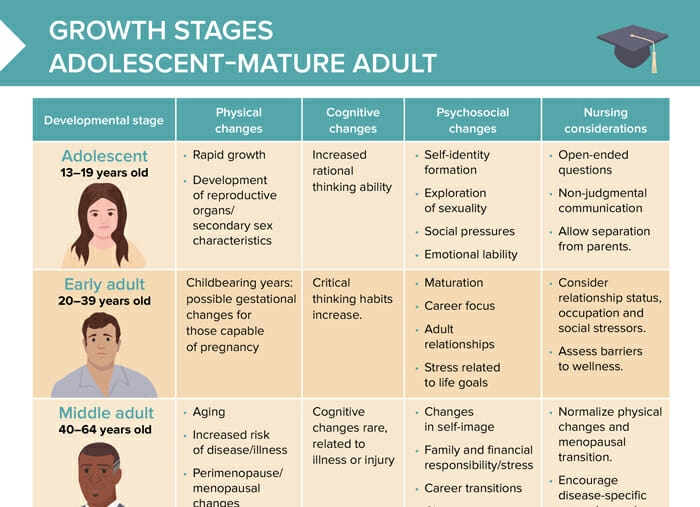
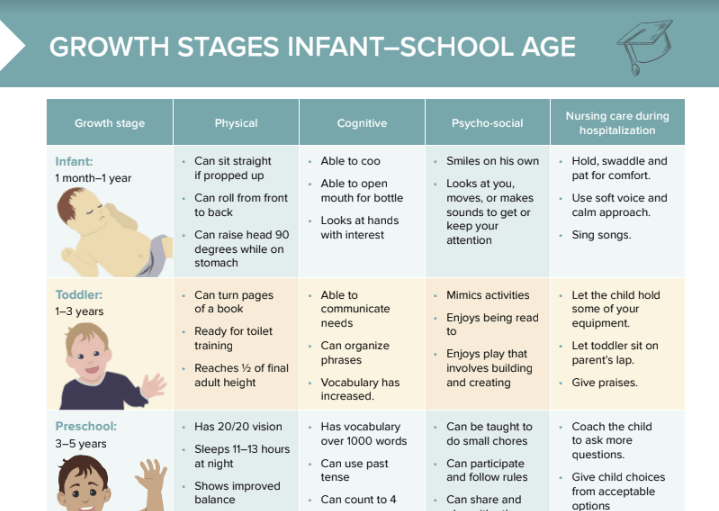
Developmental milestones are specific skills or behaviors expected to be achieved by infants and older children and adolescents at certain ages. These can include motor skills, social behaviors, language, and cognitive abilities. In adults, factors of aging become relevant and influence the requirements of nursing care. For nurses, monitoring these milestones is helpful for early identification of developmental delays or potential health issues, as well as for providing age-appropriate care.
Developmental milestones are specific skills or behaviors that most children achieve by a certain age, such as walking or talking. They are used to assess a child’s developmental progress. Monitoring these helps identify potential developmental delays or concerns.
What are growth stages?
Growth stages refer to specific periods in human development characterized by rapid physical and/or psychological change. Examples include infancy, childhood, adolescence, and adulthood. Monitoring growth stages helps in understanding and anticipating health needs relevant to each stage.
Infant milestones: 1 month–1 year
Physical milestones for infants
Can sit straight if propped up
Can roll from front to back
Can raise head 90 degrees while on stomach
Cognitive milestones for infants
Able to coo
Able to open mouth for bottle
Looks at hands with interest
Psychosocial milestones for infants
Smiles on his own
Looks at you, moves, or makes sounds to get or keep your attention
Nursing care tips for infants
Hold, swaddle and pat for comfort.
Use soft voice and calm approach.
Sing songs.
Toddler developmental milestones: 1–3 years
Physical milestones for toddlers
Can turn pages of a book
Ready for toilet training
Reaches 1⁄2 of final adult height
Cognitive milestones for toddlers
Able to communicate needs
Can organize phrases
Vocabulary has increased.
Psychosocial milestones for toddlers
Mimics activities
Enjoys being read to
Enjoys play that involves building and creating
Nursing care tips for toddlers
Let the child hold some of your equipment.
Let toddler sit on parent’s lap.
Give praises.
Preschool children milestones: 3–5 years
Physical milestones for preschool children
Has 20/20 vision
Sleeps 11–13 hours at night
Shows improved balance
Cognitive milestones for preschool children
Has vocabulary over 1000 words
Can use past tense
Can count to 4
Psychosocial milestones for preschool children
Can be taught to do small chores
Can participate and follow rules
Can share and play with other children
Nursing care tips for preschool children
Coach the child to ask more questions.
Give child choices from acceptable options (e.g., do you want your shot in the right arm or left arm?).
Use drawings to explain procedures.
Children in elementary school: 6–10 years
Physical milestones for elementary school children
Ability to make bed
Dresses appropriately
Writes neatly
Cognitive milestones for elementary school children
Rapid mental skill development
Less focused on oneself
Uses five- to seven-word sentences
Psychosocial milestones for elementary school children
Begins thinking about future
Wants to be accepted
More independent of family
Nursing care tips for elementary school children
Knock on door before entering.
Provide fresh air.
Encourage deep breathing to allay anxiety.
Adolescents: 13–19 years
Physical changes in adolescents
Rapid growth
Development of reproductive organs/secondary sex characteristics