Strokes are a common and serious medical emergency that can have devastating consequences for patients and their families. There are two main types of stroke: ischemic and hemorrhagic. Ischemic strokes occur when a blood clot blocks a blood vessel in the brain, while hemorrhagic strokes are caused by bleeding in the brain. Understanding the differences between these two types of stroke is crucial for nurses and other healthcare professionals, as it can help guide treatment decisions and improve patient outcomes.
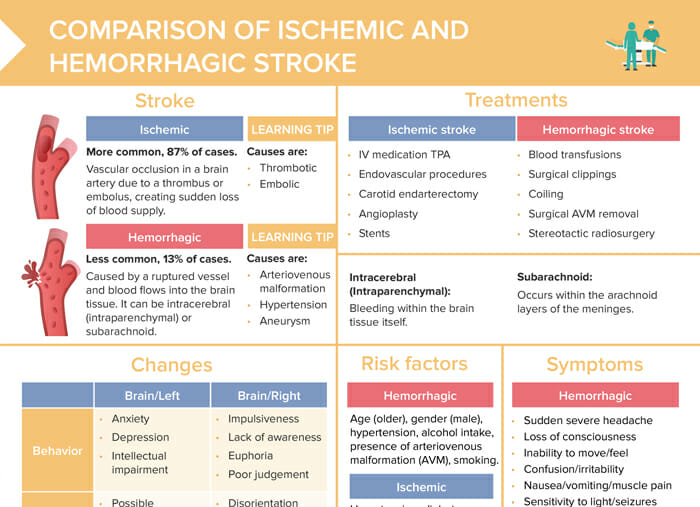
An ischemic stroke is a vascular occlusion in a brain artery due to a thrombus or embolus, creating sudden loss of blood supply. Ischemic strokes are the more common type with about 87% of stroke cases being ischemic strokes.
A hemorrhagic stroke (13% of stroke cases) is caused by a ruptured vessel through which blood flows into the brain tissue. It can be intracerebral (intraparenchymal, bleeding within the brain tissue itself) or subarachnoid (within the arachnoid layers of the meninges).
Hemorrhagic stroke risk factors vs ischemic stroke risk factors and causes
What causes ischemic stroke?
Risk factors for ischemic stroke include:
Hypertension
Diabetes
Smoking
Older age
Male gender
Race (African American)
What is the most common cause of ischemic stroke?
The most common cause of ischemic stroke is atherosclerosis, where fatty deposits (plaques) build up on the inner walls of arteries, leading to reduced blood flow or blockages.
What type of ischemic stroke has no single determined cause?
A type of ischemic stroke that has no single determined cause is called a cryptogenic stroke. In these cases, despite thorough evaluation, the specific cause of the stroke remains unidentified.
What causes hemorrhagic stroke?
Risk factors for hemorrhagic stroke include:
Older age
Male gender
Hypertension
Alcohol intake
Presence of arteriovenous malformation
Smoking
Ischemic stroke symptoms vs hemorrhagic stroke symptoms
What are the symptoms of ischemic stroke?
The symptoms of ischemic strokes will have a sudden onset and include:
Blindness/double vision
Weakness/paralysis
Dizziness/vertigo
Loss of coordination
Face drooping one sided
Arm drifting
Slurred speech
What are the symptoms of hemorrhagic stroke?
The symptoms of hemorrhagic strokes include:
Sudden severe headache
Loss of consciousness
Inability to move/feel
Confusion/irritability
Nausea/vomiting/muscle pain
Sensitivity to light/seizures
Unequal size pupils
Drooping eyelid/vision problems
Hemorrhagic stroke treatment vs ischemic stroke treatment
How is ischemic stroke treated?
The following are treatment measures for ischemic stroke:
IV medication TPA
Endovascular procedures
Carotid endarterectomy
Angioplasty
Stents
How is hemorrhagic stroke treated?
The following are treatment measures for hemorrhagic stroke:
Blood transfusions
Surgical clippings
Coiling
Surgical AVM removal
Stereotactic radiosurgery
Neuro checks for stroke diagnosis
Asymmetric smile, drooping side of the face?
Arm drifting down?
Speech slurred?
Alert and oriented x3?
Pupils, equal, round, reactive to light, and accommodation (PERRLA)
A very common tool to assess for stroke are the FAST warning signs:
F.A.S.T.
Face drooping – asymmetric smile
Arm weakness – drifting
Speech difficulty – slurred
Time to call 911 (for public)
Alert and oriented x3?
Pupils, equal, round, reactive to light, and accommodation (PERRLA)