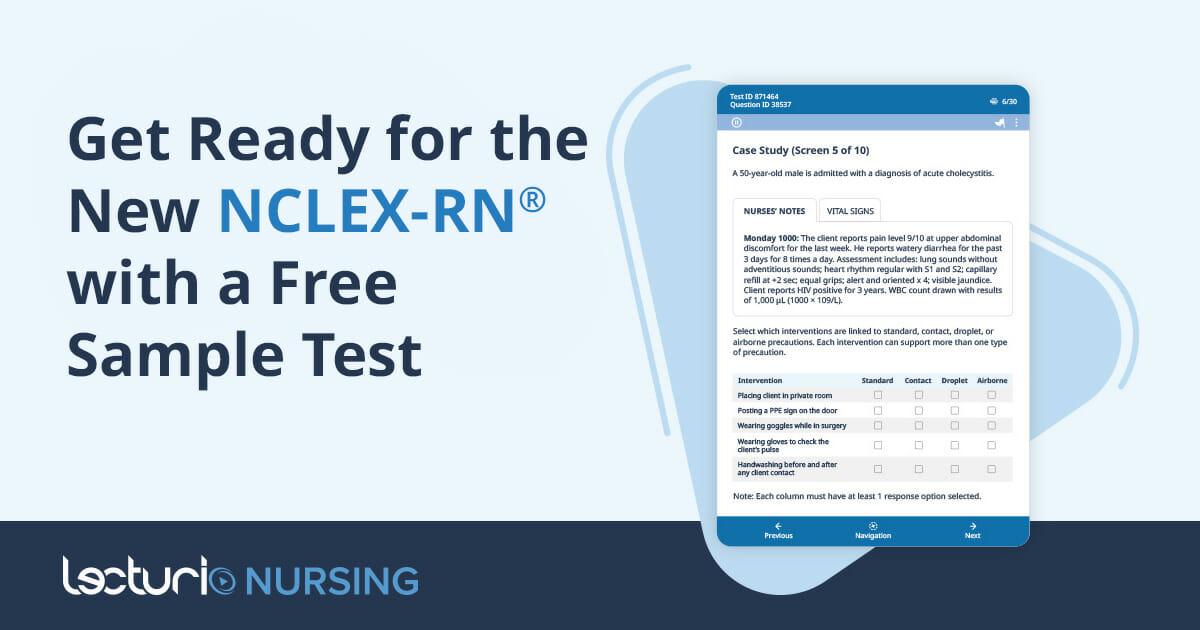


An NGN case study gives you one evolving patient scenario and asks six questions about it, in a fixed order that mirrors how nurses actually make decisions: notice what matters, interpret it, decide what’s most likely going on, weigh the options, act, and then check whether the action worked. The six questions map one-to-one onto the six steps of NCSBN’s Clinical Judgment Measurement Model (CJMM). Once you know that structure, an unfolding case stops feeling like six random questions and starts feeling like one story you already know how to read.
Below is a complete, original worked case — the same anatomy you’ll meet on exam day, with the reasoning spelled out at each step. (For the individual item formats that appear inside case studies — matrix grids, drop-downs, highlight items — see our Next Gen NCLEX question type guide.)
How Do NGN Case Studies Work?
Each case study presents a realistic clinical scenario that unfolds across six questions. The left side of your screen holds the patient chart — nurses’ notes, vital signs, labs, orders — and it updates as the scenario progresses. The right side holds the current question. You cannot go back: once you answer a question, the case moves forward, often adding new information.
The six questions always follow the CJMM sequence:
| Question | CJMM step | What it’s really asking |
| 1 | Recognize cues | Which findings matter right now? |
| 2 | Analyze cues | What do those findings suggest? |
| 3 | Prioritize hypotheses | Which explanation is most likely — and most dangerous? |
| 4 | Generate solutions | What are the appropriate interventions? |
| 5 | Take action | What do you do first / what do you implement? |
| 6 | Evaluate outcomes | Did it work? Which findings show progress? |
The exam blueprint and format details live on NCSBN’s official NGN resources — that’s the primary source worth bookmarking. Format questions aside, the preparation itself hasn’t changed as much as students fear: strong content knowledge plus deliberate practice with the new formats covers it (our 2026 NCLEX changes guide covers what’s actually different this year).
The Case: Day 2 After Bowel Surgery
The following case is an original teaching example written for this article. It is not a real NCLEX item.
Scenario opening — what you see in the chart:
| Chart tab | Entry |
| Nurses’ note, 07:30 | 58-year-old client, post-op day 2 after open bowel resection. Reports increasing abdominal pain overnight, rated 7/10, “different from the incision pain.” Breakfast refused; client feels “shaky and cold.” |
| Vital signs, 07:30 | Temp 38.6°C (101.5°F) · HR 118/min · RR 24/min · BP 96/58 mm Hg · SpO2 94% on room air |
| Vital signs, 19:30 yesterday | Temp 37.4°C · HR 88 · RR 16 · BP 128/76 · SpO2 97% |
| Labs, 07:45 | WBC 16.8 × 10⁹/L (was 11.2 post-op) · Lactate 2.9 mmol/L · Incision site: edges approximated, small amount of purulent drainage noted at inferior margin |
Question 1 — Recognize Cues
Which findings require immediate follow-up? Select all that apply.
The skill here is separating signal from expected post-op noise. Incision discomfort on day 2? Expected. A client who refuses one meal? Worth noting, not alarming alone. The signal cluster: new fever, heart rate climbing while blood pressure falls, rising respiratory rate, borderline oxygen saturation, WBC jump, elevated lactate, purulent drainage, and pain that the client distinguishes from incision pain. Every one of those is a cue; together they sketch a pattern.
Trap to avoid: selecting everything. Recognize-cues items reward discrimination — the approximated wound edges, for instance, are a normal finding.
Question 2 — Analyze Cues
The findings are most consistent with which condition?
Now link the cues: fever + tachycardia + hypotension + tachypnea + leukocytosis + rising lactate, two days after bowel surgery, with purulent drainage and new abdominal pain. That constellation points to infection progressing toward sepsis — likely surgical-site or intra-abdominal in origin. Analyze-cues distractors typically offer plausible single-cue explanations (pain response, dehydration, normal inflammatory response); the correct answer is the one that explains the whole pattern, not one data point.
Question 3 — Prioritize Hypotheses
Which condition poses the greatest immediate risk?
Even when several explanations remain possible, one carries the most danger per hour of inaction. Falling blood pressure with rising lactate signals sepsis with early signs of hypoperfusion — impaired tissue perfusion is the priority hypothesis. A wound infection alone could wait for a dressing change protocol; hypoperfusion cannot. Prioritize means ranking by likelihood and by consequence.
Question 4 — Generate Solutions
Which interventions are appropriate for this client? Select all that apply.
Think in terms of the sepsis response you’d expect on any surgical floor: notify the provider/rapid response, obtain cultures before antibiotics if that does not delay them, prepare for prompt antimicrobial administration, establish or confirm IV access for fluid resuscitation, apply supplemental oxygen, and increase monitoring frequency. Wrong-answer patterns: interventions that delay definitive care (waiting to re-check vitals in an hour) or that are outside the immediate problem (ambulating the client).
Question 5 — Take Action
Which action should the nurse take first?
When everything is indicated, sequence by physiology. The client is hypotensive and hypoperfusing: escalate now — activate the provider/rapid response while another team member establishes access and applies oxygen. “First” items test whether you treat the most lethal problem on the clock, not whether you can list every correct task. Cultures, antibiotics, and fluids follow within the escalation you’ve triggered.
Question 6 — Evaluate Outcomes
Two hours after interventions, which findings indicate improvement? Select all that apply.
Close the loop against the original cues: BP trending up (e.g., 112/68), heart rate settling toward baseline, respiratory rate normalizing, SpO2 rising on the same oxygen dose, lactate falling on repeat, client reporting less pain and warmer extremities. A repeat WBC drawn two hours later is a distractor — it moves too slowly to show improvement in that window. Evaluation items reward knowing which parameters respond fast and which don’t.
What Does This Case Teach About the Format?
Three takeaways transfer to any unfolding case you’ll meet:
- The six steps are a scaffold, not a surprise. Before you read question 1, you already know question 5 will ask “what first?” and question 6 will ask “did it work?” Read the chart with that ending in mind.
- Chart data is layered on purpose. Trends beat snapshots — the 19:30-vs-07:30 vital comparison is the question. Train yourself to hunt for the delta.
- Distractors are single-cue stories. Almost every wrong answer explains one finding while ignoring the pattern. The right answer accounts for the most data.
Practicing full cases — not just isolated items — is what builds this rhythm. Lecturio’s NCLEX prep includes NGN-style case practice with rationales at each step, and if you’re still deciding where to sit the exam, remote options exist too (see our NCLEX remote testing guide).
Frequently Asked Questions (FAQs)
How many case studies are on the NGN NCLEX? Every candidate sees unfolding case studies as part of the exam; NCSBN publishes current exam-composition details on nclex.com — check there for the up-to-date structure rather than relying on secondhand numbers.
Are NGN case study questions scored all-or-nothing? No — NGN items use partial-credit scoring models, so a partially correct select-all answer can still earn points. The specific scoring rules per item type are described in NCSBN’s NGN documentation.
Can I go back to earlier questions in a case study? No. Case studies move forward only, and the chart updates as the scenario unfolds — mirroring how a real clinical situation gives you information.
What’s the best way to practice for case studies? Work complete six-question cases under the CJMM lens, then review the rationale at every step — including the steps you got right. Pattern recognition across the six-step arc is the trainable skill.