O vírus ChikungunyaChikungunyaChikungunya virus belongs to the Alphavirus genus and causes a viral infection characterized by fever and joint pain. Symptoms usually appear within 1 week of infection. Additional manifestations of chikungunya virus may include muscle pain, headache, maculopapular rash, and lymphadenopathy. Chikungunya Virus pertence ao género AlphavirusAlphavirusA genus of togaviridae, also known as group a arboviruses, serologically related to each other but not to other togaviridae. The viruses are transmitted by mosquitoes. The type species is the sindbis virus.Equine Encephalitis Viruses e causa uma infeção viral caracterizada por febre e dores nas articulações. O vírus transportado por artrópodes (arbovírus) é transmitido por mosquitos (geralmente Aedes albopictus e Aedes aegypti). Os sintomas geralmente aparecem dentro de 1 semana após a infeção. Manifestações adicionais do vírus ChikungunyaChikungunyaChikungunya virus belongs to the Alphavirus genus and causes a viral infection characterized by fever and joint pain. Symptoms usually appear within 1 week of infection. Additional manifestations of chikungunya virus may include muscle pain, headache, maculopapular rash, and lymphadenopathy. Chikungunya Virus podem incluir mialgias, cefaleias, rashRashRocky Mountain Spotted FevermaculopapularMaculopapularDermatologic Examination e linfadenopatia. A maioria dos indivíduos infetados recupera, mas podem desenvolver artrite crónica. O tratamento visa aliviar os sintomas. A doença é prevenida ao evitar mosquitos e pelo uso de repelente de insetos e roupas de proteção.
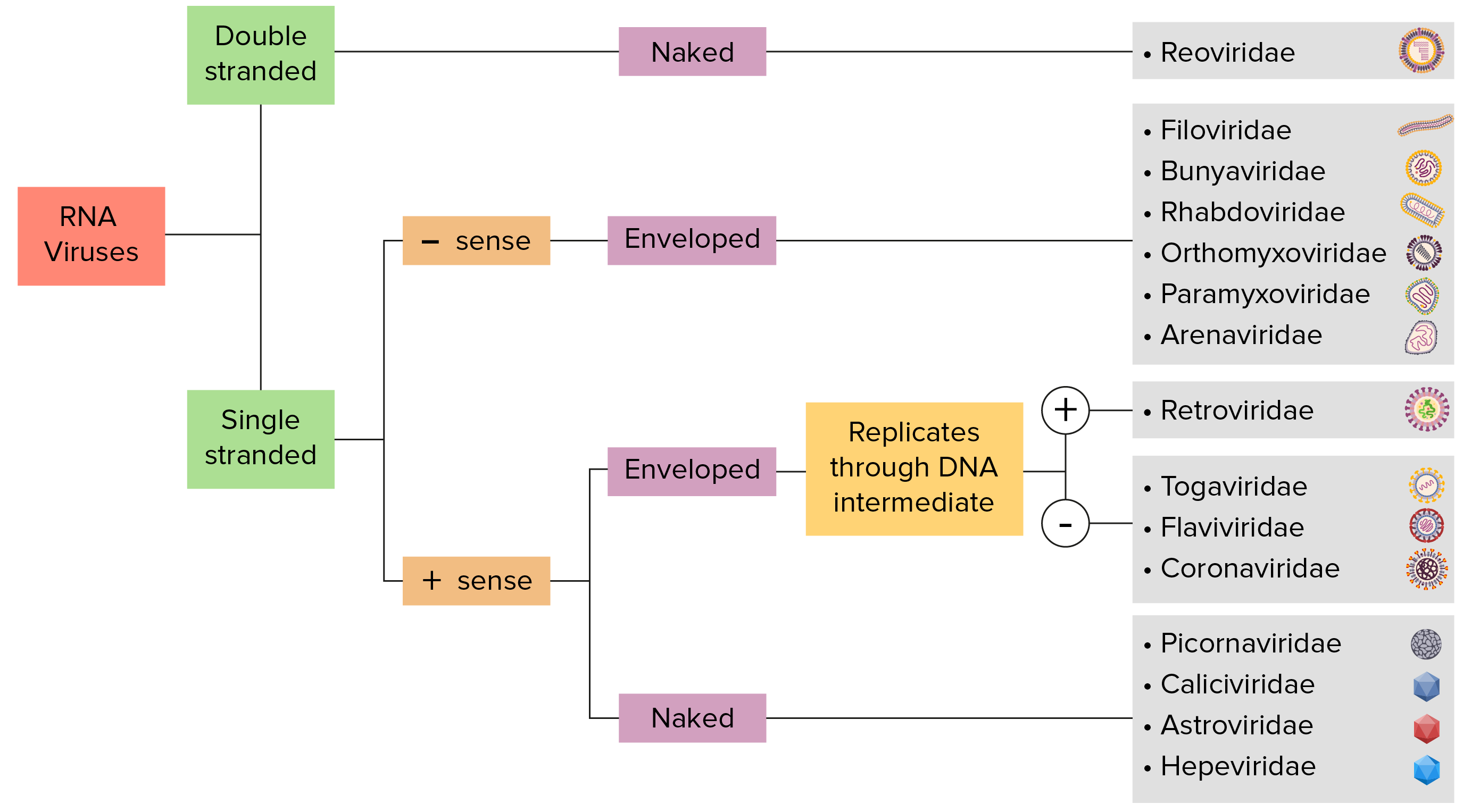
Identificação do vírus RNA: Os vírus podem ser classificados de várias maneiras. A maioria dos vírus, no entanto, terá um genoma formado por DNA ou RNA. Os vírus de genoma de RNA podem ser ainda caracterizados por um RNA de cadeia simples ou dupla. Os vírus “envelopados” são cobertos por uma fina camada de membrana celular (geralmente retirada da célula hospedeira). Se a camada estiver ausente, os vírus são chamados de vírus “nus”. Os vírus com genomas de cadeia simples são vírus de “sentido positivo” se o genoma for usado diretamente como RNA mensageiro (mRNA), que é traduzido em proteínas. Os vírus de “sentido negativo” usam a RNA polimerase dependente de RNA, uma enzima viral, para transcrever o seu genoma em RNA mensageiro.
Vírus ChikungunyaChikungunyaChikungunya virus belongs to the Alphavirus genus and causes a viral infection characterized by fever and joint pain. Symptoms usually appear within 1 week of infection. Additional manifestations of chikungunya virus may include muscle pain, headache, maculopapular rash, and lymphadenopathy. Chikungunya Virus:
Família TogaviridaeTogaviridaeA family of RNA viruses, mainly arboviruses, consisting of two genera: alphavirus (group A arboviruses), and rubivirus. Virions are spherical, 60-70 nm in diameter, with a lipoprotein envelope tightly applied to the icosahedral nucleocapsid.Rubella Virus
Género AlphavirusAlphavirusA genus of togaviridae, also known as group a arboviruses, serologically related to each other but not to other togaviridae. The viruses are transmitted by mosquitoes. The type species is the sindbis virus.Equine Encephalitis Viruses
Genoma:
RNARNAA polynucleotide consisting essentially of chains with a repeating backbone of phosphate and ribose units to which nitrogenous bases are attached. RNA is unique among biological macromolecules in that it can encode genetic information, serve as an abundant structural component of cells, and also possesses catalytic activity.RNA Types and Structure de cadeia simples de sentido positivo
Tamanho: 11,8 kb
Propriedades:
Com envelopeEnvelopeBilayer lipid membrane acquired by viral particles during viral morphogenesis. Although the lipids of the viral envelope are host derived, various virus-encoded integral membrane proteins, i.e. Viral envelope proteins are incorporated there.Virology
O envelopeEnvelopeBilayer lipid membrane acquired by viral particles during viral morphogenesis. Although the lipids of the viral envelope are host derived, various virus-encoded integral membrane proteins, i.e. Viral envelope proteins are incorporated there.Virology de bicamada lipídica possui glicoproteínas codificadas por vírus, que medeiam a ligação e a entrada nas células:
E1E1An aromatized C18 steroid with a 3-hydroxyl group and a 17-ketone, a major mammalian estrogen. It is converted from androstenedione directly, or from testosterone via estradiol. In humans, it is produced primarily by the cyclic ovaries, placenta, and the adipose tissue of men and postmenopausal women.Noncontraceptive Estrogen and Progestins: consiste em peptídeos de fusão, que se dissociam de E2 em pHpHThe quantitative measurement of the acidity or basicity of a solution.Acid-Base Balance baixo e facilitam a libertação de nucleocapsídeos no citoplasma do hospedeiro
E2: liga-se a recetores celulares, o que resulta em endocitose mediada pelos recetores
Capsídeo icosaédrico pequeno
Epidemiologia
Distribuição geográfica:
Surtos frequentes:
África
Sudeste da Ásia
Subcontinente indiano
América do Sul e ilhas das Caraíbas
Estados Unidos:
Casos relatados de turistas que viajam para as áreas acima referidas
Transmissão local observada na Florida, Porto Rico e Ilhas Virgens dos Estados Unidos
Patogénese
Vetores
Mosquitos do género Aedes
Principais vetores (também transmitem o vírus ZikaZikaZika virus belongs to the genus Flavivirus and is primarily transmitted by Aedes aegypti mosquitoes, but can also be transmitted sexually and transplacentally. Although most infected patients are asymptomatic, some may present with low-grade fever, pruritic rash, and conjunctivitis. Zika Virus Infection e o vírus dengueDengueAn acute febrile disease transmitted by the bite of aedes mosquitoes infected with dengue virus. It is self-limiting and characterized by fever, myalgia, headache, and rash. Severe dengue is a more virulent form of dengue.Dengue Virus):
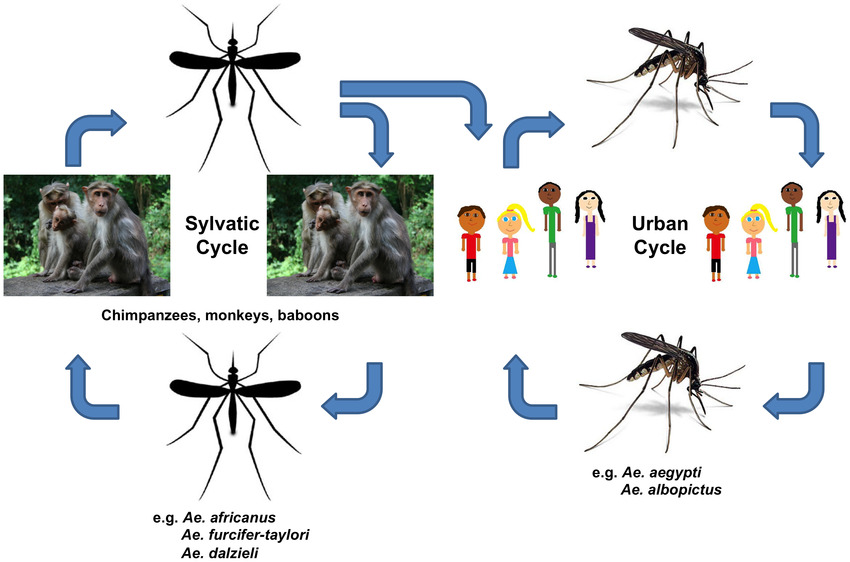
Primatas: O vírus está presente em África e é mantido no ciclo selvagem (por exemplo, primatas selvagens, macacos e mosquitos).
Transmissão
Transmitida de mosquitos para humanos
Transmissão vertical (raro)
Transfusão de sangue (raro)
O ciclo de vida do vírus Chikungunya na África mostra a interconexão entre o ciclo selvagem, que envolve primatas e mosquitos, e o ciclo urbano, que envolve humanos e mosquitos.
Imagem : “Life cycle of Chikungunya virus” por Michelle M Thiboutot et al. Licença: CC BY 4.0
Fatores de risco do hospedeiro
Proximidade dos locais de reprodução de mosquitos
A doença grave pode ocorrer em:
Recém-nascidos
Adultos ≥ 65 anos de idade
Indivíduos com comorbilidades, como diabetesDiabetesDiabetes mellitus (DM) is a metabolic disease characterized by hyperglycemia and dysfunction of the regulation of glucose metabolism by insulin. Type 1 DM is diagnosed mostly in children and young adults as the result of autoimmune destruction of β cells in the pancreas and the resulting lack of insulin. Type 2 DM has a significant association with obesity and is characterized by insulin resistance.Diabetes Mellitus ou doença cardiovascular
Fisiopatologia
O vírus ChikungunyaChikungunyaChikungunya virus belongs to the Alphavirus genus and causes a viral infection characterized by fever and joint pain. Symptoms usually appear within 1 week of infection. Additional manifestations of chikungunya virus may include muscle pain, headache, maculopapular rash, and lymphadenopathy. Chikungunya Virus é introduzido na pele humana e na corrente sanguínea através de uma picada de mosquito.
A replicação viral ocorre nos fibroblastos dérmicos e depois na corrente sanguínea:
O vírus invade e replica diretamente nas articulações e nos músculos.
↑ das citocinas pró-inflamatórias e células inflamatórias
A disseminação e invasão de outros órgãos pode ocorrer:
Fígado (células endoteliais)
Cérebro (células endoteliais e epiteliais)
Tecido linfoide (gânglios linfáticos e baço)
A doença articular crónica é observada em até 60% dos doentes e causada por:
Replicação viral persistente
Resposta imune contínua ao RNARNAA polynucleotide consisting essentially of chains with a repeating backbone of phosphate and ribose units to which nitrogenous bases are attached. RNA is unique among biological macromolecules in that it can encode genetic information, serve as an abundant structural component of cells, and also possesses catalytic activity.RNA Types and Structure remanescente
Autoimunidade
Apresentação Clínica
Infeção neonatal
A infeção do recém-nascidos é observada até 1 semana após o parto. Os sinais e sintomas incluem:
Febre
Má alimentação
EdemaEdemaEdema is a condition in which excess serous fluid accumulates in the body cavity or interstitial space of connective tissues. Edema is a symptom observed in several medical conditions. It can be categorized into 2 types, namely, peripheral (in the extremities) and internal (in an organ or body cavity). Edema
O período de incubação é de 3 a 7 dias. Os sintomas da febre ChikungunyaChikungunyaChikungunya virus belongs to the Alphavirus genus and causes a viral infection characterized by fever and joint pain. Symptoms usually appear within 1 week of infection. Additional manifestations of chikungunya virus may include muscle pain, headache, maculopapular rash, and lymphadenopathy. Chikungunya Virus aparecem até 1 semana após a infeção e incluem:
Febre alta
Artralgia debilitante e artrite:
Bilateral e simétrica
Poliarticular: geralmente envolve as pequenas articulações das mãos, punhos e tornozelos
Os doentes geralmente apresentam-se em postura fletida devido à dor.
O desenvolvimento de artrite crónica aumenta naqueles ≥ 45 anos de idade e/ou com osteoartrite preexistente.
Sintomas graves podem ocorrer em pessoas com fatores de risco:
Encefalite
Miocardite
Hepatite
Insuficiência renal
Hemorragia
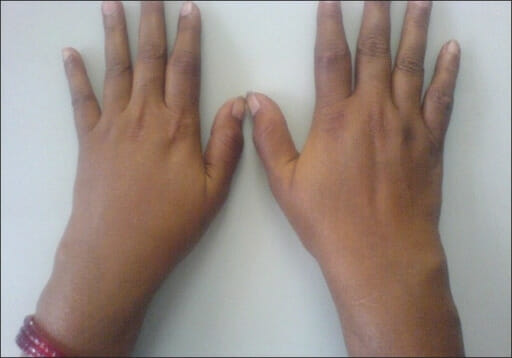
Poliartrite simétrica das pequenas articulações num indivíduo com febre Chikungunya em estádio crónico
Imagem: “Symmetrical inflammatory polyarthritis of the small joints of the hands and tenosynovitis of the wrist joints in a patient with chronic stage of Chikungunya fever” por Alladi Mohan et al. Licença: CC BY 2.0
Diagnóstico
Diagnóstico
História clínica: febre, dor nas articulações e exposição relevante (ou seja, viajar ou morar em área endémica)
Serologia via ELISAELISAAn immunoassay utilizing an antibody labeled with an enzyme marker such as horseradish peroxidase. While either the enzyme or the antibody is bound to an immunosorbent substrate, they both retain their biologic activity; the change in enzyme activity as a result of the enzyme-antibody-antigen reaction is proportional to the concentration of the antigen and can be measured spectrophotometrically or with the naked eye. Many variations of the method have been developed.St. Louis Encephalitis Virus ou anticorpo fluorescente indireto (IFA, pela sigla em inglês):
IgMIgMA class of immunoglobulin bearing mu chains (immunoglobulin mu-chains). Igm can fix complement. The name comes from its high molecular weight and originally being called a macroglobulin.Immunoglobulins: Types and Functions observada no 5º dia do início dos sintomas e pode persistir até 3 meses
IgGIgGThe major immunoglobulin isotype class in normal human serum. There are several isotype subclasses of igg, for example, igg1, igg2a, and igg2b.Hypersensitivity Pneumonitis observada 2 semanas após o início dos sintomas
RT-PCRRT-PCRA variation of the pcr technique in which cDNA is made from RNA via reverse transcription. The resultant cDNA is then amplified using standard pcr protocols.Polymerase Chain Reaction (PCR) do RNARNAA polynucleotide consisting essentially of chains with a repeating backbone of phosphate and ribose units to which nitrogenous bases are attached. RNA is unique among biological macromolecules in that it can encode genetic information, serve as an abundant structural component of cells, and also possesses catalytic activity.RNA Types and Structure do vírus ChikungunyaChikungunyaChikungunya virus belongs to the Alphavirus genus and causes a viral infection characterized by fever and joint pain. Symptoms usually appear within 1 week of infection. Additional manifestations of chikungunya virus may include muscle pain, headache, maculopapular rash, and lymphadenopathy. Chikungunya Virus
Como os complexos de sintomas são semelhantes e os doentes podem estar coinfetados com maisMAISAndrogen Insensitivity Syndrome de 1 vírus, o CDC e a WHO recomendam testar os vírus ChikungunyaChikungunyaChikungunya virus belongs to the Alphavirus genus and causes a viral infection characterized by fever and joint pain. Symptoms usually appear within 1 week of infection. Additional manifestations of chikungunya virus may include muscle pain, headache, maculopapular rash, and lymphadenopathy. Chikungunya Virus, DengueDengueAn acute febrile disease transmitted by the bite of aedes mosquitoes infected with dengue virus. It is self-limiting and characterized by fever, myalgia, headache, and rash. Severe dengue is a more virulent form of dengue.Dengue Virus e ZikaZikaZika virus belongs to the genus Flavivirus and is primarily transmitted by Aedes aegypti mosquitoes, but can also be transmitted sexually and transplacentally. Although most infected patients are asymptomatic, some may present with low-grade fever, pruritic rash, and conjunctivitis. Zika Virus Infection em doentes que apresentam sintomas suspeitos.
Hemograma:
Linfopenia
Trombocitopenia
Outros achados:
↑ TransaminasesTransaminasesA subclass of enzymes of the transferase class that catalyze the transfer of an amino group from a donor (generally an amino acid) to an acceptor (generally a 2-keto acid). Most of these enzymes are pyridoxyl phosphate proteins.Autoimmune Hepatitis hepáticas
↑ Creatinina
Tratamento
Doença aguda
O tratamento da febre ChikungunyaChikungunyaChikungunya virus belongs to the Alphavirus genus and causes a viral infection characterized by fever and joint pain. Symptoms usually appear within 1 week of infection. Additional manifestations of chikungunya virus may include muscle pain, headache, maculopapular rash, and lymphadenopathy. Chikungunya Virus é sintomático:
Evitar AINEs e aspirina até febre dengueDengueAn acute febrile disease transmitted by the bite of aedes mosquitoes infected with dengue virus. It is self-limiting and characterized by fever, myalgia, headache, and rash. Severe dengue is a more virulent form of dengue.Dengue Virus estar excluída (devido ao risco de hemorragia)
Os sintomas podem persistir ou recidivar, especialmente dor nas articulações.
Analgésicos como acetaminofeno e/ou AINEs podem ser usados.
Para sinovite grave e elevação contínua de marcadores inflamatórios, pode ser administrado um esquema curto de glucocorticoides.
Para sintomas ≥ 3 meses, podem ser administrados fármacos antirreumáticos modificadores da doença (DMARDsDMARDsDisease-modifying antirheumatic drugs are antiinflammatory medications used to manage rheumatoid arthritis. The medications slow, but do not cure, the progression of the disease. The medications are classified as either synthetic or biologic agents and each has unique mechanisms of action and side effects.Disease-Modifying Antirheumatic Drugs (DMARDs), pela sigla em inglês), como metotrexato e sulfassalazina.
Prevenção
Evitar áreas de reprodução de mosquitos atarvés de controlo ambiental (ou seja, sem água parada em recipientes) e usar proteção individual:
Repelente de insetos
Usar roupas de proteção.
Dormir debaixo de uma rede de mosquitos.
Comparações de Espécies
O vírus ChikungunyaChikungunyaChikungunya virus belongs to the Alphavirus genus and causes a viral infection characterized by fever and joint pain. Symptoms usually appear within 1 week of infection. Additional manifestations of chikungunya virus may include muscle pain, headache, maculopapular rash, and lymphadenopathy. Chikungunya Virus e o vírus da Encefalite Equina pertencem ao género AlphavirusAlphavirusA genus of togaviridae, also known as group a arboviruses, serologically related to each other but not to other togaviridae. The viruses are transmitted by mosquitoes. The type species is the sindbis virus.Equine Encephalitis Viruses e são as principais etiologias de encefalite nos Estados Unidos.
Tabela: Comparação do vírus ChikungunyaChikungunyaChikungunya virus belongs to the Alphavirus genus and causes a viral infection characterized by fever and joint pain. Symptoms usually appear within 1 week of infection. Additional manifestations of chikungunya virus may include muscle pain, headache, maculopapular rash, and lymphadenopathy. Chikungunya Virus e vírus da Encefalite Equina
Organismo
Vírus ChikungunyaChikungunyaChikungunya virus belongs to the Alphavirus genus and causes a viral infection characterized by fever and joint pain. Symptoms usually appear within 1 week of infection. Additional manifestations of chikungunya virus may include muscle pain, headache, maculopapular rash, and lymphadenopathy. Chikungunya Virus
Vírus da Encefalite Equina
Família
TogaviridaeTogaviridaeA family of RNA viruses, mainly arboviruses, consisting of two genera: alphavirus (group A arboviruses), and rubivirus. Virions are spherical, 60-70 nm in diameter, with a lipoprotein envelope tightly applied to the icosahedral nucleocapsid.Rubella Virus
RT-PCRRT-PCRA variation of the pcr technique in which cDNA is made from RNA via reverse transcription. The resultant cDNA is then amplified using standard pcr protocols.Polymerase Chain Reaction (PCR)
Tratamento
Sintomático
Controlo das dores articulares
Suporte
Prevenção
Evitar mosquitos
Repelente de insetos
Roupa de proteção
Rede de mosquitos
Diagnóstico Diferencial
Condições que mimetizam a febre ChikungunyaChikungunyaChikungunya virus belongs to the Alphavirus genus and causes a viral infection characterized by fever and joint pain. Symptoms usually appear within 1 week of infection. Additional manifestations of chikungunya virus may include muscle pain, headache, maculopapular rash, and lymphadenopathy. Chikungunya Virus aguda, têm um complexo de sintomas semelhante e pertencem à família Flaviridae e ao género FlavivirusFlavivirusA genus of flaviviridae containing several subgroups and many species. Most are arboviruses transmitted by mosquitoes or ticks. The type species is yellow fever virus.Tick-borne Encephalitis Virus:
Vírus dengueDengueAn acute febrile disease transmitted by the bite of aedes mosquitoes infected with dengue virus. It is self-limiting and characterized by fever, myalgia, headache, and rash. Severe dengue is a more virulent form of dengue.Dengue Virus: pequeno vírus de RNARNAA polynucleotide consisting essentially of chains with a repeating backbone of phosphate and ribose units to which nitrogenous bases are attached. RNA is unique among biological macromolecules in that it can encode genetic information, serve as an abundant structural component of cells, and also possesses catalytic activity.RNA Types and Structure cadeia simples, de sentido positivo, transmitido aos humanos pela picada de uma fêmea do mosquito Aedes. A maioria das infeções é assintomática. Indivíduos sintomáticos podem progredir por diferentes estadios. A fase febril inclui febre, cefaleia, dor retro-orbitária, mialgias, artralgias e rashRashRocky Mountain Spotted FevermaculopapularMaculopapularDermatologic Examination. Manifestações maisMAISAndrogen Insensitivity Syndrome graves de extravasamento capilar, hemorragia e choque podem ocorrer na fase crítica. A resolução dos sinais e sintomas ocorre na fase de convalescença. Os testesTestesGonadal Hormones de diagnóstico incluem serologia, teste de antigénio ou PCRPCRPolymerase chain reaction (PCR) is a technique that amplifies DNA fragments exponentially for analysis. The process is highly specific, allowing for the targeting of specific genomic sequences, even with minuscule sample amounts. The PCR cycles multiple times through 3 phases: denaturation of the template DNA, annealing of a specific primer to the individual DNA strands, and synthesis/elongation of new DNA molecules.Polymerase Chain Reaction (PCR). O tratamento é de suporte.
Vírus ZikaZikaZika virus belongs to the genus Flavivirus and is primarily transmitted by Aedes aegypti mosquitoes, but can also be transmitted sexually and transplacentally. Although most infected patients are asymptomatic, some may present with low-grade fever, pruritic rash, and conjunctivitis. Zika Virus Infection: vírus de RNARNAA polynucleotide consisting essentially of chains with a repeating backbone of phosphate and ribose units to which nitrogenous bases are attached. RNA is unique among biological macromolecules in that it can encode genetic information, serve as an abundant structural component of cells, and also possesses catalytic activity.RNA Types and Structure cadeia simples, de sentido positivo maisMAISAndrogen Insensitivity Syndrome frequentemente transmitido por um mosquito A. aegypti. O vírus pode também ser transmitido sexualmente e por via transplacentária. A maioria dos doentes infetados está assintomática, mas alguns podem apresentar febre baixa, rashRashRocky Mountain Spotted Fever pruriginoso e conjuntivite. A síndrome congénita ZikaZikaZika virus belongs to the genus Flavivirus and is primarily transmitted by Aedes aegypti mosquitoes, but can also be transmitted sexually and transplacentally. Although most infected patients are asymptomatic, some may present with low-grade fever, pruritic rash, and conjunctivitis. Zika Virus Infection é uma infeção fetal transplacentária, que se manifesta com defeitos oculares, microcefalia, espasticidade e convulsões. O diagnóstico é feito por RT-PCRRT-PCRA variation of the pcr technique in which cDNA is made from RNA via reverse transcription. The resultant cDNA is then amplified using standard pcr protocols.Polymerase Chain Reaction (PCR) ou serologia. O tratamento é principalmente de suporte. A prevenção inclui o controlo da população de mosquitos com repelente de insetos e roupas de proteção.
Condições que se apresentam como artrite crónica:
Artrite reumatoide soronegativa: artrite inflamatória em 3 ou maisMAISAndrogen Insensitivity Syndrome articulações, que dura por > 6 semanas. Os testesTestesGonadal Hormones de fator reumatoide e antipeptídeo citrulinado cíclico são negativos e podem apresentar-se de forma semelhante à infeção por ChikungunyaChikungunyaChikungunya virus belongs to the Alphavirus genus and causes a viral infection characterized by fever and joint pain. Symptoms usually appear within 1 week of infection. Additional manifestations of chikungunya virus may include muscle pain, headache, maculopapular rash, and lymphadenopathy. Chikungunya Virus. A serologia e a história (incluindo viagens) distinguem a artrite reumatoide soronegativa da infeção por ChikungunyaChikungunyaChikungunya virus belongs to the Alphavirus genus and causes a viral infection characterized by fever and joint pain. Symptoms usually appear within 1 week of infection. Additional manifestations of chikungunya virus may include muscle pain, headache, maculopapular rash, and lymphadenopathy. Chikungunya Virus.
Artrite reativa: artrite que ocorre concomitantemente com ou após uma infeção extra-articular. As características incluem oligoartrite assimétrica (muitas vezes envolve as extremidades inferiores), entesite, dor nas costas e dactilite. O diagnóstico é feito pela história (é frequentemente observada infeção gastrointestinal ou urinária) e após exclusão de outras etiologias de artrite com exames laboratoriais e de imagem.
Referências:
Centers for Disease Control and Prevention. (2024). Chikungunya virus. Retrieved October 28, 2025, from https://www.cdc.gov/chikungunya/
A Lecturio Medical complementa o teu estudo através de métodos de ensino baseados em evidência, vídeos de palestras, perguntas e muito mais – tudo combinado num só lugar e fácil de usar.
User Reviews
Details
×
Obtenha Premium para testar os seus conhecimentos
Lecturio Premium dá-lhe acesso total a todos os conteúdos e características
Obtenha Premium para ver todos os vídeos
Verifique agora o seu e-mail para obter um teste gratuito.
Crie uma conta gratuita para testar os seus conhecimentos
Lecturio Premium dá-lhe acesso total a todos os conteúdos e características - incluindo o Qbank de Lecturio com perguntas actualizadas ao estilo do board-.