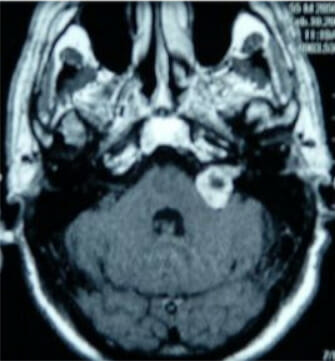



Neurinoma do Acústico

O neurinoma do acústico, também conhecido como schwannoma Schwannoma Schwannomas (also known as neurilemmomas) are benign nerve sheath tumors in the peripheral nervous system (PNS), arising from Schwann cells that encase the peripheral nerves. Schwannomas are the most common tumors in the PNS. Schwannoma vestibular, é um tumor Tumor Inflammation benigno com origem nas células de Schwann da divisão vestibular do VIII par PAR The PAR is the attributable risk for an entire population. It represents the fraction of cases that would not occur in a population if the exposure was eliminated. Measures of Risk craniano. O neurinoma do acústico forma-se no canal auditivo interno e estende-se até ao ângulo pontocerebeloso. Normalmente, o schwannoma Schwannoma Schwannomas (also known as neurilemmomas) are benign nerve sheath tumors in the peripheral nervous system (PNS), arising from Schwann cells that encase the peripheral nerves. Schwannomas are the most common tumors in the PNS. Schwannoma vestibular é unilateral. Os schwannomas vestibulares bilaterais estão associados à neurofibromatose do tipo II. Os sintomas resultam da compressão dos pares cranianos V, VII, e VIII e do cerebelo. A queixa mais MAIS Androgen Insensitivity Syndrome comum é a perda auditiva unilateral, mas o neurinoma acústico também se pode manifestar com vertigem, diminuição da sensação facial, paralisia de Bell e ataxia Ataxia Impairment of the ability to perform smoothly coordinated voluntary movements. This condition may affect the limbs, trunk, eyes, pharynx, larynx, and other structures. Ataxia may result from impaired sensory or motor function. Sensory ataxia may result from posterior column injury or peripheral nerve diseases. Motor ataxia may be associated with cerebellar diseases; cerebral cortex diseases; thalamic diseases; basal ganglia diseases; injury to the red nucleus; and other conditions. Ataxia-telangiectasia. O diagnóstico do schwannoma Schwannoma Schwannomas (also known as neurilemmomas) are benign nerve sheath tumors in the peripheral nervous system (PNS), arising from Schwann cells that encase the peripheral nerves. Schwannomas are the most common tumors in the PNS. Schwannoma vestibular é feito através de uma ressonância magnética do cérebro com contraste. O tratamento depende do tamanho do tumor Tumor Inflammation e da gravidade dos sintomas. Os tumores grandes com grande perda auditiva são tratados com excisão cirúrgica ou radioterapia, enquanto os tumores de menores dimensões e com sintomas leves a observação/ terapêutica expectante está recomendada.

Last updated: Dec 15, 2025

Editorial responsibility: Stanley Oiseth, Lindsay Jones, Evelin Maza

Descrição Geral

Definição

Um neurinoma do acústico é um tumor Tumor Inflammation benigno de células de Schwann que surge mais MAIS Androgen Insensitivity Syndrome frequentemente no nervo craniano VIII (nervo vestibulococlear).

Classificação dos tumores do sistema nervoso

Tabela: Classificação dos tumores do sistema nervoso
Categorias Tumores específicos
Tumores neuroepiteliais do SNC
  • Astrocitomas, incluindo glioblastoma multiforme Glioblastoma multiforme Glioblastoma multiforme is a high-grade astrocytoma, an aggressive brain tumor arising from astrocytes, with an unknown cause and a poorly understood link to risk factors. There are two main types: primary, a more aggressive form seen more commonly in older patients, and secondary, developing from lower-grade astrocytomas and seen more commonly in younger patients. Glioblastoma Multiforme
  • Oligodendroglioma Oligodendroglioma Oligodendrogliomas are malignant CNS tumors arising from neural glial cell precursors. Oligodendrogliomas often arise in the frontal lobes of the brain and have a generally favorable prognosis when compared to other gliomas. Oligodendrogliomas are the 3rd most common CNS tumor. The most frequent presenting symptom is a seizure. Oligodendroglioma
  • Ependimoma e tumores do plexo coroide
  • Meduloblastomas (tumores embrionários)
Tumores meníngeos
  • Meningiomas
  • Hemangioblastomas Hemangioblastomas A benign tumor of the nervous system that may occur sporadically or in association with von Hippel-Lindau disease. It accounts for approximately 2% of intracranial tumors, arising most frequently in the cerebellar hemispheres and vermis. Histologically, the tumors are composed of multiple capillary and sinusoidal channels lined with endothelial cells and clusters of lipid-laden pseudoxanthoma cells. Usually solitary, these tumors can be multiple and may also occur in the brain stem, spinal cord, retina, and supratentorial compartment. Cerebellar hemangioblastomas usually present in the third decade with intracranial hypertension, and ataxia. Von Hippel-Lindau Disease
Tumores da região selar
  • Craniofaringioma
  • Adenoma da hipófise
  • Pinealoma
Linfoma primário do SNC Linfoma primário do SNC
Metástases cerebrais (5x mais MAIS Androgen Insensitivity Syndrome comum do que os tumores cerebrais primários) Que resultam frequentemente de:
  • Neoplasia do pulmão, da mama e do carcinoma de células renais
  • Melanoma Melanoma Melanoma is a malignant tumor arising from melanocytes, the melanin-producing cells of the epidermis. These tumors are most common in fair-skinned individuals with a history of excessive sun exposure and sunburns. Melanoma
Tumores periféricos
  • Schwannomas, incluindo o neurinoma do acústico
  • Neuroblastoma Neuroblastoma Neuroblastoma is a malignancy that arises from the neural crest cell derivatives along the sympathetic chain (neuroblasts) and is most commonly located in the adrenal medulla. The tumor often presents in childhood with a flank mass that crosses the midline. Neuroblastoma

Epidemiologia

  • Mediana da idade de diagnóstico: 53 anos
  • Tumor Tumor Inflammation mais MAIS Androgen Insensitivity Syndrome comum do ângulo pontocerebeloso
  • Normalmente é unilateral
  • Incidência: 11 por 1 milhão de pessoas nos Estados Unidos
  • Não há diferença na incidência entre sexos
  • Maior incidência nas ilhas asiáticas do Pacífico

Etiologia

  • A maioria dos casos tem uma etiologia desconhecida.
  • Por vezes associado à mutação no braço longo do cromossoma 22:
    • O gene Gene A category of nucleic acid sequences that function as units of heredity and which code for the basic instructions for the development, reproduction, and maintenance of organisms. Basic Terms of Genetics NF2 NF2 Neurofibromatosis type 2 is a neurocutaneous disorder that can arise from mutations in the NF2 gene located in chromosome 22 and may be inherited in an autosomal dominant fashion or occur from de novo mutations. The main clinical features are bilateral vestibular schwannomas, intracranial/spinal meningioma, and intramedullary and extramedullary spinal tumors. Neurofibromatosis Type 2 produz schwanomina ou merlina, um supressor tumoral.
    • O gene Gene A category of nucleic acid sequences that function as units of heredity and which code for the basic instructions for the development, reproduction, and maintenance of organisms. Basic Terms of Genetics inativado tem sido encontrado em alguns neurinomas do acústico.
  • Tem sido associado à exposição a ruídos, à radioterapia da cabeça e pescoço e à neurofibromatose do tipo 2

Apresentação Clínica

Os sintomas de neurinoma do acústico são divididos em fases iniciais e finais.

Fase inicial

Expansão tumoral no canal auditivo interno exercendo pressão sobre o nervo vestibulococlear (CN VIII):

  • Compressão do nervo vestibular:
    • Tonturas
    • Desequilíbrio postural
  • Compressão do nervo coclear:
    • Perda auditiva neurossensorial unilateral (sintoma mais MAIS Androgen Insensitivity Syndrome comum)
    • Tinnitus Tinnitus A nonspecific symptom of hearing disorder characterized by the sensation of buzzing, ringing, clicking, pulsations, and other noises in the ear. Objective tinnitus refers to noises generated from within the ear or adjacent structures that can be heard by other individuals. The term subjective tinnitus is used when the sound is audible only to the affected individual. Tinnitus may occur as a manifestation of cochlear diseases; vestibulocochlear nerve diseases; intracranial hypertension; craniocerebral trauma; and other conditions. Cranial Nerve Palsies (zumbidos)

Fase tardia

Compressão de estruturas adjacentes no ângulo pontocerebeloso:
  • Compressão dos nervos faciais:
    • Fraqueza facial ipsilateral ou paralisia facial completa (paralisia de Bell)
    • Também se pode apresentar com:
  • Compressão do nervo trigémeo:
    • Diminuição da sensação facial ou dormência ipsilateral
    • Dor facial ipsilateral
  • Compressão ipsilateral cerebelar:
    • Ataxia Ataxia Impairment of the ability to perform smoothly coordinated voluntary movements. This condition may affect the limbs, trunk, eyes, pharynx, larynx, and other structures. Ataxia may result from impaired sensory or motor function. Sensory ataxia may result from posterior column injury or peripheral nerve diseases. Motor ataxia may be associated with cerebellar diseases; cerebral cortex diseases; thalamic diseases; basal ganglia diseases; injury to the red nucleus; and other conditions. Ataxia-telangiectasia
    • Disdiadococinesia (incapacidade para efetuar movimentos alternados rápidos )
    • Dismetria

Diagnóstico

Avaliação dos pares cránianos

  • Nervo vestibulococlear: audiometria
    • Perda auditiva neurossensorial
    • Dificuldade na deteção de sons de alta frequência
  • Nervo facial:
    • Fraqueza facial ipsilateral
    • Tremores faciais ipsilaterais
  • Nervo do trigémeo:
    • Diminuição da sensibilidade facial ipsilateral
    • Reflexos da corneanos diminuídos ipsilateralmente

Estudos de imagem

  • Ressonância magnética do cérebro com contraste:
    • Teste de escolha inicial
    • Realizado nos doentes com resultados anormais na audiometria e alta suspeita de schwannoma Schwannoma Schwannomas (also known as neurilemmomas) are benign nerve sheath tumors in the peripheral nervous system (PNS), arising from Schwann cells that encase the peripheral nerves. Schwannomas are the most common tumors in the PNS. Schwannoma vestibular
    • Achados:
      • Lesão hiperintensa no meato auditivo interno
      • Expansão para o ângulo pontocerebeloso
      • Degeneração quística/ de gordura é vista frequentemente.
  • TAC do cérebro com contraste:
    • Realizado nos doentes que não são elegíveis para a RM (por exemplo, por possuírem um pacemaker Pacemaker A device designed to stimulate, by electric impulses, contraction of the heart muscles. It may be temporary (external) or permanent (internal or internal-external). Bradyarrhythmias ou implante metálico)
    • Achados semelhantes aos da ressonância magnética

Histopatologia

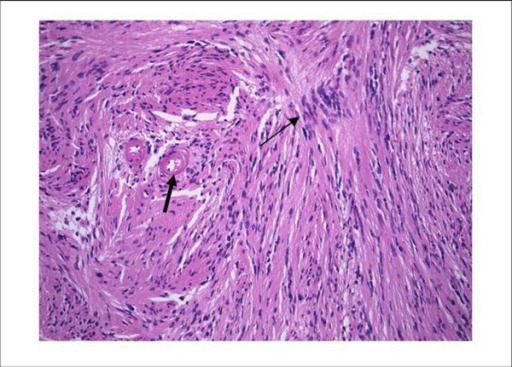
  • Marcação intensa para S100 S100 A family of highly acidic calcium-binding proteins found in large concentration in the brain and believed to be glial in origin. They are also found in other organs in the body. They have in common the ef-hand motif (ef hand motifs) found on a number of calcium binding proteins. The name of this family derives from the property of being soluble in a 100% saturated ammonium sulfate solution. Acoustic Neuroma
  • Áreas hipercelulares com células fusiformes (referidas como Antoni A) alternadas com estroma hipocelular mixoide (referidas como Antoni B)

Tratamento

Tumor Tumor Inflammation grande com perda auditiva grave

  • Excisão cirúrgica:
    • A cirurgia não recupera as perdas auditivas, mas evita mais MAIS Androgen Insensitivity Syndrome perdas.
    • Monitorização intraoperatória dos nervos cranianos para reduzir o risco de lesões nervosas
    • Complicações:
      • Acufenos
      • Perda de audição
      • Paralisia facial
      • Alterações do paladar (disgeusia)
      • Dores de cabeça
  • Radioterapia:
    • Radiocirurgia estereotáxica, radioterapia por protões ou radioterapia estereotáxica fracionada
    • O objetivo da radioterapia é controlar o crescimento tumoral, prevenindo o seu crescimento e, por vezes, reduzir o tamanho do mesmo.
    • Complicações:
      • Fraqueza facial
      • Doença maligna
      • Expansão tumoral
      • Formação de quistos

Pequeno tumor Tumor Inflammation com perda auditiva leve

Vigilância:

  • Ressonância magnética a cada 6-12 meses para avaliar a progressão tumoral
  • Aparelhos auditivos para perda auditiva (cerca de 50% dos doentes observados durante 10 anos perdem audição funcional)

Diagnóstico Diferencial

  • Meningioma Meningioma Meningiomas are slow-growing tumors that arise from the meninges of the brain and spinal cord. The vast majority are benign. These tumors commonly occur in individuals with a history of high doses of skull radiation, head trauma, and neurofibromatosis 2. Meningioma: tumor Tumor Inflammation benigno que surge nas meninges Meninges The brain and the spinal cord are enveloped by 3 overlapping layers of connective tissue called the meninges. The layers are, from the most external layer to the most internal layer, the dura mater, arachnoid mater, and pia mater. Between these layers are 3 potential spaces called the epidural, subdural, and subarachnoid spaces. Meninges: Anatomy do cérebro ou da medula espinhal. Os fatores de risco incluem exposição à radiação. A apresentação clínica do meningioma Meningioma Meningiomas are slow-growing tumors that arise from the meninges of the brain and spinal cord. The vast majority are benign. These tumors commonly occur in individuals with a history of high doses of skull radiation, head trauma, and neurofibromatosis 2. Meningioma inclui dores de cabeça, distúrbios visuais e eventualmente convulsões. Os exames de imagem e a biópsia cerebral são as principais ferramentas para o diagnóstico. O meningioma Meningioma Meningiomas are slow-growing tumors that arise from the meninges of the brain and spinal cord. The vast majority are benign. These tumors commonly occur in individuals with a history of high doses of skull radiation, head trauma, and neurofibromatosis 2. Meningioma pode ser tratado com cirurgia ou radioterapia.
  • Neurofibromatose tipo II: é uma síndrome neurocutânea autossómica dominante causada pela mutação do gene Gene A category of nucleic acid sequences that function as units of heredity and which code for the basic instructions for the development, reproduction, and maintenance of organisms. Basic Terms of Genetics NF2 NF2 Neurofibromatosis type 2 is a neurocutaneous disorder that can arise from mutations in the NF2 gene located in chromosome 22 and may be inherited in an autosomal dominant fashion or occur from de novo mutations. The main clinical features are bilateral vestibular schwannomas, intracranial/spinal meningioma, and intramedullary and extramedullary spinal tumors. Neurofibromatosis Type 2 no cromossoma 22. O gene Gene A category of nucleic acid sequences that function as units of heredity and which code for the basic instructions for the development, reproduction, and maintenance of organisms. Basic Terms of Genetics NF2 NF2 Neurofibromatosis type 2 is a neurocutaneous disorder that can arise from mutations in the NF2 gene located in chromosome 22 and may be inherited in an autosomal dominant fashion or occur from de novo mutations. The main clinical features are bilateral vestibular schwannomas, intracranial/spinal meningioma, and intramedullary and extramedullary spinal tumors. Neurofibromatosis Type 2 codifica a proteína merlin Merlin A membrane protein homologous to the erm (ezrin-radixin-moesin) family of cytoskeleton-associated proteins which regulate physical properties of membranes. Alterations in neurofibromin 2 are the cause of neurofibromatosis 2. Neurofibromatosis Type 2. Os sintomas dependem do tipo tumor Tumor Inflammation e da sua localização. Estes tumores incluem cataratas bilaterais, neurinomas do acústico bilaterais, meningiomas, ependimomas e neurofibromas. O diagnóstico é feito com a história genética do doente, exame físico, exames de imagem e testes Testes Gonadal Hormones genéticos. O tratamento inclui a excisão cirúrgica ou radiação dos tumores e aparelhos auditivos para qualquer perda auditiva funcional.
  • Doença de Meniere:doença do ouvido interno, normalmente unilateral, que leva a uma sensação de vertigem, de acufeno e de plenitude auricular. Os sintomas parecem resultar da acumulação de fluido no labirinto do ouvido interno. A doença é considerada progressiva e pode causar perda auditiva. O diagnóstico é baseado na avaliação clínica e no exame auditivo. O tratamento consiste em antieméticos e ansiolíticos (nos episódios agudos) e fisioterapia, alterações dietéticas, com uma dieta pobre em sal e counselling (a longo prazo). Ao contrário do neurinoma do acústico, na doença de Meniere não há nenhuma lesão ocupante de espaço nos exames de imagem.

Referências

  1. Park, J.K., Vernick, D.M. (2025). Vestibular schwannoma (acoustic neuroma). UpToDate. Retrieved March 24, 2025, from https://www.uptodate.com/contents/vestibular-schwannoma-acoustic-neuroma
  2. Martin, K.A. (n.d.). Patient education: Vestibular schwannoma (acoustic neuroma). UpToDate. Retrieved March 24, 2025, from https://www.uptodate.com/contents/vestibular-schwannoma-acoustic-neuroma-the-basics
  3. Kutz, J.W. (2024). Acoustic neuroma. Medscape. Retrieved March 24, 2025, from https://emedicine.medscape.com/article/882876-overview

Crie sua conta gratuita ou faça login para continuar lendo!

Cadastre-se agora e tenha acesso grátis ao Lecturio, com páginas de conceitos, vídeos de medicina e questões para sua educação médica.

Aprende mais com a Lecturio:

Multiple devices displaying human anatomy and health education content.

Complementa o teu estudo da faculdade com o companheiro de estudo tudo-em-um da Lecturio, através de métodos de ensino baseados em evidência.

Estuda onde quiseres

Two iPhones display medical education apps, one showing anatomy, the other Bookmatcher.

A Lecturio Medical complementa o teu estudo através de métodos de ensino baseados em evidência, vídeos de palestras, perguntas e muito mais – tudo combinado num só lugar e fácil de usar.

User Reviews

Details