



Gastrite

A gastrite é a inflamação da mucosa gástrica e pode ser classificada por curso temporal (aguda ou crónica), características histológicas e etiologia. Pode ser assintomática ou causar sintomas, tais como dor abdominal em queimadura ou ardor (que ou piora ou melhora com a alimentação), dispépsia, náuseas e vómitos. As etiologias mais MAIS Androgen Insensitivity Syndrome comuns de gastrite são a infeção pelo Helicobacter Helicobacter Helicobacter pylori is a gram-negative bacterium that causes gastric infection. It is the most well known and clinically significant species of Helicobacter. Transmission is believed to occur by ingestion of contaminated food or water; therefore, a higher prevalence of infection is seen in areas with poor sanitation. Helicobacter pylori e o uso de aspirina/AINEs. A gastrite crónica (metaplásica) pode-se dever a causas autoimunes ou ambientais e é um fator de risco para cancro gástrico. O tratamento da gastrite aguda e crónica devido à infeção por H. pylori envolve a supressão de ácidos e antibióticos. As outras causas são tratadas através da evicção de agentes agressores e reposição dos défices associados.

Last updated: Dec 15, 2025

Editorial responsibility: Stanley Oiseth, Lindsay Jones, Evelin Maza

Descrição Geral

Definição

A gastrite é a inflamação da mucosa gástrica associada a lesão da mucosa.

Epidemiologia

  • Prevalência de 6,3 por 100.000 habitantes
  • Helicobacter pylori Helicobacter pylori A spiral bacterium active as a human gastric pathogen. It is a gram-negative, urease-positive, curved or slightly spiral organism initially isolated in 1982 from patients with lesions of gastritis or peptic ulcers in Western Australia. Helicobacter pylori was originally classified in the genus campylobacter, but RNA sequencing, cellular fatty acid profiles, growth patterns, and other taxonomic characteristics indicate that the micro-organism should be included in the genus Helicobacter. It has been officially transferred to Helicobacter gen. Helicobacter: prevalência na população pediátrica (determinante primário da gastrite por H. pylori H. pylori A spiral bacterium active as a human gastric pathogen. It is a gram-negative, urease-positive, curved or slightly spiral organism initially isolated in 1982 from patients with lesions of gastritis or peptic ulcers in Western Australia. Helicobacter pylori was originally classified in the genus campylobacter, but RNA sequencing, cellular fatty acid profiles, growth patterns, and other taxonomic characteristics indicate that the micro-organism should be included in the genus Helicobacter. It has been officially transferred to Helicobacter gen. Helicobacter):
    • 10% nos países ocidentais
    • 50% nos países em desenvolvimento
    • Transmissão por via fecal-oral
  • Gastrite autoimune:
    • Prevalência: 2%–5% nos países ocidentais
    • Mais MAIS Androgen Insensitivity Syndrome comum em mulheres e aumenta com a idade
    • Associada a outras doenças autoimunes (por exemplo, doenças da tireoide, diabetes Diabetes Diabetes mellitus (DM) is a metabolic disease characterized by hyperglycemia and dysfunction of the regulation of glucose metabolism by insulin. Type 1 DM is diagnosed mostly in children and young adults as the result of autoimmune destruction of β cells in the pancreas and the resulting lack of insulin. Type 2 DM has a significant association with obesity and is characterized by insulin resistance. Diabetes Mellitus)

Etiologia

A gastrite é geralmente causada por uma infeção ou por um processo imunomediado.
  • Infeciosa:
    • H. pylori H. pylori A spiral bacterium active as a human gastric pathogen. It is a gram-negative, urease-positive, curved or slightly spiral organism initially isolated in 1982 from patients with lesions of gastritis or peptic ulcers in Western Australia. Helicobacter pylori was originally classified in the genus campylobacter, but RNA sequencing, cellular fatty acid profiles, growth patterns, and other taxonomic characteristics indicate that the micro-organism should be included in the genus Helicobacter. It has been officially transferred to Helicobacter gen. Helicobacter ( mais MAIS Androgen Insensitivity Syndrome comum)
    • Mycobacterium avium Mycobacterium avium A bacterium causing tuberculosis in domestic fowl and other birds. In pigs, it may cause localized and sometimes disseminated disease. The organism occurs occasionally in sheep and cattle. It should be distinguished from the m. avium complex, which infects primarily humans. Mycobacterium intracellulare
    • Enterococcus Enterococcus Enterococcus is a genus of oval-shaped gram-positive cocci that are arranged in pairs or short chains. Distinguishing factors include optochin resistance and the presence of pyrrolidonyl arylamidase (PYR) and Lancefield D antigen. Enterococcus is part of the normal flora of the human GI tract. Enterococcus
    • Herpes simplex Herpes Simplex A group of acute infections caused by herpes simplex virus type 1 or type 2 that is characterized by the development of one or more small fluid-filled vesicles with a raised erythematous base on the skin or mucous membrane. It occurs as a primary infection or recurs due to a reactivation of a latent infection. Congenital TORCH Infections
    • Citomegalovírus
    • Parasitas
  • Autoimune (associada a anticorpos anti-células parietais e anti-fator intrínseco)
  • Causas raras:
    • Doença de Crohn
    • Sarcoidose
    • Vasculite
    • Gastrite colagenosa
    • Gastrite eosinofílica
    • Gastrite isquémica

Fisiopatologia

Gastrite associada ao H. pylori H. pylori A spiral bacterium active as a human gastric pathogen. It is a gram-negative, urease-positive, curved or slightly spiral organism initially isolated in 1982 from patients with lesions of gastritis or peptic ulcers in Western Australia. Helicobacter pylori was originally classified in the genus campylobacter, but RNA sequencing, cellular fatty acid profiles, growth patterns, and other taxonomic characteristics indicate that the micro-organism should be included in the genus Helicobacter. It has been officially transferred to Helicobacter gen. Helicobacter

  • Pode ser aguda ou crónica
  • O H. pylori H. pylori A spiral bacterium active as a human gastric pathogen. It is a gram-negative, urease-positive, curved or slightly spiral organism initially isolated in 1982 from patients with lesions of gastritis or peptic ulcers in Western Australia. Helicobacter pylori was originally classified in the genus campylobacter, but RNA sequencing, cellular fatty acid profiles, growth patterns, and other taxonomic characteristics indicate that the micro-organism should be included in the genus Helicobacter. It has been officially transferred to Helicobacter gen. Helicobacter reside no muco gástrico adjacente às células epiteliais e invade a lâmina própria.
  • Aguda (fase inicial):
    • Inflamação ou gastrite predominantemente no antro
    • Gastrina + ↓ somatostatina = ↑ produção de ácido
    • O aumento do ácido exacerba a lesão e a inflamação da mucosa.
    • Devido à localização antral, a úlcera duodenal é uma complicação.
  • Crónica (fase tardia):
    • Gastrite atrófica metaplásica ambiental (EMAG, pela sigla em inglês)
    • A inflamação contínua da mucosa gástrica resulta na perda de células G (produtoras de gastrina) e de células parietais (produtoras de ácido).
    • Esta alteração permite a migração proximal do H. pylori H. pylori A spiral bacterium active as a human gastric pathogen. It is a gram-negative, urease-positive, curved or slightly spiral organism initially isolated in 1982 from patients with lesions of gastritis or peptic ulcers in Western Australia. Helicobacter pylori was originally classified in the genus campylobacter, but RNA sequencing, cellular fatty acid profiles, growth patterns, and other taxonomic characteristics indicate that the micro-organism should be included in the genus Helicobacter. It has been officially transferred to Helicobacter gen. Helicobacter → disseminação do antro para o corpo gástrico
    • Efeitos:
      • Glândulas atróficas → metaplasia Metaplasia A condition in which there is a change of one adult cell type to another similar adult cell type. Cellular Adaptation intestinal da mucosa gástrica (risco aumentado de cancro gástrico)
      • Diminuição da produção de ácido → hipocloridria → redução da absorção de ferro
      • Perda de células parietais → ↓ fator intrínseco → deficiência de B12
    • Risco de cancro:
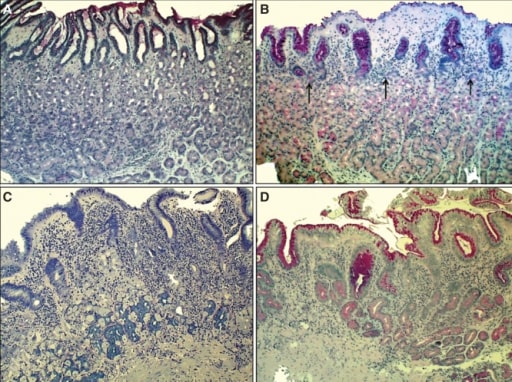
Corpus mucosa

Gastrite crónica por H. pylori:
A: Mucosa normal do corpo
B: Gastrite não atrófica: inflamação mononuclear ligeira observada na camada superior da mucosa (gastrite superficial, como indicada pelas setas). A camada glandular permanece intacta.
C: Gastrite atrófica moderada: inflamação mononuclear crónica intensa ocorre nas camadas inferiores, acompanhada de atrofia das glândulas oxínticas (indicando um estômago com hipocloridria). A secreção de ácido está afetada devido à perda de células parietais (nas glândulas oxínticas).
D: Gastrite atrófica grave, com inflamação ligeira, mas com perda das glândulas oxínticas.
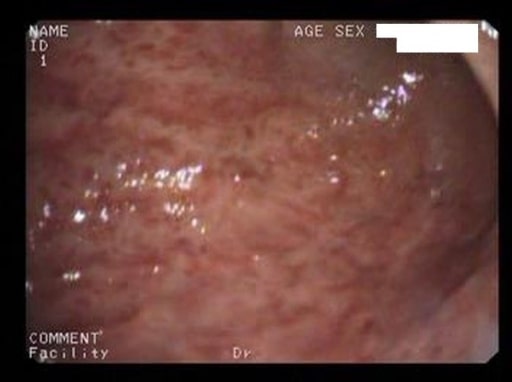
Imagem: “Corpus mucosa” de Patolab Oy, Espoo, Finland and Tartu State University, Tartu, Estonia. Licença: CC BY 4.0

Gastrite atrófica metaplásica autoimune (AMAG, pela sigla em inglês)

  • Inflamação ou gastrite predominantemente no corpo
  • Associada a doença autoimune crónica mediada por células T:
    • As células T destroem a mucosa oxíntica.
    • Anticorpos contra as células parietais e o fator intrínseco
    • Efeitos:
      • Perda de glândulas oxínticas, substituídas por mucosa atrófica → metaplasia Metaplasia A condition in which there is a change of one adult cell type to another similar adult cell type. Cellular Adaptation intestinal
      • Estas alterações patológicas levam à redução da produção de ácido → hipocloridria / acloridria → ↑ gastrina (perda do feedback negativo)
      • Diminuição do ácido → diminuição da absorção de ferro
      • Perda de células parietais e de fator intrínseco devido aos anticorpos: anemia Anemia Anemia is a condition in which individuals have low Hb levels, which can arise from various causes. Anemia is accompanied by a reduced number of RBCs and may manifest with fatigue, shortness of breath, pallor, and weakness. Subtypes are classified by the size of RBCs, chronicity, and etiology. Anemia: Overview and Types perniciosa (deficiência de B12)
  • Risco de cancro:
    • Tumores neuroendócrinos / carcinoides gástricos: A gastrina elevada também estimula as células enterocromafins.
    • Adenocarcinoma gástrico

Gastropatia

  • Lesão do revestimento epitelial com inflamação associada mínima ou ausente
  • Tecnicamente é uma entidade separada da gastrite
  • Associada à lesão da mucosa por destruição da barreira protetora normal (mucinas, bicarbonato e epitélio)
  • Pode ter uma apresentação semelhante à gastrite
  • Pode ocorrer hemorragia (gastropatia hemorrágica aguda).
  • Causas comuns:
    • Fármacos
    • Álcool
    • Refluxo biliar
    • Anti-inflamatórios não esteroides (AINEs)
    • Stress (choque, trauma, lesão do sistema nervoso central (SNC))
Alterações na gastrite erosiva aguda

Alterações de gastrite erosiva aguda (vista endoscópica) num doente que fez tratamento prolongado com AINEs COX-2

Imagem: “Acute erosive gastritis” do Department of Medical Sciences II, Medical Rehabilitation, University of Medicine and Pharmacy of Craiova, Romania. Licença: CC BY 2.0
Apresentação Clínica e Diagnóstico

Apresentação clínica

  • Gastrite por H. pylori H. pylori A spiral bacterium active as a human gastric pathogen. It is a gram-negative, urease-positive, curved or slightly spiral organism initially isolated in 1982 from patients with lesions of gastritis or peptic ulcers in Western Australia. Helicobacter pylori was originally classified in the genus campylobacter, but RNA sequencing, cellular fatty acid profiles, growth patterns, and other taxonomic characteristics indicate that the micro-organism should be included in the genus Helicobacter. It has been officially transferred to Helicobacter gen. Helicobacter (aguda e crónica):
    • Assintomática ou dispépsia leve na forma aguda
    • Dor abdominal e dispépsia na EMAG
    • Anemia Anemia Anemia is a condition in which individuals have low Hb levels, which can arise from various causes. Anemia is accompanied by a reduced number of RBCs and may manifest with fatigue, shortness of breath, pallor, and weakness. Subtypes are classified by the size of RBCs, chronicity, and etiology. Anemia: Overview and Types ferropénica
    • Deficiência de B12
  • AMAG:
    • Pode ser assintomática, mas frequentemente com dispépsia
    • Deficiência de B12 : fadiga, glossite, declínio cognitivo e outras manifestações neurológicas
    • Anemia Anemia Anemia is a condition in which individuals have low Hb levels, which can arise from various causes. Anemia is accompanied by a reduced number of RBCs and may manifest with fatigue, shortness of breath, pallor, and weakness. Subtypes are classified by the size of RBCs, chronicity, and etiology. Anemia: Overview and Types ferropénica: ocorre antes da deficiência de B12
  • Outros: hematemeses (gastropatia hemorrágica)

Investigação diagnóstica

  • Análises laboratoriais:
    • AMAG:
      • ↑ Níveis de gastrina (jejum) em fase aguda / inicial
      • ↓ razão pepsinogénio I / pepsinogénio II
      • Hemograma completo: anemia Anemia Anemia is a condition in which individuals have low Hb levels, which can arise from various causes. Anemia is accompanied by a reduced number of RBCs and may manifest with fatigue, shortness of breath, pallor, and weakness. Subtypes are classified by the size of RBCs, chronicity, and etiology. Anemia: Overview and Types (↓ ferro, ↓ B12 )
      • Serologia: anticorpos anti células parietais e fator intrínseco
    • EMAG:
      • Gastrina não tão elevada
      • Níveis baixos de pepsinogénio I no soro ou razão ↓ pepsinogénio I / pepsinogénio II
      • Anemia Anemia Anemia is a condition in which individuals have low Hb levels, which can arise from various causes. Anemia is accompanied by a reduced number of RBCs and may manifest with fatigue, shortness of breath, pallor, and weakness. Subtypes are classified by the size of RBCs, chronicity, and etiology. Anemia: Overview and Types perniciosa ausente
      • Sem autoanticorpos contra as células parietais e o fator intrínseco
  • Endoscopia digestiva alta:
    • Pode não ter alterações patológicas óbvias
    • Os achados, muitas vezes inespecíficos, podem incluir:
      • Eritema da mucosa / mucosa friável
      • Nodularidade antral
      • Aplanamento das pregas gástricas (gastrite atrófica avançada)
      • Erosões da mucosa, hemorragias petequiais (gastropatia erosiva)
  • Biópsia:
    • São recomendadas múltiplas biópsias (corpo e antro)
    • Todas as áreas de aparência suspeita devem ser biopsiadas.
    • Incluir também tecido normal adjacente.
    • Achados na gastrite aguda por H. pylori H. pylori A spiral bacterium active as a human gastric pathogen. It is a gram-negative, urease-positive, curved or slightly spiral organism initially isolated in 1982 from patients with lesions of gastritis or peptic ulcers in Western Australia. Helicobacter pylori was originally classified in the genus campylobacter, but RNA sequencing, cellular fatty acid profiles, growth patterns, and other taxonomic characteristics indicate that the micro-organism should be included in the genus Helicobacter. It has been officially transferred to Helicobacter gen. Helicobacter:
      • Bacilos em espiral na amostra
      • Neutrófilos na mucosa
    • Achados na gastrite crónica por H. pylori H. pylori A spiral bacterium active as a human gastric pathogen. It is a gram-negative, urease-positive, curved or slightly spiral organism initially isolated in 1982 from patients with lesions of gastritis or peptic ulcers in Western Australia. Helicobacter pylori was originally classified in the genus campylobacter, but RNA sequencing, cellular fatty acid profiles, growth patterns, and other taxonomic characteristics indicate that the micro-organism should be included in the genus Helicobacter. It has been officially transferred to Helicobacter gen. Helicobacter:
      • Linfócitos, plasmócitos, eosinófilos
      • Folículos linfoides
    • Achados na AMAG precoce:
      • Inflamação profunda, eosinófilos
      • Destruição das glândulas oxínticas
      • Metaplasia Metaplasia A condition in which there is a change of one adult cell type to another similar adult cell type. Cellular Adaptation intestinal ou pseudopilórica
    • Achados na AMAG avançada:
      • As glândulas metaplásicas substituem as glândulas oxínticas.
      • Células epiteliais megaloblásticas
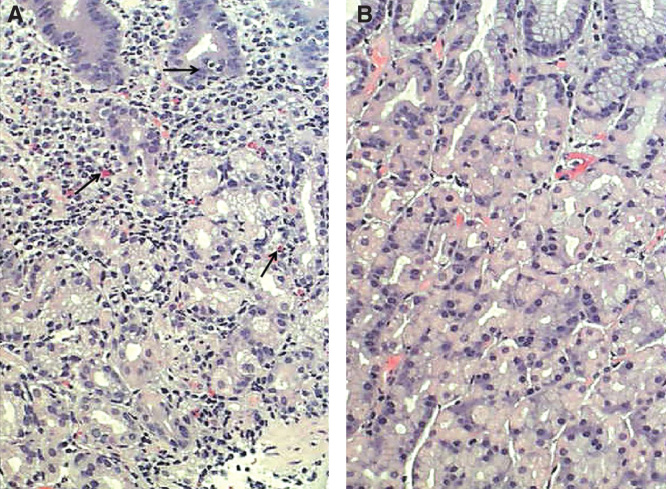
Mucosa do corpo com gastrite crónica "ativa"

Gastrite crónica. A: inflamação da mucosa com muitas células mononucleares (setas); B: mucosa normal.

Imagem: “Corpus mucosa” de Informa Healthcare. Licença: CC BY 4.0
Testes Testes Gonadal Hormones específicos para o H. pylori H. pylori A spiral bacterium active as a human gastric pathogen. It is a gram-negative, urease-positive, curved or slightly spiral organism initially isolated in 1982 from patients with lesions of gastritis or peptic ulcers in Western Australia. Helicobacter pylori was originally classified in the genus campylobacter, but RNA sequencing, cellular fatty acid profiles, growth patterns, and other taxonomic characteristics indicate that the micro-organism should be included in the genus Helicobacter. It has been officially transferred to Helicobacter gen. Helicobacter

  • Não invasivos:
    • Teste de antigénio fecal:
      • Para o diagnóstico inicial
      • Para confirmar a erradicação
    • Teste respiratório da ureia:
      • O doente ingere ureia marcada radioativamente por via oral.
      • A urease Urease An enzyme that catalyzes the conversion of urea and water to carbon dioxide and ammonia. Nocardia/Nocardiosis produzida pelo H. pylori H. pylori A spiral bacterium active as a human gastric pathogen. It is a gram-negative, urease-positive, curved or slightly spiral organism initially isolated in 1982 from patients with lesions of gastritis or peptic ulcers in Western Australia. Helicobacter pylori was originally classified in the genus campylobacter, but RNA sequencing, cellular fatty acid profiles, growth patterns, and other taxonomic characteristics indicate that the micro-organism should be included in the genus Helicobacter. It has been officially transferred to Helicobacter gen. Helicobacter divide-a e liberta CO2 .
      • O CO2 radioativo é detetado na respiração.
    • Serologia:
      • Deteção de imunoglobulina G ( IgG IgG The major immunoglobulin isotype class in normal human serum. There are several isotype subclasses of igg, for example, igg1, igg2a, and igg2b. Hypersensitivity Pneumonitis) sérica contra o H. pylori H. pylori A spiral bacterium active as a human gastric pathogen. It is a gram-negative, urease-positive, curved or slightly spiral organism initially isolated in 1982 from patients with lesions of gastritis or peptic ulcers in Western Australia. Helicobacter pylori was originally classified in the genus campylobacter, but RNA sequencing, cellular fatty acid profiles, growth patterns, and other taxonomic characteristics indicate that the micro-organism should be included in the genus Helicobacter. It has been officially transferred to Helicobacter gen. Helicobacter
      • Baixa precisão
      • A IgG IgG The major immunoglobulin isotype class in normal human serum. There are several isotype subclasses of igg, for example, igg1, igg2a, and igg2b. Hypersensitivity Pneumonitis permanece positiva após a erradicação.
  • Invasivos (requer uma amostra da mucosa gástrica):
    • Teste da urease Urease An enzyme that catalyzes the conversion of urea and water to carbon dioxide and ammonia. Nocardia/Nocardiosis na biópsia:
      • A urease Urease An enzyme that catalyzes the conversion of urea and water to carbon dioxide and ammonia. Nocardia/Nocardiosis produzida pelo H. pylori H. pylori A spiral bacterium active as a human gastric pathogen. It is a gram-negative, urease-positive, curved or slightly spiral organism initially isolated in 1982 from patients with lesions of gastritis or peptic ulcers in Western Australia. Helicobacter pylori was originally classified in the genus campylobacter, but RNA sequencing, cellular fatty acid profiles, growth patterns, and other taxonomic characteristics indicate that the micro-organism should be included in the genus Helicobacter. It has been officially transferred to Helicobacter gen. Helicobacter liberta amónia a partir da ureia.
      • O pH pH The quantitative measurement of the acidity or basicity of a solution. Acid-Base Balance alcalino muda a cor de um reagente de pH pH The quantitative measurement of the acidity or basicity of a solution. Acid-Base Balance.
    • Histologia:
      • Hematoxilina e eosina (H&E), imunohistoquímica, coloração de Giemsa
      • Veem-se bacilos gram-negativos curvos e flagelados.
    • Cultura e sensibilidade da bactéria
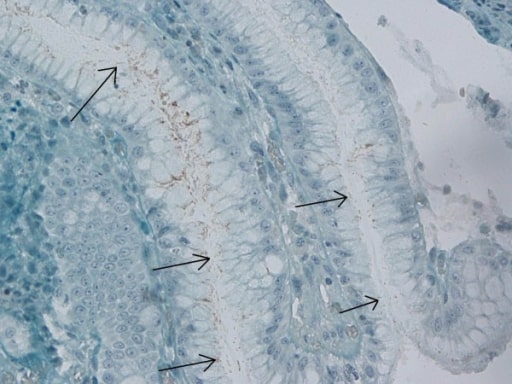
Positividade imunohistoquímica do H. pylori

Coloração imunohistoquímica para H. pylori no antro gástrico

Imagem: “Immunohistochemical H. pylori” do Department of Gastroenterology, Bakirkoy Dr Sadi Konuk Training and Research Hospital, Istanbul, Turkey. Licença: CC BY 2.0

Related videos

Tratamento e Complicações

Tratamento

  • Princípios gerais:
    • Inibidores da bomba de protões (IBPs)
    • Tratamento de reposição B12
    • Tratamento da deficiência de ferro
    • Para os doentes sintomáticos: Evitar quaisquer agentes precipitantes / irritantes gástricos.
  • Gastrite associadaao H. pylori H. pylori A spiral bacterium active as a human gastric pathogen. It is a gram-negative, urease-positive, curved or slightly spiral organism initially isolated in 1982 from patients with lesions of gastritis or peptic ulcers in Western Australia. Helicobacter pylori was originally classified in the genus campylobacter, but RNA sequencing, cellular fatty acid profiles, growth patterns, and other taxonomic characteristics indicate that the micro-organism should be included in the genus Helicobacter. It has been officially transferred to Helicobacter gen. Helicobacter :
    • Tratamento de erradicação do H. pylori H. pylori A spiral bacterium active as a human gastric pathogen. It is a gram-negative, urease-positive, curved or slightly spiral organism initially isolated in 1982 from patients with lesions of gastritis or peptic ulcers in Western Australia. Helicobacter pylori was originally classified in the genus campylobacter, but RNA sequencing, cellular fatty acid profiles, growth patterns, and other taxonomic characteristics indicate that the micro-organism should be included in the genus Helicobacter. It has been officially transferred to Helicobacter gen. Helicobacter
    • Um esquema de antibióticos associado a um IBP:
      • Terapia tripla: IBP + claritromicina + amoxicilina ou metronidazol
      • Terapia quádrupla contendo bismuto: IBP + bismuto + tetraciclina + metronidazol

Complicações

  • Cancro gástrico do tipo intestinal:
    • Associado a AMAG e EMAG
    • Progressão da atrofia da mucosa para metaplasia Metaplasia A condition in which there is a change of one adult cell type to another similar adult cell type. Cellular Adaptation intestinal
    • A metaplasia Metaplasia A condition in which there is a change of one adult cell type to another similar adult cell type. Cellular Adaptation progride para displasia e, eventualmente, para adenocarcinoma invasivo.
  • MALToma MALToma Extranodal marginal zone lymphoma (EMZL) of mucosa-associated lymphoid tissue (also called MALToma, MALT lymphoma, and pseudolymphoma) is a group of non-Hodgkin’s lymphomas that have historically been grouped together because they appear to arise from postgerminal center marginal zone B cells and share a similar immunophenotype. MALT Lymphoma ( tumor Tumor Inflammation linfoide associado à mucosa):
    • Linfoma de células B do estômago
    • Associação clara com infeção por H. pylori H. pylori A spiral bacterium active as a human gastric pathogen. It is a gram-negative, urease-positive, curved or slightly spiral organism initially isolated in 1982 from patients with lesions of gastritis or peptic ulcers in Western Australia. Helicobacter pylori was originally classified in the genus campylobacter, but RNA sequencing, cellular fatty acid profiles, growth patterns, and other taxonomic characteristics indicate that the micro-organism should be included in the genus Helicobacter. It has been officially transferred to Helicobacter gen. Helicobacter
    • Geralmente regride com a erradicação do H. pylori H. pylori A spiral bacterium active as a human gastric pathogen. It is a gram-negative, urease-positive, curved or slightly spiral organism initially isolated in 1982 from patients with lesions of gastritis or peptic ulcers in Western Australia. Helicobacter pylori was originally classified in the genus campylobacter, but RNA sequencing, cellular fatty acid profiles, growth patterns, and other taxonomic characteristics indicate that the micro-organism should be included in the genus Helicobacter. It has been officially transferred to Helicobacter gen. Helicobacter

Diagnóstico Diferencial

  • Doença de Ménétrier ( DM DM Diabetes mellitus (DM) is a metabolic disease characterized by hyperglycemia and dysfunction of the regulation of glucose metabolism by insulin. Type 1 DM is diagnosed mostly in children and young adults as the result of autoimmune destruction of β cells in the pancreas and the resulting lack of insulin. Type 2 DM has a significant association with obesity and is characterized by insulin resistance. Diabetes Mellitus): gastropatia perdedora de proteínas caracterizada por pregas hiperplásicas gigantes da mucosa do corpo e fundo gástricos. Esta doença apresenta-se com dor abdominal, náuseas e vómitos, no entanto, a perda de peso e a diarreia associadas podem ajudar a diferenciar a DM DM Diabetes mellitus (DM) is a metabolic disease characterized by hyperglycemia and dysfunction of the regulation of glucose metabolism by insulin. Type 1 DM is diagnosed mostly in children and young adults as the result of autoimmune destruction of β cells in the pancreas and the resulting lack of insulin. Type 2 DM has a significant association with obesity and is characterized by insulin resistance. Diabetes Mellitus da gastrite. Uma avaliação adicional por EDA com biópsia permite confirmar a DM DM Diabetes mellitus (DM) is a metabolic disease characterized by hyperglycemia and dysfunction of the regulation of glucose metabolism by insulin. Type 1 DM is diagnosed mostly in children and young adults as the result of autoimmune destruction of β cells in the pancreas and the resulting lack of insulin. Type 2 DM has a significant association with obesity and is characterized by insulin resistance. Diabetes Mellitus.
  • Doença Ulcerosa Péptica (DUP): úlcera de espessura total envolvendo a parede gástrica ou duodenal. A doença ulcerosa péptica manifesta-se por dor abdominal, náuseas / vómitos e, por vezes, hemorragia digestiva alta. Esta doença também se associa ao H. pylori H. pylori A spiral bacterium active as a human gastric pathogen. It is a gram-negative, urease-positive, curved or slightly spiral organism initially isolated in 1982 from patients with lesions of gastritis or peptic ulcers in Western Australia. Helicobacter pylori was originally classified in the genus campylobacter, but RNA sequencing, cellular fatty acid profiles, growth patterns, and other taxonomic characteristics indicate that the micro-organism should be included in the genus Helicobacter. It has been officially transferred to Helicobacter gen. Helicobacter. O diagnóstico é feito por endoscopia.
  • Colelitíase / colecistite: cálculos biliares a obstruir o ducto cístico (colelitíase) que podem estar associados a inflamação da vesícula biliar (colecistite). A colecistite apresenta-se frequentemente com dor epigástrica e no quadrante superior direito, náuseas e vómitos. Ao contrário da gastrite, está frequentemente associada a dor no quadrante superior direito ou subcostal.
  • Gastroenterite vírica: doença aguda autolimitada associada a dor abdominal difusa, vómitos e diarreia. A diarreia aquosa pode ajudar a diferenciar esta doença da gastrite aguda.
  • Pancreatite: inflamação do pâncreas; pode ser aguda ou crónica. A pancreatite manifesta-se, geralmente, por dor epigástrica com irradiação dorsal, náuseas, vómitos e distensão abdominal. As análises sanguíneas irão revelar amilase e lipase Lipase An enzyme of the hydrolase class that catalyzes the reaction of triacylglycerol and water to yield diacylglycerol and a fatty acid anion. It is produced by glands on the tongue and by the pancreas and initiates the digestion of dietary fats. Malabsorption and Maldigestion elevadas.

Referências

  1. Azer S.A., Akhondi H. (2020). Gastritis. https://www.ncbi.nlm.nih.gov/books/NBK544250/
  2. Jensen P.J, Feldman M. (2020). Acute and chronic gastritis due to Helicobacter pylori. Obtido a 25 de novembro de 2020, em https://www.uptodate.com/contents/acute-and-chronic-gastritis-due-to-helicobacter-pylori
  3. Jensen P.J, Feldman M. (2020). Metaplastic (chronic) atrophic gastritis. Recuperado a 25 de novembro de 2020, em https://www.uptodate.com/contents/metaplastic-chronic-atrophic-gastritis
  4. Jensen P.J, Feldman M. (2020). Gastritis: Etiology and diagnosis. Recuperado a 25 de novembro de 2020, em https://www.uptodate.com/contents/gastritis-etiology-and-diagnosis

Crie sua conta gratuita ou faça login para continuar lendo!

Cadastre-se agora e tenha acesso grátis ao Lecturio, com páginas de conceitos, vídeos de medicina e questões para sua educação médica.

Aprende mais com a Lecturio:

Multiple devices displaying human anatomy and health education content.

Complementa o teu estudo da faculdade com o companheiro de estudo tudo-em-um da Lecturio, através de métodos de ensino baseados em evidência.

Estuda onde quiseres

Two iPhones display medical education apps, one showing anatomy, the other Bookmatcher.

A Lecturio Medical complementa o teu estudo através de métodos de ensino baseados em evidência, vídeos de palestras, perguntas e muito mais – tudo combinado num só lugar e fácil de usar.

User Reviews

Have a holly, jolly study session 🎁 Save 50% on all plans now >>

Que tengas una sesión de estudio alegre y navideña 🎁 Ahorra 50% en todos los planes >>

Details