


Doença Ulcerosa Péptica

A Doença ulcerosa péptica (DUP) refere-se às ulcerações da espessura total da mucosa duodenal ou gástrica. As úlceras formam-se quando a exposição ao ácido e às enzimas digestivas supera os mecanismos de defesa da mucosa. As etiologias mais MAIS Androgen Insensitivity Syndrome comuns são a infeção por Helicobacter pylori Helicobacter pylori A spiral bacterium active as a human gastric pathogen. It is a gram-negative, urease-positive, curved or slightly spiral organism initially isolated in 1982 from patients with lesions of gastritis or peptic ulcers in Western Australia. Helicobacter pylori was originally classified in the genus campylobacter, but RNA sequencing, cellular fatty acid profiles, growth patterns, and other taxonomic characteristics indicate that the micro-organism should be included in the genus Helicobacter. It has been officially transferred to Helicobacter gen. Helicobacter ( H. pylori H. pylori A spiral bacterium active as a human gastric pathogen. It is a gram-negative, urease-positive, curved or slightly spiral organism initially isolated in 1982 from patients with lesions of gastritis or peptic ulcers in Western Australia. Helicobacter pylori was originally classified in the genus campylobacter, but RNA sequencing, cellular fatty acid profiles, growth patterns, and other taxonomic characteristics indicate that the micro-organism should be included in the genus Helicobacter. It has been officially transferred to Helicobacter gen. Helicobacter ) e o uso prolongado de anti-inflamatórios não esteroides (AINEs). Os doentes podem ser assintomáticos ou apresentar-se com dor abdominal, náuseas e saciedade precoce. A doença ulcerosa péptica geralmente responde bem ao tratamento médico, que consiste na erradicação do H. pylori H. pylori A spiral bacterium active as a human gastric pathogen. It is a gram-negative, urease-positive, curved or slightly spiral organism initially isolated in 1982 from patients with lesions of gastritis or peptic ulcers in Western Australia. Helicobacter pylori was originally classified in the genus campylobacter, but RNA sequencing, cellular fatty acid profiles, growth patterns, and other taxonomic characteristics indicate that the micro-organism should be included in the genus Helicobacter. It has been officially transferred to Helicobacter gen. Helicobacter, na eliminação de fatores de risco e em inibidores da bomba de protões (IBPs). Se não for tratada, pode levar a hemorragia, perfuração, obstrução do trato de saída gástrico e cancro gástrico.

Last updated: Dec 15, 2025

Editorial responsibility: Stanley Oiseth, Lindsay Jones, Evelin Maza

Descrição Geral

Definição

Uma úlcera péptica é um defeito da mucosa na parede do estômago ou duodeno que atinge a muscularis mucosa.

Epidemiologia

  • Incidência:
    • Doença ulcerosa péptica (DUP) não complicada: 1 caso por 1.000 pessoas-ano na população em geral
    • Complicações de DUP: 0,7 casos por 1.000 pessoas-ano na população em geral
  • Úlceras duodenais > Úlceras gástricas (3:1)
  • Afeta homens e mulheres de igual forma
  • As úlceras duodenais ocorrem, em média, 2 décadas antes das úlceras gástricas.
  • As taxas de DUP têm caído nas últimas décadas.

Etiologia

  • Infeção:
    • Helicobacter pylori Helicobacter pylori A spiral bacterium active as a human gastric pathogen. It is a gram-negative, urease-positive, curved or slightly spiral organism initially isolated in 1982 from patients with lesions of gastritis or peptic ulcers in Western Australia. Helicobacter pylori was originally classified in the genus campylobacter, but RNA sequencing, cellular fatty acid profiles, growth patterns, and other taxonomic characteristics indicate that the micro-organism should be included in the genus Helicobacter. It has been officially transferred to Helicobacter gen. Helicobacterou H. pylori H. pylori A spiral bacterium active as a human gastric pathogen. It is a gram-negative, urease-positive, curved or slightly spiral organism initially isolated in 1982 from patients with lesions of gastritis or peptic ulcers in Western Australia. Helicobacter pylori was originally classified in the genus campylobacter, but RNA sequencing, cellular fatty acid profiles, growth patterns, and other taxonomic characteristics indicate that the micro-organism should be included in the genus Helicobacter. It has been officially transferred to Helicobacter gen. Helicobacter ( mais MAIS Androgen Insensitivity Syndrome comum):
      • 80%–90% úlceras duodenais
      • 70%–80% úlceras gástricas
    • Vírus:
      • Vírus Herpes simplex Herpes Simplex A group of acute infections caused by herpes simplex virus type 1 or type 2 that is characterized by the development of one or more small fluid-filled vesicles with a raised erythematous base on the skin or mucous membrane. It occurs as a primary infection or recurs due to a reactivation of a latent infection. Congenital TORCH Infections ( HSV HSV Herpes simplex virus (HSV) is a double-stranded DNA virus belonging to the family Herpesviridae. Herpes simplex virus commonly causes recurrent infections involving the skin and mucosal surfaces, including the mouth, lips, eyes, and genitals. Herpes Simplex Virus 1 and 2)
      • Citomegalovírus (CMV)
    • Infeções raras:
      • Tuberculose ( TB TB Tuberculosis (TB) is an infectious disease caused by Mycobacterium tuberculosis complex bacteria. The bacteria usually attack the lungs but can also damage other parts of the body. Approximately 30% of people around the world are infected with this pathogen, with the majority harboring a latent infection. Tuberculosis spreads through the air when a person with active pulmonary infection coughs or sneezes. Tuberculosis)
      • Sífilis
      • Mucormicose
  • Fármacos:
    • Anti-inflamatórios não esteroides (AINEs; mais MAIS Androgen Insensitivity Syndrome comum)
    • Fármacos associados a DUP ou que implicam risco aumentado de DUP pela combinação com AINEs:
      • Bisfosfonatos
      • Clopidogrel Clopidogrel A ticlopidine analog and platelet purinergic p2y receptor antagonist that inhibits adenosine diphosphate-mediated platelet aggregation. It is used to prevent thromboembolism in patients with arterial occlusive diseases; myocardial infarction; stroke; or atrial fibrillation. Antiplatelet Drugs
      • Corticoides
      • Espironolactona
    • Quimioterapia
    • Sirolimus Sirolimus A macrolide compound obtained from streptomyces hygroscopicus that acts by selectively blocking the transcriptional activation of cytokines thereby inhibiting cytokine production. It is bioactive only when bound to immunophilins. Sirolimus is a potent immunosuppressant and possesses both antifungal and antineoplastic properties. Immunosuppressants
    • Micofenolato mofetil
    • Cloreto de Potássio
  • Hormonal:
    • Gastrinoma Gastrinoma A gastrinoma is a tumor that secretes excessive levels of the hormone gastrin and is responsible for Zollinger-Ellison syndrome (ZES). Gastrinomas are frequently associated with multiple endocrine neoplasia 1 (MEN 1) and can arise from the pancreas, stomach, duodenum, jejunum, and/or even from the lymph nodes. Gastrinoma (Síndrome de Zollinger-Ellison)
    • Hiperplasia / hiperfunção das células G do antro (gastrite)
  • Pós-cirurgia:
    • Exclusão do antro
    • Bypass gástrico
  • Isquemia: uso de cocaína
  • Doenças crónicas descompensadas:
    • Cirrose
    • Insuficiência renal
    • Doença pulmonar obstrutiva crónica (DPOC)
    • Estadia prolongada na unidade de cuidados intensivos (UCI) por qualquer motivo
  • Idiopática
  • Outras causas raras:
    • Pâncreas anular
    • Sarcoidose
    • Doença de Crohn
    • Radiação

Fatores de risco

Em muitos casos, as etiologias listadas não são suficientes para desenvolver DUP. Fatores de risco que contribuem para o desenvolvimento de DUP:

  • Tabagismo
  • Álcool
  • Stress (por doença grave, psicológico)
  • Dieta
  • Predisposição genética
  • Grupos sanguíneos A e O

Fisiopatologia

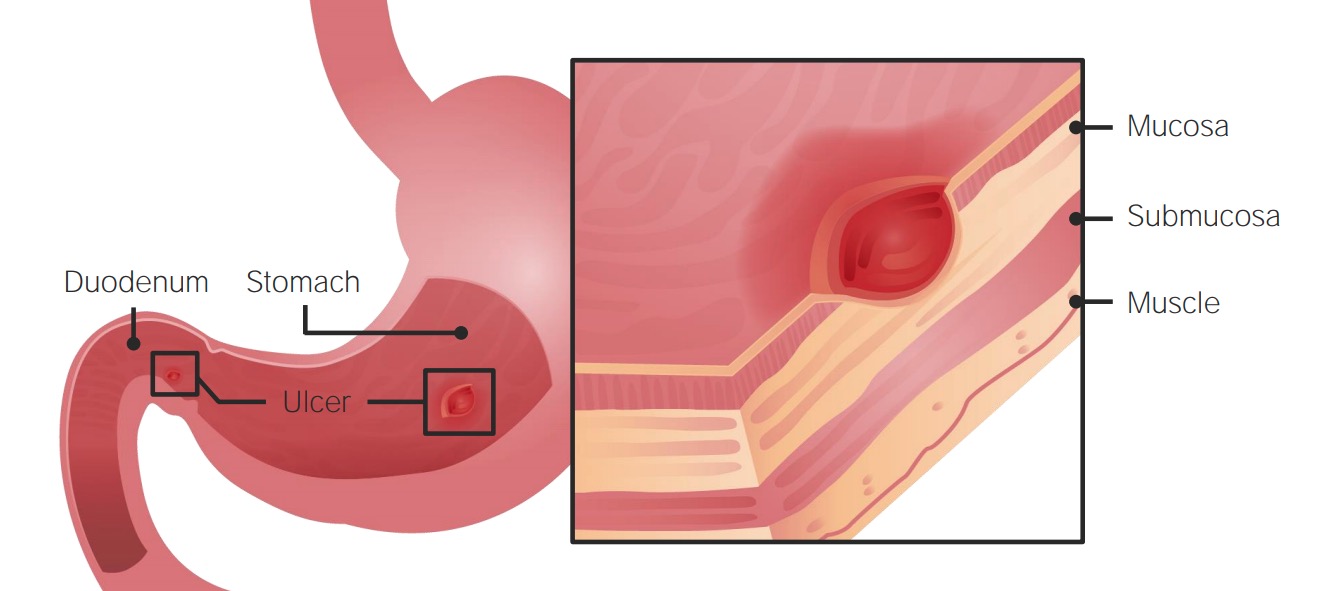
Localização anatómica das úlceras

  • Úlcera duodenal: úlcera localizada no duodeno, geralmente no bulbo duodenal (1ª parte)
  • Úlcera gástrica: úlcera no revestimento do estômago, geralmente na curvatura menor, perto da junção entre a mucosa do fundo e do antro (ou tipo I)
Tabela: Classificação das úlceras gástricas por localização (classificação de Johnson modificada)
Tipo Localização Nível de ácido
I Curvatura menor do estômago, na incisura angular Baixo a normal
II Corpo gástrico; coexiste com úlcera duodenal Elevado
III No antro pilórico (a menos de 3 cm do piloro) Elevado
IV Úlcera gastroesofágica proximal Normal
V Em qualquer parte do estômago (induzida por aspirina / AINEs) Normal
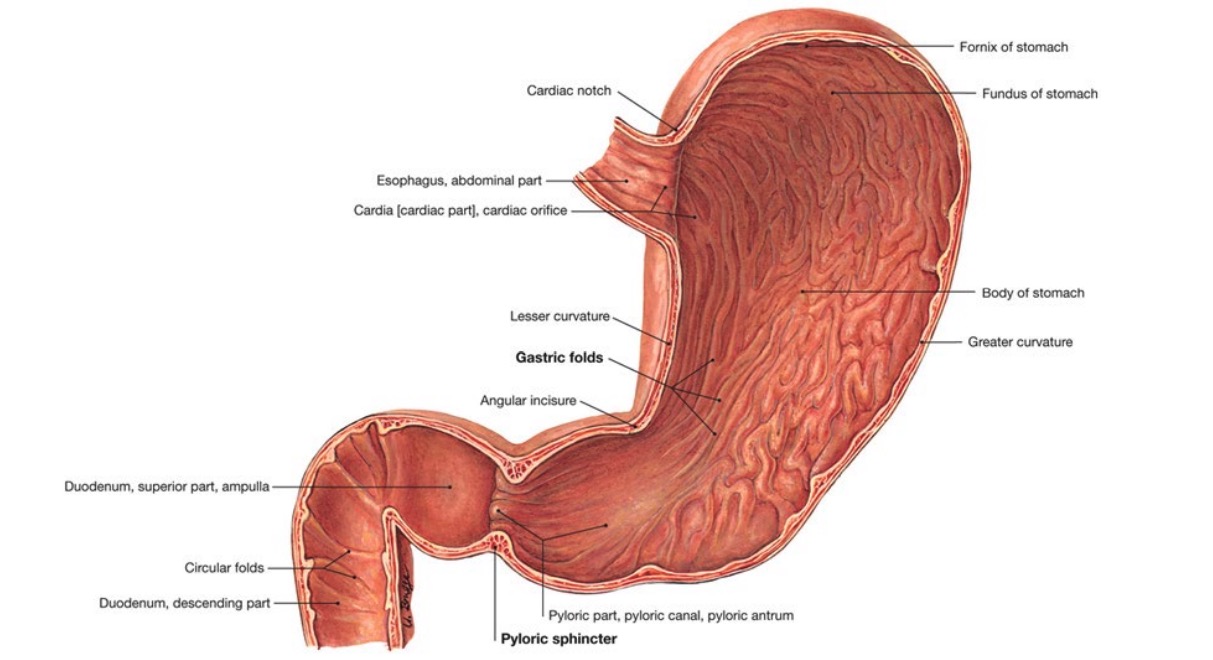
Componentes anatómicos do estômago

Componentes anatómicos do estômago

Imagem de Lecturio.
Fisiopatologia

  • Estômago e duodeno:
    • Normalmente expostos a um ambiente tóxico (ácido + pepsina)
    • O desequilíbrio entre os agentes agressores e os mecanismos de defesa leva à DUP.
  • Defesas que previnem a lesão da mucosa:
    • Camada de muco, bicarbonato e fosfolípidos
    • Camada epitelial (cuja reparação é regulada pelas prostaglandinas)
    • Defesas subepiteliais (fluxo sanguíneo da mucosa para fornecimento de nutrientes e oxigénio bem como eliminação dos agentes nocivos)
  • Mecanismos dos agentes agressores:
    • Secreção de ácido gástrico aumentada:
      • Gastrite ou inflamação por H. pylori H. pylori A spiral bacterium active as a human gastric pathogen. It is a gram-negative, urease-positive, curved or slightly spiral organism initially isolated in 1982 from patients with lesions of gastritis or peptic ulcers in Western Australia. Helicobacter pylori was originally classified in the genus campylobacter, but RNA sequencing, cellular fatty acid profiles, growth patterns, and other taxonomic characteristics indicate that the micro-organism should be included in the genus Helicobacter. It has been officially transferred to Helicobacter gen. Helicobacter: ↑ ácido gástrico, inibe a somatostatina, ↓ muco
      • Inibição da COX 1 COX 1 A constitutively-expressed subtype of prostaglandin-endoperoxide synthase. It plays an important role in many cellular processes. Antiplatelet Drugs pelos AINEs → ↓ prostaglandinas (↓ muco, ↓ fluxo sanguíneo da mucosa, ↓ proliferação epitelial)
      • Inibição da COX 2 COX 2 An inducibly-expressed subtype of prostaglandin-endoperoxide synthase. It plays an important role in many cellular processes and inflammation. It is the target of cox 2 inhibitors. Antiplatelet Drugs pelos AINEs → atrasa a cicatrização
    • Secreção duodenal de bicarbonato diminuída (em doentes com úlceras duodenais)
    • Efeitos de outras etiologias ou fatores de risco:
      • Tabagismo → ↑ secreção de ácido, ↓ prostaglandinas
      • Síndrome de Zollinger-Ellison ( gastrinoma Gastrinoma A gastrinoma is a tumor that secretes excessive levels of the hormone gastrin and is responsible for Zollinger-Ellison syndrome (ZES). Gastrinomas are frequently associated with multiple endocrine neoplasia 1 (MEN 1) and can arise from the pancreas, stomach, duodenum, jejunum, and/or even from the lymph nodes. Gastrinoma) → ↑ gastrina
      • Lesão cerebral → aumento da pressão intracraniana → sobrestimulação do nervo vago → ↑ ácido gástrico (Úlcera de Cushing)
      • Queimadura (stress) → volume reduzido e necrose celular → descamação da mucosa gástrica → disfunção da barreira ( Úlcera de Curling )
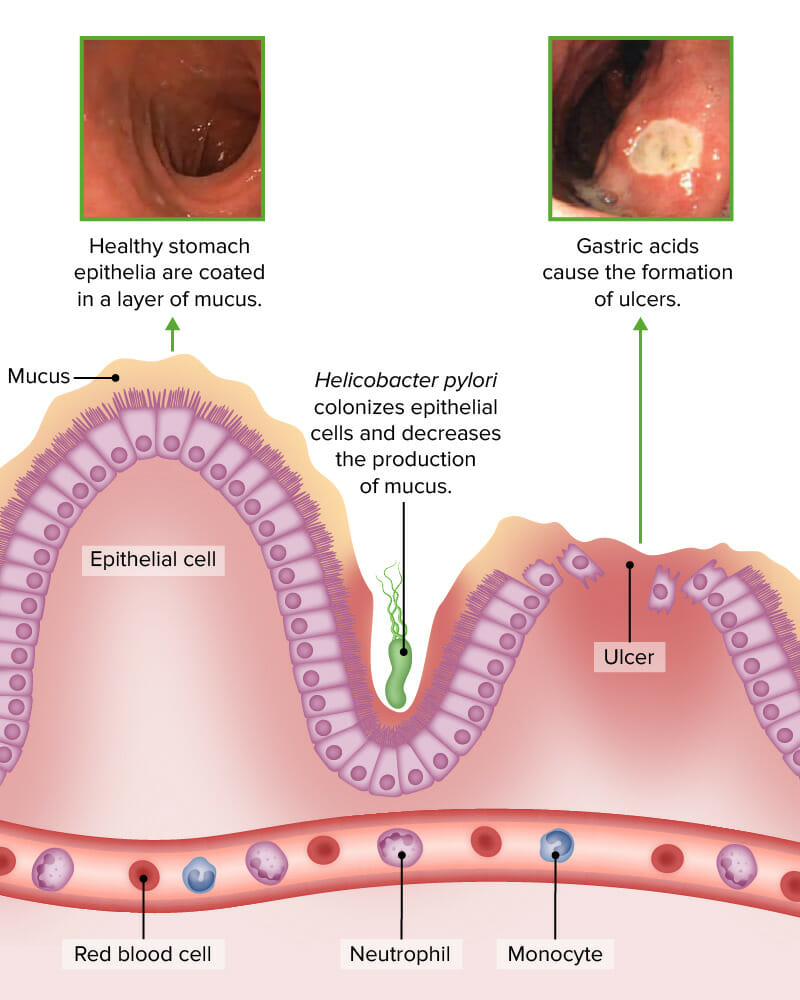
Doença ulcerosa péptica

Desenvolvimento de DUP no estômago e duodeno

Imagem de Lecturio.
Apresentação Clínica

Assintomática

  • 70% dos doentes com DUP
  • Adultos mais MAIS Androgen Insensitivity Syndrome velhos
  • Doentes a tomar AINEs
  • As complicações, como hemorragia ou perfuração, podem ser a 1ª manifestação clínica, sem sintomas antecedentes.

Sintomática

  • Dor abdominal:
    • Epigástrica com irradiação para os quadrantes superiores esquerdo ou direito
    • Por vezes irradia para as costas
    • Dor clássica de úlcera duodenal: 2–5 horas após a refeição e durante a noite (quando o ácido é secretado na ausência de alimentos)
    • Por vezes exacerbada pela alimentação (úlceras do canal pilórico)
  • Outros sintomas:
    • Náuseas / vómitos
    • Saciedade precoce
    • Sensação de plenitude / meteorismo pós-prandial
    • Eructações
    • Melenas
    • Hematémese

Diagnóstico

História

Revisão dos fatores de risco mais MAIS Androgen Insensitivity Syndrome comuns:
  • Utilização de AINEs / aspirina
  • Utilização concomitante de fármacos de alto risco
  • Doença crónica subjacente
  • Cirurgia ou irradiação gástrica prévias

Estudo laboratorial

  • Anemia Anemia Anemia is a condition in which individuals have low Hb levels, which can arise from various causes. Anemia is accompanied by a reduced number of RBCs and may manifest with fatigue, shortness of breath, pallor, and weakness. Subtypes are classified by the size of RBCs, chronicity, and etiology. Anemia: Overview and Types (hemorragia oculta e / ou má absorção de ferro)
  • Níveis elevados de gastrina em jejum (se houver suspeita de Síndrome de Zollinger-Ellison)

Endoscopia Digestiva Alta (EDA)

  • Exame de diagnóstico mais MAIS Androgen Insensitivity Syndrome preciso
  • Achados:
    • Úlcera gástrica:
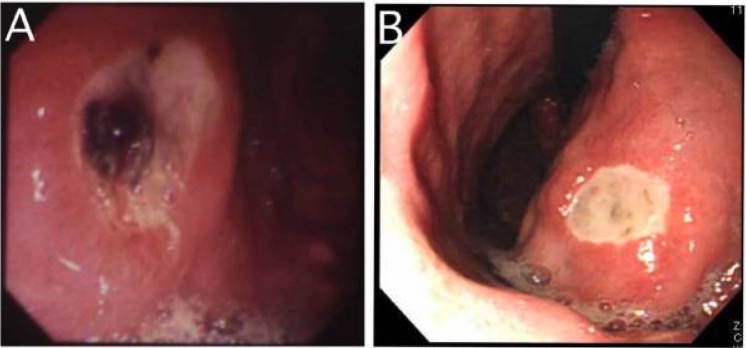
      • Lesões discretas da mucosa, geralmente solitárias, com base lisa e com aspeto “punched-out”.
      • As lesões benignas têm bordas arredondadas e lisas (em oposição às bordas irregulares observadas nas lesões malignas).
      • Geralmente na curvatura menor
    • Úlcera duodenal:
      • Pequenas lesões da mucosa, frequentemente <1 cm
      • Observadas geralmente na 1ª parte do duodeno
  • Indicações para biópsia:
    • Suspeita de malignidade (massa ulcerada, margens irregulares, pregas anormais da mucosa)
    • Qualquer úlcera gástrica em áreas de elevada incidência de cancro gástrico
    • Se houver suspeita de etiologia incomum (por exemplo, sarcoidose)
    • Biópsia da mucosa gástrica do antro e do corpo (para além da própria úlcera) para deteção de H. pylori H. pylori A spiral bacterium active as a human gastric pathogen. It is a gram-negative, urease-positive, curved or slightly spiral organism initially isolated in 1982 from patients with lesions of gastritis or peptic ulcers in Western Australia. Helicobacter pylori was originally classified in the genus campylobacter, but RNA sequencing, cellular fatty acid profiles, growth patterns, and other taxonomic characteristics indicate that the micro-organism should be included in the genus Helicobacter. It has been officially transferred to Helicobacter gen. Helicobacter
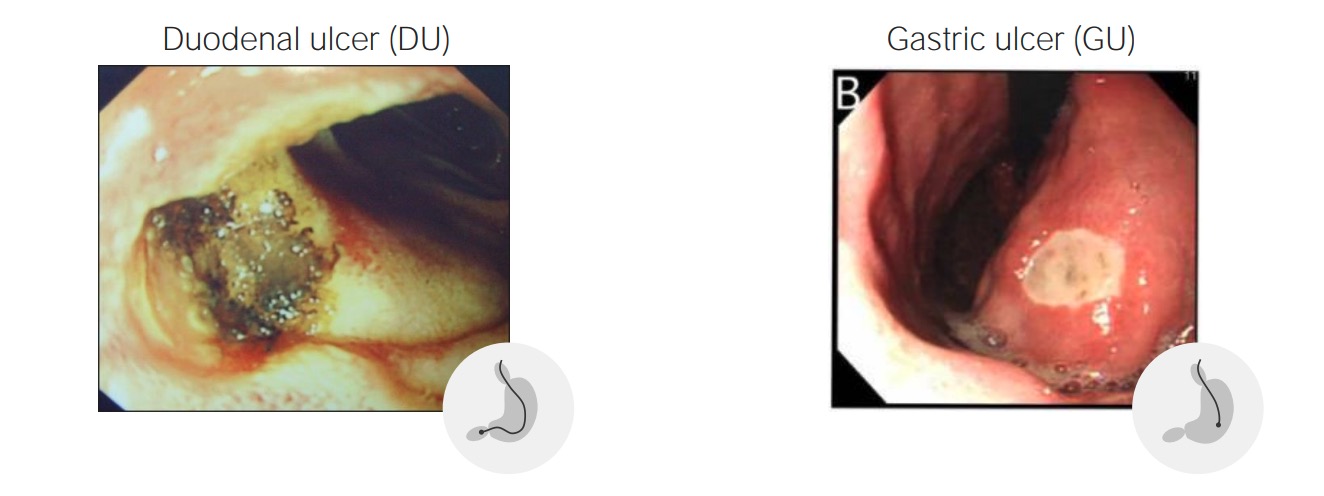
Endoscopia de lesões ulceradas

Vista endoscópica de lesões ulceradas duodenal (esquerda) e gástrica (direita)

Imagem: “F0002” do Department of Surgery, King Fahad Specialist Hospital, Dammam, Saudi Arabia. Licença: CC BY 2.0, e Imagem: “F1” do Department of Psychosomatic Internal Medicine, Health Sciences University of Hokkaido, Japan. Licença: CC BY 2.0 , editado por Lecturio.
Testes Testes Gonadal Hormones para o H. pylori H. pylori A spiral bacterium active as a human gastric pathogen. It is a gram-negative, urease-positive, curved or slightly spiral organism initially isolated in 1982 from patients with lesions of gastritis or peptic ulcers in Western Australia. Helicobacter pylori was originally classified in the genus campylobacter, but RNA sequencing, cellular fatty acid profiles, growth patterns, and other taxonomic characteristics indicate that the micro-organism should be included in the genus Helicobacter. It has been officially transferred to Helicobacter gen. Helicobacter

  • Não invasivos:
    • Teste do antigénio fecal:
      • Para diagnóstico inicial
      • Para confirmar a erradicação
    • Teste respiratório da ureia:
      • O doente ingere ureia marcada radioativamente por via oral.
      • A urease Urease An enzyme that catalyzes the conversion of urea and water to carbon dioxide and ammonia. Nocardia/Nocardiosis produzida pelo H. pylori H. pylori A spiral bacterium active as a human gastric pathogen. It is a gram-negative, urease-positive, curved or slightly spiral organism initially isolated in 1982 from patients with lesions of gastritis or peptic ulcers in Western Australia. Helicobacter pylori was originally classified in the genus campylobacter, but RNA sequencing, cellular fatty acid profiles, growth patterns, and other taxonomic characteristics indicate that the micro-organism should be included in the genus Helicobacter. It has been officially transferred to Helicobacter gen. Helicobacter divide a ureia e liberta CO2 .
      • O CO2 radioativo é detetado na respiração.
    • Serologia:
      • Deteção da IgG IgG The major immunoglobulin isotype class in normal human serum. There are several isotype subclasses of igg, for example, igg1, igg2a, and igg2b. Hypersensitivity Pneumonitis sérica contra o H. pylori H. pylori A spiral bacterium active as a human gastric pathogen. It is a gram-negative, urease-positive, curved or slightly spiral organism initially isolated in 1982 from patients with lesions of gastritis or peptic ulcers in Western Australia. Helicobacter pylori was originally classified in the genus campylobacter, but RNA sequencing, cellular fatty acid profiles, growth patterns, and other taxonomic characteristics indicate that the micro-organism should be included in the genus Helicobacter. It has been officially transferred to Helicobacter gen. Helicobacter
      • Baixa precisão
      • A IgG IgG The major immunoglobulin isotype class in normal human serum. There are several isotype subclasses of igg, for example, igg1, igg2a, and igg2b. Hypersensitivity Pneumonitis permanece positiva após a erradicação.
  • Invasivos (requerem uma amostra da mucosa gástrica):
    • Teste rápido da urease Urease An enzyme that catalyzes the conversion of urea and water to carbon dioxide and ammonia. Nocardia/Nocardiosis:
      • A urease Urease An enzyme that catalyzes the conversion of urea and water to carbon dioxide and ammonia. Nocardia/Nocardiosis produzida pelo H. pylori H. pylori A spiral bacterium active as a human gastric pathogen. It is a gram-negative, urease-positive, curved or slightly spiral organism initially isolated in 1982 from patients with lesions of gastritis or peptic ulcers in Western Australia. Helicobacter pylori was originally classified in the genus campylobacter, but RNA sequencing, cellular fatty acid profiles, growth patterns, and other taxonomic characteristics indicate that the micro-organism should be included in the genus Helicobacter. It has been officially transferred to Helicobacter gen. Helicobacter liberta amónia a partir da ureia.
      • O pH pH The quantitative measurement of the acidity or basicity of a solution. Acid-Base Balance alcalino altera a cor de um reagente de pH pH The quantitative measurement of the acidity or basicity of a solution. Acid-Base Balance.
    • Histologia:
      • A precisão é melhorada por colorações (imunohistoquímicas, corante de Giemsa)
      • Veem-se bacilos gram-negativos curvos e flagelados.
    • Cultura e sensibilidade da bactéria

Tratamento

Modificação de fatores de risco

  • Descontinuar os AINEs.
  • Cessação tabágica e do consumo de álcool e drogas.
  • Dieta pouco condimentada e de fácil digestão

Fármacos

  • Erradicação do H. pylori H. pylori A spiral bacterium active as a human gastric pathogen. It is a gram-negative, urease-positive, curved or slightly spiral organism initially isolated in 1982 from patients with lesions of gastritis or peptic ulcers in Western Australia. Helicobacter pylori was originally classified in the genus campylobacter, but RNA sequencing, cellular fatty acid profiles, growth patterns, and other taxonomic characteristics indicate that the micro-organism should be included in the genus Helicobacter. It has been officially transferred to Helicobacter gen. Helicobacter:
    • Combinação de um esquema de antibióticos com inibidores da bomba de protões (IBPs):
      • Terapêutica tripla: IBP + claritromicina + amoxicilina ou metronidazol
      • Terapêutica quádrupla com bismuto (primeira linha empírica preferida na maioria dos casos): IBP + bismuto + tetraciclina + metronidazol
    • Confirmar a erradicação do H. pylori H. pylori A spiral bacterium active as a human gastric pathogen. It is a gram-negative, urease-positive, curved or slightly spiral organism initially isolated in 1982 from patients with lesions of gastritis or peptic ulcers in Western Australia. Helicobacter pylori was originally classified in the genus campylobacter, but RNA sequencing, cellular fatty acid profiles, growth patterns, and other taxonomic characteristics indicate that the micro-organism should be included in the genus Helicobacter. It has been officially transferred to Helicobacter gen. Helicobacter após o tratamento.
  • IBPs:
    • Úlceras não complicadas:
      • Administrado por 2 semanas ( mais MAIS Androgen Insensitivity Syndrome antibioterapia para H. pylori H. pylori A spiral bacterium active as a human gastric pathogen. It is a gram-negative, urease-positive, curved or slightly spiral organism initially isolated in 1982 from patients with lesions of gastritis or peptic ulcers in Western Australia. Helicobacter pylori was originally classified in the genus campylobacter, but RNA sequencing, cellular fatty acid profiles, growth patterns, and other taxonomic characteristics indicate that the micro-organism should be included in the genus Helicobacter. It has been officially transferred to Helicobacter gen. Helicobacter se positivo)
      • Mais MAIS Androgen Insensitivity Syndrome tempo se o doente tiver indicação para tratamento de manutenção
    • Úlceras complicadas (hemorragia, penetração, obstrução ou perfuração):
      • Úlcera duodenal: 4-8 semanas
      • Úlcera gástrica: 8-12 semanas (necessária confirmação da cicatrização da úlcera)
      • Mais MAIS Androgen Insensitivity Syndrome tempo se o doente tiver indicação para tratamento de manutenção
    • Tratamento de manutenção:
      • Se os AINEs ou aspirina necessitam de ser continuados
      • Úlcera gigante (> 2 cm)
      • H. pylori H. pylori A spiral bacterium active as a human gastric pathogen. It is a gram-negative, urease-positive, curved or slightly spiral organism initially isolated in 1982 from patients with lesions of gastritis or peptic ulcers in Western Australia. Helicobacter pylori was originally classified in the genus campylobacter, but RNA sequencing, cellular fatty acid profiles, growth patterns, and other taxonomic characteristics indicate that the micro-organism should be included in the genus Helicobacter. It has been officially transferred to Helicobacter gen. Helicobacter negativo, úlceras AINE-negativas
      • DUP recorrente (> 2 / ano)

Repetição da endoscopia

  • Úlceras duodenais:
    • Normalmente não é necessária
    • Se os sintomas persistirem com tratamento > 4 semanas
    • Se houver evidência de hemorragia ativa
  • Úlceras gástricas:
    • Sintomas persistentes apesar de 8 a 12 semanas de tratamento médico
    • Etiologia não esclarecida
    • Úlcera gigante (> 2 cm)
    • Úlcera suspeita de malignidade na 1ª endoscopia (mesmo com a biópsia negativa).
    • Evidência de hemorragia ativa
    • Falência na erradicação da infeção por H. pylori H. pylori A spiral bacterium active as a human gastric pathogen. It is a gram-negative, urease-positive, curved or slightly spiral organism initially isolated in 1982 from patients with lesions of gastritis or peptic ulcers in Western Australia. Helicobacter pylori was originally classified in the genus campylobacter, but RNA sequencing, cellular fatty acid profiles, growth patterns, and other taxonomic characteristics indicate that the micro-organism should be included in the genus Helicobacter. It has been officially transferred to Helicobacter gen. Helicobacter
    • Fatores de risco para cancro gástrico:
      • Idade > 50
      • H. pylori H. pylori A spiral bacterium active as a human gastric pathogen. It is a gram-negative, urease-positive, curved or slightly spiral organism initially isolated in 1982 from patients with lesions of gastritis or peptic ulcers in Western Australia. Helicobacter pylori was originally classified in the genus campylobacter, but RNA sequencing, cellular fatty acid profiles, growth patterns, and other taxonomic characteristics indicate that the micro-organism should be included in the genus Helicobacter. It has been officially transferred to Helicobacter gen. Helicobacter
      • História familiar
      • Imigrantes de áreas endémicas (Japão, Coreia)
      • Atrofia gástrica, metaplasia Metaplasia A condition in which there is a change of one adult cell type to another similar adult cell type. Cellular Adaptation / displasia, adenoma

Tratamento cirúrgico

  • Pouco comum porque o tratamento médico é muito eficaz
  • Indicações para cirurgia:
    • Tratamento das complicações:
      • Hemorragia
      • Perfuração
      • Obstrução do trato de saída gástrico
    • DUP refratária ao tratamento médico
    • Não adesão ou efeitos adversos intoleráveis dos fármacos
  • Princípios cirúrgicos:
    • Prevenir complicações da úlcera: resseção da úlcera
    • Reduzir a secreção de ácido: vagotomia, antrectomia
    • Minimizar os distúrbios fisiológicos pós-operatórios: piloroplastia para facilitar o esvaziamento gástrico após a vagotomia
  • Procedimentos:
    • Vagotomia altamente seletiva: apenas são seccionados os ramos vagais que estimulam a secreção de ácido.
    • Vagotomia e drenagem (piloroplastia ou gastrojejunostomia)
    • Procedimentos que envolvem a resseção parcial do estômago:
      • Vagotomia e antrectomia: remove a porção do estômago produtora de ácido
      • Gastrectomia parcial: remove a porção do estômago que contém a úlcera gástrica
      • Reconstrução necessária na gastrectomia parcial: por anastomose gastroduodenal (Billroth I) ou gastrojejunal (Billroth II)

Complicações

Hemorragia gastrointestinal

  • Os doentes apresentam-se com hematemeses e / ou melenas.
  • Pode ser crónica / de baixo grau e apresentar-se como anemia Anemia Anemia is a condition in which individuals have low Hb levels, which can arise from various causes. Anemia is accompanied by a reduced number of RBCs and may manifest with fatigue, shortness of breath, pallor, and weakness. Subtypes are classified by the size of RBCs, chronicity, and etiology. Anemia: Overview and Types
  • A hemorragia aguda é, geralmente, intervencionada endoscopicamente.
  • Lesão de Dieulafoy: malformação vascular no estômago (submucosa) que ulcera e causa hemorragia maciça
  • A cirurgia pode ser necessária se não for possível o controlo endoscópico.

Perfuração

  • Um defeito da espessura total da parede do estômago que permite a saída de conteúdo para a cavidade peritoneal
  • Início súbito de dor abdominal difusa e intensa, peritonite e taquicardia
  • É necessária cirurgia emergente.

Penetração

  • Uma úlcera pode perfurar a parede e:
    • Involver órgãos adjacentes (e.g., pâncreas)
    • Originar uma perfuração contida (e.g., sem fuga de conteúdo para a cavidade peritoneal devido a aderências)
  • Os sintomas não são tão pronunciados como numa perfuração livre; início subagudo
  • Frequentemente resulta na formação de um abcesso ou em fístulas para os órgãos adjacentes (cólon, árvore biliar, vasos sanguíneos)

Obstrução do trato de saída gástrico

  • Obstrução mecânica pela inflamação e cicatrização / fibrose peri-pilórica
  • O tratamento de primeira linha é a erradicação do H. pylori H. pylori A spiral bacterium active as a human gastric pathogen. It is a gram-negative, urease-positive, curved or slightly spiral organism initially isolated in 1982 from patients with lesions of gastritis or peptic ulcers in Western Australia. Helicobacter pylori was originally classified in the genus campylobacter, but RNA sequencing, cellular fatty acid profiles, growth patterns, and other taxonomic characteristics indicate that the micro-organism should be included in the genus Helicobacter. It has been officially transferred to Helicobacter gen. Helicobacter e IBP.
  • Dilatação endoscópica se falência do tratamento médico
  • Cirurgia como último recurso

Cancro gástrico

  • Adenocarcinoma
  • MALToma MALToma Extranodal marginal zone lymphoma (EMZL) of mucosa-associated lymphoid tissue (also called MALToma, MALT lymphoma, and pseudolymphoma) is a group of non-Hodgkin’s lymphomas that have historically been grouped together because they appear to arise from postgerminal center marginal zone B cells and share a similar immunophenotype. MALT Lymphoma (tecido linfóide associado à mucosa)
  • Ambos associados à infeção crónica e gastrite atrófica por H. pylori H. pylori A spiral bacterium active as a human gastric pathogen. It is a gram-negative, urease-positive, curved or slightly spiral organism initially isolated in 1982 from patients with lesions of gastritis or peptic ulcers in Western Australia. Helicobacter pylori was originally classified in the genus campylobacter, but RNA sequencing, cellular fatty acid profiles, growth patterns, and other taxonomic characteristics indicate that the micro-organism should be included in the genus Helicobacter. It has been officially transferred to Helicobacter gen. Helicobacter
Achados de uma úlcera péptica na EDA

A: endoscopia digestiva alta de uma úlcera gástrica aberta com um vaso exposto
B: úlcera gástrica sem hemorragia ativa

Imagem: “F1” do Department of Psychosomatic Internal Medicine, Health Sciences University of Hokkaido, Japan. Licença: CC BY 2.0

Diagnóstico Diferencial

  • Doença de refluxo gastroesofágico (DRGE): pode-se apresentar com regurgitação, sensação de ardor epigástrico / subesternal, indigestão e eructação recorrentes. O mecanismo da doença envolve um relaxamento inapropriado do esfíncter esofágico inferior. A doença de refluxo gastroesofágico pode causar dano na mucosa do esófago distal devido à exposição ao ácido gástrico.
  • Cancro gástrico: pode ser assintomático nos estadios iniciais, mas geralmente apresenta-se com meteorismo, saciedade precoce, disfagia, perda ponderal e fadiga relacionada com o cancro. O diagnóstico é feito por endoscopia com biópsia.
  • Gastrite: inflamação da mucosa gástrica. A infeção por H. pylori H. pylori A spiral bacterium active as a human gastric pathogen. It is a gram-negative, urease-positive, curved or slightly spiral organism initially isolated in 1982 from patients with lesions of gastritis or peptic ulcers in Western Australia. Helicobacter pylori was originally classified in the genus campylobacter, but RNA sequencing, cellular fatty acid profiles, growth patterns, and other taxonomic characteristics indicate that the micro-organism should be included in the genus Helicobacter. It has been officially transferred to Helicobacter gen. Helicobacter é também a etiologia mais MAIS Androgen Insensitivity Syndrome comum. A gastrite pode coexistir com a DUP e apresenta-se com dor epigástrica, náuseas e dispépsia. A endoscopia pode mostrar irritação / atrofia da mucosa, mas sem ulcerações de toda a espessura da parede.
  • Colecistite / colelitíase: cálculos biliares que obstruem o ducto cístico com ou sem inflamação da vesícula biliar associada. A apresentação mais MAIS Androgen Insensitivity Syndrome comum é a dor no quadrante superior direito e epigástrica, náuseas e vómitos. Frequentemente associadas a dor à palpação do quadrante superior direito ou subcostal. O diagnóstico é feito por ecografia.
  • Gastroenterite viral: doença aguda auto-limitada associada a dor abdominal difusa, vómitos e diarreia. Também pode estar associada a febre. A diarreia aquosa é uma caraterística típica.
  • Pancreatite: inflamação do pâncreas. A pancreatite pode ser aguda ou crónica e geralmente cursa com dor epigástrica com irradiação dorsal, náuseas, vómitos e distensão abdominal /meteorismo. As análises sanguíneas mostrarão níveis elevados de amilase e lipase Lipase An enzyme of the hydrolase class that catalyzes the reaction of triacylglycerol and water to yield diacylglycerol and a fatty acid anion. It is produced by glands on the tongue and by the pancreas and initiates the digestion of dietary fats. Malabsorption and Maldigestion.
  • Síndrome coronária aguda: apresenta-se com dor torácica, sendo geralmente descrita como um aperto pré-cordial que pode irradiar para o pescoço, ombro, mandíbula, dorso, abdómen superior ou qualquer um dos membros superiores. A síndrome coronária aguda pode, por vezes, apresentar-se sobretudo como dor subesternal / epigástrica, pelo que é importante manter um alto índice de suspeição. Um eletrocardiograma irá revelar alterações devido à isquemia / enfarte do miocárdio.

Referências

  1. Vakil, N.B. (2025). Peptic ulcer disease: Clinical manifestations and diagnosis. Retrieved May 21, 2025, from https://www.uptodate.com/contents/peptic-ulcer-disease-clinical-manifestations-and-diagnosis
  2. Vakil, N. B. (2025). Peptic ulcer disease: Epidemiology, etiology, and pathogenesis. UpToDate. Retrieved May 21, 2025, from https://www.uptodate.com/contents/peptic-ulcer-disease-epidemiology-etiology-and-pathogenesis
  3. Vakil, N. B. (2024). Peptic ulcer disease: Treatment and secondary prevention. UpToDate. Retrieved May 21, 2025, from https://www.uptodate.com/contents/peptic-ulcer-disease-treatment-and-secondary-prevention
  4. Vakil, N. B. (2025). Overview of complications of peptic ulcer disease. UpToDate. Retrieved May 21, 2025, from https://www.uptodate.com/contents/overview-of-complications-of-peptic-ulcer-disease
  5. American College of Gastroenterology. (2024). ACG guideline on treatment of Helicobacter pylori: New recommendations… Will practice change? American Journal of Gastroenterology. https://gi.org/journals-publications/ebgi/schoenfeld_sep2024/

Crie sua conta gratuita ou faça login para continuar lendo!

Cadastre-se agora e tenha acesso grátis ao Lecturio, com páginas de conceitos, vídeos de medicina e questões para sua educação médica.

Aprende mais com a Lecturio:

Multiple devices displaying human anatomy and health education content.

Complementa o teu estudo da faculdade com o companheiro de estudo tudo-em-um da Lecturio, através de métodos de ensino baseados em evidência.

Estuda onde quiseres

Two iPhones display medical education apps, one showing anatomy, the other Bookmatcher.

A Lecturio Medical complementa o teu estudo através de métodos de ensino baseados em evidência, vídeos de palestras, perguntas e muito mais – tudo combinado num só lugar e fácil de usar.

User Reviews

Details