


Agentes de Quimioterapia Antimetabolitos

Os agentes de quimioterapia antimetabolitos pertencem aos fármacos específicos do ciclo celular, que atuam numa fase específica do ciclo celular. As células cancerígenas dividem-se mais MAIS Androgen Insensitivity Syndrome rapidamente do que as células normais, tornando-as um alvo fácil para a quimioterapia. As diferentes fases do ciclo celular incluem G1, S, G2 e M. Os antimetabolitos têm como alvo a fase S, quando ocorre a replicação de DNA DNA A deoxyribonucleotide polymer that is the primary genetic material of all cells. Eukaryotic and prokaryotic organisms normally contain DNA in a double-stranded state, yet several important biological processes transiently involve single-stranded regions. DNA, which consists of a polysugar-phosphate backbone possessing projections of purines (adenine and guanine) and pyrimidines (thymine and cytosine), forms a double helix that is held together by hydrogen bonds between these purines and pyrimidines (adenine to thymine and guanine to cytosine). DNA Types and Structure, inibindo assim a síntese de DNA DNA A deoxyribonucleotide polymer that is the primary genetic material of all cells. Eukaryotic and prokaryotic organisms normally contain DNA in a double-stranded state, yet several important biological processes transiently involve single-stranded regions. DNA, which consists of a polysugar-phosphate backbone possessing projections of purines (adenine and guanine) and pyrimidines (thymine and cytosine), forms a double helix that is held together by hydrogen bonds between these purines and pyrimidines (adenine to thymine and guanine to cytosine). DNA Types and Structure das células tumorais. Neste grupo, os fármacos incluem antifolatos (que bloqueiam a atividade do ácido fólico, um componente essencial dos precursores de DNA DNA A deoxyribonucleotide polymer that is the primary genetic material of all cells. Eukaryotic and prokaryotic organisms normally contain DNA in a double-stranded state, yet several important biological processes transiently involve single-stranded regions. DNA, which consists of a polysugar-phosphate backbone possessing projections of purines (adenine and guanine) and pyrimidines (thymine and cytosine), forms a double helix that is held together by hydrogen bonds between these purines and pyrimidines (adenine to thymine and guanine to cytosine). DNA Types and Structure e de RNA RNA A polynucleotide consisting essentially of chains with a repeating backbone of phosphate and ribose units to which nitrogenous bases are attached. RNA is unique among biological macromolecules in that it can encode genetic information, serve as an abundant structural component of cells, and also possesses catalytic activity. RNA Types and Structure), análogos de pirimidina e purina (que interferem no processo de síntese do DNA DNA A deoxyribonucleotide polymer that is the primary genetic material of all cells. Eukaryotic and prokaryotic organisms normally contain DNA in a double-stranded state, yet several important biological processes transiently involve single-stranded regions. DNA, which consists of a polysugar-phosphate backbone possessing projections of purines (adenine and guanine) and pyrimidines (thymine and cytosine), forms a double helix that is held together by hydrogen bonds between these purines and pyrimidines (adenine to thymine and guanine to cytosine). DNA Types and Structure) e inibidores da ribonucleótido redutase (que reduzem a produção de desoxirribonucleótidos). Os fármacos de quimioterapia específicos para o ciclo celular não conseguem diferenciar as células saudáveis das cancerígenas, sendo observados efeitos adversos. A mielossupressão é um achado comum durante o tratamento.

Last updated: Dec 15, 2025
Editorial responsibility: Stanley Oiseth, Lindsay Jones, Evelin Maza

Descrição Geral

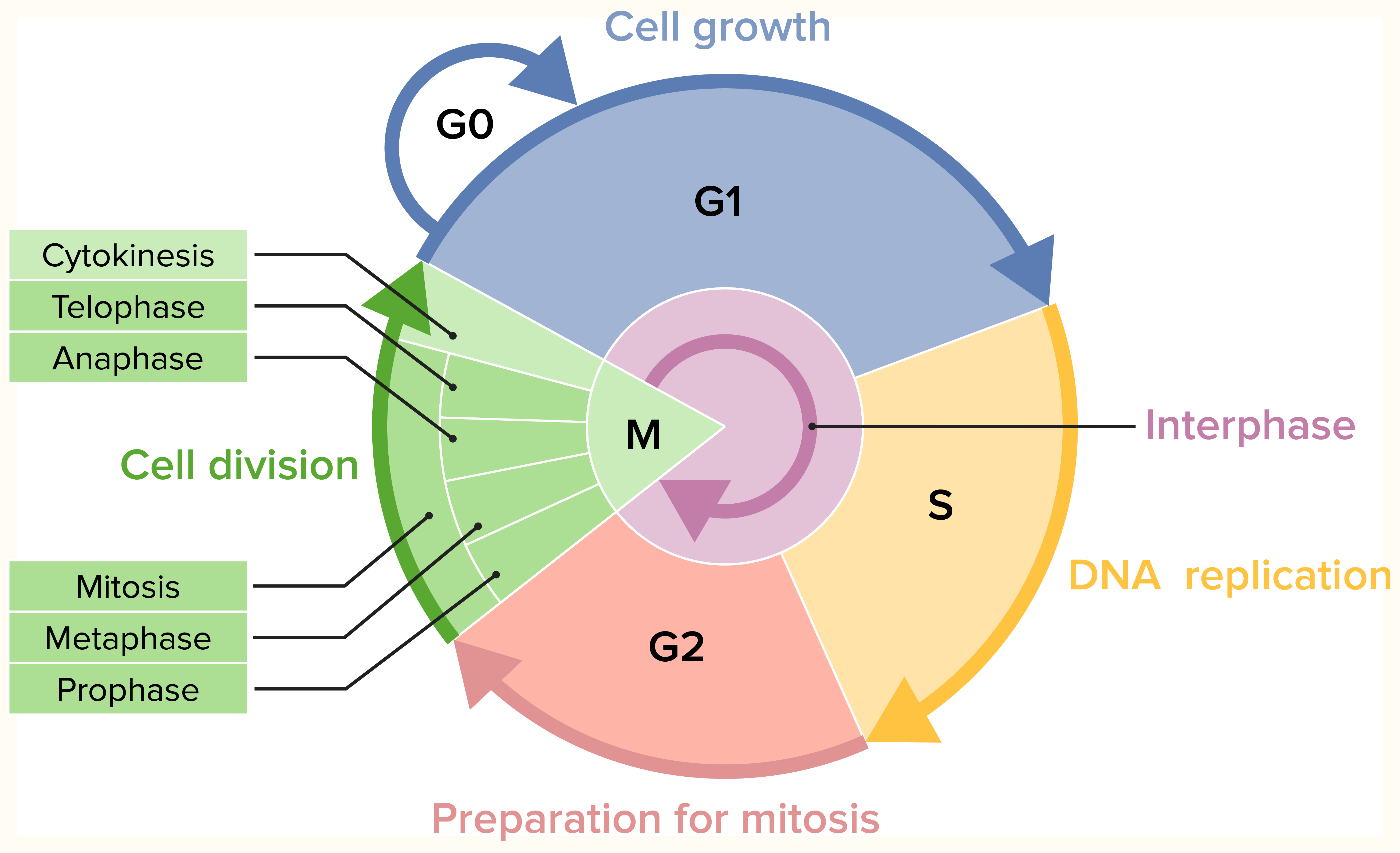
Cinética do ciclo celular

  • O ciclo celular é um processo de crescimento e maturação celular com várias fases.
  • Diferentes fases e eventos associados:
    • Fase G1: crescimento celular em preparação para replicação de DNA DNA A deoxyribonucleotide polymer that is the primary genetic material of all cells. Eukaryotic and prokaryotic organisms normally contain DNA in a double-stranded state, yet several important biological processes transiently involve single-stranded regions. DNA, which consists of a polysugar-phosphate backbone possessing projections of purines (adenine and guanine) and pyrimidines (thymine and cytosine), forms a double helix that is held together by hydrogen bonds between these purines and pyrimidines (adenine to thymine and guanine to cytosine). DNA Types and Structure
    • Fase S: replicação de DNA DNA A deoxyribonucleotide polymer that is the primary genetic material of all cells. Eukaryotic and prokaryotic organisms normally contain DNA in a double-stranded state, yet several important biological processes transiently involve single-stranded regions. DNA, which consists of a polysugar-phosphate backbone possessing projections of purines (adenine and guanine) and pyrimidines (thymine and cytosine), forms a double helix that is held together by hydrogen bonds between these purines and pyrimidines (adenine to thymine and guanine to cytosine). DNA Types and Structure
    • Fase G2: maior crescimento celular (por exemplo, replicação de organelos) em preparação para a mitose
    • Fase M: o DNA DNA A deoxyribonucleotide polymer that is the primary genetic material of all cells. Eukaryotic and prokaryotic organisms normally contain DNA in a double-stranded state, yet several important biological processes transiently involve single-stranded regions. DNA, which consists of a polysugar-phosphate backbone possessing projections of purines (adenine and guanine) and pyrimidines (thymine and cytosine), forms a double helix that is held together by hydrogen bonds between these purines and pyrimidines (adenine to thymine and guanine to cytosine). DNA Types and Structure duplicado é separado e distribuído por 2 células filhas idênticas
Antimetabolite Chemotherapy Agents

Fases do ciclo celular

Imagem por Lecturio.

Quimioterapia

  • O objetivo da quimioterapia é parar o crescimento celular ou destruir as células cancerígenas.
  • Hipótese de “log-kill”: A dose de quimioterapia mata a mesma fração de células tumorais, independentemente do tamanho do tumor Tumor Inflammation.
  • Os agentes de quimioterapia antimetabolitos são fármacos específicos do ciclo celular (atuam numa fase específica do ciclo celular):
    • Eficazes contra células que se dividem a uma taxa elevada (movendo-se através do ciclo celular)
    • Análogos para as unidades de DNA DNA A deoxyribonucleotide polymer that is the primary genetic material of all cells. Eukaryotic and prokaryotic organisms normally contain DNA in a double-stranded state, yet several important biological processes transiently involve single-stranded regions. DNA, which consists of a polysugar-phosphate backbone possessing projections of purines (adenine and guanine) and pyrimidines (thymine and cytosine), forms a double helix that is held together by hydrogen bonds between these purines and pyrimidines (adenine to thymine and guanine to cytosine). DNA Types and Structure e RNA RNA A polynucleotide consisting essentially of chains with a repeating backbone of phosphate and ribose units to which nitrogenous bases are attached. RNA is unique among biological macromolecules in that it can encode genetic information, serve as an abundant structural component of cells, and also possesses catalytic activity. RNA Types and Structure que, quando incorporados, interrompem a síntese de DNA DNA A deoxyribonucleotide polymer that is the primary genetic material of all cells. Eukaryotic and prokaryotic organisms normally contain DNA in a double-stranded state, yet several important biological processes transiently involve single-stranded regions. DNA, which consists of a polysugar-phosphate backbone possessing projections of purines (adenine and guanine) and pyrimidines (thymine and cytosine), forms a double helix that is held together by hydrogen bonds between these purines and pyrimidines (adenine to thymine and guanine to cytosine). DNA Types and Structure e RNA RNA A polynucleotide consisting essentially of chains with a repeating backbone of phosphate and ribose units to which nitrogenous bases are attached. RNA is unique among biological macromolecules in that it can encode genetic information, serve as an abundant structural component of cells, and also possesses catalytic activity. RNA Types and Structure.
    • Têm como alvo a fase S do ciclo celular → inibem a síntese normal de DNA DNA A deoxyribonucleotide polymer that is the primary genetic material of all cells. Eukaryotic and prokaryotic organisms normally contain DNA in a double-stranded state, yet several important biological processes transiently involve single-stranded regions. DNA, which consists of a polysugar-phosphate backbone possessing projections of purines (adenine and guanine) and pyrimidines (thymine and cytosine), forms a double helix that is held together by hydrogen bonds between these purines and pyrimidines (adenine to thymine and guanine to cytosine). DNA Types and Structure e RNA RNA A polynucleotide consisting essentially of chains with a repeating backbone of phosphate and ribose units to which nitrogenous bases are attached. RNA is unique among biological macromolecules in that it can encode genetic information, serve as an abundant structural component of cells, and also possesses catalytic activity. RNA Types and Structure

Classificação de antimetabolitos

Os subtipos dos agentes de quimioterapia antimetabolitos são:

  • Antifolatos (antagonistas do ácido fólico):
    • Metotrexato
    • Pemetrexed Pemetrexed A guanine-derived antineoplastic agent that functions as a nucleic acid synthesis inhibitor through its binding to, and inhibition of, thymidylate synthase. Antimetabolite Chemotherapy
    • Pralatrexato
  • Análogos de pirimidina:
    • Fluoropirimidinas:
      • 5-Fluorouracilo
      • Capecitabina
    • Análogos do desoxinucleósidos (desoxicitidina):
      • Citarabina
      • Gemcitabina
  • Análogos de purinas:
    • Tiopurinas:
      • 6-Mercaptopurina
      • 6-Tioguanina
    • Fludarabina
    • Cladribina
    • Pentostatina
  • Inibidores da ribonucleótido redutase: hidroxiureia

Resistência a fármacos

  • A resistência primária é a ausência de resposta na 1.ª exposição por alguns cancros devido à instabilidade genómica.
  • Resistência adquirida:
    • ↑ Expressão do MDR1 ( gene Gene A category of nucleic acid sequences that function as units of heredity and which code for the basic instructions for the development, reproduction, and maintenance of organisms. Basic Terms of Genetics de multirresistência a fármacos), codificando uma glicoproteína P na superfície celular, o que causa um fluxo para o exterior do fármaco
    • ↑ Capacidade de reparar o DNA DNA A deoxyribonucleotide polymer that is the primary genetic material of all cells. Eukaryotic and prokaryotic organisms normally contain DNA in a double-stranded state, yet several important biological processes transiently involve single-stranded regions. DNA, which consists of a polysugar-phosphate backbone possessing projections of purines (adenine and guanine) and pyrimidines (thymine and cytosine), forms a double helix that is held together by hydrogen bonds between these purines and pyrimidines (adenine to thymine and guanine to cytosine). DNA Types and Structure
    • ↑ Atividade das enzimas celulares tumorais, que inativar os fármacos anticancerígenos
    • Mudança na sensibilidade da enzima alvo ao fármaco
    • ↓ Conversão de pró-fármacos por enzimas de células tumorais
    • Expressão de glutationa ou proteínas associadas à glutationa, que se conjugam a alguns fármacos

Antifolatos

Agentes antifolatos

  • Agentes quimioterápicos antimetabolitos que bloqueiam a atividade do ácido fólico para inibir a divisão celular.
  • O folato ou ácido fólico é essencial no fornecimento de grupos metilo para precursores de DNA DNA A deoxyribonucleotide polymer that is the primary genetic material of all cells. Eukaryotic and prokaryotic organisms normally contain DNA in a double-stranded state, yet several important biological processes transiently involve single-stranded regions. DNA, which consists of a polysugar-phosphate backbone possessing projections of purines (adenine and guanine) and pyrimidines (thymine and cytosine), forms a double helix that is held together by hydrogen bonds between these purines and pyrimidines (adenine to thymine and guanine to cytosine). DNA Types and Structure e RNA RNA A polynucleotide consisting essentially of chains with a repeating backbone of phosphate and ribose units to which nitrogenous bases are attached. RNA is unique among biological macromolecules in that it can encode genetic information, serve as an abundant structural component of cells, and also possesses catalytic activity. RNA Types and Structure.
  • Os fármacos desta classe inibem a dihidrofolato redutase, em geral:
    • Metotrexato
    • Pemetrexed Pemetrexed A guanine-derived antineoplastic agent that functions as a nucleic acid synthesis inhibitor through its binding to, and inhibition of, thymidylate synthase. Antimetabolite Chemotherapy
    • Pralatrexato
    • Proguanilo (antimalárico)
    • Trimetoprim (antibiótico/antibacteriano)

Metotrexato ( MTX MTX An antineoplastic antimetabolite with immunosuppressant properties. It is an inhibitor of tetrahydrofolate dehydrogenase and prevents the formation of tetrahydrofolate, necessary for synthesis of thymidylate, an essential component of DNA. Antimetabolite Chemotherapy)

  • Análogo do ácido fólico
  • Mecanismo de ação:
    • Liga-se à dihidrofolato redutase (DHFR) → inibe a formação de tetrahidrofolato (FH₄) → ↓ síntese de DNA DNA A deoxyribonucleotide polymer that is the primary genetic material of all cells. Eukaryotic and prokaryotic organisms normally contain DNA in a double-stranded state, yet several important biological processes transiently involve single-stranded regions. DNA, which consists of a polysugar-phosphate backbone possessing projections of purines (adenine and guanine) and pyrimidines (thymine and cytosine), forms a double helix that is held together by hydrogen bonds between these purines and pyrimidines (adenine to thymine and guanine to cytosine). DNA Types and Structure
    • A folilglutamato sintetase (FPGS) adiciona resíduos de glutamil à molécula, tornando-a incapaz de atravessar membranas celulares.
    • Este mecanismo de retenção de iões permite a retenção prolongada de MTX MTX An antineoplastic antimetabolite with immunosuppressant properties. It is an inhibitor of tetrahydrofolate dehydrogenase and prevents the formation of tetrahydrofolate, necessary for synthesis of thymidylate, an essential component of DNA. Antimetabolite Chemotherapy na célula.
  • Mecanismo de resistência:
    • DHFR alterado (ligação fraca ao MTX MTX An antineoplastic antimetabolite with immunosuppressant properties. It is an inhibitor of tetrahydrofolate dehydrogenase and prevents the formation of tetrahydrofolate, necessary for synthesis of thymidylate, an essential component of DNA. Antimetabolite Chemotherapy)
    • Transporte de MTX MTX An antineoplastic antimetabolite with immunosuppressant properties. It is an inhibitor of tetrahydrofolate dehydrogenase and prevents the formation of tetrahydrofolate, necessary for synthesis of thymidylate, an essential component of DNA. Antimetabolite Chemotherapy para as células reduzido
    • ↓ Poliglutamação
  • Farmacocinética:
    • Absorção: via oral, intratecal, IV, IM
    • Distribuição: 50% ligado a proteínas plasmáticas
    • Metabolismo e excreção: 90% inalterado e excretado na urina (renal)
  • Indicações:
    • Usos em oncologia:
      • Cancro da mama
      • Leucemia Linfoblástica Aguda (LLA)
      • Cancro da cabeça e do pescoço
      • Linfoma cutâneo de células T
      • Neoplasia trofoblástica gestacional
      • Linfoma Não Hodgkin
      • Osteossarcoma
    • Não neoplásticas:
      • Artrite reumatoide
      • Psoríase
      • Artrite idiopática juvenil
  • Efeitos adversos:
    • Mielossupressão: anemia Anemia Anemia is a condition in which individuals have low Hb levels, which can arise from various causes. Anemia is accompanied by a reduced number of RBCs and may manifest with fatigue, shortness of breath, pallor, and weakness. Subtypes are classified by the size of RBCs, chronicity, and etiology. Anemia: Overview and Types, neutropenia Neutropenia Neutrophils are an important component of the immune system and play a significant role in the eradication of infections. Low numbers of circulating neutrophils, referred to as neutropenia, predispose the body to recurrent infections or sepsis, though patients can also be asymptomatic. Neutropenia e trombocitopenia
    • Hepatotoxicidade: ↑ enzimas hepáticas
    • Imunossupressão
    • Gastrointestinal: estomatite, diarreia, náuseas, vómitos
    • Nefrotoxicidade: nefropatia por cristais e toxicidade tubular direta
    • Neurotoxicidade
    • Toxicidade pulmonar: pneumonite intersticial
    • Dermatológicos: síndrome de Stevens-Johnson (SSJ), eritema multiforme, necrólise epidérmica tóxica (NET)
  • Precauções:
    • Usar o agente modulador de quimioterapia L-leucovorina, um análogo do folato.
    • Contrariar os efeitos antifolato (resgatar as células da toxicidade)
    • Iniciar dentro de 24-36 horas após início do metotrexato
  • Contraindicações:
    • Hipersensibilidade a qualquer fármaco antifolato
    • Gravidez (já que o fármaco causa defeitos no tubo neural e outros defeitos congénitos devido a folato ↓)
  • Interações medicamentosas:
    • Salicilatos e AINEs: ↑ níveis de fármaco
    • Vacinas inativadas: Os antifolatos geralmente reduzem os efeitos terapêuticos das vacinas inativadas.
    • Vacinas vivas (evitar): Os antifolatos aumentam os efeitos tóxicos das vacinas vivas.

Pemetrexed Pemetrexed A guanine-derived antineoplastic agent that functions as a nucleic acid synthesis inhibitor through its binding to, and inhibition of, thymidylate synthase. Antimetabolite Chemotherapy

  • Mecanismo de ação:
    • Inibe a DHFR e a timidilato sintase para ↓ timidina
    • Também inibe as seguintes enzimas:
      • Glicinamida ribonucleótido formil transferase (GARFT), aminoimidazola carboxamida ribonucleótido formil transferase (AICARFT)
      • Resultada numa ↓ síntese de nucleótidos → ↓ síntese de proteínas
  • Farmacocinética:
    • Absorção: via de administração IV
    • Distribuição: 80% ligado a proteínas
    • Metabolismo e excreção: metabolismo residual e excretado até 90% de forma inalterada na urina (renal)
  • Indicações (rotuladas):
    • Mesotelioma
    • Cancro do pulmão de não pequenas células
  • Efeitos adversos:
    • Mielossupressão
    • Erupções cutâneas
    • Nefrotoxicidade
    • Toxicidade pulmonar
    • GI: náuseas, vómitos, diarreia, estomatite
  • Precauções: ácido fólico profilático e vitamina B12 para ↓ toxicidade hematológica e GI
  • Contraindicações: hipersensibilidade a qualquer fármaco antifolato
  • Considerações sobre a gravidez: com base na ação do fármaco e em estudos com animais, pode causar danos fetais
  • Interações medicamentosas:
    • Salicilatos e AINEs: ↑ níveis de fármaco
    • Vacinas inativadas: Os antifolatos geralmente reduzem os efeitos terapêuticos das vacinas inativadas.
    • Vacinas vivas (evitar): Os antifolatos aumentam os efeitos tóxicos das vacinas vivas.

Pralatrexato

  • Mecanismo de ação:
    • Inibe a DHFR
    • Entra seletivamente nas células ao expressar ↓ portador de folato reduzido (RFC-1)
    • Também poliglutamado pela FPGS
  • Farmacocinética:
    • Absorção: via de administração IV
    • Distribuição: 67% ligado a proteínas
    • Metabolismo e excreção: minimamente metabolizados, com cerca de 34% excretados de forma inalterada na urina
  • Indicação: linfoma periférico de células T (reincidente ou refratário)
  • Efeitos adversos:
    • Mielossupressão: anemia Anemia Anemia is a condition in which individuals have low Hb levels, which can arise from various causes. Anemia is accompanied by a reduced number of RBCs and may manifest with fatigue, shortness of breath, pallor, and weakness. Subtypes are classified by the size of RBCs, chronicity, and etiology. Anemia: Overview and Types, leucopenia, trombocitopenia
    • GI: náuseas, dor abdominal, diarreia, estomatite
    • Fadiga
    • Edema Edema Edema is a condition in which excess serous fluid accumulates in the body cavity or interstitial space of connective tissues. Edema is a symptom observed in several medical conditions. It can be categorized into 2 types, namely, peripheral (in the extremities) and internal (in an organ or body cavity). Edema
  • Contraindicações: hipersensibilidade a qualquer fármaco antifolato
  • Considerações sobre a gravidez: com base na ação do fármaco e em estudos com animais, pode causar danos fetais
  • Interações medicamentosas:
    • Salicilatos e AINEs: ↑ níveis de fármaco
    • Vacinas inativadas: Os antifolatos geralmente reduzem os efeitos terapêuticos das vacinas inativadas.
    • Vacinas vivas (evitar): Os antifolatos aumentam os efeitos tóxicos das vacinas vivas.

Comparação de agentes antifolato

Tabela: Comparação de agentes antifolato
Agente Mecanismo de ação Indicações rotuladas Efeitos adversos Considerações adicionais
Metotrexato Inibem a DHFR
  • Leucemia Linfoblástica Aguda (LLA)
  • Cancro da mama
  • Neoplasia trofoblástica gestacional
  • Cancro da cabeça e do pescoço
  • Linfoma não Hodgkin
  • Linfoma cutâneo de células T
  • Osteossarcoma
  • Mielossupressão
  • Imunossupressão
  • Nefrotoxicidade
  • Hepatotoxicidade
  • Neurotoxicidade
  • Toxicidade pulmonar
  • Efeitos colaterais GI
  • Gravidez: defeitos no tubo neural
Adicionar leucovorina para recuperar as células da toxicidade.
Pemetrexed Pemetrexed A guanine-derived antineoplastic agent that functions as a nucleic acid synthesis inhibitor through its binding to, and inhibition of, thymidylate synthase. Antimetabolite Chemotherapy Inibe:
  • Tiamidilato sintetase
  • DHFR
  • GARFT
  • AICARFT
  • NSCLC
  • Mesotelioma
  • Mielossupressão
  • Nefrotoxicidade
  • Toxicidade pulmonar
  • Erupções cutâneas
  • Efeitos colaterais GI
Adicionar vitamina B12 e folato para ↓ toxicidade.
Pralatrexato
  • Inibem a DHFR
  • ↑ Afinidade para o RFC-1 (melhor transporte)
  • ↑ FPGS (↑ metabolitos citotóxicos)
Linfoma periférico de células T
  • Mielossupressão
  • Efeitos colaterais GI
Adicionar vitamina B12 e folato para ↓ toxicidade
NSCLC: cancro de pulmão de não pequenas células

Análogos de Pirimidina

Antimetabolitos pirimidínicos

  • Agentes quimioterápicos citotóxicos que inibem a síntese de DNA DNA A deoxyribonucleotide polymer that is the primary genetic material of all cells. Eukaryotic and prokaryotic organisms normally contain DNA in a double-stranded state, yet several important biological processes transiently involve single-stranded regions. DNA, which consists of a polysugar-phosphate backbone possessing projections of purines (adenine and guanine) and pyrimidines (thymine and cytosine), forms a double helix that is held together by hydrogen bonds between these purines and pyrimidines (adenine to thymine and guanine to cytosine). DNA Types and Structure através dos efeitos dos análogos precursores que entram nas células tumorais.
  • Contexto:
    • 4 bases Bases Usually a hydroxide of lithium, sodium, potassium, rubidium or cesium, but also the carbonates of these metals, ammonia, and the amines. Acid-Base Balance que são precursoras:
      • 2 pirimidinas: citosina e timina (em RNA RNA A polynucleotide consisting essentially of chains with a repeating backbone of phosphate and ribose units to which nitrogenous bases are attached. RNA is unique among biological macromolecules in that it can encode genetic information, serve as an abundant structural component of cells, and also possesses catalytic activity. RNA Types and Structure: uracilo em vez de timina)
      • 2 purinas: guanina e adenina
    • As purinas e as pirimidinas podem ser sintetizadas de novo, mas alguns precursores são captados pelas células na corrente sanguínea:
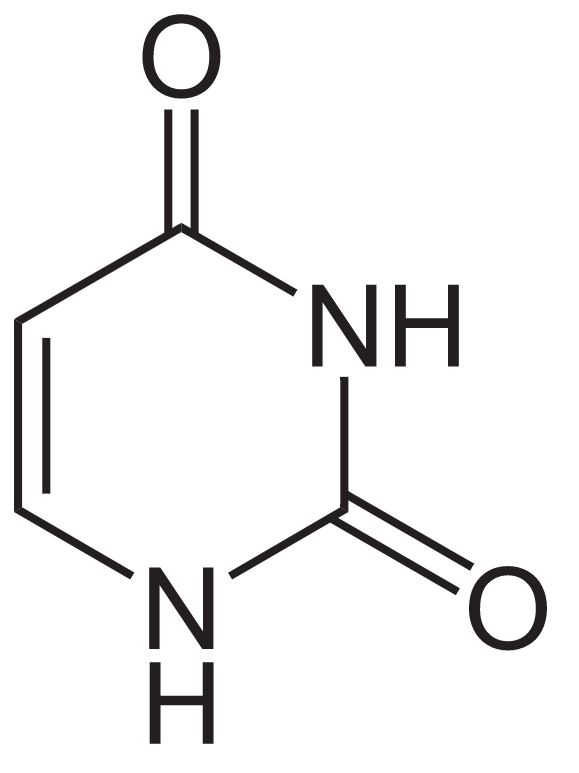
      • Algumas bases Bases Usually a hydroxide of lithium, sodium, potassium, rubidium or cesium, but also the carbonates of these metals, ammonia, and the amines. Acid-Base Balance (uracilo) entram nas células, por isso os análogos (5-fluorouracilo, capecitabina) podem ser substitutos para estas bases Bases Usually a hydroxide of lithium, sodium, potassium, rubidium or cesium, but also the carbonates of these metals, ammonia, and the amines. Acid-Base Balance.
      • Outras bases Bases Usually a hydroxide of lithium, sodium, potassium, rubidium or cesium, but also the carbonates of these metals, ammonia, and the amines. Acid-Base Balance (citosina, timina) são transportadas para as células como desoxinucleósidos (como a desoxicitidina).
      • Como tal TAL Renal Sodium and Water Regulation, os análogos deoxicitidina (citarabina, gemcitabina) podem competir com a desoxicitidina e entrar nas células.
  • Estes antimetabolitos pirimidínicos são transportados para as células tumorais e tornam-se ativados intracelularmente.

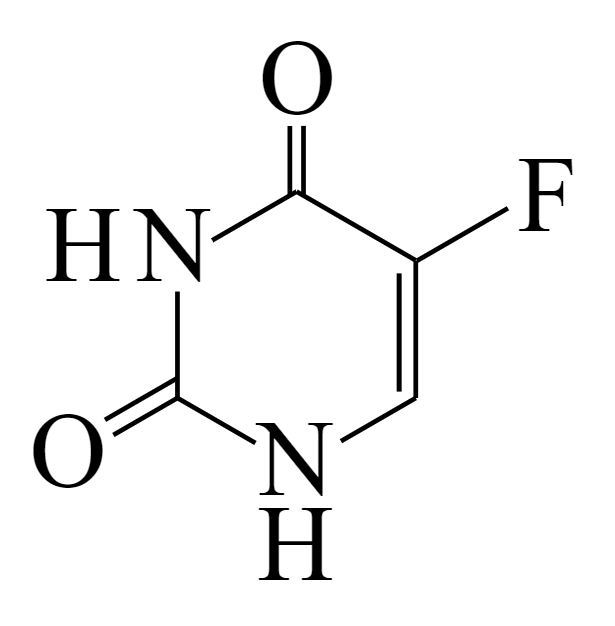
5-Fluorouracilo ( 5-FU 5-FU A pyrimidine analog that is an antineoplastic antimetabolite. It interferes with DNA synthesis by blocking the thymidylate synthetase conversion of deoxyuridylic acid to thymidylic acid. Antimetabolite Chemotherapy)

  • Piririmidina fluorada/fluoropirimidina
  • Mecanismo de ação:
    • O 5-FU 5-FU A pyrimidine analog that is an antineoplastic antimetabolite. It interferes with DNA synthesis by blocking the thymidylate synthetase conversion of deoxyuridylic acid to thymidylic acid. Antimetabolite Chemotherapy é ativado a fluorouridina monofosfato (F-UMP), que inibe o crescimento celular através da substituição do uracilo no RNA RNA A polynucleotide consisting essentially of chains with a repeating backbone of phosphate and ribose units to which nitrogenous bases are attached. RNA is unique among biological macromolecules in that it can encode genetic information, serve as an abundant structural component of cells, and also possesses catalytic activity. RNA Types and Structure.
    • Também convertido a 5-fluorodesoxiuridina monofosfato (5-FdUMP) → 5-FdUMP liga-se à timidilato sintetase (TS)
    • Inibição da TS → a desoxiuridina monofosfato (dUMP) não pode ser convertida em desoxitimidina monofosfato (dTMP) → ↓ síntese de DNA DNA A deoxyribonucleotide polymer that is the primary genetic material of all cells. Eukaryotic and prokaryotic organisms normally contain DNA in a double-stranded state, yet several important biological processes transiently involve single-stranded regions. DNA, which consists of a polysugar-phosphate backbone possessing projections of purines (adenine and guanine) and pyrimidines (thymine and cytosine), forms a double helix that is held together by hydrogen bonds between these purines and pyrimidines (adenine to thymine and guanine to cytosine). DNA Types and Structure e de proteínas
  • Mecanismo de resistência:
    • ↓ Atividade de ativação de enzimas pelo 5-FU 5-FU A pyrimidine analog that is an antineoplastic antimetabolite. It interferes with DNA synthesis by blocking the thymidylate synthetase conversion of deoxyuridylic acid to thymidylic acid. Antimetabolite Chemotherapy
    • Amplificação ou mutação da TS
  • Farmacocinética:
    • Absorção: administrada via IV (má absorção oral)
    • Distribuição: bem distribuída, inclusive no LCR
    • Metabolismo: hepático
    • Excreção: renal
  • Indicações (rotuladas):
    • Cancro da mama
    • Cancro colorretal
    • Cancro do estômago
    • Cancro do pâncreas
  • Efeitos adversos:
    • Mielossupressão
    • Toxicidade cardiovascular: angina, arritmia, insuficiência cardíaca
    • Neurotoxicidade: dor de cabeça, confusão, desorientação
    • Erupção cutânea, SSJ, NET
    • Síndrome da mão-pé (inchaço doloroso e eritematoso das mãos e dos pés)
    • Encefalopatia hiperamonémica
    • Estomatite, anorexia Anorexia The lack or loss of appetite accompanied by an aversion to food and the inability to eat. It is the defining characteristic of the disorder anorexia nervosa. Anorexia Nervosa, diarreia
  • Precauções: deficiência de dihidropirimidina desidrogenase (DPD)
    • A enzima é importante na desintoxicação.
    • A deficiência levará a um aumento do risco de toxicidade.
  • Contraindicações: hipersensibilidade a 5-FU 5-FU A pyrimidine analog that is an antineoplastic antimetabolite. It interferes with DNA synthesis by blocking the thymidylate synthetase conversion of deoxyuridylic acid to thymidylic acid. Antimetabolite Chemotherapy
  • Considerações sobre a gravidez: com base na ação do fármaco e em estudos com animais, pode causar danos fetais
  • Interações medicamentosas:
    • Vacinas inativadas: ↓ eficácia das vacinas
    • Vacinas vivas: ↑ efeitos tóxicos das vacinas
    • Varfarina: ↑ risco de hemorragia

Capecitabina

  • Pró-fármaco do 5-FU 5-FU A pyrimidine analog that is an antineoplastic antimetabolite. It interferes with DNA synthesis by blocking the thymidylate synthetase conversion of deoxyuridylic acid to thymidylic acid. Antimetabolite Chemotherapy
  • Mecanismo de ação: pró-fármaco do 5-FU 5-FU A pyrimidine analog that is an antineoplastic antimetabolite. It interferes with DNA synthesis by blocking the thymidylate synthetase conversion of deoxyuridylic acid to thymidylic acid. Antimetabolite Chemotherapy que é hidrolisado a 5-FU 5-FU A pyrimidine analog that is an antineoplastic antimetabolite. It interferes with DNA synthesis by blocking the thymidylate synthetase conversion of deoxyuridylic acid to thymidylic acid. Antimetabolite Chemotherapy
  • Farmacocinética:
    • Absorção: reduzida pelos alimentos
    • Distribuição: cerca de 35% ligado à albumina
    • Metabolismo: metabolismo hepático e no tecido
    • Excreção: renal
  • Indicações (rotuladas):
    • Cancro da mama (metastático)
    • Cancro colorretal
  • Efeitos adversos:
    • Mielossupressão
    • Toxicidade GI:
      • Mucosite
      • Náuseas, vómitos
      • Diarreia: pode limitar a dosagem devido à gravidade
    • Cardiotoxicidade: isquemia, arritmia, insuficiência cardíaca
    • Síndrome de mão-pé
    • Hepatotoxicidade (↑ bilirrubina)
    • Neurotoxicidade:
      • Cefaleias
      • Encefalopatia
      • Ataxia Ataxia Impairment of the ability to perform smoothly coordinated voluntary movements. This condition may affect the limbs, trunk, eyes, pharynx, larynx, and other structures. Ataxia may result from impaired sensory or motor function. Sensory ataxia may result from posterior column injury or peripheral nerve diseases. Motor ataxia may be associated with cerebellar diseases; cerebral cortex diseases; thalamic diseases; basal ganglia diseases; injury to the red nucleus; and other conditions. Ataxia-telangiectasia
      • Neuropatia
  • Precauções: deficiência de dihidropirimidina desidrogenase:
    • A enzima é importante na desintoxicação.
    • A deficiência levará a um aumento do risco de toxicidade.
  • Contraindicações: hipersensibilidade à capecitabina
  • Considerações sobre a gravidez: com base na ação do fármaco e em estudos com animais, pode causar danos fetais
  • Interações medicamentosas:
    • Vacinas inativadas: ↓ eficácia das vacinas
    • Vacinas vivas: ↑ efeitos tóxicos das vacinas
    • Varfarina: ↑ risco de hemorragia
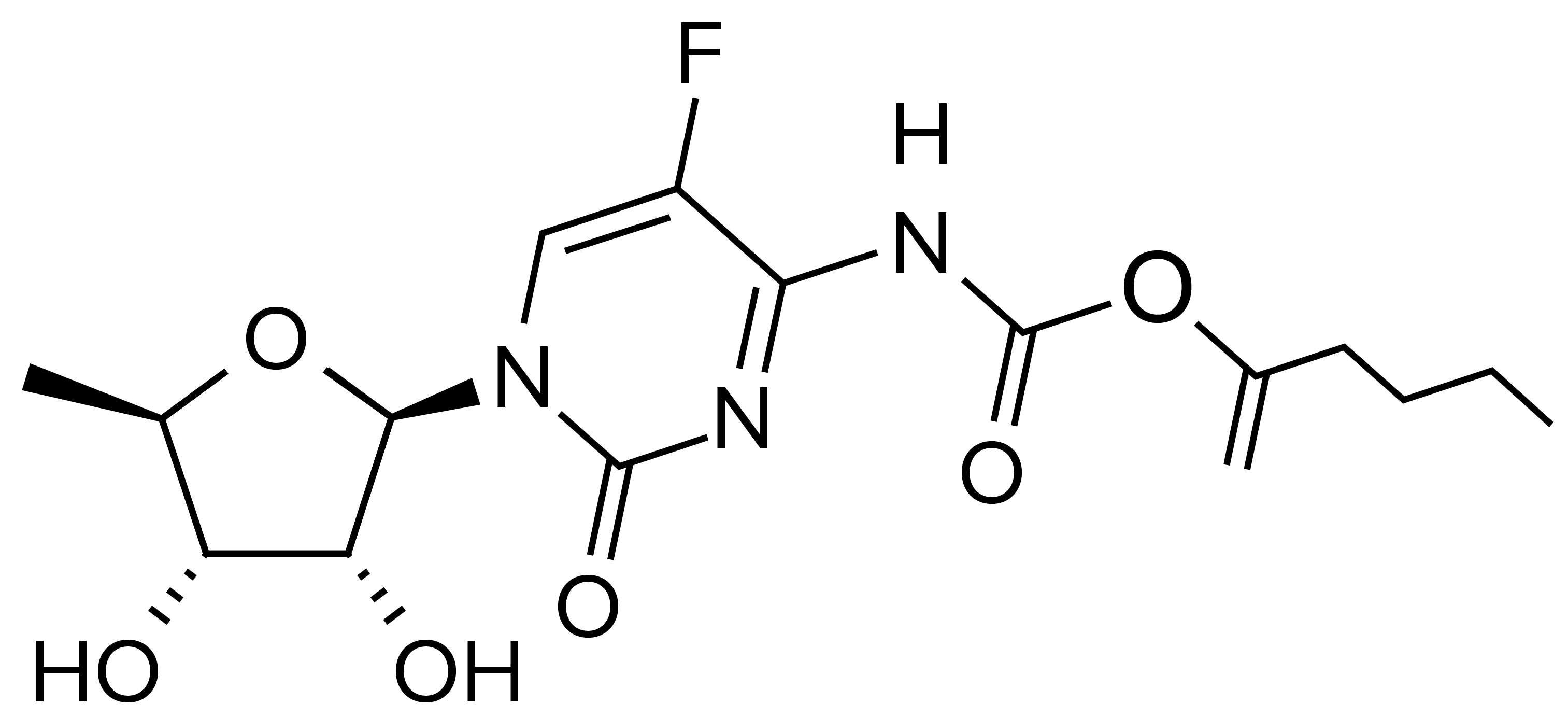
Capecitabine_Structure

Estrutura da capecitabina

Imagem pro Lecturio.
Citarabina

  • A citarabina (também chamada citosina arabinosida ( ara-C ara-C A pyrimidine nucleoside analog that is used mainly in the treatment of leukemia, especially acute non-lymphoblastic leukemia. Cytarabine is an antimetabolite antineoplastic agent that inhibits the synthesis of DNA. Its actions are specific for the s phase of the cell cycle. It also has antiviral and immunosuppressant properties. Antimetabolite Chemotherapy)) é uma base de citosina combinada com um açúcar de arabinose Arabinose Antimycobacterial Drugs, em vez de desoxirribose.
  • Análogo desoxicitidina
  • Mecanismo de ação:
    • Na célula, citarabina → ara-citidina monofosfato (ara-CMP) pela desoxicitidina quinase (dCK) → ara-citidina trifosfato (ara-CTP)
    • Ara-CTP compete com o deoxy-CTP para ser incorporado no DNA DNA A deoxyribonucleotide polymer that is the primary genetic material of all cells. Eukaryotic and prokaryotic organisms normally contain DNA in a double-stranded state, yet several important biological processes transiently involve single-stranded regions. DNA, which consists of a polysugar-phosphate backbone possessing projections of purines (adenine and guanine) and pyrimidines (thymine and cytosine), forms a double helix that is held together by hydrogen bonds between these purines and pyrimidines (adenine to thymine and guanine to cytosine). DNA Types and Structure pela DNA DNA A deoxyribonucleotide polymer that is the primary genetic material of all cells. Eukaryotic and prokaryotic organisms normally contain DNA in a double-stranded state, yet several important biological processes transiently involve single-stranded regions. DNA, which consists of a polysugar-phosphate backbone possessing projections of purines (adenine and guanine) and pyrimidines (thymine and cytosine), forms a double helix that is held together by hydrogen bonds between these purines and pyrimidines (adenine to thymine and guanine to cytosine). DNA Types and Structure polimerase.
    • Quando o ara-CTP é incorporado, ocorre a terminação do alongamento da cadeia de DNA DNA A deoxyribonucleotide polymer that is the primary genetic material of all cells. Eukaryotic and prokaryotic organisms normally contain DNA in a double-stranded state, yet several important biological processes transiently involve single-stranded regions. DNA, which consists of a polysugar-phosphate backbone possessing projections of purines (adenine and guanine) and pyrimidines (thymine and cytosine), forms a double helix that is held together by hydrogen bonds between these purines and pyrimidines (adenine to thymine and guanine to cytosine). DNA Types and Structure.
    • O ciclo celular não continua → DNA DNA A deoxyribonucleotide polymer that is the primary genetic material of all cells. Eukaryotic and prokaryotic organisms normally contain DNA in a double-stranded state, yet several important biological processes transiently involve single-stranded regions. DNA, which consists of a polysugar-phosphate backbone possessing projections of purines (adenine and guanine) and pyrimidines (thymine and cytosine), forms a double helix that is held together by hydrogen bonds between these purines and pyrimidines (adenine to thymine and guanine to cytosine). DNA Types and Structure rompe → morte celular
  • Mecanismo de resistência:
    • Perda de dCK
    • Aumento da expressão de citidina desaminase (CDA; converte ara-C ara-C A pyrimidine nucleoside analog that is used mainly in the treatment of leukemia, especially acute non-lymphoblastic leukemia. Cytarabine is an antimetabolite antineoplastic agent that inhibits the synthesis of DNA. Its actions are specific for the s phase of the cell cycle. It also has antiviral and immunosuppressant properties. Antimetabolite Chemotherapy no metabolito não tóxico ara-uridina)
  • Farmacocinética:
    • Absorção:
      • Administração via IV
      • Com ↑ CDA no trato GI, a absorção oral é fraca.
    • Distribuição: entra facilmente nas células, atravessa a barreira hematoencefálica
    • Metabolismo e excreção:
      • Metabolizado no fígado
      • Excretado principalmente renalmente (90% como metabolito uracilo arabinosídeo)
  • Indicações:
    • Leucemia Linfoblástica Aguda (LLA)
    • LMA
    • LMC
    • Leucemia meníngea
  • Efeitos adversos:
    • Principal efeito tóxico: mielossupressão ( neutropenia Neutropenia Neutrophils are an important component of the immune system and play a significant role in the eradication of infections. Low numbers of circulating neutrophils, referred to as neutropenia, predispose the body to recurrent infections or sepsis, though patients can also be asymptomatic. Neutropenia, trombocitopenia, leucopenia)
    • Outros:
      • GI: mucosite, náuseas, diarreia, dor abdominal, pancreatite
      • Hepatotoxicidade: ↑ transaminases Transaminases A subclass of enzymes of the transferase class that catalyze the transfer of an amino group from a donor (generally an amino acid) to an acceptor (generally a 2-keto acid). Most of these enzymes are pyridoxyl phosphate proteins. Autoimmune Hepatitis
      • Tonturas, dores de cabeça, neurotoxicidade
      • Cardiotoxicidade: angina, pericardite
      • Hiperuricemia
      • Síndrome de citarabina (6–12 horas após a administração): febre, mialgia, dor óssea, erupção cutânea, conjuntivite, mal-estar
  • Precauções: ajuste da dose em insuficiência hepática e renal
  • Contraindicações: hipersensibilidade à citarabina
  • Considerações sobre a gravidez: com base na ação do fármaco e em estudos com animais, pode causar danos fetais
  • Interações medicamentosas:
    • Vacinas inativadas: ↓ eficácia das vacinas
    • Vacinas vivas: ↑ efeitos tóxicos das vacinas
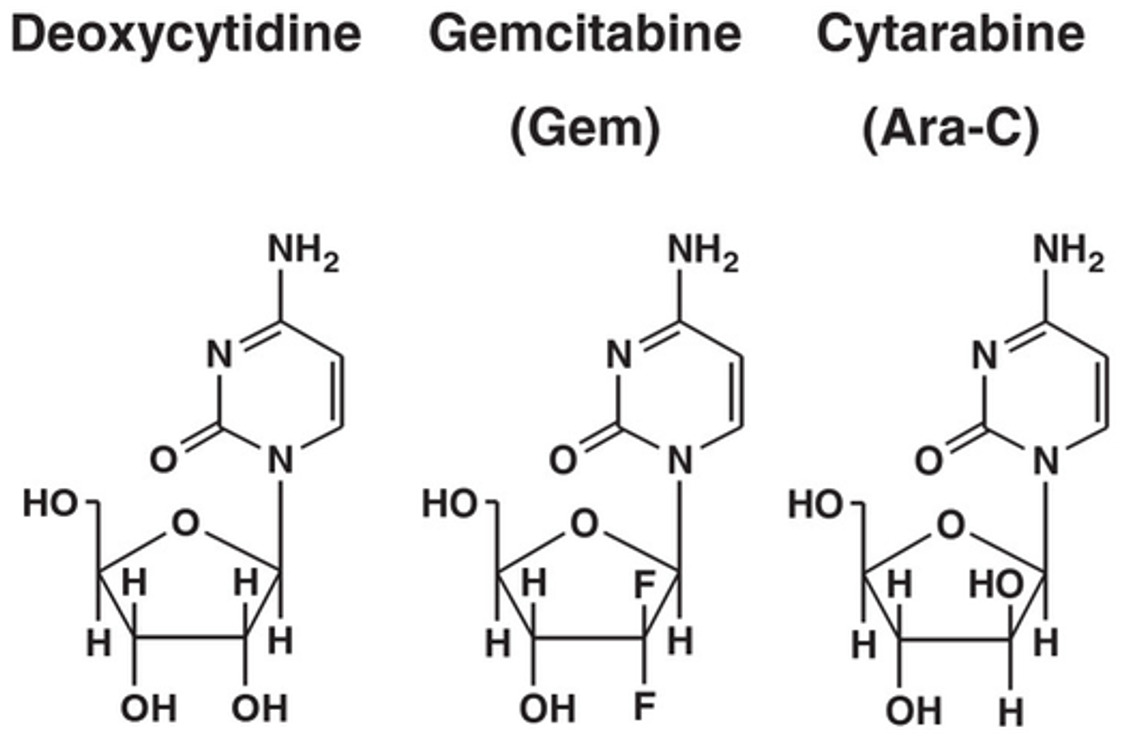
Desoxicitidina e análogos

Desoxicitidina e análogos:
Gemcitabina (análogo difluoro) e citosina (citosina arabinosídeo)

Imagem: “Structural formulae of deoxycytidine, gemcitabine, cytarabine, troxacitabine and PMEA” by Godefridus J Peters, et al. Licença: CC BY 4.0, cortado por Lecturio.

Gemcitabina

  • Análogo difluoro de desoxicitidina
  • Mecanismo de ação:
    • A gemcitabina é fosforilada pela dCK em gemcitabina monofosfato → gemcitabina difosfato → gemcitabina trifosfato
    • A gemcitabina difosfato inibe a ribonucleótido redutase (que converte os ribonucleótidos em desoxirribonucleótidos) → ↓ síntese de DNA DNA A deoxyribonucleotide polymer that is the primary genetic material of all cells. Eukaryotic and prokaryotic organisms normally contain DNA in a double-stranded state, yet several important biological processes transiently involve single-stranded regions. DNA, which consists of a polysugar-phosphate backbone possessing projections of purines (adenine and guanine) and pyrimidines (thymine and cytosine), forms a double helix that is held together by hydrogen bonds between these purines and pyrimidines (adenine to thymine and guanine to cytosine). DNA Types and Structure
    • A gemcitabina trifosfato (estruturalmente semelhante ao trifosfato de desoxitidina) é incorporada no DNA DNA A deoxyribonucleotide polymer that is the primary genetic material of all cells. Eukaryotic and prokaryotic organisms normally contain DNA in a double-stranded state, yet several important biological processes transiently involve single-stranded regions. DNA, which consists of a polysugar-phosphate backbone possessing projections of purines (adenine and guanine) and pyrimidines (thymine and cytosine), forms a double helix that is held together by hydrogen bonds between these purines and pyrimidines (adenine to thymine and guanine to cytosine). DNA Types and Structure.
    • Incorporação no DNA DNA A deoxyribonucleotide polymer that is the primary genetic material of all cells. Eukaryotic and prokaryotic organisms normally contain DNA in a double-stranded state, yet several important biological processes transiently involve single-stranded regions. DNA, which consists of a polysugar-phosphate backbone possessing projections of purines (adenine and guanine) and pyrimidines (thymine and cytosine), forms a double helix that is held together by hydrogen bonds between these purines and pyrimidines (adenine to thymine and guanine to cytosine). DNA Types and Structure → inibição da DNA DNA A deoxyribonucleotide polymer that is the primary genetic material of all cells. Eukaryotic and prokaryotic organisms normally contain DNA in a double-stranded state, yet several important biological processes transiently involve single-stranded regions. DNA, which consists of a polysugar-phosphate backbone possessing projections of purines (adenine and guanine) and pyrimidines (thymine and cytosine), forms a double helix that is held together by hydrogen bonds between these purines and pyrimidines (adenine to thymine and guanine to cytosine). DNA Types and Structure polimerase → cessação da síntese de DNA DNA A deoxyribonucleotide polymer that is the primary genetic material of all cells. Eukaryotic and prokaryotic organisms normally contain DNA in a double-stranded state, yet several important biological processes transiently involve single-stranded regions. DNA, which consists of a polysugar-phosphate backbone possessing projections of purines (adenine and guanine) and pyrimidines (thymine and cytosine), forms a double helix that is held together by hydrogen bonds between these purines and pyrimidines (adenine to thymine and guanine to cytosine). DNA Types and Structure → morte celular
  • Farmacocinética:
    • Absorção: administração via IV
    • Distribuição: amplamente distribuída, ligação a proteínas residual
    • Metabolismo: metabolizada intracelularmente (em difosfatos e trifosfatos) por cinases
    • Excreção: renal (> 92%)
  • Indicações (rotuladas):
    • Cancro do pulmão de não pequenas células
    • Cancro do pâncreas
    • Cancro da mama
    • Cancro do ovário
  • Efeitos adversos:
    • Mielossupressão
    • Síndrome de transudação capilar (hiperpermeabilidade capilar súbita potencialmente letal → edema Edema Edema is a condition in which excess serous fluid accumulates in the body cavity or interstitial space of connective tissues. Edema is a symptom observed in several medical conditions. It can be categorized into 2 types, namely, peripheral (in the extremities) and internal (in an organ or body cavity). Edema, hipotensão, ↓ albumina)
    • GI: mucosite, náuseas, diarreia, dores abdominais
    • Hepatotoxicidade: ↑ transaminases Transaminases A subclass of enzymes of the transferase class that catalyze the transfer of an amino group from a donor (generally an amino acid) to an acceptor (generally a 2-keto acid). Most of these enzymes are pyridoxyl phosphate proteins. Autoimmune Hepatitis
    • Síndrome hemolítica urémica
    • Toxicidade pulmonar
  • Precauções: descontinuar se ocorrer toxicidade renal ou hepática grave
  • Contraindicações: hipersensibilidade à gemcitabina
  • Considerações sobre a gravidez: com base na ação do fármaco e em estudos com animais, pode causar danos fetais
  • Interações medicamentosas:
    • Vacinas inativadas: ↓ eficácia das vacinas
    • Vacinas vivas: ↑ efeitos tóxicos das vacinas
    • A coadministração com anticoagulantes aumenta o risco de hemorragia.

Comparação de análogos de pirimidina

Tabela: Comparação de análogos de pirimidina
Agente Mecanismo de ação Indicações rotuladas Efeitos adversos Considerações adicionais
5-FU 5-FU A pyrimidine analog that is an antineoplastic antimetabolite. It interferes with DNA synthesis by blocking the thymidylate synthetase conversion of deoxyuridylic acid to thymidylic acid. Antimetabolite Chemotherapy Inibe a timidilato sintetase
  • Cancro da mama
  • Cancro colorretal
  • Cancro do estômago
  • Cancro do pâncreas
  • Mielossupressão
  • Toxicidade CV CV Vasculitides
  • Neurotoxicidade
  • Erupções cutâneas
  • Síndrome do pé-mão
  • ↑ Amónia
  • ↑ Hemorragia com varfarina
Na deficiência de DPD: ↑ toxicidade
Capecitabina Pró-fármaco do 5-FU 5-FU A pyrimidine analog that is an antineoplastic antimetabolite. It interferes with DNA synthesis by blocking the thymidylate synthetase conversion of deoxyuridylic acid to thymidylic acid. Antimetabolite Chemotherapy (inibe a timidilato sintetase)
  • Cancro da mama
  • Cancro colorretal
  • Mielossupressão
  • Toxicidade CV CV Vasculitides
  • Neurotoxicidade
  • Toxicidade GI
  • Síndrome do pé-mão
  • ↑ Hemorragia com varfarina
Na deficiência de DPD: ↑ toxicidade
Citarabina Inibe a DNA DNA A deoxyribonucleotide polymer that is the primary genetic material of all cells. Eukaryotic and prokaryotic organisms normally contain DNA in a double-stranded state, yet several important biological processes transiently involve single-stranded regions. DNA, which consists of a polysugar-phosphate backbone possessing projections of purines (adenine and guanine) and pyrimidines (thymine and cytosine), forms a double helix that is held together by hydrogen bonds between these purines and pyrimidines (adenine to thymine and guanine to cytosine). DNA Types and Structure polimerase
  • Leucemia Linfoblástica Aguda (LLA)
  • Leucemia mieloide aguda
  • Leucemia mieloide crónica
  • Leucemia meníngea
  • Mielossupressão
  • Síndrome de Ara-C ara-C A pyrimidine nucleoside analog that is used mainly in the treatment of leukemia, especially acute non-lymphoblastic leukemia. Cytarabine is an antimetabolite antineoplastic agent that inhibits the synthesis of DNA. Its actions are specific for the s phase of the cell cycle. It also has antiviral and immunosuppressant properties. Antimetabolite Chemotherapy
  • Toxicidade GI
  • Hepatotoxicidade
  • Pancreatite
  • Hiperuricemia
Gemcitabina Inibe a DNA DNA A deoxyribonucleotide polymer that is the primary genetic material of all cells. Eukaryotic and prokaryotic organisms normally contain DNA in a double-stranded state, yet several important biological processes transiently involve single-stranded regions. DNA, which consists of a polysugar-phosphate backbone possessing projections of purines (adenine and guanine) and pyrimidines (thymine and cytosine), forms a double helix that is held together by hydrogen bonds between these purines and pyrimidines (adenine to thymine and guanine to cytosine). DNA Types and Structure polimerase e a ribonucleótido redutase
  • NSCLC
  • Cancro do pâncreas
  • Cancro da mama
  • Cancro do ovário
  • Mielossupressão
  • Síndrome de transudação capilar
  • SHU
  • Toxicidade pulmonar
  • ↑ Hemorragia com varfarina
5-FU: 5-fluorouracilo
CV: cardiovascular
SHU: síndrome hemolítica urémica
NSCLC: cancro do pulmão de não pequenas células

Analógicos de Purina

Análogos de adenina ou guanina

  • Estes antimetabolitos interferem ou competem com os nucleósidos trifosfatos na síntese de DNA DNA A deoxyribonucleotide polymer that is the primary genetic material of all cells. Eukaryotic and prokaryotic organisms normally contain DNA in a double-stranded state, yet several important biological processes transiently involve single-stranded regions. DNA, which consists of a polysugar-phosphate backbone possessing projections of purines (adenine and guanine) and pyrimidines (thymine and cytosine), forms a double helix that is held together by hydrogen bonds between these purines and pyrimidines (adenine to thymine and guanine to cytosine). DNA Types and Structure e/ou RNA RNA A polynucleotide consisting essentially of chains with a repeating backbone of phosphate and ribose units to which nitrogenous bases are attached. RNA is unique among biological macromolecules in that it can encode genetic information, serve as an abundant structural component of cells, and also possesses catalytic activity. RNA Types and Structure.
  • Geralmente possuem excelente atividade contra leucemias e linfomas
  • Fármacos nesta classe de medicamentos:
    • Tiopurinas (inibem a síntese de novo de purinas):
      • 6-Mercaptopurina ( 6-MP 6-MP An antimetabolite antineoplastic agent with immunosuppressant properties. It interferes with nucleic acid synthesis by inhibiting purine metabolism and is used, usually in combination with other drugs, in the treatment of or in remission maintenance programs for leukemia. Antimetabolite Chemotherapy): agente antineoplástico e imunossupressor
      • 6-Tioguanina
      • Azatioprina (imunossupressor): sofre redução não enzimática a 6-MP 6-MP An antimetabolite antineoplastic agent with immunosuppressant properties. It interferes with nucleic acid synthesis by inhibiting purine metabolism and is used, usually in combination with other drugs, in the treatment of or in remission maintenance programs for leukemia. Antimetabolite Chemotherapy
    • Fludarabina
    • Cladribina

6-Mercaptopurina

  • Mecanismo de ação:
    • Metabolizada pela hipoxantina-guanina fosforibosil transferase (HGPRTase) a um metabolito tioinosina monofosfato (TIMP).
    • TIMP:
      • Ganha a competição com derivados de purina
      • Como a TIMP é um substrato pobre para a guanilil cinase, acumula-se na célula e inibe as enzimas na síntese de purinas.
      • Metabolizada à sua forma trifosfato → incorporado no DNA DNA A deoxyribonucleotide polymer that is the primary genetic material of all cells. Eukaryotic and prokaryotic organisms normally contain DNA in a double-stranded state, yet several important biological processes transiently involve single-stranded regions. DNA, which consists of a polysugar-phosphate backbone possessing projections of purines (adenine and guanine) and pyrimidines (thymine and cytosine), forms a double helix that is held together by hydrogen bonds between these purines and pyrimidines (adenine to thymine and guanine to cytosine). DNA Types and Structure e no RNA RNA A polynucleotide consisting essentially of chains with a repeating backbone of phosphate and ribose units to which nitrogenous bases are attached. RNA is unique among biological macromolecules in that it can encode genetic information, serve as an abundant structural component of cells, and also possesses catalytic activity. RNA Types and Structure
  • Mecanismo de resistência:
    • Falta de HGPRT
    • ↑ Atividade da fosfatase alcalina
  • Farmacocinética:
    • Absorção:
      • Absorção oral reduzida por alimentos e antibióticos.
      • Absorção oral melhorada pelo MTX MTX An antineoplastic antimetabolite with immunosuppressant properties. It is an inhibitor of tetrahydrofolate dehydrogenase and prevents the formation of tetrahydrofolate, necessary for synthesis of thymidylate, an essential component of DNA. Antimetabolite Chemotherapy.
      • Meia-vida por via IV: cerca de 1 hora
    • Distribuição: má distribuição no SNC
    • Metabolismo:
      • Metabolismo hepático pela xantina oxidase Oxidase Neisseria
      • Metilação pela tiopurina metiltransferase (TPMT), em que um grupo metilo é ligado ao anel de tiopurina
    • Excreção: renal
  • Indicação: LLA
  • Efeitos adversos:
    • Supressão de medula óssea
    • Hepatotoxicidade
    • Imunossupressão
    • Fotossensibilidade
    • Malignidade secundária
    • Síndrome de ativação de macrófagos ou linfohistiocitose hemofagocítica (↑ risco em perturbações autoimunes)
  • Precauções:
    • As doses orais de 6-MP 6-MP An antimetabolite antineoplastic agent with immunosuppressant properties. It interferes with nucleic acid synthesis by inhibiting purine metabolism and is used, usually in combination with other drugs, in the treatment of or in remission maintenance programs for leukemia. Antimetabolite Chemotherapy devem ser reduzidas ao receber o inibidor de xantina oxidase Oxidase Neisseria alopurinol, que pode ↑ 6-MP 6-MP An antimetabolite antineoplastic agent with immunosuppressant properties. It interferes with nucleic acid synthesis by inhibiting purine metabolism and is used, usually in combination with other drugs, in the treatment of or in remission maintenance programs for leukemia. Antimetabolite Chemotherapy.
    • Considerar testagem para a deficiência de TPMT e nudix hidrolase 15 (nucleótido difosfatase (NUDT15)): ↑ risco de toxicidade grave
  • Contraindicações: hipersensibilidade à 6-MP 6-MP An antimetabolite antineoplastic agent with immunosuppressant properties. It interferes with nucleic acid synthesis by inhibiting purine metabolism and is used, usually in combination with other drugs, in the treatment of or in remission maintenance programs for leukemia. Antimetabolite Chemotherapy
  • Considerações sobre a gravidez: com base na ação do fármaco e em estudos com animais, pode causar danos fetais
  • Interações medicamentosas:
    • Vacinas inativadas: ↓ eficácia das vacinas
    • Vacinas vivas: ↑ efeitos tóxicos das vacinas
    • Alopurinol: ↑ 6-MP 6-MP An antimetabolite antineoplastic agent with immunosuppressant properties. It interferes with nucleic acid synthesis by inhibiting purine metabolism and is used, usually in combination with other drugs, in the treatment of or in remission maintenance programs for leukemia. Antimetabolite Chemotherapy
    • MTX MTX An antineoplastic antimetabolite with immunosuppressant properties. It is an inhibitor of tetrahydrofolate dehydrogenase and prevents the formation of tetrahydrofolate, necessary for synthesis of thymidylate, an essential component of DNA. Antimetabolite Chemotherapy: ↑ 6-MP 6-MP An antimetabolite antineoplastic agent with immunosuppressant properties. It interferes with nucleic acid synthesis by inhibiting purine metabolism and is used, usually in combination with other drugs, in the treatment of or in remission maintenance programs for leukemia. Antimetabolite Chemotherapy
    • ↓ Efeito da varfarina
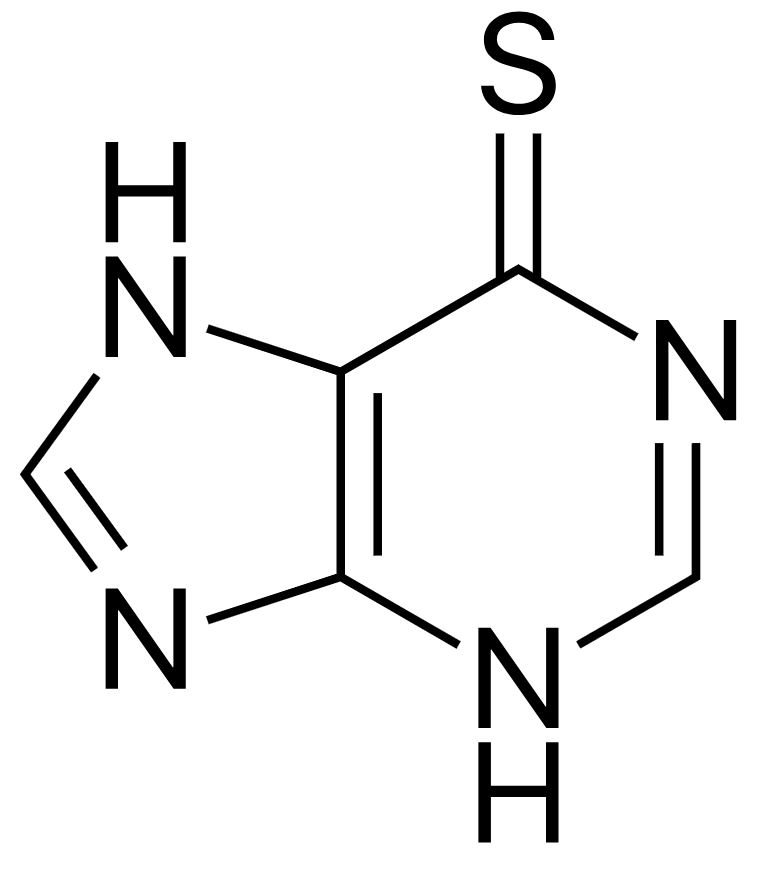
Estrutura da 6-mercaptopurina

Estrutura da 6-mercaptopurina

Imagem: “Mercaptopurine” by Fvasconcellos. Licença: Public Domain
6-Tioguanina

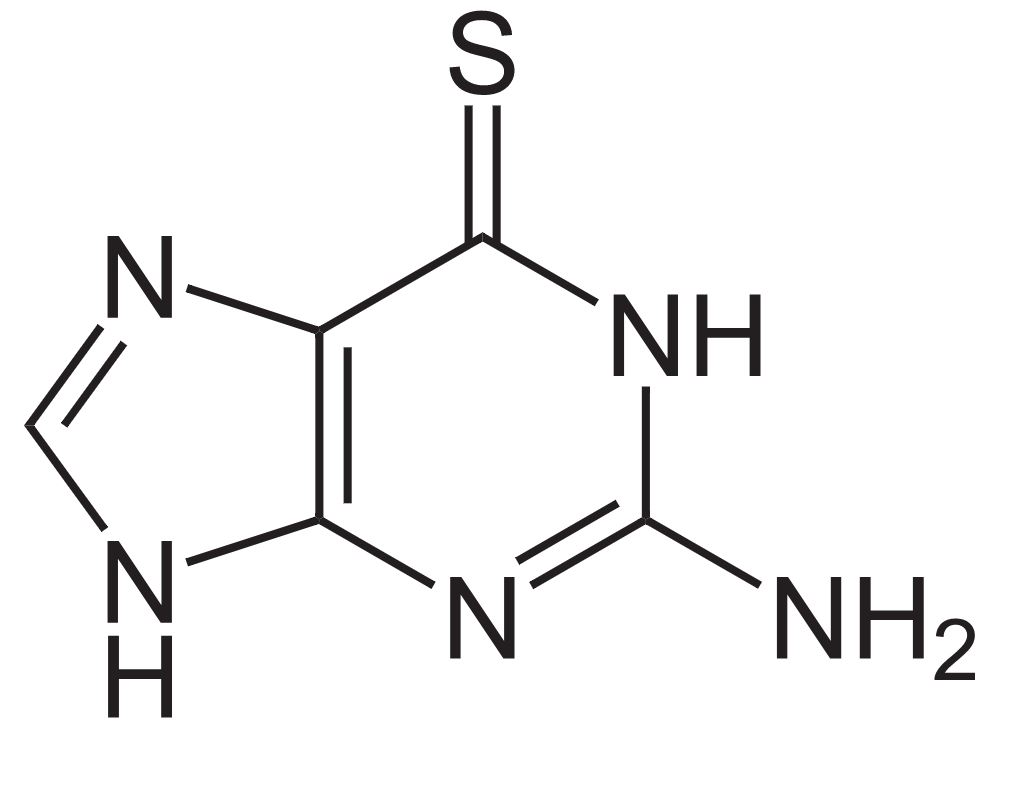
  • Mecanismo de ação:
    • Análogo de guanina
    • Incorpora-se no DNA DNA A deoxyribonucleotide polymer that is the primary genetic material of all cells. Eukaryotic and prokaryotic organisms normally contain DNA in a double-stranded state, yet several important biological processes transiently involve single-stranded regions. DNA, which consists of a polysugar-phosphate backbone possessing projections of purines (adenine and guanine) and pyrimidines (thymine and cytosine), forms a double helix that is held together by hydrogen bonds between these purines and pyrimidines (adenine to thymine and guanine to cytosine). DNA Types and Structure e no RNA RNA A polynucleotide consisting essentially of chains with a repeating backbone of phosphate and ribose units to which nitrogenous bases are attached. RNA is unique among biological macromolecules in that it can encode genetic information, serve as an abundant structural component of cells, and also possesses catalytic activity. RNA Types and Structure → inibe a síntese de nucleótidos de purina
  • Farmacodinâmica:
    • Absorção: cerca de 30% (variável)
    • Distribuição: não atinge níveis significativos no LCR
    • Metabolismo: hepático pela TPMT
    • Excreção: renal
  • Indicação: LMA
  • Efeitos adversos:
    • Supressão de medula óssea
    • Hepatotoxicidade
    • Malignidade secundária
    • Síndrome de lise tumoral
    • Fotossensibilidade
  • Precauções: considerar testagem para deficiência de TPMT e de NUDT15: ↑ risco de toxicidade grave
  • Contraindicações: hipersensibilidade a 6-tioguanina
  • Considerações sobre a gravidez: com base na ação do fármaco e em estudos com animais, pode causar danos fetais
  • Interações medicamentosas:
    • Vacinas inativadas: ↓ eficácia das vacinas
    • Vacinas vivas: ↑ efeitos tóxicos das vacinas
Estrutura de 6-tioguanina

Estrutura de 6-tioguanina

Imagem: “6-Thioguanin” by NEUROtiker. Licença: Public Domain
Fludarabina

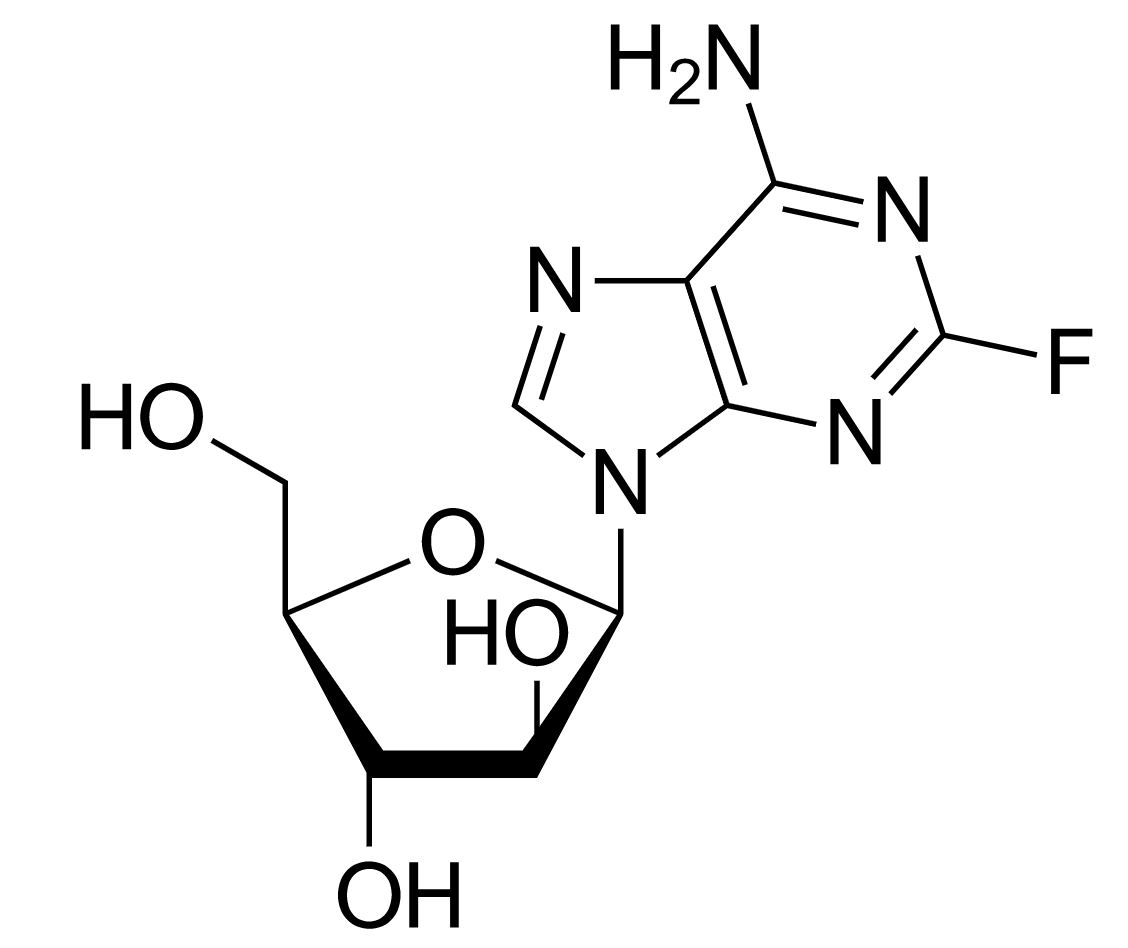
  • Mecanismo de ação:
    • Desfosforilada no plasma Plasma The residual portion of blood that is left after removal of blood cells by centrifugation without prior blood coagulation. Transfusion Products → entra nas células → refosforilada no trifosfato ativo
    • Inibe a DNA DNA A deoxyribonucleotide polymer that is the primary genetic material of all cells. Eukaryotic and prokaryotic organisms normally contain DNA in a double-stranded state, yet several important biological processes transiently involve single-stranded regions. DNA, which consists of a polysugar-phosphate backbone possessing projections of purines (adenine and guanine) and pyrimidines (thymine and cytosine), forms a double helix that is held together by hydrogen bonds between these purines and pyrimidines (adenine to thymine and guanine to cytosine). DNA Types and Structure polimerase, a ribonucleótido redutase, a DNA DNA A deoxyribonucleotide polymer that is the primary genetic material of all cells. Eukaryotic and prokaryotic organisms normally contain DNA in a double-stranded state, yet several important biological processes transiently involve single-stranded regions. DNA, which consists of a polysugar-phosphate backbone possessing projections of purines (adenine and guanine) and pyrimidines (thymine and cytosine), forms a double helix that is held together by hydrogen bonds between these purines and pyrimidines (adenine to thymine and guanine to cytosine). DNA Types and Structure primase e a DNA DNA A deoxyribonucleotide polymer that is the primary genetic material of all cells. Eukaryotic and prokaryotic organisms normally contain DNA in a double-stranded state, yet several important biological processes transiently involve single-stranded regions. DNA, which consists of a polysugar-phosphate backbone possessing projections of purines (adenine and guanine) and pyrimidines (thymine and cytosine), forms a double helix that is held together by hydrogen bonds between these purines and pyrimidines (adenine to thymine and guanine to cytosine). DNA Types and Structure ligase I
    • Quando incorporada no DNA DNA A deoxyribonucleotide polymer that is the primary genetic material of all cells. Eukaryotic and prokaryotic organisms normally contain DNA in a double-stranded state, yet several important biological processes transiently involve single-stranded regions. DNA, which consists of a polysugar-phosphate backbone possessing projections of purines (adenine and guanine) and pyrimidines (thymine and cytosine), forms a double helix that is held together by hydrogen bonds between these purines and pyrimidines (adenine to thymine and guanine to cytosine). DNA Types and Structure → terminação da cadeia
    • Quando incorporada no RNA RNA A polynucleotide consisting essentially of chains with a repeating backbone of phosphate and ribose units to which nitrogenous bases are attached. RNA is unique among biological macromolecules in that it can encode genetic information, serve as an abundant structural component of cells, and also possesses catalytic activity. RNA Types and Structure → inibição do processamento e tradução de RNA RNA A polynucleotide consisting essentially of chains with a repeating backbone of phosphate and ribose units to which nitrogenous bases are attached. RNA is unique among biological macromolecules in that it can encode genetic information, serve as an abundant structural component of cells, and also possesses catalytic activity. RNA Types and Structure
  • Farmacocinética:
    • Absorção: oral e IV
    • Distribuição: pico de concentração no plasma Plasma The residual portion of blood that is left after removal of blood cells by centrifugation without prior blood coagulation. Transfusion Products dentro de 1,5 horas (com administração oral)
    • Metabolismo: desfosforilada no plasma Plasma The residual portion of blood that is left after removal of blood cells by centrifugation without prior blood coagulation. Transfusion Products ao seu metabolito ativo, que entra nas células
    • Excreção: renal
  • Indicações: LLC
  • Efeitos adversos:
    • Supressão de medula óssea
    • Autoimunidade
    • Neurotoxicidade (confusão, agitação, coma Coma Coma is defined as a deep state of unarousable unresponsiveness, characterized by a score of 3 points on the GCS. A comatose state can be caused by a multitude of conditions, making the precise epidemiology and prognosis of coma difficult to determine. Coma, convulsões)
    • Edema Edema Edema is a condition in which excess serous fluid accumulates in the body cavity or interstitial space of connective tissues. Edema is a symptom observed in several medical conditions. It can be categorized into 2 types, namely, peripheral (in the extremities) and internal (in an organ or body cavity). Edema
    • Infeções
    • Diarreia, náuseas, vómitos
    • Síndrome de lise tumoral
  • Precauções: ajuste da dose em insuficiência renal
  • Contraindicações:
    • Hipersensibilidade à fludarabina
    • Coadministração com pentostatina → toxicidade pulmonar grave
  • Considerações sobre a gravidez: com base na ação do fármaco e em estudos com animais, pode causar danos fetais
  • Interações medicamentosas:
    • Pentostatina: toxicidade pulmonar
    • Vacinas inativadas: ↓ eficácia das vacinas
    • Vacinas vivas: ↑ efeitos tóxicos das vacinas
Estrutura da fludarabina

Estrutura da fludarabina

Imagem: “Fludarabine” by Yikrazuul. Licença: Public Domain
Cladribina

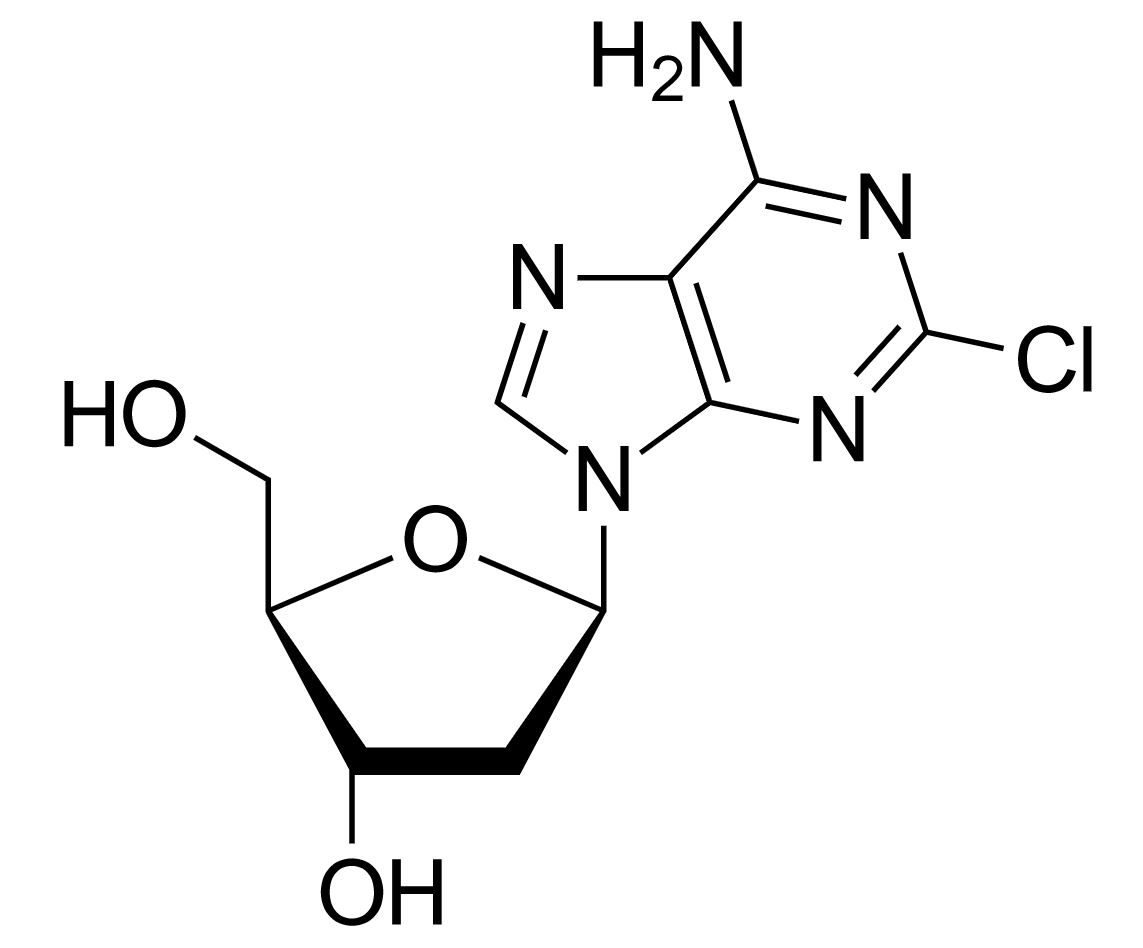
  • Mecanismo de ação:
    • Análogo nucleósido de purina
    • Pró-fármaco que é convertido em cladribina adenosina trifosfato (Cd-ATP).
    • Incorpora-se no DNA DNA A deoxyribonucleotide polymer that is the primary genetic material of all cells. Eukaryotic and prokaryotic organisms normally contain DNA in a double-stranded state, yet several important biological processes transiently involve single-stranded regions. DNA, which consists of a polysugar-phosphate backbone possessing projections of purines (adenine and guanine) and pyrimidines (thymine and cytosine), forms a double helix that is held together by hydrogen bonds between these purines and pyrimidines (adenine to thymine and guanine to cytosine). DNA Types and Structure → A cadeia de DNA DNA A deoxyribonucleotide polymer that is the primary genetic material of all cells. Eukaryotic and prokaryotic organisms normally contain DNA in a double-stranded state, yet several important biological processes transiently involve single-stranded regions. DNA, which consists of a polysugar-phosphate backbone possessing projections of purines (adenine and guanine) and pyrimidines (thymine and cytosine), forms a double helix that is held together by hydrogen bonds between these purines and pyrimidines (adenine to thymine and guanine to cytosine). DNA Types and Structure quebra → inibição da síntese e da reparação de DNA DNA A deoxyribonucleotide polymer that is the primary genetic material of all cells. Eukaryotic and prokaryotic organisms normally contain DNA in a double-stranded state, yet several important biological processes transiently involve single-stranded regions. DNA, which consists of a polysugar-phosphate backbone possessing projections of purines (adenine and guanine) and pyrimidines (thymine and cytosine), forms a double helix that is held together by hydrogen bonds between these purines and pyrimidines (adenine to thymine and guanine to cytosine). DNA Types and Structure
  • Farmacocinética:
    • Absorção:
      • Administrado por via oral e IV
      • Administração oral atrasada por alimentos
    • Distribuição:
      • 20% ligado a proteínas
      • Penetra no LCR
    • Metabolismo: pró-fármaco (cinases intracelulares fosforilam o fármaco)
    • Excreção: renal
  • Indicações (rotuladas):
    • Leucemia de células cabeludas
    • LMA
  • Efeitos adversos:
    • Mielossupressão
    • Distúrbios GI
    • Hepatotoxicidade
    • Malignidade secundária
    • Infeções oportunistas
    • Síndrome de lise tumoral
    • Toxicidade renal
    • Neurotoxicidade
  • Precauções: ajuste da dose em insuficiência renal e hepática
  • Contraindicações:
    • Hipersensibilidade à cladribina
    • Gravidez (teratogénica)
  • Interações medicamentosas:
    • Vacinas inativadas: ↓ eficácia das vacinas
    • Vacinas vivas: ↑ efeitos tóxicos das vacinas
Estrutura do cladribina

Estrutura do cladribina

Imagem: “Cladribine” by Yikrazuul. Licença: Public Domain
Pentostatina

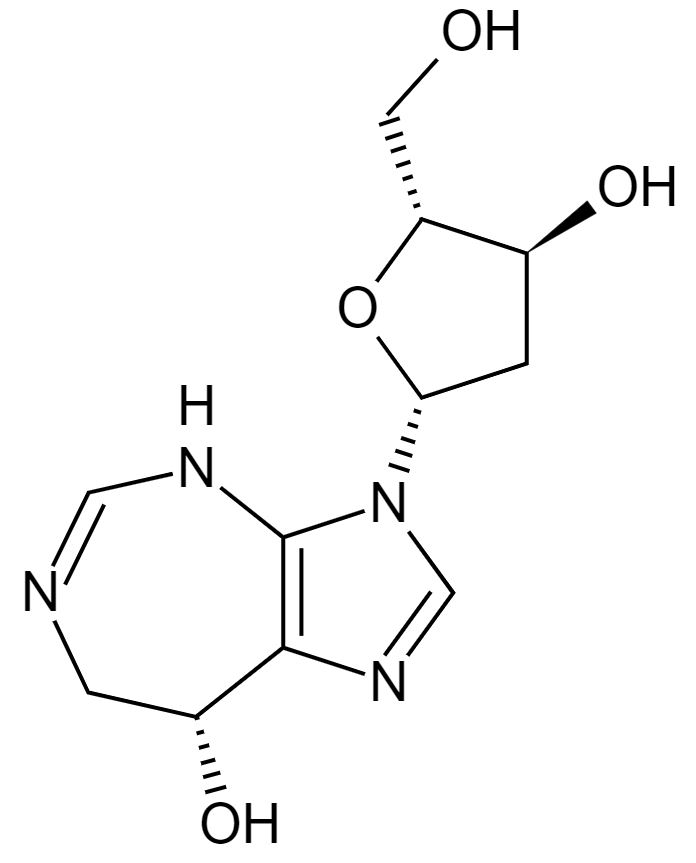
  • 2′-desoxicoformicina
  • Analógico do intermediário na reação da adenosina desaminase ( ADA ADA An enzyme that catalyzes the hydrolysis of adenosine to inosine with the elimination of ammonia. Purine and Pyrimidine Metabolism)
  • Mecanismo de ação:
    • Inibe a ADA ADA An enzyme that catalyzes the hydrolysis of adenosine to inosine with the elimination of ammonia. Purine and Pyrimidine Metabolism → adenosina não desaminada a inosina
    • Efeitos: ↑ adenosina intracelular e nucleótidos desoxiadenosina → bloqueiam a síntese de DNA DNA A deoxyribonucleotide polymer that is the primary genetic material of all cells. Eukaryotic and prokaryotic organisms normally contain DNA in a double-stranded state, yet several important biological processes transiently involve single-stranded regions. DNA, which consists of a polysugar-phosphate backbone possessing projections of purines (adenine and guanine) and pyrimidines (thymine and cytosine), forms a double helix that is held together by hydrogen bonds between these purines and pyrimidines (adenine to thymine and guanine to cytosine). DNA Types and Structure
  • Farmacodinâmica:
    • Absorção: administração via IV
    • Distribuição: cerca de 4% ligado a proteínas
    • Metabolismo e excreção: eliminados pelos rins
  • Indicação: leucemia de células cabeludas
  • Efeitos adversos:
    • Mielossupressão
    • Neurotoxicidade
    • Hepatotoxicidade
    • Toxicidade dermatológica (erupções cutâneas graves)
    • Toxicidade pulmonar
    • Toxicidade renal
    • Infeções agravantes
  • Contraindicações:
    • Hipersensibilidade à pentostatina
    • Coadministração com fludarabina → toxicidade pulmonar grave
  • Considerações sobre a gravidez: com base na ação do fármaco e em estudos com animais, pode causar danos fetais
  • Interações medicamentosas:
    • Fludarabina: toxicidade pulmonar
    • Vacinas inativadas: ↓ eficácia das vacinas
    • Vacinas vivas: ↑ efeitos tóxicos das vacinas
Estrutura da pentostatina

Estrutura da pentostatina

Imagem: “Pentostatin” by Fvasconcellos. Licença: Public Domain

Comparação de análogos de purina

Tabela: Comparação de análogos de purina
Agente Mecanismo de ação Indicações rotuladas Efeitos adversos Considerações adicionais
6-MP 6-MP An antimetabolite antineoplastic agent with immunosuppressant properties. It interferes with nucleic acid synthesis by inhibiting purine metabolism and is used, usually in combination with other drugs, in the treatment of or in remission maintenance programs for leukemia. Antimetabolite Chemotherapy Antagonista de purinas (inibe a síntese de nucleótidos de purina) Leucemia Linfoblástica Aguda (LLA)
  • Mielossupressão
  • Imunossupressão
  • Hepatotoxicidade
  • Malignidade secundária
  • Fotossensibilidade
  • SAM SAM Anterior displacement of the mitral valve during systole. Hypertrophic Cardiomyopathy
  • ↓ Efeito da varfarina
↓ Dose se estiver a tomar alopurinol
6-TG 6-TG An antineoplastic compound which also has antimetabolite action. The drug is used in the therapy of acute leukemia. Antimetabolite Chemotherapy Antagonista de purinas LMA
  • Mielossupressão
  • Hepatotoxicidade
  • Fotossensibilidade
  • Malignidade secundária
  • Síndrome de lise tumoral
Fludarabina Inibe:
  • DNA DNA A deoxyribonucleotide polymer that is the primary genetic material of all cells. Eukaryotic and prokaryotic organisms normally contain DNA in a double-stranded state, yet several important biological processes transiently involve single-stranded regions. DNA, which consists of a polysugar-phosphate backbone possessing projections of purines (adenine and guanine) and pyrimidines (thymine and cytosine), forms a double helix that is held together by hydrogen bonds between these purines and pyrimidines (adenine to thymine and guanine to cytosine). DNA Types and Structure polimerase
  • Ribonucleótido redutase
  • DNA DNA A deoxyribonucleotide polymer that is the primary genetic material of all cells. Eukaryotic and prokaryotic organisms normally contain DNA in a double-stranded state, yet several important biological processes transiently involve single-stranded regions. DNA, which consists of a polysugar-phosphate backbone possessing projections of purines (adenine and guanine) and pyrimidines (thymine and cytosine), forms a double helix that is held together by hydrogen bonds between these purines and pyrimidines (adenine to thymine and guanine to cytosine). DNA Types and Structure primase
  • DNA DNA A deoxyribonucleotide polymer that is the primary genetic material of all cells. Eukaryotic and prokaryotic organisms normally contain DNA in a double-stranded state, yet several important biological processes transiently involve single-stranded regions. DNA, which consists of a polysugar-phosphate backbone possessing projections of purines (adenine and guanine) and pyrimidines (thymine and cytosine), forms a double helix that is held together by hydrogen bonds between these purines and pyrimidines (adenine to thymine and guanine to cytosine). DNA Types and Structure ligase I
LLC
  • Mielossupressão
  • Autoimunidade
  • Infeções
  • Neurotoxicidade
Evitar pentostatina (↑ toxicidade pulmonar)
Cladribina Inibe:
  • Síntese de DNA DNA A deoxyribonucleotide polymer that is the primary genetic material of all cells. Eukaryotic and prokaryotic organisms normally contain DNA in a double-stranded state, yet several important biological processes transiently involve single-stranded regions. DNA, which consists of a polysugar-phosphate backbone possessing projections of purines (adenine and guanine) and pyrimidines (thymine and cytosine), forms a double helix that is held together by hydrogen bonds between these purines and pyrimidines (adenine to thymine and guanine to cytosine). DNA Types and Structure (produzindo quebras nas cadeias de DNA DNA A deoxyribonucleotide polymer that is the primary genetic material of all cells. Eukaryotic and prokaryotic organisms normally contain DNA in a double-stranded state, yet several important biological processes transiently involve single-stranded regions. DNA, which consists of a polysugar-phosphate backbone possessing projections of purines (adenine and guanine) and pyrimidines (thymine and cytosine), forms a double helix that is held together by hydrogen bonds between these purines and pyrimidines (adenine to thymine and guanine to cytosine). DNA Types and Structure)
  • Ribonucleótido redutase
Leucemia das células cabeludas
  • Mielossupressão
  • Cardiotoxicidade
  • Hepatotoxicidade
  • Neurotoxicidade
  • Nefrotoxicidade
  • Síndrome de lise tumoral
  • Infeções
  • Malignidade secundária
Pentostatina Inibe a adenosina desaminase (↓ síntese de ADN) Leucemia das células cabeludas
  • Mielossupressão
  • Neurotoxicidade
  • Toxicidade pulmonar
  • Toxicidade renal
  • Toxicidade dermatológica
  • Hepatotoxicidade
  • Infeções
Evitar fludarabina (↑ toxicidade pulmonar)
SAM: síndrome de ativação macrofágica
6-TG: 6-tioguanina

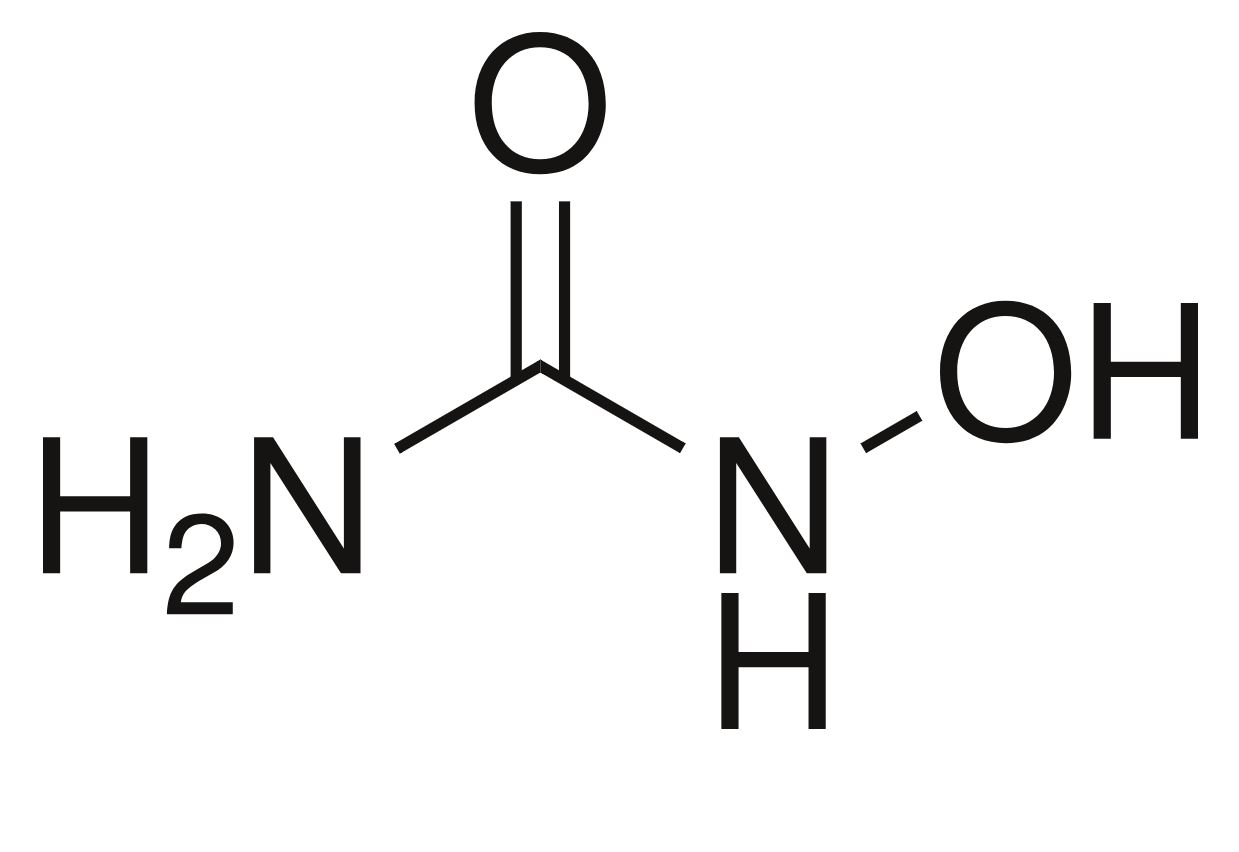
Hidroxiureia

  • Também conhecida como hidroxicarbamida
  • Análogo hidroxilado da ureia
  • Usado para tratar tumores sólidos e doenças mieloproliferativas
  • Mecanismo de ação:
    • Inibição da enzima ribonucleótido redutase ( RR RR Relative risk (RR) is the risk of a disease or condition occurring in a group or population with a particular exposure relative to a control (unexposed) group. Measures of Risk)
    • A RR RR Relative risk (RR) is the risk of a disease or condition occurring in a group or population with a particular exposure relative to a control (unexposed) group. Measures of Risk medeia a conversão de ribonucleótidos a desoxirribonucleótidos (precursores de DNA DNA A deoxyribonucleotide polymer that is the primary genetic material of all cells. Eukaryotic and prokaryotic organisms normally contain DNA in a double-stranded state, yet several important biological processes transiently involve single-stranded regions. DNA, which consists of a polysugar-phosphate backbone possessing projections of purines (adenine and guanine) and pyrimidines (thymine and cytosine), forms a double helix that is held together by hydrogen bonds between these purines and pyrimidines (adenine to thymine and guanine to cytosine). DNA Types and Structure)
    • ↓ Produção de desoxirribonucleótidos → ↓ Síntese de DNA DNA A deoxyribonucleotide polymer that is the primary genetic material of all cells. Eukaryotic and prokaryotic organisms normally contain DNA in a double-stranded state, yet several important biological processes transiently involve single-stranded regions. DNA, which consists of a polysugar-phosphate backbone possessing projections of purines (adenine and guanine) and pyrimidines (thymine and cytosine), forms a double helix that is held together by hydrogen bonds between these purines and pyrimidines (adenine to thymine and guanine to cytosine). DNA Types and Structure e replicação do ciclo celular
    • Efeito citotóxico específico da fase S nas células
  • Farmacocinética:
    • Absorção: administração oral, absorvida rapidamente
    • Distribuição: ampla distribuição (incluindo o cérebro)
    • Metabolismo: fígado (60%), trato GI
    • Excreção: renal
  • Indicações (rotuladas):
    • LMC
    • Indicação não cancerígena: anemia Anemia Anemia is a condition in which individuals have low Hb levels, which can arise from various causes. Anemia is accompanied by a reduced number of RBCs and may manifest with fatigue, shortness of breath, pallor, and weakness. Subtypes are classified by the size of RBCs, chronicity, and etiology. Anemia: Overview and Types falciforme
  • Efeitos adversos:
    • Mielossupressão
    • Malignidade secundária
    • Toxicidade cutânea vasculítica (ulcerações e gangrena)
    • Toxicidade pulmonar
    • Anemia Anemia Anemia is a condition in which individuals have low Hb levels, which can arise from various causes. Anemia is accompanied by a reduced number of RBCs and may manifest with fatigue, shortness of breath, pallor, and weakness. Subtypes are classified by the size of RBCs, chronicity, and etiology. Anemia: Overview and Types hemolítica
    • Macrocitose
    • Infeções bacterianas e virais
    • Mucosite, náusea
  • Contraindicações:
    • Hipersensibilidade à hidroxiureia
    • Mielossupressão grave
    • Gravidez (potencialmente teratogénica)
  • Interações medicamentosas:
    • Fármacos antirretrovirais (didanosina e estavudina): pancreatite, neuropatia periférica, hepatotoxicidade
    • Vacinas inativadas: ↓ eficácia das vacinas
    • Vacinas vivas: ↑ efeitos tóxicos das vacinas
Estrutura da hidroxiureia

Estrutura da hidroxiureia

Imagem: “Hydroxyurea-2D-skeletal” by Chem Sim 2001. Licença: Public Domain

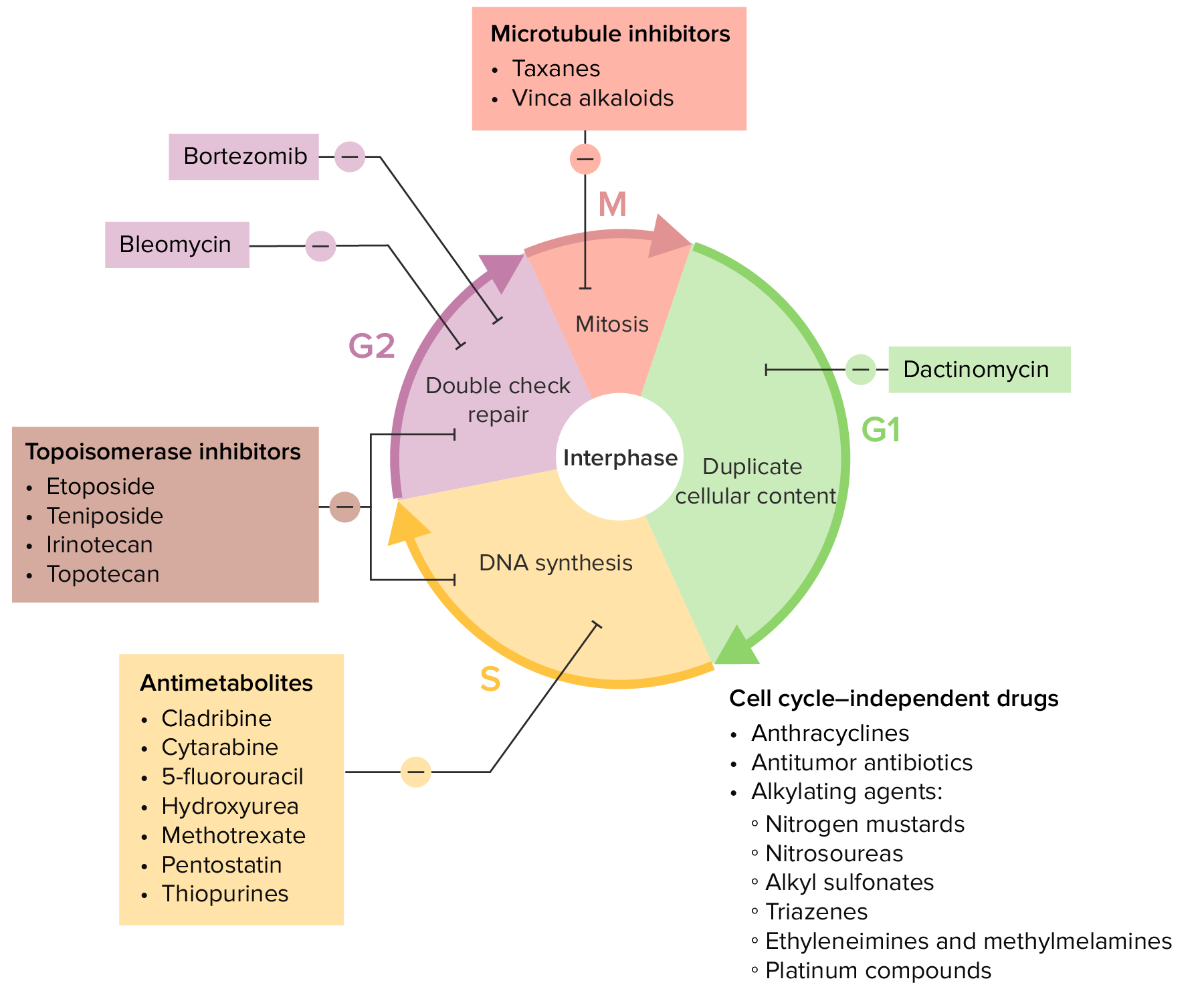
Comparação com Outros Agentes Quimioterápicos

Tabela: Comparação dos fármacos de quimioterapia dependentes do ciclo celular
Classe do fármaco Fase do ciclo celular afetada Mecanismo de ação
Antifolatos Paragem do ciclo celular na fase S Inibem:
  • Dihidrofolato redutase
  • Timidilato sintase
Fluoropirimidinas Paragem do ciclo celular na fase S Inibem a timidilato sintetase
Análogos de desoxicitidina Paragem do ciclo celular na fase S Inibem:
  • DNA DNA A deoxyribonucleotide polymer that is the primary genetic material of all cells. Eukaryotic and prokaryotic organisms normally contain DNA in a double-stranded state, yet several important biological processes transiently involve single-stranded regions. DNA, which consists of a polysugar-phosphate backbone possessing projections of purines (adenine and guanine) and pyrimidines (thymine and cytosine), forms a double helix that is held together by hydrogen bonds between these purines and pyrimidines (adenine to thymine and guanine to cytosine). DNA Types and Structure polimerase
  • Ribonucleótido redutase
Análogos de purina Paragem do ciclo celular na fase S Inibição da síntese de novo de purinas
Inibidores da topoisomerase II Topoisomerase II DNA topoisomerases that catalyze ATP-dependent breakage of both strands of DNA, passage of the unbroken strands through the breaks, and rejoining of the broken strands. These enzymes bring about relaxation of the supercoiled DNA and resolution of a knotted circular DNA duplex. Fluoroquinolones Paragem do ciclo celular nas fases S e G2 Inibem a topoisomerase II Topoisomerase II DNA topoisomerases that catalyze ATP-dependent breakage of both strands of DNA, passage of the unbroken strands through the breaks, and rejoining of the broken strands. These enzymes bring about relaxation of the supercoiled DNA and resolution of a knotted circular DNA duplex. Fluoroquinolones
Taxanos Paragem do ciclo celular na metáfase da fase M Hiperestabilização de microtúbulos
Alcalóides da vinca Paragem celular durante a metáfase da fase M Liga-se à beta-tubulina e previne a polimerização de microtúbulos
Chemotherapy comparison

Vários fármacos de quimioterapia e os seus efeitos sobre o ciclo celular

Imagem por Lecturio.

Referências

  1. Katzung, B.G., Kruidering-Hall, M., Tuan, R., Vanderah, T.W., Trevor, A.J. (2021). Cancer chemotherapy. Chapter 54 of Katzung & Trevor’s Pharmacology: Examination & Board Review, 13th ed. McGraw-Hill. https://accessmedicine.mhmedical.com/content.aspx?bookid=3058&sectionid=255307933
  2. Parker, W. B. (2009). Enzymology of purine and pyrimidine antimetabolites used in the treatment of cancer. Chemical Reviews 109:2880–2893. https://doi.org/10.1021/cr900028p
  3. UpToDate. (2025). Methotrexate. UpToDate. Retrieved October 17, 2025, from https://www.uptodate.com/contents/methotrexate-drug-information
  4. UpToDate. (2025). Pemetrexed. UpToDate. Retrieved October 17, 2025, from https://www.uptodate.com/contents/pemetrexed-drug-information
  5. UpToDate. (2025). Thioguanine. UpToDate. Retrieved October 17, 2025, from https://www.uptodate.com/contents/thioguanine-drug-information
  6. UpToDate. (2025). Mercaptopurine. UpToDate. Retrieved October 17, 2025, from https://www.uptodate.com/contents/mercaptopurine-drug-information
  7. UpToDate, Inc. (2025). Hydroxyurea. UpToDate. Retrieved October 17, 2025, from https://www.uptodate.com/contents/hydroxyurea-hydroxycarbamide-drug-information
  8. UpToDate. (2025). Cytarabine. UpToDate. Retrieved October 17, 2025, from https://www.uptodate.com/contents/cytarabine-conventional-drug-information
  9. UpToDate. (2025). Gemcitabine. UpToDate. Retrieved October 17, 2025, from https://www.uptodate.com/contents/gemcitabine-drug-information
  10. UpToDate. (2025). Capecitabine. UpToDate. Retrieved October 17, 2025, from https://www.uptodate.com/contents/capecitabine-drug-information
  11. UpToDate. (2025). Pralatrexate. UpToDate. Retrieved October 17, 2025, from https://www.uptodate.com/contents/pemetrexed-drug-information
  12. UpToDate. (2025). Fluorouracil. UpToDate. Retrieved October 17, 2025, from https://www.uptodate.com/contents/fluorouracil-systemic-drug-information
  13. UpToDate. (2025). Pentostatin. UpToDate. Retrieved October 17, 2025, from https://www.uptodate.com/contents/pentostatin-drug-information
  14. Wellstein, A., Giaccone, G., Atkins, M.B., Sausville, E.A. (2017). Cytotoxic drugs. Chapter 66 of Brunton, L.L., Hilal-Dandan, R., Knollmann, B.C. (Eds.), Goodman & Gilman’s: The Pharmacological Basis of Therapeutics, 13th ed. McGraw-Hill. https://accessmedicine.mhmedical.com/content.aspx?bookid=2189&sectionid=172486857

Crie sua conta gratuita ou faça login para continuar lendo!

Cadastre-se agora e tenha acesso grátis ao Lecturio, com páginas de conceitos, vídeos de medicina e questões para sua educação médica.

Aprende mais com a Lecturio:

Multiple devices displaying human anatomy and health education content.

Complementa o teu estudo da faculdade com o companheiro de estudo tudo-em-um da Lecturio, através de métodos de ensino baseados em evidência.

Estuda onde quiseres

Two iPhones display medical education apps, one showing anatomy, the other Bookmatcher.

A Lecturio Medical complementa o teu estudo através de métodos de ensino baseados em evidência, vídeos de palestras, perguntas e muito mais – tudo combinado num só lugar e fácil de usar.

User Reviews

Have a holly, jolly study session 🎁 Save 50% on all plans now >>

Que tengas una sesión de estudio alegre y navideña 🎁 Ahorra 50% en todos los planes >>

Details