

Tip: Age is often crucial information about the client you are dealing with in the question scenario.
A school-age client could be around 6–12 years of age. The information about the client’s symptoms comes from the parent, an adult, so we can assume here that the information is trustworthy. With the suspicion of pneumonia, further assessment would be done, and depending on the findings, pneumonia could be confirmed in this child.
The question then gives us a selection of assessment findings. The task is to select those findings that are consistent with pneumonia in a school-age child.
Pneumonia is a common infection in the lungs that can be caused by various bacteria, viruses, or fungi. Its severity can vary from mild to life-threatening.
Symptoms include:
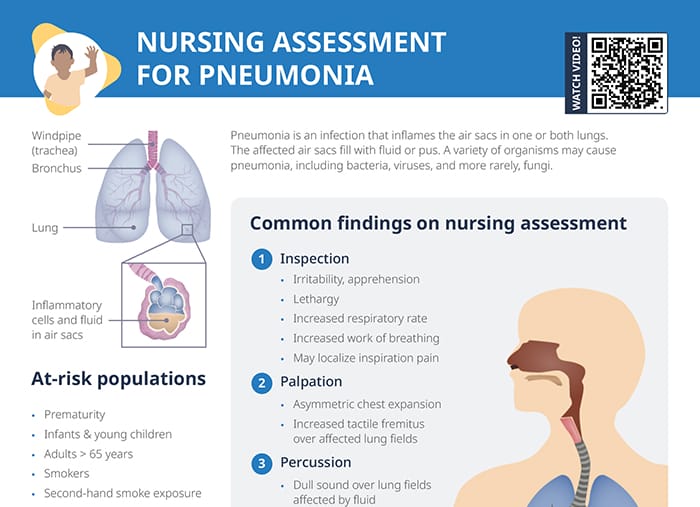
Pneumonia risk factors, signs/symptoms and common assessment findings in pediatric clients with suspected pneumonia.
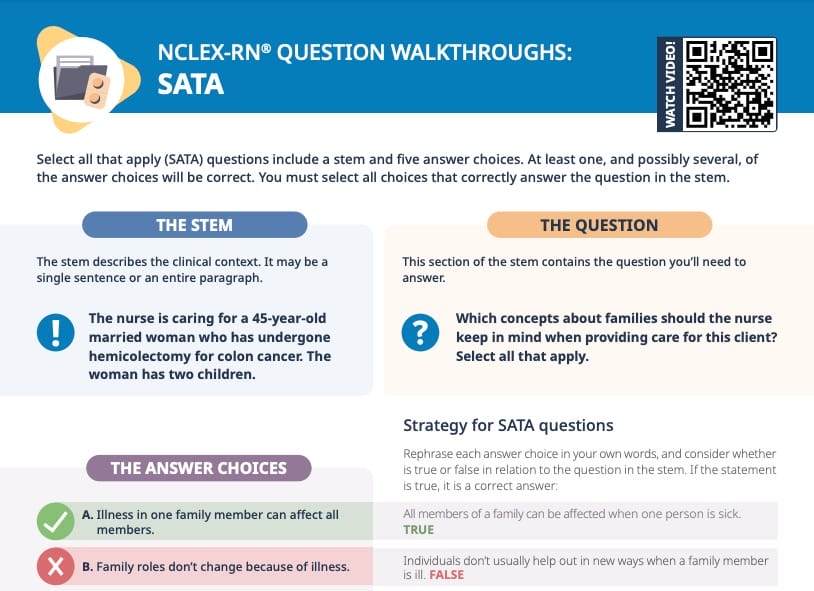
Tip: When under stress in an exam situation, it can seem tedious to keep repeating the original question for each answer choice, and it can be tempting to compare the answers and try to find tricks or shortcuts. For Select-all-that-apply questions, this is not helpful – take the time to ask the question separately for each answer choice: Is this finding consistent with pneumonia in a school-age child, yes or no?
Tip: A common mistake is to forget halfway through what your question actually is: It’s easy to get confused and, at first, look for answers consistent with pneumonia, but halfway through choose answers that are inconsistent with pneumonia. Repeating the original question literally and consistently for each answer choice makes sure you don’t get it switched around.
Tip: When you look at any number in an NCLEX question, categorize it: Is this a high, normal, or low value?
Especially for pediatric values, information can be inconsistent between sources – but don’t worry too much: On the NCLEX, it will be made clear what is wrong with a client and these disagreements between sources will not be what makes your answer wrong in the end. So, is this value high, low, or normal? A respiratory rate of 19 is a normal value for breaths per minute. If a child has pneumonia, you would expect them to not be able to oxygenate very well, resulting in an elevated respiratory rate. If they are very worn out, they may breathe slower than normal. In any case, we’d expect a client with pneumonia to be outside the normal range here and a normal value of 19 is not an indication for pneumonia. → does not apply.
Is this value high, low, or normal?
A temperature this high indicates a fever.
Does this finding indicate pneumonia, or not?
Pneumonia is an infection, so a fever would be an expected reaction of the body to try and fight it off. So, elevated temperature is consistent with pneumonia in a school-age child. → applies.
Having pain in the chest is common for patients with pneumonia, so this finding is consistent with the diagnosis. → applies.
Not every child with pneumonia will have intercostal retractions. They are a sign that the child is getting really tired and when pneumonia worsens, this can be a result.
Tip: With more severe symptoms like this, it is easy to get distracted and start thinking about all the specific things this client would need. They are not the topic of this question! Focus on the basic question: Is this symptom consistent with pneumonia? Would pneumonia be the reason why the child is experiencing this?
For someone with pneumonia, it would be consistent to have intercostal retractions. → applies.
An infection in the lungs will cause coughing with mucus. The airway is irritated and the mucus production tries to rid the body of the infection. → applies.
Remember: For multiple-response questions, any number between 1 and all of the choices can be correct. When you get your five answer choices in a select-all-that-apply question, you really have five individual questions: You ask “Does this apply?” for each individual one.