

Nursing Knowledge
Central lines are intravenous lines that are inserted into large, central veins that lead to the heart, typically in the neck (jugular), chest (subclavian), or groin (femoral).
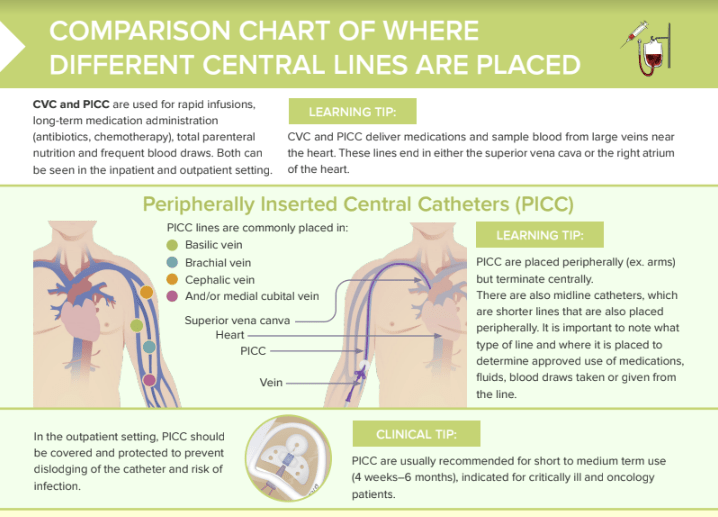
They are used for rapid infusions, long-term medication administration (antibiotics, chemotherapy), total parenteral nutrition and frequent blood draws. They can be seen in the inpatient and outpatient setting.
There are two types: peripherally inserted central catheters (PICC) and central venous catheters (CVC). Both deliver medications and sample blood from large veins near the heart. The lines end in either the superior vena cava or the right atrium of the heart.
PICC lines are commonly placed in:
CVC lines are commonly placed in:
Proper insertion technique, line maintenance, and prompt removal when no longer needed can mitigate these risks. Always monitor your clients closely for signs of complications.
A PICC line (peripherally inserted central catheter) is a long, thin tube that’s inserted through a vein in the arm and passed through to the larger veins near the heart. It’s used to deliver medications, nutrients, fluids, or to draw blood. PICC are placed peripherally (ex. arms) but terminate centrally. There are also midline catheters, which are shorter lines that are also placed peripherally. It is important to note the type of line and where it is placed to determine approved use of medications, fluids, blood draws taken or given from the line.
In the outpatient setting, PICC should be covered and protected to prevent dislodging of the catheter and risk of infection.
PICC are usually recommended for short to medium term use (4 weeks–6 months), indicated for critically ill and oncology patients.
A CVC (central venous catheter) is a catheter placed into a large vein for administering medication or fluids or obtaining blood tests. It can provide a long-term solution for access to the central circulatory system, making it particularly useful for patients receiving treatments such as chemotherapy, long-term antibiotic therapy, dialysis, or parenteral nutrition.
Catheters in the chest can sometimes be attached to a port, which lies underneath the skin. A port, also known as a “port-a-cath” or simply “port,” is a small medical appliance that is installed beneath the skin. A catheter connects the port to a vein.
Both CVC and PICC lines provide access to a patient’s central venous system, but they differ in their placement and uses.
Table: Differences in location and usage between CVCs and PICC lines
| CVC | PICC | |
| Location | Large vein in neck, chest, or groin, with tip resting near the heart | Peripheral vein (upper arm), threaded into central vein (superior vena cava) |
| Usage | Acute settings to administer fluid/medication rapidly | Used for intermediate and long-term therapies like antibiotics or chemotherapy |
RELATED TOPIC:
Free Download
Master the topic with a unique study combination of a concise summary paired with video lectures.
Your free account gives you access to:
or