
Domina Conceptos Médicos

Estudia para la escuela de medicina y tus examenes con Lecturio.

Síndrome del Intestino Irritable

El síndrome del intestino irritable es una enfermedad intestinal funcional caracterizada por dolor Dolor Inflammation abdominal crónico y hábitos intestinales alterados sin una causa orgánica identificable. La etiología y la fisiopatología de esta enfermedad no se comprenden bien, y hay muchos factores que pueden contribuir. El síndrome del intestino irritable es un diagnóstico de exclusión y deben descartarse causas orgánicas. Una vez diagnosticado, el énfasis está en EN Erythema nodosum is an immune-mediated panniculitis (inflammation of the subcutaneous fat) caused by a type IV (delayed-type) hypersensitivity reaction. It commonly manifests in young women as tender, erythematous nodules on the shins. Erythema Nodosum educar y tranquilizar al AL Amyloidosis paciente. También se pueden instituir modificaciones dietéticas y medidas de control de síntomas, dependiendo del síntoma predominante.

Last updated: Dec 15, 2025

Editorial responsibility: Stanley Oiseth, Lindsay Jones, Evelin Maza

Epidemiología y Fisiopatología

Epidemiología

  • El inicio de los LOS Neisseria síntomas suele comenzar en EN Erythema nodosum is an immune-mediated panniculitis (inflammation of the subcutaneous fat) caused by a type IV (delayed-type) hypersensitivity reaction. It commonly manifests in young women as tender, erythematous nodules on the shins. Erythema Nodosum la adolescencia y la adultez temprana. Aproximadamente el 50% de los LOS Neisseria pacientes reportan síntomas antes de los LOS Neisseria 35 años.
  • 60%–70% de los LOS Neisseria casos son mujeres.
  • La prevalencia en EN Erythema nodosum is an immune-mediated panniculitis (inflammation of the subcutaneous fat) caused by a type IV (delayed-type) hypersensitivity reaction. It commonly manifests in young women as tender, erythematous nodules on the shins. Erythema Nodosum América del Norte es de 10%–15%.

Fisiopatología

Aunque no se ha HA Hemolytic anemia (HA) is the term given to a large group of anemias that are caused by the premature destruction/hemolysis of circulating red blood cells (RBCs). Hemolysis can occur within (intravascular hemolysis) or outside the blood vessels (extravascular hemolysis). Hemolytic Anemia identificado una causa orgánica específica, existen varios mecanismos patogénicos posibles.
  • Motilidad anormal:
    • ↑ Frecuencia de las contracciones luminales en EN Erythema nodosum is an immune-mediated panniculitis (inflammation of the subcutaneous fat) caused by a type IV (delayed-type) hypersensitivity reaction. It commonly manifests in young women as tender, erythematous nodules on the shins. Erythema Nodosum los LOS Neisseria intestinos
    • Irregularidad de las contracciones luminales
    • Tránsito lento → síndrome del intestino irritable con estreñimiento
    • ↑ Respuesta motora a colecistoquinina y comidas → síndrome del intestino irritable con diarrea
  • Hiperalgesia visceral:
    • Se ha HA Hemolytic anemia (HA) is the term given to a large group of anemias that are caused by the premature destruction/hemolysis of circulating red blood cells (RBCs). Hemolysis can occur within (intravascular hemolysis) or outside the blood vessels (extravascular hemolysis). Hemolytic Anemia hipotetizado que se debe a un ↑ en EN Erythema nodosum is an immune-mediated panniculitis (inflammation of the subcutaneous fat) caused by a type IV (delayed-type) hypersensitivity reaction. It commonly manifests in young women as tender, erythematous nodules on the shins. Erythema Nodosum la estimulación del receptor Receptor Receptors are proteins located either on the surface of or within a cell that can bind to signaling molecules known as ligands (e.g., hormones) and cause some type of response within the cell. Receptors en EN Erythema nodosum is an immune-mediated panniculitis (inflammation of the subcutaneous fat) caused by a type IV (delayed-type) hypersensitivity reaction. It commonly manifests in young women as tender, erythematous nodules on the shins. Erythema Nodosum la pared intestinal
    • ↑ Sensibilidad a la distensión abdominal y rectal
    • ↑ Sensibilidad a la inflamación y los LOS Neisseria gases
  • Inflamación intestinal:
    • Se han observado ↑ linfocitos y mastocitos en EN Erythema nodosum is an immune-mediated panniculitis (inflammation of the subcutaneous fat) caused by a type IV (delayed-type) hypersensitivity reaction. It commonly manifests in young women as tender, erythematous nodules on the shins. Erythema Nodosum el intestino → posible ↑ liberación de mediadores que estimulan el sistema nervioso entérico
  • Cambios postinfecciosos:
    • ↑ Linfocitos T y células enteroendocrinas → ↑ niveles de serotonina → ↑ motilidad y sensibilidad gastrointestinal
    • El uso de antibióticos también puede desempeñar un papel.
  • Alteraciones psicosociales:
    • > 50% de los LOS Neisseria pacientes con síndrome del intestino irritable tienen depresión subyacente, ansiedad o trastornos de somatización.
    • Estrés → puede ↑ actividad del factor liberador de corticotropina (mediador de la respuesta al AL Amyloidosis estrés) → ↑ dolor Dolor Inflammation abdominal y motilidad del colon Colon The large intestines constitute the last portion of the digestive system. The large intestine consists of the cecum, appendix, colon (with ascending, transverse, descending, and sigmoid segments), rectum, and anal canal. The primary function of the colon is to remove water and compact the stool prior to expulsion from the body via the rectum and anal canal. Colon, Cecum, and Appendix: Anatomy → ↑ síntomas del síndrome del intestino irritable
  • Otros factores que se están investigando:
    • Alteración de la flora fecal o crecimiento excesivo de bacterias en EN Erythema nodosum is an immune-mediated panniculitis (inflammation of the subcutaneous fat) caused by a type IV (delayed-type) hypersensitivity reaction. It commonly manifests in young women as tender, erythematous nodules on the shins. Erythema Nodosum el intestino delgado
    • Alergias alimentarias, malabsorción y sensibilidad
    • Genética
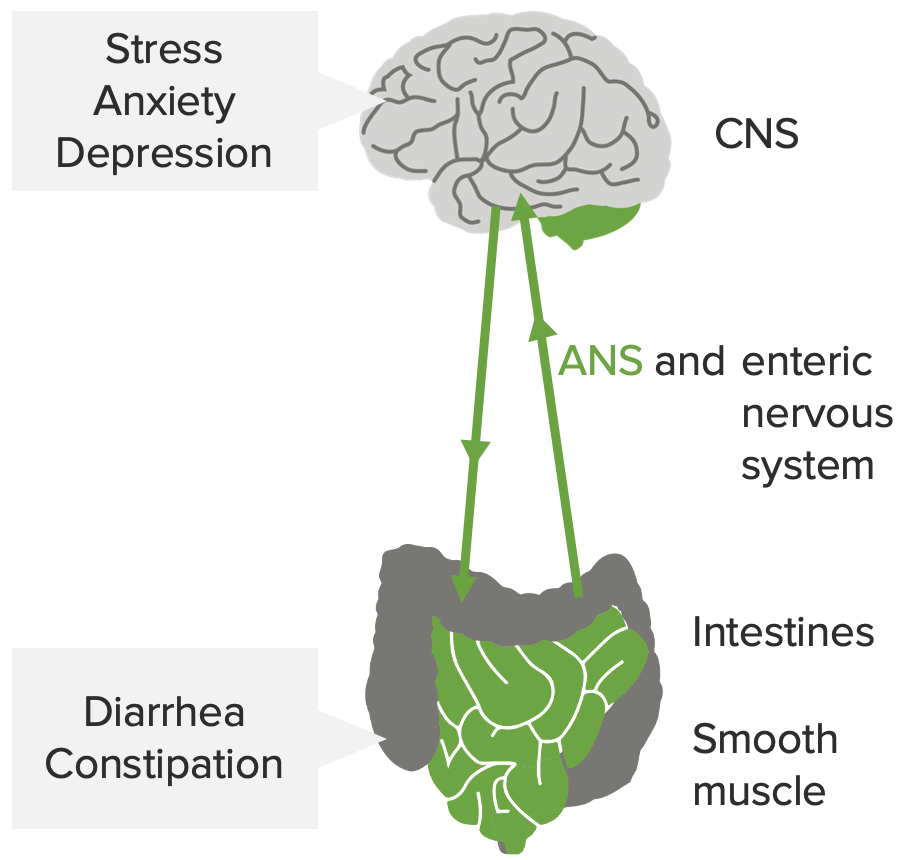
interacción mente-intestino que contribuye a la fisiopatología del SII

La interacción mente-intestino que contribuye a la fisiopatología del síndrome del intestino irritable: el estrés, la ansiedad y la depresión influyen en el sistema nervioso central (SNC), el sistema nervioso autónomo (SNA) y el sistema nervioso entérico. Esto puede afectar los músculos lisos de los intestinos, lo que lleva a los síntomas del síndrome del intestino irritable.

Imagen por Lecturio.

Presentación Clínica

Clasificación

El síndrome del intestino irritable se clasifica según la presentación clínica.

  • Síndrome del intestino irritable con predominio de diarrea:
    • Heces blandas o acuosas
    • Evacuaciones frecuentes (> 3/día)
    • Urgencia +/- incontinencia fecal
  • Síndrome del intestino irritable con predominio de estreñimiento:
    • Heces duras o grumosas
    • Deposiciones poco frecuentes (< 3/semana)
    • Esfuerzo durante la defecación
  • Síndrome del intestino irritable con hábitos intestinales mixtos: se presenta con diarrea y estreñimiento
  • Síndrome del intestino irritable no clasificado: anormalidad insuficiente en EN Erythema nodosum is an immune-mediated panniculitis (inflammation of the subcutaneous fat) caused by a type IV (delayed-type) hypersensitivity reaction. It commonly manifests in young women as tender, erythematous nodules on the shins. Erythema Nodosum la consistencia o frecuencia de las heces para cumplir con los LOS Neisseria criterios para los LOS Neisseria otros tipos

Otros signos y síntomas

  • Dolor Dolor Inflammation abdominal crónico
    • Intermitente, con calambres y con frecuencia en EN Erythema nodosum is an immune-mediated panniculitis (inflammation of the subcutaneous fat) caused by a type IV (delayed-type) hypersensitivity reaction. It commonly manifests in young women as tender, erythematous nodules on the shins. Erythema Nodosum la parte inferior del abdomen
    • Asociado con hábitos intestinales alterados
    • Puede mejorar o empeorar con la defecación
    • La sensibilidad abdominal está comúnmente presente en EN Erythema nodosum is an immune-mediated panniculitis (inflammation of the subcutaneous fat) caused by a type IV (delayed-type) hypersensitivity reaction. It commonly manifests in young women as tender, erythematous nodules on the shins. Erythema Nodosum la parte inferior del abdomen.
  • Distensión o inflamación abdominal
  • Heces mucosas
  • Síntomas extraintestinales:
    • Síntomas somáticos (e.g., dolor Dolor Inflammation generalizado, fatiga)
    • Dispareunia
    • Aumento de la frecuencia y urgencia urinaria
  • Características de alarma que sugieren un diagnóstico alternativo y justifican más investigaciones:
    • Pérdida de peso o anorexia Anorexia The lack or loss of appetite accompanied by an aversion to food and the inability to eat. It is the defining characteristic of the disorder anorexia nervosa. Anorexia Nervosa
    • Fiebre
    • Diarrea nocturna
    • Anemia Anemia Anemia is a condition in which individuals have low Hb levels, which can arise from various causes. Anemia is accompanied by a reduced number of RBCs and may manifest with fatigue, shortness of breath, pallor, and weakness. Subtypes are classified by the size of RBCs, chronicity, and etiology. Anemia: Overview and Types
    • Estreñimiento severo o diarrea
    • Síntomas progresivos
    • Inicio agudo de la enfermedad, o inicio en EN Erythema nodosum is an immune-mediated panniculitis (inflammation of the subcutaneous fat) caused by a type IV (delayed-type) hypersensitivity reaction. It commonly manifests in young women as tender, erythematous nodules on the shins. Erythema Nodosum pacientes mayores

Diagnóstico

Criterios para el diagnóstico

El síndrome del intestino irritable es un diagnóstico de exclusión, pero los LOS Neisseria criterios de Roma IV ayudan a proporcionar un diagnóstico estandarizado:

  • Dolor Dolor Inflammation abdominal recurrente que dura al AL Amyloidosis menos 1 día por semana durante los LOS Neisseria 3 meses anteriores
  • El inicio del dolor Dolor Inflammation abdominal es ≥ 6 meses antes del diagnóstico.
  • Está asociado con ≥ 2 de los LOS Neisseria siguientes:
    • Dolor Dolor Inflammation relacionado con la defecación
    • Cambio en EN Erythema nodosum is an immune-mediated panniculitis (inflammation of the subcutaneous fat) caused by a type IV (delayed-type) hypersensitivity reaction. It commonly manifests in young women as tender, erythematous nodules on the shins. Erythema Nodosum la frecuencia de las deposiciones
    • Cambio en EN Erythema nodosum is an immune-mediated panniculitis (inflammation of the subcutaneous fat) caused by a type IV (delayed-type) hypersensitivity reaction. It commonly manifests in young women as tender, erythematous nodules on the shins. Erythema Nodosum la apariencia o forma de las heces

Pruebas para descartar enfermedad orgánica

El estudio se guiará por la presentación clínica del paciente.

  • Pruebas de laboratorio:
    • Hemograma completo → detección de anemia Anemia Anemia is a condition in which individuals have low Hb levels, which can arise from various causes. Anemia is accompanied by a reduced number of RBCs and may manifest with fatigue, shortness of breath, pallor, and weakness. Subtypes are classified by the size of RBCs, chronicity, and etiology. Anemia: Overview and Types por deficiencia de hierro → malignidad, enfermedad celíaca
    • Calprotectina fecal o lactoferrina fecal → detección de enfermedad inflamatoria intestinal
    • Transglutaminasa tisular de inmunoglobulina A ( IgA IgA Represents 15-20% of the human serum immunoglobulins, mostly as the 4-chain polymer in humans or dimer in other mammals. Secretory iga is the main immunoglobulin in secretions. Immunoglobulins: Types and Functions) → detección de enfermedad celíaca
    • Hormona estimulante de la tiroides → hipertiroidismo o hipotiroidismo
    • Heces → examinar por Giardia Giardia A genus of flagellate intestinal eukaryotes parasitic in various vertebrates, including humans. Characteristics include the presence of four pairs of flagella arising from a complicated system of axonemes and cysts that are ellipsoidal to ovoidal in shape. Nitroimidazoles
  • Radiografía de abdomen
    • Realizada en EN Erythema nodosum is an immune-mediated panniculitis (inflammation of the subcutaneous fat) caused by a type IV (delayed-type) hypersensitivity reaction. It commonly manifests in young women as tender, erythematous nodules on the shins. Erythema Nodosum pacientes con estreñimiento
    • Descarta impactación de heces
    • Determina la gravedad del estreñimiento
  • Colonoscopia con biopsia
    • Todos los LOS Neisseria pacientes deben someterse a exámenes de detección de cáncer apropiados para su edad.
    • El uso se basa en EN Erythema nodosum is an immune-mediated panniculitis (inflammation of the subcutaneous fat) caused by a type IV (delayed-type) hypersensitivity reaction. It commonly manifests in young women as tender, erythematous nodules on the shins. Erythema Nodosum la presentación del paciente para excluir malignidad, enfermedad inflamatoria intestinal y colitis Colitis Inflammation of the colon section of the large intestine, usually with symptoms such as diarrhea (often with blood and mucus), abdominal pain, and fever. Pseudomembranous Colitis microscópica.

Tratamiento

Medidas generales

  • Tranquilizar al AL Amyloidosis paciente, educación y soporte
  • Involucrar al AL Amyloidosis paciente en EN Erythema nodosum is an immune-mediated panniculitis (inflammation of the subcutaneous fat) caused by a type IV (delayed-type) hypersensitivity reaction. It commonly manifests in young women as tender, erythematous nodules on the shins. Erythema Nodosum el proceso de tratamiento.
  • Fomentar la actividad física.

Modificaciones dietéticas

  • La mayoría de los LOS Neisseria pacientes pueden seguir una dieta normal.
  • Puede excluirse los LOS Neisseria alimentos que producen gases (e.g., frijoles, coles de bruselas)
  • Dieta baja en EN Erythema nodosum is an immune-mediated panniculitis (inflammation of the subcutaneous fat) caused by a type IV (delayed-type) hypersensitivity reaction. It commonly manifests in young women as tender, erythematous nodules on the shins. Erythema Nodosum oligo-, di-, mono-sacáridos y polioles fermentables
  • Fibra dietética o suplementaria
  • Evitar/restringir el alcohol y la cafeína.
  • Mantener una hidratación adecuada.

Agentes farmacológicos, basados en EN Erythema nodosum is an immune-mediated panniculitis (inflammation of the subcutaneous fat) caused by a type IV (delayed-type) hypersensitivity reaction. It commonly manifests in young women as tender, erythematous nodules on the shins. Erythema Nodosum los LOS Neisseria síntomas

Síndrome del intestino irritable con predominio de diarrea:

  • Loperamida (antidiarrico):
    • Tratamiento razonable de 1ª línea
    • Actúa sobre los LOS Neisseria receptores μ-opioides (agonista de los LOS Neisseria receptores opioides):
    • ↑ Tiempo de tránsito intestinal, ↓ peristaltismo y secreción.
  • Secuestrantes de ácidos biliares:
    • Opciones: colestiramina, colesevelam Colesevelam An allylamine derivative that binds bile acids in the intestine and is used as an anticholesteremic agent in the treatment of hypercholesterolemia and hyperlipidemias. Lipid Control Drugs ( en EN Erythema nodosum is an immune-mediated panniculitis (inflammation of the subcutaneous fat) caused by a type IV (delayed-type) hypersensitivity reaction. It commonly manifests in young women as tender, erythematous nodules on the shins. Erythema Nodosum el síndrome de intestino irritable con predominio de diarrea puede haber malabsorción idiopática de ácidos biliares contribuyendo a los LOS Neisseria síntomas.
  • Antagonistas de los LOS Neisseria receptores de la 5-hidroxitriptamina 3 (5-HT3):
    • Opciones: ondansetrón, alosetrón
    • Ralentizan el tránsito colónico y disminuyen la secreción
  • Eluxadolina:
    • Fármaco mixto de receptores opioides:
    • Opción de 2ª línea para SII-D grave (que no responde a los LOS Neisseria tratamientos iniciales
  • Rifaximina:
    • Antibiótico oral no absorbible (activo frente a bacterias aerobias y anaerobias gramnegativas y grampositivas).
    • Ayuda con la diarrea y la hinchazón

Síndrome del intestino irritable con predominio de estreñimiento:

  • Polietilenglicol (laxante osmótico):
    • Tratamiento de 1ra línea (de venta libre) para el estreñimiento ocasional, aunque no se ha HA Hemolytic anemia (HA) is the term given to a large group of anemias that are caused by the premature destruction/hemolysis of circulating red blood cells (RBCs). Hemolysis can occur within (intravascular hemolysis) or outside the blood vessels (extravascular hemolysis). Hemolytic Anemia demostrado su eficacia para aliviar el dolor Dolor Inflammation abdominal del SII-C[15].
    • Polímero de cadena larga de óxido de etileno
  • Lubiprostona (activador de los LOS Neisseria canales de cloruro):
    • Tratamiento de 2da línea
    • ↑ Secreción de líquido intestinal rico en EN Erythema nodosum is an immune-mediated panniculitis (inflammation of the subcutaneous fat) caused by a type IV (delayed-type) hypersensitivity reaction. It commonly manifests in young women as tender, erythematous nodules on the shins. Erythema Nodosum cloruro
  • Linaclotida (agonista de la guanilato ciclasa-C [GC-C]):
    • Tratamiento de 2da línea
    • Péptido de 14 aminoácidos no absorbido → estimula el receptor Receptor Receptors are proteins located either on the surface of or within a cell that can bind to signaling molecules known as ligands (e.g., hormones) and cause some type of response within the cell. Receptors GC-C en EN Erythema nodosum is an immune-mediated panniculitis (inflammation of the subcutaneous fat) caused by a type IV (delayed-type) hypersensitivity reaction. It commonly manifests in young women as tender, erythematous nodules on the shins. Erythema Nodosum los LOS Neisseria enterocitos → secreción intestinal de cloruro y bicarbonato
  • Plecanatida (agonista de la guanilato ciclasa-C [GC-C]):
    • Tratamiento de 2da línea
    • Péptido de 16 aminoácidos → estimula el receptor Receptor Receptors are proteins located either on the surface of or within a cell that can bind to signaling molecules known as ligands (e.g., hormones) and cause some type of response within the cell. Receptors GC-C en EN Erythema nodosum is an immune-mediated panniculitis (inflammation of the subcutaneous fat) caused by a type IV (delayed-type) hypersensitivity reaction. It commonly manifests in young women as tender, erythematous nodules on the shins. Erythema Nodosum los LOS Neisseria enterocitos → secreción de fluidos y electrolitos
  • Tegaserod (agonista parcial del receptor Receptor Receptors are proteins located either on the surface of or within a cell that can bind to signaling molecules known as ligands (e.g., hormones) and cause some type of response within the cell. Receptors 5-hidroxitriptamina 4 (5-HT4)):
    • Estimula la motilidad GI y ↑ fluido en EN Erythema nodosum is an immune-mediated panniculitis (inflammation of the subcutaneous fat) caused by a type IV (delayed-type) hypersensitivity reaction. It commonly manifests in young women as tender, erythematous nodules on the shins. Erythema Nodosum el intestino.
    • Fue retirado previamente del mercado, pero ahora con uso limitado (seguridad en EN Erythema nodosum is an immune-mediated panniculitis (inflammation of the subcutaneous fat) caused by a type IV (delayed-type) hypersensitivity reaction. It commonly manifests in young women as tender, erythematous nodules on the shins. Erythema Nodosum hombres o mujeres > 65 años no establecida; ↑ evento cardiovascular)
  • Tenapanor:
    • Otras opciones terapéuticas han fracasado
    • ↓ absorción de sodio, ↑ secreción de agua

Dolor Dolor Inflammation abdominal y distensión abdominal:

  • Aceite de menta:
  • Agentes antiespasmódicos:
    • Opciones: hiosciamina, diciclomina
    • ↓ Contracción del músculo liso e hipersensibilidad visceral
  • Antidepresivos tricíclicos (ATC):
    • Opciones: amitriptilina, nortriptilina
    • Moduladores intestino-cerebro → mejoran el dolor Dolor Inflammation visceral y central al AL Amyloidosis actuar sobre los LOS Neisseria receptores de norepinefrina y dopaminérgicos
  • Probióticos:
    • No se administran de forma rutinaria, pero ↓ dolor Dolor Inflammation abdominal.
    • No se recomienda ninguna cepa o especie específica.

Diagnóstico Diferencial

  • Enfermedad celíaca: una enfermedad inmunológicamente mediada que resulta en EN Erythema nodosum is an immune-mediated panniculitis (inflammation of the subcutaneous fat) caused by a type IV (delayed-type) hypersensitivity reaction. It commonly manifests in young women as tender, erythematous nodules on the shins. Erythema Nodosum inflamación de la mucosa y atrofia de las vellosidades en EN Erythema nodosum is an immune-mediated panniculitis (inflammation of the subcutaneous fat) caused by a type IV (delayed-type) hypersensitivity reaction. It commonly manifests in young women as tender, erythematous nodules on the shins. Erythema Nodosum el intestino delgado debido al AL Amyloidosis gluten Gluten Prolamins in the endosperm of seeds from the triticeae tribe which includes species of wheat; barley; and rye. Celiac Disease. Los LOS Neisseria síntomas incluyen inflamación abdominal y diarrea maloliente. Los LOS Neisseria pacientes también pueden tener deficiencias nutricionales y pérdida de peso debido a la malabsorción, que no se encuentra en EN Erythema nodosum is an immune-mediated panniculitis (inflammation of the subcutaneous fat) caused by a type IV (delayed-type) hypersensitivity reaction. It commonly manifests in young women as tender, erythematous nodules on the shins. Erythema Nodosum el síndrome del intestino irritable. El diagnóstico se establece con marcadores serológicos y biopsia de intestino delgado. El tratamiento requiere una dieta estricta sin gluten Gluten Prolamins in the endosperm of seeds from the triticeae tribe which includes species of wheat; barley; and rye. Celiac Disease.
  • Enfermedad inflamatoria intestinal: incluye la enfermedad de Crohn y la colitis Colitis Inflammation of the colon section of the large intestine, usually with symptoms such as diarrhea (often with blood and mucus), abdominal pain, and fever. Pseudomembranous Colitis ulcerosa. La enfermedad se caracteriza por una inflamación crónica del tracto gastrointestinal debido a una respuesta inmune mediada por células a la mucosa gastrointestinal. Los LOS Neisseria síntomas incluyen diarrea, dolor Dolor Inflammation abdominal, pérdida de peso y manifestaciones extraintestinales, que ayudan a diferenciar la enfermedad inflamatoria intestinal del síndrome del intestino irritable. El diagnóstico incluye imagenología, endoscopia y biopsia. El tratamiento incluye esteroides, aminosalicilatos, inmunomoduladores y agentes biológicos.
  • Colitis Colitis Inflammation of the colon section of the large intestine, usually with symptoms such as diarrhea (often with blood and mucus), abdominal pain, and fever. Pseudomembranous Colitis microscópica: una enfermedad inflamatoria crónica del colon Colon The large intestines constitute the last portion of the digestive system. The large intestine consists of the cecum, appendix, colon (with ascending, transverse, descending, and sigmoid segments), rectum, and anal canal. The primary function of the colon is to remove water and compact the stool prior to expulsion from the body via the rectum and anal canal. Colon, Cecum, and Appendix: Anatomy, que se puede categorizar como colitis Colitis Inflammation of the colon section of the large intestine, usually with symptoms such as diarrhea (often with blood and mucus), abdominal pain, and fever. Pseudomembranous Colitis colágena o linfocítica. Los LOS Neisseria pacientes tienden a ser de mediana edad. Los LOS Neisseria síntomas incluyen diarrea acuosa crónica, dolor Dolor Inflammation abdominal e inflamación. Una colonoscopia parecerá normal, pero en EN Erythema nodosum is an immune-mediated panniculitis (inflammation of the subcutaneous fat) caused by a type IV (delayed-type) hypersensitivity reaction. It commonly manifests in young women as tender, erythematous nodules on the shins. Erythema Nodosum la biopsia se observarán células inflamatorias, criptitis o una banda subepitelial de colágeno, lo que diferencia la colitis Colitis Inflammation of the colon section of the large intestine, usually with symptoms such as diarrhea (often with blood and mucus), abdominal pain, and fever. Pseudomembranous Colitis microscópica del síndrome del intestino irritable. El tratamiento incluye evitar los LOS Neisseria desencadenantes, glucocorticoides y control de los LOS Neisseria síntomas.
  • Sobrecrecimiento bacteriano en EN Erythema nodosum is an immune-mediated panniculitis (inflammation of the subcutaneous fat) caused by a type IV (delayed-type) hypersensitivity reaction. It commonly manifests in young women as tender, erythematous nodules on the shins. Erythema Nodosum el intestino delgado: se define como el crecimiento excesivo de bacterias en EN Erythema nodosum is an immune-mediated panniculitis (inflammation of the subcutaneous fat) caused by a type IV (delayed-type) hypersensitivity reaction. It commonly manifests in young women as tender, erythematous nodules on the shins. Erythema Nodosum el intestino delgado y puede deberse a una alteración en EN Erythema nodosum is an immune-mediated panniculitis (inflammation of the subcutaneous fat) caused by a type IV (delayed-type) hypersensitivity reaction. It commonly manifests in young women as tender, erythematous nodules on the shins. Erythema Nodosum la anatomía o la motilidad intestinal. Los LOS Neisseria síntomas pueden variar desde levemente sintomáticos hasta diarrea crónica, pérdida de peso y malabsorción. Los LOS Neisseria cultivos bacterianos y las pruebas de aliento pueden distinguir esta afección del síndrome del intestino irritable. El tratamiento incluye antibióticos y corrección de deficiencias nutricionales.
  • Intolerancia a la lactosa: intolerancia a los LOS Neisseria alimentos que contienen lactosa debido a la deficiencia de lactasa. Los LOS Neisseria síntomas incluyen dolor Dolor Inflammation abdominal tipo cólico, inflamación abdominal, náuseas y diarrea. El diagnóstico se basa en EN Erythema nodosum is an immune-mediated panniculitis (inflammation of the subcutaneous fat) caused by a type IV (delayed-type) hypersensitivity reaction. It commonly manifests in young women as tender, erythematous nodules on the shins. Erythema Nodosum la asociación con alimentos que contienen lactosa y una prueba de aliento con hidrógeno de lactosa, que diferenciará la afección del síndrome del intestino irritable. El tratamiento incluye la restricción de la lactosa en EN Erythema nodosum is an immune-mediated panniculitis (inflammation of the subcutaneous fat) caused by a type IV (delayed-type) hypersensitivity reaction. It commonly manifests in young women as tender, erythematous nodules on the shins. Erythema Nodosum la dieta y el reemplazo de enzimas.
  • Giardiasis Giardiasis An infection of the small intestine caused by the flagellated protozoan giardia. It is spread via contaminated food and water and by direct person-to-person contact. Giardia/Giardiasis: infección intestinal por Giardia Giardia A genus of flagellate intestinal eukaryotes parasitic in various vertebrates, including humans. Characteristics include the presence of four pairs of flagella arising from a complicated system of axonemes and cysts that are ellipsoidal to ovoidal in shape. Nitroimidazoles duodenalis. Los LOS Neisseria pacientes pueden estar asintomáticos o tener diarrea acuosa y maloliente; cólicos abdominales; y distensión. La pérdida de peso y la evidencia de malabsorción pueden estar presentes y diferenciarán esta afección del síndrome del intestino irritable. Los LOS Neisseria estudios de heces para Giardia Giardia A genus of flagellate intestinal eukaryotes parasitic in various vertebrates, including humans. Characteristics include the presence of four pairs of flagella arising from a complicated system of axonemes and cysts that are ellipsoidal to ovoidal in shape. Nitroimidazoles establecerán el diagnóstico y el tratamiento incluye metronidazol, tinidazol o nitazoxanida.

Referencias

  1. Moleski, S.M. (2020). Irritable bowel syndrome (IBS). [online] MSD Manual Professional Version. Retrieved November 16, 2020, from https://www.msdmanuals.com/professional/gastrointestinal-disorders/irritable-bowel-syndrome-ibs/irritable-bowel-syndrome-ibs
  2. Lehrer, J.K., and Lichtenstein, G.R. (2019). Irritable bowel syndrome (IBS). In Anand, B.S. (Ed.), Medscape. Retrieved November 16, 2020, from https://emedicine.medscape.com/article/180389-overview
  3. Walk, A. (2019). Clinical manifestations and diagnosis of irritable bowel syndrome in adults. In Grover, S. (Ed.), UpToDate. Retrieved November 16, 2020, from https://www.uptodate.com/contents/clinical-manifestations-and-diagnosis-of-irritable-bowel-syndrome-in-adults
  4. Wald, A. (2020). Pathophysiology of irritable bowel syndrome. In Grover, S. (Ed.), UpToDate.  Retrieved November 16, 2020, from https://www.uptodate.com/contents/pathophysiology-of-irritable-bowel-syndrome
  5. Walkd, A. (2020). Treatment of irritable bowel syndrome in adults. In Grover, S. (Ed.), UpToDate. Retrieved November 16, 2020, from https://www.uptodate.com/contents/treatment-of-irritable-bowel-syndrome-in-adults

¡Crea tu cuenta gratis o inicia una sesión para seguir leyendo!

Regístrate ahora y obtén acceso gratuito a Lecturio con páginas de concepto, videos médicos y cuestionarios para tu educación médica.

User Reviews

Que tengas una sesión de estudio alegre y navideña 🎁 Ahorra 50% en todos los planes >>

Details