Domina Conceptos Médicos

Estudia para la escuela de medicina y tus examenes con Lecturio.

Reacción de Hipersensibilidad Tipo III

La hipersensibilidad tipo III, también conocida como hipersensibilidad mediada por inmunocomplejos, se produce cuando los LOS Neisseria anticuerpos y los LOS Neisseria antígenos forman inmunocomplejos en EN Erythema nodosum is an immune-mediated panniculitis (inflammation of the subcutaneous fat) caused by a type IV (delayed-type) hypersensitivity reaction. It commonly manifests in young women as tender, erythematous nodules on the shins. Erythema Nodosum la circulación y se depositan en EN Erythema nodosum is an immune-mediated panniculitis (inflammation of the subcutaneous fat) caused by a type IV (delayed-type) hypersensitivity reaction. It commonly manifests in young women as tender, erythematous nodules on the shins. Erythema Nodosum tejidos susceptibles. El sistema del complemento desencadena la respuesta inmune, lo que provoca reclutamiento de leucocitos y lesión de los LOS Neisseria tejidos. No existe un único síndrome clínico para esta hipersensibilidad. Los LOS Neisseria síntomas reflejan la afectación de múltiples sistemas orgánicos en EN Erythema nodosum is an immune-mediated panniculitis (inflammation of the subcutaneous fat) caused by a type IV (delayed-type) hypersensitivity reaction. It commonly manifests in young women as tender, erythematous nodules on the shins. Erythema Nodosum función de los LOS Neisseria lugares de depósito de inmunocomplejos. La evaluación diagnóstica depende en EN Erythema nodosum is an immune-mediated panniculitis (inflammation of the subcutaneous fat) caused by a type IV (delayed-type) hypersensitivity reaction. It commonly manifests in young women as tender, erythematous nodules on the shins. Erythema Nodosum gran medida de los LOS Neisseria antecedentes e incluye pruebas de laboratorio, imagenología y biopsia del órgano afectado. El tratamiento consiste en EN Erythema nodosum is an immune-mediated panniculitis (inflammation of the subcutaneous fat) caused by a type IV (delayed-type) hypersensitivity reaction. It commonly manifests in young women as tender, erythematous nodules on the shins. Erythema Nodosum eliminar o evitar los LOS Neisseria agentes ofensivos y, en EN Erythema nodosum is an immune-mediated panniculitis (inflammation of the subcutaneous fat) caused by a type IV (delayed-type) hypersensitivity reaction. It commonly manifests in young women as tender, erythematous nodules on the shins. Erythema Nodosum condiciones severas, glucocorticoides o terapia inmunosupresora.

Last updated: Dec 15, 2025

Editorial responsibility: Stanley Oiseth, Lindsay Jones, Evelin Maza

Descripción General

  • Reacción de hipersensibilidad
    • Una respuesta “hiper” o exagerada a lo que deberían considerarse antígenos ambientales inofensivos
    • Los LOS Neisseria tipos I, II y III son reacciones inmediatas que se producen en EN Erythema nodosum is an immune-mediated panniculitis (inflammation of the subcutaneous fat) caused by a type IV (delayed-type) hypersensitivity reaction. It commonly manifests in young women as tender, erythematous nodules on the shins. Erythema Nodosum un plazo de 24 horas.
    • La reacción de tipo IV se desarrolla durante varios días.
  • Reacción de hipersensibilidad tipo III
    • Hipersensibilidad mediada por inmunocomplejos: desencadenada por complejos antígeno-anticuerpo depositados en EN Erythema nodosum is an immune-mediated panniculitis (inflammation of the subcutaneous fat) caused by a type IV (delayed-type) hypersensitivity reaction. It commonly manifests in young women as tender, erythematous nodules on the shins. Erythema Nodosum los LOS Neisseria tejidos
    • Antígeno: intrínseco (parte del huésped) o extrínseco (fuente exógena como bacterias, virus Virus Viruses are infectious, obligate intracellular parasites composed of a nucleic acid core surrounded by a protein capsid. Viruses can be either naked (non-enveloped) or enveloped. The classification of viruses is complex and based on many factors, including type and structure of the nucleoid and capsid, the presence of an envelope, the replication cycle, and the host range. Virology)
    • Al AL Amyloidosis igual que en EN Erythema nodosum is an immune-mediated panniculitis (inflammation of the subcutaneous fat) caused by a type IV (delayed-type) hypersensitivity reaction. It commonly manifests in young women as tender, erythematous nodules on the shins. Erythema Nodosum la hipersensibilidad tipo II, la lesión celular es similar: El sistema del complemento conduce a una reacción que produce daño celular.
    • A diferencia de la hipersensibilidad tipo II, en EN Erythema nodosum is an immune-mediated panniculitis (inflammation of the subcutaneous fat) caused by a type IV (delayed-type) hypersensitivity reaction. It commonly manifests in young women as tender, erythematous nodules on the shins. Erythema Nodosum las reacciones de tipo III:
      • Los LOS Neisseria antígenos no están unidos a la superficie de las células.
      • Los LOS Neisseria complejos antígeno-anticuerpo se forman en EN Erythema nodosum is an immune-mediated panniculitis (inflammation of the subcutaneous fat) caused by a type IV (delayed-type) hypersensitivity reaction. It commonly manifests in young women as tender, erythematous nodules on the shins. Erythema Nodosum la circulación.
      • La diana de la respuesta inmune no es el tejido o la célula.
      • La diana es el inmunocomplejo depositado en EN Erythema nodosum is an immune-mediated panniculitis (inflammation of the subcutaneous fat) caused by a type IV (delayed-type) hypersensitivity reaction. It commonly manifests in young women as tender, erythematous nodules on the shins. Erythema Nodosum el tejido.

Fisiopatología

Fisiología

  • La formación de inmunocomplejos normalmente da lugar a la neutralización del antígeno.
  • El sistema del complemento reduce la acumulación patológica de inmunocomplejos.
    • Los LOS Neisseria anticuerpos tienen 2 regiones:
      • Región Fab Fab Univalent antigen-binding fragments composed of one entire immunoglobulin light chain and the amino terminal end of one of the immunoglobulin heavy chains from the hinge region, linked to each other by disulfide bonds. Fab contains the immunoglobulin variable regions, which are part of the antigen-binding site, and the first immunoglobulin constant regions. This fragment can be obtained by digestion of immunoglobulins with the proteolytic enzyme papain. Immunoglobulins: Types and Functions: se une a los LOS Neisseria antígenos
      • Región Fc Fc Crystallizable fragments composed of the carboxy-terminal halves of both immunoglobulin heavy chains linked to each other by disulfide bonds. Fc fragments contain the carboxy-terminal parts of the heavy chain constant regions that are responsible for the effector functions of an immunoglobulin (complement fixation, binding to the cell membrane via fc receptors, and placental transport). This fragment can be obtained by digestion of immunoglobulins with the proteolytic enzyme papain. Immunoglobulins: Types and Functions: interactúa con el complemento y con células con receptores para Fc Fc Crystallizable fragments composed of the carboxy-terminal halves of both immunoglobulin heavy chains linked to each other by disulfide bonds. Fc fragments contain the carboxy-terminal parts of the heavy chain constant regions that are responsible for the effector functions of an immunoglobulin (complement fixation, binding to the cell membrane via fc receptors, and placental transport). This fragment can be obtained by digestion of immunoglobulins with the proteolytic enzyme papain. Immunoglobulins: Types and Functions
    • C1q: activa el sistema del complemento y se une a la región Fc Fc Crystallizable fragments composed of the carboxy-terminal halves of both immunoglobulin heavy chains linked to each other by disulfide bonds. Fc fragments contain the carboxy-terminal parts of the heavy chain constant regions that are responsible for the effector functions of an immunoglobulin (complement fixation, binding to the cell membrane via fc receptors, and placental transport). This fragment can be obtained by digestion of immunoglobulins with the proteolytic enzyme papain. Immunoglobulins: Types and Functions del anticuerpo, mediando la eliminación del inmunocomplejo por células con receptores para Fc Fc Crystallizable fragments composed of the carboxy-terminal halves of both immunoglobulin heavy chains linked to each other by disulfide bonds. Fc fragments contain the carboxy-terminal parts of the heavy chain constant regions that are responsible for the effector functions of an immunoglobulin (complement fixation, binding to the cell membrane via fc receptors, and placental transport). This fragment can be obtained by digestion of immunoglobulins with the proteolytic enzyme papain. Immunoglobulins: Types and Functions.
    • C3b: hace HACE Altitude Sickness que los LOS Neisseria inmunocomplejos sean solubles y los LOS Neisseria marca para la fagocitosis (opsonización).

Patogénesis

Formación de inmunocomplejos: inmunocomplejo formado por la unión de antígeno y anticuerpo

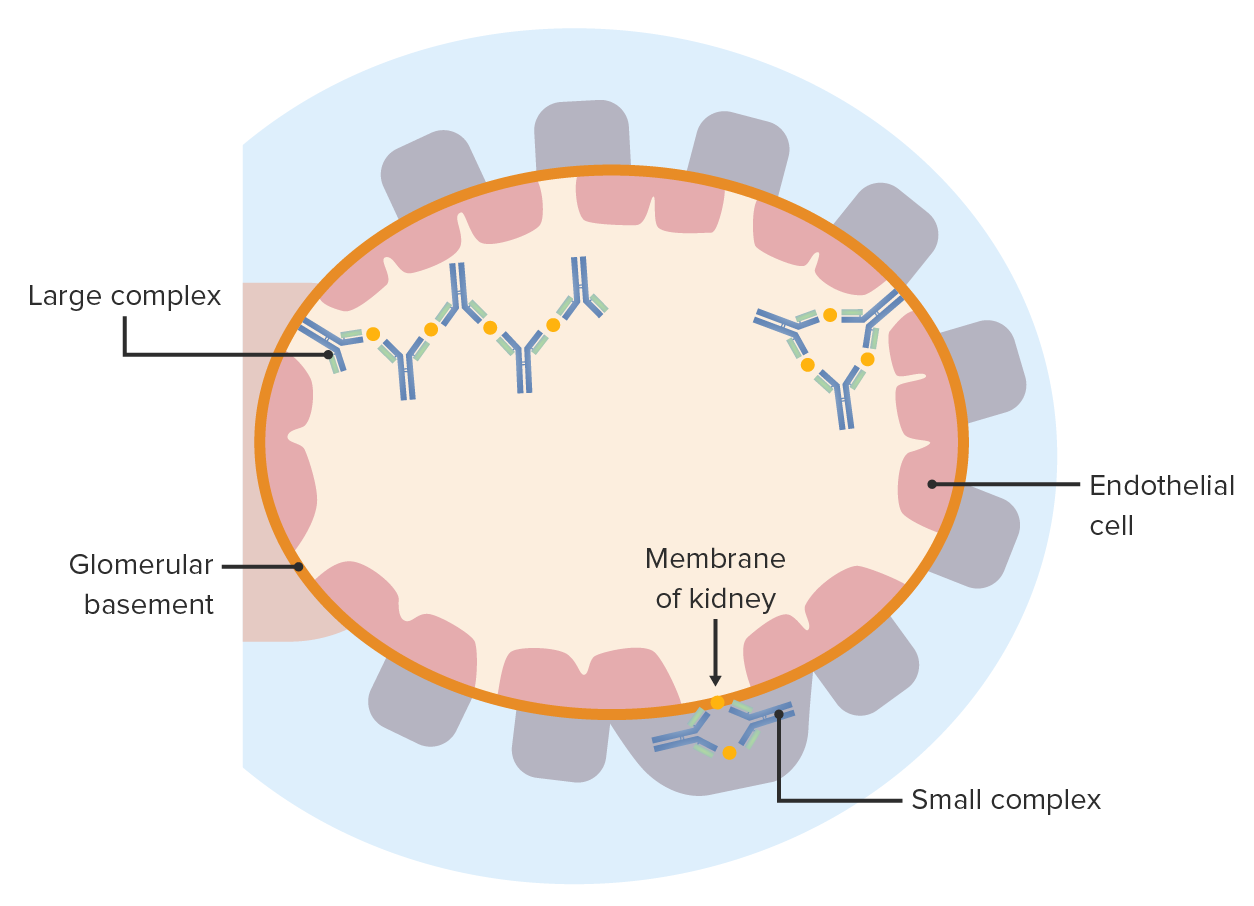
Depósito de inmunocomplejos

La deposición de inmunocomplejos depende de:

  • Propiedades físicas del inmunocomplejo:
    • Afinidad del anticuerpo con el complemento, el tamaño y la carga del inmunocomplejo
    • Aumento de la tasa de formación de inmunocomplejos → desborda el mecanismo de compensación → los LOS Neisseria inmunocomplejos circulan libremente hacia los LOS Neisseria órganos
  • Relación antígeno-anticuerpo:
    • Pocos anticuerpos o exceso de anticuerpos → disminución de la activación de efectores
  • Hemodinámica específica del tejido
    • Los LOS Neisseria inmunocomplejos se localizan primero dentro de los LOS Neisseria vasos sanguíneos → vasculitis Vasculitis Inflammation of any one of the blood vessels, including the arteries; veins; and rest of the vasculature system in the body. Systemic Lupus Erythematosus
    • Las zonas más afectadas son los tejidos susceptibles a “permeabilidad”:
      • Glomérulos (nefritis)
      • Articulaciones/sinovias (artritis)

Reacción inflamatoria de inmunocomplejos
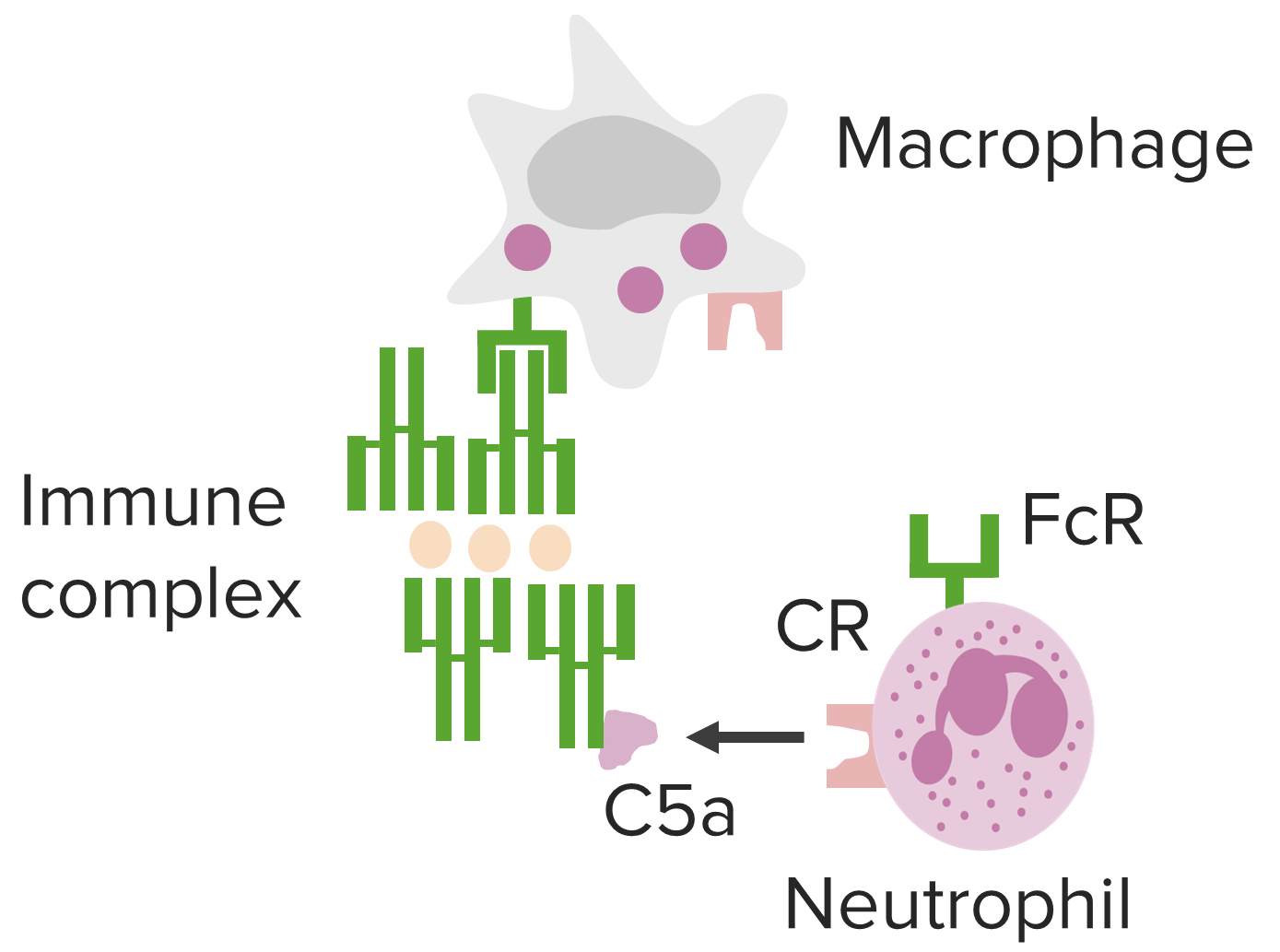
  • Los LOS Neisseria depósitos de inmunocomplejos activan la cascada del complemento.
  • C3a inicia la degranulación de los LOS Neisseria mastocitos:
    • La histamina aumenta la permeabilidad vascular en EN Erythema nodosum is an immune-mediated panniculitis (inflammation of the subcutaneous fat) caused by a type IV (delayed-type) hypersensitivity reaction. It commonly manifests in young women as tender, erythematous nodules on the shins. Erythema Nodosum el tejido afectado.
    • Los LOS Neisseria inmunocomplejos entran en EN Erythema nodosum is an immune-mediated panniculitis (inflammation of the subcutaneous fat) caused by a type IV (delayed-type) hypersensitivity reaction. It commonly manifests in young women as tender, erythematous nodules on the shins. Erythema Nodosum el tejido → el tejido normal con inmunocomplejos se convierte en EN Erythema nodosum is an immune-mediated panniculitis (inflammation of the subcutaneous fat) caused by a type IV (delayed-type) hypersensitivity reaction. It commonly manifests in young women as tender, erythematous nodules on the shins. Erythema Nodosum una diana de la respuesta inflamatoria
  • C5a (quimiotáctica) recluta neutrófilos → libera lisozimas y mediadores inflamatorios → muerte celular y lesión tisular
  • C3b opsoniza el tejido → fagocitosis y lisis celular mediada por el complejo de ataque de membrana
  • Macrófagos, linfocitos asesinos naturales → liberan mediadores líticos y lesionan las células del tejido
  • Puede producirse agregación plaquetaria → formación de microtrombos
Vías mediadas por inmunocomplejos subyacentes a la hipersensibilidad tipo III.

Vías mediadas por inmunocomplejos subyacentes a la hipersensibilidad tipo III.

Imagen por Lecturio.

Presentación Clínica

Las manifestaciones se ven afectadas por la vía de entrada, el( los LOS Neisseria) lugar(es) de depósito de inmunocomplejos y la persistencia del( los LOS Neisseria) antígeno(s).

Fenómeno de Arthus/Reacción de Arthus

  • Un antígeno inyectado localmente (e.g., inmunización como la Toxoide, difteria celular y pertussis Pertussis Pertussis, or whooping cough, is a potentially life-threatening highly contagious bacterial infection of the respiratory tract caused by Bordetella pertussis. The disease has 3 clinical stages, the second and third of which are characterized by an intense paroxysmal cough, an inspiratory whoop, and post-tussive vomiting. Pertussis (Whooping Cough) (Tdap, por sus siglas en EN Erythema nodosum is an immune-mediated panniculitis (inflammation of the subcutaneous fat) caused by a type IV (delayed-type) hypersensitivity reaction. It commonly manifests in young women as tender, erythematous nodules on the shins. Erythema Nodosum inglés)) provoca una reacción localizada.
  • Debido al AL Amyloidosis exceso de antígeno y al AL Amyloidosis depósito de inmunocomplejos en EN Erythema nodosum is an immune-mediated panniculitis (inflammation of the subcutaneous fat) caused by a type IV (delayed-type) hypersensitivity reaction. It commonly manifests in young women as tender, erythematous nodules on the shins. Erythema Nodosum las paredes vasculares
  • Necrosis Necrosis The death of cells in an organ or tissue due to disease, injury or failure of the blood supply. Ischemic Cell Damage de los LOS Neisseria tejidos afectados: dolor Dolor Inflammation, enrojecimiento, induración y edema Edema Edema is a condition in which excess serous fluid accumulates in the body cavity or interstitial space of connective tissues. Edema is a symptom observed in several medical conditions. It can be categorized into 2 types, namely, peripheral (in the extremities) and internal (in an organ or body cavity). Edema en EN Erythema nodosum is an immune-mediated panniculitis (inflammation of the subcutaneous fat) caused by a type IV (delayed-type) hypersensitivity reaction. It commonly manifests in young women as tender, erythematous nodules on the shins. Erythema Nodosum el sitio de inyección
  • Autolimitado

Lupus eritematoso sistémico (LES)

  • Anticuerpos dirigidos contra partes del núcleo: anticuerpos antinucleares (ANA), un hallazgo universal en EN Erythema nodosum is an immune-mediated panniculitis (inflammation of the subcutaneous fat) caused by a type IV (delayed-type) hypersensitivity reaction. It commonly manifests in young women as tender, erythematous nodules on the shins. Erythema Nodosum LES
  • Anticuerpos contra otras partes del núcleo:
    • Histona (Anticuerpos anti-histona)
    • ADN (Anticuerpos anti-ADNdc)
    • Ribonucleoproteína (Anticuerpos anti-RNP)
    • Antígeno nuclear extraíble/Antígeno de Smith (Anticuerpos anti-Smith)
  • Otros: Anticuerpos contra los LOS Neisseria fosfolípidos de las células (Anticuerpos antifosfolipídicos)
    • Presentes en EN Erythema nodosum is an immune-mediated panniculitis (inflammation of the subcutaneous fat) caused by a type IV (delayed-type) hypersensitivity reaction. It commonly manifests in young women as tender, erythematous nodules on the shins. Erythema Nodosum 30%–40% de los LOS Neisseria pacientes con LES
    • Mayor riesgo de trombosis
  • Los LOS Neisseria complejos antígeno-anticuerpo se depositan en EN Erythema nodosum is an immune-mediated panniculitis (inflammation of the subcutaneous fat) caused by a type IV (delayed-type) hypersensitivity reaction. It commonly manifests in young women as tender, erythematous nodules on the shins. Erythema Nodosum múltiples zonas:
    • Piel/mucocutáneo (erupción malar, fotosensibilidad, úlceras orales)
    • Riñones (glomerulonefritis)
    • Articulaciones (artritis)
    • Vasos sanguíneos ( vasculitis Vasculitis Inflammation of any one of the blood vessels, including the arteries; veins; and rest of the vasculature system in the body. Systemic Lupus Erythematosus, fenómeno de Raynaud, coágulos sanguíneos)
    • Pleura Pleura The pleura is a serous membrane that lines the walls of the thoracic cavity and the surface of the lungs. This structure of mesodermal origin covers both lungs, the mediastinum, the thoracic surface of the diaphragm, and the inner part of the thoracic cage. The pleura is divided into a visceral pleura and parietal pleura. Pleura: Anatomy (derrame)
    • Pericardio ( pericarditis Pericarditis Pericarditis is an inflammation of the pericardium, often with fluid accumulation. It can be caused by infection (often viral), myocardial infarction, drugs, malignancies, metabolic disorders, autoimmune disorders, or trauma. Acute, subacute, and chronic forms exist. Pericarditis)
    • Células sanguíneas ( anemia Anemia Anemia is a condition in which individuals have low Hb levels, which can arise from various causes. Anemia is accompanied by a reduced number of RBCs and may manifest with fatigue, shortness of breath, pallor, and weakness. Subtypes are classified by the size of RBCs, chronicity, and etiology. Anemia: Overview and Types, leucopenia, trombocitopenia)
    • Sistema nervioso central (accidentes cerebrovasculares, convulsiones)

Glomerulonefritis post-estreptocócica

  • Reacción a los LOS Neisseria antígenos nefritógenos del estreptococo beta-hemolítico del grupo A
  • Puede darse por una infección de garganta o de la piel por estreptococos
  • Presentación: hematuria Hematuria Presence of blood in the urine. Renal Cell Carcinoma, proteinuria Proteinuria The presence of proteins in the urine, an indicator of kidney diseases. Nephrotic Syndrome in Children, hipertensión, edema Edema Edema is a condition in which excess serous fluid accumulates in the body cavity or interstitial space of connective tissues. Edema is a symptom observed in several medical conditions. It can be categorized into 2 types, namely, peripheral (in the extremities) and internal (in an organ or body cavity). Edema y creatinina elevada

Enfermedad del suero

  • Reacción a antisueros extraños (e.g., antiveneno)
  • Dosis más altas del agente administrado tienen más probabilidades de provocar una reacción
  • 1–2 semanas después de la exposición: fiebre, erupción cutánea, artritis; se produce proteinuria Proteinuria The presence of proteins in the urine, an indicator of kidney diseases. Nephrotic Syndrome in Children con afectación renal

Neumonitis por hipersensibilidad

  • Alveolitis alérgica extrínseca
  • Antígeno: un microbio, proteína o sustancia química
  • Depósito de inmunocomplejos en EN Erythema nodosum is an immune-mediated panniculitis (inflammation of the subcutaneous fat) caused by a type IV (delayed-type) hypersensitivity reaction. It commonly manifests in young women as tender, erythematous nodules on the shins. Erythema Nodosum alvéolos, intersticio, bronquiolos y parénquima pulmonar
  • Pulmón del granjero: Antígenos de los LOS Neisseria mohos termófilos en EN Erythema nodosum is an immune-mediated panniculitis (inflammation of the subcutaneous fat) caused by a type IV (delayed-type) hypersensitivity reaction. It commonly manifests in young women as tender, erythematous nodules on the shins. Erythema Nodosum los LOS Neisseria cultivos
  • Enfermedad de los LOS Neisseria criadores de aves: Anticuerpos de la mucina intestinal en EN Erythema nodosum is an immune-mediated panniculitis (inflammation of the subcutaneous fat) caused by a type IV (delayed-type) hypersensitivity reaction. It commonly manifests in young women as tender, erythematous nodules on the shins. Erythema Nodosum excrementos o plumas
  • Nota: también puede ser mediada por linfocitos T (reacción de tipo IV)

Poliarteritis nodosa

  • Etiología principalmente idiopática, pero puede ser una reacción al AL Amyloidosis antigeno de superficie del virus Virus Viruses are infectious, obligate intracellular parasites composed of a nucleic acid core surrounded by a protein capsid. Viruses can be either naked (non-enveloped) or enveloped. The classification of viruses is complex and based on many factors, including type and structure of the nucleoid and capsid, the presence of an envelope, the replication cycle, and the host range. Virology de la hepatitis B Hepatitis B Hepatitis B virus (HBV) is a partially double-stranded DNA virus, which belongs to the Orthohepadnavirus genus and the Hepadnaviridae family. Most individuals with acute HBV infection are asymptomatic or have mild, self-limiting symptoms. Chronic infection can be asymptomatic or create hepatic inflammation, leading to liver cirrhosis and hepatocellular carcinoma (HCC). Hepatitis B Virus
  • Inflamación arterial de tamaño medio → ↓ flujo sanguíneo, ↑ trombosis; evita las venas.
  • Riñones: órgano más comúnmente implicado
  • Presentación:
    • Nódulos eritematosos sensibles, hipertensión, insuficiencia renal y neuropatía
    • Algunos tienen síntomas abdominales (arteritis mesentérica)

Diagnóstico y Tratamiento

Diagnóstico

  • Antecedentes y hallazgos clínicos (reacción de Arthus, enfermedad del suero a menudo diagnosticada clínicamente)
  • Estudios de laboratorio:
    • Hemograma
      • Anemia Anemia Anemia is a condition in which individuals have low Hb levels, which can arise from various causes. Anemia is accompanied by a reduced number of RBCs and may manifest with fatigue, shortness of breath, pallor, and weakness. Subtypes are classified by the size of RBCs, chronicity, and etiology. Anemia: Overview and Types, trombocitopenia, leucopenia: LES
      • Eosinofilia: enfermedad del suero, neumonitis por hipersensibilidad
    • Panel metabólico
      • La creatinina está anormal en EN Erythema nodosum is an immune-mediated panniculitis (inflammation of the subcutaneous fat) caused by a type IV (delayed-type) hypersensitivity reaction. It commonly manifests in young women as tender, erythematous nodules on the shins. Erythema Nodosum las reacciones que afectan a los LOS Neisseria riñones
    • Serologías y cultivos
      • Panel de hepatitis para la poliarteritis nodosa
      • Cultivo: infección estreptocócica (solo el 25% de los LOS Neisseria pacientes tendrán resultados positivos dado que la glomerulonefritis postestreptocócica se produce semanas después de la infección)
    • Niveles de complemento
      • Generalmente se encuentra en EN Erythema nodosum is an immune-mediated panniculitis (inflammation of the subcutaneous fat) caused by a type IV (delayed-type) hypersensitivity reaction. It commonly manifests in young women as tender, erythematous nodules on the shins. Erythema Nodosum niveles bajos en EN Erythema nodosum is an immune-mediated panniculitis (inflammation of the subcutaneous fat) caused by a type IV (delayed-type) hypersensitivity reaction. It commonly manifests in young women as tender, erythematous nodules on the shins. Erythema Nodosum condiciones asociadas
    • Anticuerpos
      • ANA, Anticuerpos anti-ADNdc, Anticuerpos anti-Smith, Anticuerpos anti-RNP, Anticuerpos antifosfolipídico: LES
      • Glomerulonefritis postestreptocócica: anti-estreptolisina, prueba de la estreptozima
    • Análisis de orina
    • Marcadores inflamatorios
      • Proteína C reactiva ( PCR PCR Polymerase chain reaction (PCR) is a technique that amplifies DNA fragments exponentially for analysis. The process is highly specific, allowing for the targeting of specific genomic sequences, even with minuscule sample amounts. The PCR cycles multiple times through 3 phases: denaturation of the template DNA, annealing of a specific primer to the individual DNA strands, and synthesis/elongation of new DNA molecules. Polymerase Chain Reaction (PCR)) y velocidad de sedimentación globular generalmente elevadas durante la inflamación activa
    • Imagenología
      • TC de alta resolución (pulmón): neumonitis por hipersensibilidad
      • Arteriografía o angiografía por TC/RM: para poliarteritis nodosa
      • Radiografía: afectación articular
    • Procedimientos quirúrgicos
      • Biopsia renal: para afectación renal
      • Biopsia de piel: para afectación cutánea
      • Broncoscopia: para afectación pulmonar
Neumonitis por hipersensibilidad

Una paciente de 27 años con antecedente de exposición al moho. TC de alta resolución del tórax (ventana pulmonar) a nivel de los lóbulos inferiores muestra extensas opacidades en vidrio esmerilado (asteriscos), con focos superpuestos de atrapamiento aéreo lobular (flechas).

Imagen: “Hypersensitivity Pneumonitis” por Torres PP, Moreira MA, Silva DG, da Gama RR, Sugita DM, Moreira MA. Licencia: CC BY 4.0

Tratamiento

  • Retirar o evitar el agente ofensivo
  • Antihistamínicos, antiinflamatorios no esteroideos (AINE) para el alivio de los LOS Neisseria síntomas (erupción, picor, dolores articulares)
  • En EN Erythema nodosum is an immune-mediated panniculitis (inflammation of the subcutaneous fat) caused by a type IV (delayed-type) hypersensitivity reaction. It commonly manifests in young women as tender, erythematous nodules on the shins. Erythema Nodosum las reacciones debidas a infección (glomerulonefritis postestreptocócica), terapia antibiótica si la infección sigue presente
  • Control de complicaciones como hipertensión (glomerulonefritis postestreptocócica, poliarteritis nodosa), edema Edema Edema is a condition in which excess serous fluid accumulates in the body cavity or interstitial space of connective tissues. Edema is a symptom observed in several medical conditions. It can be categorized into 2 types, namely, peripheral (in the extremities) and internal (in an organ or body cavity). Edema (glomerulonefritis postestreptocócica, LES), síntomas de las vías respiratorias (neumonitis por hipersensibilidad)
  • Los LOS Neisseria glucocorticoides se usan en EN Erythema nodosum is an immune-mediated panniculitis (inflammation of the subcutaneous fat) caused by a type IV (delayed-type) hypersensitivity reaction. It commonly manifests in young women as tender, erythematous nodules on the shins. Erythema Nodosum casos severos para suprimir la inflamación
  • Opciones terapéuticas para condiciones específicas:
    • Neumonitis por hipersensibilidad: tratamiento inmunosupresor (micofenolato, azatioprina)
    • LES:
      • Antimaláricos (hidroxicloroquina, cloroquina)
      • Tratamiento inmunosupresor: micofenolato, azatioprina, ciclofosfamida, rituximab Rituximab A murine-derived monoclonal antibody and antineoplastic agent that binds specifically to the cd20 antigen and is used in the treatment of leukemia; lymphoma and rheumatoid arthritis. Immunosuppressants, belimumab Belimumab Immunosuppressants, anifrolumab
      • Anticoagulación a largo plazo si hay trombosis: warfarina, heparina de bajo peso molecular
    • Poliarteritis nodosa:
      • Metotrexato, un medicamento antirreumático modificador de la enfermedad
      • Terapia inmunosupresora (ciclofosfamida, azatioprina)
  • Diálisis para enfermedad renal terminal por LES
  • Trasplante de órganos:
    • Trasplante de pulmón para enfermedad pulmonar avanzada en EN Erythema nodosum is an immune-mediated panniculitis (inflammation of the subcutaneous fat) caused by a type IV (delayed-type) hypersensitivity reaction. It commonly manifests in young women as tender, erythematous nodules on the shins. Erythema Nodosum neumonitis por hipersensibilidad
    • Trasplante renal para enfermedad renal terminal en EN Erythema nodosum is an immune-mediated panniculitis (inflammation of the subcutaneous fat) caused by a type IV (delayed-type) hypersensitivity reaction. It commonly manifests in young women as tender, erythematous nodules on the shins. Erythema Nodosum LES

Referencias

  1. King, T., Flaherty, K. & Hollingsworth, H. (Eds.). (2024). Hypersensitivity pneumonitis (extrinsic allergic alveolitis): Clinical manifestations and diagnosis. UpToDate. Retrieved November 23, 2024, from https://www.uptodate.com/contents/hypersensitivity-pneumonitis-extrinsic-allergic-alveolitis-clinical-manifestations-and-diagnosis
  2. King, T., Flaherty, K. & Hollingsworth, H. (Eds.). (2024). Hypersensitivity pneumonitis (extrinsic allergic alveolitis): Treatment, prognosis, and prevention. UpToDate.  Retrieved November 23, 2024, from https://www.uptodate.com/contents/hypersensitivity-pneumonitis-extrinsic-allergic-alveolitis-treatment-prognosis-and-prevention
  3. Lu, L., Suscovich, T., Fortune, S., Galit, A. (2018). Beyond Binding: antibody effector functions in infectious diseases. Nature Reviews Immunology, 18, 46–61. Retrieved November 23, 2024, from https://doi.org/10.1038/nri.2017.106
  4. Mak, T., Saunders, M., Jett, B. (2014). Primer to the Immune response. Elsevier, 2nd ed.
  5. Mayadas, T., Tsokos, G., Tsuboi, N. (2009). Mechanisms of Immune Complex-mediated Neutrophil Recruitment and Tissue Injury: official publication of the Circulation, 120(20), 2012–2014. Retrieved November 23, 2024, from https://www.ahajournals.org/doi/10.1161/CIRCULATIONAHA.108.771170
  6. Merkel, P., Hunder, G. & Ramirez Curtis, M. (Eds.) (2024). Clinical manifestations and diagnosis of polyarteritis arteritis nodosa in adults. UpToDate.  Retrieved November 23, 2024, from https://www.uptodate.com/contents/clinical-manifestations-and-diagnosis-of-polyarteritis-nodosa-in-adults
  7. Wallace, D., Gladman, D., Pisetsky, D.,Shur, P & Ramirez Curtis, M. (Eds.) (2024). Clinical manifestations and diagnosis of systemic lupus erythematosus in adults. UpToDate. Retrieved November 23, 2024, from https://www.uptodate.com/contents/clinical-manifestations-and-diagnosis-of-systemic-lupus-erythematosus-in-adults
  8. Wallace, D., Pisetsky, D., Shur, P & Ramirez Curtis, M. (Eds.) (2024). Overview of the management and prognosis of systemic lupus erythematosus in adults. UpToDate. Retrieved  November 23, 2024, from https://www.uptodate.com/contents/overview-of-the-management-and-prognosis-of-systemic-lupus-erythematosus-in-adults
  9. Agrawal, A., & Singh, P. (2024). Immune complex-mediated diseases: Pathophysiology and management. Journal of Clinical Immunology, 44(2), 155-168.
  10. Bousquet, J., et al. (2023). The global allergy and asthma European network (GA2LEN) and the European Academy of Allergy and Clinical Immunology (EAACI) position paper on allergic rhinitis. Allergy, 78(2), 301-314.
  11. Gell, P. G. H., & Coombs, R. R. A. (2024). Classification of allergic reactions underlying disease. In Clinical aspects of immunology (pp. 761-781). Wiley.
  12. Kumar, V., Abbas, A. K., & Aster, J. C. (2021). Robbins and Cotran Pathologic Basis of Disease (10th ed.). Elsevier.
  13. McGowan, M. R., & Leslie, G. (2023). Immune complexes in systemic disease: Clinical implications and treatment strategies. Nature Reviews Immunology, 23(3), 182-197.
  14. van Neerven, R. J., et al. (2024). Advances in understanding the mechanisms of Type III hypersensitivity reactions: Implications for therapy. Frontiers in Immunology, 15, 123456.
  15. Vohr, H. W. (2024). Hypersensitivity reactions. In Encyclopedic Reference of Immunotoxicology (pp. 302-305). Springer.

¡Crea tu cuenta gratis o inicia una sesión para seguir leyendo!

Regístrate ahora y obtén acceso gratuito a Lecturio con páginas de concepto, videos médicos y cuestionarios para tu educación médica.

User Reviews

Que tengas una sesión de estudio alegre y navideña 🎁 Ahorra 50% en todos los planes >>

Details