Domina Conceptos Médicos

Estudia para la escuela de medicina y tus examenes con Lecturio.

Obstrucción Del Intestino Delgado

La obstrucción del intestino delgado es una interrupción del flujo del contenido intraluminal a través del intestino delgado, y se clasifica como mecánica (debida a un bloqueo físico) o funcional (debida a la alteración de la motilidad normal). La causa más común de obstrucción del intestino delgado en EN Erythema nodosum is an immune-mediated panniculitis (inflammation of the subcutaneous fat) caused by a type IV (delayed-type) hypersensitivity reaction. It commonly manifests in young women as tender, erythematous nodules on the shins. Erythema Nodosum los LOS Neisseria países occidentales son las adherencias postoperatorias. La obstrucción del intestino delgado se presenta típicamente con náuseas, vómitos, dolor Dolor Inflammation abdominal, distensión, estreñimiento y/u obstrucción. El diagnóstico se establece mediante imagenología. Hasta el 80% de los LOS Neisseria casos se resuelven con un tratamiento de soporte (reposo intestinal, hidratación intravenosa y descompresión nasogástrica). Sin embargo, la cirugía es necesaria para los LOS Neisseria casos persistentes o complicados.

Last updated: Dec 15, 2025

Editorial responsibility: Stanley Oiseth, Lindsay Jones, Evelin Maza

Descripción General

Definición

La obstrucción del intestino delgado es la interrupción del flujo del contenido intraluminal a través del intestino delgado (duodeno, yeyuno o íleon).
Epidemiología

  • La edad media de aparición es de 64 años.
  • Incidencia similar en EN Erythema nodosum is an immune-mediated panniculitis (inflammation of the subcutaneous fat) caused by a type IV (delayed-type) hypersensitivity reaction. It commonly manifests in young women as tender, erythematous nodules on the shins. Erythema Nodosum hombres y mujeres
  • Representa 2%–4% de las visitas a los LOS Neisseria servicios de urgencias en EN Erythema nodosum is an immune-mediated panniculitis (inflammation of the subcutaneous fat) caused by a type IV (delayed-type) hypersensitivity reaction. It commonly manifests in young women as tender, erythematous nodules on the shins. Erythema Nodosum Estados Unidos
  • Constituye el 80% de las obstrucciones intestinales mecánicas

Etiología

  • Mecánica:
    • Adherencias (postoperatorias):
      • La causa más común en EN Erythema nodosum is an immune-mediated panniculitis (inflammation of the subcutaneous fat) caused by a type IV (delayed-type) hypersensitivity reaction. It commonly manifests in young women as tender, erythematous nodules on the shins. Erythema Nodosum los LOS Neisseria países occidentales
      • Cirugía abierta: aumento de 4 veces el riesgo de obstrucción del intestino delgado en EN Erythema nodosum is an immune-mediated panniculitis (inflammation of the subcutaneous fat) caused by a type IV (delayed-type) hypersensitivity reaction. It commonly manifests in young women as tender, erythematous nodules on the shins. Erythema Nodosum 5 años
    • Tumores
    • Hernias
    • Enfermedad de Crohn (estenosis o adherencias inflamatorias)
    • Cálculos biliares (íleo biliar)
    • Vólvulo
    • Intususcepción
    • Ingestión de cuerpos extraños
  • Funcional (también denominado íleo paralítico o adinámico):
    • Cirugía
    • Peritonitis Peritonitis Inflammation of the peritoneum lining the abdominal cavity as the result of infectious, autoimmune, or chemical processes. Primary peritonitis is due to infection of the peritoneal cavity via hematogenous or lymphatic spread and without intra-abdominal source. Secondary peritonitis arises from the abdominal cavity itself through rupture or abscess of intra-abdominal organs. Penetrating Abdominal Injury
    • Trauma
    • Isquemia intestinal
    • Medicamentos (opiáceos, antagonistas del calcio, diuréticos)
    • Desequilibrio electrolítico

Mnemotecnia

  • Las 3 causas más comunes de la obstrucción del intestino delgado: ABC
    • Adhesions (adherencias)
    • Bulge (bultos, hernias)
    • Cancer (cáncer, neoplasias)
  • Causas de la obstrucción del intestino delgado: SHAVING
    • Stricture (estenosis)
    • Hernia ( hernia Hernia Protrusion of tissue, structure, or part of an organ through the bone, muscular tissue, or the membrane by which it is normally contained. Hernia may involve tissues such as the abdominal wall or the respiratory diaphragm. Hernias may be internal, external, congenital, or acquired. Abdominal Hernias)
    • Adhesions (adherencias)
    • Volvulus (vólvulo)
    • Intussusception/inflammatory bowel disease (intususcepción/enfermedad inflamatoria intestinal)
    • Neoplasm (neoplasias)
    • Gallstones (cálculos biliares)
  • Causas del íleo paralítico o adinámico (5 Ps PS Invasive Mechanical Ventilation):
    • Postoperatorio
    • Peritonitis, Pancreatitis
    • Potasio (bajo), medicación para el Parkinson, analgésicos (Painkillers, en EN Erythema nodosum is an immune-mediated panniculitis (inflammation of the subcutaneous fat) caused by a type IV (delayed-type) hypersensitivity reaction. It commonly manifests in young women as tender, erythematous nodules on the shins. Erythema Nodosum inglés)
    • Fracturas de Pelvis y columna vertebral
    • Parto

Fisiopatología

Clasificación

  • Por etiología:
    • Mecánica: resulta de la compresión intrínseca (tumores) o extrínseca (adherencias, hernias)
    • Funcional (íleo):
      • Resultado del deterioro de la motilidad
      • Puede limitarse al AL Amyloidosis intestino delgado o incluir también el colon Colon The large intestines constitute the last portion of the digestive system. The large intestine consists of the cecum, appendix, colon (with ascending, transverse, descending, and sigmoid segments), rectum, and anal canal. The primary function of the colon is to remove water and compact the stool prior to expulsion from the body via the rectum and anal canal. Colon, Cecum, and Appendix: Anatomy
  • Por grado de obstrucción:
    • Completa: no hay paso del contenido luminal más allá del punto de obstrucción
    • Parcial: pasa parte del contenido intestinal más allá del punto del obstrucción.
    • En EN Erythema nodosum is an immune-mediated panniculitis (inflammation of the subcutaneous fat) caused by a type IV (delayed-type) hypersensitivity reaction. It commonly manifests in young women as tender, erythematous nodules on the shins. Erythema Nodosum asa ASA Anterior Cord Syndrome cerrada:
      • El segmento de intestino está obstruido proximal y distalmente.
      • Presente en EN Erythema nodosum is an immune-mediated panniculitis (inflammation of the subcutaneous fat) caused by a type IV (delayed-type) hypersensitivity reaction. It commonly manifests in young women as tender, erythematous nodules on the shins. Erythema Nodosum el vólvulo
      • El gas y el líquido no pueden escapar → ↑ presión intraluminal, ↑ riesgo de estrangulamiento.
      • La isquemia, la necrosis Necrosis The death of cells in an organ or tissue due to disease, injury or failure of the blood supply. Ischemic Cell Damage y la perforación pueden desarrollarse rápidamente.
  • Por complicación asociada:
    • Simple: obstrucción sin isquemia
    • Complicado: la circulación está comprometida, con isquemia asociada, infarto y/o perforación.

Fisiopatología

  • Temprana:
    • La obstrucción intrínseca o la compresión extrínseca provocan la interrupción del flujo del contenido del intestino, lo que provoca:
      • Acumulación de aire y gas producido por la fermentación bacteriana
      • Distensión intestinal progresiva (proximal al AL Amyloidosis punto de obstrucción) que provoca una reducción de la motilidad intestinal
      • Secuestro de líquido en EN Erythema nodosum is an immune-mediated panniculitis (inflammation of the subcutaneous fat) caused by a type IV (delayed-type) hypersensitivity reaction. It commonly manifests in young women as tender, erythematous nodules on the shins. Erythema Nodosum la luz del intestino
      • Pérdida de la absorción intestinal normal
    • La emesis provoca la pérdida de líquidos y electrolitos (Na, K, H, Cl) → se produce hipovolemia y alcalosis metabólica
  • Tardía:
    • Cambios en EN Erythema nodosum is an immune-mediated panniculitis (inflammation of the subcutaneous fat) caused by a type IV (delayed-type) hypersensitivity reaction. It commonly manifests in young women as tender, erythematous nodules on the shins. Erythema Nodosum la flora luminal → la descomposición bacteriana del contenido estancado da lugar a un líquido fecal
    • Edema Edema Edema is a condition in which excess serous fluid accumulates in the body cavity or interstitial space of connective tissues. Edema is a symptom observed in several medical conditions. It can be categorized into 2 types, namely, peripheral (in the extremities) and internal (in an organ or body cavity). Edema persistente de la pared intestinal → isquemia intestinal por compresión de los LOS Neisseria vasos intramurales
    • Con la isquemia → se acumula ácido láctico → acidosis Acidosis A pathologic condition of acid accumulation or depletion of base in the body. The two main types are respiratory acidosis and metabolic acidosis, due to metabolic acid build up. Respiratory Acidosis metabólica
    • La isquemia intestinal puede provocar la translocación intestinal de bacterias, la necrosis Necrosis The death of cells in an organ or tissue due to disease, injury or failure of the blood supply. Ischemic Cell Damage y la perforación.
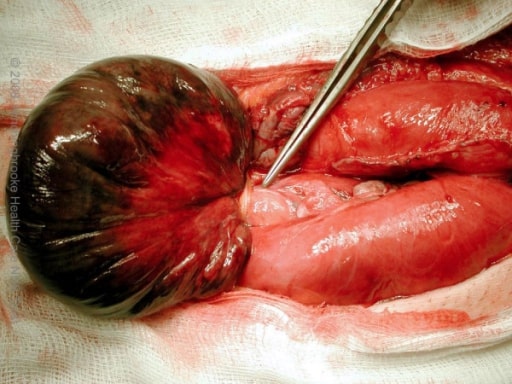
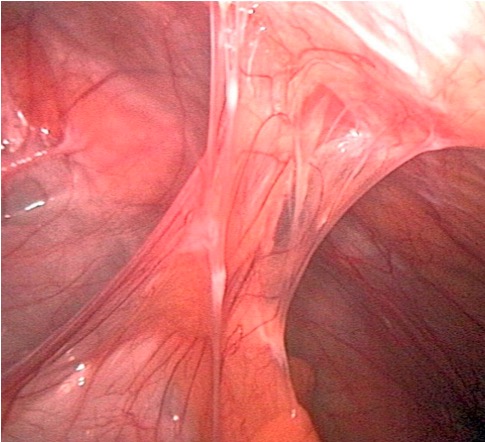
Hernia inguinal estrangulada

Intestino delgado gangrenoso con obstrucción en asa cerrada causada por una adherencia de banda omental

Imagen: “Intra-operative photograph” por the Department of Surgery, Hinchingbrooke Hospital, Hinchingbrooke Healthcare NHS Trust, Huntingdon, Cambridgeshire, UK. Licencia: CC BY 2.0.
Presentación Clínica

Síntomas

  • Obstrucción aguda:
    • Dolor Dolor Inflammation abdominal:
      • Aparición repentina (la mayoría de las veces de manera difusa)
      • Frecuentemente intermitente (cólicos)
      • Puede aliviarse temporalmente con el vómito
    • Un dolor Dolor Inflammation intenso y constante puede indicar isquemia o perforación
    • Náuseas y vómitos biliosos
    • Estreñimiento
    • Obstipación (incapacidad para expulsar el flato o las heces)
  • Obstrucción crónica:
    • Los LOS Neisseria síntomas suelen ser más leves.
    • Cólicos/malestar abdominal postprandial
    • Náuseas/vómitos intermitentes
  • Obstrucción en EN Erythema nodosum is an immune-mediated panniculitis (inflammation of the subcutaneous fat) caused by a type IV (delayed-type) hypersensitivity reaction. It commonly manifests in young women as tender, erythematous nodules on the shins. Erythema Nodosum asa ASA Anterior Cord Syndrome cerrada:
    • Dolor Dolor Inflammation abdominal severo
    • La distensión abdominal puede ser mínima.
    • Puede no tener náuseas ni vómitos

Examen físico

  • Signos de deshidratación (sello distintivo de la obstrucción del intestino delgado):
    • Taquicardia
    • Hipotensión (ortostática)
    • Baja producción de orina
  • Examen abdominal:
    • Inspección: distensión abdominal
    • Auscultación:
      • Ruidos intestinales agudos (obstrucción del intestino delgado temprana)
      • Disminución/ausencia de ruidos intestinales (obstrucción del intestino delgado tardía o funcional)
    • Percusión: timpanismo o hiperresonancia; matidez si está lleno de líquido
    • Palpación:
      • Buscar hernias y masas.
      • La sensibilidad a la palpación mínima indica una posible peritonitis Peritonitis Inflammation of the peritoneum lining the abdominal cavity as the result of infectious, autoimmune, or chemical processes. Primary peritonitis is due to infection of the peritoneal cavity via hematogenous or lymphatic spread and without intra-abdominal source. Secondary peritonitis arises from the abdominal cavity itself through rupture or abscess of intra-abdominal organs. Penetrating Abdominal Injury (indicativa de complicaciones como isquemia o perforación).
  • Tacto rectal:
    • Descartar la impactación fecal como causa de los LOS Neisseria síntomas
    • La presencia de sangre haría sospechar de un tumor Tumor Inflammation.

Diagnóstico

Historia clínica

  • Factores de riesgo para adherencias:
    • Cirugías abdominales previas (lo más importante): ↑ riesgo de adherencias
    • Afecciones inflamatorias (enfermedad de Crohn, diverticulitis Diverticulitis Inflammation of a diverticulum or diverticula. Diverticular Disease)
    • Exposición a la radiación
  • Otros factores de riesgo para la obstrucción del intestino delgado mecánica:
    • Historial de hernias
    • Ingestión de cuerpos extraños
    • Historial de cáncer
  • Factores de riesgo para la obstrucción del intestino delgado funcional:
    • Medicamentos
    • Enfermedad sistémica aguda o crónica (por ejemplo, neumonía)
    • Traumatismo abdominal
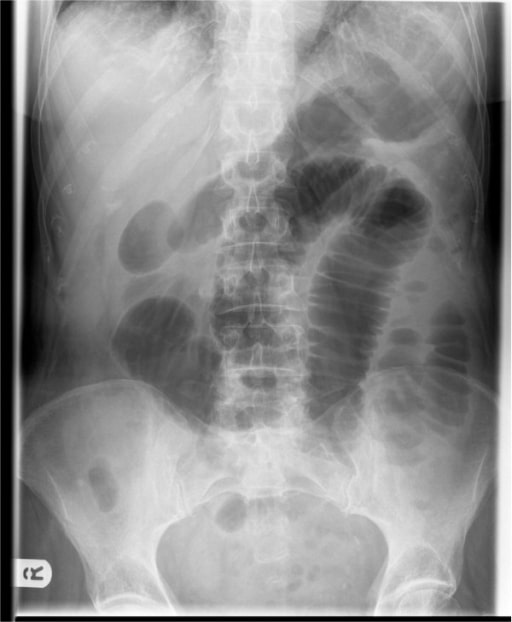
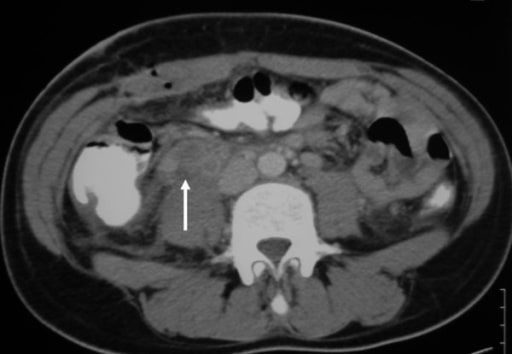
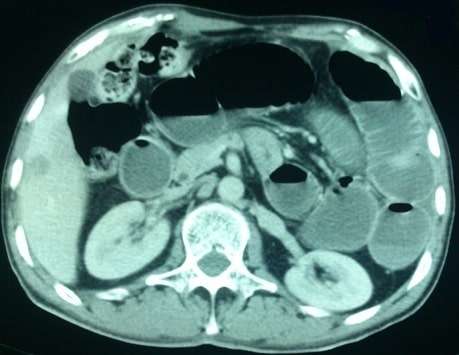
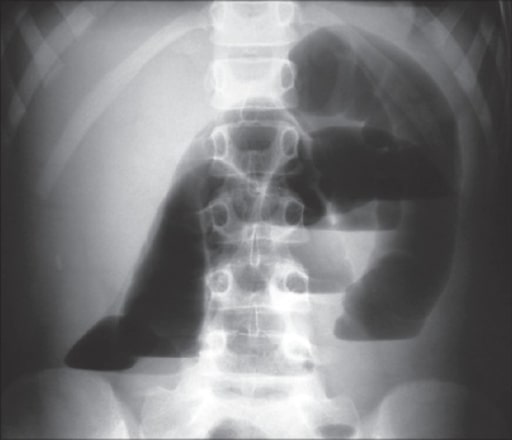
Adherencia postoperatoria obstrucción del intestino delgado

Las adherencias que pueden desarrollarse en el postoperatorio son la causa más común de obstrucción intestinal.

Imagen de Kevin Pei, PD.
Pruebas de laboratorio

  • Desequilibrios electrolíticos (comúnmente observadas en EN Erythema nodosum is an immune-mediated panniculitis (inflammation of the subcutaneous fat) caused by a type IV (delayed-type) hypersensitivity reaction. It commonly manifests in young women as tender, erythematous nodules on the shins. Erythema Nodosum el inicio agudo):
    • Hiponatremia
    • Hipopotasemia
    • Nitrógeno ureico en EN Erythema nodosum is an immune-mediated panniculitis (inflammation of the subcutaneous fat) caused by a type IV (delayed-type) hypersensitivity reaction. It commonly manifests in young women as tender, erythematous nodules on the shins. Erythema Nodosum sangre (BUN)/creatinina elevado
    • Hipocloremia
    • Alcalosis metabólica por vómitos (bicarbonato alto)
    • Acidosis Acidosis A pathologic condition of acid accumulation or depletion of base in the body. The two main types are respiratory acidosis and metabolic acidosis, due to metabolic acid build up. Respiratory Acidosis metabólica en EN Erythema nodosum is an immune-mediated panniculitis (inflammation of the subcutaneous fat) caused by a type IV (delayed-type) hypersensitivity reaction. It commonly manifests in young women as tender, erythematous nodules on the shins. Erythema Nodosum fases avanzadas
  • Hemograma:
    • Hemoconcentración
    • Leucocitosis:
      • Puede ser reactiva
      • Puede ser indicativa de complicaciones
    • Anemia Anemia Anemia is a condition in which individuals have low Hb levels, which can arise from various causes. Anemia is accompanied by a reduced number of RBCs and may manifest with fatigue, shortness of breath, pallor, and weakness. Subtypes are classified by the size of RBCs, chronicity, and etiology. Anemia: Overview and Types: si tiene etiología asociada (Crohn, cáncer)
  • Otros:
    • Lactato: un nivel elevado es sensible para isquemia intestinal.
    • Hemocultivos: en EN Erythema nodosum is an immune-mediated panniculitis (inflammation of the subcutaneous fat) caused by a type IV (delayed-type) hypersensitivity reaction. It commonly manifests in young women as tender, erythematous nodules on the shins. Erythema Nodosum caso de bacteriemia

Imagenología

  • Radiografía (prueba inicial de elección):
    • Radiografía de abdomen realizada en EN Erythema nodosum is an immune-mediated panniculitis (inflammation of the subcutaneous fat) caused by a type IV (delayed-type) hypersensitivity reaction. It commonly manifests in young women as tender, erythematous nodules on the shins. Erythema Nodosum posición supina y vertical o en EN Erythema nodosum is an immune-mediated panniculitis (inflammation of the subcutaneous fat) caused by a type IV (delayed-type) hypersensitivity reaction. It commonly manifests in young women as tender, erythematous nodules on the shins. Erythema Nodosum decúbito lateral
    • Realizado junto con radiografía de tórax en EN Erythema nodosum is an immune-mediated panniculitis (inflammation of the subcutaneous fat) caused by a type IV (delayed-type) hypersensitivity reaction. It commonly manifests in young women as tender, erythematous nodules on the shins. Erythema Nodosum posición vertical
    • Hallazgos:
      • Dilatación del intestino delgado proximal > 3 cm
      • Niveles de aire-líquido (con asas de intestino delgado apiladas) en EN Erythema nodosum is an immune-mediated panniculitis (inflammation of the subcutaneous fat) caused by a type IV (delayed-type) hypersensitivity reaction. It commonly manifests in young women as tender, erythematous nodules on the shins. Erythema Nodosum distribución vertical (signo de la escalera)
      • Falta de aire en EN Erythema nodosum is an immune-mediated panniculitis (inflammation of the subcutaneous fat) caused by a type IV (delayed-type) hypersensitivity reaction. It commonly manifests in young women as tender, erythematous nodules on the shins. Erythema Nodosum el colon Colon The large intestines constitute the last portion of the digestive system. The large intestine consists of the cecum, appendix, colon (with ascending, transverse, descending, and sigmoid segments), rectum, and anal canal. The primary function of the colon is to remove water and compact the stool prior to expulsion from the body via the rectum and anal canal. Colon, Cecum, and Appendix: Anatomy
      • Abdomen sin gas (si todas las asas del intestino delgado están llenas de líquido)
      • Íleo: puede mostrar una dilatación difusa del intestino delgado y del colon Colon The large intestines constitute the last portion of the digestive system. The large intestine consists of the cecum, appendix, colon (with ascending, transverse, descending, and sigmoid segments), rectum, and anal canal. The primary function of the colon is to remove water and compact the stool prior to expulsion from the body via the rectum and anal canal. Colon, Cecum, and Appendix: Anatomy
      • Aire libre en EN Erythema nodosum is an immune-mediated panniculitis (inflammation of the subcutaneous fat) caused by a type IV (delayed-type) hypersensitivity reaction. It commonly manifests in young women as tender, erythematous nodules on the shins. Erythema Nodosum caso de perforación (bajo el diafragma)
  • Tomografía computarizada:
    • Contraste intravenoso recomendado (para signos de inflamación, isquemia)
    • El contraste oral no es necesario si se sospecha una obstrucción de alto grado o completa.
    • Ayuda a identificar:
      • Lugar de la obstrucción
      • Etiología (por ejemplo, hernia Hernia Protrusion of tissue, structure, or part of an organ through the bone, muscular tissue, or the membrane by which it is normally contained. Hernia may involve tissues such as the abdominal wall or the respiratory diaphragm. Hernias may be internal, external, congenital, or acquired. Abdominal Hernias, vólvulo, tumor Tumor Inflammation)
      • Gravedad (debe excluir el compromiso intestinal)
    • Hallazgos en EN Erythema nodosum is an immune-mediated panniculitis (inflammation of the subcutaneous fat) caused by a type IV (delayed-type) hypersensitivity reaction. It commonly manifests in young women as tender, erythematous nodules on the shins. Erythema Nodosum la obstrucción del intestino delgado:
      • Zona de transición con dilatación del intestino proximal y descompresión del intestino distal
      • Contraste intraluminal que no va VA Ventilation: Mechanics of Breathing más allá de la zona de transición
      • El colon Colon The large intestines constitute the last portion of the digestive system. The large intestine consists of the cecum, appendix, colon (with ascending, transverse, descending, and sigmoid segments), rectum, and anal canal. The primary function of the colon is to remove water and compact the stool prior to expulsion from the body via the rectum and anal canal. Colon, Cecum, and Appendix: Anatomy tiene poco gas o líquido.
    • Hallazgos de obstrucción en EN Erythema nodosum is an immune-mediated panniculitis (inflammation of the subcutaneous fat) caused by a type IV (delayed-type) hypersensitivity reaction. It commonly manifests in young women as tender, erythematous nodules on the shins. Erythema Nodosum asa ASA Anterior Cord Syndrome cerrada:
      • Asa ASA Anterior Cord Syndrome intestinal dilatada en EN Erythema nodosum is an immune-mediated panniculitis (inflammation of the subcutaneous fat) caused by a type IV (delayed-type) hypersensitivity reaction. It commonly manifests in young women as tender, erythematous nodules on the shins. Erythema Nodosum forma de U o de C
      • Vasos mesentéricos que convergen hacia un punto de torsión
      • 2 asas intestinales colapsadas adyacentes a la obstrucción
    • Neumoperitoneo (indicativo de perforación):
      • Aire libre sobre el bazo o el hígado
      • Aire libre adyacente al AL Amyloidosis duodeno (retroperitoneo)
      • “Signo de fútbol”: tomografía computarizada en EN Erythema nodosum is an immune-mediated panniculitis (inflammation of the subcutaneous fat) caused by a type IV (delayed-type) hypersensitivity reaction. It commonly manifests in young women as tender, erythematous nodules on the shins. Erythema Nodosum posición supina
    • Hallazgos de estrangulamiento/isquemia:
      • Pared intestinal gruesa
      • Neumatosis intestinal (aire en EN Erythema nodosum is an immune-mediated panniculitis (inflammation of the subcutaneous fat) caused by a type IV (delayed-type) hypersensitivity reaction. It commonly manifests in young women as tender, erythematous nodules on the shins. Erythema Nodosum la pared intestinal)
      • Gas en EN Erythema nodosum is an immune-mediated panniculitis (inflammation of the subcutaneous fat) caused by a type IV (delayed-type) hypersensitivity reaction. It commonly manifests in young women as tender, erythematous nodules on the shins. Erythema Nodosum la vena porta
      • Edema Edema Edema is a condition in which excess serous fluid accumulates in the body cavity or interstitial space of connective tissues. Edema is a symptom observed in several medical conditions. It can be categorized into 2 types, namely, peripheral (in the extremities) and internal (in an organ or body cavity). Edema mesentérico
      • El contraste intravenoso tiene una escasa captación en EN Erythema nodosum is an immune-mediated panniculitis (inflammation of the subcutaneous fat) caused by a type IV (delayed-type) hypersensitivity reaction. It commonly manifests in young women as tender, erythematous nodules on the shins. Erythema Nodosum la pared del intestino afectado.
      • Ascitis
  • Prueba de permeabilidad del intestino delgado:
    • En EN Erythema nodosum is an immune-mediated panniculitis (inflammation of the subcutaneous fat) caused by a type IV (delayed-type) hypersensitivity reaction. It commonly manifests in young women as tender, erythematous nodules on the shins. Erythema Nodosum caso de que exista una perforación se utiliza gastrografina (contraste hidrosoluble).
    • Generalmente uso inferior a la tomografía computarizada en EN Erythema nodosum is an immune-mediated panniculitis (inflammation of the subcutaneous fat) caused by a type IV (delayed-type) hypersensitivity reaction. It commonly manifests in young women as tender, erythematous nodules on the shins. Erythema Nodosum situaciones agudas, pero útil en EN Erythema nodosum is an immune-mediated panniculitis (inflammation of the subcutaneous fat) caused by a type IV (delayed-type) hypersensitivity reaction. It commonly manifests in young women as tender, erythematous nodules on the shins. Erythema Nodosum la obstrucción del intestino delgado parcial
    • No se puede utilizar en EN Erythema nodosum is an immune-mediated panniculitis (inflammation of the subcutaneous fat) caused by a type IV (delayed-type) hypersensitivity reaction. It commonly manifests in young women as tender, erythematous nodules on the shins. Erythema Nodosum caso de isquemia intestinal o embarazo
    • Se utiliza como prueba de diagnóstico:
      • Ayuda a decidir si la cirugía sigue siendo necesaria
      • Radiografía a las 24 horas de la administración: si el contraste llega al AL Amyloidosis colon Colon The large intestines constitute the last portion of the digestive system. The large intestine consists of the cecum, appendix, colon (with ascending, transverse, descending, and sigmoid segments), rectum, and anal canal. The primary function of the colon is to remove water and compact the stool prior to expulsion from the body via the rectum and anal canal. Colon, Cecum, and Appendix: Anatomy, es probable que la obstrucción del intestino delgado se resuelva sin cirugía.
    • Se utiliza como agente terapéutico en EN Erythema nodosum is an immune-mediated panniculitis (inflammation of the subcutaneous fat) caused by a type IV (delayed-type) hypersensitivity reaction. It commonly manifests in young women as tender, erythematous nodules on the shins. Erythema Nodosum la obstrucción del intestino delgado mecánica adhesiva: la gastrografina hipertónica reduce el edema Edema Edema is a condition in which excess serous fluid accumulates in the body cavity or interstitial space of connective tissues. Edema is a symptom observed in several medical conditions. It can be categorized into 2 types, namely, peripheral (in the extremities) and internal (in an organ or body cavity). Edema de la pared intestinal, favoreciendo así el peristaltismo.
  • Resonancia magnética: si la tomografía computarizada está contraindicada (niños, mujeres embarazadas)

Tratamiento y Pronóstico

Tratamiento médico

  • Tratamiento necesario para el íleo (obstrucción del intestino delgado funcional)
  • El 75%–80% de las obstrucciones del intestino delgado mecánicas adhesivas se resuelven solo con el tratamiento médico:
    • Hidratación intravenosa
    • Corrección de las anomalías electrolíticas
    • Reposo intestinal y estado nada por boca
    • Descompresión con sonda nasogástrica:
      • Para los LOS Neisseria vómitos y la distensión abdominal
      • Mejora el confort del paciente
      • Puede ayudar a mejorar/prevenir una mayor dilatación del intestino
  • Antibióticos:
    • No se justifica en EN Erythema nodosum is an immune-mediated panniculitis (inflammation of the subcutaneous fat) caused by a type IV (delayed-type) hypersensitivity reaction. It commonly manifests in young women as tender, erythematous nodules on the shins. Erythema Nodosum la obstrucción del intestino delgado no complicada
    • Se administra en EN Erythema nodosum is an immune-mediated panniculitis (inflammation of the subcutaneous fat) caused by a type IV (delayed-type) hypersensitivity reaction. It commonly manifests in young women as tender, erythematous nodules on the shins. Erythema Nodosum caso de compromiso intestinal y como profilaxis estándar en EN Erythema nodosum is an immune-mediated panniculitis (inflammation of the subcutaneous fat) caused by a type IV (delayed-type) hypersensitivity reaction. It commonly manifests in young women as tender, erythematous nodules on the shins. Erythema Nodosum los LOS Neisseria casos en EN Erythema nodosum is an immune-mediated panniculitis (inflammation of the subcutaneous fat) caused by a type IV (delayed-type) hypersensitivity reaction. It commonly manifests in young women as tender, erythematous nodules on the shins. Erythema Nodosum los LOS Neisseria que se prevé una intervención quirúrgica
    • Se administra si la etiología es una causa infecciosa

Cirugía

  • De emergencia:
    • Obstrucción en EN Erythema nodosum is an immune-mediated panniculitis (inflammation of the subcutaneous fat) caused by a type IV (delayed-type) hypersensitivity reaction. It commonly manifests in young women as tender, erythematous nodules on the shins. Erythema Nodosum asa ASA Anterior Cord Syndrome cerrada
    • Isquemia/ necrosis Necrosis The death of cells in an organ or tissue due to disease, injury or failure of the blood supply. Ischemic Cell Damage intestinal
    • Perforación
  • Causas corregibles quirúrgicamente:
    • Tumor Tumor Inflammation
    • Cuerpo extraño/cálculos biliares
    • Hernia Hernia Protrusion of tissue, structure, or part of an organ through the bone, muscular tissue, or the membrane by which it is normally contained. Hernia may involve tissues such as the abdominal wall or the respiratory diaphragm. Hernias may be internal, external, congenital, or acquired. Abdominal Hernias
    • Intususcepción/vólvulo
  • Por fracaso del tratamiento médico:
    • Si la obstrucción del intestino delgado no se resuelve en EN Erythema nodosum is an immune-mediated panniculitis (inflammation of the subcutaneous fat) caused by a type IV (delayed-type) hypersensitivity reaction. It commonly manifests in young women as tender, erythematous nodules on the shins. Erythema Nodosum 3-5 días
    • En EN Erythema nodosum is an immune-mediated panniculitis (inflammation of the subcutaneous fat) caused by a type IV (delayed-type) hypersensitivity reaction. It commonly manifests in young women as tender, erythematous nodules on the shins. Erythema Nodosum cualquier momento si el paciente muestra un deterioro clínico
  • Procedimientos (dependen de las etiologías específicas):
    • Lisis de adherencias
    • Reparación de hernia Hernia Protrusion of tissue, structure, or part of an organ through the bone, muscular tissue, or the membrane by which it is normally contained. Hernia may involve tissues such as the abdominal wall or the respiratory diaphragm. Hernias may be internal, external, congenital, or acquired. Abdominal Hernias
    • Extracción de cálculos biliares o cuerpos extraños
    • Resección del intestino delgado:

Pronóstico

  • Tasa de mortalidad perioperatoria < 5% para la obstrucción del intestino delgado no estrangulada
  • Mayor tasa de mortalidad perioperatoria para la obstrucción del intestino delgado estranguladora o complicada
  • La probabilidad de recurrencia aumenta con cada episodio de obstrucción del intestino delgado, hasta que se realiza la cirugía.

Diagnóstico Diferencial

  • Síndrome del intestino irritable: trastorno funcional del intestino sin una clara anomalía anatómica. El síndrome del intestino irritable puede presentarse con dolor Dolor Inflammation abdominal y estreñimiento, pero la aparición repentina de los LOS Neisseria síntomas no es una característica del síndrome del intestino irritable. Las pruebas de imagen y de laboratorio suelen ser normales en EN Erythema nodosum is an immune-mediated panniculitis (inflammation of the subcutaneous fat) caused by a type IV (delayed-type) hypersensitivity reaction. It commonly manifests in young women as tender, erythematous nodules on the shins. Erythema Nodosum el síndrome del intestino irritable.
  • Gastroenteritis Gastroenteritis Gastroenteritis is inflammation of the stomach and intestines, commonly caused by infections from bacteria, viruses, or parasites. Transmission may be foodborne, fecal-oral, or through animal contact. Common clinical features include abdominal pain, diarrhea, vomiting, fever, and dehydration. Gastroenteritis: enfermedad aguda autolimitada, generalmente causada por un virus Virus Viruses are infectious, obligate intracellular parasites composed of a nucleic acid core surrounded by a protein capsid. Viruses can be either naked (non-enveloped) or enveloped. The classification of viruses is complex and based on many factors, including type and structure of the nucleoid and capsid, the presence of an envelope, the replication cycle, and the host range. Virology. La gastroenteritis Gastroenteritis Gastroenteritis is inflammation of the stomach and intestines, commonly caused by infections from bacteria, viruses, or parasites. Transmission may be foodborne, fecal-oral, or through animal contact. Common clinical features include abdominal pain, diarrhea, vomiting, fever, and dehydration. Gastroenteritis también puede presentarse con dolor Dolor Inflammation abdominal tipo cólico, pero la presentación típica también incluye diarrea (acuosa o sanguinolenta), que es poco frecuente en EN Erythema nodosum is an immune-mediated panniculitis (inflammation of the subcutaneous fat) caused by a type IV (delayed-type) hypersensitivity reaction. It commonly manifests in young women as tender, erythematous nodules on the shins. Erythema Nodosum la obstrucción del intestino delgado aguda.
  • Enfermedad de la úlcera péptica: ulceración de la mucosa del estómago o del duodeno. La enfermedad de úlcera péptica se presenta con dolor Dolor Inflammation abdominal superior, náuseas y vómitos. La enfermedad de la úlcera péptica no suele estar asociada a la distensión y el estreñimiento. Los LOS Neisseria vómitos suelen ser no biliosos.
  • Apendicitis: inflamación del apéndice. La apendicitis temprana puede presentarse con un dolor Dolor Inflammation cólico difuso, pero el dolor Dolor Inflammation y la sensibilidad acaban localizándose en EN Erythema nodosum is an immune-mediated panniculitis (inflammation of the subcutaneous fat) caused by a type IV (delayed-type) hypersensitivity reaction. It commonly manifests in young women as tender, erythematous nodules on the shins. Erythema Nodosum el cuadrante inferior derecho. El diagnóstico se establece mediante una tomografía computarizada.
  • Pancreatitis Pancreatitis Inflammation of the pancreas. Pancreatitis is classified as acute unless there are computed tomographic or endoscopic retrograde cholangiopancreatographic findings of chronic pancreatitis. The two most common forms of acute pancreatitis are alcoholic pancreatitis and gallstone pancreatitis. Acute Pancreatitis: inflamación del páncreas. La pancreatitis Pancreatitis Inflammation of the pancreas. Pancreatitis is classified as acute unless there are computed tomographic or endoscopic retrograde cholangiopancreatographic findings of chronic pancreatitis. The two most common forms of acute pancreatitis are alcoholic pancreatitis and gallstone pancreatitis. Acute Pancreatitis se presenta con dolor Dolor Inflammation epigástrico, náuseas y vómitos. Los LOS Neisseria análisis de sangre mostrarán una amilasa/lipasa elevada. Una tomografía computarizada puede mostrar una inflamación pancreática.
  • Diverticulitis Diverticulitis Inflammation of a diverticulum or diverticula. Diverticular Disease: inflamación de los LOS Neisseria divertículos colónicos. La diverticulitis Diverticulitis Inflammation of a diverticulum or diverticula. Diverticular Disease se presenta con dolor Dolor Inflammation abdominal bajo, muchas veces con estreñimiento. La diverticulitis Diverticulitis Inflammation of a diverticulum or diverticula. Diverticular Disease se asocia frecuentemente con fiebre y leucocitosis. Una tomografía computarizada muestra los LOS Neisseria hallazgos característicos.

Referencias

  1. Bordeianou, L., & Yeh, D.D. (2019). Etiologies, clinical manifestations, and diagnosis of mechanical small bowel obstruction in adults. Retrieved 3 December 2020, from https://www.uptodate.com/contents/etiologies-clinical-manifestations-and-diagnosis-of-mechanical-small-bowel-obstruction-in-adults?search=bowel%20obstruction&source=search_result&selectedTitle=1~150&usage_type=default&display_rank=1
  2. Bordeianou, L., & Yeh, D.D. (2020). Management of small bowel obstruction in adults. Retrieved 4 December 2020, from https://www.uptodate.com/contents/overview-of-mechanical-colorectal-obstruction?search=bowel%20obstruction&source=search_result&selectedTitle=3~150&usage_type=default&display_rank=3
  3. Kulaylat, M.N., Doerr, R.J., Holzheimer, R.G., & Mannick, J.A. (Eds.) (2001) Small bowel obstruction. Surgical Treatment: Evidence-based and Problem-oriented. Munich: Zuckschwerdt. https://www.ncbi.nlm.nih.gov/books/NBK6873/
  4. Shah, V., & Gaillard, F. (2020). Paralytic ileus (mnemonic). Retrieved 5 Dec 2020, from https://radiopaedia.org/articles/paralytic-ileus-mnemonic.
  5. Tavakkoli, A., Ashley, S.W., & Zinner, M.J. (2019). Small intestine. In Brunicardi, F., Andersen, D.K., Billiar, T.R., Dunn, D.L., Kao, L.S., Hunter, J.G., Matthews, J.B., & Pollock, R.E. (Eds.), Schwartz’s Principles of Surgery, 11e. McGraw-Hill.

¡Crea tu cuenta gratis o inicia una sesión para seguir leyendo!

Regístrate ahora y obtén acceso gratuito a Lecturio con páginas de concepto, videos médicos y cuestionarios para tu educación médica.

User Reviews

Que tengas una sesión de estudio alegre y navideña 🎁 Ahorra 50% en todos los planes >>

Details