
Domina Conceptos Médicos

Estudia para la escuela de medicina y tus examenes con Lecturio.

Meduloblastoma

Los LOS Neisseria meduloblastomas son tumores embrionarios malignos que surgen en EN Erythema nodosum is an immune-mediated panniculitis (inflammation of the subcutaneous fat) caused by a type IV (delayed-type) hypersensitivity reaction. It commonly manifests in young women as tender, erythematous nodules on the shins. Erythema Nodosum la fosa posterior de los LOS Neisseria niños. Los LOS Neisseria meduloblastomas son los LOS Neisseria tumores cerebrales malignos más frecuentes en EN Erythema nodosum is an immune-mediated panniculitis (inflammation of the subcutaneous fat) caused by a type IV (delayed-type) hypersensitivity reaction. It commonly manifests in young women as tender, erythematous nodules on the shins. Erythema Nodosum los LOS Neisseria niños. Los LOS Neisseria pacientes con meduloblastoma presentan síntomas de aumento de la presión intracraneal y signos cerebelosos, que evolucionan y empeoran a lo largo de semanas o en EN Erythema nodosum is an immune-mediated panniculitis (inflammation of the subcutaneous fat) caused by a type IV (delayed-type) hypersensitivity reaction. It commonly manifests in young women as tender, erythematous nodules on the shins. Erythema Nodosum unos pocos meses. La resonancia magnética es el método de imagenología de elección y suele mostrar una masa cerebelosa en EN Erythema nodosum is an immune-mediated panniculitis (inflammation of the subcutaneous fat) caused by a type IV (delayed-type) hypersensitivity reaction. It commonly manifests in young women as tender, erythematous nodules on the shins. Erythema Nodosum la línea media o paramedial que se realza con el contraste, pero se requiere un análisis histopatológico tras la resección quirúrgica para el diagnóstico. El tratamiento consiste en EN Erythema nodosum is an immune-mediated panniculitis (inflammation of the subcutaneous fat) caused by a type IV (delayed-type) hypersensitivity reaction. It commonly manifests in young women as tender, erythematous nodules on the shins. Erythema Nodosum una combinación de cirugía, radioterapia y quimioterapia. El pronóstico depende de diversos factores, pero con la terapia multimodal moderna, aproximadamente el 75% de los LOS Neisseria niños diagnosticados con meduloblastomas sobreviven hasta la edad adulta.

Last updated: Dec 15, 2025

Editorial responsibility: Stanley Oiseth, Lindsay Jones, Evelin Maza

Descripción General

Definición

El meduloblastoma es un tumor Tumor Inflammation embrionario altamente maligno que se desarrolla en EN Erythema nodosum is an immune-mediated panniculitis (inflammation of the subcutaneous fat) caused by a type IV (delayed-type) hypersensitivity reaction. It commonly manifests in young women as tender, erythematous nodules on the shins. Erythema Nodosum la fosa posterior de los LOS Neisseria niños. Se trata de un tumor Tumor Inflammation embrionario, que surge de las células progenitoras neuronales y generalmente tiene un mal pronóstico.

Clasificación de los LOS Neisseria tumores del sistema nervioso

Tabla: Clasificación de los LOS Neisseria tumores del sistema nervioso
Categorías Tumores específicos
Tumores neuroepiteliales en EN Erythema nodosum is an immune-mediated panniculitis (inflammation of the subcutaneous fat) caused by a type IV (delayed-type) hypersensitivity reaction. It commonly manifests in young women as tender, erythematous nodules on the shins. Erythema Nodosum el SNC
  • Astrocitomas, incluido el glioblastoma multiforme Glioblastoma multiforme Glioblastoma multiforme is a high-grade astrocytoma, an aggressive brain tumor arising from astrocytes, with an unknown cause and a poorly understood link to risk factors. There are two main types: primary, a more aggressive form seen more commonly in older patients, and secondary, developing from lower-grade astrocytomas and seen more commonly in younger patients. Glioblastoma Multiforme
  • Oligodendroglioma Oligodendroglioma Oligodendrogliomas are malignant CNS tumors arising from neural glial cell precursors. Oligodendrogliomas often arise in the frontal lobes of the brain and have a generally favorable prognosis when compared to other gliomas. Oligodendrogliomas are the 3rd most common CNS tumor. The most frequent presenting symptom is a seizure. Oligodendroglioma
  • Ependimoma y tumores del plexo coroideo
  • Meduloblastomas (tumores embrionarios)
Tumores meníngeos
  • Meningiomas
  • Hemangioblastomas Hemangioblastomas A benign tumor of the nervous system that may occur sporadically or in association with von Hippel-Lindau disease. It accounts for approximately 2% of intracranial tumors, arising most frequently in the cerebellar hemispheres and vermis. Histologically, the tumors are composed of multiple capillary and sinusoidal channels lined with endothelial cells and clusters of lipid-laden pseudoxanthoma cells. Usually solitary, these tumors can be multiple and may also occur in the brain stem, spinal cord, retina, and supratentorial compartment. Cerebellar hemangioblastomas usually present in the third decade with intracranial hypertension, and ataxia. Von Hippel-Lindau Disease
Tumores de la región selar
  • Craneofaringioma
  • Adenoma hipofisario
  • Pinealoma/pinealoblastoma
Linfoma primario del SNC Linfoma primario del SNC
Metástasis al AL Amyloidosis cerebro (5 veces más común que los LOS Neisseria tumores cerebrales primarios) Más comúnmente surgen de:
  • Carcinomas de pulmón, mama y células renales
  • Melanoma Melanoma Melanoma is a malignant tumor arising from melanocytes, the melanin-producing cells of the epidermis. These tumors are most common in fair-skinned individuals with a history of excessive sun exposure and sunburns. Melanoma
Tumores periféricos
  • Schwannomas, incluido el neurinoma del acústico
  • Neuroblastoma Neuroblastoma Neuroblastoma is a malignancy that arises from the neural crest cell derivatives along the sympathetic chain (neuroblasts) and is most commonly located in the adrenal medulla. The tumor often presents in childhood with a flank mass that crosses the midline. Neuroblastoma

Epidemiología

  • Incidencia:
    • En EN Erythema nodosum is an immune-mediated panniculitis (inflammation of the subcutaneous fat) caused by a type IV (delayed-type) hypersensitivity reaction. It commonly manifests in young women as tender, erythematous nodules on the shins. Erythema Nodosum Estados Unidos se diagnostican aproximadamente 0,5 por cada 100.000 niños
    • Es el tumor Tumor Inflammation cerebral maligno más frecuente en EN Erythema nodosum is an immune-mediated panniculitis (inflammation of the subcutaneous fat) caused by a type IV (delayed-type) hypersensitivity reaction. It commonly manifests in young women as tender, erythematous nodules on the shins. Erythema Nodosum los LOS Neisseria niños
    • Es aproximadamente del 10%–20% de todos los LOS Neisseria tumores primarios del SNC en EN Erythema nodosum is an immune-mediated panniculitis (inflammation of the subcutaneous fat) caused by a type IV (delayed-type) hypersensitivity reaction. It commonly manifests in young women as tender, erythematous nodules on the shins. Erythema Nodosum niños ≤ 18 años de edad
  • Edad:
    • El pico de incidencia está entre los LOS Neisseria 5 y los LOS Neisseria 9 años de edad.
    • El 70%–80% de los LOS Neisseria pacientes son diagnosticados antes de los LOS Neisseria 20 años.
    • La enfermedad es extremadamente rara en EN Erythema nodosum is an immune-mediated panniculitis (inflammation of the subcutaneous fat) caused by a type IV (delayed-type) hypersensitivity reaction. It commonly manifests in young women as tender, erythematous nodules on the shins. Erythema Nodosum pacientes mayores de 30 años.
  • Sexo: la proporción entre hombres y mujeres es de aproximadamente 1,5 a 1.
  • Raza: altas tasas de frecuencia en EN Erythema nodosum is an immune-mediated panniculitis (inflammation of the subcutaneous fat) caused by a type IV (delayed-type) hypersensitivity reaction. It commonly manifests in young women as tender, erythematous nodules on the shins. Erythema Nodosum blancos que en EN Erythema nodosum is an immune-mediated panniculitis (inflammation of the subcutaneous fat) caused by a type IV (delayed-type) hypersensitivity reaction. It commonly manifests in young women as tender, erythematous nodules on the shins. Erythema Nodosum negros (80% blancos)

Clasificación

La OMS ha HA Hemolytic anemia (HA) is the term given to a large group of anemias that are caused by the premature destruction/hemolysis of circulating red blood cells (RBCs). Hemolysis can occur within (intravascular hemolysis) or outside the blood vessels (extravascular hemolysis). Hemolytic Anemia desarrollado clasificaciones genéticas e histológicas para los LOS Neisseria meduloblastomas.

  • Meduloblastomas, definidos genéticamente:
    • Sitio de integración activado relacionado con el gen Wingless (Wnt, por sus siglas en EN Erythema nodosum is an immune-mediated panniculitis (inflammation of the subcutaneous fat) caused by a type IV (delayed-type) hypersensitivity reaction. It commonly manifests in young women as tender, erythematous nodules on the shins. Erythema Nodosum inglés)
    • Sonic hedgehog activado:
      • Sonic hedgehog activado y TP53 mutante
      • Sonic hedgehog activado y TP53 salvaje
    • No-Wnt/no-Sonic hedgehog:
      • Grupo 3: se caracteriza por la amplificación del oncogén MYC
      • Grupo 4: se caracteriza por la amplificación de los LOS Neisseria oncogenes Oncogenes Genes whose gain-of-function alterations lead to neoplastic cell transformation. They include, for example, genes for activators or stimulators of cell proliferation such as growth factors, growth factor receptors, protein kinases, signal transducers, nuclear phosphoproteins, and transcription factors. A prefix of ‘v-‘ before oncogene symbols indicates oncogenes captured and transmitted by retroviruses; the prefix ‘c-‘ before the gene symbol of an oncogene indicates it is the cellular homolog (proto-oncogenes) of a v-oncogene. Carcinogenesis N-myc y la quinasa dependiente de ciclina 6 (CDK6, por sus siglas en EN Erythema nodosum is an immune-mediated panniculitis (inflammation of the subcutaneous fat) caused by a type IV (delayed-type) hypersensitivity reaction. It commonly manifests in young women as tender, erythematous nodules on the shins. Erythema Nodosum inglés)
  • Meduloblastomas, definidos histológicamente:
    • Meduloblastoma clásico
    • Meduloblastoma desmoplásico/nodular
    • Meduloblastoma con nodularidad extensa
    • Meduloblastoma de células grandes/anaplásico
  • Meduloblastoma, no especificado

Etiología y fisiopatología

  • La mayoría de los LOS Neisseria casos se producen de manera esporádica.
  • La mayoría de los LOS Neisseria casos surgen en EN Erythema nodosum is an immune-mediated panniculitis (inflammation of the subcutaneous fat) caused by a type IV (delayed-type) hypersensitivity reaction. It commonly manifests in young women as tender, erythematous nodules on the shins. Erythema Nodosum la fosa posterior.
  • Metástasis a través del SNC y al AL Amyloidosis hueso
  • Mutaciones genéticas implicadas en EN Erythema nodosum is an immune-mediated panniculitis (inflammation of the subcutaneous fat) caused by a type IV (delayed-type) hypersensitivity reaction. It commonly manifests in young women as tender, erythematous nodules on the shins. Erythema Nodosum la clasificación de la OMS:
    • Wnt: una familia de oncoproteínas de señalización que intervienen en EN Erythema nodosum is an immune-mediated panniculitis (inflammation of the subcutaneous fat) caused by a type IV (delayed-type) hypersensitivity reaction. It commonly manifests in young women as tender, erythematous nodules on the shins. Erythema Nodosum las decisiones de remodelación durante el desarrollo embrionario
    • Sonic hedgehog: estimula la proliferación de los LOS Neisseria progenitores de las células granulares en EN Erythema nodosum is an immune-mediated panniculitis (inflammation of the subcutaneous fat) caused by a type IV (delayed-type) hypersensitivity reaction. It commonly manifests in young women as tender, erythematous nodules on the shins. Erythema Nodosum el cerebro
    • Proteína tumoral 53 (p53): una proteína supresora de tumores
    • MYC: un oncogén que codifica una proteína nuclear multifuncional que interviene en EN Erythema nodosum is an immune-mediated panniculitis (inflammation of the subcutaneous fat) caused by a type IV (delayed-type) hypersensitivity reaction. It commonly manifests in young women as tender, erythematous nodules on the shins. Erythema Nodosum la regulación del crecimiento celular, la división celular, la apoptosis Apoptosis A regulated cell death mechanism characterized by distinctive morphologic changes in the nucleus and cytoplasm, including the endonucleolytic cleavage of genomic DNA, at regularly spaced, internucleosomal sites, I.e., DNA fragmentation. It is genetically-programmed and serves as a balance to mitosis in regulating the size of animal tissues and in mediating pathologic processes associated with tumor growth. Ischemic Cell Damage y el metabolismo
  • Aproximadamente el 5%–6% de los LOS Neisseria pacientes tienen un síndrome de cáncer hereditario, que incluye:
    • Poliposis adenomatosa familiar: causada por mutaciones inactivadoras en EN Erythema nodosum is an immune-mediated panniculitis (inflammation of the subcutaneous fat) caused by a type IV (delayed-type) hypersensitivity reaction. It commonly manifests in young women as tender, erythematous nodules on the shins. Erythema Nodosum el gen APC APC A polyposis syndrome due to an autosomal dominant mutation of the apc genes on chromosome 5. The syndrome is characterized by the development of hundreds of adenomatous polyps in the colon and rectum of affected individuals by early adulthood. Familial Adenomatous Polyposis (parte de un complejo de la vía de señalización Wnt)
    • Síndrome del carcinoma nevoide de células basales: causado por mutaciones en EN Erythema nodosum is an immune-mediated panniculitis (inflammation of the subcutaneous fat) caused by a type IV (delayed-type) hypersensitivity reaction. It commonly manifests in young women as tender, erythematous nodules on the shins. Erythema Nodosum la línea germinal del gen PTCH1 PTCH1 A patched receptor for several hedgehog proteins that associates with the smoothened receptor to modulate hedgehog signaling. It is also a tumor suppressor protein; mutations in the patched-1 gene are associated with basal cell nevus syndrome; squamous cell carcinoma of the esophagus; trichoepitheliomas, and carcinoma, transitional cell of the urinary bladder. Basal Cell Carcinoma (BCC) (implicado en EN Erythema nodosum is an immune-mediated panniculitis (inflammation of the subcutaneous fat) caused by a type IV (delayed-type) hypersensitivity reaction. It commonly manifests in young women as tender, erythematous nodules on the shins. Erythema Nodosum la señalización de Sonic hedgehog)
    • Síndrome de Li-Fraumeni: causado por mutaciones en EN Erythema nodosum is an immune-mediated panniculitis (inflammation of the subcutaneous fat) caused by a type IV (delayed-type) hypersensitivity reaction. It commonly manifests in young women as tender, erythematous nodules on the shins. Erythema Nodosum p53
    • Otras mutaciones de la línea germinal, incluyendo:
      • BRCA2
      • PALB2
      • GPR161

Presentación Clínica

Los LOS Neisseria meduloblastomas suelen surgir en EN Erythema nodosum is an immune-mediated panniculitis (inflammation of the subcutaneous fat) caused by a type IV (delayed-type) hypersensitivity reaction. It commonly manifests in young women as tender, erythematous nodules on the shins. Erythema Nodosum el cerebelo, por lo que los LOS Neisseria pacientes suelen presentar síntomas cerebelosos y dado que la complicación más común del meduloblastoma es la hidrocefalia, también existen signos del aumento de la presión intracraneal (PIC).

  • Signos y síntomas cerebelosos:
    • Tumores cerebelosos de la línea media:
      • Ataxia Ataxia Impairment of the ability to perform smoothly coordinated voluntary movements. This condition may affect the limbs, trunk, eyes, pharynx, larynx, and other structures. Ataxia may result from impaired sensory or motor function. Sensory ataxia may result from posterior column injury or peripheral nerve diseases. Motor ataxia may be associated with cerebellar diseases; cerebral cortex diseases; thalamic diseases; basal ganglia diseases; injury to the red nucleus; and other conditions. Ataxia-telangiectasia en EN Erythema nodosum is an immune-mediated panniculitis (inflammation of the subcutaneous fat) caused by a type IV (delayed-type) hypersensitivity reaction. It commonly manifests in young women as tender, erythematous nodules on the shins. Erythema Nodosum la marcha: marcha de base ancha y/o dificultad para caminar de talón a dedo
      • Inestabilidad troncal
      • Titubeo de la cabeza (balanceo)
      • Nistagmo
    • Tumores cerebelosos laterales: torpeza o incoordinación de las extremidades
      • Dismetría al AL Amyloidosis tocar la nariz con el dedo
      • Temblores de intención
      • Dificultad para tocar la espinilla con el talón
  • Signos y síntomas de ↑ PIC:
    • Cefalea nocturna o matutina
    • Náuseas y vómitos potencialmente graves
    • Alteración del estado mental
    • Papiledema
  • La afectación del tronco encefálico puede provocar déficits de los LOS Neisseria nervios craneales:
    • Diplopía
    • Pérdida de la audición
    • Debilidad facial
    • Lateralización de la cabeza
  • Mareos o la visión doble pueden deberse a una afectación del cerebelo, del tronco encefálico o de los LOS Neisseria nervios craneales.
  • La diseminación leptomeníngea puede provocar:
    • Compresión de la médula espinal → paraplejia
    • Compresión de las raíces nerviosas → radiculopatía

Diagnóstico

Imagenología

La resonancia magnética es la imagenología de elección. Debido a que del 20%–25% de los LOS Neisseria pacientes tienen afectación de la columna vertebral en EN Erythema nodosum is an immune-mediated panniculitis (inflammation of the subcutaneous fat) caused by a type IV (delayed-type) hypersensitivity reaction. It commonly manifests in young women as tender, erythematous nodules on the shins. Erythema Nodosum el momento de la presentación, debe realizarse una RM tanto del cerebro como de la médula espinal. Los LOS Neisseria hallazgos incluyen:
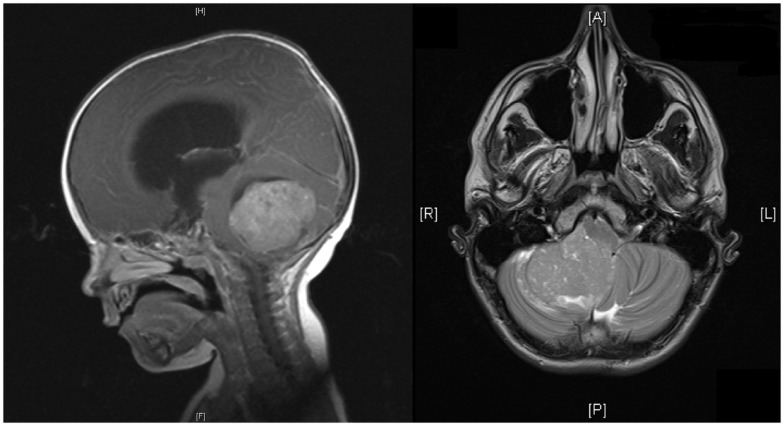
  • Masa cerebelosa con realce de contraste en EN Erythema nodosum is an immune-mediated panniculitis (inflammation of the subcutaneous fat) caused by a type IV (delayed-type) hypersensitivity reaction. It commonly manifests in young women as tender, erythematous nodules on the shins. Erythema Nodosum la línea media o paramedial
  • La masa suele comprimir el 4to ventrículo → puede provocar hidrocefalia
  • Puede haber regiones necróticas, hemorrágicas o quísticas.
  • Puede presentar un realce nodular o lineal en EN Erythema nodosum is an immune-mediated panniculitis (inflammation of the subcutaneous fat) caused by a type IV (delayed-type) hypersensitivity reaction. It commonly manifests in young women as tender, erythematous nodules on the shins. Erythema Nodosum la médula espinal:
    • Conocida como diseminación leptomeníngea
    • Puede alcanzar la cauda equina Cauda Equina The lower part of the spinal cord consisting of the lumbar, sacral, and coccygeal nerve roots. Spinal Cord Injuries en EN Erythema nodosum is an immune-mediated panniculitis (inflammation of the subcutaneous fat) caused by a type IV (delayed-type) hypersensitivity reaction. It commonly manifests in young women as tender, erythematous nodules on the shins. Erythema Nodosum un fenómeno conocido como metástasis en EN Erythema nodosum is an immune-mediated panniculitis (inflammation of the subcutaneous fat) caused by a type IV (delayed-type) hypersensitivity reaction. It commonly manifests in young women as tender, erythematous nodules on the shins. Erythema Nodosum gota
  • Se puede realizar una TC si la RM está contraindicada, pero la TC es menos sensible.
RM de la cabeza que muestra un meduloblastoma cerebeloso

RM de la cabeza que muestra un meduloblastoma cerebeloso en vistas sagital y horizontal:
La vista sagital muestra un meduloblastoma en la línea media de la fosa posterior con una intensidad de señal intermedia. Hay una obstrucción del flujo del LCR, hidrocefalia marcada y edema.
La vista horizontal muestra un meduloblastoma de realce homogéneo que surge del hemisferio cerebeloso derecho con desplazamiento del vermis.

Imagen: “Pediatric medulloblastoma – update on molecular classification driving targeted therapies” por DeSouza RM, Jones BR, Lowis SP, Kurian KM. Licencia: CC BY 3.0

Análisis del líquido cefalorraquídeo

El análisis del líquido cefalorraquídeo es importante en EN Erythema nodosum is an immune-mediated panniculitis (inflammation of the subcutaneous fat) caused by a type IV (delayed-type) hypersensitivity reaction. It commonly manifests in young women as tender, erythematous nodules on the shins. Erythema Nodosum la evaluación de la metástasis, ya que aproximadamente ⅓ de los LOS Neisseria meduloblastomas hacen metástasis a través del LCR. Estos meduloblastomas muestran:

  • Células neoplásicas en EN Erythema nodosum is an immune-mediated panniculitis (inflammation of the subcutaneous fat) caused by a type IV (delayed-type) hypersensitivity reaction. It commonly manifests in young women as tender, erythematous nodules on the shins. Erythema Nodosum el examen citopatológico
  • Proteínas elevadas y pleocitosis leve (hallazgos inespecíficos)
  • ↑ Riesgo de recaída y peor pronóstico
  • Nota: La mayoría de los LOS Neisseria pacientes se presentan con PIC ↑ y/o hidrocefalia, requiere que la punción lumbar se posponga hasta después de la resección quirúrgica para evitar una herniación cerebral.

Histopatología

El diagnóstico requiere la confirmación mediante un examen histopatológico en EN Erythema nodosum is an immune-mediated panniculitis (inflammation of the subcutaneous fat) caused by a type IV (delayed-type) hypersensitivity reaction. It commonly manifests in young women as tender, erythematous nodules on the shins. Erythema Nodosum el momento de la resección quirúrgica.
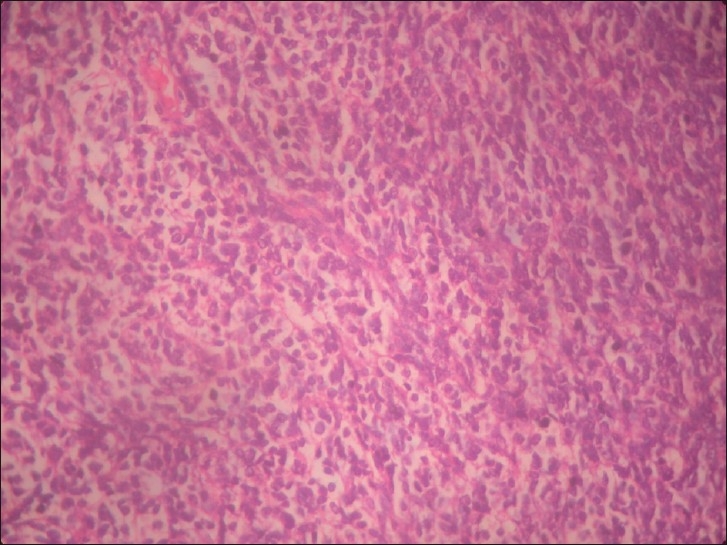
  • Características macroscópicas:
    • Tumores bien circunscritos, grises, blandos y friables
    • Usualmente se relacionan con necrosis Necrosis The death of cells in an organ or tissue due to disease, injury or failure of the blood supply. Ischemic Cell Damage
  • Características microscópicas:
    • Tumores muy celulares con abundante tinción oscura
    • Células pequeñas con poco citoplasma
    • Núcleos ovalados o redondos, hipercromáticos, alargados o en EN Erythema nodosum is an immune-mediated panniculitis (inflammation of the subcutaneous fat) caused by a type IV (delayed-type) hypersensitivity reaction. It commonly manifests in young women as tender, erythematous nodules on the shins. Erythema Nodosum forma de media luna.
    • Suelen tener abundantes mitosis Mitosis A type of cell nucleus division by means of which the two daughter nuclei normally receive identical complements of the number of chromosomes of the somatic cells of the species. Cell Cycle
    • Rosetas de Homer Wright se encuentran hasta en EN Erythema nodosum is an immune-mediated panniculitis (inflammation of the subcutaneous fat) caused by a type IV (delayed-type) hypersensitivity reaction. It commonly manifests in young women as tender, erythematous nodules on the shins. Erythema Nodosum el 40% de los LOS Neisseria pacientes.
  • Marcadores expresados en EN Erythema nodosum is an immune-mediated panniculitis (inflammation of the subcutaneous fat) caused by a type IV (delayed-type) hypersensitivity reaction. It commonly manifests in young women as tender, erythematous nodules on the shins. Erythema Nodosum estudios histopatológicos:
    • Sinaptofisina
    • Enolasa específica de las neuronas
    • Nestina (un marcador de células neuroepiteliales primitivas)
    • Tinción nuclear de β-catenina: presente en EN Erythema nodosum is an immune-mediated panniculitis (inflammation of the subcutaneous fat) caused by a type IV (delayed-type) hypersensitivity reaction. It commonly manifests in young women as tender, erythematous nodules on the shins. Erythema Nodosum los LOS Neisseria tumores de la vía Wnt
    • Mutaciones de P53
Microfotografía de meduloblastoma

Microfotografía de meduloblastoma (H&E, ×20):
La imagen muestra un tumor altamente celular compuesto por rosetas de pequeñas células redondas, con una elevada relación núcleo-citoplasma.

Imagen: “Extra axial adult cerebellopontine angle medulloblastoma: An extremely rare site of tumor with metastasis” por Singh M, Cugati G, Symss NP, Pande A, Vasudevan MC, Ramamurthi R. Licencia: CC BY 2.0

Tratamiento y Pronóstico

Tratamiento

El tratamiento estándar del meduloblastoma es la terapia de modalidad combinada, que incluye cirugía, quimioterapia y radiación.

  • Objetivos de la terapia:
  • Cirugía con la máxima resección segura del tumor Tumor Inflammation
  • Quimioterapia sistémica
  • Radioterapia craneoespinal:
    • Las dosis más altas se asocian a un mejor control del tumor Tumor Inflammation.
    • La radioterapia craneoespinal en EN Erythema nodosum is an immune-mediated panniculitis (inflammation of the subcutaneous fat) caused by a type IV (delayed-type) hypersensitivity reaction. It commonly manifests in young women as tender, erythematous nodules on the shins. Erythema Nodosum niños puede causar:
      • Deterioro neurocognitivo significativo
      • Pérdida de la audición
      • Anomalías de crecimiento
      • Hipotiroidismo
      • Insuficiencia suprarrenal
      • Hipogonadismo e infertilidad
    • La radioterapia craneoespinal debe evitarse o administrarse en EN Erythema nodosum is an immune-mediated panniculitis (inflammation of the subcutaneous fat) caused by a type IV (delayed-type) hypersensitivity reaction. It commonly manifests in young women as tender, erythematous nodules on the shins. Erythema Nodosum dosis más bajas en EN Erythema nodosum is an immune-mediated panniculitis (inflammation of the subcutaneous fat) caused by a type IV (delayed-type) hypersensitivity reaction. It commonly manifests in young women as tender, erythematous nodules on the shins. Erythema Nodosum lactantes y niños muy pequeños.
  • Para la enfermedad con un alto riesgo (enfermedad metastásica, irresecable o recurrente):
    • Se desconoce la terapia óptima.
    • Los LOS Neisseria pacientes deben ser incluidos en EN Erythema nodosum is an immune-mediated panniculitis (inflammation of the subcutaneous fat) caused by a type IV (delayed-type) hypersensitivity reaction. It commonly manifests in young women as tender, erythematous nodules on the shins. Erythema Nodosum un estudio clínico si es posible.

Pronóstico

  • Supervivencia en EN Erythema nodosum is an immune-mediated panniculitis (inflammation of the subcutaneous fat) caused by a type IV (delayed-type) hypersensitivity reaction. It commonly manifests in young women as tender, erythematous nodules on the shins. Erythema Nodosum los LOS Neisseria niños:
    • Con la moderna terapia de modalidad combinada, aproximadamente el 75% de los LOS Neisseria niños diagnosticados de meduloblastoma sobreviven hasta la edad adulta.
    • Supervivencia a 5 años:
      • Niños diagnosticados antes de los LOS Neisseria 3 años: 40%–50%.
      • Si la enfermedad está diseminada en EN Erythema nodosum is an immune-mediated panniculitis (inflammation of the subcutaneous fat) caused by a type IV (delayed-type) hypersensitivity reaction. It commonly manifests in young women as tender, erythematous nodules on the shins. Erythema Nodosum el momento del diagnóstico: 15%–30%.
  • Supervivencia en EN Erythema nodosum is an immune-mediated panniculitis (inflammation of the subcutaneous fat) caused by a type IV (delayed-type) hypersensitivity reaction. It commonly manifests in young women as tender, erythematous nodules on the shins. Erythema Nodosum adultos:
    • Tasa de supervivencia a 5 años: 65%
    • Tasa de supervivencia a 10 años: 52%
  • Los LOS Neisseria tumores Wnt se asocian a un excelente pronóstico.
  • Factores asociados a un mal pronóstico:
    • Edad temprana (< 3 años)
    • Enfermedad diseminada o metastásica en EN Erythema nodosum is an immune-mediated panniculitis (inflammation of the subcutaneous fat) caused by a type IV (delayed-type) hypersensitivity reaction. It commonly manifests in young women as tender, erythematous nodules on the shins. Erythema Nodosum el momento del diagnóstico
    • Tumor Tumor Inflammation residual después de la resección
    • Histología de células grandes o anaplásica
    • Tumores del grupo 3 y 4 no-Wnt/no-Sonic hedgehog
  • En EN Erythema nodosum is an immune-mediated panniculitis (inflammation of the subcutaneous fat) caused by a type IV (delayed-type) hypersensitivity reaction. It commonly manifests in young women as tender, erythematous nodules on the shins. Erythema Nodosum el 80% de los LOS Neisseria supervivientes, hay morbilidades relacionadas con el tratamiento, especialmente las causadas por la radioterapia craneoespinal mencionadas anteriormente.

Diagnóstico Diferencial

Los LOS Neisseria siguientes tumores de la fosa posterior son diagnósticos diferenciales del meduloblastoma:

  • Astrocitoma pilocítico: 2do tumor Tumor Inflammation cerebral más frecuente en EN Erythema nodosum is an immune-mediated panniculitis (inflammation of the subcutaneous fat) caused by a type IV (delayed-type) hypersensitivity reaction. It commonly manifests in young women as tender, erythematous nodules on the shins. Erythema Nodosum los LOS Neisseria niños. La resonancia magnética puede ayudar a distinguir este tumor Tumor Inflammation de otros. Por ejemplo, los LOS Neisseria astrocitomas pilocíticos suelen ser lesiones quísticas solitarias con un nódulo mural o presentan una necrosis Necrosis The death of cells in an organ or tissue due to disease, injury or failure of the blood supply. Ischemic Cell Damage central con un borde grueso de tejido que realza con el contraste. Por el contrario, los LOS Neisseria meduloblastomas tienden a tener múltiples quistes más pequeños, si es que hay quistes.
  • Ependimoma: tumor Tumor Inflammation que surge del revestimiento ependimal del sistema ventricular, normalmente en EN Erythema nodosum is an immune-mediated panniculitis (inflammation of the subcutaneous fat) caused by a type IV (delayed-type) hypersensitivity reaction. It commonly manifests in young women as tender, erythematous nodules on the shins. Erythema Nodosum la base del 4to ventrículo. Los LOS Neisseria tumores suelen ser intracraneales en EN Erythema nodosum is an immune-mediated panniculitis (inflammation of the subcutaneous fat) caused by a type IV (delayed-type) hypersensitivity reaction. It commonly manifests in young women as tender, erythematous nodules on the shins. Erythema Nodosum los LOS Neisseria niños y en EN Erythema nodosum is an immune-mediated panniculitis (inflammation of the subcutaneous fat) caused by a type IV (delayed-type) hypersensitivity reaction. It commonly manifests in young women as tender, erythematous nodules on the shins. Erythema Nodosum la médula espinal en EN Erythema nodosum is an immune-mediated panniculitis (inflammation of the subcutaneous fat) caused by a type IV (delayed-type) hypersensitivity reaction. It commonly manifests in young women as tender, erythematous nodules on the shins. Erythema Nodosum los LOS Neisseria adultos. Los LOS Neisseria ependimomas se extienden más comúnmente a través del agujero de Magendie (inferiormente) o de Luschka (lateralmente), mientras que este tipo de extensión es rara en EN Erythema nodosum is an immune-mediated panniculitis (inflammation of the subcutaneous fat) caused by a type IV (delayed-type) hypersensitivity reaction. It commonly manifests in young women as tender, erythematous nodules on the shins. Erythema Nodosum el meduloblastoma. La resonancia magnética es la imagenología estándar, pero se requiere la confirmación histológica para el diagnóstico. El tratamiento consiste en EN Erythema nodosum is an immune-mediated panniculitis (inflammation of the subcutaneous fat) caused by a type IV (delayed-type) hypersensitivity reaction. It commonly manifests in young women as tender, erythematous nodules on the shins. Erythema Nodosum la resección quirúrgica y la radioterapia y/o quimioterapia adyuvante (según la edad).
  • Tumores teratoides/rabdoides atípicos: un tumor Tumor Inflammation primario del SNC poco frecuente y agresivo que surge de células embrionarias y que puede parecer similar a un meduloblastoma en EN Erythema nodosum is an immune-mediated panniculitis (inflammation of the subcutaneous fat) caused by a type IV (delayed-type) hypersensitivity reaction. It commonly manifests in young women as tender, erythematous nodules on the shins. Erythema Nodosum la RM. Los LOS Neisseria tumores teratoides/rabdoides atípicos pueden formarse en EN Erythema nodosum is an immune-mediated panniculitis (inflammation of the subcutaneous fat) caused by a type IV (delayed-type) hypersensitivity reaction. It commonly manifests in young women as tender, erythematous nodules on the shins. Erythema Nodosum cualquier parte del SNC, pero normalmente se desarrollan en EN Erythema nodosum is an immune-mediated panniculitis (inflammation of the subcutaneous fat) caused by a type IV (delayed-type) hypersensitivity reaction. It commonly manifests in young women as tender, erythematous nodules on the shins. Erythema Nodosum el cerebelo, más comúnmente en EN Erythema nodosum is an immune-mediated panniculitis (inflammation of the subcutaneous fat) caused by a type IV (delayed-type) hypersensitivity reaction. It commonly manifests in young women as tender, erythematous nodules on the shins. Erythema Nodosum niños < 3 años. Estos tumores contienen células neuroepiteliales, rabdoides, epiteliales y mesenquimales. En EN Erythema nodosum is an immune-mediated panniculitis (inflammation of the subcutaneous fat) caused by a type IV (delayed-type) hypersensitivity reaction. It commonly manifests in young women as tender, erythematous nodules on the shins. Erythema Nodosum comparación con los LOS Neisseria meduloblastomas, es más probable que los LOS Neisseria tumores teratoides/rabdoides atípicos afecten a los LOS Neisseria hemisferios laterales o al AL Amyloidosis ángulo pontocerebeloso y contengan hemorragias dentro del tumor Tumor Inflammation.

Referencias

  1. AlRayahi, J., Alwalid, O., Mubarak, W., Maaz, A. U. R., & Mifsud, W. (2023). Pediatric brain tumors in the molecular era: Updates for the radiologist. Seminars in Roentgenology, 58(1), 47–66. https://doi.org/10.1053/j.ro.2022.09.004
  2. DeAngelis, LM, Wen, PY. (2018). Primary and metastatic tumors of the nervous system. In Jameson, J., et al. (Eds.), Harrison’s Principles of Internal Medicine, 20e. McGraw-Hill. https://accessmedicine-mhmedical-com.aucmed.idm.oclc.org/content.aspx?bookid=2129&sectionid=192016511
  3. National Organization of Rare Diseases. (2013). Medulloblastoma. Retrieved April 14, 2025, from https://rarediseases.org/rare-diseases/medulloblastoma/
  4. Pomeroy, SL. (2025). Clinical presentation, diagnosis, and risk stratification of medulloblastoma. UpToDate. Retrieved April 14, 2025, from https://www.uptodate.com/contents/clinical-presentation-diagnosis-and-risk-stratification-of-medulloblastoma
  5. Pomeroy, SL. (2025). Histopathology, genetics, and molecular groups of medulloblastoma. UpToDate. Retrieved April 14, 2025, from https://www.uptodate.com/contents/histopathology-genetics-and-molecular-groups-of-medulloblastoma
  6. Pomeroy, SL. (2025). Treatment and prognosis of medulloblastoma. UpToDate. Retrieved April 14, 2025, from https://www.uptodate.com/contents/treatment-and-prognosis-of-medulloblastoma
  7. Rossi, A, et al. (2008). Medulloblastoma: From molecular pathology to therapy. Clin Cancer Res. 14(4), 971‒976. https://pubmed.ncbi.nlm.nih.gov/18281528/
  8. Pfister, S, et al. (2009). Outcome prediction in pediatric medulloblastoma based on DNA copy-number aberrations of chromosomes 6q and 17q and the MYC and MYCN loci. J Clin Oncol. 27(10), 1627‒1636. https://pubmed.ncbi.nlm.nih.gov/19255330/

¡Crea tu cuenta gratis o inicia una sesión para seguir leyendo!

Regístrate ahora y obtén acceso gratuito a Lecturio con páginas de concepto, videos médicos y cuestionarios para tu educación médica.

User Reviews

Que tengas una sesión de estudio alegre y navideña 🎁 Ahorra 50% en todos los planes >>

Details