
Domina Conceptos Médicos

Estudia para la escuela de medicina y tus examenes con Lecturio.

Hipercalcemia

La hipercalcemia (calcio sérico > 10,5 mg/dL) puede ser el resultado de varias afecciones, la mayoría de las cuales se deben al AL Amyloidosis hiperparatiroidismo y a las neoplasias. Otras causas son los LOS Neisseria trastornos que provocan la elevación de la vitamina D, las enfermedades granulomatosas y el uso de ciertos agentes farmacológicos. Los LOS Neisseria niveles de calcio se regulan y se ven afectados por factores como la ingesta dietética y el pH pH The quantitative measurement of the acidity or basicity of a solution. Acid-Base Balance, y los LOS Neisseria niveles de la hormona paratiroidea (PTH, por sus siglas en EN Erythema nodosum is an immune-mediated panniculitis (inflammation of the subcutaneous fat) caused by a type IV (delayed-type) hypersensitivity reaction. It commonly manifests in young women as tender, erythematous nodules on the shins. Erythema Nodosum inglés), la vitamina D y la albúmina. Los LOS Neisseria síntomas varían en EN Erythema nodosum is an immune-mediated panniculitis (inflammation of the subcutaneous fat) caused by a type IV (delayed-type) hypersensitivity reaction. It commonly manifests in young women as tender, erythematous nodules on the shins. Erythema Nodosum función de los LOS Neisseria niveles de calcio y de la aparición de la hipercalcemia. En EN Erythema nodosum is an immune-mediated panniculitis (inflammation of the subcutaneous fat) caused by a type IV (delayed-type) hypersensitivity reaction. It commonly manifests in young women as tender, erythematous nodules on the shins. Erythema Nodosum general, se observan manifestaciones neuropsiquiátricas (confusión, alteración del estado mental), gastrointestinales (vómitos, dolor Dolor Inflammation abdominal), musculoesqueléticas ( dolor Dolor Inflammation óseo, debilidad) y renales (poliuria, polidipsia). Es necesario confirmar la hipercalcemia. La corrección del valor se basa en EN Erythema nodosum is an immune-mediated panniculitis (inflammation of the subcutaneous fat) caused by a type IV (delayed-type) hypersensitivity reaction. It commonly manifests in young women as tender, erythematous nodules on the shins. Erythema Nodosum los LOS Neisseria niveles de albúmina o después de determinar los LOS Neisseria niveles de calcio ionizado (la forma metabólicamente activa), a lo que sigue la determinación de los LOS Neisseria niveles de la PTH. Las pruebas de laboratorio y los LOS Neisseria estudios de imagenología posteriores se solicitan en EN Erythema nodosum is an immune-mediated panniculitis (inflammation of the subcutaneous fat) caused by a type IV (delayed-type) hypersensitivity reaction. It commonly manifests in young women as tender, erythematous nodules on the shins. Erythema Nodosum función del antecedente y la presentación. La corrección de la hipercalcemia depende de su gravedad. Los LOS Neisseria niveles de calcio > 14 mg/dL se tratan con hidratación salina isotónica intravenosa, calcitonina y bifosfonatos. La hemodiálisis se considera en EN Erythema nodosum is an immune-mediated panniculitis (inflammation of the subcutaneous fat) caused by a type IV (delayed-type) hypersensitivity reaction. It commonly manifests in young women as tender, erythematous nodules on the shins. Erythema Nodosum casos raros. Se recomienda el tratamiento de la causa subyacente.

Last updated: Dec 15, 2025

Editorial responsibility: Stanley Oiseth, Lindsay Jones, Evelin Maza

Homeostasis del Calcio

Calcio

El calcio es el mineral más abundante en EN Erythema nodosum is an immune-mediated panniculitis (inflammation of the subcutaneous fat) caused by a type IV (delayed-type) hypersensitivity reaction. It commonly manifests in young women as tender, erythematous nodules on the shins. Erythema Nodosum el cuerpo humano, y el 99% se encuentra sólo en EN Erythema nodosum is an immune-mediated panniculitis (inflammation of the subcutaneous fat) caused by a type IV (delayed-type) hypersensitivity reaction. It commonly manifests in young women as tender, erythematous nodules on the shins. Erythema Nodosum los LOS Neisseria huesos. El calcio en EN Erythema nodosum is an immune-mediated panniculitis (inflammation of the subcutaneous fat) caused by a type IV (delayed-type) hypersensitivity reaction. It commonly manifests in young women as tender, erythematous nodules on the shins. Erythema Nodosum la sangre existe en EN Erythema nodosum is an immune-mediated panniculitis (inflammation of the subcutaneous fat) caused by a type IV (delayed-type) hypersensitivity reaction. It commonly manifests in young women as tender, erythematous nodules on the shins. Erythema Nodosum 3 formas:

  • El 15% del calcio está unido a pequeños aniones (citrato, fosfato).
  • El 45% del calcio está ligado a las proteínas (principalmente a la albúmina).
  • El 40% del calcio está ionizado o en EN Erythema nodosum is an immune-mediated panniculitis (inflammation of the subcutaneous fat) caused by a type IV (delayed-type) hypersensitivity reaction. It commonly manifests in young women as tender, erythematous nodules on the shins. Erythema Nodosum forma libre (metabólicamente activo o puede ser transportado a las células)

Niveles:

  • Calcio total sérico normal: 8,5–10,5 mg/dL (2,12–2,62 mmol/L)
  • Calcio ionizado normal: 4,65–5,25 mg/dL (1,16–1,31 mmol/L)

La importancia del calcio:

  • Mineralización ósea
  • Cofactor de enzimas
  • Función cardíaca y nerviosa
  • Contracción muscular
  • Regulación de los LOS Neisseria mecanismos de coagulación
  • Mensajero intracelular eficaz para varias moléculas como la insulina

Regulación del calcio

Los LOS Neisseria huesos, el intestino y los LOS Neisseria riñones participan en EN Erythema nodosum is an immune-mediated panniculitis (inflammation of the subcutaneous fat) caused by a type IV (delayed-type) hypersensitivity reaction. It commonly manifests in young women as tender, erythematous nodules on the shins. Erythema Nodosum la homeostasis Homeostasis The processes whereby the internal environment of an organism tends to remain balanced and stable. Cell Injury and Death.

Elementos clave de la regulación del calcio:
  • Hormona paratiroidea (PTH, por sus siglas en EN Erythema nodosum is an immune-mediated panniculitis (inflammation of the subcutaneous fat) caused by a type IV (delayed-type) hypersensitivity reaction. It commonly manifests in young women as tender, erythematous nodules on the shins. Erythema Nodosum inglés) de las glándulas paratiroides:
    • ↑ Producción de vitamina D en EN Erythema nodosum is an immune-mediated panniculitis (inflammation of the subcutaneous fat) caused by a type IV (delayed-type) hypersensitivity reaction. It commonly manifests in young women as tender, erythematous nodules on the shins. Erythema Nodosum los LOS Neisseria riñones, ↑ reabsorción de calcio en EN Erythema nodosum is an immune-mediated panniculitis (inflammation of the subcutaneous fat) caused by a type IV (delayed-type) hypersensitivity reaction. It commonly manifests in young women as tender, erythematous nodules on the shins. Erythema Nodosum los LOS Neisseria túbulos distales.
    • ↑ Absorción del calcio en EN Erythema nodosum is an immune-mediated panniculitis (inflammation of the subcutaneous fat) caused by a type IV (delayed-type) hypersensitivity reaction. It commonly manifests in young women as tender, erythematous nodules on the shins. Erythema Nodosum el intestino
    • ↑ Resorción ósea (liberación de calcio y fosfato de los LOS Neisseria huesos)
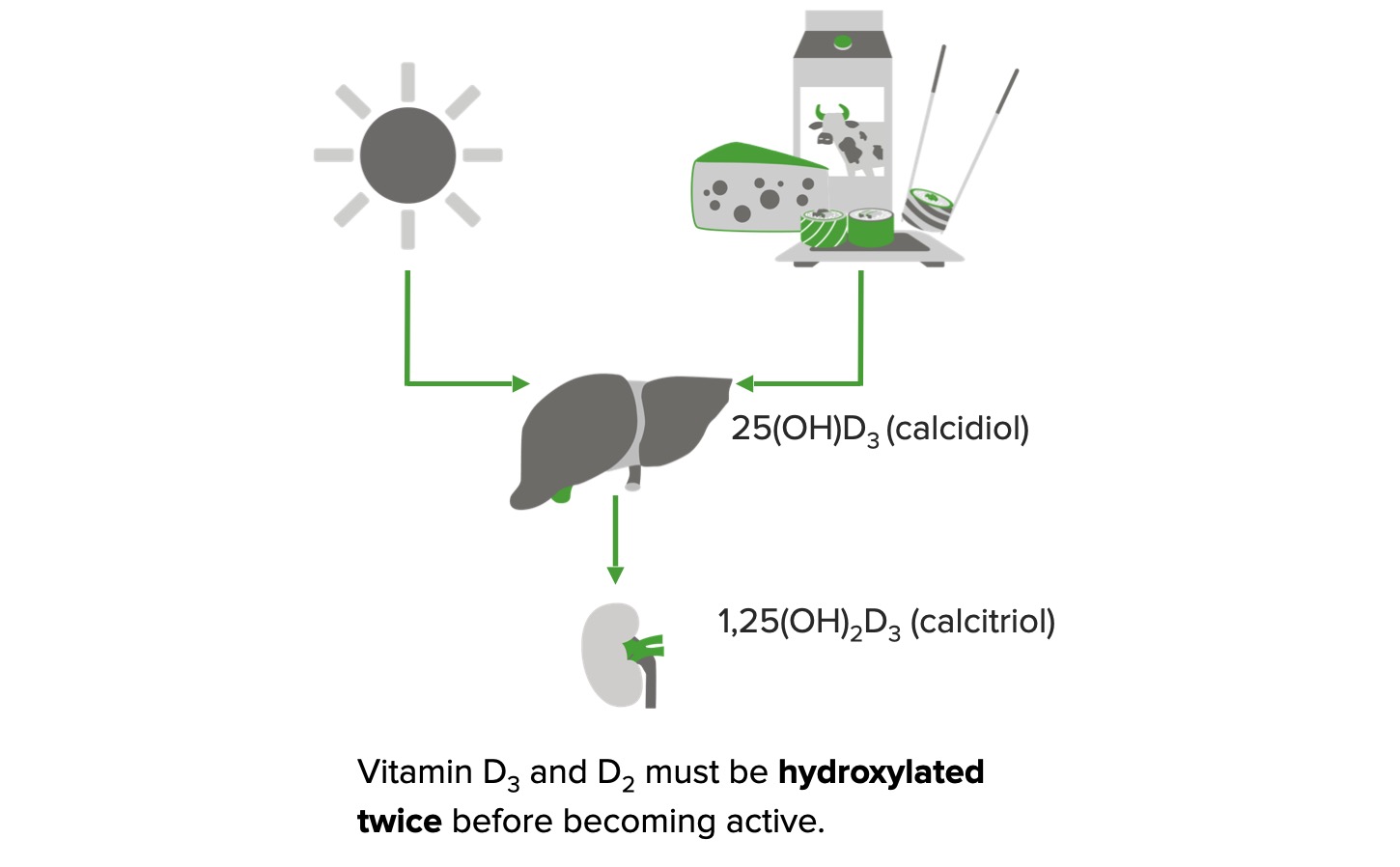
  • Vitamina D:
    • En EN Erythema nodosum is an immune-mediated panniculitis (inflammation of the subcutaneous fat) caused by a type IV (delayed-type) hypersensitivity reaction. It commonly manifests in young women as tender, erythematous nodules on the shins. Erythema Nodosum presencia de la luz solar, el 7-dihidrocolesterol se convierte en EN Erythema nodosum is an immune-mediated panniculitis (inflammation of the subcutaneous fat) caused by a type IV (delayed-type) hypersensitivity reaction. It commonly manifests in young women as tender, erythematous nodules on the shins. Erythema Nodosum colecalciferol (vitamina D3) en EN Erythema nodosum is an immune-mediated panniculitis (inflammation of the subcutaneous fat) caused by a type IV (delayed-type) hypersensitivity reaction. It commonly manifests in young women as tender, erythematous nodules on the shins. Erythema Nodosum la piel.
    • La vitamina D3 se convierte en EN Erythema nodosum is an immune-mediated panniculitis (inflammation of the subcutaneous fat) caused by a type IV (delayed-type) hypersensitivity reaction. It commonly manifests in young women as tender, erythematous nodules on the shins. Erythema Nodosum 25-hidroxivitamina D ( calcidiol calcidiol The major circulating metabolite of vitamin d3. It is produced in the liver and is the best indicator of the body’s vitamin D stores. It is effective in the treatment of rickets and osteomalacia, both in azotemic and non-azotemic patients. Calcifediol also has mineralizing properties. Calcium Hemostasis and Bone Metabolism) en EN Erythema nodosum is an immune-mediated panniculitis (inflammation of the subcutaneous fat) caused by a type IV (delayed-type) hypersensitivity reaction. It commonly manifests in young women as tender, erythematous nodules on the shins. Erythema Nodosum el hígado.
    • En EN Erythema nodosum is an immune-mediated panniculitis (inflammation of the subcutaneous fat) caused by a type IV (delayed-type) hypersensitivity reaction. It commonly manifests in young women as tender, erythematous nodules on the shins. Erythema Nodosum el riñón, el calcidiol calcidiol The major circulating metabolite of vitamin d3. It is produced in the liver and is the best indicator of the body’s vitamin D stores. It is effective in the treatment of rickets and osteomalacia, both in azotemic and non-azotemic patients. Calcifediol also has mineralizing properties. Calcium Hemostasis and Bone Metabolism se convierte en EN Erythema nodosum is an immune-mediated panniculitis (inflammation of the subcutaneous fat) caused by a type IV (delayed-type) hypersensitivity reaction. It commonly manifests in young women as tender, erythematous nodules on the shins. Erythema Nodosum la forma activa, la 1,25-dihidroxivitamina D ( calcitriol Calcitriol The physiologically active form of vitamin d. It is formed primarily in the kidney by enzymatic hydroxylation of 25-hydroxycholecalciferol (calcifediol). Its production is stimulated by low blood calcium levels and parathyroid hormone. Calcitriol increases intestinal absorption of calcium and phosphorus, and in concert with parathyroid hormone increases bone resorption. Parathyroid Glands: Anatomy).
    • Efectos: activación de los LOS Neisseria osteoclastos para liberar el calcio y fósforo, y la absorción de calcio y fosfato intestinal
  • pH pH The quantitative measurement of the acidity or basicity of a solution. Acid-Base Balance:
    • ↑ El pH pH The quantitative measurement of the acidity or basicity of a solution. Acid-Base Balance (alcalosis) ↑ la unión del calcio a la albúmina = ↓ calcio ionizado.
    • ↓ El pH pH The quantitative measurement of the acidity or basicity of a solution. Acid-Base Balance ( acidosis Acidosis A pathologic condition of acid accumulation or depletion of base in the body. The two main types are respiratory acidosis and metabolic acidosis, due to metabolic acid build up. Respiratory Acidosis) ↓ la unión del calcio a la albúmina = ↑ calcio ionizado.
  • Albúmina:
    • ↓ Proteína/albúmina sérica (i.e., síndrome nefrótico) = ↓ calcio sérico (pseudohipocalcemia)
    • ↑ Proteína/albúmina sérica (i.e., mieloma múltiple) = ↑ calcio sérico (pseudohipercalcemia)
    • Los LOS Neisseria niveles de calcio ionizado son normales en EN Erythema nodosum is an immune-mediated panniculitis (inflammation of the subcutaneous fat) caused by a type IV (delayed-type) hypersensitivity reaction. It commonly manifests in young women as tender, erythematous nodules on the shins. Erythema Nodosum los LOS Neisseria casos anteriores.
    • Cada 1 g/dL ↓ en EN Erythema nodosum is an immune-mediated panniculitis (inflammation of the subcutaneous fat) caused by a type IV (delayed-type) hypersensitivity reaction. It commonly manifests in young women as tender, erythematous nodules on the shins. Erythema Nodosum albúmina → ↓ en EN Erythema nodosum is an immune-mediated panniculitis (inflammation of the subcutaneous fat) caused by a type IV (delayed-type) hypersensitivity reaction. It commonly manifests in young women as tender, erythematous nodules on the shins. Erythema Nodosum calcio en EN Erythema nodosum is an immune-mediated panniculitis (inflammation of the subcutaneous fat) caused by a type IV (delayed-type) hypersensitivity reaction. It commonly manifests in young women as tender, erythematous nodules on the shins. Erythema Nodosum 0,8 mg/dL
    • Calcio corregido (mg/dL) = calcio total medido (mg/dL) + [0,8 x (4,0 – concentración de albúmina (g/dL))]
  • Otros factores:
    • La calcitonina de la glándula tiroides se opone a los LOS Neisseria efectos de la PTH → ↓ calcio
    • Hiperfosfatemia (↑ fijación de fosfato, ↓ calcio ionizado)
    • Hipomagnesemia (↓ liberación de PTH → ↓ calcio)
Metabolismo del calcio

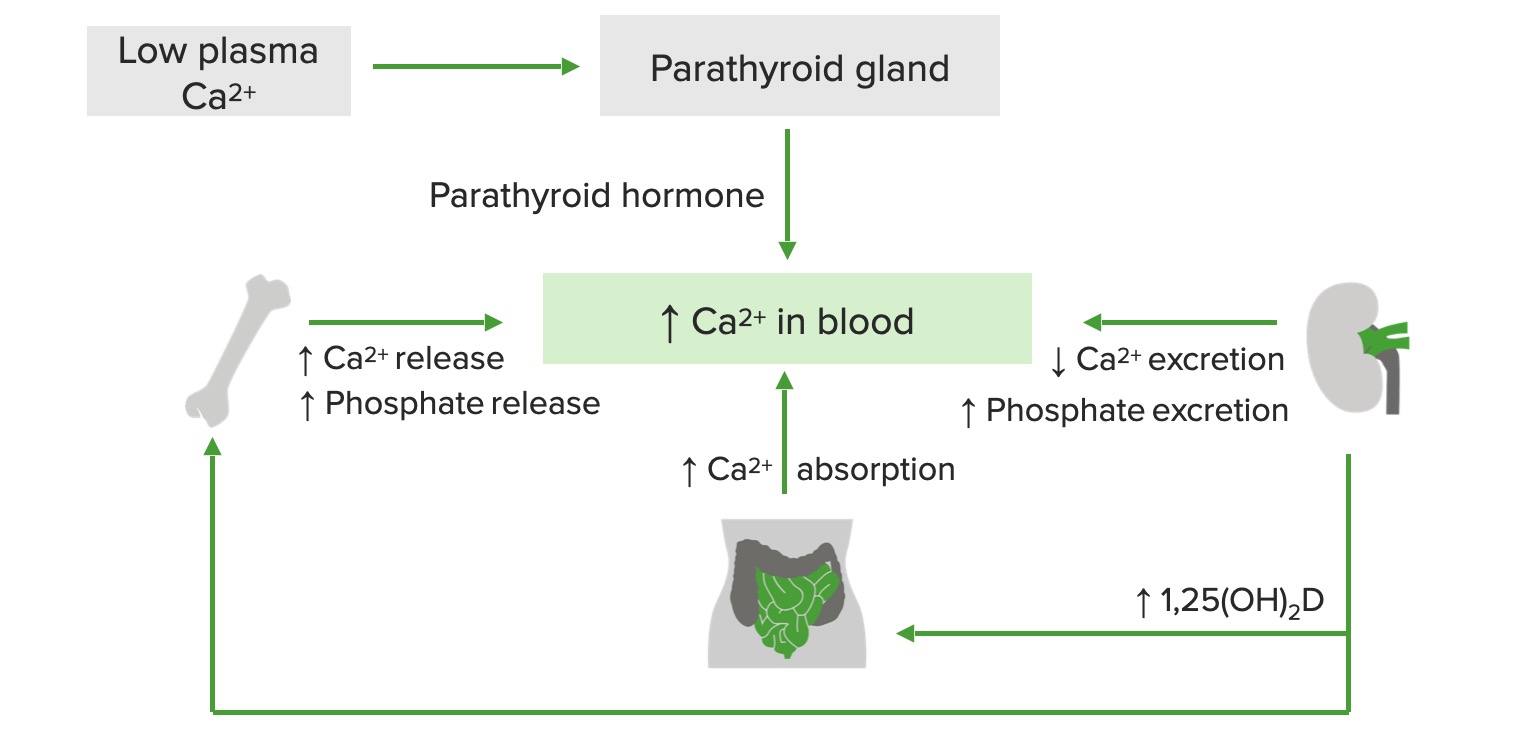
Diagrama esquemático de la regulación del calcio:
Un nivel bajo de calcio en el plasma estimula la liberación de la hormona paratiroidea, que aumenta la liberación de calcio y fosfato del hueso, la absorción de calcio en el tracto gastrointestinal y la producción de vitamina D en los riñones. La vitamina D activa, a su vez, aumenta la liberación de calcio de los huesos y la absorción de calcio en el intestino delgado.
Ca+2: calcio
1,25(OH)2D: calcitriol

Imagen por Lecturio.

Epidemiología y Etiología

Epidemiología

  • La hipercalcemia suele detectarse de forma incidental.
  • Prevalencia en EN Erythema nodosum is an immune-mediated panniculitis (inflammation of the subcutaneous fat) caused by a type IV (delayed-type) hypersensitivity reaction. It commonly manifests in young women as tender, erythematous nodules on the shins. Erythema Nodosum la población general: 1%–2%
  • El hiperparatiroidismo primario y la neoplasia representan el 90% de las causas.
  • La hipercalcemia grave suele deberse a una hipercalcemia relacionada con una neoplasia maligna

Mecanismos

La hipercalcemia se caracteriza por niveles elevados de calcio y suele ser el resultado de uno de estos factores o de una combinación de ellos:

  • Aumento de la resorción ósea
  • Aumento de la absorción de calcio en EN Erythema nodosum is an immune-mediated panniculitis (inflammation of the subcutaneous fat) caused by a type IV (delayed-type) hypersensitivity reaction. It commonly manifests in young women as tender, erythematous nodules on the shins. Erythema Nodosum el tracto gastrointestinal
  • Aumento de la reabsorción tubular renal de calcio
  • Disminución de la excreción renal de calcio

Etiología

Aumento de la resorción ósea:

  • Hiperparatiroidismo:
    • ↑ PTH → resorción ósea por activación de osteoclastos (también con ↑ de absorción intestinal de calcio).
    • Primario (frecuentemente a partir de un adenoma paratiroideo)
  • Tirotoxicosis: La hormona tiroidea medía la resorción ósea.
  • La malignidad aumenta la resorción ósea por:
    • Secreción de la proteína relacionada con la PTH ( PTHrP PTHrP Hypercalcemia) de los LOS Neisseria tumores sólidos
    • Metástasis: ↑ actividad osteoclástica → ↑ resorción ósea
    • ↑ Factores activadores de los LOS Neisseria osteoclastos, como la interleucina-6 y la linfotoxina ( en EN Erythema nodosum is an immune-mediated panniculitis (inflammation of the subcutaneous fat) caused by a type IV (delayed-type) hypersensitivity reaction. It commonly manifests in young women as tender, erythematous nodules on the shins. Erythema Nodosum el mieloma múltiple)
    • Producción de calcitriol Calcitriol The physiologically active form of vitamin d. It is formed primarily in the kidney by enzymatic hydroxylation of 25-hydroxycholecalciferol (calcifediol). Its production is stimulated by low blood calcium levels and parathyroid hormone. Calcitriol increases intestinal absorption of calcium and phosphorus, and in concert with parathyroid hormone increases bone resorption. Parathyroid Glands: Anatomy de los LOS Neisseria macrófagos ( en EN Erythema nodosum is an immune-mediated panniculitis (inflammation of the subcutaneous fat) caused by a type IV (delayed-type) hypersensitivity reaction. It commonly manifests in young women as tender, erythematous nodules on the shins. Erythema Nodosum el linfoma)
  • Otros:
    • Inmovilización
    • Enfermedad de Paget ósea
    • Estrógenos o antiestrógenos (tamoxifeno) en EN Erythema nodosum is an immune-mediated panniculitis (inflammation of the subcutaneous fat) caused by a type IV (delayed-type) hypersensitivity reaction. It commonly manifests in young women as tender, erythematous nodules on the shins. Erythema Nodosum pacientes con cáncer de mama
    • Hipervitaminosis A: aumento de la resorción ósea dependiente de la dosis

Aumento de la absorción de calcio:

  • ERC:
    • La enfermedad renal por sí sola no causa hipercalcemia (el ↑fosfato concurrente y la disminución de la síntesis de calcitriol Calcitriol The physiologically active form of vitamin d. It is formed primarily in the kidney by enzymatic hydroxylation of 25-hydroxycholecalciferol (calcifediol). Its production is stimulated by low blood calcium levels and parathyroid hormone. Calcitriol increases intestinal absorption of calcium and phosphorus, and in concert with parathyroid hormone increases bone resorption. Parathyroid Glands: Anatomy la previenen)
    • Sin embargo, los LOS Neisseria pacientes reciben carbonato cálcico como quelante del fosfato y calcitriol Calcitriol The physiologically active form of vitamin d. It is formed primarily in the kidney by enzymatic hydroxylation of 25-hydroxycholecalciferol (calcifediol). Its production is stimulated by low blood calcium levels and parathyroid hormone. Calcitriol increases intestinal absorption of calcium and phosphorus, and in concert with parathyroid hormone increases bone resorption. Parathyroid Glands: Anatomy para el hiperparatiroidismo secundario con hipocalcemia.
    • La combinación anterior aumenta el riesgo de hipercalcemia en EN Erythema nodosum is an immune-mediated panniculitis (inflammation of the subcutaneous fat) caused by a type IV (delayed-type) hypersensitivity reaction. It commonly manifests in young women as tender, erythematous nodules on the shins. Erythema Nodosum pacientes con ERC
  • Síndrome de la leche-alcalina:
    • Resultados de ↑ ingesta de leche o carbonato de calcio (cuando se trata de dispepsia u osteoporosis Osteoporosis Osteoporosis refers to a decrease in bone mass and density leading to an increased number of fractures. There are 2 forms of osteoporosis: primary, which is commonly postmenopausal or senile; and secondary, which is a manifestation of immobilization, underlying medical disorders, or long-term use of certain medications. Osteoporosis)
    • Síndrome de hipercalcemia + alcalosis (que además ↑ reabsorción de calcio) + insuficiencia renal
  • Toxicidad de la vitamina D:
    • A menudo debido a la ingestión de calcitriol Calcitriol The physiologically active form of vitamin d. It is formed primarily in the kidney by enzymatic hydroxylation of 25-hydroxycholecalciferol (calcifediol). Its production is stimulated by low blood calcium levels and parathyroid hormone. Calcitriol increases intestinal absorption of calcium and phosphorus, and in concert with parathyroid hormone increases bone resorption. Parathyroid Glands: Anatomy para tratar el hipoparatiroidismo o la hipocalcemia
    • Puede resultar de los LOS Neisseria suplementos de venta libre

Otros:

  • Insuficiencia suprarrenal: ↑ reabsorción ósea, ↑ reabsorción renal de calcio.
  • Feocromocitoma: por PTHrP PTHrP Hypercalcemia o como parte del síndrome de neoplasia endócrina múltiple
  • Litio: ↑ PTH
  • Diuréticos tiazídicos: ↓ excreción renal de calcio
  • Efecto metabólico de la toxicidad de la teofilina
  • Enfermedad granulomatosa crónica ( sarcoidosis Sarcoidosis Sarcoidosis is a multisystem inflammatory disease that causes noncaseating granulomas. The exact etiology is unknown. Sarcoidosis usually affects the lungs and thoracic lymph nodes, but it can also affect almost every system in the body, including the skin, heart, and eyes, most commonly. Sarcoidosis, tuberculosis Tuberculosis Tuberculosis (TB) is an infectious disease caused by Mycobacterium tuberculosis complex bacteria. The bacteria usually attack the lungs but can also damage other parts of the body. Approximately 30% of people around the world are infected with this pathogen, with the majority harboring a latent infection. Tuberculosis spreads through the air when a person with active pulmonary infection coughs or sneezes. Tuberculosis): producción ectópica de vitamina D
  • Hipercalcemia hipocalciúrica familiar (FHH, por sus siglas en EN Erythema nodosum is an immune-mediated panniculitis (inflammation of the subcutaneous fat) caused by a type IV (delayed-type) hypersensitivity reaction. It commonly manifests in young women as tender, erythematous nodules on the shins. Erythema Nodosum inglés): mutación en EN Erythema nodosum is an immune-mediated panniculitis (inflammation of the subcutaneous fat) caused by a type IV (delayed-type) hypersensitivity reaction. It commonly manifests in young women as tender, erythematous nodules on the shins. Erythema Nodosum el gen del receptor Receptor Receptors are proteins located either on the surface of or within a cell that can bind to signaling molecules known as ligands (e.g., hormones) and cause some type of response within the cell. Receptors del calcio
  • Síndrome de Williams: mutaciones de novo

Presentación Clínica

Las manifestaciones dependen del nivel y del inicio de la hipercalcemia.

Hipercalcemia con calcio total corregido por albúmina < 12 mg/dL:

  • Generalmente asintomático
  • Puede manifestarse con síntomas vagos:
    • Depresión
    • Fatiga
    • Estreñimiento

Hipercalcemia con calcio total corregido por albúmina > 12 mg/dL:

  • Presentación aguda:
    • Gastrointestinal: anorexia Anorexia The lack or loss of appetite accompanied by an aversion to food and the inability to eat. It is the defining characteristic of the disorder anorexia nervosa. Anorexia Nervosa, náuseas, vómitos, estreñimiento, dolor Dolor Inflammation abdominal
    • Neurológicos: confusión, letargia, hiporreflexia, alteración del estado mental, coma Coma Coma is defined as a deep state of unarousable unresponsiveness, characterized by a score of 3 points on the GCS. A comatose state can be caused by a multitude of conditions, making the precise epidemiology and prognosis of coma difficult to determine. Coma (especialmente si > 14 mg/dL)
    • Cardiovasculares: hipertensión, bradicardia, cambios en EN Erythema nodosum is an immune-mediated panniculitis (inflammation of the subcutaneous fat) caused by a type IV (delayed-type) hypersensitivity reaction. It commonly manifests in young women as tender, erythematous nodules on the shins. Erythema Nodosum el ECG ECG An electrocardiogram (ECG) is a graphic representation of the electrical activity of the heart plotted against time. Adhesive electrodes are affixed to the skin surface allowing measurement of cardiac impulses from many angles. The ECG provides 3-dimensional information about the conduction system of the heart, the myocardium, and other cardiac structures. Electrocardiogram (ECG) (bloqueo cardíaco de primer grado, acortamiento del intervalo QT, ondas J, inversiones de la onda T)
    • Renal: poliuria o nicturia, polidipsia
    • Musculoesquelético: debilidad, dolor Dolor Inflammation de huesos
  • Presentación crónica:
    • Osteoporosis Osteoporosis Osteoporosis refers to a decrease in bone mass and density leading to an increased number of fractures. There are 2 forms of osteoporosis: primary, which is commonly postmenopausal or senile; and secondary, which is a manifestation of immobilization, underlying medical disorders, or long-term use of certain medications. Osteoporosis con dolor Dolor Inflammation de huesos
    • Nefrocalcinosis
    • Queratopatía en EN Erythema nodosum is an immune-mediated panniculitis (inflammation of the subcutaneous fat) caused by a type IV (delayed-type) hypersensitivity reaction. It commonly manifests in young women as tender, erythematous nodules on the shins. Erythema Nodosum banda (degeneración de la córnea por depósito de calcio)
    • Condrocalcinosis
    • Pancreatitis Pancreatitis Inflammation of the pancreas. Pancreatitis is classified as acute unless there are computed tomographic or endoscopic retrograde cholangiopancreatographic findings of chronic pancreatitis. The two most common forms of acute pancreatitis are alcoholic pancreatitis and gallstone pancreatitis. Acute Pancreatitis
    • Hipertensión

Crisis hipercalcémica/hipercalcemia grave:

  • Condición que amenaza la vida que ocurre cuando el calcio total > 14 mg/dL
  • Síntomas: deshidratación, náuseas, vómitos, fiebre, psicosis, coma Coma Coma is defined as a deep state of unarousable unresponsiveness, characterized by a score of 3 points on the GCS. A comatose state can be caused by a multitude of conditions, making the precise epidemiology and prognosis of coma difficult to determine. Coma

Mnemotecnia:

Para recordar los LOS Neisseria síntomas clínicos comunes de la hipercalcemia, recuerde quejidos, huesos, piedras, gemidos, tronos y síntomas psíquicos”:

  • Quejidos: dolor Dolor Inflammation abdominal, náuseas, vómitos, úlceras gástricas y duodenales, pancreatitis Pancreatitis Inflammation of the pancreas. Pancreatitis is classified as acute unless there are computed tomographic or endoscopic retrograde cholangiopancreatographic findings of chronic pancreatitis. The two most common forms of acute pancreatitis are alcoholic pancreatitis and gallstone pancreatitis. Acute Pancreatitis
  • Huesos: osteopenia Osteopenia Osteoporosis, osteoporosis Osteoporosis Osteoporosis refers to a decrease in bone mass and density leading to an increased number of fractures. There are 2 forms of osteoporosis: primary, which is commonly postmenopausal or senile; and secondary, which is a manifestation of immobilization, underlying medical disorders, or long-term use of certain medications. Osteoporosis, dolor Dolor Inflammation de huesos
  • Piedras: nefrolitiasis (cálculos de fosfato de calcio o de oxalato de calcio)
  • Gemidos: fatiga, malestar
  • Tronos: poliuria, polidipsia, estreñimiento
  • Síntomas psíquicos: confusión, depresión, pérdida de memoria

Diagnóstico

Tabla: Evaluación de la hipercalcemia
Niveles de PTH Diagnóstico y pruebas adicionales
Elevado Hiperparatiroidismo primario
Normal/ligeramente elevado
  • Calcio urinario bajo en EN Erythema nodosum is an immune-mediated panniculitis (inflammation of the subcutaneous fat) caused by a type IV (delayed-type) hypersensitivity reaction. It commonly manifests in young women as tender, erythematous nodules on the shins. Erythema Nodosum la hipercalcemia hipocalciúrica familiar
  • De lo contrario, es hiperparatiroidismo primario probablemente
Bajo
  • PTHrP PTHrP Hypercalcemia: malignidad
  • ↑ 1,25(OH)2D: linfoma, enfermedad granulomatosa
  • ↑ 25(OH)D: toxicidad de la vitamina D
  • Sin PTHrP PTHrP Hypercalcemia y con 1,25(OH)2D o 25(OH)D normales:
    • Electroforesis de proteínas en EN Erythema nodosum is an immune-mediated panniculitis (inflammation of the subcutaneous fat) caused by a type IV (delayed-type) hypersensitivity reaction. It commonly manifests in young women as tender, erythematous nodules on the shins. Erythema Nodosum suero y/o Electroforesis de proteínas en EN Erythema nodosum is an immune-mediated panniculitis (inflammation of the subcutaneous fat) caused by a type IV (delayed-type) hypersensitivity reaction. It commonly manifests in young women as tender, erythematous nodules on the shins. Erythema Nodosum orina para excluir el mieloma
    • TSH para excluir el hipertiroidismo
    • Vitamina A para determinar la toxicidad
PTH: hormona paratiroidea
PTHrP: proteína relacionada con la PTH
1,25(OH)2D: calcitriol
25(OH)D: calcidiol
TSH: hormona estimulante de la tiroides

Diagnóstico

  • Revisar los LOS Neisseria antecedentes clínicos y las manifestaciones.
  • Estudios de laboratorio:
    • Niveles de calcio en EN Erythema nodosum is an immune-mediated panniculitis (inflammation of the subcutaneous fat) caused by a type IV (delayed-type) hypersensitivity reaction. It commonly manifests in young women as tender, erythematous nodules on the shins. Erythema Nodosum suero
    • Confirmar una verdadera hipercalcemia:
      • Repetir el estudio.
      • Determinar el nivel de albúmina sérica y calcular el nivel de calcio corregido (mg/dL).
      • Nivel de calcio ionizado
  • Niveles de PTH:
    • Aumento de la PTH: hiperparatiroidismo primario
    • PTH normal/ligeramente aumentada:
      • Niveles bajos de calcio en EN Erythema nodosum is an immune-mediated panniculitis (inflammation of the subcutaneous fat) caused by a type IV (delayed-type) hypersensitivity reaction. It commonly manifests in young women as tender, erythematous nodules on the shins. Erythema Nodosum la orina de 24 horas → Hipercalcemia hipocalciúrica familiar
      • De lo contrario, es hiperparatiroidismo primario probablemente
    • Disminución de la PTH (no de la PTHrP PTHrP Hypercalcemia): obtener estudios adicionales
      • PTHrP PTHrP Hypercalcemia: malignidad
      • ↑ 1,25-Dihidroxivitamina D3: linfoma, enfermedad granulomatosa
      • ↑ 25-Hidroxivitamina D: toxicidad de la vitamina D

Estudios complementarios

  • Estudios adicionales en EN Erythema nodosum is an immune-mediated panniculitis (inflammation of the subcutaneous fat) caused by a type IV (delayed-type) hypersensitivity reaction. It commonly manifests in young women as tender, erythematous nodules on the shins. Erythema Nodosum caso de la disminución de la PTH:
    • Electroforesis de proteínas en EN Erythema nodosum is an immune-mediated panniculitis (inflammation of the subcutaneous fat) caused by a type IV (delayed-type) hypersensitivity reaction. It commonly manifests in young women as tender, erythematous nodules on the shins. Erythema Nodosum suero y electroforesis de proteínas en EN Erythema nodosum is an immune-mediated panniculitis (inflammation of the subcutaneous fat) caused by a type IV (delayed-type) hypersensitivity reaction. It commonly manifests in young women as tender, erythematous nodules on the shins. Erythema Nodosum orina para excluir el mieloma
    • Hormona estimulante del tiroides (TSH, por sus siglas en EN Erythema nodosum is an immune-mediated panniculitis (inflammation of the subcutaneous fat) caused by a type IV (delayed-type) hypersensitivity reaction. It commonly manifests in young women as tender, erythematous nodules on the shins. Erythema Nodosum inglés) en EN Erythema nodosum is an immune-mediated panniculitis (inflammation of the subcutaneous fat) caused by a type IV (delayed-type) hypersensitivity reaction. It commonly manifests in young women as tender, erythematous nodules on the shins. Erythema Nodosum suero para excluir hipertiroidismo
    • Vitamina A para determinar la toxicidad
  • Estudio específico de la enfermedad cuando se ha HA Hemolytic anemia (HA) is the term given to a large group of anemias that are caused by the premature destruction/hemolysis of circulating red blood cells (RBCs). Hemolysis can occur within (intravascular hemolysis) or outside the blood vessels (extravascular hemolysis). Hemolytic Anemia realizado el diagnóstico:
    • Pruebas adicionales (i.e., cortisol Cortisol Glucocorticoids, hormona adrenocorticotrópica (ACTH, por sus siglas en EN Erythema nodosum is an immune-mediated panniculitis (inflammation of the subcutaneous fat) caused by a type IV (delayed-type) hypersensitivity reaction. It commonly manifests in young women as tender, erythematous nodules on the shins. Erythema Nodosum inglés) en EN Erythema nodosum is an immune-mediated panniculitis (inflammation of the subcutaneous fat) caused by a type IV (delayed-type) hypersensitivity reaction. It commonly manifests in young women as tender, erythematous nodules on the shins. Erythema Nodosum la insuficiencia suprarrenal)
    • Estudios de imagenología:
      • Radiografía de tórax para el cáncer de pulmón y la sarcoidosis Sarcoidosis Sarcoidosis is a multisystem inflammatory disease that causes noncaseating granulomas. The exact etiology is unknown. Sarcoidosis usually affects the lungs and thoracic lymph nodes, but it can also affect almost every system in the body, including the skin, heart, and eyes, most commonly. Sarcoidosis
      • Mamografía para el cáncer de mama
      • TC para evaluar la nefrolitiasis

Tratamiento

Hipercalcemia leve (calcio total corregido por albúmina < 12 mg/dL)

  • Los LOS Neisseria pacientes asintomáticos o ligeramente sintomáticos no requieren un tratamiento inmediato.
  • Dieta baja en EN Erythema nodosum is an immune-mediated panniculitis (inflammation of the subcutaneous fat) caused by a type IV (delayed-type) hypersensitivity reaction. It commonly manifests in young women as tender, erythematous nodules on the shins. Erythema Nodosum calcio
  • Evite los LOS Neisseria diuréticos tiazídicos (y otros medicamentos que aumentan el calcio), la inmovilización y la deshidratación.

Hipercalcemia moderada (calcio total corregido por albúmina = 12–14 mg/dL)

  • Un aumento agudo de los LOS Neisseria niveles de calcio se trata con:
    • Hidratación salina isotónica intravenosa
    • Bifosfonato
  • Recomendar precauciones similares a las utilizadas para la hipercalcemia leve.

Hipercalcemia grave (calcio total corregido por albúmina > 14 mg/dL)

  • Tratamiento agudo:
    • Líquidos intravenosos para la expansión de volumen y la prevención de la deshidratación
    • Los LOS Neisseria diuréticos del asa ASA Anterior Cord Syndrome no se utilizan de forma rutinaria, sino que se consideran con criterio (i.e., para prevenir la sobrecarga de líquidos en EN Erythema nodosum is an immune-mediated panniculitis (inflammation of the subcutaneous fat) caused by a type IV (delayed-type) hypersensitivity reaction. It commonly manifests in young women as tender, erythematous nodules on the shins. Erythema Nodosum la insuficiencia cardíaca).
    • La calcitonina se utiliza para aumentar la excreción renal de calcio e inhibir la resorción ósea.
    • Los LOS Neisseria bifosfonatos intravenosos (ácido zoledrónico o pamidronato) se utilizan para suprimir la resorción ósea.
    • El denosumab Denosumab A humanized monoclonal antibody and an inhibitor of the rank ligand, which regulates osteoclast differentiation and bone remodeling. It is used as a bone density conservation agent in the treatment of osteoporosis. Other Antiresorptive Drugs se utiliza si los LOS Neisseria bifosfonatos están contraindicados.
    • Considerar la hemodiálisis para el calcio > 18 mg/dL, o en EN Erythema nodosum is an immune-mediated panniculitis (inflammation of the subcutaneous fat) caused by a type IV (delayed-type) hypersensitivity reaction. It commonly manifests in young women as tender, erythematous nodules on the shins. Erythema Nodosum el caso de insuficiencia cardíaca o renal.
  • Prevención de la recidiva:
    • Bifosfonatos
    • Denosumab Denosumab A humanized monoclonal antibody and an inhibitor of the rank ligand, which regulates osteoclast differentiation and bone remodeling. It is used as a bone density conservation agent in the treatment of osteoporosis. Other Antiresorptive Drugs

Tratamiento específico

  • Paratiroidectomía para el hiperparatiroidismo
  • Glucocorticoides para enfermedades granulomatosas y toxicidad de la vitamina D

Relevancia Clínica

  • Hiperparatiroidismo: enfermedad asociada a niveles elevados de PTH. El hiperparatiroidismo primario es una enfermedad inherente a las glándulas paratiroides que provoca una secreción anormal de PTH. El hiperparatiroidismo secundario es el resultado de las anomalías del metabolismo del calcio, que, si no se trata, puede evolucionar hacia el hiperparatiroidismo terciario, que se caracteriza por la hipertrofia de la glándula paratiroidea y la hipersecreción de PTH, incluso si se elimina la causa primaria. El diagnóstico se basa en EN Erythema nodosum is an immune-mediated panniculitis (inflammation of the subcutaneous fat) caused by a type IV (delayed-type) hypersensitivity reaction. It commonly manifests in young women as tender, erythematous nodules on the shins. Erythema Nodosum pruebas de laboratorio (niveles de PTH, calcio, fosfato y calcio urinario). El tratamiento del hiperparatiroidismo primario y terciario implica la paratiroidectomía quirúrgica. El tratamiento del hiperparatiroidismo secundario consiste en EN Erythema nodosum is an immune-mediated panniculitis (inflammation of the subcutaneous fat) caused by a type IV (delayed-type) hypersensitivity reaction. It commonly manifests in young women as tender, erythematous nodules on the shins. Erythema Nodosum tratar la enfermedad subyacente.
  • Tirotoxicosis: manifestación del exceso de hormonas tiroideas. Las características clínicas se deben principalmente a un aumento de la tasa metabólica y a la hiperactividad del sistema nervioso simpático. El diagnóstico se realiza midiendo los LOS Neisseria niveles de TSH, T4 T4 The major hormone derived from the thyroid gland. Thyroxine is synthesized via the iodination of tyrosines (monoiodotyrosine) and the coupling of iodotyrosines (diiodotyrosine) in the thyroglobulin. Thyroxine is released from thyroglobulin by proteolysis and secreted into the blood. Thyroxine is peripherally deiodinated to form triiodothyronine which exerts a broad spectrum of stimulatory effects on cell metabolism. Thyroid Hormones libre y T3 T3 A T3 thyroid hormone normally synthesized and secreted by the thyroid gland in much smaller quantities than thyroxine (T4). Most T3 is derived from peripheral monodeiodination of T4 at the 5′ position of the outer ring of the iodothyronine nucleus. The hormone finally delivered and used by the tissues is mainly t3. Thyroid Hormones. Dependiendo de la etiología y de la presentación clínica, la tirotoxicosis puede tratarse farmacológicamente, quirúrgicamente o con radioyodo.
  • Hipercalcemia hipocalciúrica familiar: un síndrome autosómico dominante que implica mutaciones inactivadoras en EN Erythema nodosum is an immune-mediated panniculitis (inflammation of the subcutaneous fat) caused by a type IV (delayed-type) hypersensitivity reaction. It commonly manifests in young women as tender, erythematous nodules on the shins. Erythema Nodosum los LOS Neisseria receptores del sensor de calcio. Los LOS Neisseria niveles de calcio en EN Erythema nodosum is an immune-mediated panniculitis (inflammation of the subcutaneous fat) caused by a type IV (delayed-type) hypersensitivity reaction. It commonly manifests in young women as tender, erythematous nodules on the shins. Erythema Nodosum la orina se reducen debido a la excesiva reabsorción renal de calcio. Los LOS Neisseria niveles de calcio sérico son elevados y los LOS Neisseria niveles de PTH suelen ser normales o ligeramente elevados. La mayoría de los LOS Neisseria pacientes tienen una hipercalcemia leve y no requieren tratamiento.
  • Síndrome de Williams: resulta de una microdeleción en EN Erythema nodosum is an immune-mediated panniculitis (inflammation of the subcutaneous fat) caused by a type IV (delayed-type) hypersensitivity reaction. It commonly manifests in young women as tender, erythematous nodules on the shins. Erythema Nodosum la región q11.23 del cromosoma 7. El síndrome de Williams es principalmente el resultado de mutaciones de novo, pero también se observa con un patrón autosómico dominante. Los LOS Neisseria individuos afectados presentan rasgos que incluyen una facies característica de elfo, anomalías cardiovasculares, déficits cognitivos, baja estatura y anomalías endocrinas (hipercalcemia e hipotiroidismo). Los LOS Neisseria pacientes presentan una leve elevación de los LOS Neisseria niveles de calcio y son asintomáticos. La causa de la hipercalcemia generalmente no está clara.
  • Enfermedad de Paget ósea (osteítis deformante): trastorno del metabolismo óseo caracterizado por una remodelación ósea acelerada que da lugar a un crecimiento excesivo de los LOS Neisseria huesos que son débiles y frágiles. Las zonas más afectadas son el cráneo, la columna vertebral, la pelvis Pelvis The pelvis consists of the bony pelvic girdle, the muscular and ligamentous pelvic floor, and the pelvic cavity, which contains viscera, vessels, and multiple nerves and muscles. The pelvic girdle, composed of 2 “hip” bones and the sacrum, is a ring-like bony structure of the axial skeleton that links the vertebral column with the lower extremities. Pelvis: Anatomy y los LOS Neisseria huesos largos de las extremidades inferiores. Las principales manifestaciones clínicas de la enfermedad de Paget son el dolor Dolor Inflammation óseo y las consecuencias de las deformidades óseas, como las fracturas, la artrosis y el pinzamiento nervioso. El tratamiento es con bifosfonatos y calcitonina, y la cirugía está indicada para el tratamiento de fracturas, deformidades y otras complicaciones.
  • Insuficiencia suprarrenal: producción inadecuada de hormonas suprarrenales: glucocorticoides, mineralocorticoides y andrógenos suprarrenales. La insuficiencia suprarrenal primaria, o enfermedad de Addison, está causada por un trastorno de la glándula suprarrenal (i.e., una enfermedad autoinmune). El tipo secundario está causado por la disminución de la producción de ACTH de la glándula pituitaria, mientras que el tipo terciario se debe a trastornos hipotalámicos y a un tratamiento prolongado con glucocorticoides. El diagnóstico se realiza mediante la demostración del hipocortisolismo y la determinación de la etiología (autoanticuerpos suprarrenales, imagenología). El tratamiento incluye la sustitución de glucocorticoides. Los LOS Neisseria mineralocorticoides también se utilizan en EN Erythema nodosum is an immune-mediated panniculitis (inflammation of the subcutaneous fat) caused by a type IV (delayed-type) hypersensitivity reaction. It commonly manifests in young women as tender, erythematous nodules on the shins. Erythema Nodosum la insuficiencia suprarrenal primaria.
  • Feocromocitoma: tumor Tumor Inflammation secretor de catecolaminas derivado de las células cromafines. Aunque la mayoría de los LOS Neisseria feocromocitomas se originan en EN Erythema nodosum is an immune-mediated panniculitis (inflammation of the subcutaneous fat) caused by a type IV (delayed-type) hypersensitivity reaction. It commonly manifests in young women as tender, erythematous nodules on the shins. Erythema Nodosum la médula suprarrenal, también pueden originarse en EN Erythema nodosum is an immune-mediated panniculitis (inflammation of the subcutaneous fat) caused by a type IV (delayed-type) hypersensitivity reaction. It commonly manifests in young women as tender, erythematous nodules on the shins. Erythema Nodosum los LOS Neisseria ganglios simpáticos (también denominados paragangliomas). Los LOS Neisseria síntomas son similares a los LOS Neisseria observados en EN Erythema nodosum is an immune-mediated panniculitis (inflammation of the subcutaneous fat) caused by a type IV (delayed-type) hypersensitivity reaction. It commonly manifests in young women as tender, erythematous nodules on the shins. Erythema Nodosum caso de producción excesiva de catecolaminas e incluyen hipertensión, taquicardia, cefalea y sudoración. El síndrome de neoplasia endocrina múltiple 2A clásico se caracteriza por un feocromocitoma, junto con un hiperparatiroidismo primario y un carcinoma medular de tiroides. El tratamiento es mediante resección quirúrgica. El pronóstico es generalmente bueno para los LOS Neisseria tumores benignos esporádicos completamente resecados, pero se asocia con mayores tasas de recurrencia y un potencial de malignidad en EN Erythema nodosum is an immune-mediated panniculitis (inflammation of the subcutaneous fat) caused by a type IV (delayed-type) hypersensitivity reaction. It commonly manifests in young women as tender, erythematous nodules on the shins. Erythema Nodosum las formas familiares.
  • Sarcoidosis Sarcoidosis Sarcoidosis is a multisystem inflammatory disease that causes noncaseating granulomas. The exact etiology is unknown. Sarcoidosis usually affects the lungs and thoracic lymph nodes, but it can also affect almost every system in the body, including the skin, heart, and eyes, most commonly. Sarcoidosis: enfermedad multisistémica que suele afectar a los LOS Neisseria pulmones y los LOS Neisseria ganglios linfáticos torácicos (también afecta a la piel, el corazón y los LOS Neisseria ojos). La sarcoidosis Sarcoidosis Sarcoidosis is a multisystem inflammatory disease that causes noncaseating granulomas. The exact etiology is unknown. Sarcoidosis usually affects the lungs and thoracic lymph nodes, but it can also affect almost every system in the body, including the skin, heart, and eyes, most commonly. Sarcoidosis aguda se presenta con linfadenopatía, fiebre, malestar general, dolores articulares, paniculitis en EN Erythema nodosum is an immune-mediated panniculitis (inflammation of the subcutaneous fat) caused by a type IV (delayed-type) hypersensitivity reaction. It commonly manifests in young women as tender, erythematous nodules on the shins. Erythema Nodosum las espinillas (eritema nodoso), tos TOS Thoracic outlet syndrome (TOS) is a broad term used for a spectrum of syndromes related to the general region of the thoracic outlet, which involves the compression or irritation of elements of the brachial plexus, subclavian artery, or subclavian vein. Thoracic Outlet Syndrome ocasional y dificultad respiratoria. La sarcoidosis Sarcoidosis Sarcoidosis is a multisystem inflammatory disease that causes noncaseating granulomas. The exact etiology is unknown. Sarcoidosis usually affects the lungs and thoracic lymph nodes, but it can also affect almost every system in the body, including the skin, heart, and eyes, most commonly. Sarcoidosis pulmonar crónica se presenta con un inicio insidioso de disnea, tos TOS Thoracic outlet syndrome (TOS) is a broad term used for a spectrum of syndromes related to the general region of the thoracic outlet, which involves the compression or irritation of elements of the brachial plexus, subclavian artery, or subclavian vein. Thoracic Outlet Syndrome y dolor Dolor Inflammation torácico, e incluye otros síntomas dependiendo de los LOS Neisseria sistemas implicados. El diagnóstico suele requerir una biopsia de los LOS Neisseria granulomas Granulomas A relatively small nodular inflammatory lesion containing grouped mononuclear phagocytes, caused by infectious and noninfectious agents. Sarcoidosis. El tratamiento incluye la observación, los LOS Neisseria glucocorticoides y, potencialmente, un agente ahorrador de esteroides.
  • TB TB Tuberculosis (TB) is an infectious disease caused by Mycobacterium tuberculosis complex bacteria. The bacteria usually attack the lungs but can also damage other parts of the body. Approximately 30% of people around the world are infected with this pathogen, with the majority harboring a latent infection. Tuberculosis spreads through the air when a person with active pulmonary infection coughs or sneezes. Tuberculosis: enfermedad causada por el Mycobacterium tuberculosis Mycobacterium tuberculosis Tuberculosis (TB) is an infectious disease caused by Mycobacterium tuberculosis complex bacteria. The bacteria usually attack the lungs but can also damage other parts of the body. Approximately 30% of people around the world are infected with this pathogen, with the majority harboring a latent infection. Tuberculosis spreads through the air when a person with active pulmonary infection coughs or sneezes. Tuberculosis. Estas bacterias ácido-alcohol resistentes suelen afectar a los LOS Neisseria pulmones; sin embargo, también pueden afectar a otros órganos. La tuberculosis Tuberculosis Tuberculosis (TB) is an infectious disease caused by Mycobacterium tuberculosis complex bacteria. The bacteria usually attack the lungs but can also damage other parts of the body. Approximately 30% of people around the world are infected with this pathogen, with the majority harboring a latent infection. Tuberculosis spreads through the air when a person with active pulmonary infection coughs or sneezes. Tuberculosis se propaga por el aire cuando un individuo con una infección pulmonar activa tose o estornuda. M. tuberculosis Tuberculosis Tuberculosis (TB) is an infectious disease caused by Mycobacterium tuberculosis complex bacteria. The bacteria usually attack the lungs but can also damage other parts of the body. Approximately 30% of people around the world are infected with this pathogen, with the majority harboring a latent infection. Tuberculosis spreads through the air when a person with active pulmonary infection coughs or sneezes. Tuberculosis es una bacteria Bacteria Bacteria are prokaryotic single-celled microorganisms that are metabolically active and divide by binary fission. Some of these organisms play a significant role in the pathogenesis of diseases. Bacteriology de crecimiento lento que puede sobrevivir en EN Erythema nodosum is an immune-mediated panniculitis (inflammation of the subcutaneous fat) caused by a type IV (delayed-type) hypersensitivity reaction. It commonly manifests in young women as tender, erythematous nodules on the shins. Erythema Nodosum los LOS Neisseria macrófagos; por lo tanto, existe la posibilidad de una infección latente que puede permanecer asintomática durante décadas y suponer un reto para su diagnóstico, tratamiento o prevención. El diagnóstico se establece sobre la base de la prueba cutánea de la tuberculina, el cultivo de esputo y la imagenología pulmonar. La piedra angular del tratamiento son medicamentos antimicobacterianos.

Referencias

  1. Cleveland Clinic. (2022). Hypercalcemia. Retrieved October 13, 2025, from https://my.clevelandclinic.org/health/diseases/14597-hypercalcemia
  2. Khosla, S., (2018). Hypercalcemia and hypocalcemia. Jameson, J., Fauci, A.S., Kasper, D.L., Hauser, S.L., Longo, D.L., Loscalzo, J. (Eds.). Harrison’s Principles of Internal Medicine, 20e. McGraw-Hill. https://accessmedicine.mhmedical.com/content.aspx?bookid=2129&sectionid=192013331
  3. Sadiq, N. M., Anastasopoulou, C., Patel, G., & Badireddy, M. (2024). Hypercalcemia. In StatPearls [Internet]. National Library of Medicine. Retrieved October 13, 2025, from  https://www.ncbi.nlm.nih.gov/books/NBK430714/
  4. Shane, E. (2024). Clinical manifestations of hypercalcemia. UpToDate. Retrieved October 13, 2025, from https://www.uptodate.com/contents/clinical-manifestations-of-hypercalcemia
  5. Shane, E. (2024). Etiology of hypercalcemia. UpToDate. Retrieved October 13, 2025, from https://www.uptodate.com/contents/etiology-of-hypercalcemia
  6. Shane, E., Berenson, J. (2024). Treatment of hypercalcemia. UpToDate. Retrieved October 13, 2025, from https://www.uptodate.com/contents/treatment-of-hypercalcemia

¡Crea tu cuenta gratis o inicia una sesión para seguir leyendo!

Regístrate ahora y obtén acceso gratuito a Lecturio con páginas de concepto, videos médicos y cuestionarios para tu educación médica.

User Reviews

Que tengas una sesión de estudio alegre y navideña 🎁 Ahorra 50% en todos los planes >>

Details