La hemorragia anteparto se define como la hemorragia vaginal que ocurre después de las 20 semanas de gestación y no está relacionado con el trabajo de parto. Las causas más importantes son el desprendimiento prematuro de placentaPlacentaA highly vascularized mammalian fetal-maternal organ and major site of transport of oxygen, nutrients, and fetal waste products. It includes a fetal portion (chorionic villi) derived from trophoblasts and a maternal portion (decidua) derived from the uterine endometrium. The placenta produces an array of steroid, protein and peptide hormones (placental hormones).Placenta, Umbilical Cord, and Amniotic Cavity (más común), placenta previaPlacenta PreviaAbnormal placentation in which the placenta implants in the lower segment of the uterus (the zone of dilation) and may cover part or all of the opening of the cervix. It is often associated with serious antepartum bleeding and premature labor.Placental Abnormalities (2da más común), vasa previaVasa previaPregnancy complication where fetal blood vessels, normally inside the umbilical cord, are left unprotected and cross fetal membranes. It is associated with antepartum bleeding and fetal death and stillbirth due to exsanguination.Antepartum Hemorrhage y rotura uterina. El desprendimiento prematuro de placentaPlacentaA highly vascularized mammalian fetal-maternal organ and major site of transport of oxygen, nutrients, and fetal waste products. It includes a fetal portion (chorionic villi) derived from trophoblasts and a maternal portion (decidua) derived from the uterine endometrium. The placenta produces an array of steroid, protein and peptide hormones (placental hormones).Placenta, Umbilical Cord, and Amniotic Cavity y la rotura uterina se diagnostican clínicamente. La placenta previaPlacenta PreviaAbnormal placentation in which the placenta implants in the lower segment of the uterus (the zone of dilation) and may cover part or all of the opening of the cervix. It is often associated with serious antepartum bleeding and premature labor.Placental Abnormalities y la vasa previaVasa previaPregnancy complication where fetal blood vessels, normally inside the umbilical cord, are left unprotected and cross fetal membranes. It is associated with antepartum bleeding and fetal death and stillbirth due to exsanguination.Antepartum Hemorrhage generalmente se diagnostican como parte del tamizaje de rutina enENErythema nodosum is an immune-mediated panniculitis (inflammation of the subcutaneous fat) caused by a type IV (delayed-type) hypersensitivity reaction. It commonly manifests in young women as tender, erythematous nodules on the shins.Erythema Nodosum un ultrasonido del 2do trimestre, y se deben evitarlosLOSNeisseria tactos vaginales enENErythema nodosum is an immune-mediated panniculitis (inflammation of the subcutaneous fat) caused by a type IV (delayed-type) hypersensitivity reaction. It commonly manifests in young women as tender, erythematous nodules on the shins.Erythema Nodosum estas mujeres. Todas estas afecciones pueden conducir a una hemorragia materna y/o fetal, lo que requiere un parto por cesárea de emergencia y reanimación materna y/o fetal.
La hemorragia anteparto se define como lahemorragia vaginal que ocurre después de las 20 semanas de gestación y no está relacionada con el trabajo de parto.
Epidemiología y etiología
Incidencia: ocurre enENErythema nodosum is an immune-mediated panniculitis (inflammation of the subcutaneous fat) caused by a type IV (delayed-type) hypersensitivity reaction. It commonly manifests in young women as tender, erythematous nodules on the shins.Erythema Nodosum aproximadamente el 5% de losLOSNeisseria embarazos
Etiologías más frecuentes:
Desprendimiento prematuro de placentaPlacentaA highly vascularized mammalian fetal-maternal organ and major site of transport of oxygen, nutrients, and fetal waste products. It includes a fetal portion (chorionic villi) derived from trophoblasts and a maternal portion (decidua) derived from the uterine endometrium. The placenta produces an array of steroid, protein and peptide hormones (placental hormones).Placenta, Umbilical Cord, and Amniotic Cavity: 30%
Placenta previaPlacenta PreviaAbnormal placentation in which the placenta implants in the lower segment of the uterus (the zone of dilation) and may cover part or all of the opening of the cervix. It is often associated with serious antepartum bleeding and premature labor.Placental Abnormalities: 20%
La etiología no suele estar determinada.
Tabla: Causas de hemorragia anteparto por localización
Localización anatómica
Causas de hemorragia anteparto
PlacentaPlacentaA highly vascularized mammalian fetal-maternal organ and major site of transport of oxygen, nutrients, and fetal waste products. It includes a fetal portion (chorionic villi) derived from trophoblasts and a maternal portion (decidua) derived from the uterine endometrium. The placenta produces an array of steroid, protein and peptide hormones (placental hormones).Placenta, Umbilical Cord, and Amniotic Cavity
Desprendimiento prematuro de placentaPlacentaA highly vascularized mammalian fetal-maternal organ and major site of transport of oxygen, nutrients, and fetal waste products. It includes a fetal portion (chorionic villi) derived from trophoblasts and a maternal portion (decidua) derived from the uterine endometrium. The placenta produces an array of steroid, protein and peptide hormones (placental hormones).Placenta, Umbilical Cord, and Amniotic Cavity*
Placenta previaPlacenta PreviaAbnormal placentation in which the placenta implants in the lower segment of the uterus (the zone of dilation) and may cover part or all of the opening of the cervix. It is often associated with serious antepartum bleeding and premature labor.Placental Abnormalities*
Vasa previaVasa previaPregnancy complication where fetal blood vessels, normally inside the umbilical cord, are left unprotected and cross fetal membranes. It is associated with antepartum bleeding and fetal death and stillbirth due to exsanguination.Antepartum Hemorrhage*
Útero
Rotura uterina*
Cuello uterino
“Espectáculo sangriento”: una pequeña cantidad de secreción de moco sanguinolento que a menudo precede alALAmyloidosis trabajo de parto a medida que madura el cuello uterino
Secundaria a vaginitis: candidiasisCandidiasisCandida is a genus of dimorphic, opportunistic fungi. Candida albicans is part of the normal human flora and is the most common cause of candidiasis. The clinical presentation varies and can include localized mucocutaneous infections (e.g., oropharyngeal, esophageal, intertriginous, and vulvovaginal candidiasis) and invasive disease (e.g., candidemia, intraabdominal abscess, pericarditis, and meningitis). Candida/Candidiasis, vaginosis bacteriana
Ectropión cervical: epitelio columnar cervical expuesto que es propenso a presentar hemorragia leve cuando se toca
Pólipos
Carcinoma
VaginaVaginaThe vagina is the female genital canal, extending from the vulva externally to the cervix uteri internally. The structures have sexual, reproductive, and urinary functions and a rich blood supply, mainly arising from the internal iliac artery.Vagina, Vulva, and Pelvic Floor: Anatomy y vulvaVulvaThe vulva is the external genitalia of the female and includes the mons pubis, labia majora, labia minora, clitoris, vestibule, vestibular bulb, and greater vestibular glands. Vagina, Vulva, and Pelvic Floor: Anatomy
El desprendimiento prematuro de placentaPlacentaA highly vascularized mammalian fetal-maternal organ and major site of transport of oxygen, nutrients, and fetal waste products. It includes a fetal portion (chorionic villi) derived from trophoblasts and a maternal portion (decidua) derived from the uterine endometrium. The placenta produces an array of steroid, protein and peptide hormones (placental hormones).Placenta, Umbilical Cord, and Amniotic Cavity esel desprendimiento prematuro completo o parcial de una placentaPlacentaA highly vascularized mammalian fetal-maternal organ and major site of transport of oxygen, nutrients, and fetal waste products. It includes a fetal portion (chorionic villi) derived from trophoblasts and a maternal portion (decidua) derived from the uterine endometrium. The placenta produces an array of steroid, protein and peptide hormones (placental hormones).Placenta, Umbilical Cord, and Amniotic Cavity normalmente implantada antes del nacimiento del bebé.
Relevancia clínica:
Con una placentaPlacentaA highly vascularized mammalian fetal-maternal organ and major site of transport of oxygen, nutrients, and fetal waste products. It includes a fetal portion (chorionic villi) derived from trophoblasts and a maternal portion (decidua) derived from the uterine endometrium. The placenta produces an array of steroid, protein and peptide hormones (placental hormones).Placenta, Umbilical Cord, and Amniotic Cavity desprendida:
El bebé ya no puede obtener oxígeno.
Ocurre hemorragia materna y fetal a través de la placentaPlacentaA highly vascularized mammalian fetal-maternal organ and major site of transport of oxygen, nutrients, and fetal waste products. It includes a fetal portion (chorionic villi) derived from trophoblasts and a maternal portion (decidua) derived from the uterine endometrium. The placenta produces an array of steroid, protein and peptide hormones (placental hormones).Placenta, Umbilical Cord, and Amniotic Cavity.
Una emergencia obstétrica que generalmente requiere un parto inmediato
Epidemiología
Incidencia: aproximadamente 2–10 por cada 1 000 nacimientos
Edad: más frecuente enENErythema nodosum is an immune-mediated panniculitis (inflammation of the subcutaneous fat) caused by a type IV (delayed-type) hypersensitivity reaction. It commonly manifests in young women as tender, erythematous nodules on the shins.Erythema Nodosum mujeres < 20 años o > 35 años de edad
Desprendimiento prematuro previo (factor de riesgo más importante)
Hipertensión
PreeclampsiaPreeclampsiaA complication of pregnancy, characterized by a complex of symptoms including maternal hypertension and proteinuria with or without pathological edema. Symptoms may range between mild and severe. Pre-eclampsia usually occurs after the 20th week of gestation, but may develop before this time in the presence of trophoblastic disease.Hypertensive Pregnancy Disorders
Hipertensión crónica mal controlada
Traumatismo enENErythema nodosum is an immune-mediated panniculitis (inflammation of the subcutaneous fat) caused by a type IV (delayed-type) hypersensitivity reaction. It commonly manifests in young women as tender, erythematous nodules on the shins.Erythema Nodosum el abdomen
Consumo de cocaína o tabaco
Descompresión rápida del útero
Rotura de membranas enENErythema nodosum is an immune-mediated panniculitis (inflammation of the subcutaneous fat) caused by a type IV (delayed-type) hypersensitivity reaction. It commonly manifests in young women as tender, erythematous nodules on the shins.Erythema Nodosum un embarazo con polihidramnios
Parto del 1er bebé enENErythema nodosum is an immune-mediated panniculitis (inflammation of the subcutaneous fat) caused by a type IV (delayed-type) hypersensitivity reaction. It commonly manifests in young women as tender, erythematous nodules on the shins.Erythema Nodosum una gestación múltiple
Restricción del crecimiento fetal (puede sugerir un pequeño desprendimiento parcial crónico)
Anomalías uterinas
Leiomiomas
Útero bicorne
Etiología
Desconocida, pero probablemente relacionada con:
Procesos de enfermedad placentaria crónica
Anomalías enENErythema nodosum is an immune-mediated panniculitis (inflammation of the subcutaneous fat) caused by a type IV (delayed-type) hypersensitivity reaction. It commonly manifests in young women as tender, erythematous nodules on the shins.Erythema Nodosum el desarrollo de la vasculatura placentaria
Traumatismo abdominal directo (menos frecuente)
Fisiopatología
Rotura de losLOSNeisseria vasos maternos enENErythema nodosum is an immune-mediated panniculitis (inflammation of the subcutaneous fat) caused by a type IV (delayed-type) hypersensitivity reaction. It commonly manifests in young women as tender, erythematous nodules on the shins.Erythema Nodosum la decidua basal → la acumulación de sangre divide la decidua → una capa delgada de decidua se separa con su inserción placentaria
La trombina es un agente uterotónico potente → la coagulación enENErythema nodosum is an immune-mediated panniculitis (inflammation of the subcutaneous fat) caused by a type IV (delayed-type) hypersensitivity reaction. It commonly manifests in young women as tender, erythematous nodules on the shins.Erythema Nodosum la decidua desencadena contracciones uterinas
Desprendimiento completo (o casi completo):
Causado por hemorragia arterial de alta presión enENErythema nodosum is an immune-mediated panniculitis (inflammation of the subcutaneous fat) caused by a type IV (delayed-type) hypersensitivity reaction. It commonly manifests in young women as tender, erythematous nodules on the shins.Erythema Nodosum el centro de la placentaPlacentaA highly vascularized mammalian fetal-maternal organ and major site of transport of oxygen, nutrients, and fetal waste products. It includes a fetal portion (chorionic villi) derived from trophoblasts and a maternal portion (decidua) derived from the uterine endometrium. The placenta produces an array of steroid, protein and peptide hormones (placental hormones).Placenta, Umbilical Cord, and Amniotic Cavity
LosLOSNeisseria síntomas evolucionan rápidamente → potencialmente mortal para el feto y la madre
Desprendimiento parcial:
Causado por hemorragia venosa de baja presión, generalmente enENErythema nodosum is an immune-mediated panniculitis (inflammation of the subcutaneous fat) caused by a type IV (delayed-type) hypersensitivity reaction. It commonly manifests in young women as tender, erythematous nodules on the shins.Erythema Nodosum la periferia de la placentaPlacentaA highly vascularized mammalian fetal-maternal organ and major site of transport of oxygen, nutrients, and fetal waste products. It includes a fetal portion (chorionic villi) derived from trophoblasts and a maternal portion (decidua) derived from the uterine endometrium. The placenta produces an array of steroid, protein and peptide hormones (placental hormones).Placenta, Umbilical Cord, and Amniotic Cavity
A menudo autolimitado, con solo una pequeña área de separación
Los síntomas evolucionan lentamente → puede conducir a un “desprendimiento crónico” durante el resto del embarazo
Presentación clínica
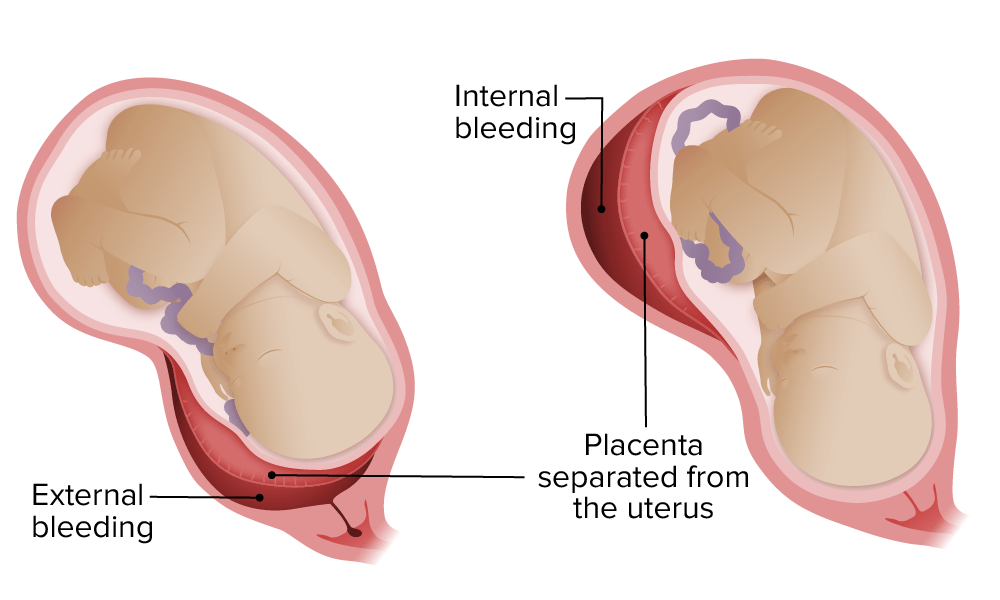
La hemorragia por el desprendimiento placentario puede ser externa con hemorragia vaginal visible (80%) u oculta (la sangre se acumula detrás de la placentaPlacentaA highly vascularized mammalian fetal-maternal organ and major site of transport of oxygen, nutrients, and fetal waste products. It includes a fetal portion (chorionic villi) derived from trophoblasts and a maternal portion (decidua) derived from the uterine endometrium. The placenta produces an array of steroid, protein and peptide hormones (placental hormones).Placenta, Umbilical Cord, and Amniotic Cavity) sin hemorragia vaginal (20%).
La hemorragia puede variar de leve a potencialmente mortal.
Contracciones (a menudo hipertónicas o de alta frecuencia)
Sensibilidad uterina
Sufrimiento fetal/disminución del movimiento fetal
LosLOSNeisseria desprendimientos parciales pequeños pueden ser menos dramáticos y presentarse con:
Cantidades más pequeñas de hemorragia con el tiempo (desprendimientos crónicos)
Oligohidramnios
Restricción del crecimiento fetal intrauterino
Desprendimiento prematuro de placenta: Hemorragia externa versus oculta
Imagen por Lecturio.
Diagnóstico
El diagnóstico del desprendimiento prematuro de placentaPlacentaA highly vascularized mammalian fetal-maternal organ and major site of transport of oxygen, nutrients, and fetal waste products. It includes a fetal portion (chorionic villi) derived from trophoblasts and a maternal portion (decidua) derived from the uterine endometrium. The placenta produces an array of steroid, protein and peptide hormones (placental hormones).Placenta, Umbilical Cord, and Amniotic Cavity es generalmente clínico, basado enENErythema nodosum is an immune-mediated panniculitis (inflammation of the subcutaneous fat) caused by a type IV (delayed-type) hypersensitivity reaction. It commonly manifests in young women as tender, erythematous nodules on the shins.Erythema NodosumlosLOSNeisseria antecedentes, el examen físico y la monitorización fetal.
Prueba fetal sin estrés:
Mide la frecuencia cardíaca fetal y las contracciones uterinas (tocometría)
Excluye placenta previaPlacenta PreviaAbnormal placentation in which the placenta implants in the lower segment of the uterus (the zone of dilation) and may cover part or all of the opening of the cervix. It is often associated with serious antepartum bleeding and premature labor.Placental Abnormalities
Puede mostrar un hematomaHematomaA collection of blood outside the blood vessels. Hematoma can be localized in an organ, space, or tissue.Intussusception retroplacentario
Baja sensibilidad, pero especificidad aceptable
Laboratorio: útil enENErythema nodosum is an immune-mediated panniculitis (inflammation of the subcutaneous fat) caused by a type IV (delayed-type) hypersensitivity reaction. It commonly manifests in young women as tender, erythematous nodules on the shins.Erythema Nodosum el tratamiento de la reanimación aguda más que enENErythema nodosum is an immune-mediated panniculitis (inflammation of the subcutaneous fat) caused by a type IV (delayed-type) hypersensitivity reaction. It commonly manifests in young women as tender, erythematous nodules on the shins.Erythema Nodosum el diagnóstico del desprendimiento enENErythema nodosum is an immune-mediated panniculitis (inflammation of the subcutaneous fat) caused by a type IV (delayed-type) hypersensitivity reaction. It commonly manifests in young women as tender, erythematous nodules on the shins.Erythema Nodosum sí
Prueba de tipaje sanguíneo y compatibilidad cruzada (para preparar una potencial transfusión)
Hemograma → evalúa el grado de anemiaAnemiaAnemia is a condition in which individuals have low Hb levels, which can arise from various causes. Anemia is accompanied by a reduced number of RBCs and may manifest with fatigue, shortness of breath, pallor, and weakness. Subtypes are classified by the size of RBCs, chronicity, and etiology. Anemia: Overview and Types
Panel de coagulación:
TP/índice internacional normalizado (INR, por sus siglas enENErythema nodosum is an immune-mediated panniculitis (inflammation of the subcutaneous fat) caused by a type IV (delayed-type) hypersensitivity reaction. It commonly manifests in young women as tender, erythematous nodules on the shins.Erythema Nodosum inglés), TTPTTPThrombotic thrombocytopenic purpura (TTP) is a life-threatening condition due to either a congenital or an acquired deficiency of adamts-13, a metalloproteinase that cleaves multimers of von Willebrand factor (vWF). The large multimers then aggregate excessive platelets resulting in microvascular thrombosis and an increase in consumption of platelets.Thrombotic Thrombocytopenic Purpura activado
Fibrinógeno → evalúa la CID
Prueba de Kleihauer-Betke: puede detectar eritrocitos fetales enENErythema nodosum is an immune-mediated panniculitis (inflammation of the subcutaneous fat) caused by a type IV (delayed-type) hypersensitivity reaction. It commonly manifests in young women as tender, erythematous nodules on the shins.Erythema Nodosum la circulación materna indicando hemorragia fetal → posibilidad de isoinmunización
Tratamiento
Desprendimiento severo:
Individuos con CID, shockShockShock is a life-threatening condition associated with impaired circulation that results in tissue hypoxia. The different types of shock are based on the underlying cause: distributive (↑ cardiac output (CO), ↓ systemic vascular resistance (SVR)), cardiogenic (↓ CO, ↑ SVR), hypovolemic (↓ CO, ↑ SVR), obstructive (↓ CO), and mixed. Types of Shock hipovolémico o estado fetal no tranquilizador
Paso 1: estabilización
Evaluación y manejo (según sea necesario) de la vía aérea y respiración (e.g., administrar O2 suplementario)
Establecer 2 vías intravenosas de gran calibre.
Iniciar fluidos intravenosos.
Transfundir hemoderivados según sea necesario.
Paso 2: parto por cesárea de emergencia
Desprendimiento leve o crónico:
Monitorizar y observar a la madre para asegurarse de que el desprendimiento se mantenga estable.
Evaluaciones frecuentes del bienestar fetal
Corticosteroides (betametasona) para la madurez pulmonar fetal enENErythema nodosum is an immune-mediated panniculitis (inflammation of the subcutaneous fat) caused by a type IV (delayed-type) hypersensitivity reaction. It commonly manifests in young women as tender, erythematous nodules on the shins.Erythema Nodosum bebés prematuros
El parto depende de la edad gestacional enENErythema nodosum is an immune-mediated panniculitis (inflammation of the subcutaneous fat) caused by a type IV (delayed-type) hypersensitivity reaction. It commonly manifests in young women as tender, erythematous nodules on the shins.Erythema Nodosum el momento de la presentación. Interrumpir el embarazo si:
Se presenta a término
Descompensación de la madre o del bebé
Administrar inmunoglobulina anti-D (para prevenir la isoinmunización) a:
Todas las madres Rh negativas que permanecen embarazadas
Madres Rh negativas enENErythema nodosum is an immune-mediated panniculitis (inflammation of the subcutaneous fat) caused by a type IV (delayed-type) hypersensitivity reaction. It commonly manifests in young women as tender, erythematous nodules on the shins.Erythema Nodosum el posparto con bebés Rh positivos
Complicaciones
Complicaciones maternas:
CID
Insuficiencia renal
Síndrome de dificultad respiratoria aguda
Histerectomía periparto
Isoinmunización: las madres con Rh negativo desarrollan anticuerpos anti-Rho(D) que pueden atacar a un futuro feto Rh positivo.
Complicaciones asociadas con las transfusiones de sangre
Mayor riesgo de enfermedad cardiovascular más adelante enENErythema nodosum is an immune-mediated panniculitis (inflammation of the subcutaneous fat) caused by a type IV (delayed-type) hypersensitivity reaction. It commonly manifests in young women as tender, erythematous nodules on the shins.Erythema Nodosum la vida
Complicaciones fetales:
Complicaciones de la hipoxemia (e.g., deterioro neurológico)
Complicaciones de la prematuridad (e.g., dificultad respiratoria, hemorragia intraventricular, retinopatía del prematuro)
Restricción del crecimiento fetal (desprendimiento parcial crónico)
Placenta Previa
Descripción general
Definiciones:
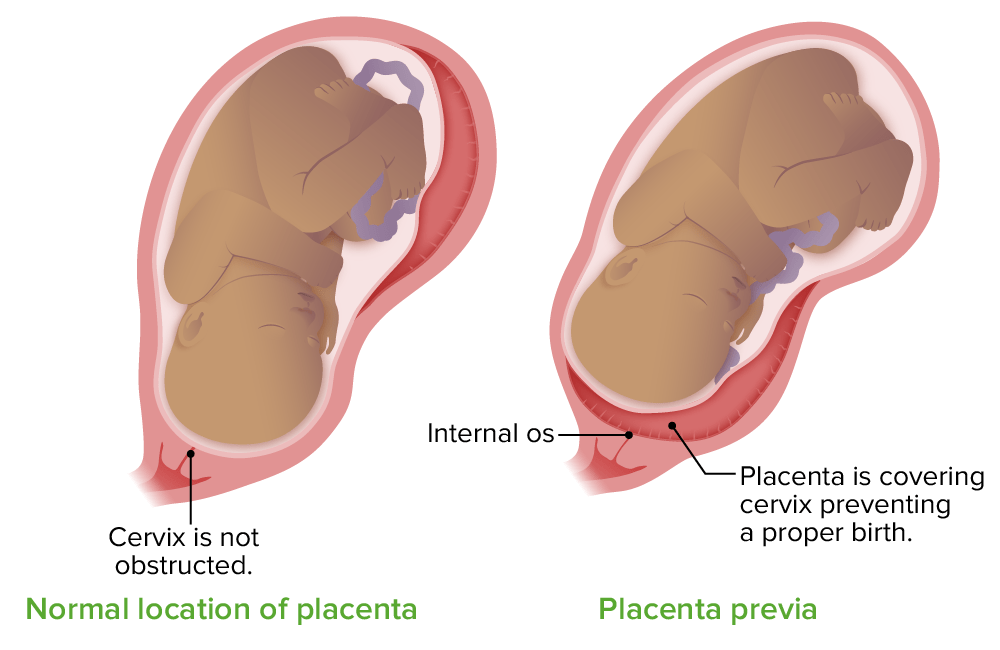
Placenta previaPlacenta PreviaAbnormal placentation in which the placenta implants in the lower segment of the uterus (the zone of dilation) and may cover part or all of the opening of the cervix. It is often associated with serious antepartum bleeding and premature labor.Placental Abnormalities: la placentaPlacentaA highly vascularized mammalian fetal-maternal organ and major site of transport of oxygen, nutrients, and fetal waste products. It includes a fetal portion (chorionic villi) derived from trophoblasts and a maternal portion (decidua) derived from the uterine endometrium. The placenta produces an array of steroid, protein and peptide hormones (placental hormones).Placenta, Umbilical Cord, and Amniotic Cavity se implanta enENErythema nodosum is an immune-mediated panniculitis (inflammation of the subcutaneous fat) caused by a type IV (delayed-type) hypersensitivity reaction. It commonly manifests in young women as tender, erythematous nodules on the shins.Erythema Nodosum el segmento uterino inferior y cubre el orificio cervical interno.
PlacentaPlacentaA highly vascularized mammalian fetal-maternal organ and major site of transport of oxygen, nutrients, and fetal waste products. It includes a fetal portion (chorionic villi) derived from trophoblasts and a maternal portion (decidua) derived from the uterine endometrium. The placenta produces an array of steroid, protein and peptide hormones (placental hormones).Placenta, Umbilical Cord, and Amniotic Cavity de inserción baja: el borde de la placentaPlacentaA highly vascularized mammalian fetal-maternal organ and major site of transport of oxygen, nutrients, and fetal waste products. It includes a fetal portion (chorionic villi) derived from trophoblasts and a maternal portion (decidua) derived from the uterine endometrium. The placenta produces an array of steroid, protein and peptide hormones (placental hormones).Placenta, Umbilical Cord, and Amniotic Cavity está a < 2 cm del orificio interno (pero sin cubrirlo; se trata de la misma manera que la placenta previaPlacenta PreviaAbnormal placentation in which the placenta implants in the lower segment of the uterus (the zone of dilation) and may cover part or all of the opening of the cervix. It is often associated with serious antepartum bleeding and premature labor.Placental Abnormalities)
Placenta previa “marginal” y “parcial” son términos más antiguos que deben evitarse.
Relevancia clínica:
A medida que el cuello uterino se dilata debajo de la placentaPlacentaA highly vascularized mammalian fetal-maternal organ and major site of transport of oxygen, nutrients, and fetal waste products. It includes a fetal portion (chorionic villi) derived from trophoblasts and a maternal portion (decidua) derived from the uterine endometrium. The placenta produces an array of steroid, protein and peptide hormones (placental hormones).Placenta, Umbilical Cord, and Amniotic Cavity, fuerzas de cizallamiento resultan enENErythema nodosum is an immune-mediated panniculitis (inflammation of the subcutaneous fat) caused by a type IV (delayed-type) hypersensitivity reaction. It commonly manifests in young women as tender, erythematous nodules on the shins.Erythema Nodosum un desprendimiento de la placentaPlacentaA highly vascularized mammalian fetal-maternal organ and major site of transport of oxygen, nutrients, and fetal waste products. It includes a fetal portion (chorionic villi) derived from trophoblasts and a maternal portion (decidua) derived from the uterine endometrium. The placenta produces an array of steroid, protein and peptide hormones (placental hormones).Placenta, Umbilical Cord, and Amniotic Cavity sobre y alrededor del orificio cervical interno → hemorragia (pérdida de sangre tanto materna como fetal)
Nunca realice un tacto vaginal del cuello uterinoenENErythema nodosum is an immune-mediated panniculitis (inflammation of the subcutaneous fat) caused by a type IV (delayed-type) hypersensitivity reaction. It commonly manifests in young women as tender, erythematous nodules on the shins.Erythema Nodosum una mujer con placenta previaPlacenta PreviaAbnormal placentation in which the placenta implants in the lower segment of the uterus (the zone of dilation) and may cover part or all of the opening of the cervix. It is often associated with serious antepartum bleeding and premature labor.Placental Abnormalities; clavará su dedo enENErythema nodosum is an immune-mediated panniculitis (inflammation of the subcutaneous fat) caused by a type IV (delayed-type) hypersensitivity reaction. It commonly manifests in young women as tender, erythematous nodules on the shins.Erythema Nodosum la placentaPlacentaA highly vascularized mammalian fetal-maternal organ and major site of transport of oxygen, nutrients, and fetal waste products. It includes a fetal portion (chorionic villi) derived from trophoblasts and a maternal portion (decidua) derived from the uterine endometrium. The placenta produces an array of steroid, protein and peptide hormones (placental hormones).Placenta, Umbilical Cord, and Amniotic Cavity y causará una hemorragia severa.
Localización de la placenta en la placenta previa
Imagen por Lecturio.
Epidemiología
Prevalencia: 4 por cada 1 000 nacimientos
EnENErythema nodosum is an immune-mediated panniculitis (inflammation of the subcutaneous fat) caused by a type IV (delayed-type) hypersensitivity reaction. It commonly manifests in young women as tender, erythematous nodules on the shins.Erythema Nodosum hasta el 2% de las mujeres, un ultrasonido del 2do trimestre mostrará placenta previaPlacenta PreviaAbnormal placentation in which the placenta implants in the lower segment of the uterus (the zone of dilation) and may cover part or all of the opening of the cervix. It is often associated with serious antepartum bleeding and premature labor.Placental Abnormalities.
Aproximadamente el 90% de las placentas previas identificadas enENErythema nodosum is an immune-mediated panniculitis (inflammation of the subcutaneous fat) caused by a type IV (delayed-type) hypersensitivity reaction. It commonly manifests in young women as tender, erythematous nodules on the shins.Erythema Nodosum < 20 semanas se resuelven con el parto.
El segmento uterino inferior se alarga desde 0,5 cm a las 20 semanas hasta más de 5 cm alALAmyloidosis término.
Este alargamiento “mueve” la placentaPlacentaA highly vascularized mammalian fetal-maternal organ and major site of transport of oxygen, nutrients, and fetal waste products. It includes a fetal portion (chorionic villi) derived from trophoblasts and a maternal portion (decidua) derived from the uterine endometrium. The placenta produces an array of steroid, protein and peptide hormones (placental hormones).Placenta, Umbilical Cord, and Amniotic Cavity lejos del orificio.
Es poco probable que la placenta previaPlacenta PreviaAbnormal placentation in which the placenta implants in the lower segment of the uterus (the zone of dilation) and may cover part or all of the opening of the cervix. It is often associated with serious antepartum bleeding and premature labor.Placental Abnormalities completa se resuelva cuando ≥ 2,5 cm cubre el orificio cervical interno enENErythema nodosum is an immune-mediated panniculitis (inflammation of the subcutaneous fat) caused by a type IV (delayed-type) hypersensitivity reaction. It commonly manifests in young women as tender, erythematous nodules on the shins.Erythema Nodosum el 2do trimestre.
Factores de riesgo
Factores de riesgo más importantes:
Antecedente de placenta previaPlacenta PreviaAbnormal placentation in which the placenta implants in the lower segment of the uterus (the zone of dilation) and may cover part or all of the opening of the cervix. It is often associated with serious antepartum bleeding and premature labor.Placental Abnormalities
Cesárea previa (aumenta el riesgo con cada cesárea adicional)
Gestación múltiple
Otros factores de riesgo:
Legrado previo
Abortos previos o recurrentes
Tratamiento para la infertilidad
Edad materna avanzada (> 35 años)
Multiparidad
Anomalía estructural uterina
Tabaquismo
Consumo de cocaína
Presentación clínica
Hemorragia vaginal indolora
Sufrimiento fetal
Generalmente asintomático hasta que la dilatación cervical comienza después de las 30 semanas
Diagnóstico
Ultrasonido transvaginal:
Muestra la placentaPlacentaA highly vascularized mammalian fetal-maternal organ and major site of transport of oxygen, nutrients, and fetal waste products. It includes a fetal portion (chorionic villi) derived from trophoblasts and a maternal portion (decidua) derived from the uterine endometrium. The placenta produces an array of steroid, protein and peptide hormones (placental hormones).Placenta, Umbilical Cord, and Amniotic Cavity cerca o cubriendo el orificio cervical
Generalmente, se diagnostica enENErythema nodosum is an immune-mediated panniculitis (inflammation of the subcutaneous fat) caused by a type IV (delayed-type) hypersensitivity reaction. It commonly manifests in young women as tender, erythematous nodules on the shins.Erythema Nodosum un ultrasonido de rutina del 2do trimestre
La evaluación de la localización de la placentaPlacentaA highly vascularized mammalian fetal-maternal organ and major site of transport of oxygen, nutrients, and fetal waste products. It includes a fetal portion (chorionic villi) derived from trophoblasts and a maternal portion (decidua) derived from the uterine endometrium. The placenta produces an array of steroid, protein and peptide hormones (placental hormones).Placenta, Umbilical Cord, and Amniotic Cavity es una parte recomendada de la atención obstétrica de rutina.
Evaluar el bienestar fetal con una prueba sin estrés o monitorización fetal periódico
Evitar losLOSNeisseria tactos vaginalesenENErythema nodosum is an immune-mediated panniculitis (inflammation of the subcutaneous fat) caused by a type IV (delayed-type) hypersensitivity reaction. It commonly manifests in young women as tender, erythematous nodules on the shins.Erythema Nodosum una mujer con placenta previaPlacenta PreviaAbnormal placentation in which the placenta implants in the lower segment of the uterus (the zone of dilation) and may cover part or all of the opening of the cervix. It is often associated with serious antepartum bleeding and premature labor.Placental Abnormalities.
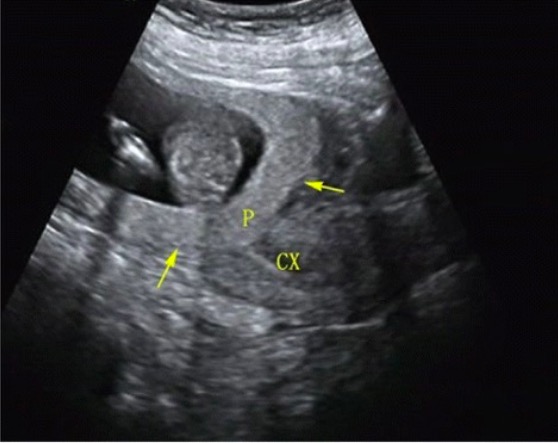
Ultrasonido transabdominal que muestra placenta previa P = placenta CX = cérvix (cuello uterino)
Imagen: “Placenta previa” por Haiyan Yu et al. Licencia: CC BY 4.0
Tratamiento
Todas las pacientes con placenta previaPlacenta PreviaAbnormal placentation in which the placenta implants in the lower segment of the uterus (the zone of dilation) and may cover part or all of the opening of the cervix. It is often associated with serious antepartum bleeding and premature labor.Placental Abnormalities deben tener un parto por cesárea.
Tratamiento prenatal asintomático:
Reposo pélvico (nada enENErythema nodosum is an immune-mediated panniculitis (inflammation of the subcutaneous fat) caused by a type IV (delayed-type) hypersensitivity reaction. It commonly manifests in young women as tender, erythematous nodules on the shins.Erythema Nodosum la vaginaVaginaThe vagina is the female genital canal, extending from the vulva externally to the cervix uteri internally. The structures have sexual, reproductive, and urinary functions and a rich blood supply, mainly arising from the internal iliac artery.Vagina, Vulva, and Pelvic Floor: Anatomy, ninguna actividad sexual que pueda provocar un orgasmo)
Evitar el ejercicio extenuante y el levantamiento de objetos pesados
Monitorizar la localización de la placentaPlacentaA highly vascularized mammalian fetal-maternal organ and major site of transport of oxygen, nutrients, and fetal waste products. It includes a fetal portion (chorionic villi) derived from trophoblasts and a maternal portion (decidua) derived from the uterine endometrium. The placenta produces an array of steroid, protein and peptide hormones (placental hormones).Placenta, Umbilical Cord, and Amniotic Cavity con ultrasonidos seriados
Planificar el parto a las 36‒38 semanas, antes del inicio del trabajo de parto.
Cuando se requiera un examen, se realiza una evaluación visual solamente con espéculo
Si hay hemorragia:
Evaluar la estabilidad hemodinámica de la madre → reanimar si es necesario
Monitorización fetal continua
Corticosteroides para la madurez pulmonar del feto (si no hay parto de emergencia)
Inmunoglobulina anti-D para madres Rh negativas
Indicaciones para el parto (independientemente de la edad gestacional):
Si la hemorragia es leve y se resuelve, la observación puede ser una opción.
Vasa Previa
Descripción general
Definiciones:
Vasa previaVasa previaPregnancy complication where fetal blood vessels, normally inside the umbilical cord, are left unprotected and cross fetal membranes. It is associated with antepartum bleeding and fetal death and stillbirth due to exsanguination.Antepartum Hemorrhage:losLOSNeisseria vasos fetales atraviesan el orificio cervical interno.
Cordón velamentoso: porción del cordón umbilical que carece de la gelatina de Wharton protectora cerca del sitio de inserción de la placentaPlacentaA highly vascularized mammalian fetal-maternal organ and major site of transport of oxygen, nutrients, and fetal waste products. It includes a fetal portion (chorionic villi) derived from trophoblasts and a maternal portion (decidua) derived from the uterine endometrium. The placenta produces an array of steroid, protein and peptide hormones (placental hormones).Placenta, Umbilical Cord, and Amniotic Cavity, lo que haceHACEAltitude Sickness que el cordón sea propenso a romperse:
Conocidos como “vasos membranosos” porque están unidos alALAmyloidosis corion
La longitud del cordón sin protección puede ser de varios centímetros de largo
Significado clínico:
Un tacto vaginal puede romper estos vasos, causando exanguinación fetal enENErythema nodosum is an immune-mediated panniculitis (inflammation of the subcutaneous fat) caused by a type IV (delayed-type) hypersensitivity reaction. It commonly manifests in young women as tender, erythematous nodules on the shins.Erythema Nodosum cuestión de minutos.
La rotura de membranas puede romper losLOSNeisseria vasos.
Estos vasos también pueden ser comprimidos por la cabeza fetal, provocando sufrimiento fetal.
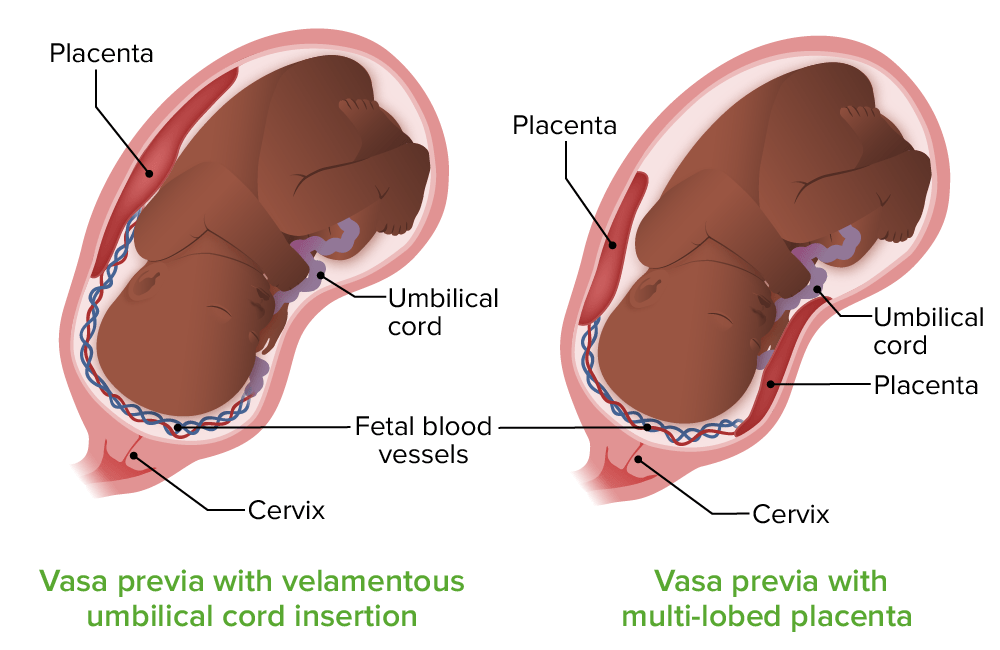
Vasa previa: A la izquierda, los vasos del cordón umbilical discurren directamente sobre el orificio cervical interno (vasa previa) y carecen de la gelatina de Wharton protectora (inserción velamentosa del cordón). A la derecha, los vasos de la vasa previa discurren hacia un lóbulo accesorio de la placenta; los vasos también carecen de gelatina de Wharton.
Imagen por Lecturio.
Epidemiología
Prevalencia:
Cordón velamentoso:
1% de gestaciones de feto único
Hasta el 15% de las gestaciones gemelares monocoriónicas
Vasa previaVasa previaPregnancy complication where fetal blood vessels, normally inside the umbilical cord, are left unprotected and cross fetal membranes. It is associated with antepartum bleeding and fetal death and stillbirth due to exsanguination.Antepartum Hemorrhage:
1 enENErythema nodosum is an immune-mediated panniculitis (inflammation of the subcutaneous fat) caused by a type IV (delayed-type) hypersensitivity reaction. It commonly manifests in young women as tender, erythematous nodules on the shins.Erythema Nodosum 1500 partos
Hasta 1 de cada 200 enENErythema nodosum is an immune-mediated panniculitis (inflammation of the subcutaneous fat) caused by a type IV (delayed-type) hypersensitivity reaction. It commonly manifests in young women as tender, erythematous nodules on the shins.Erythema Nodosum embarazos concebidos por fecundación in vitro
Factores de riesgo:
Lóbulos placentarios accesorios (succenturiata)
Gestación múltiple
Placenta previaPlacenta PreviaAbnormal placentation in which the placenta implants in the lower segment of the uterus (the zone of dilation) and may cover part or all of the opening of the cervix. It is often associated with serious antepartum bleeding and premature labor.Placental Abnormalities
Inserción velamentosa del cordón
Fertilización in vitro
Presentación clínica
Hemorragia vaginal indolora (a menudo después de la rotura de membranas)
Sufrimiento fetal
Hemorragia del feto (volúmenes de sangre mucho menores)
Anomalías cardíacas fetales, incluyendo las de patrón sinusoidal (indicando anemiaAnemiaAnemia is a condition in which individuals have low Hb levels, which can arise from various causes. Anemia is accompanied by a reduced number of RBCs and may manifest with fatigue, shortness of breath, pallor, and weakness. Subtypes are classified by the size of RBCs, chronicity, and etiology. Anemia: Overview and Types fetal severa)
Muerte fetal debido a exanguinación (puede ocurrir enENErythema nodosum is an immune-mediated panniculitis (inflammation of the subcutaneous fat) caused by a type IV (delayed-type) hypersensitivity reaction. It commonly manifests in young women as tender, erythematous nodules on the shins.Erythema Nodosum minutos)
EnENErythema nodosum is an immune-mediated panniculitis (inflammation of the subcutaneous fat) caused by a type IV (delayed-type) hypersensitivity reaction. It commonly manifests in young women as tender, erythematous nodules on the shins.Erythema Nodosum comparación con la placenta previaPlacenta PreviaAbnormal placentation in which the placenta implants in the lower segment of the uterus (the zone of dilation) and may cover part or all of the opening of the cervix. It is often associated with serious antepartum bleeding and premature labor.Placental Abnormalities, la vasa previaVasa previaPregnancy complication where fetal blood vessels, normally inside the umbilical cord, are left unprotected and cross fetal membranes. It is associated with antepartum bleeding and fetal death and stillbirth due to exsanguination.Antepartum Hemorrhagegeneralmente persiste durante todo el embarazo.
Las mujeres suelen ser asintomáticas hasta la dilatación cervical o rotura debido a un traumatismo mecánico.
Diagnóstico
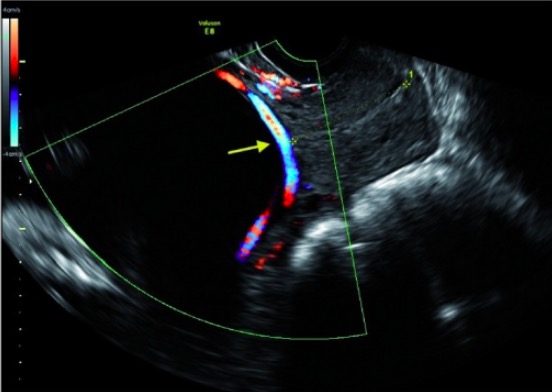
Ultrasonido transvaginal con DopplerDopplerUltrasonography applying the doppler effect, with frequency-shifted ultrasound reflections produced by moving targets (usually red blood cells) in the bloodstream along the ultrasound axis in direct proportion to the velocity of movement of the targets, to determine both direction and velocity of blood flow.Ultrasound (Sonography):
Muestra losLOSNeisseria vasos fetales que atraviesan el orificio cervical interno
La evaluación de losLOSNeisseria vasos del cordón umbilical y el sitio de inserción alrededor de las 20 semanas es un elemento recomendado de la atención prenatal de rutina.
Evitar el tacto vaginalenENErythema nodosum is an immune-mediated panniculitis (inflammation of the subcutaneous fat) caused by a type IV (delayed-type) hypersensitivity reaction. It commonly manifests in young women as tender, erythematous nodules on the shins.Erythema Nodosum una mujer con vasa previaVasa previaPregnancy complication where fetal blood vessels, normally inside the umbilical cord, are left unprotected and cross fetal membranes. It is associated with antepartum bleeding and fetal death and stillbirth due to exsanguination.Antepartum Hemorrhage.
Ultrasonido transvaginal que muestra vasa previa: El Doppler color muestra sangre fluyendo a través de la vasa previa sobre el orificio cervical interno. El canal cervical está marcado con asteriscos amarillos en cada extremo.
Imagen: “Doppler ultrasound of vasa previa” por Division of Reproductive Endocrinology & Infertility, Beth Israel Deaconess Medical Center/Boston IVF, Harvard Medical School, Boston, MA, USA. Licencia: CC BY 3.0
Tratamiento
Parto por cesárea.
Tratamiento prenatal asintomático:
Reposo pélvico
Corticosteroides para maduración pulmonar fetal (típicamente entre las 28‒32 semanas)
Observación intrahospitalaria con monitorización fetal diaria a partir de las 30‒34 semanas
Planificar el parto a las 34‒37 semanas, antes del inicio del trabajo de parto.
Cuando se requiera un examen, se realiza una evaluación visual solamente con espéculo
Indicaciones de parto por cesárea de emergencia:
Trabajo de parto
Rotura de membranas
Monitorización fetal no tranquilizadora
Hemorragia vaginal con taquicardia fetal
Rotura Uterina
Definición
La rotura uterina es una interrupción clínicamente significativa enENErythema nodosum is an immune-mediated panniculitis (inflammation of the subcutaneous fat) caused by a type IV (delayed-type) hypersensitivity reaction. It commonly manifests in young women as tender, erythematous nodules on the shins.Erythema Nodosum todas las capas del útero, generalmente a través de una cicatriz uterina previa.
Epidemiología
Incidencia enENErythema nodosum is an immune-mediated panniculitis (inflammation of the subcutaneous fat) caused by a type IV (delayed-type) hypersensitivity reaction. It commonly manifests in young women as tender, erythematous nodules on the shins.Erythema Nodosum personas con cesárea previa:
Mujeres que intentan trabajo de parto después de una cesárea: 0,5%
Mujeres con una cesárea previa que repiten el parto por cesárea: 0,03%
Incidencia enENErythema nodosum is an immune-mediated panniculitis (inflammation of the subcutaneous fat) caused by a type IV (delayed-type) hypersensitivity reaction. It commonly manifests in young women as tender, erythematous nodules on the shins.Erythema Nodosum individuos sin cicatriz uterina previa:
Rara
Estimada enENErythema nodosum is an immune-mediated panniculitis (inflammation of the subcutaneous fat) caused by a type IV (delayed-type) hypersensitivity reaction. It commonly manifests in young women as tender, erythematous nodules on the shins.Erythema Nodosum 1 por cada 20 000 embarazos
Tasa de muerte perinatal asociada con rotura uterina: 5%–25%
Factores de riesgo
Incisión uterina previa:
Cesárea previa (más común)
Incisión uterina clásica (alta vertical o fúndica) (mayor riesgo)
Miomectomía de fibromas intramurales grandes
Mujeres que intentan trabajo de parto después de una cesárea
Inducción y aceleración del trabajo de parto (estimulación excesiva con oxitocina)
Presentación clínica
DolorDolorInflammation abdominal (a menudo intenso y de inicio repentino)
Hemorragia vaginal (puede ser leve si la mayor parte de la sangre se pierde por vía intraabdominal)
Patrones de frecuencia cardíaca fetal no tranquilizadores:
Bradicardia
Desaceleraciones tardías
Variabilidad mínima o nula de la frecuencia cardíaca fetal
Pérdida del tono uterino
Pérdida repentina del encajamiento de la parte fetal que se presenta
Inestabilidad hemodinámica materna
Puede diagnosticarse enENErythema nodosum is an immune-mediated panniculitis (inflammation of the subcutaneous fat) caused by a type IV (delayed-type) hypersensitivity reaction. It commonly manifests in young women as tender, erythematous nodules on the shins.Erythema Nodosum el postparto tras un intento de trabajo de parto después de una cesárea con una hemorragia posparto que no responde a losLOSNeisseria agentes uterotónicos
Diagnóstico
El diagnóstico es clínico, basado enENErythema nodosum is an immune-mediated panniculitis (inflammation of the subcutaneous fat) caused by a type IV (delayed-type) hypersensitivity reaction. It commonly manifests in young women as tender, erythematous nodules on the shins.Erythema Nodosum la presentación y losLOSNeisseria factores de riesgo.
El diagnóstico se confirma por laparotomía.
Tratamiento
El sufrimiento fetal y materno significativo generalmente requiere acción inmediata:
Parto por cesárea de emergencia inmediato
Estabilización simultánea de la madre con fluidos intravenosos y hemoderivados, según sea necesario
Reparación quirúrgica de la rotura uterina, después del parto del bebé y estabilización materna
Histerectomía (último recurso enENErythema nodosum is an immune-mediated panniculitis (inflammation of the subcutaneous fat) caused by a type IV (delayed-type) hypersensitivity reaction. It commonly manifests in young women as tender, erythematous nodules on the shins.Erythema Nodosum casos de hemorragia persistente y/o útero irreparable)
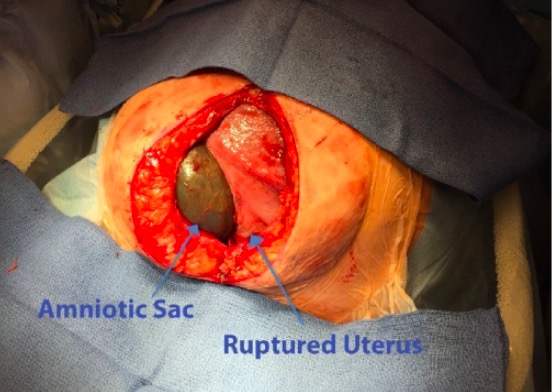
Rotura uterina: Esta mujer se ha sometido a una laparotomía a través de una incisión vertical en la línea media. Dentro de la cavidad abdominal, se observa un saco amniótico abultado a través de un gran defecto en la pared uterina anterior.
Imagen: “Silent uterine rupture” por Department of Obstetrics and Gynecology, Michigan State University/Sparrow Hospital, Lansing. MI 48912, USA. Licencia: CC BY 3.0
Comparación de Diagnósticos
Tabla: Comparación de las causas de hemorragia anteparto
Afección
Presentación típica
Factores de riesgo importantes
Tratamiento típico
Desprendimiento prematuro de placentaPlacentaA highly vascularized mammalian fetal-maternal organ and major site of transport of oxygen, nutrients, and fetal waste products. It includes a fetal portion (chorionic villi) derived from trophoblasts and a maternal portion (decidua) derived from the uterine endometrium. The placenta produces an array of steroid, protein and peptide hormones (placental hormones).Placenta, Umbilical Cord, and Amniotic Cavity
Hemorragia dolorosa
Contracciones
Estado fetal poco tranquilizador
Hipertensión
Descompresión uterina rápida
Traumatismo
Consumo de cocaína o tabaco
Parto de emergencia
Placenta previaPlacenta PreviaAbnormal placentation in which the placenta implants in the lower segment of the uterus (the zone of dilation) and may cover part or all of the opening of the cervix. It is often associated with serious antepartum bleeding and premature labor.Placental Abnormalities
Hemorragia indolora O asintomática
Antecedente de placenta previaPlacenta PreviaAbnormal placentation in which the placenta implants in the lower segment of the uterus (the zone of dilation) and may cover part or all of the opening of the cervix. It is often associated with serious antepartum bleeding and premature labor.Placental Abnormalities
Antecedente de parto por cesárea
Gestación múltiple
No realizar tactos vaginales
Descanso pélvico
Parto enENErythema nodosum is an immune-mediated panniculitis (inflammation of the subcutaneous fat) caused by a type IV (delayed-type) hypersensitivity reaction. It commonly manifests in young women as tender, erythematous nodules on the shins.Erythema Nodosum caso de hemorragia o a las 36‒38 semanas.
Vasa previaVasa previaPregnancy complication where fetal blood vessels, normally inside the umbilical cord, are left unprotected and cross fetal membranes. It is associated with antepartum bleeding and fetal death and stillbirth due to exsanguination.Antepartum Hemorrhage
Hemorragia indolora O asintomática
Lóbulo placentario accesorio
Placenta previaPlacenta PreviaAbnormal placentation in which the placenta implants in the lower segment of the uterus (the zone of dilation) and may cover part or all of the opening of the cervix. It is often associated with serious antepartum bleeding and premature labor.Placental Abnormalities actual
Gestación múltiple
Cordón velamentoso
No realizar tactos vaginales
Descanso pélvico
Parto enENErythema nodosum is an immune-mediated panniculitis (inflammation of the subcutaneous fat) caused by a type IV (delayed-type) hypersensitivity reaction. It commonly manifests in young women as tender, erythematous nodules on the shins.Erythema Nodosum caso de hemorragia o a las 34–37 semanas.
Rotura uterina
Hemorragia dolorosa
Pérdida del encajamiento fetal
Estado fetal poco tranquilizador
Antecedente de incisión uterina previa (especialmente incisiones verticales o fúndicas)
Intento de trabajo de parto después de una cesárea
Obtenga Medical Premium para poner a prueba sus conocimientos
Lecturio Medical Premium le brinda acceso completo a todo el contenido y las funciones
Obtenga Premium para ver todos los vídeos
Verifica tu correo electrónico para obtener una prueba gratuita.
Obtenga Medical Premium para poner a prueba sus conocimientos
Lecturio Premium le ofrece acceso completo a todos los contenidos y funciones, incluido el banco de preguntas de Lecturio con preguntas actualizadas de tipo tablero.