Domina Conceptos Médicos

Estudia para la escuela de medicina y tus examenes con Lecturio.

Medicamentos Contra el Virus de Inmunodeficiencia Humana (VIH)

La terapia antirretroviral (TAR) se dirige al AL Amyloidosis ciclo de replicación del virus Virus Viruses are infectious, obligate intracellular parasites composed of a nucleic acid core surrounded by a protein capsid. Viruses can be either naked (non-enveloped) or enveloped. The classification of viruses is complex and based on many factors, including type and structure of the nucleoid and capsid, the presence of an envelope, the replication cycle, and the host range. Virology de la inmunodeficiencia humana (VIH) y se clasifica según la enzima viral o el mecanismo que se inhibe. El objetivo de la terapia es suprimir la replicación viral para alcanzar el resultado de una carga viral indetectable. En EN Erythema nodosum is an immune-mediated panniculitis (inflammation of the subcutaneous fat) caused by a type IV (delayed-type) hypersensitivity reaction. It commonly manifests in young women as tender, erythematous nodules on the shins. Erythema Nodosum la actualidad, la transcriptasa inversa, la proteasa, la integrasa y los LOS Neisseria inhibidores de entrada se utilizan en EN Erythema nodosum is an immune-mediated panniculitis (inflammation of the subcutaneous fat) caused by a type IV (delayed-type) hypersensitivity reaction. It commonly manifests in young women as tender, erythematous nodules on the shins. Erythema Nodosum regímenes combinados de terapia antirretroviral de gran actividad. La terapia combinada (régimen de 3 medicamentos) se usa para prevenir la resistencia a los LOS Neisseria medicamentos y la resistencia cruzada, que se desarrolla a través de mutaciones genéticas.

Last updated: Jul 22, 2023

Editorial responsibility: Stanley Oiseth, Lindsay Jones, Evelin Maza

Descripción General

Medicamentos antirretrovirales

  • Clasificados según la fase del ciclo de vida del retrovirus que inhibe el medicamento
  • Objetivo: suprimir la replicación viral en EN Erythema nodosum is an immune-mediated panniculitis (inflammation of the subcutaneous fat) caused by a type IV (delayed-type) hypersensitivity reaction. It commonly manifests in young women as tender, erythematous nodules on the shins. Erythema Nodosum la infección por el virus Virus Viruses are infectious, obligate intracellular parasites composed of a nucleic acid core surrounded by a protein capsid. Viruses can be either naked (non-enveloped) or enveloped. The classification of viruses is complex and based on many factors, including type and structure of the nucleoid and capsid, the presence of an envelope, the replication cycle, and the host range. Virology de la inmunodeficiencia humana (VIH)
  • Estándar de atención: al AL Amyloidosis menos 3 medicamentos tomados simultáneamente

Estructura del virión del VIH

  • La envoltura de virión contiene 2 glicoproteínas de membrana:
    • gp41 Gp41 Transmembrane envelope protein of the human immunodeficiency virus which is encoded by the HIV env gene. It has a molecular weight of 41, 000 and is glycosylated. The n-terminal part of gp41 is thought to be involved in cell fusion with the CD4 antigens of T4 lymphocytes, leading to syncytial formation. Gp41 is one of the most common HIV antigens detected by immunoblotting. HIV Infection and AIDS (transmembrana)
    • gp120 Gp120 External envelope protein of the human immunodeficiency virus which is encoded by the HIV env gene. It has a molecular weight of 120 kda and contains numerous glycosylation sites. Gp120 binds to cells expressing CD4 cell-surface antigens, most notably t4-lymphocytes and monocytes/macrophages. Gp120 has been shown to interfere with the normal function of CD4 and is at least partly responsible for the cytopathic effect of HIV. HIV Infection and AIDS (superficie/proteína de acoplamiento)
  • Proteína de matriz p17: rodea el núcleo del virus Virus Viruses are infectious, obligate intracellular parasites composed of a nucleic acid core surrounded by a protein capsid. Viruses can be either naked (non-enveloped) or enveloped. The classification of viruses is complex and based on many factors, including type and structure of the nucleoid and capsid, the presence of an envelope, the replication cycle, and the host range. Virology
  • Núcleo del virus Virus Viruses are infectious, obligate intracellular parasites composed of a nucleic acid core surrounded by a protein capsid. Viruses can be either naked (non-enveloped) or enveloped. The classification of viruses is complex and based on many factors, including type and structure of the nucleoid and capsid, the presence of an envelope, the replication cycle, and the host range. Virology:
    • Proteína de la cápside p24
    • 2 ácidos ribonucleicos (ARN) de sentido positivo monocatenarios envueltos, recubiertos con proteína nucleocápsida
    • Enzimas (transcriptasa inversa, integrasa, proteasa)

Ciclo de replicación del VIH

  • Células diana: linfocitos T CD4+, macrófagos y células dendríticas
  • Entrada del VIH a las células:
    • El virión entra primero a través de una ruptura en EN Erythema nodosum is an immune-mediated panniculitis (inflammation of the subcutaneous fat) caused by a type IV (delayed-type) hypersensitivity reaction. It commonly manifests in young women as tender, erythematous nodules on the shins. Erythema Nodosum la membrana mucosa.
    • El virión atraviesa la barrera de la mucosa y busca células diana.
  • Replicación del VIH:
    1. Fusión de membranas y unión de receptores (entrada): el virión (que transporta ARN viral, transcriptasa inversa, integrasa y otras proteínas) inicia la entrada en EN Erythema nodosum is an immune-mediated panniculitis (inflammation of the subcutaneous fat) caused by a type IV (delayed-type) hypersensitivity reaction. It commonly manifests in young women as tender, erythematous nodules on the shins. Erythema Nodosum la célula huésped.
      • El virión se une al AL Amyloidosis receptor Receptor Receptors are proteins located either on the surface of or within a cell that can bind to signaling molecules known as ligands (e.g., hormones) and cause some type of response within the cell. Receptors CD4 y a un receptor Receptor Receptors are proteins located either on the surface of or within a cell that can bind to signaling molecules known as ligands (e.g., hormones) and cause some type of response within the cell. Receptors de quimioquinas ( CCR5 CCR5 Ccr receptors with specificity for chemokine ccl3; chemokine ccl4; and chemokine ccl5. They are expressed at high levels in T-lymphocytes; B-lymphocytes; macrophages; mast cells; and nk cells. The ccr5 receptor is used by the human immunodeficiency virus to infect cells. HIV Infection and AIDS en EN Erythema nodosum is an immune-mediated panniculitis (inflammation of the subcutaneous fat) caused by a type IV (delayed-type) hypersensitivity reaction. It commonly manifests in young women as tender, erythematous nodules on the shins. Erythema Nodosum macrófagos, CXCR4 CXCR4 Cxcr receptors with specificity for cxcl12 chemokine. The receptors may play a role in hematopoiesis regulation and can also function as coreceptors for the human immunodeficiency virus. HIV Infection and AIDS en EN Erythema nodosum is an immune-mediated panniculitis (inflammation of the subcutaneous fat) caused by a type IV (delayed-type) hypersensitivity reaction. It commonly manifests in young women as tender, erythematous nodules on the shins. Erythema Nodosum linfocitos T).
        • Virus Virus Viruses are infectious, obligate intracellular parasites composed of a nucleic acid core surrounded by a protein capsid. Viruses can be either naked (non-enveloped) or enveloped. The classification of viruses is complex and based on many factors, including type and structure of the nucleoid and capsid, the presence of an envelope, the replication cycle, and the host range. Virology con tropismo para macrófagos: cepas R5
        • Virus Virus Viruses are infectious, obligate intracellular parasites composed of a nucleic acid core surrounded by a protein capsid. Viruses can be either naked (non-enveloped) or enveloped. The classification of viruses is complex and based on many factors, including type and structure of the nucleoid and capsid, the presence of an envelope, the replication cycle, and the host range. Virology tropismo para linfocitos T: cepas X4
      • La unión de gp120 Gp120 External envelope protein of the human immunodeficiency virus which is encoded by the HIV env gene. It has a molecular weight of 120 kda and contains numerous glycosylation sites. Gp120 binds to cells expressing CD4 cell-surface antigens, most notably t4-lymphocytes and monocytes/macrophages. Gp120 has been shown to interfere with the normal function of CD4 and is at least partly responsible for the cytopathic effect of HIV. HIV Infection and AIDS con CD4 y los LOS Neisseria receptores de quimioquinas conduce a un cambio conformacional, exponiendo el dominio de fusión en EN Erythema nodosum is an immune-mediated panniculitis (inflammation of the subcutaneous fat) caused by a type IV (delayed-type) hypersensitivity reaction. It commonly manifests in young women as tender, erythematous nodules on the shins. Erythema Nodosum gp41 Gp41 Transmembrane envelope protein of the human immunodeficiency virus which is encoded by the HIV env gene. It has a molecular weight of 41, 000 and is glycosylated. The n-terminal part of gp41 is thought to be involved in cell fusion with the CD4 antigens of T4 lymphocytes, leading to syncytial formation. Gp41 is one of the most common HIV antigens detected by immunoblotting. HIV Infection and AIDS.
      • Este proceso une las membranas virales y celulares, fusionándolas.
    2. La capa de proteína de la cápside (que rodea el ARN viral y las proteínas) es descubierta cuando el virión atraviesa el citoplasma.
    3. Transcripción inversa: Se produce síntesis mediada por transcriptasa inversa de ácido desoxirribonucleico proviral o ADN (a partir del ARN viral).
    4. Integración: El ADN viral se transporta a través del núcleo y se integra en EN Erythema nodosum is an immune-mediated panniculitis (inflammation of the subcutaneous fat) caused by a type IV (delayed-type) hypersensitivity reaction. It commonly manifests in young women as tender, erythematous nodules on the shins. Erythema Nodosum el ADN del huésped, facilitado por la integrasa.
    5. Replicación: Se transcribe el ADN viral y se forman múltiples copias de nuevo ARN del VIH, que se transportan al AL Amyloidosis citoplasma.
      • El nuevo ARN del VIH se convierte en EN Erythema nodosum is an immune-mediated panniculitis (inflammation of the subcutaneous fat) caused by a type IV (delayed-type) hypersensitivity reaction. It commonly manifests in young women as tender, erythematous nodules on the shins. Erythema Nodosum el genoma del nuevo virus Virus Viruses are infectious, obligate intracellular parasites composed of a nucleic acid core surrounded by a protein capsid. Viruses can be either naked (non-enveloped) or enveloped. The classification of viruses is complex and based on many factors, including type and structure of the nucleoid and capsid, the presence of an envelope, the replication cycle, and the host range. Virology.
      • Otras copias del ARN se utilizan para producir nuevas proteínas del VIH.
    6. Ensamblaje: Los LOS Neisseria nuevos ARN + proteínas + enzimas virales se mueven hacia la superficie celular y forman partículas no infecciosas.
    7. Gemación y maduración:
      • Las partículas (ARN + proteínas virales) eventualmente geman de la célula huésped con el VIH inmaduro.
      • La proteasa proteica viral luego escinde las poliproteínas recién sintetizadas, produciendo VIH maduro.
Ciclo de replicación del VIH

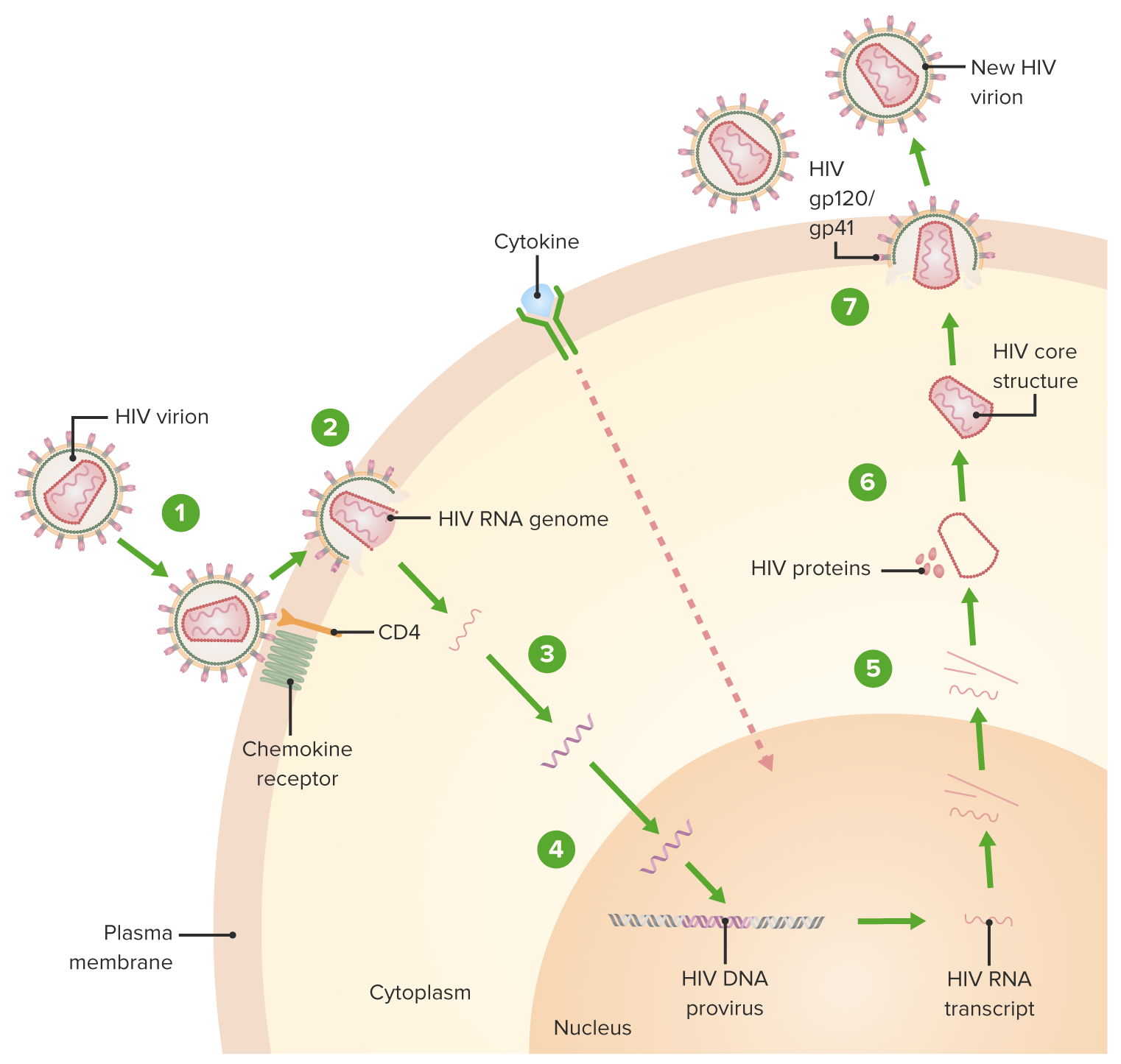
Ciclo de replicación del VIH:
1. El virión se une al receptor CD4 y un receptor de quimioquina, seguido de un cambio conformacional que facilita la fusión del virión y la célula huésped.
2. Una capa de proteína de la cápside (que rodea el ARN y proteínas virales) se descubre cuando el virión atraviesa el citoplasma.
3. Se produce la síntesis de ADN proviral mediada por transcriptasa inversa.
4. El ADN viral se transporta a través del núcleo y se integra en el ADN del huésped, facilitado por la integrasa.
5. Se transcribe el ADN viral y se forman y transportan múltiples copias del nuevo ARN del VIH al citoplasma. El nuevo ARN del VIH se convierte en el genoma de un nuevo virus. También se produce la activación de citoquinas de la célula.
6. El nuevo ARN + proteínas + enzimas virales se mueven a la superficie celular y forman una partícula no infecciosa.
7. Las partículas (ARN + proteínas virales) eventualmente brotan de la célula huésped con el VIH inmaduro. La proteasa viral (enzima) luego escinde poliproteínas recién sintetizadas produciendo un VIH maduro.

Imagen por Lecturio.

Principales clases de medicamentos antirretrovirales

Tabla: Principales clases de medicamentos antirretrovirales
Tipo de medicamento Mecanismo de acción
Inhibidores de la transcriptasa inversa
  • Inhibidores nucleósidos de la transcriptasa inversa
  • Inhibidores nucleótidos de la transcriptasa inversa
  • Inhibidores no nucleósidos de la transcriptasa inversa
  • Interfieren con la traducción del ARN viral en EN Erythema nodosum is an immune-mediated panniculitis (inflammation of the subcutaneous fat) caused by a type IV (delayed-type) hypersensitivity reaction. It commonly manifests in young women as tender, erythematous nodules on the shins. Erythema Nodosum ADN
  • Afectan a la transcripción inversa
Inhibidores de transferencia de cadena de integrasa
  • Impiden la inserción del genoma viral en EN Erythema nodosum is an immune-mediated panniculitis (inflammation of the subcutaneous fat) caused by a type IV (delayed-type) hypersensitivity reaction. It commonly manifests in young women as tender, erythematous nodules on the shins. Erythema Nodosum el ADN del huésped
  • Afectan la integración
Inhibidores de la proteasa
  • Bloquean la escisión de los LOS Neisseria precursores de proteínas (por proteasa) necesarios para producir partículas virales infecciosas maduras
  • Afectan la gemación y la maduración
Inhibidores de la entrada:
  • Antagonistas de CCR5 CCR5 Ccr receptors with specificity for chemokine ccl3; chemokine ccl4; and chemokine ccl5. They are expressed at high levels in T-lymphocytes; B-lymphocytes; macrophages; mast cells; and nk cells. The ccr5 receptor is used by the human immunodeficiency virus to infect cells. HIV Infection and AIDS
  • Inhibidores de la fusión
  • Inhibidores de la fijación
  • Inhiben la unión del virión a través de gp120 Gp120 External envelope protein of the human immunodeficiency virus which is encoded by the HIV env gene. It has a molecular weight of 120 kda and contains numerous glycosylation sites. Gp120 binds to cells expressing CD4 cell-surface antigens, most notably t4-lymphocytes and monocytes/macrophages. Gp120 has been shown to interfere with the normal function of CD4 and is at least partly responsible for the cytopathic effect of HIV. HIV Infection and AIDS (inhibidor de la unión) o el receptor Receptor Receptors are proteins located either on the surface of or within a cell that can bind to signaling molecules known as ligands (e.g., hormones) and cause some type of response within the cell. Receptors CCR5 CCR5 Ccr receptors with specificity for chemokine ccl3; chemokine ccl4; and chemokine ccl5. They are expressed at high levels in T-lymphocytes; B-lymphocytes; macrophages; mast cells; and nk cells. The ccr5 receptor is used by the human immunodeficiency virus to infect cells. HIV Infection and AIDS (antagonista de CCR5 CCR5 Ccr receptors with specificity for chemokine ccl3; chemokine ccl4; and chemokine ccl5. They are expressed at high levels in T-lymphocytes; B-lymphocytes; macrophages; mast cells; and nk cells. The ccr5 receptor is used by the human immunodeficiency virus to infect cells. HIV Infection and AIDS) y la fusión virión-célula huésped (inhibidor de la fusión)
  • Afectan la entrada viral
Inhibidor posterior a la fijación Se une a la molécula CD4, bloqueando la entrada pero no la fijación
Clases de medicamentos contra el VIH

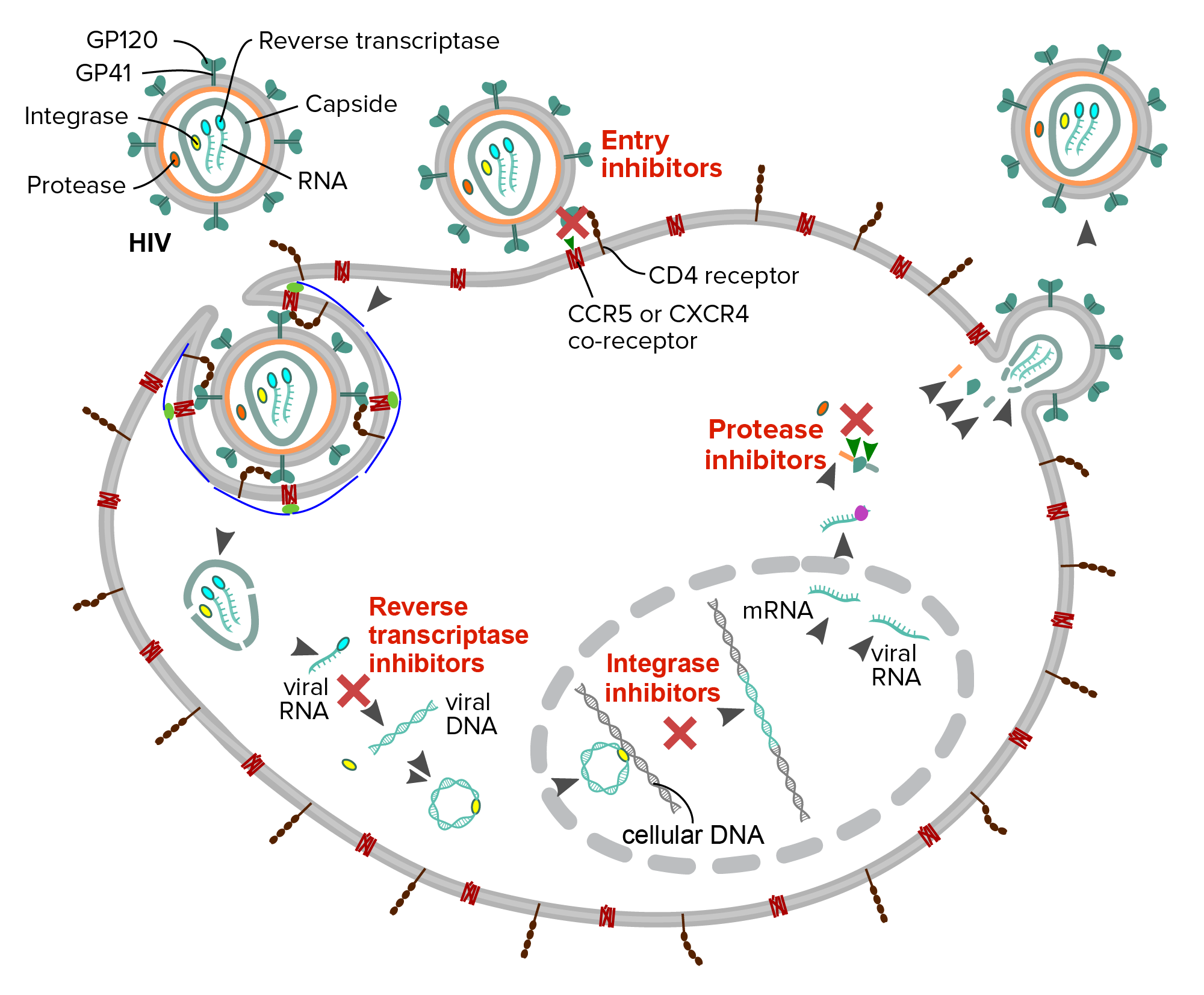
Descripción esquemática del mecanismo de 4 clases de medicamentos antirretrovirales contra el VIH:
Inhibidores de la fusión o entrada: interfieren con la unión, fusión o entrada del virión del VIH
Inhibidores de la transcriptasa inversa: interfieren con la transcripción reversa del ARN viral en ADN
Inhibidores de la integrasa: evitan la inserción del genoma viral en el ADN del huésped
Inhibidores de la proteasa: bloquean la escisión de los precursores de proteínas necesarios para la producción de partículas virales infecciosas

Imagen: “HIV-drug-classes” por Thomas Splettstoesser. Licencia: CC BY 3.0, editada por Lecturio.

Fracaso de un régimen antirretroviral

  • Niveles plasmáticos persistentemente elevados de ARN del VIH en EN Erythema nodosum is an immune-mediated panniculitis (inflammation of the subcutaneous fat) caused by a type IV (delayed-type) hypersensitivity reaction. It commonly manifests in young women as tender, erythematous nodules on the shins. Erythema Nodosum pacientes con virus Virus Viruses are infectious, obligate intracellular parasites composed of a nucleic acid core surrounded by a protein capsid. Viruses can be either naked (non-enveloped) or enveloped. The classification of viruses is complex and based on many factors, including type and structure of the nucleoid and capsid, the presence of an envelope, the replication cycle, and the host range. Virology previamente indetectable, incluso con tratamiento continuo
  • Indica resistencia a 1 o más medicamentos en EN Erythema nodosum is an immune-mediated panniculitis (inflammation of the subcutaneous fat) caused by a type IV (delayed-type) hypersensitivity reaction. It commonly manifests in young women as tender, erythematous nodules on the shins. Erythema Nodosum el régimen
  • Requiere cambio en EN Erythema nodosum is an immune-mediated panniculitis (inflammation of the subcutaneous fat) caused by a type IV (delayed-type) hypersensitivity reaction. It commonly manifests in young women as tender, erythematous nodules on the shins. Erythema Nodosum el régimen (necesidad de implementar una combinación completamente nueva de medicamentos)

Inhibidores Nucleósidos de la Transcriptasa Inversa e Inhibidores Nucleótidos de la Transcriptasa Inversa

Medicamentos

  • Inhibidores nucleósidos de la transcriptasa inversa:
    • Zidovudina (ZDV o azidotimidina (AZT): inhibidores de la transcriptasa inversa representativos
    • Lamivudina (3TC)
    • Abacavir Abacavir Anti-HIV Drugs (ABC)
    • Emtricitabina (FTC)
    • Entecavir Entecavir Anti-HIV Drugs (ETV)
    • Truvada Truvada Anti-HIV Drugs (emtricitabina/ tenofovir Tenofovir An adenine analog reverse transcriptase inhibitor with antiviral activity against HIV-1 and hepatitis b. It is used to treat HIV infections and chronic hepatitis b, in combination with other antiviral agents, due to the emergence of antiviral drug resistance when it is used alone. Anti-HIV Drugs)
    • Zalcitabina (ddC): descontinuada
  • Inhibidores nucleótidos de la transcriptasa inversa ( tenofovir Tenofovir An adenine analog reverse transcriptase inhibitor with antiviral activity against HIV-1 and hepatitis b. It is used to treat HIV infections and chronic hepatitis b, in combination with other antiviral agents, due to the emergence of antiviral drug resistance when it is used alone. Anti-HIV Drugs, el único análogo de nucleótido):
    • Tenofovir Tenofovir An adenine analog reverse transcriptase inhibitor with antiviral activity against HIV-1 and hepatitis b. It is used to treat HIV infections and chronic hepatitis b, in combination with other antiviral agents, due to the emergence of antiviral drug resistance when it is used alone. Anti-HIV Drugs alafenamida (TAF)
    • Tenofovir Tenofovir An adenine analog reverse transcriptase inhibitor with antiviral activity against HIV-1 and hepatitis b. It is used to treat HIV infections and chronic hepatitis b, in combination with other antiviral agents, due to the emergence of antiviral drug resistance when it is used alone. Anti-HIV Drugs disoproxil fumarato (TDF)
  • Inhibidores nucleósidos de la transcriptasa inversa que ya no se recomienda usar (United States Department of Health and Human Services, ( HHS HHS Diabetic ketoacidosis (DKA) and hyperosmolar hyperglycemic state (HHS) are serious, acute complications of diabetes mellitus. Hyperosmolar hyperglycemic state occurs due to a relative deficiency of insulin or insulin resistance, leading to severe hyperglycemia and elevated serum osmolality. Hyperglycemic Crises, por sus siglas en EN Erythema nodosum is an immune-mediated panniculitis (inflammation of the subcutaneous fat) caused by a type IV (delayed-type) hypersensitivity reaction. It commonly manifests in young women as tender, erythematous nodules on the shins. Erythema Nodosum inglés) 2019):
    • Didanosina (ddl): acidosis Acidosis A pathologic condition of acid accumulation or depletion of base in the body. The two main types are respiratory acidosis and metabolic acidosis, due to metabolic acid build up. Respiratory Acidosis láctica, pancreatitis Pancreatitis Inflammation of the pancreas. Pancreatitis is classified as acute unless there are computed tomographic or endoscopic retrograde cholangiopancreatographic findings of chronic pancreatitis. The two most common forms of acute pancreatitis are alcoholic pancreatitis and gallstone pancreatitis. Acute Pancreatitis
    • Estavudina (d4T): acidosis Acidosis A pathologic condition of acid accumulation or depletion of base in the body. The two main types are respiratory acidosis and metabolic acidosis, due to metabolic acid build up. Respiratory Acidosis láctica, pancreatitis Pancreatitis Inflammation of the pancreas. Pancreatitis is classified as acute unless there are computed tomographic or endoscopic retrograde cholangiopancreatographic findings of chronic pancreatitis. The two most common forms of acute pancreatitis are alcoholic pancreatitis and gallstone pancreatitis. Acute Pancreatitis

Mecanismo de acción

  • Actúan como terminadores de cadena del ADN proviral (carecen del grupo 3′-hidroxi, por lo que otros nucleótidos no pueden continuar uniéndose)
  • Se unen de manera competitiva al AL Amyloidosis sitio de unión del desoxinucleótido trifosfato de la transcriptasa inversa, terminando la elongación

Efectos secundarios

  • Toxicidad mitocondrial:
    • Los LOS Neisseria trifosfatos intracelulares para los LOS Neisseria inhibidores nucleósidos de la transcriptasa inversa no afectan la ADN polimerasa α y la ADN polimerasa β humanas.
    • Algunos trifosfatos intracelulares para los LOS Neisseria inhibidores nucleósidos de la transcriptasa inversa inhiben la ADN polimerasa γ humana (enzima mitocondrial), lo que produce toxicidades relacionadas con la inhibición de la síntesis de ADN mitocondrial.
    • Vista como:
      • Lipodistrofia: distribución anormal de la grasa, “joroba de búfalo”
      • Esteatosis hepática
      • Neuropatía periférica
      • Pancreatitis Pancreatitis Inflammation of the pancreas. Pancreatitis is classified as acute unless there are computed tomographic or endoscopic retrograde cholangiopancreatographic findings of chronic pancreatitis. The two most common forms of acute pancreatitis are alcoholic pancreatitis and gallstone pancreatitis. Acute Pancreatitis
      • Acidosis Acidosis A pathologic condition of acid accumulation or depletion of base in the body. The two main types are respiratory acidosis and metabolic acidosis, due to metabolic acid build up. Respiratory Acidosis láctica
    • Didanosina, estavudina: ↑ riesgo de toxicidad mitocondrial
    • La emtricitabina, lamivudina y tenofovir Tenofovir An adenine analog reverse transcriptase inhibitor with antiviral activity against HIV-1 and hepatitis b. It is used to treat HIV infections and chronic hepatitis b, in combination with other antiviral agents, due to the emergence of antiviral drug resistance when it is used alone. Anti-HIV Drugs fosforilados no afectan a la ADN polimerasa γ humana (sin toxicidad mitocondrial).
  • Supresión de la médula ósea: anemia Anemia Anemia is a condition in which individuals have low Hb levels, which can arise from various causes. Anemia is accompanied by a reduced number of RBCs and may manifest with fatigue, shortness of breath, pallor, and weakness. Subtypes are classified by the size of RBCs, chronicity, and etiology. Anemia: Overview and Types, neutropenia Neutropenia Neutrophils are an important component of the immune system and play a significant role in the eradication of infections. Low numbers of circulating neutrophils, referred to as neutropenia, predispose the body to recurrent infections or sepsis, though patients can also be asymptomatic. Neutropenia, trombocitopenia
  • Gastrointestinales: náuseas, vómitos, diarrea, hepatitis colestásica aguda
  • Agitación, cefaleas, mialgia e insomnio

Características importantes

  • Inhibidores nucleósidos de la transcriptasa inversa: para infecciones por VIH-1 y VIH-2
  • Los LOS Neisseria inhibidores nucleósidos de la transcriptasa inversa son profármacos: deben estar trifosforilados para estar activos
  • Inhibidores nucleótidos de la transcriptasa inversa ( tenofovir Tenofovir An adenine analog reverse transcriptase inhibitor with antiviral activity against HIV-1 and hepatitis b. It is used to treat HIV infections and chronic hepatitis b, in combination with other antiviral agents, due to the emergence of antiviral drug resistance when it is used alone. Anti-HIV Drugs): debe desfosforilarse para ser activo
  • Metabolismo y eliminación:
    • Tenofovir Tenofovir An adenine analog reverse transcriptase inhibitor with antiviral activity against HIV-1 and hepatitis b. It is used to treat HIV infections and chronic hepatitis b, in combination with other antiviral agents, due to the emergence of antiviral drug resistance when it is used alone. Anti-HIV Drugs: larga vida media de eliminación (17 horas)
    • Emtricitabina, lamivudina, tenofovir Tenofovir An adenine analog reverse transcriptase inhibitor with antiviral activity against HIV-1 and hepatitis b. It is used to treat HIV infections and chronic hepatitis b, in combination with other antiviral agents, due to the emergence of antiviral drug resistance when it is used alone. Anti-HIV Drugs: excreción renal del medicamento original
    • Zidovudina, abacavir Abacavir Anti-HIV Drugs: hepáticos (glucuronidación)
  • Resistencia: rápida, especialmente cuando se usan como agentes únicos

Resumen de medicamentos inhibidores nucléosidos de la transcriptasa inversa e inhibidores nucléotidos de la transcriptasa inversa

Tabla: Inhibidores de la transcriptasa inversa de nucleósidos y de nucleótidos
Medicamento Efectos secundarios Interacciones/contraindicaciones
Zidovudina (AZT):
  • Primer medicamento TAR para el VIH
  • Atraviesa la placenta Placenta A highly vascularized mammalian fetal-maternal organ and major site of transport of oxygen, nutrients, and fetal waste products. It includes a fetal portion (chorionic villi) derived from trophoblasts and a maternal portion (decidua) derived from the uterine endometrium. The placenta produces an array of steroid, protein and peptide hormones (placental hormones). Placenta, Umbilical Cord, and Amniotic Cavity (evita la transmisión de madre a hijo)
  • Acidosis Acidosis A pathologic condition of acid accumulation or depletion of base in the body. The two main types are respiratory acidosis and metabolic acidosis, due to metabolic acid build up. Respiratory Acidosis láctica, hepatomegalia, esteatosis hepática
  • Supresión de la médula ósea: anemia Anemia Anemia is a condition in which individuals have low Hb levels, which can arise from various causes. Anemia is accompanied by a reduced number of RBCs and may manifest with fatigue, shortness of breath, pallor, and weakness. Subtypes are classified by the size of RBCs, chronicity, and etiology. Anemia: Overview and Types y neutropenia Neutropenia Neutrophils are an important component of the immune system and play a significant role in the eradication of infections. Low numbers of circulating neutrophils, referred to as neutropenia, predispose the body to recurrent infections or sepsis, though patients can also be asymptomatic. Neutropenia
  • Gastrointestinales: vómitos, diarrea
  • Cefalea, miopatía, insomnio, hiperpigmentación de las uñas
  • Diabetes Diabetes Diabetes mellitus (DM) is a metabolic disease characterized by hyperglycemia and dysfunction of the regulation of glucose metabolism by insulin. Type 1 DM is diagnosed mostly in children and young adults as the result of autoimmune destruction of β cells in the pancreas and the resulting lack of insulin. Type 2 DM has a significant association with obesity and is characterized by insulin resistance. Diabetes Mellitus, hepatitis colestásica aguda
  • Los LOS Neisseria antifúngicos azólicos, el ácido valproico y la atovacuona aumentan los LOS Neisseria niveles plasmáticos
  • Precaución en EN Erythema nodosum is an immune-mediated panniculitis (inflammation of the subcutaneous fat) caused by a type IV (delayed-type) hypersensitivity reaction. It commonly manifests in young women as tender, erythematous nodules on the shins. Erythema Nodosum anemia Anemia Anemia is a condition in which individuals have low Hb levels, which can arise from various causes. Anemia is accompanied by a reduced number of RBCs and may manifest with fatigue, shortness of breath, pallor, and weakness. Subtypes are classified by the size of RBCs, chronicity, and etiology. Anemia: Overview and Types, neutropenia Neutropenia Neutrophils are an important component of the immune system and play a significant role in the eradication of infections. Low numbers of circulating neutrophils, referred to as neutropenia, predispose the body to recurrent infections or sepsis, though patients can also be asymptomatic. Neutropenia, disfunción hepática (requiere ajuste de dosis)
Emtricitabina: estructuralmente similar a lamivudina
  • Toxicidad mínima
  • Hiperpigmentación palmoplantar, cefalea, diarrea, prurito
  • Hepatitis grave en EN Erythema nodosum is an immune-mediated panniculitis (inflammation of the subcutaneous fat) caused by a type IV (delayed-type) hypersensitivity reaction. It commonly manifests in young women as tender, erythematous nodules on the shins. Erythema Nodosum personas infectadas por el HBV HBV Hepatitis B virus (HBV) is a partially double-stranded DNA virus, which belongs to the Orthohepadnavirus genus and the Hepadnaviridae family. Hepatitis B virus is transmitted by exposure to infectious blood or body fluids. Examples of types of exposure include sexual intercourse, IV drug use, and childbirth. Hepatitis B Virus, si se interrumpe el medicamento
No combinar con lamivudina ( los LOS Neisseria medicamentos compiten con la fosforilación intracelular).
Lamivudina: activa contra el virus Virus Viruses are infectious, obligate intracellular parasites composed of a nucleic acid core surrounded by a protein capsid. Viruses can be either naked (non-enveloped) or enveloped. The classification of viruses is complex and based on many factors, including type and structure of the nucleoid and capsid, the presence of an envelope, the replication cycle, and the host range. Virology de la hepatitis B Hepatitis B Hepatitis B virus (HBV) is a partially double-stranded DNA virus, which belongs to the Orthohepadnavirus genus and the Hepadnaviridae family. Most individuals with acute HBV infection are asymptomatic or have mild, self-limiting symptoms. Chronic infection can be asymptomatic or create hepatic inflammation, leading to liver cirrhosis and hepatocellular carcinoma (HCC). Hepatitis B Virus
  • Generalmente bien tolerada
  • Pancreatitis Pancreatitis Inflammation of the pancreas. Pancreatitis is classified as acute unless there are computed tomographic or endoscopic retrograde cholangiopancreatographic findings of chronic pancreatitis. The two most common forms of acute pancreatitis are alcoholic pancreatitis and gallstone pancreatitis. Acute Pancreatitis en EN Erythema nodosum is an immune-mediated panniculitis (inflammation of the subcutaneous fat) caused by a type IV (delayed-type) hypersensitivity reaction. It commonly manifests in young women as tender, erythematous nodules on the shins. Erythema Nodosum niños
  • Hepatitis grave en EN Erythema nodosum is an immune-mediated panniculitis (inflammation of the subcutaneous fat) caused by a type IV (delayed-type) hypersensitivity reaction. It commonly manifests in young women as tender, erythematous nodules on the shins. Erythema Nodosum personas con HBV HBV Hepatitis B virus (HBV) is a partially double-stranded DNA virus, which belongs to the Orthohepadnavirus genus and the Hepadnaviridae family. Hepatitis B virus is transmitted by exposure to infectious blood or body fluids. Examples of types of exposure include sexual intercourse, IV drug use, and childbirth. Hepatitis B Virus, si se interrumpe el medicamento
No combinar con emtricitabina ( los LOS Neisseria medicamentos compiten con la fosforilación intracelular).
Abacavir Abacavir Anti-HIV Drugs Reacción de hipersensibilidad (potencialmente mortal): fiebre, erupción cutánea, dolor Dolor Inflammation abdominal, vómitos, disnea
  • Contraindicado en EN Erythema nodosum is an immune-mediated panniculitis (inflammation of the subcutaneous fat) caused by a type IV (delayed-type) hypersensitivity reaction. It commonly manifests in young women as tender, erythematous nodules on the shins. Erythema Nodosum pacientes con HLAB*5701 positivo (riesgo de reacción de hipersensibilidad)
  • Asociado a eventos cardiovasculares
Tenofovir Tenofovir An adenine analog reverse transcriptase inhibitor with antiviral activity against HIV-1 and hepatitis b. It is used to treat HIV infections and chronic hepatitis b, in combination with other antiviral agents, due to the emergence of antiviral drug resistance when it is used alone. Anti-HIV Drugs (inhibidores nucleótidos de la transcriptasa inversa): TAF y TDF (TAF: activo contra el virus Virus Viruses are infectious, obligate intracellular parasites composed of a nucleic acid core surrounded by a protein capsid. Viruses can be either naked (non-enveloped) or enveloped. The classification of viruses is complex and based on many factors, including type and structure of the nucleoid and capsid, the presence of an envelope, the replication cycle, and the host range. Virology de la hepatitis B Hepatitis B Hepatitis B virus (HBV) is a partially double-stranded DNA virus, which belongs to the Orthohepadnavirus genus and the Hepadnaviridae family. Most individuals with acute HBV infection are asymptomatic or have mild, self-limiting symptoms. Chronic infection can be asymptomatic or create hepatic inflammation, leading to liver cirrhosis and hepatocellular carcinoma (HCC). Hepatitis B Virus)
  • Síntomas gastrointestinales
  • Lesión renal (TDF > TAF), síndrome de Fanconi, pérdida ósea (TDF > TAF)
  • Hepatitis grave en EN Erythema nodosum is an immune-mediated panniculitis (inflammation of the subcutaneous fat) caused by a type IV (delayed-type) hypersensitivity reaction. It commonly manifests in young women as tender, erythematous nodules on the shins. Erythema Nodosum personas infectadas por el HBV HBV Hepatitis B virus (HBV) is a partially double-stranded DNA virus, which belongs to the Orthohepadnavirus genus and the Hepadnaviridae family. Hepatitis B virus is transmitted by exposure to infectious blood or body fluids. Examples of types of exposure include sexual intercourse, IV drug use, and childbirth. Hepatitis B Virus, si se interrumpe el medicamento
TAR: terapia antirretroviral
HBV: virus de la hepatitis B
VIH: virus de inmunodeficiencia humana
TAF: tenofovir alafenamida
TDF: tenofovir disoproxil fumarato

Inhibidores No Nucleósidos de la Transcriptasa Inversa

Medicamentos

  • 1ra generación:
  • 2da generación:
    • Etravirina (ETV)
    • Rilpivirina (RPV)
    • Doravirina (DOR)
  • Delavirdina (DLV): ya no se recomienda su uso (United States HHS HHS Diabetic ketoacidosis (DKA) and hyperosmolar hyperglycemic state (HHS) are serious, acute complications of diabetes mellitus. Hyperosmolar hyperglycemic state occurs due to a relative deficiency of insulin or insulin resistance, leading to severe hyperglycemia and elevated serum osmolality. Hyperglycemic Crises, 2019)

Mecanismo de acción

Inhibidores no competitivos de la transcriptasa inversa:
  • Se unen directamente a la transcriptasa inversa e inhiben la síntesis de ADN viral
  • Inducen cambios conformacionales en EN Erythema nodosum is an immune-mediated panniculitis (inflammation of the subcutaneous fat) caused by a type IV (delayed-type) hypersensitivity reaction. It commonly manifests in young women as tender, erythematous nodules on the shins. Erythema Nodosum la estructura de la enzima, haciéndola inactiva
Antivirales Medicamentos contra el VIH

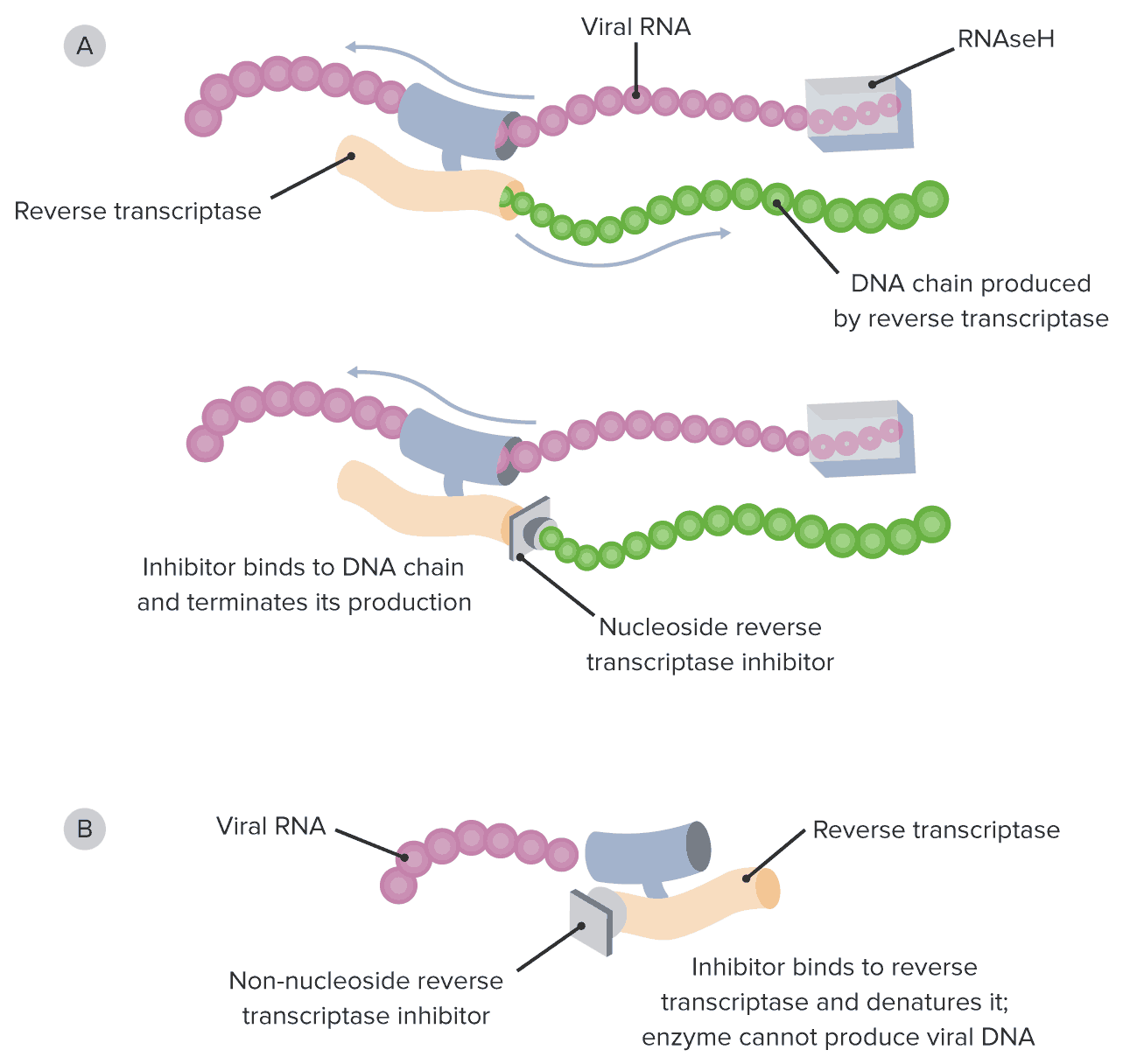
Diagrama del mecanismo de acción de los inhibidores nucleósidos de la transcriptasa inversa y los inhibidores no nucleósidos de la transcriptasa inversa:
A: Notar cómo los inhibidores nucleósidos de la transcriptasa inversa bloquean el genoma del ADN viral en crecimiento al sustituir los nucleósidos naturales y funcionar como terminadores de cadena.
B: Por otro lado, los inhibidores no nucleósidos de la transcriptasa inversa se unen directamente a la enzima transcriptasa inversa, evitando directamente la síntesis de ADN viral.

Imagen por Lecturio.

Efectos secundarios

  • Erupción, síntomas gastrointestinales, cefalea, fiebre
  • Hepatotoxicidad (aumento de enzimas hepáticas)

Características importantes

  • Para la infección por VIH-1
  • Sin efecto sobre la ADN polimerasa de la célula huésped
  • Metabolismo: hepático (por citocromo P450 (CYP))
  • Debe evitarse el uso concomitante de inductores o inhibidores potentes de CYP
  • Resistencia:
    • Tasa de farmacorresistencia: 2%–8%
    • Los LOS Neisseria medicamentos de 1ra generación tienen perfiles de resistencia diferentes a los LOS Neisseria de 2da generación.
    • No usar como monoterapia; deben combinarse con otros agentes para evitar la resistencia.

Resumen de medicamentos inhibidores no nucleósidos de la transcriptasa inversa

Tabla: Medicamentos inhibidores no nucleósidos de la transcriptasa inversa
Medicamento Efectos secundarios Interacciones/contraindicaciones
Etravirina: el inhibidor no nucleósido más utilizado en EN Erythema nodosum is an immune-mediated panniculitis (inflammation of the subcutaneous fat) caused by a type IV (delayed-type) hypersensitivity reaction. It commonly manifests in young women as tender, erythematous nodules on the shins. Erythema Nodosum casos de VIH resistente
  • Erupción
  • Náuseas
Puede interactuar con otros medicamentos antirretrovirales (e.g., si se combinan, se debe duplicar la dosis de maraviroc Maraviroc A cyclohexane and triazole derivative that acts as an antagonist of the ccr5 receptor. It prevents infection by HIV-1 virus strains which use ccr5 as a co-receptor for membrane fusion and cellular entry. Anti-HIV Drugs)
Efavirenz Efavirenz Anti-HIV Drugs
  • Efectos sobre el SNC/psiquiátricos: ↓ concentración, mareo, disforia
  • Erupción
  • Prolongación del QT
  • Hepatitis
Evitar en EN Erythema nodosum is an immune-mediated panniculitis (inflammation of the subcutaneous fat) caused by a type IV (delayed-type) hypersensitivity reaction. It commonly manifests in young women as tender, erythematous nodules on the shins. Erythema Nodosum síndrome de QT largo, enfermedad hepática, enfermedad psiquiátrica
Doravirina Efectos sobre el SNC/psiquiátricos similares a efavirenz Efavirenz Anti-HIV Drugs (pero mucho menos comunes) Uso con rifampicina contraindicado (↓ exposición a doravirina)
Rilpivirina
  • Prolongación del QT
  • Erupción
  • Depresión, insomnio, cefalea
  • La absorción depende del pH pH The quantitative measurement of the acidity or basicity of a solution. Acid-Base Balance, por lo que no debe administrarse con inhibidores de la bomba de protones, inhibidores H2/antiácidos.
  • Evitar en EN Erythema nodosum is an immune-mediated panniculitis (inflammation of the subcutaneous fat) caused by a type IV (delayed-type) hypersensitivity reaction. It commonly manifests in young women as tender, erythematous nodules on the shins. Erythema Nodosum el síndrome de QT largo
Nevirapina: no tratamiento inicial de pacientes sin tratamiento previo (↑ toxicidad)
  • Necrosis Necrosis The death of cells in an organ or tissue due to disease, injury or failure of the blood supply. Ischemic Cell Damage hepática
  • Erupción, reacciones cutáneas graves
  • Si se considera, evitar en EN Erythema nodosum is an immune-mediated panniculitis (inflammation of the subcutaneous fat) caused by a type IV (delayed-type) hypersensitivity reaction. It commonly manifests in young women as tender, erythematous nodules on the shins. Erythema Nodosum pacientes con enfermedad hepática moderada a grave.
  • Si se considera, evitar en EN Erythema nodosum is an immune-mediated panniculitis (inflammation of the subcutaneous fat) caused by a type IV (delayed-type) hypersensitivity reaction. It commonly manifests in young women as tender, erythematous nodules on the shins. Erythema Nodosum mujeres con recuento de CD4 > 250 células/mL o en EN Erythema nodosum is an immune-mediated panniculitis (inflammation of the subcutaneous fat) caused by a type IV (delayed-type) hypersensitivity reaction. It commonly manifests in young women as tender, erythematous nodules on the shins. Erythema Nodosum hombres con recuento de CD4 > 400 células/mL (umbral de hepatotoxicidad).
SNC: sistema nervioso central

Inhibidores de la Proteasa

Medicamentos

  • Darunavir
  • Atazanavir Atazanavir Anti-HIV Drugs
  • Ritonavir Ritonavir An HIV protease inhibitor that works by interfering with the reproductive cycle of HIV. It also inhibits cytochrome p-450 cyp3a. Anti-HIV Drugs
  • Lopinavir Lopinavir An HIV protease inhibitor used in a fixed-dose combination with ritonavir. It is also an inhibitor of cytochrome p-450 cyp3a. Anti-HIV Drugs: no para el tratamiento inicial del VIH
  • Fosamprenavir Fosamprenavir Anti-HIV Drugs: no para el tratamiento inicial del VIH
  • Tipranavir Tipranavir Anti-HIV Drugs: no para el tratamiento inicial del VIH
  • Ya no se recomienda su uso (United States HHS HHS Diabetic ketoacidosis (DKA) and hyperosmolar hyperglycemic state (HHS) are serious, acute complications of diabetes mellitus. Hyperosmolar hyperglycemic state occurs due to a relative deficiency of insulin or insulin resistance, leading to severe hyperglycemia and elevated serum osmolality. Hyperglycemic Crises, 2019):
    • Indinavir Indinavir A potent and specific HIV protease inhibitor that appears to have good oral bioavailability. Anti-HIV Drugs
    • Nelfinavir Nelfinavir A potent HIV protease inhibitor. It is used in combination with other antiviral drugs in the treatment of HIV in both adults and children. Anti-HIV Drugs
    • Saquinavir Saquinavir An HIV protease inhibitor which acts as an analog of an HIV protease cleavage site. It is a highly specific inhibitor of HIV-1 and HIV-2 proteases, and also inhibits cytochrome p-450 cyp3a. Anti-HIV Drugs: descontinuado en EN Erythema nodosum is an immune-mediated panniculitis (inflammation of the subcutaneous fat) caused by a type IV (delayed-type) hypersensitivity reaction. It commonly manifests in young women as tender, erythematous nodules on the shins. Erythema Nodosum los LOS Neisseria Estados Unidos

Mecanismo de acción

  • Unión a la enzima aspartil proteasa del VIH, lo que previene la escisión de las poliproteínas Gag-Pol y hace HACE Altitude Sickness que los LOS Neisseria viriones recién creados sean inmaduros/no infecciosos
  • Refuerzo los LOS Neisseria inhibidores de la proteasa:
    • Objetivo: inhibir la depuración metabólica de los LOS Neisseria inhibidores de la proteasa del VIH (para mejorar la biodisponibilidad oral y prolongar la vida media de eliminación)
    • Medicamentos/refuerzos utilizados:
      • Ritonavir Ritonavir An HIV protease inhibitor that works by interfering with the reproductive cycle of HIV. It also inhibits cytochrome p-450 cyp3a. Anti-HIV Drugs
      • Cobicistat (un análogo de ritonavir Ritonavir An HIV protease inhibitor that works by interfering with the reproductive cycle of HIV. It also inhibits cytochrome p-450 cyp3a. Anti-HIV Drugs): mejor tolerado
    • Efectos:
      • Permite la reducción de la dosis del medicamento y la frecuencia de dosificación
      • Aumenta la concentración del medicamento

Efectos secundarios

  • Síntomas gastrointestinales: náuseas, vómitos y diarrea
  • Dislipidemias, depósito de grasa o síndrome metabólico
  • Lipodistrofia
  • Hepatotoxicidad
  • Hiperglicemia, diabetes Diabetes Diabetes mellitus (DM) is a metabolic disease characterized by hyperglycemia and dysfunction of the regulation of glucose metabolism by insulin. Type 1 DM is diagnosed mostly in children and young adults as the result of autoimmune destruction of β cells in the pancreas and the resulting lack of insulin. Type 2 DM has a significant association with obesity and is characterized by insulin resistance. Diabetes Mellitus
  • Nefrolitiasis
  • Sangrado en EN Erythema nodosum is an immune-mediated panniculitis (inflammation of the subcutaneous fat) caused by a type IV (delayed-type) hypersensitivity reaction. It commonly manifests in young women as tender, erythematous nodules on the shins. Erythema Nodosum la hemofilia
  • Prolongación de intervalo PR

Características importantes

  • Activos contra:
    • VIH-1 y VIH-2
    • Hepatitis C Hepatitis C Hepatitis C is an infection of the liver caused by the hepatitis C virus (HCV). The infection can be transmitted through infectious blood or body fluids and may be transmitted during childbirth or through IV drug use or sexual intercourse. Hepatitis C virus can cause both acute and chronic hepatitis, ranging from a mild to a serious, lifelong illness including liver cirrhosis and hepatocellular carcinoma (HCC). Hepatitis C Virus
  • Metabolismo:
    • Ampliamente metabolizado por CYP 3A4 (excepto nelfinavir Nelfinavir A potent HIV protease inhibitor. It is used in combination with other antiviral drugs in the treatment of HIV in both adults and children. Anti-HIV Drugs: CYP 2C19)
    • Debe evitarse la administración concomitante de otros inductores o inhibidores potentes del CYP.
  • Resistencia poco común

Resumen de los LOS Neisseria inhibidores de la proteasa

Tabla: Inhibidores de la proteasa
Medicamento Efectos secundarios Interacciones/contraindicaciones
Atazanavir Atazanavir Anti-HIV Drugs
  • Hiperbilirrubinemia (indirecta), colestasis/colecistitis, pruebas de función hepática anormales
  • ↑ Riesgo de cálculos renales
  • Menor riesgo de hiperlipidemia que otros inhibidores de la proteasa
Darunavir
  • Síntomas gastrointestinales
  • Hepatotoxicidad
  • Erupción
  • Administrado con dosis bajas de ritonavir Ritonavir An HIV protease inhibitor that works by interfering with the reproductive cycle of HIV. It also inhibits cytochrome p-450 cyp3a. Anti-HIV Drugs/cobicistat; el medicamento combinado aumenta los LOS Neisseria niveles de maraviroc Maraviroc A cyclohexane and triazole derivative that acts as an antagonist of the ccr5 receptor. It prevents infection by HIV-1 virus strains which use ccr5 as a co-receptor for membrane fusion and cellular entry. Anti-HIV Drugs (cuya dosis debe reducirse)
  • Evitar en EN Erythema nodosum is an immune-mediated panniculitis (inflammation of the subcutaneous fat) caused by a type IV (delayed-type) hypersensitivity reaction. It commonly manifests in young women as tender, erythematous nodules on the shins. Erythema Nodosum enfermedad hepática grave
Ritonavir Ritonavir An HIV protease inhibitor that works by interfering with the reproductive cycle of HIV. It also inhibits cytochrome p-450 cyp3a. Anti-HIV Drugs: refuerzo
  • Síntomas gastrointestinales
  • Parestesias
  • Anomalías de lípidos
Uno de los LOS Neisseria inhibidores conocidos más potentes de CYP3A4 CYP3A4 Class 3 Antiarrhythmic Drugs (Potassium Channel Blockers); evitar tomar medicamentos con índice terapéutico estrecho.
Lopinavir Lopinavir An HIV protease inhibitor used in a fixed-dose combination with ritonavir. It is also an inhibitor of cytochrome p-450 cyp3a. Anti-HIV Drugs: coformulado con ritonavir Ritonavir An HIV protease inhibitor that works by interfering with the reproductive cycle of HIV. It also inhibits cytochrome p-450 cyp3a. Anti-HIV Drugs
  • Síntomas gastrointestinales
  • Anomalías de lípidos
No para el tratamiento inicial (relacionado con la potencia y la toxicidad)
CYP: citocromo P450
IBP: inhibidores de la bomba de protones

Inhibidores de Transferencia de Cadena de Integrasa

Medicamentos

Mecanismo de acción

  • Se une a la enzima viral integrasa, responsable de la integración del ADN viral en EN Erythema nodosum is an immune-mediated panniculitis (inflammation of the subcutaneous fat) caused by a type IV (delayed-type) hypersensitivity reaction. It commonly manifests in young women as tender, erythematous nodules on the shins. Erythema Nodosum el ADN huésped de la célula infectada
  • Inhibe la unión del complejo de preintegración

Efectos secundarios

  • Generalmente bien tolerados
  • Aumento de peso
  • Síntomas gastrointestinales: mareo, fatiga
  • Aumenta la creatina quinasa (potencial miopatía o rabdomiólisis)
  • Depresión (ideaciones suicidas)

Características importantes

Resumen de los LOS Neisseria inhibidores de transferencia de cadena de integrasa

Tabla: Inhibidores de transferencia de cadena de integrasa
Medicamentos Efectos secundarios Interacciones/contraindicaciones
Raltegravir Raltegravir Anti-HIV Drugs
  • Generalmente bien tolerado
  • Síntomas gastrointestinales más comunes
  • Mareo, cefalea, posible miopatía, depresión (ideación suicida)
  • Erupción
Los LOS Neisseria inductores enzimáticos (e.g., rifampicina) aumentan su metabolismo al AL Amyloidosis inducir la UDP-glucuronosiltransferasa.
Dolutegravir Dolutegravir Anti-HIV Drugs Leve elevación de creatinina reversible (inhibe el transportador renal, OCT2)
  • Contraindicado en EN Erythema nodosum is an immune-mediated panniculitis (inflammation of the subcutaneous fat) caused by a type IV (delayed-type) hypersensitivity reaction. It commonly manifests in young women as tender, erythematous nodules on the shins. Erythema Nodosum pacientes con mutación Q148
  • Los LOS Neisseria inductores enzimáticos (e.g., rifampicina) aumentan su metabolismo al AL Amyloidosis inducir la UDP-glucuronosiltransferasa.
Elvitegravir Elvitegravir Anti-HIV Drugs: administrado con cobicistat o ritonavir Ritonavir An HIV protease inhibitor that works by interfering with the reproductive cycle of HIV. It also inhibits cytochrome p-450 cyp3a. Anti-HIV Drugs Síntomas gastrointestinales Actualmente disponible solo en EN Erythema nodosum is an immune-mediated panniculitis (inflammation of the subcutaneous fat) caused by a type IV (delayed-type) hypersensitivity reaction. It commonly manifests in young women as tender, erythematous nodules on the shins. Erythema Nodosum una combinación de dosis fija con tenofovir Tenofovir An adenine analog reverse transcriptase inhibitor with antiviral activity against HIV-1 and hepatitis b. It is used to treat HIV infections and chronic hepatitis b, in combination with other antiviral agents, due to the emergence of antiviral drug resistance when it is used alone. Anti-HIV Drugs, emtricitabina y cobicistat (que ↑ interacciones medicamento-medicamento)
Bictegravir Bictegravir Anti-HIV Drugs: coformulado con emtricitabina y TAF
  • Diarrea
  • Cefalea
  • Aumento de peso
Contraindicada la ingesta con rifampicina o dofetilida
OCT2: transportador de cationes orgánicos-2
TAF: tenofovir alafenamida
UDP: uridina-5′-difosfo

Inhibidores de la Entrada e Inhibidores Posteriores a la Fijación

Inhibidores de la entrada

  • Antagonista CCR5 CCR5 Ccr receptors with specificity for chemokine ccl3; chemokine ccl4; and chemokine ccl5. They are expressed at high levels in T-lymphocytes; B-lymphocytes; macrophages; mast cells; and nk cells. The ccr5 receptor is used by the human immunodeficiency virus to infect cells. HIV Infection and AIDS: maraviroc Maraviroc A cyclohexane and triazole derivative that acts as an antagonist of the ccr5 receptor. It prevents infection by HIV-1 virus strains which use ccr5 as a co-receptor for membrane fusion and cellular entry. Anti-HIV Drugs (MVC)
    • Mecanismo de acción: bloquea el correceptor CCR5 CCR5 Ccr receptors with specificity for chemokine ccl3; chemokine ccl4; and chemokine ccl5. They are expressed at high levels in T-lymphocytes; B-lymphocytes; macrophages; mast cells; and nk cells. The ccr5 receptor is used by the human immunodeficiency virus to infect cells. HIV Infection and AIDS, interfiriendo con la entrada del VIH
    • Efectos secundarios:
      • Hepatotoxicidad
      • Erupción o reacciones alérgicas sistémicas
      • Tos TOS Thoracic outlet syndrome (TOS) is a broad term used for a spectrum of syndromes related to the general region of the thoracic outlet, which involves the compression or irritation of elements of the brachial plexus, subclavian artery, or subclavian vein. Thoracic Outlet Syndrome, infecciones de las vías respiratorias superiores
      • Dolores articulares
    • Características importantes:
      • Para virus Virus Viruses are infectious, obligate intracellular parasites composed of a nucleic acid core surrounded by a protein capsid. Viruses can be either naked (non-enveloped) or enveloped. The classification of viruses is complex and based on many factors, including type and structure of the nucleoid and capsid, the presence of an envelope, the replication cycle, and the host range. Virology con tropismo predominantemente CCR5 CCR5 Ccr receptors with specificity for chemokine ccl3; chemokine ccl4; and chemokine ccl5. They are expressed at high levels in T-lymphocytes; B-lymphocytes; macrophages; mast cells; and nk cells. The ccr5 receptor is used by the human immunodeficiency virus to infect cells. HIV Infection and AIDS (VIH-1)
      • Metabolismo: renal y hepático
      • En EN Erythema nodosum is an immune-mediated panniculitis (inflammation of the subcutaneous fat) caused by a type IV (delayed-type) hypersensitivity reaction. It commonly manifests in young women as tender, erythematous nodules on the shins. Erythema Nodosum todos los LOS Neisseria regímenes donde maraviroc Maraviroc A cyclohexane and triazole derivative that acts as an antagonist of the ccr5 receptor. It prevents infection by HIV-1 virus strains which use ccr5 as a co-receptor for membrane fusion and cellular entry. Anti-HIV Drugs se combina con otros antirretrovirales, es necesario ajustar la dosis.
      • Cuando se combina con inhibidores de CYP3A → la dosis de maraviroc Maraviroc A cyclohexane and triazole derivative that acts as an antagonist of the ccr5 receptor. It prevents infection by HIV-1 virus strains which use ccr5 as a co-receptor for membrane fusion and cellular entry. Anti-HIV Drugs es menor; con inductores de CYP3A → la dosis de maraviroc Maraviroc A cyclohexane and triazole derivative that acts as an antagonist of the ccr5 receptor. It prevents infection by HIV-1 virus strains which use ccr5 as a co-receptor for membrane fusion and cellular entry. Anti-HIV Drugs es mayor
      • Se desarrolla resistencia cuando ocurre el cambio de correceptor (cambio en EN Erythema nodosum is an immune-mediated panniculitis (inflammation of the subcutaneous fat) caused by a type IV (delayed-type) hypersensitivity reaction. It commonly manifests in young women as tender, erythematous nodules on the shins. Erythema Nodosum el tropismo).
  • Inhibidor de la fusión: enfuvirtida
    • Mecanismo de acción: se une a la gp41 Gp41 Transmembrane envelope protein of the human immunodeficiency virus which is encoded by the HIV env gene. It has a molecular weight of 41, 000 and is glycosylated. The n-terminal part of gp41 is thought to be involved in cell fusion with the CD4 antigens of T4 lymphocytes, leading to syncytial formation. Gp41 is one of the most common HIV antigens detected by immunoblotting. HIV Infection and AIDS del VIH, evitando la fusión con el linfocito T CD4
    • Efectos secundarios:
      • Complicaciones en EN Erythema nodosum is an immune-mediated panniculitis (inflammation of the subcutaneous fat) caused by a type IV (delayed-type) hypersensitivity reaction. It commonly manifests in young women as tender, erythematous nodules on the shins. Erythema Nodosum el lugar de la inyección ( dolor Dolor Inflammation, eritema, induración y nódulos)
      • Mayor incidencia de neumonía
    • Características importantes:
      • Para la infección por VIH-1
      • Administrado como inyección subcutánea
      • No inhibe el CYP ni afecta a los LOS Neisseria sustratos del CYP
  • Inhibidor de la fijación: fostemsavir Fostemsavir Anti-HIV Drugs
    • Mecanismo de acción:
      • Fostemsavir Fostemsavir Anti-HIV Drugs: un profármaco que se convierte en EN Erythema nodosum is an immune-mediated panniculitis (inflammation of the subcutaneous fat) caused by a type IV (delayed-type) hypersensitivity reaction. It commonly manifests in young women as tender, erythematous nodules on the shins. Erythema Nodosum temsavir
      • Temsavir se une a gp120 Gp120 External envelope protein of the human immunodeficiency virus which is encoded by the HIV env gene. It has a molecular weight of 120 kda and contains numerous glycosylation sites. Gp120 binds to cells expressing CD4 cell-surface antigens, most notably t4-lymphocytes and monocytes/macrophages. Gp120 has been shown to interfere with the normal function of CD4 and is at least partly responsible for the cytopathic effect of HIV. HIV Infection and AIDS, inhibiendo la fijación del virión al AL Amyloidosis linfocito T huésped.
    • Efectos secundarios:
      • Náuseas
      • Prolongación del QT
      • Puede aumentar las enzimas hepáticas en EN Erythema nodosum is an immune-mediated panniculitis (inflammation of the subcutaneous fat) caused by a type IV (delayed-type) hypersensitivity reaction. It commonly manifests in young women as tender, erythematous nodules on the shins. Erythema Nodosum pacientes con hepatitis B Hepatitis B Hepatitis B virus (HBV) is a partially double-stranded DNA virus, which belongs to the Orthohepadnavirus genus and the Hepadnaviridae family. Most individuals with acute HBV infection are asymptomatic or have mild, self-limiting symptoms. Chronic infection can be asymptomatic or create hepatic inflammation, leading to liver cirrhosis and hepatocellular carcinoma (HCC). Hepatitis B Virus/C
    • Características importantes:
      • Para la infección por VIH-1
      • Potente inductor de CYP3A que disminuye los LOS Neisseria niveles del medicamento
Entrada del VIH en una célula huésped

Diagrama esquemático de la entrada viral y pasos inhibidos por enfuvirtida y maraviroc:
La subunidad trimérica gp120 del complejo glicoproteico de la envoltura viral se une al CD4 en la superficie de la célula diana, desencadenando un cambio conformacional que promueve interacciones con los receptores de quimioquinas (en este caso, CCR5). La subunidad transmembrana trimérica gp41 se activa para mediar en la fusión de la membrana para que el contenido viral pueda ingresar a la célula. Maraviroc bloquea el correceptor CCR5. La enfuvirtida se une a la gp41 y evita la fusión.

Imagen: “HIV entry into a host cell” por Laboratory of Experimental Virology, Department of Medical Microbiology, Center for Infection and Immunity Amsterdam (CINIMA), Academic Medical Center, University of Amsterdam, 1105 AZ Amsterdam, The Netherlands. Licencia: CC BY 2.0

Inhibidor posterior a la fijación

  • Medicamento: ibalizumab Ibalizumab Anti-HIV Drugs
  • Mecanismo de acción:
    • Anticuerpo monoclonal
    • Se une a la molécula CD4 y bloquea la entrada del virión
  • Efectos secundarios:
    • Erupción
    • Síntomas gastrointestinales
    • Mareo
    • Aumento de creatinina
  • Características importantes:
    • Para la infección por VIH-1
    • Para pacientes con multirresistencia
    • Administrado por vía intravenosa (después de la dosis inicial, administrada cada 14 días)

Regímenes Combinados de Terapia Antirretroviral

Pautas antirretrovirales para adultos y adolescentes ( HHS HHS Diabetic ketoacidosis (DKA) and hyperosmolar hyperglycemic state (HHS) are serious, acute complications of diabetes mellitus. Hyperosmolar hyperglycemic state occurs due to a relative deficiency of insulin or insulin resistance, leading to severe hyperglycemia and elevated serum osmolality. Hyperglycemic Crises, 2022)

  • Terapia antirretroviral (TAR) recomendada para:
    • Reducir la morbilidad y la mortalidad
    • Reducir la transmisión del VIH
  • La terapia antirretroviral debe iniciarse inmediatamente después del diagnóstico de VIH.
  • Regímenes iniciales recomendados:
    • Bictegravir Bictegravir Anti-HIV Drugs + tenofovir Tenofovir An adenine analog reverse transcriptase inhibitor with antiviral activity against HIV-1 and hepatitis b. It is used to treat HIV infections and chronic hepatitis b, in combination with other antiviral agents, due to the emergence of antiviral drug resistance when it is used alone. Anti-HIV Drugs alafenamida + emtricitabina
    • Dolutegravir Dolutegravir Anti-HIV Drugs + tenofovir Tenofovir An adenine analog reverse transcriptase inhibitor with antiviral activity against HIV-1 and hepatitis b. It is used to treat HIV infections and chronic hepatitis b, in combination with other antiviral agents, due to the emergence of antiviral drug resistance when it is used alone. Anti-HIV Drugs alafenamida/disoproxil fumarato + emtricitabina o lamivudina
  • Regímenes iniciales que deben cumplir ciertos criterios:
    • Dolutegravir Dolutegravir Anti-HIV Drugs + abacavir Abacavir Anti-HIV Drugs + lamivudina: solo para personas HLA-B HLA-B Class I human histocompatibility (HLA) surface antigens encoded by more than 30 detectable alleles on locus B of the HLA complex, the most polymorphic of all the HLA specificities. Several of these antigens (e.g., hla-b27, -b7, -b8) are strongly associated with predisposition to rheumatoid and other autoimmune disorders. Like other class I HLA determinants, they are involved in the cellular immune reactivity of cytolytic T lymphocytes. Organ Transplantation*5701 negativas y sin hepatitis B Hepatitis B Hepatitis B virus (HBV) is a partially double-stranded DNA virus, which belongs to the Orthohepadnavirus genus and the Hepadnaviridae family. Most individuals with acute HBV infection are asymptomatic or have mild, self-limiting symptoms. Chronic infection can be asymptomatic or create hepatic inflammation, leading to liver cirrhosis and hepatocellular carcinoma (HCC). Hepatitis B Virus crónica
    • Dolutegravir Dolutegravir Anti-HIV Drugs + lamivudina, excepto:
      • Individuos con ARN del VIH > 500 000 copias/mL
      • Individuos con coinfección por el virus Virus Viruses are infectious, obligate intracellular parasites composed of a nucleic acid core surrounded by a protein capsid. Viruses can be either naked (non-enveloped) or enveloped. The classification of viruses is complex and based on many factors, including type and structure of the nucleoid and capsid, the presence of an envelope, the replication cycle, and the host range. Virology de la hepatitis B Hepatitis B Hepatitis B virus (HBV) is a partially double-stranded DNA virus, which belongs to the Orthohepadnavirus genus and the Hepadnaviridae family. Most individuals with acute HBV infection are asymptomatic or have mild, self-limiting symptoms. Chronic infection can be asymptomatic or create hepatic inflammation, leading to liver cirrhosis and hepatocellular carcinoma (HCC). Hepatitis B Virus ( HBV HBV Hepatitis B virus (HBV) is a partially double-stranded DNA virus, which belongs to the Orthohepadnavirus genus and the Hepadnaviridae family. Hepatitis B virus is transmitted by exposure to infectious blood or body fluids. Examples of types of exposure include sexual intercourse, IV drug use, and childbirth. Hepatitis B Virus)
      • Individuos en EN Erythema nodosum is an immune-mediated panniculitis (inflammation of the subcutaneous fat) caused by a type IV (delayed-type) hypersensitivity reaction. It commonly manifests in young women as tender, erythematous nodules on the shins. Erythema Nodosum quienes se debe iniciar la TAR antes de obtener resultados de la prueba de resistencia genotípica del VIH para la transcriptasa inversa o el descarte de HBV HBV Hepatitis B virus (HBV) is a partially double-stranded DNA virus, which belongs to the Orthohepadnavirus genus and the Hepadnaviridae family. Hepatitis B virus is transmitted by exposure to infectious blood or body fluids. Examples of types of exposure include sexual intercourse, IV drug use, and childbirth. Hepatitis B Virus

Tratamiento antirretroviral de mujeres embarazadas

  • A las mujeres embarazadas sin tratamiento previo se les recomienda TAR.
  • El régimen de medicamentos consiste en EN Erythema nodosum is an immune-mediated panniculitis (inflammation of the subcutaneous fat) caused by a type IV (delayed-type) hypersensitivity reaction. It commonly manifests in young women as tender, erythematous nodules on the shins. Erythema Nodosum:
    • Pilar dual de inhibidores nucleósidos de la transcriptasa inversa
    • 3er medicamento (ya sea inhibidor de la integrasa o inhibidor de la proteasa)
  • Régimen:
    • Opciones para el pilar de inhibidores nucleósidos de la transcriptasa inversa:
      • Abacavir Abacavir Anti-HIV Drugs + lamivudina ( Abacavir Abacavir Anti-HIV Drugs no debe usarse en EN Erythema nodosum is an immune-mediated panniculitis (inflammation of the subcutaneous fat) caused by a type IV (delayed-type) hypersensitivity reaction. It commonly manifests in young women as tender, erythematous nodules on the shins. Erythema Nodosum pacientes positivos para HLA-B HLA-B Class I human histocompatibility (HLA) surface antigens encoded by more than 30 detectable alleles on locus B of the HLA complex, the most polymorphic of all the HLA specificities. Several of these antigens (e.g., hla-b27, -b7, -b8) are strongly associated with predisposition to rheumatoid and other autoimmune disorders. Like other class I HLA determinants, they are involved in the cellular immune reactivity of cytolytic T lymphocytes. Organ Transplantation*5701; no recomendado si el ARN del VIH previo al AL Amyloidosis tratamiento es > 100 000 copias/mL)
      • Tenofovir Tenofovir An adenine analog reverse transcriptase inhibitor with antiviral activity against HIV-1 and hepatitis b. It is used to treat HIV infections and chronic hepatitis b, in combination with other antiviral agents, due to the emergence of antiviral drug resistance when it is used alone. Anti-HIV Drugs disoproxil fumarato o alafenamida + emtricitabina
      • Tenofovir Tenofovir An adenine analog reverse transcriptase inhibitor with antiviral activity against HIV-1 and hepatitis b. It is used to treat HIV infections and chronic hepatitis b, in combination with other antiviral agents, due to the emergence of antiviral drug resistance when it is used alone. Anti-HIV Drugs disoproxil fumarato o alafenamida + lamivudina
    • 3eras opciones de medicamentos:

Tratamiento antirretroviral de los LOS Neisseria recién nacidos

  • Bajo riesgo de transmisión perinatal del VIH:
    • Considerado en EN Erythema nodosum is an immune-mediated panniculitis (inflammation of the subcutaneous fat) caused by a type IV (delayed-type) hypersensitivity reaction. It commonly manifests in young women as tender, erythematous nodules on the shins. Erythema Nodosum:
      • Madres en EN Erythema nodosum is an immune-mediated panniculitis (inflammation of the subcutaneous fat) caused by a type IV (delayed-type) hypersensitivity reaction. It commonly manifests in young women as tender, erythematous nodules on the shins. Erythema Nodosum TAR durante el embarazo, que son adherentes a la terapia
      • Nivel de ARN del VIH confirmado de < 50 copias/mL (supresión viral) cerca del parto
    • Medicamento neonatal: zidovudina durante 4 semanas
  • Alto riesgo de transmisión perinatal del VIH:
    • Considerado en EN Erythema nodosum is an immune-mediated panniculitis (inflammation of the subcutaneous fat) caused by a type IV (delayed-type) hypersensitivity reaction. It commonly manifests in young women as tender, erythematous nodules on the shins. Erythema Nodosum:
      • Madres sin tratamiento antirretroviral anteparto/intraparto o solo TAR intraparto
      • Madres sin supresión viral
      • Madres con VIH agudo durante el embarazo o la lactancia
    • Intraparto: zidovudina intravenosa si ARN del VIH > 1000 copias/mL
    • Desde el nacimiento hasta las 6 semanas (terapia presuntiva del VIH para recién nacidos):
  • Presunta exposición del recién nacido:
    • Considerada en EN Erythema nodosum is an immune-mediated panniculitis (inflammation of the subcutaneous fat) caused by a type IV (delayed-type) hypersensitivity reaction. It commonly manifests in young women as tender, erythematous nodules on the shins. Erythema Nodosum:
      • Madres que tienen al AL Amyloidosis menos 1 prueba positiva de VIH en EN Erythema nodosum is an immune-mediated panniculitis (inflammation of the subcutaneous fat) caused by a type IV (delayed-type) hypersensitivity reaction. It commonly manifests in young women as tender, erythematous nodules on the shins. Erythema Nodosum el parto o posparto
      • Madres cuyos recién nacidos tienen una prueba positiva de anticuerpos contra el VIH
    • Igual que el tratamiento presuntivo del VIH para recién nacidos
  • Recién nacidos con VIH (prueba virológica de VIH confirmada): usar TAR de 3 medicamentos (usando las dosis adecuadas)

Referencias

  1. Fletcher, C., Bartlett, J., Mitty, J. (2020) Overview of antiretroviral agents used to treat HIV. Retrieved 11 Jan 2021, from https://www.uptodate.com/contents/overview-of-antiretroviral-agents-used-to-treat-hiv
  2. Flexner C.W. (2017). Antiretroviral agents and treatment of HIV infection. Brunton L.L., & Hilal-Dandan R, & Knollmann B.C.(Eds.), Goodman & Gilman’s: The Pharmacological Basis of Therapeutics, 13e. McGraw-Hill.
  3. Panel on Antiretroviral Guidelines for Adults and Adolescents. Guidelines for the Use of Antiretroviral Agents in Adults and Adolescents with HIV. Department of Health and Human Services. Retrieved 11 Jan 2021, from https://clinicalinfo.hiv.gov/sites/default/files/inline-files/AdultandAdolescentGL.pdf
  4. Panel on Antiretroviral Therapy and Medical Management of Children Living with HIV. (2024). Guidelines for the use of antiretroviral agents in pediatric HIV infection. U.S. Department of Health and Human Services. https://clinicalinfo.hiv.gov/sites/default/files/guidelines/documents/pediatric-arv/guidelines-pediatric-arv.pdf
  5. Atkinson, A., Tulloch, K., Boucoiran, I., & Money, D. (2024). Guideline No. 450: Care of pregnant women living with HIV and interventions to reduce perinatal transmission. Journal of Obstetrics and Gynaecology Canada, 46(6), 102551. https://doi.org/10.1016/j.jogc.2024.102551
  6. Safrin, Sharon (2021) “Antiviral Agents.” Basic & Clinical Pharmacology, 15e Eds. Bertram G. Katzung, and Todd W. Vanderah. McGraw-Hill.

¡Crea tu cuenta gratis o inicia una sesión para seguir leyendo!

Regístrate ahora y obtén acceso gratuito a Lecturio con páginas de concepto, videos médicos y cuestionarios para tu educación médica.

User Reviews

Que tengas una sesión de estudio alegre y navideña 🎁 Ahorra 50% en todos los planes >>

Details