Domina Conceptos Médicos

Estudia para la escuela de medicina y tus examenes con Lecturio.

Factor de Necrosis Tumoral (TNF)

El factor de necrosis Necrosis The death of cells in an organ or tissue due to disease, injury or failure of the blood supply. Ischemic Cell Damage tumoral ( TNF TNF Tumor necrosis factor (TNF) is a major cytokine, released primarily by macrophages in response to stimuli. The presence of microbial products and dead cells and injury are among the stimulating factors. This protein belongs to the TNF superfamily, a group of ligands and receptors performing functions in inflammatory response, morphogenesis, and cell proliferation. Tumor Necrosis Factor (TNF), por sus siglas en EN Erythema nodosum is an immune-mediated panniculitis (inflammation of the subcutaneous fat) caused by a type IV (delayed-type) hypersensitivity reaction. It commonly manifests in young women as tender, erythematous nodules on the shins. Erythema Nodosum inglés) es una citoquina importante, liberada principalmente por macrófagos en EN Erythema nodosum is an immune-mediated panniculitis (inflammation of the subcutaneous fat) caused by a type IV (delayed-type) hypersensitivity reaction. It commonly manifests in young women as tender, erythematous nodules on the shins. Erythema Nodosum respuesta a estímulos. Entre los LOS Neisseria factores estimulantes se incluye; la presencia de productos microbianos, células muertas y lesiones. Esta proteína pertenece a la superfamilia TNF TNF Tumor necrosis factor (TNF) is a major cytokine, released primarily by macrophages in response to stimuli. The presence of microbial products and dead cells and injury are among the stimulating factors. This protein belongs to the TNF superfamily, a group of ligands and receptors performing functions in inflammatory response, morphogenesis, and cell proliferation. Tumor Necrosis Factor (TNF), un grupo de ligandos y receptores que realizan funciones en EN Erythema nodosum is an immune-mediated panniculitis (inflammation of the subcutaneous fat) caused by a type IV (delayed-type) hypersensitivity reaction. It commonly manifests in young women as tender, erythematous nodules on the shins. Erythema Nodosum la respuesta inflamatoria, la morfogénesis y la proliferación celular. El factor de necrosis Necrosis The death of cells in an organ or tissue due to disease, injury or failure of the blood supply. Ischemic Cell Damage tumoral interactúa con 2 receptores, que inician vías de transducción de señales que conducen a diferentes respuestas celulares (inflamación, supervivencia celular o apoptosis Apoptosis A regulated cell death mechanism characterized by distinctive morphologic changes in the nucleus and cytoplasm, including the endonucleolytic cleavage of genomic DNA, at regularly spaced, internucleosomal sites, I.e., DNA fragmentation. It is genetically-programmed and serves as a balance to mitosis in regulating the size of animal tissues and in mediating pathologic processes associated with tumor growth. Ischemic Cell Damage). La activación inapropiada o desenfrenada de la señalización de TNF TNF Tumor necrosis factor (TNF) is a major cytokine, released primarily by macrophages in response to stimuli. The presence of microbial products and dead cells and injury are among the stimulating factors. This protein belongs to the TNF superfamily, a group of ligands and receptors performing functions in inflammatory response, morphogenesis, and cell proliferation. Tumor Necrosis Factor (TNF) produce inflamación crónica, como se observa en EN Erythema nodosum is an immune-mediated panniculitis (inflammation of the subcutaneous fat) caused by a type IV (delayed-type) hypersensitivity reaction. It commonly manifests in young women as tender, erythematous nodules on the shins. Erythema Nodosum enfermedades autoinmunes (e.g., artritis reumatoide, psoriasis Psoriasis Psoriasis is a common T-cell-mediated inflammatory skin condition. The etiology is unknown, but is thought to be due to genetic inheritance and environmental triggers. There are 4 major subtypes, with the most common form being chronic plaque psoriasis. Psoriasis). El mecanismo de inhibición del TNF TNF Tumor necrosis factor (TNF) is a major cytokine, released primarily by macrophages in response to stimuli. The presence of microbial products and dead cells and injury are among the stimulating factors. This protein belongs to the TNF superfamily, a group of ligands and receptors performing functions in inflammatory response, morphogenesis, and cell proliferation. Tumor Necrosis Factor (TNF) se ha HA Hemolytic anemia (HA) is the term given to a large group of anemias that are caused by the premature destruction/hemolysis of circulating red blood cells (RBCs). Hemolysis can occur within (intravascular hemolysis) or outside the blood vessels (extravascular hemolysis). Hemolytic Anemia utilizado en EN Erythema nodosum is an immune-mediated panniculitis (inflammation of the subcutaneous fat) caused by a type IV (delayed-type) hypersensitivity reaction. It commonly manifests in young women as tender, erythematous nodules on the shins. Erythema Nodosum el tratamiento de estas enfermedades inflamatorias.

Last updated: May 18, 2023
Editorial responsibility: Stanley Oiseth, Lindsay Jones, Evelin Maza

Descripción General

Factor de necrosis Necrosis The death of cells in an organ or tissue due to disease, injury or failure of the blood supply. Ischemic Cell Damage tumoral ( TNF TNF Tumor necrosis factor (TNF) is a major cytokine, released primarily by macrophages in response to stimuli. The presence of microbial products and dead cells and injury are among the stimulating factors. This protein belongs to the TNF superfamily, a group of ligands and receptors performing functions in inflammatory response, morphogenesis, and cell proliferation. Tumor Necrosis Factor (TNF))

  • Otros nombres: TNF-ɑ, caquectina
    • Originalmente, la proteína derivada de los LOS Neisseria macrófagos se denominó factor de necrosis Necrosis The death of cells in an organ or tissue due to disease, injury or failure of the blood supply. Ischemic Cell Damage tumoral y una segunda, relacionada, derivada de los LOS Neisseria linfocitos, se denominó linfotoxina.
    • Al AL Amyloidosis estar unidas al AL Amyloidosis mismo receptor Receptor Receptors are proteins located either on the surface of or within a cell that can bind to signaling molecules known as ligands (e.g., hormones) and cause some type of response within the cell. Receptors y compartir similitudes en EN Erythema nodosum is an immune-mediated panniculitis (inflammation of the subcutaneous fat) caused by a type IV (delayed-type) hypersensitivity reaction. It commonly manifests in young women as tender, erythematous nodules on the shins. Erythema Nodosum las secuencias de aminoácidos, estas proteínas se denominaban anteriormente:
      • TNF-α (para TNF TNF Tumor necrosis factor (TNF) is a major cytokine, released primarily by macrophages in response to stimuli. The presence of microbial products and dead cells and injury are among the stimulating factors. This protein belongs to the TNF superfamily, a group of ligands and receptors performing functions in inflammatory response, morphogenesis, and cell proliferation. Tumor Necrosis Factor (TNF))
      • TNF-β (para linfotoxina)
    • Estudios adicionales sobre las secuencias de proteínas ahora identifican múltiples miembros (ligandos y receptores) de la superfamilia TNF TNF Tumor necrosis factor (TNF) is a major cytokine, released primarily by macrophages in response to stimuli. The presence of microbial products and dead cells and injury are among the stimulating factors. This protein belongs to the TNF superfamily, a group of ligands and receptors performing functions in inflammatory response, morphogenesis, and cell proliferation. Tumor Necrosis Factor (TNF).
  • Citocina principal, liberada principalmente por los LOS Neisseria macrófagos en EN Erythema nodosum is an immune-mediated panniculitis (inflammation of the subcutaneous fat) caused by a type IV (delayed-type) hypersensitivity reaction. It commonly manifests in young women as tender, erythematous nodules on the shins. Erythema Nodosum respuesta a estímulos (como los LOS Neisseria lipopolisacáridos u otros estímulos que activan los LOS Neisseria receptores de tipo toll)
  • Otras células (e.g., células T, mastocitos, fibroblastos) también producen TNF TNF Tumor necrosis factor (TNF) is a major cytokine, released primarily by macrophages in response to stimuli. The presence of microbial products and dead cells and injury are among the stimulating factors. This protein belongs to the TNF superfamily, a group of ligands and receptors performing functions in inflammatory response, morphogenesis, and cell proliferation. Tumor Necrosis Factor (TNF).

Funciones generales del factor de necrosis Necrosis The death of cells in an organ or tissue due to disease, injury or failure of the blood supply. Ischemic Cell Damage tumoral

  • Proinflamatorias:
    • Activación endotelial:
      • ↑ Moléculas de adhesión endotelial (e.g., P-selectina, E-selectina)
      • ↑ Mediadores (otras citocinas, quimiocinas, eicosanoides)
      • ↑ Actividad procoagulante
    • Activación de células inmunitarias (como los LOS Neisseria leucocitos)
    • Respuesta de fase aguda: movilización de lípidos y proteínas y ↓ apetito (que conduce a pérdida de peso y caquexia)
  • Proliferación y diferenciación celular
  • Apoptosis Apoptosis A regulated cell death mechanism characterized by distinctive morphologic changes in the nucleus and cytoplasm, including the endonucleolytic cleavage of genomic DNA, at regularly spaced, internucleosomal sites, I.e., DNA fragmentation. It is genetically-programmed and serves as a balance to mitosis in regulating the size of animal tissues and in mediating pathologic processes associated with tumor growth. Ischemic Cell Damage
  • Actividad antitumoral

Superfamilia del Factor de Necrosis Tumoral

Miembros de la superfamilia

  • 19 ligandos que interactúan con 29 receptores; cada ligando capaz de interactuar con > 1 receptor Receptor Receptors are proteins located either on the surface of or within a cell that can bind to signaling molecules known as ligands (e.g., hormones) and cause some type of response within the cell. Receptors
  • Las propiedades proinflamatorias están predominantemente presentes en EN Erythema nodosum is an immune-mediated panniculitis (inflammation of the subcutaneous fat) caused by a type IV (delayed-type) hypersensitivity reaction. It commonly manifests in young women as tender, erythematous nodules on the shins. Erythema Nodosum los LOS Neisseria ligandos.
  • La mayoría de los LOS Neisseria miembros tienen funciones protectoras, pero también tienen efectos nocivos (con vínculos con una variedad de enfermedades).

Miembros Notables

  • TNF TNF Tumor necrosis factor (TNF) is a major cytokine, released primarily by macrophages in response to stimuli. The presence of microbial products and dead cells and injury are among the stimulating factors. This protein belongs to the TNF superfamily, a group of ligands and receptors performing functions in inflammatory response, morphogenesis, and cell proliferation. Tumor Necrosis Factor (TNF):
    • Fiebre (pirógena)
    • Antitumoral
    • Mediador de inflamación y sepsis Sepsis Systemic inflammatory response syndrome with a proven or suspected infectious etiology. When sepsis is associated with organ dysfunction distant from the site of infection, it is called severe sepsis. When sepsis is accompanied by hypotension despite adequate fluid infusion, it is called septic shock. Sepsis and Septic Shock
  • Linfotoxina:
  • Ligando CD40 CD40 Members of the tumor necrosis factor receptor superfamily with specificity for CD40 ligand. They are found on mature B-lymphocytes, some epithelial cells; and lymphoid dendritic cells. Evidence suggests that CD40-dependent activation of B-cells is important for generation of memory B-cells within the germinal centers. Mutations in the CD40 antigen gene result in hyper-igm immunodeficiency syndrome, type 3. Signaling of the receptor occurs through its association with tnf receptor-associated factors. Hyper-IgM Syndrome (CD40L):
    • Expresado en EN Erythema nodosum is an immune-mediated panniculitis (inflammation of the subcutaneous fat) caused by a type IV (delayed-type) hypersensitivity reaction. It commonly manifests in young women as tender, erythematous nodules on the shins. Erythema Nodosum células T e interactúa con el CD40 CD40 Members of the tumor necrosis factor receptor superfamily with specificity for CD40 ligand. They are found on mature B-lymphocytes, some epithelial cells; and lymphoid dendritic cells. Evidence suggests that CD40-dependent activation of B-cells is important for generation of memory B-cells within the germinal centers. Mutations in the CD40 antigen gene result in hyper-igm immunodeficiency syndrome, type 3. Signaling of the receptor occurs through its association with tnf receptor-associated factors. Hyper-IgM Syndrome en EN Erythema nodosum is an immune-mediated panniculitis (inflammation of the subcutaneous fat) caused by a type IV (delayed-type) hypersensitivity reaction. It commonly manifests in young women as tender, erythematous nodules on the shins. Erythema Nodosum células B
    • ​​CD40L– CD40 CD40 Members of the tumor necrosis factor receptor superfamily with specificity for CD40 ligand. They are found on mature B-lymphocytes, some epithelial cells; and lymphoid dendritic cells. Evidence suggests that CD40-dependent activation of B-cells is important for generation of memory B-cells within the germinal centers. Mutations in the CD40 antigen gene result in hyper-igm immunodeficiency syndrome, type 3. Signaling of the receptor occurs through its association with tnf receptor-associated factors. Hyper-IgM Syndrome induce la proliferación de células B, la recombinación de cambio de clase y la hipermutación somática.
  • Ligando Fas (FasL):
    • Expresado en EN Erythema nodosum is an immune-mediated panniculitis (inflammation of the subcutaneous fat) caused by a type IV (delayed-type) hypersensitivity reaction. It commonly manifests in young women as tender, erythematous nodules on the shins. Erythema Nodosum citotóxicos células T
    • Interacción de FasL y Fas (un receptor Receptor Receptors are proteins located either on the surface of or within a cell that can bind to signaling molecules known as ligands (e.g., hormones) and cause some type of response within the cell. Receptors de muerte) → proteína asociada a Fas con dominio de muerte → activación de caspasa 8 → apoptosis Apoptosis A regulated cell death mechanism characterized by distinctive morphologic changes in the nucleus and cytoplasm, including the endonucleolytic cleavage of genomic DNA, at regularly spaced, internucleosomal sites, I.e., DNA fragmentation. It is genetically-programmed and serves as a balance to mitosis in regulating the size of animal tissues and in mediating pathologic processes associated with tumor growth. Ischemic Cell Damage

Efectos del Factor de Necrosis Tumoral

Inducción

  • TNF TNF Tumor necrosis factor (TNF) is a major cytokine, released primarily by macrophages in response to stimuli. The presence of microbial products and dead cells and injury are among the stimulating factors. This protein belongs to the TNF superfamily, a group of ligands and receptors performing functions in inflammatory response, morphogenesis, and cell proliferation. Tumor Necrosis Factor (TNF) producido por varias células (predominantemente macrófagos); los LOS Neisseria estímulos incluyen:
    • Productos microbianos (e.g., lipopolisacárido)
    • Células muertas
    • Complejos inmunes
    • Antígenos/cuerpos extraños
    • Lesión física
    • Interlequina-1
  • Comienza inicialmente como unida a la membrana (pro-TNF):
    • Luego se expresa como una proteína transmembrana
    • Requiere escisión proteolítica por la enzima convertidora de TNF-α → liberación de la forma soluble de TNF TNF Tumor necrosis factor (TNF) is a major cytokine, released primarily by macrophages in response to stimuli. The presence of microbial products and dead cells and injury are among the stimulating factors. This protein belongs to the TNF superfamily, a group of ligands and receptors performing functions in inflammatory response, morphogenesis, and cell proliferation. Tumor Necrosis Factor (TNF)

Receptores del factor de necrosis Necrosis The death of cells in an organ or tissue due to disease, injury or failure of the blood supply. Ischemic Cell Damage tumoral

  • Las funciones del TNF TNF Tumor necrosis factor (TNF) is a major cytokine, released primarily by macrophages in response to stimuli. The presence of microbial products and dead cells and injury are among the stimulating factors. This protein belongs to the TNF superfamily, a group of ligands and receptors performing functions in inflammatory response, morphogenesis, and cell proliferation. Tumor Necrosis Factor (TNF) están mediadas por 2 tipos de receptores:
    • TNFR1 TNFR1 A tumor necrosis factor receptor subtype that has specificity for tumor necrosis factor alpha and lymphotoxin alpha. It is constitutively expressed in most tissues and is a key mediator of tumor necrosis factor signaling in the vast majority of cells. The activated receptor signals via a conserved death domain that associates with specific tnf receptor-associated factors in the cytoplasm. Tumor Necrosis Factor (TNF):
      • Ampliamente estudiado
      • Más prevalente
      • Expresado universalmente en EN Erythema nodosum is an immune-mediated panniculitis (inflammation of the subcutaneous fat) caused by a type IV (delayed-type) hypersensitivity reaction. It commonly manifests in young women as tender, erythematous nodules on the shins. Erythema Nodosum casi todos los LOS Neisseria tipos de células.
      • Contiene dominio de muerte y es miembro de la familia de receptores de muerte, con capacidad para inducir muerte por apoptosis Apoptosis A regulated cell death mechanism characterized by distinctive morphologic changes in the nucleus and cytoplasm, including the endonucleolytic cleavage of genomic DNA, at regularly spaced, internucleosomal sites, I.e., DNA fragmentation. It is genetically-programmed and serves as a balance to mitosis in regulating the size of animal tissues and in mediating pathologic processes associated with tumor growth. Ischemic Cell Damage
    • TNFR2 TNFR2 A tumor necrosis factor receptor subtype that is expressed primarily in immune system cells. It has specificity for membrane-bound form of tumor necrosis factors and mediates intracellular-signaling through tnf receptor associated factors. Tumor Necrosis Factor (TNF):
      • Restringido principalmente a las células inmunitarias y algunas células tumorales.
      • No contiene dominio de muerte, pero tiene un sitio de unión al AL Amyloidosis factor asociado al AL Amyloidosis receptor Receptor Receptors are proteins located either on the surface of or within a cell that can bind to signaling molecules known as ligands (e.g., hormones) and cause some type of response within the cell. Receptors de TNF TNF Tumor necrosis factor (TNF) is a major cytokine, released primarily by macrophages in response to stimuli. The presence of microbial products and dead cells and injury are among the stimulating factors. This protein belongs to the TNF superfamily, a group of ligands and receptors performing functions in inflammatory response, morphogenesis, and cell proliferation. Tumor Necrosis Factor (TNF)
      • Se cree que tiene un papel en EN Erythema nodosum is an immune-mediated panniculitis (inflammation of the subcutaneous fat) caused by a type IV (delayed-type) hypersensitivity reaction. It commonly manifests in young women as tender, erythematous nodules on the shins. Erythema Nodosum la supervivencia y regeneración celular.
  • Los LOS Neisseria receptores desencadenan vías de señalización distintas, pero también interconectadas.

Efectos

  • TNF TNF Tumor necrosis factor (TNF) is a major cytokine, released primarily by macrophages in response to stimuli. The presence of microbial products and dead cells and injury are among the stimulating factors. This protein belongs to the TNF superfamily, a group of ligands and receptors performing functions in inflammatory response, morphogenesis, and cell proliferation. Tumor Necrosis Factor (TNF), vía TNFR1 TNFR1 A tumor necrosis factor receptor subtype that has specificity for tumor necrosis factor alpha and lymphotoxin alpha. It is constitutively expressed in most tissues and is a key mediator of tumor necrosis factor signaling in the vast majority of cells. The activated receptor signals via a conserved death domain that associates with specific tnf receptor-associated factors in the cytoplasm. Tumor Necrosis Factor (TNF):
    • Efecto inflamatorio:
      • Ciertas proteínas (dominio de muerte asociado al AL Amyloidosis receptor Receptor Receptors are proteins located either on the surface of or within a cell that can bind to signaling molecules known as ligands (e.g., hormones) and cause some type of response within the cell. Receptors de TNF TNF Tumor necrosis factor (TNF) is a major cytokine, released primarily by macrophages in response to stimuli. The presence of microbial products and dead cells and injury are among the stimulating factors. This protein belongs to the TNF superfamily, a group of ligands and receptors performing functions in inflammatory response, morphogenesis, and cell proliferation. Tumor Necrosis Factor (TNF) tipo 1), factor 2 asociado al AL Amyloidosis receptor Receptor Receptors are proteins located either on the surface of or within a cell that can bind to signaling molecules known as ligands (e.g., hormones) and cause some type of response within the cell. Receptors de TNF TNF Tumor necrosis factor (TNF) is a major cytokine, released primarily by macrophages in response to stimuli. The presence of microbial products and dead cells and injury are among the stimulating factors. This protein belongs to the TNF superfamily, a group of ligands and receptors performing functions in inflammatory response, morphogenesis, and cell proliferation. Tumor Necrosis Factor (TNF) (TRAF2) y proteína que interactúa con el receptor Receptor Receptors are proteins located either on the surface of or within a cell that can bind to signaling molecules known as ligands (e.g., hormones) and cause some type of response within the cell. Receptors) se reclutan secuencialmente.
      • Se activan vías proinflamatorias como el factor nuclear kappa-B (NF-κB) y la proteína quinasa activada por mitógeno.
      • Activación de NF-κB → transcripción de proteínas inflamatorias, supervivencia y proliferación celular, inducción de genes Genes A category of nucleic acid sequences that function as units of heredity and which code for the basic instructions for the development, reproduction, and maintenance of organisms. DNA Types and Structure antiapoptóticos
    • Efecto apoptótico:
      • Se recluta el dominio de muerte asociado al AL Amyloidosis receptor Receptor Receptors are proteins located either on the surface of or within a cell that can bind to signaling molecules known as ligands (e.g., hormones) and cause some type of response within the cell. Receptors de TNF TNF Tumor necrosis factor (TNF) is a major cytokine, released primarily by macrophages in response to stimuli. The presence of microbial products and dead cells and injury are among the stimulating factors. This protein belongs to the TNF superfamily, a group of ligands and receptors performing functions in inflammatory response, morphogenesis, and cell proliferation. Tumor Necrosis Factor (TNF) tipo 1 y la proteína asociada a Fas con dominio de muerte.
      • Se desencadena la activación de la caspasa 8 → cascada proteolítica → apoptosis Apoptosis A regulated cell death mechanism characterized by distinctive morphologic changes in the nucleus and cytoplasm, including the endonucleolytic cleavage of genomic DNA, at regularly spaced, internucleosomal sites, I.e., DNA fragmentation. It is genetically-programmed and serves as a balance to mitosis in regulating the size of animal tissues and in mediating pathologic processes associated with tumor growth. Ischemic Cell Damage
  • TNF TNF Tumor necrosis factor (TNF) is a major cytokine, released primarily by macrophages in response to stimuli. The presence of microbial products and dead cells and injury are among the stimulating factors. This protein belongs to the TNF superfamily, a group of ligands and receptors performing functions in inflammatory response, morphogenesis, and cell proliferation. Tumor Necrosis Factor (TNF), vía TNFR2 TNFR2 A tumor necrosis factor receptor subtype that is expressed primarily in immune system cells. It has specificity for membrane-bound form of tumor necrosis factors and mediates intracellular-signaling through tnf receptor associated factors. Tumor Necrosis Factor (TNF):
    • TRAF2 es reclutado → activación de diferentes vías, como NF-κB y proteína quinasa activada por mitógeno
    • Efectos:
      • Regeneración, proliferación y supervivencia de tejidos/células
      • Defensa del huésped contra patógenos (inflamación)
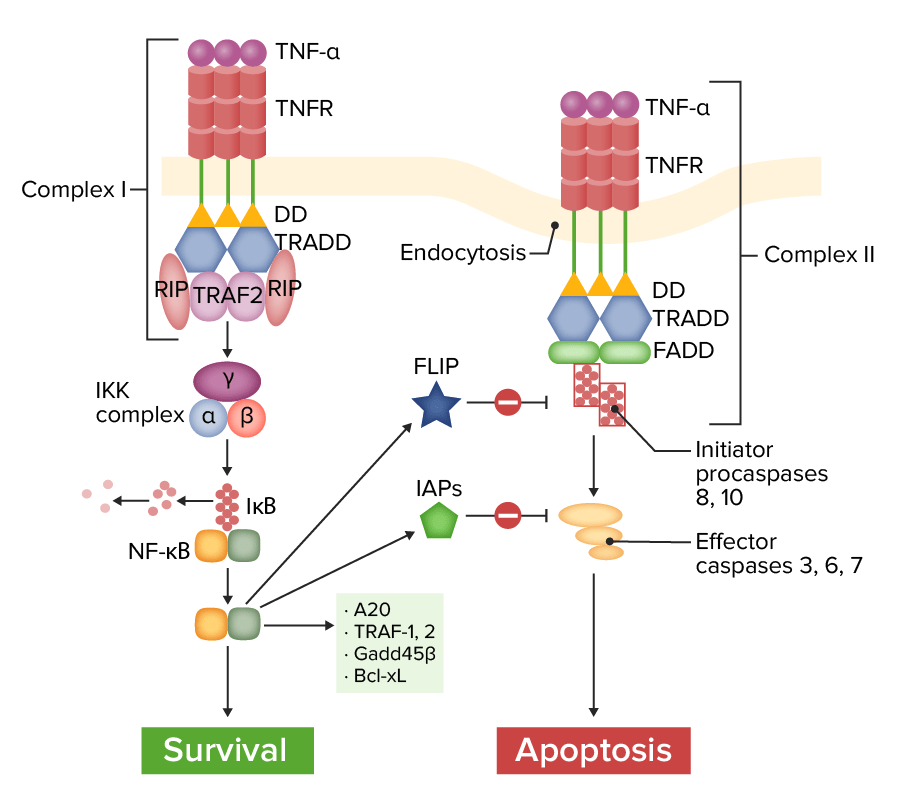
TNF receptor (TNFR) pathway of signaling

Vía de señalización del receptor 1 del factor de necrosis tumoral (TNFR1, por sus siglas en inglés):
Complejo I (a la izquierda): Con la ligadura del TNF-α, el receptor del factor de necrosis tumoral recluta varias moléculas adaptadoras, lo que da lugar a la activación del factor nuclear kappa-B (NF-κB), que induce varios genes antiapoptóticos y señales de supervivencia. La proteína inhibidora FLICE (FLIP) y las proteínas inhibidoras de la apoptosis (IAP) modulan e inhiben la vía de la apoptosis. Complejo II (a la derecha): Sin ciertas proteínas adaptadoras (TRAF-2, RIP), el TNFR conduce al reclutamiento de la proteína asociada a Fas con dominio de muerte (FADD, por sus siglas en inglés). La caspasa-8 se activa y se libera en el citoplasma, activando las caspasas efectoras para inducir la apoptosis.

IκB: inhibidor de NF-κTRAF-2: factor asociado al receptor del TNF.

RIP: proteína que interactúa con el receptor

Imagen por Lecturio.

Factor de Necrosis Tumoral y Enfermedades

Enfermedades

  • Al AL Amyloidosis unirse a 2 receptores diferentes, el TNF TNF Tumor necrosis factor (TNF) is a major cytokine, released primarily by macrophages in response to stimuli. The presence of microbial products and dead cells and injury are among the stimulating factors. This protein belongs to the TNF superfamily, a group of ligands and receptors performing functions in inflammatory response, morphogenesis, and cell proliferation. Tumor Necrosis Factor (TNF) inicia vías de transducción de señales que producen diversas respuestas celulares, incluida la supervivencia celular, la diferenciación, la proliferación y la muerte celular.
  • La activación inapropiada o descontrolada de la señalización de TNF TNF Tumor necrosis factor (TNF) is a major cytokine, released primarily by macrophages in response to stimuli. The presence of microbial products and dead cells and injury are among the stimulating factors. This protein belongs to the TNF superfamily, a group of ligands and receptors performing functions in inflammatory response, morphogenesis, and cell proliferation. Tumor Necrosis Factor (TNF) produce inflamación crónica → complicaciones patológicas como enfermedades autoinmunes
  • La secreción anormal de TNF TNF Tumor necrosis factor (TNF) is a major cytokine, released primarily by macrophages in response to stimuli. The presence of microbial products and dead cells and injury are among the stimulating factors. This protein belongs to the TNF superfamily, a group of ligands and receptors performing functions in inflammatory response, morphogenesis, and cell proliferation. Tumor Necrosis Factor (TNF) se ha HA Hemolytic anemia (HA) is the term given to a large group of anemias that are caused by the premature destruction/hemolysis of circulating red blood cells (RBCs). Hemolysis can occur within (intravascular hemolysis) or outside the blood vessels (extravascular hemolysis). Hemolytic Anemia asociado con:
    • Artritis reumatoide
    • Enfermedad inflamatoria intestinal (enfermedad de Crohn y colitis Colitis Inflammation of the colon section of the large intestine, usually with symptoms such as diarrhea (often with blood and mucus), abdominal pain, and fever. Pseudomembranous Colitis ulcerosa)
    • Artritis psoriásica
    • Psoriasis Psoriasis Psoriasis is a common T-cell-mediated inflammatory skin condition. The etiology is unknown, but is thought to be due to genetic inheritance and environmental triggers. There are 4 major subtypes, with the most common form being chronic plaque psoriasis. Psoriasis
    • Uveítis no infecciosa
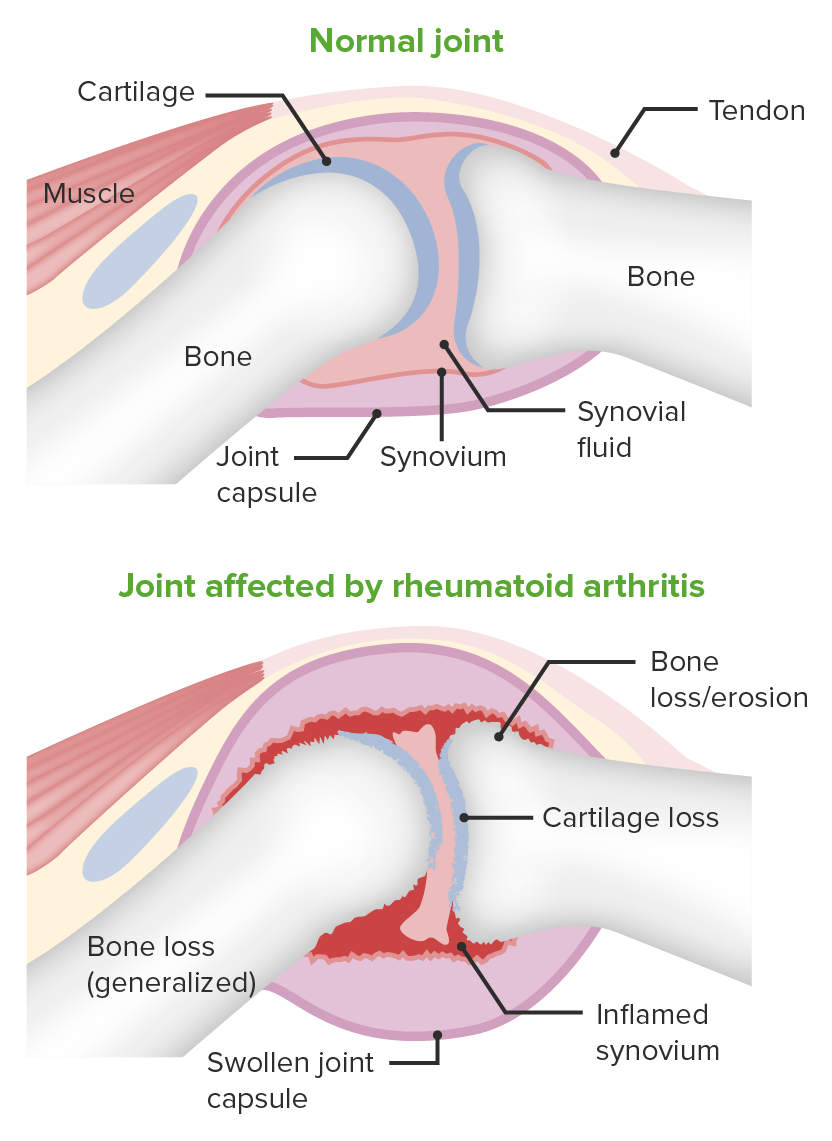
Pathology of Rheumatoid arthritis

Imagen que demuestra la patología de la artritis reumatoide:
Se muestran los cambios en el espacio articular.

Imagen por Lecturio.

Terapia antifactor de necrosis Necrosis The death of cells in an organ or tissue due to disease, injury or failure of the blood supply. Ischemic Cell Damage tumoral

El factor de necrosis Necrosis The death of cells in an organ or tissue due to disease, injury or failure of the blood supply. Ischemic Cell Damage tumoral tiene múltiples efectos biológicos y, en EN Erythema nodosum is an immune-mediated panniculitis (inflammation of the subcutaneous fat) caused by a type IV (delayed-type) hypersensitivity reaction. It commonly manifests in young women as tender, erythematous nodules on the shins. Erythema Nodosum ciertas afecciones (e.g., artritis reumatoide), se han observado niveles elevados de TNF TNF Tumor necrosis factor (TNF) is a major cytokine, released primarily by macrophages in response to stimuli. The presence of microbial products and dead cells and injury are among the stimulating factors. This protein belongs to the TNF superfamily, a group of ligands and receptors performing functions in inflammatory response, morphogenesis, and cell proliferation. Tumor Necrosis Factor (TNF). El mecanismo de inhibición de TNF TNF Tumor necrosis factor (TNF) is a major cytokine, released primarily by macrophages in response to stimuli. The presence of microbial products and dead cells and injury are among the stimulating factors. This protein belongs to the TNF superfamily, a group of ligands and receptors performing functions in inflammatory response, morphogenesis, and cell proliferation. Tumor Necrosis Factor (TNF) se ha HA Hemolytic anemia (HA) is the term given to a large group of anemias that are caused by the premature destruction/hemolysis of circulating red blood cells (RBCs). Hemolysis can occur within (intravascular hemolysis) or outside the blood vessels (extravascular hemolysis). Hemolytic Anemia utilizado en EN Erythema nodosum is an immune-mediated panniculitis (inflammation of the subcutaneous fat) caused by a type IV (delayed-type) hypersensitivity reaction. It commonly manifests in young women as tender, erythematous nodules on the shins. Erythema Nodosum el tratamiento de enfermedades inflamatorias.

Tabla: Indicaciones para la terapia con factor de necrosis Necrosis The death of cells in an organ or tissue due to disease, injury or failure of the blood supply. Ischemic Cell Damage antitumoral
Terapia anti-TNF Mecanismo de acción Indicaciones
Infliximab Infliximab A chimeric monoclonal antibody to tnf-alpha that is used in the treatment of rheumatoid arthritis; ankylosing spondylitis; psoriatic arthritis and Crohn’s disease. Disease-Modifying Antirheumatic Drugs (DMARDs) Anticuerpo quimérico recombinante (que tiene una región variable Variable Variables represent information about something that can change. The design of the measurement scales, or of the methods for obtaining information, will determine the data gathered and the characteristics of that data. As a result, a variable can be qualitative or quantitative, and may be further classified into subgroups. Types of Variables murina y una región constante de IgG1 humana) que se une al AL Amyloidosis TNF TNF Tumor necrosis factor (TNF) is a major cytokine, released primarily by macrophages in response to stimuli. The presence of microbial products and dead cells and injury are among the stimulating factors. This protein belongs to the TNF superfamily, a group of ligands and receptors performing functions in inflammatory response, morphogenesis, and cell proliferation. Tumor Necrosis Factor (TNF) y evita la interacción con el receptor Receptor Receptors are proteins located either on the surface of or within a cell that can bind to signaling molecules known as ligands (e.g., hormones) and cause some type of response within the cell. Receptors
  • Enfermedad de Crohn
  • Artritis reumatoide
  • Espondilitis anquilosante
  • Psoriasis Psoriasis Psoriasis is a common T-cell-mediated inflammatory skin condition. The etiology is unknown, but is thought to be due to genetic inheritance and environmental triggers. There are 4 major subtypes, with the most common form being chronic plaque psoriasis. Psoriasis en EN Erythema nodosum is an immune-mediated panniculitis (inflammation of the subcutaneous fat) caused by a type IV (delayed-type) hypersensitivity reaction. It commonly manifests in young women as tender, erythematous nodules on the shins. Erythema Nodosum placas
  • Artritis psoriásica
  • Colitis Colitis Inflammation of the colon section of the large intestine, usually with symptoms such as diarrhea (often with blood and mucus), abdominal pain, and fever. Pseudomembranous Colitis ulcerosa
Etanercept Etanercept A recombinant version of soluble human tnf receptor fused to an IgG Fc fragment that binds specifically to tumor necrosis factor and inhibits its binding with endogenous tnf receptors. It prevents the inflammatory effect of tnf and is used to treat rheumatoid arthritis; psoriatic arthritis and ankylosing spondylitis. Immunosuppressants Proteína de fusión que se une y neutraliza el TNF TNF Tumor necrosis factor (TNF) is a major cytokine, released primarily by macrophages in response to stimuli. The presence of microbial products and dead cells and injury are among the stimulating factors. This protein belongs to the TNF superfamily, a group of ligands and receptors performing functions in inflammatory response, morphogenesis, and cell proliferation. Tumor Necrosis Factor (TNF) y la linfotoxina
  • Psoriasis Psoriasis Psoriasis is a common T-cell-mediated inflammatory skin condition. The etiology is unknown, but is thought to be due to genetic inheritance and environmental triggers. There are 4 major subtypes, with the most common form being chronic plaque psoriasis. Psoriasis en EN Erythema nodosum is an immune-mediated panniculitis (inflammation of the subcutaneous fat) caused by a type IV (delayed-type) hypersensitivity reaction. It commonly manifests in young women as tender, erythematous nodules on the shins. Erythema Nodosum placas
  • Artritis idiopática juvenil poliarticular
  • Artritis psoriásica
  • Artritis reumatoide
Adalimumab Adalimumab A humanized monoclonal antibody that binds specifically to tnf-alpha and blocks its interaction with endogenous tnf receptors to modulate inflammation. It is used in the treatment of rheumatoid arthritis; psoriatic arthritis; Crohn’s disease and ulcerative colitis. Disease-Modifying Antirheumatic Drugs (DMARDs) Anticuerpo monoclonal IgG1 totalmente humanizado que bloquea la unión del TNF TNF Tumor necrosis factor (TNF) is a major cytokine, released primarily by macrophages in response to stimuli. The presence of microbial products and dead cells and injury are among the stimulating factors. This protein belongs to the TNF superfamily, a group of ligands and receptors performing functions in inflammatory response, morphogenesis, and cell proliferation. Tumor Necrosis Factor (TNF) a los LOS Neisseria receptores
  • Espondilitis anquilosante
  • Enfermedad de Crohn
  • Hidradenitis supurativa
  • Artritis reumatoide juvenil idiopática
  • Artritis psoriásica
  • Artritis reumatoide
  • Colitis Colitis Inflammation of the colon section of the large intestine, usually with symptoms such as diarrhea (often with blood and mucus), abdominal pain, and fever. Pseudomembranous Colitis ulcerosa
  • Uveitis Uveitis Uveitis is the inflammation of the uvea, the pigmented middle layer of the eye, which comprises the iris, ciliary body, and choroid. The condition is categorized based on the site of disease; anterior uveitis is the most common. Diseases of the Uvea
Golimumab Golimumab Disease-Modifying Antirheumatic Drugs (DMARDs) Anticuerpo monoclonal IgG1 completamente humanizado con alta afinidad y especificidad por TNF TNF Tumor necrosis factor (TNF) is a major cytokine, released primarily by macrophages in response to stimuli. The presence of microbial products and dead cells and injury are among the stimulating factors. This protein belongs to the TNF superfamily, a group of ligands and receptors performing functions in inflammatory response, morphogenesis, and cell proliferation. Tumor Necrosis Factor (TNF)
  • Espondilitis anquilosante
  • Artritis psoriásica
  • Artritis reumatoide
  • Colitis Colitis Inflammation of the colon section of the large intestine, usually with symptoms such as diarrhea (often with blood and mucus), abdominal pain, and fever. Pseudomembranous Colitis ulcerosa
Certolizumab Certolizumab Disease-Modifying Antirheumatic Drugs (DMARDs) Anticuerpo monoclonal humanizado pegilado específico de TNF TNF Tumor necrosis factor (TNF) is a major cytokine, released primarily by macrophages in response to stimuli. The presence of microbial products and dead cells and injury are among the stimulating factors. This protein belongs to the TNF superfamily, a group of ligands and receptors performing functions in inflammatory response, morphogenesis, and cell proliferation. Tumor Necrosis Factor (TNF)
  • Espondilitis anquilosante
  • Enfermedad de Crohn
  • Artritis psoriásica
  • Psoriasis Psoriasis Psoriasis is a common T-cell-mediated inflammatory skin condition. The etiology is unknown, but is thought to be due to genetic inheritance and environmental triggers. There are 4 major subtypes, with the most common form being chronic plaque psoriasis. Psoriasis en EN Erythema nodosum is an immune-mediated panniculitis (inflammation of the subcutaneous fat) caused by a type IV (delayed-type) hypersensitivity reaction. It commonly manifests in young women as tender, erythematous nodules on the shins. Erythema Nodosum placas
  • Artritis reumatoide

Relevancia Clínica

  • Enfermedad de Crohn: afección crónica y recurrente que causa inflamación transmural parcheada que puede afectar cualquier parte del tracto gastrointestinal. El íleon terminal y el colon Colon The large intestines constitute the last portion of the digestive system. The large intestine consists of the cecum, appendix, colon (with ascending, transverse, descending, and sigmoid segments), rectum, and anal canal. The primary function of the colon is to remove water and compact the stool prior to expulsion from the body via the rectum and anal canal. Colon, Cecum, and Appendix: Anatomy proximal suelen verse afectados. La enfermedad de Crohn se presenta con diarrea intermitente no sanguinolenta y dolor Dolor Inflammation abdominal tipo cólico. Las manifestaciones extraintestinales pueden incluir cálculos renales de oxalato de calcio, cálculos biliares, eritema nodoso y artritis. El diagnóstico se establece mediante endoscopia con biopsia. El tratamiento es con corticoides, azatioprina, antibióticos y agentes anti-TNF ( infliximab Infliximab A chimeric monoclonal antibody to tnf-alpha that is used in the treatment of rheumatoid arthritis; ankylosing spondylitis; psoriatic arthritis and Crohn’s disease. Disease-Modifying Antirheumatic Drugs (DMARDs) y adalimumab Adalimumab A humanized monoclonal antibody that binds specifically to tnf-alpha and blocks its interaction with endogenous tnf receptors to modulate inflammation. It is used in the treatment of rheumatoid arthritis; psoriatic arthritis; Crohn’s disease and ulcerative colitis. Disease-Modifying Antirheumatic Drugs (DMARDs)).
  • Colitis Colitis Inflammation of the colon section of the large intestine, usually with symptoms such as diarrhea (often with blood and mucus), abdominal pain, and fever. Pseudomembranous Colitis ulcerosa: condición inflamatoria idiopática que involucra la superficie mucosa del colon Colon The large intestines constitute the last portion of the digestive system. The large intestine consists of the cecum, appendix, colon (with ascending, transverse, descending, and sigmoid segments), rectum, and anal canal. The primary function of the colon is to remove water and compact the stool prior to expulsion from the body via the rectum and anal canal. Colon, Cecum, and Appendix: Anatomy. El recto siempre está afectado en EN Erythema nodosum is an immune-mediated panniculitis (inflammation of the subcutaneous fat) caused by a type IV (delayed-type) hypersensitivity reaction. It commonly manifests in young women as tender, erythematous nodules on the shins. Erythema Nodosum la colitis Colitis Inflammation of the colon section of the large intestine, usually with symptoms such as diarrhea (often with blood and mucus), abdominal pain, and fever. Pseudomembranous Colitis ulcerosa y la inflamación puede extenderse proximalmente a través del colon Colon The large intestines constitute the last portion of the digestive system. The large intestine consists of the cecum, appendix, colon (with ascending, transverse, descending, and sigmoid segments), rectum, and anal canal. The primary function of the colon is to remove water and compact the stool prior to expulsion from the body via the rectum and anal canal. Colon, Cecum, and Appendix: Anatomy. La colitis Colitis Inflammation of the colon section of the large intestine, usually with symptoms such as diarrhea (often with blood and mucus), abdominal pain, and fever. Pseudomembranous Colitis ulcerosa causa friabilidad difusa, erosiones con sangrado y pérdida de las haustras, lo cual es visible en EN Erythema nodosum is an immune-mediated panniculitis (inflammation of the subcutaneous fat) caused by a type IV (delayed-type) hypersensitivity reaction. It commonly manifests in young women as tender, erythematous nodules on the shins. Erythema Nodosum la endoscopia. Los LOS Neisseria individuos presentan diarrea sanguinolenta, dolor Dolor Inflammation abdominal tipo cólico, tenesmo y urgencia defecatoria. El diagnóstico se establece mediante endoscopia con biopsia. El tratamiento incluye mesalamina tópica, 6-mercaptopurina y agentes anti-TNF o colectomía para los LOS Neisseria casos graves.
  • Psoriasis Psoriasis Psoriasis is a common T-cell-mediated inflammatory skin condition. The etiology is unknown, but is thought to be due to genetic inheritance and environmental triggers. There are 4 major subtypes, with the most common form being chronic plaque psoriasis. Psoriasis: afección cutánea inflamatoria común mediada por células T. Se desconoce la etiología, pero se cree que la psoriasis Psoriasis Psoriasis is a common T-cell-mediated inflammatory skin condition. The etiology is unknown, but is thought to be due to genetic inheritance and environmental triggers. There are 4 major subtypes, with the most common form being chronic plaque psoriasis. Psoriasis se debe a desencadenantes genéticos y ambientales. Las placas están bien delimitadas, son de color salmón y tienen escamas plateadas. Las placas suelen aparecer en EN Erythema nodosum is an immune-mediated panniculitis (inflammation of the subcutaneous fat) caused by a type IV (delayed-type) hypersensitivity reaction. It commonly manifests in young women as tender, erythematous nodules on the shins. Erythema Nodosum el cuero cabelludo y las superficies extensoras de las extremidades. El diagnóstico es clínico. Las opciones de tratamiento incluyen corticosteroides tópicos, retinoides, inhibidores de la calcineurina, medicamentos antirreumáticos modificadores de la enfermedad, productos biológicos como agentes anti-TNF y fototerapia.
  • Espondilitis anquilosante: también conocida como enfermedad de Bechterew o enfermedad de Marie-Strümpell. La espondilitis anquilosante es una espondiloartropatía seronegativa caracterizada por una inflamación crónica e indolente del esqueleto axial Axial Computed Tomography (CT). La enfermedad grave puede conducir a la fusión y rigidez de la columna vertebral. La afección se observa con mayor frecuencia en EN Erythema nodosum is an immune-mediated panniculitis (inflammation of the subcutaneous fat) caused by a type IV (delayed-type) hypersensitivity reaction. It commonly manifests in young women as tender, erythematous nodules on the shins. Erythema Nodosum hombres jóvenes y se asocia con HLA-B27. Las personas presentarán dolor Dolor Inflammation de espalda progresivo (que mejora con la actividad), rigidez matutina y disminución del rango de movimiento de la columna. También se observan manifestaciones extraarticulares. El diagnóstico se basa en EN Erythema nodosum is an immune-mediated panniculitis (inflammation of the subcutaneous fat) caused by a type IV (delayed-type) hypersensitivity reaction. It commonly manifests in young women as tender, erythematous nodules on the shins. Erythema Nodosum los LOS Neisseria antecedentes, el examen físico y la imagenología (sacroileítis y sindesmofitos prominentes). El tratamiento implica fisioterapia y antiinflamatorios no esteroides (AINE). Los LOS Neisseria casos más graves pueden requerir inhibidores de TNF TNF Tumor necrosis factor (TNF) is a major cytokine, released primarily by macrophages in response to stimuli. The presence of microbial products and dead cells and injury are among the stimulating factors. This protein belongs to the TNF superfamily, a group of ligands and receptors performing functions in inflammatory response, morphogenesis, and cell proliferation. Tumor Necrosis Factor (TNF) o cirugía.
  • Artritis reumatoide: poliartritis inflamatoria simétrica. La artritis reumatoide es un trastorno autoinmune crónico y progresivo. La presentación incluye inflamación de las articulaciones, dolor Dolor Inflammation y rigidez matutina (a menudo en EN Erythema nodosum is an immune-mediated panniculitis (inflammation of the subcutaneous fat) caused by a type IV (delayed-type) hypersensitivity reaction. It commonly manifests in young women as tender, erythematous nodules on the shins. Erythema Nodosum las manos). La enfermedad prolongada y grave puede conducir a deformidades articulares irreversibles. La inflamación sistémica puede dar lugar a manifestaciones extraarticulares, como nódulos reumatoides, enfermedad pulmonar intersticial, síndrome de Felty y pericarditis Pericarditis Pericarditis is an inflammation of the pericardium, often with fluid accumulation. It can be caused by infection (often viral), myocardial infarction, drugs, malignancies, metabolic disorders, autoimmune disorders, or trauma. Acute, subacute, and chronic forms exist. Pericarditis. El diagnóstico es clínico y se confirma por la presencia de factor reumatoideo, anticuerpos antipéptido cíclico citrulinado y hallazgos imagenológicos característicos El tratamiento implica fisioterapia, medicamentos antirreumáticos modificadores de la enfermedad a largo plazo y productos biológicos como los LOS Neisseria agentes anti-TNF.
  • Hidradenitis supurativa: condición crónica de la piel debido a la inflamación de las glándulas sudoríparas apocrinas y los LOS Neisseria folículos pilosos. La hidradenitis supurativa ocurre comúnmente debido a la oclusión del componente folicular de las unidades pilosebáceas. La hidradenitis supurativa se caracteriza por la formación de abscesos, fístulas, lesiones cutáneas supurativas, queloides y senos pilonidales. El diagnóstico de la hidradenitis supurativa es principalmente clínico. El tratamiento incluye cambios en EN Erythema nodosum is an immune-mediated panniculitis (inflammation of the subcutaneous fat) caused by a type IV (delayed-type) hypersensitivity reaction. It commonly manifests in young women as tender, erythematous nodules on the shins. Erythema Nodosum el estilo de vida (pérdida de peso y cesación del hábito tabáquico) y tratamiento médico con antibióticos, retinoides y agentes anti-TNF. La enfermedad resistente requiere cirugía.

Referencias

  1. Aggarwal, B.B. (2003). Signaling pathways of the TNF superfamily: a double-edged sword. Nat Rev Immunol 3:745–756. 
  2. Aggarwal, B.B., Gupta, S.C., Kim, J.H. (2012). Historical perspectives on tumor necrosis factor and its superfamily: 25 years later, a golden journey. Blood 119:651–665. doi:10.1182/blood-2011-04-325225
  3. Beutler, B., Moresco, E.Y. (2021). Innate immunity. Chapter 19 of Kaushansky, K., Prchal, J.T., Burns, L.J., Lichtman, M.A., Levi, M., Linch, D.C. (Eds.),  Williams Hematology, 10th ed. McGraw-Hill. https://accessmedicine.mhmedical.com/content.aspx?bookid=2962&sectionid=252524927
  4. Favalli, E. G., Maioli, G., & Caporali, R. (2024). Biologics or Janus Kinase Inhibitors in Rheumatoid Arthritis Patients Who are Insufficient Responders to Conventional Anti-Rheumatic Drugs. Drugs84(8), 877–894. https://doi.org/10.1007/s40265-024-02059-8
  5. Grimstad, Ø. (2016). Tumor necrosis factor and the tenacious α. JAMA Dermatol 152:557. https://pubmed.ncbi.nlm.nih.gov/27168212/
  6. Kalliolias, G.D., Ivashkiv, L.B. (2016). TNF biology, pathogenic mechanisms and emerging therapeutic strategies. Nature Reviews Rheumatology 12(1):49–62. https://doi.org/10.1038/nrrheum.2015.169
  7. Krensky, A.M., Azzi, J.R., Hafler, D.A. (2017). Immunosuppressants and tolerogens. Chapter 35 of Brunton, L.L., Hilal-Dandan, R., Knollmann, B.C. (Eds.), Goodman & Gilman’s: The Pharmacological Basis of Therapeutics, 13th ed. McGraw-Hill. https://accessmedicine.mhmedical.com/content.aspx?bookid=2189&sectionid=172480027
  8. Kumar, V., Abbas, A. Aster, J. (2021). Inflammation and repair. In: Robbins and Cotran Pathologic Basis of Disease, 10th ed. Elsevier, pp. 88–90).
  9. Jang,D., Lee, A.-H., Shin, H.-Y.,  Song, H.-R., Park, J.-H., Kang, T.-B., Lee, S.-R., Yang, S.-H. (2021). The role of tumor necrosis factor alpha (TNF-α) in autoimmune disease and current TNF-α inhibitors in therapeutics. Int J Mol Sci 22:2719. https://pubmed.ncbi.nlm.nih.gov/33800290/
  10. Varfolomeev, E., Ashkenazi, A. (2004). Tumor necrosis factor. Cell 116:491–497. https://doi.org/10.1016/S0092-8674(04)00166-7
  11. Wang, X., Lin, Y. (2008). Tumor necrosis factor and cancer, buddies or foes? Acta Pharmacologica Sinica 29:1275–1288. https://doi.org/10.1111/j.1745-7254.2008.00889.x

¡Crea tu cuenta gratis o inicia una sesión para seguir leyendo!

Regístrate ahora y obtén acceso gratuito a Lecturio con páginas de concepto, videos médicos y cuestionarios para tu educación médica.

User Reviews

Que tengas una sesión de estudio alegre y navideña 🎁 Ahorra 50% en todos los planes >>

Details