Domina Conceptos Médicos

Estudia para la escuela de medicina y tus examenes con Lecturio.

Eritema Nodoso

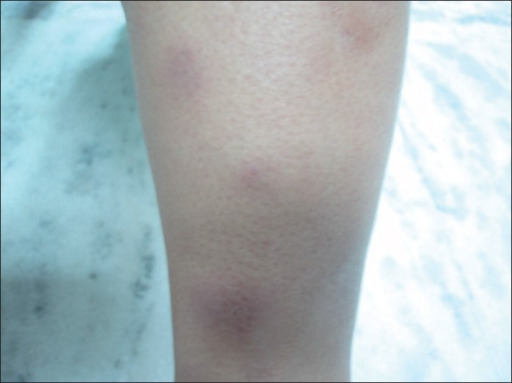
El eritema nodoso es una paniculitis (inflamación de la grasa subcutánea) inmunomediada causada por una reacción de hipersensibilidad de tipo IV (de tipo retardado). Suele manifestarse en EN Erythema nodosum is an immune-mediated panniculitis (inflammation of the subcutaneous fat) caused by a type IV (delayed-type) hypersensitivity reaction. It commonly manifests in young women as tender, erythematous nodules on the shins. Erythema Nodosum mujeres jóvenes como nódulos eritematosos y sensibles en EN Erythema nodosum is an immune-mediated panniculitis (inflammation of the subcutaneous fat) caused by a type IV (delayed-type) hypersensitivity reaction. It commonly manifests in young women as tender, erythematous nodules on the shins. Erythema Nodosum la cara anterior de las piernas. La etiología subyacente varía y puede estar asociada a una infección, a la exposición a medicamentos, a la enfermedad inflamatoria intestinal, al AL Amyloidosis embarazo o a una neoplasia. Las lesiones suelen autorresolverse en EN Erythema nodosum is an immune-mediated panniculitis (inflammation of the subcutaneous fat) caused by a type IV (delayed-type) hypersensitivity reaction. It commonly manifests in young women as tender, erythematous nodules on the shins. Erythema Nodosum 8 semanas sin dejar cicatrices. El tratamiento se enfoca en EN Erythema nodosum is an immune-mediated panniculitis (inflammation of the subcutaneous fat) caused by a type IV (delayed-type) hypersensitivity reaction. It commonly manifests in young women as tender, erythematous nodules on the shins. Erythema Nodosum identificar y tratar la causa subyacente.

Last updated: Dec 15, 2025

Editorial responsibility: Stanley Oiseth, Lindsay Jones, Evelin Maza

Epidemiología y Etiología

Epidemiología:

  • El eritema nodoso es más frecuente en EN Erythema nodosum is an immune-mediated panniculitis (inflammation of the subcutaneous fat) caused by a type IV (delayed-type) hypersensitivity reaction. It commonly manifests in young women as tender, erythematous nodules on the shins. Erythema Nodosum las mujeres entre la segunda y la cuarta década.
  • Las mujeres se ven afectadas de 3–6 veces más frecuente que los LOS Neisseria hombres.
  • Todas las edades y grupos raciales pueden verse afectados.
  • Forma más común de paniculitis (inflamación de la grasa subcutánea)

Etiología:

  • La mitad de los LOS Neisseria casos tienen una etiología desconocida.
  • La infección es la causa más comúnmente identificada, especialmente la infección estreptocócica, pero otras bacterias, así como los LOS Neisseria hongos y los LOS Neisseria virus Virus Viruses are infectious, obligate intracellular parasites composed of a nucleic acid core surrounded by a protein capsid. Viruses can be either naked (non-enveloped) or enveloped. The classification of viruses is complex and based on many factors, including type and structure of the nucleoid and capsid, the presence of an envelope, the replication cycle, and the host range. Virology, son agentes etiológicos conocidos, incluyendo la enfermedad por coronavirus Coronavirus Coronaviruses are a group of related viruses that contain positive-sense, single-stranded RNA. Coronavirus derives its name from “κορώνη korṓnē” in Greek, which translates as “crown,” after the small club-shaped proteins visible as a ring around the viral envelope in electron micrographs. Coronavirus 2019 ( COVID-19 COVID-19 Coronavirus disease 2019 (COVID-19) is an infectious disease caused by the severe acute respiratory syndrome coronavirus 2 (SARS-CoV-2) that mainly affects the respiratory system but can also cause damage to other body systems (cardiovascular, gastrointestinal, renal, and central nervous systems). ) (raramente).
  • Medicamentos: anticonceptivos orales, penicilina, sulfamidas, otros
  • Enfermedad inflamatoria intestinal
  • Malignidad: neoplasias hematológicas y carcinoma
  • Miscelánea: embarazo, sarcoidosis Sarcoidosis Sarcoidosis is a multisystem inflammatory disease that causes noncaseating granulomas. The exact etiology is unknown. Sarcoidosis usually affects the lungs and thoracic lymph nodes, but it can also affect almost every system in the body, including the skin, heart, and eyes, most commonly. Sarcoidosis, otros
Clasificación Etiologías Ejemplos
Causas infecciosas Bacteriana
  • Infecciones estreptocócicas (las más comunes), especialmente faringitis
  • Tuberculosis Tuberculosis Tuberculosis (TB) is an infectious disease caused by Mycobacterium tuberculosis complex bacteria. The bacteria usually attack the lungs but can also damage other parts of the body. Approximately 30% of people around the world are infected with this pathogen, with the majority harboring a latent infection. Tuberculosis spreads through the air when a person with active pulmonary infection coughs or sneezes. Tuberculosis
  • Neumonía por micoplasma
Viral
  • Mononucleosis Mononucleosis Infectious mononucleosis (IM), also known as “the kissing disease,” is a highly contagious viral infection caused by the Epstein-Barr virus. Its common name is derived from its main method of transmission: the spread of infected saliva via kissing. Clinical manifestations of IM include fever, tonsillar pharyngitis, and lymphadenopathy. Mononucleosis infecciosa
  • Virus Virus Viruses are infectious, obligate intracellular parasites composed of a nucleic acid core surrounded by a protein capsid. Viruses can be either naked (non-enveloped) or enveloped. The classification of viruses is complex and based on many factors, including type and structure of the nucleoid and capsid, the presence of an envelope, the replication cycle, and the host range. Virology de la hepatitis B Hepatitis B Hepatitis B virus (HBV) is a partially double-stranded DNA virus, which belongs to the Orthohepadnavirus genus and the Hepadnaviridae family. Most individuals with acute HBV infection are asymptomatic or have mild, self-limiting symptoms. Chronic infection can be asymptomatic or create hepatic inflammation, leading to liver cirrhosis and hepatocellular carcinoma (HCC). Hepatitis B Virus
Fúngica
  • Coccidiomicosis
  • Histoplasmosis Histoplasmosis Histoplasmosis is an infection caused by Histoplasma capsulatum, a dimorphic fungus. Transmission is through inhalation, and exposure to soils containing bird or bat droppings increases the risk of infection. Most infections are asymptomatic; however, immunocompromised individuals generally develop acute pulmonary infection, chronic infection, or even disseminated disease. Histoplasma/Histoplasmosis
  • Blastomicosis
Causas no infecciosas Drogas
  • Penicilinas
  • Sulfonamida
  • Píldoras anticonceptivas orales
Malignidad
  • Leucemia
  • Linfoma
  • Tumores malignos sólidos
Enfermedad inflamatoria intestinal
  • Colitis Colitis Inflammation of the colon section of the large intestine, usually with symptoms such as diarrhea (often with blood and mucus), abdominal pain, and fever. Pseudomembranous Colitis ulcerosa
  • Enfermedad de Crohn
Varios
  • Sarcoidosis Sarcoidosis Sarcoidosis is a multisystem inflammatory disease that causes noncaseating granulomas. The exact etiology is unknown. Sarcoidosis usually affects the lungs and thoracic lymph nodes, but it can also affect almost every system in the body, including the skin, heart, and eyes, most commonly. Sarcoidosis: Síndrome de Lofgren
  • Embarazo
  • Enfermedad de Behcet

Fisiopatología

Una reacción inmune mediada por varios antígenos da lugar a la inflamación de la grasa subcutánea.
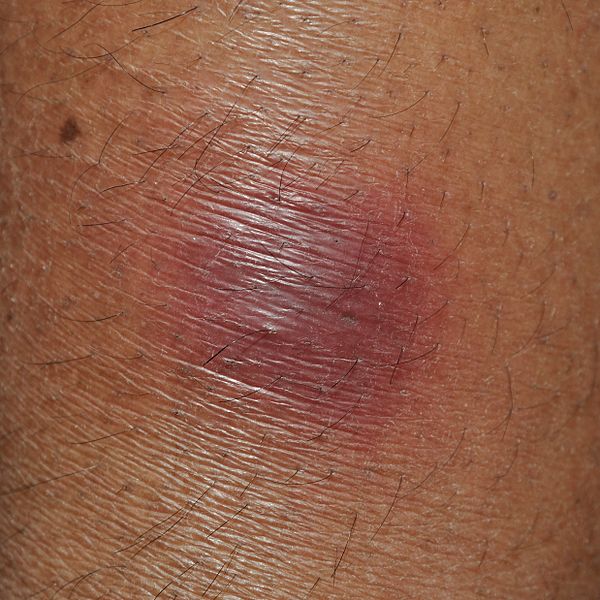
  • Se considera que la reacción de hipersensibilidad de tipo IV (hipersensibilidad retardada) a varios antígenos es el principal mecanismo inmunológico, pero pueden estar implicadas otras vías, incluyendo el depósito de inmunocomplejos en EN Erythema nodosum is an immune-mediated panniculitis (inflammation of the subcutaneous fat) caused by a type IV (delayed-type) hypersensitivity reaction. It commonly manifests in young women as tender, erythematous nodules on the shins. Erythema Nodosum la grasa subcutánea.
  • Causa nódulos eritematosos y sensibles, típicamente en EN Erythema nodosum is an immune-mediated panniculitis (inflammation of the subcutaneous fat) caused by a type IV (delayed-type) hypersensitivity reaction. It commonly manifests in young women as tender, erythematous nodules on the shins. Erythema Nodosum la cara anterior de las piernas, pero pueden verse afectadas otras zonas
  • La histología muestra paniculitis septal sin vasculitis primaria, un infiltrado inflamatorio mixto que incluye eosinófilos, granulomas “radiales” de Meischer en EN Erythema nodosum is an immune-mediated panniculitis (inflammation of the subcutaneous fat) caused by a type IV (delayed-type) hypersensitivity reaction. It commonly manifests in young women as tender, erythematous nodules on the shins. Erythema Nodosum las primeras fases (tales como agregados de histiocitos que rodean hendiduras extracelulares con neutrófilos en EN Erythema nodosum is an immune-mediated panniculitis (inflammation of the subcutaneous fat) caused by a type IV (delayed-type) hypersensitivity reaction. It commonly manifests in young women as tender, erythematous nodules on the shins. Erythema Nodosum la periferia) y células gigantes multinucleadas en EN Erythema nodosum is an immune-mediated panniculitis (inflammation of the subcutaneous fat) caused by a type IV (delayed-type) hypersensitivity reaction. It commonly manifests in young women as tender, erythematous nodules on the shins. Erythema Nodosum las últimas fases. Puede observarse una vasculitis Vasculitis Inflammation of any one of the blood vessels, including the arteries; veins; and rest of the vasculature system in the body. Systemic Lupus Erythematosus secundaria si hay infiltrados densos de neutrófilos.

Related videos

Presentación Clínica

  • Los LOS Neisseria síntomas prodrómicos pueden preceder a la erupción de las lesiones cutáneas e incluyen:
    • Fatiga
    • Fiebre
    • Malestar
    • Artralgia/artritis
  • Lesiones cutáneas características:
    • Nódulos eritematosos y sensibles en EN Erythema nodosum is an immune-mediated panniculitis (inflammation of the subcutaneous fat) caused by a type IV (delayed-type) hypersensitivity reaction. It commonly manifests in young women as tender, erythematous nodules on the shins. Erythema Nodosum la cara anterior de ambas piernas
      • No ulcerados
      • No móviles
      • Ligeramente elevados
      • Normalmente 25 cm
    • Se desarrollan durante varios días
      • Usualmente auto-resuelven sin cicatrización alrededor de 8 semanas después de aparecer
      • Pueden aparecer hematomas o hiperpigmentación residual durante la resolución.
    • Sitios menos comunes de nódulos:
      • Tobillos
      • Muslos
      • Nalgas
      • Cara posterior de las piernas
      • Cara

Diagnóstico y Tratamiento

Diagnóstico

  • El eritema nodoso suele diagnosticarse clínicamente por los LOS Neisseria antecedentes y el examen físico.
    • Es típica la aparición aguda de nódulos o placas sensibles no ulceradas en EN Erythema nodosum is an immune-mediated panniculitis (inflammation of the subcutaneous fat) caused by a type IV (delayed-type) hypersensitivity reaction. It commonly manifests in young women as tender, erythematous nodules on the shins. Erythema Nodosum la cara anterior de ambas piernas.
    • La biopsia de piel se debe reservar para confirmar el diagnóstico si existen lesiones atípicas o si el paciente se encuentra inmunosuprimido
  • Los LOS Neisseria pacientes deben ser evaluados para detectar enfermedades subyacentes.
    • Los LOS Neisseria antecedentes y la exploración física deben incluir:
      • Antecedentes de medicamentos consumidos
      • Antecedentes de viajes
      • Revisión de síntomas respiratorios, gastrointestinales y constitucionales
      • Examinación de faringe y amígdalas (para descartar una infección estreptocócica)
    • Las pruebas de laboratorio pueden incluir:
      • Hemograma
      • Velocidad de eritrosedimentación (VES) y/o proteína C reactiva ( PCR PCR Polymerase chain reaction (PCR) is a technique that amplifies DNA fragments exponentially for analysis. The process is highly specific, allowing for the targeting of specific genomic sequences, even with minuscule sample amounts. The PCR cycles multiple times through 3 phases: denaturation of the template DNA, annealing of a specific primer to the individual DNA strands, and synthesis/elongation of new DNA molecules. Polymerase Chain Reaction (PCR))
      • Cultivo faríngeo y títulos de antiestreptolisina-O (ASO)
      • Prueba cutánea de tuberculina/prueba de liberación de interferón-gamma
      • Prueba de embarazo
    • La imagenología puede incluir radiografías de tórax.

Tratamiento

  • El eritema nodoso es autolimitado y suele resolverse en EN Erythema nodosum is an immune-mediated panniculitis (inflammation of the subcutaneous fat) caused by a type IV (delayed-type) hypersensitivity reaction. It commonly manifests in young women as tender, erythematous nodules on the shins. Erythema Nodosum 8 semanas.
    • El tratamiento sintomático incluye:
      • Descanso y elevación de las piernas
      • Compresión venosa mediante medias (si se toleran)
      • Analgésicos, como los LOS Neisseria antiinflamatorios no esteroideos (AINE)
      • Como tratamiento de segunda línea, se puede utilizar yoduro de potasio (inhibe la quimiotaxis de los LOS Neisseria neutrófilos y la generación de especies reactivas de oxígeno)
      • Si se pueden descartar las causas infecciosas, el tratamiento con glucocorticoides sistémicos (prednisona 20 mg/día durante 710 días) puede mejorar tanto el dolor Dolor Inflammation como el aspecto del eritema nodoso.
  • También deben identificarse y tratarse las causas subyacentes.

Diagnóstico Diferencial

  • Vasculitis Vasculitis Inflammation of any one of the blood vessels, including the arteries; veins; and rest of the vasculature system in the body. Systemic Lupus Erythematosus nodular: una paniculitis lobular frecuentemente asociada a la tuberculosis Tuberculosis Tuberculosis (TB) is an infectious disease caused by Mycobacterium tuberculosis complex bacteria. The bacteria usually attack the lungs but can also damage other parts of the body. Approximately 30% of people around the world are infected with this pathogen, with the majority harboring a latent infection. Tuberculosis spreads through the air when a person with active pulmonary infection coughs or sneezes. Tuberculosis. A menudo se presenta en EN Erythema nodosum is an immune-mediated panniculitis (inflammation of the subcutaneous fat) caused by a type IV (delayed-type) hypersensitivity reaction. It commonly manifests in young women as tender, erythematous nodules on the shins. Erythema Nodosum la cara posterior de las piernas (pantorrillas) con nódulos ulcerados y drenantes. Es esperado que los LOS Neisseria pacientes tengan una prueba cutánea de tuberculina positiva.
  • Infecciones subcutáneas: pueden deberse a una infección bacteriana, fúngica o micobacteriana. Suele aparecer en EN Erythema nodosum is an immune-mediated panniculitis (inflammation of the subcutaneous fat) caused by a type IV (delayed-type) hypersensitivity reaction. It commonly manifests in young women as tender, erythematous nodules on the shins. Erythema Nodosum las piernas/pies con lesiones fluctuantes, ulceradas y drenantes. Se espera que los LOS Neisseria pacientes tengan signos sistémicos de infección.
  • Poliarteritis nodosa cutánea: se caracteriza por nódulos subcutáneos dolorosos en EN Erythema nodosum is an immune-mediated panniculitis (inflammation of the subcutaneous fat) caused by a type IV (delayed-type) hypersensitivity reaction. It commonly manifests in young women as tender, erythematous nodules on the shins. Erythema Nodosum las piernas. Sin embargo, estos nódulos también se asocian con livedo reticularis Livedo reticularis A condition characterized by a reticular or fishnet pattern on the skin of lower extremities and other parts of the body. This red and blue pattern is due to deoxygenated blood in unstable dermal blood vessels. The condition is intensified by cold exposure and relieved by rewarming. Chronic Kidney Disease, necrosis Necrosis The death of cells in an organ or tissue due to disease, injury or failure of the blood supply. Ischemic Cell Damage y ulceraciones. La histología muestra una vasculitis Vasculitis Inflammation of any one of the blood vessels, including the arteries; veins; and rest of the vasculature system in the body. Systemic Lupus Erythematosus necrotizante segmentaria de la arteria media.
  • Paniculitis pancreática: Estos nódulos difieren en EN Erythema nodosum is an immune-mediated panniculitis (inflammation of the subcutaneous fat) caused by a type IV (delayed-type) hypersensitivity reaction. It commonly manifests in young women as tender, erythematous nodules on the shins. Erythema Nodosum que son fluctuantes y ulcerosos con drenaje de líquido aceitoso. A menudo se curan con cicatrices. Se espera que los LOS Neisseria pacientes presenten síntomas de pancreatitis Pancreatitis Inflammation of the pancreas. Pancreatitis is classified as acute unless there are computed tomographic or endoscopic retrograde cholangiopancreatographic findings of chronic pancreatitis. The two most common forms of acute pancreatitis are alcoholic pancreatitis and gallstone pancreatitis. Acute Pancreatitis, como fiebre y dolor Dolor Inflammation abdominal. Los LOS Neisseria resultados de laboratorio revelarían una lipasa y una amilasa elevadas.
  • Deficiencia de alfa-1 antitripsina: Este defecto genético puede estar asociado a nódulos o placas subcutáneas que frecuentemente se ulceran y drenan.

Relevancia Clínica

  • El eritema nodoso puede ofrecer pistas sobre la presencia de una enfermedad grave subyacente tratable, como por ejemplo, una infección estreptocócica, sarcoidosis Sarcoidosis Sarcoidosis is a multisystem inflammatory disease that causes noncaseating granulomas. The exact etiology is unknown. Sarcoidosis usually affects the lungs and thoracic lymph nodes, but it can also affect almost every system in the body, including the skin, heart, and eyes, most commonly. Sarcoidosis, tuberculosis Tuberculosis Tuberculosis (TB) is an infectious disease caused by Mycobacterium tuberculosis complex bacteria. The bacteria usually attack the lungs but can also damage other parts of the body. Approximately 30% of people around the world are infected with this pathogen, with the majority harboring a latent infection. Tuberculosis spreads through the air when a person with active pulmonary infection coughs or sneezes. Tuberculosis y coccidioidomicosis.
  • El eritema nodoso puede tener valor pronóstico en EN Erythema nodosum is an immune-mediated panniculitis (inflammation of the subcutaneous fat) caused by a type IV (delayed-type) hypersensitivity reaction. It commonly manifests in young women as tender, erythematous nodules on the shins. Erythema Nodosum algunas situaciones porque se asocia a lo siguiente:
    • Una menor incidencia de enfermedad diseminada en EN Erythema nodosum is an immune-mediated panniculitis (inflammation of the subcutaneous fat) caused by a type IV (delayed-type) hypersensitivity reaction. It commonly manifests in young women as tender, erythematous nodules on the shins. Erythema Nodosum la coccidioidomicosis
    • Una forma menos agresiva de sarcoidosis Sarcoidosis Sarcoidosis is a multisystem inflammatory disease that causes noncaseating granulomas. The exact etiology is unknown. Sarcoidosis usually affects the lungs and thoracic lymph nodes, but it can also affect almost every system in the body, including the skin, heart, and eyes, most commonly. Sarcoidosis (tríada de síndrome de Lofgren de eritema nodoso, linfadenopatía hiliar y artritis/periartritis aguda)
  • El eritema nodoso puede preceder o coincidir con un brote agudo de enfermedad inflamatoria intestinal

Referencias

  1. Pérez-Garza, D. M., Chavez-Alvarez, S., Ocampo-Candiani, J., Gomez-Flores, M. (2021). Erythema nodosum: a practical approach and diagnostic algorithm. American Journal of Clinical Dermatology, 22(3), 367–378. https://doi.org/10.1007/s40257-021-00592-w 
  2. Leung, A. K. C., Leong, K. F., Lam, J. M. (2018). Erythema nodosum. World Journal of Pediatrics, 14(6), 548–554. https://doi.org/10.1007/s12519-018-0191-1 
  3. Schwartz, R. A., Nervi, S. J. (2007). Erythema nodosum: a sign of systemic disease. American Family Physician, 75(5), 695–700. https://www.aafp.org/pubs/afp/issues/2007/0301/p695.html 
  4. Blake, T., Manahan, M., Rodins, K. (2014). Erythema nodosum—a review of an uncommon panniculitis. Dermatology Online Journal, 20(4), 22376. https://doi.org/10.5070/D3204022376 
  5. Pink, A., & Barker, J. (2013). Erythema nodosum. British Journal of Hospital Medicine, 73(4). https://doi.org/10.12968/hmed.2012.73.sup4.C50 
  6. Kroshinsky, D. (2023). Erythema nodosum. UpToDate. Retrieved July 16, 2025, from https://www.uptodate.com/contents/erythema-nodosum 
  7. Primary Care Dermatology Society (2022). Erythema nodosum. Retrieved July 16, 2025, from https://www.pcds.https://www.pcds.org.uk/clinical-guidance/erythema-nodusumorg.uk/clinical-guidance/erythema-nodusum

¡Crea tu cuenta gratis o inicia una sesión para seguir leyendo!

Regístrate ahora y obtén acceso gratuito a Lecturio con páginas de concepto, videos médicos y cuestionarios para tu educación médica.

User Reviews

Que tengas una sesión de estudio alegre y navideña 🎁 Ahorra 50% en todos los planes >>

Details