Domina Conceptos Médicos

Estudia para la escuela de medicina y tus examenes con Lecturio.

Enfermedad de Graves

La enfermedad de Graves es un trastorno autoinmune caracterizado por la presencia de anticuerpos circulantes del receptor Receptor Receptors are proteins located either on the surface of or within a cell that can bind to signaling molecules known as ligands (e.g., hormones) and cause some type of response within the cell. Receptors de la hormona estimulante del tiroides (TSH), que provocan la hiperfunción de la glándula tiroides. Las características clínicas incluyen las del hipertiroidismo, así como orbitopatía, bocio y dermopatía/mixedema pretibial. El diagnóstico se realiza mediante pruebas de laboratorio tiroideas que muestran una TSH baja, hormonas tiroideas elevadas (tiroxina [ T4 T4 The major hormone derived from the thyroid gland. Thyroxine is synthesized via the iodination of tyrosines (monoiodotyrosine) and the coupling of iodotyrosines (diiodotyrosine) in the thyroglobulin. Thyroxine is released from thyroglobulin by proteolysis and secreted into the blood. Thyroxine is peripherally deiodinated to form triiodothyronine which exerts a broad spectrum of stimulatory effects on cell metabolism. Thyroid Hormones] y triyodotironina [ T3 T3 A T3 thyroid hormone normally synthesized and secreted by the thyroid gland in much smaller quantities than thyroxine (T4). Most T3 is derived from peripheral monodeiodination of T4 at the 5' position of the outer ring of the iodothyronine nucleus. The hormone finally delivered and used by the tissues is mainly t3. Thyroid Hormones]) y anticuerpos receptores de tirotropina ( en EN Erythema nodosum is an immune-mediated panniculitis (inflammation of the subcutaneous fat) caused by a type IV (delayed-type) hypersensitivity reaction. It commonly manifests in young women as tender, erythematous nodules on the shins. Erythema Nodosum particular el subtipo de inmunoglobulinas estimulantes de la tiroides). Si las pruebas iniciales no son diagnósticas, la captación de yodo radiactivo (aumento de la captación) y el ultrasonido tiroideo (agrandamiento difuso de la tiroides) proporcionan información diagnóstica. Las opciones de tratamiento incluyen fármacos antitiroideos, ablación con yodo radiactivo y cirugía.

Last updated: Dec 15, 2025

Editorial responsibility: Stanley Oiseth, Lindsay Jones, Evelin Maza

Descripción general

Definición

La enfermedad de Graves es un trastorno autoinmune en EN Erythema nodosum is an immune-mediated panniculitis (inflammation of the subcutaneous fat) caused by a type IV (delayed-type) hypersensitivity reaction. It commonly manifests in young women as tender, erythematous nodules on the shins. Erythema Nodosum el que los LOS Neisseria anticuerpos contra los LOS Neisseria receptores de la hormona estimulante de la tiroides (TSH) hacen que la glándula tiroides se encuentre hiperfuncionante. El síndrome puede tener las siguientes características:

  • Hipertiroidismo (más común)
  • Bocio: agrandamiento de la tiroides
  • Oftalmopatía: oftalmopatía de Graves/enfermedad ocular tiroidea
  • Dermopatía: mixedema pretibial

Epidemiología

  • Es la causa más común de hipertiroidismo, representando el 60%–80% de todos los LOS Neisseria casos
  • Incidencia anual de 20–50 casos por 100.000 personas
  • Relación mujer-hombre de 8:1
  • Inicio generalmente a los LOS Neisseria 20-40 años de edad
  • En EN Erythema nodosum is an immune-mediated panniculitis (inflammation of the subcutaneous fat) caused by a type IV (delayed-type) hypersensitivity reaction. It commonly manifests in young women as tender, erythematous nodules on the shins. Erythema Nodosum los LOS Neisseria niños, la mayoría de los LOS Neisseria casos ocurren después de los LOS Neisseria 11 años de edad.

Etiología

Se considera que la susceptibilidad a la enfermedad de Graves es una combinación de múltiples factores.

Factores de riesgo:
  • Factores genéticos:
    • Antecedentes familiares de enfermedad tiroidea u otra enfermedad autoinmune (e.g., anemia Anemia Anemia is a condition in which individuals have low Hb levels, which can arise from various causes. Anemia is accompanied by a reduced number of RBCs and may manifest with fatigue, shortness of breath, pallor, and weakness. Subtypes are classified by the size of RBCs, chronicity, and etiology. Anemia: Overview and Types perniciosa, diabetes Diabetes Diabetes mellitus (DM) is a metabolic disease characterized by hyperglycemia and dysfunction of the regulation of glucose metabolism by insulin. Type 1 DM is diagnosed mostly in children and young adults as the result of autoimmune destruction of β cells in the pancreas and the resulting lack of insulin. Type 2 DM has a significant association with obesity and is characterized by insulin resistance. Diabetes Mellitus mellitus tipo 1)
    • Polimorfismos identificados en EN Erythema nodosum is an immune-mediated panniculitis (inflammation of the subcutaneous fat) caused by a type IV (delayed-type) hypersensitivity reaction. It commonly manifests in young women as tender, erythematous nodules on the shins. Erythema Nodosum genes Genes A category of nucleic acid sequences that function as units of heredity and which code for the basic instructions for the development, reproduction, and maintenance of organisms. DNA Types and Structure inmunorreguladores: PTPN22, CTLA-4, IL2RA, gen que codifica el receptor Receptor Receptors are proteins located either on the surface of or within a cell that can bind to signaling molecules known as ligands (e.g., hormones) and cause some type of response within the cell. Receptors de TSH (TSHR, por sus siglas en EN Erythema nodosum is an immune-mediated panniculitis (inflammation of the subcutaneous fat) caused by a type IV (delayed-type) hypersensitivity reaction. It commonly manifests in young women as tender, erythematous nodules on the shins. Erythema Nodosum inglés)
    • Asociado con HLA-DR3 y HLA-B8 HLA-B8 A specific hla-b surface antigen subtype. Members of this subtype contain alpha chains that are encoded by the hla-b*08 allele family. Primary Sclerosing Cholangitis
    • Mayor riesgo de enfermedad de Graves en EN Erythema nodosum is an immune-mediated panniculitis (inflammation of the subcutaneous fat) caused by a type IV (delayed-type) hypersensitivity reaction. It commonly manifests in young women as tender, erythematous nodules on the shins. Erythema Nodosum pacientes con trisomía 21 (síndrome de Down)
  • Factores ambientales y no genéticos:
    • Tabaquismo
    • Estrés
    • Aumentos repentinos en EN Erythema nodosum is an immune-mediated panniculitis (inflammation of the subcutaneous fat) caused by a type IV (delayed-type) hypersensitivity reaction. It commonly manifests in young women as tender, erythematous nodules on the shins. Erythema Nodosum la absorción de yodo
    • Embarazo
    • Infecciones bacterianas y virales

Fisiopatología

Hipertiroidismo y bocio

  • Inmunoglobulinas estimulantes de la tiroides (reacción de hipersensibilidad tipo II):
    • Sintetizado en EN Erythema nodosum is an immune-mediated panniculitis (inflammation of the subcutaneous fat) caused by a type IV (delayed-type) hypersensitivity reaction. It commonly manifests in young women as tender, erythematous nodules on the shins. Erythema Nodosum la glándula tiroides, la médula ósea y los LOS Neisseria ganglios linfáticos
    • Estimular los LOS Neisseria receptores de TSH en EN Erythema nodosum is an immune-mediated panniculitis (inflammation of the subcutaneous fat) caused by a type IV (delayed-type) hypersensitivity reaction. It commonly manifests in young women as tender, erythematous nodules on the shins. Erythema Nodosum la glándula tiroides
    • Efectos:
      • ↑ Secreción autónoma de hormonas tiroideas ( T3 T3 A T3 thyroid hormone normally synthesized and secreted by the thyroid gland in much smaller quantities than thyroxine (T4). Most T3 is derived from peripheral monodeiodination of T4 at the 5′ position of the outer ring of the iodothyronine nucleus. The hormone finally delivered and used by the tissues is mainly t3. Thyroid Hormones/ T4 T4 The major hormone derived from the thyroid gland. Thyroxine is synthesized via the iodination of tyrosines (monoiodotyrosine) and the coupling of iodotyrosines (diiodotyrosine) in the thyroglobulin. Thyroxine is released from thyroglobulin by proteolysis and secreted into the blood. Thyroxine is peripherally deiodinated to form triiodothyronine which exerts a broad spectrum of stimulatory effects on cell metabolism. Thyroid Hormones): hipertiroidismo
      • Hipertrofia e hiperplasia folicular tiroidea: bocio tóxico difuso
    • Hallazgos histológicos en EN Erythema nodosum is an immune-mediated panniculitis (inflammation of the subcutaneous fat) caused by a type IV (delayed-type) hypersensitivity reaction. It commonly manifests in young women as tender, erythematous nodules on the shins. Erythema Nodosum la glándula tiroides:
      • Células epiteliales del folículo alto atestadas, que exhiben hipertrofia e hiperplasia
      • También se observan infiltrados linfoides.
  • Retroalimentación negativa: ↑ hormonas tiroideas → compensatoria ↓ TSH
Bucle de retroalimentación negativa clásico Hashimoto

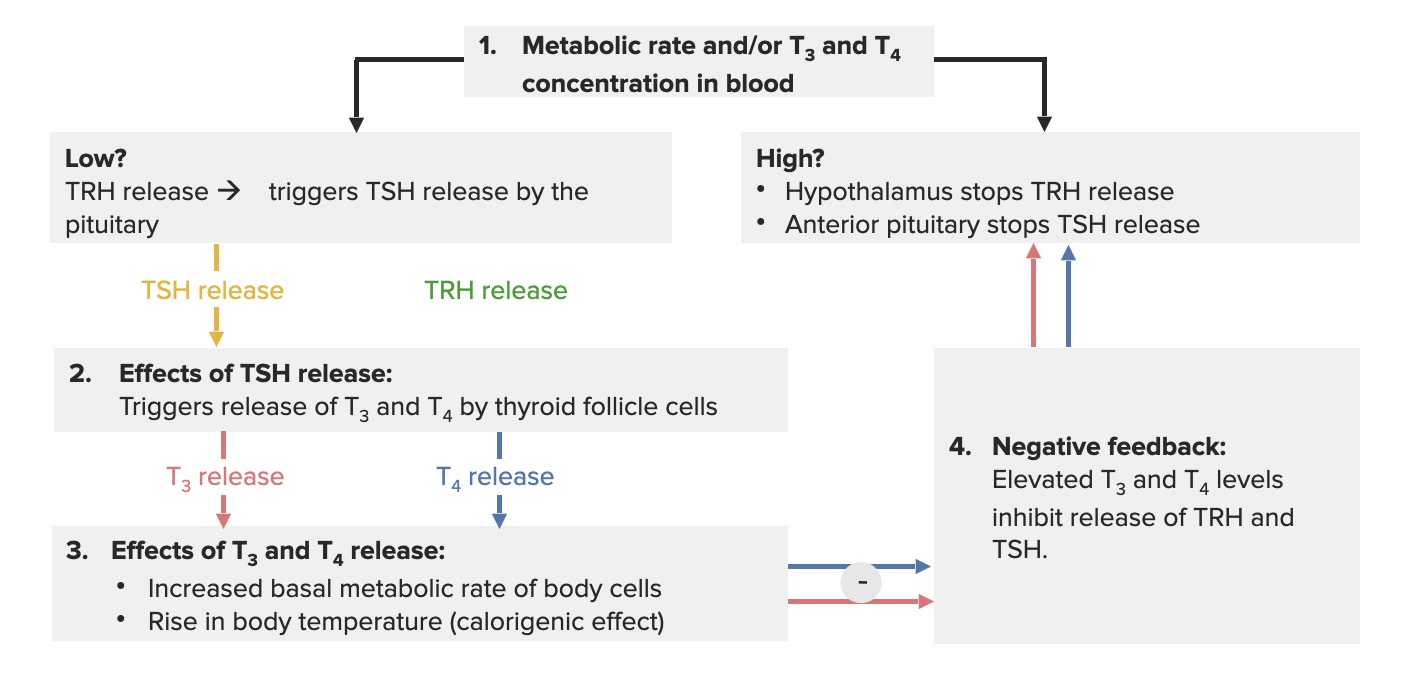
Bucle de retroalimentación del eje hipotálamo-hipófisis-tiroides:
Cuando las hormonas tiroideas son bajas, el hipotálamo libera la hormona liberadora de tirotropina (TRH), que hace que la glándula pituitaria secrete TSH. El efecto de este proceso es que la glándula tiroides produce tiroxina (T4) y triyodotironina (T3) (se produce más T4, ya que se convierte en T3). El aumento de las hormonas tiroideas (T3/T4 libre o no unida) crea una retroalimentación negativa, inhibiendo la liberación de TRH y TSH.
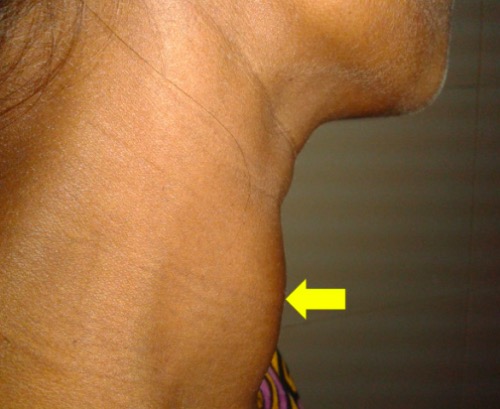
Imagen: “Classic Negative Feedback Loop” por OpenStax College.. Licencia: CC BY 3.0 , editado por Lecturio.

Oftalmopatía y mixedema

  • Se cree que es una respuesta autoinmune dirigida a un antígeno ( receptor Receptor Receptors are proteins located either on the surface of or within a cell that can bind to signaling molecules known as ligands (e.g., hormones) and cause some type of response within the cell. Receptors de TSH) compartido por la tiroides y la órbita.
  • Se considera que el proceso en EN Erythema nodosum is an immune-mediated panniculitis (inflammation of the subcutaneous fat) caused by a type IV (delayed-type) hypersensitivity reaction. It commonly manifests in young women as tender, erythematous nodules on the shins. Erythema Nodosum los LOS Neisseria tejidos dérmicos es similar, observándose la expresión de la proteína receptora de TSH en EN Erythema nodosum is an immune-mediated panniculitis (inflammation of the subcutaneous fat) caused by a type IV (delayed-type) hypersensitivity reaction. It commonly manifests in young women as tender, erythematous nodules on the shins. Erythema Nodosum los LOS Neisseria fibroblastos dérmicos normales.
    • Activación de células T dentro del espacio retroorbitario y la piel → ↑ citocinas → activación y remodelación de tejidos
    • Los LOS Neisseria fibroblastos activados aumentan los LOS Neisseria glucosaminoglucanos (que atrapan el agua), lo que conlleva a:
      • ↑ Retención de líquidos
      • Edema Edema Edema is a condition in which excess serous fluid accumulates in the body cavity or interstitial space of connective tissues. Edema is a symptom observed in several medical conditions. It can be categorized into 2 types, namely, peripheral (in the extremities) and internal (in an organ or body cavity). Edema y fibrosis Fibrosis Any pathological condition where fibrous connective tissue invades any organ, usually as a consequence of inflammation or other injury. Bronchiolitis Obliterans de los LOS Neisseria músculos involucrados.
      • Infiltración grasa (↑ adipocitos)
    • Efectos:
      • Protrusión y posible desplazamiento del globo ocular (oftalmopatía de Graves)
      • Infiltración en EN Erythema nodosum is an immune-mediated panniculitis (inflammation of the subcutaneous fat) caused by a type IV (delayed-type) hypersensitivity reaction. It commonly manifests in young women as tender, erythematous nodules on the shins. Erythema Nodosum el área de la espinilla o mixedema pretibial (mecanismo poco claro para esta localización)

Presentación Clínica

Factores que afectan la presentación

  • Gravedad y duración de la enfermedad.
  • Susceptibilidad al AL Amyloidosis exceso de hormona tiroidea
  • Edad del paciente: en EN Erythema nodosum is an immune-mediated panniculitis (inflammation of the subcutaneous fat) caused by a type IV (delayed-type) hypersensitivity reaction. It commonly manifests in young women as tender, erythematous nodules on the shins. Erythema Nodosum los LOS Neisseria ancianos, las características son sutiles.

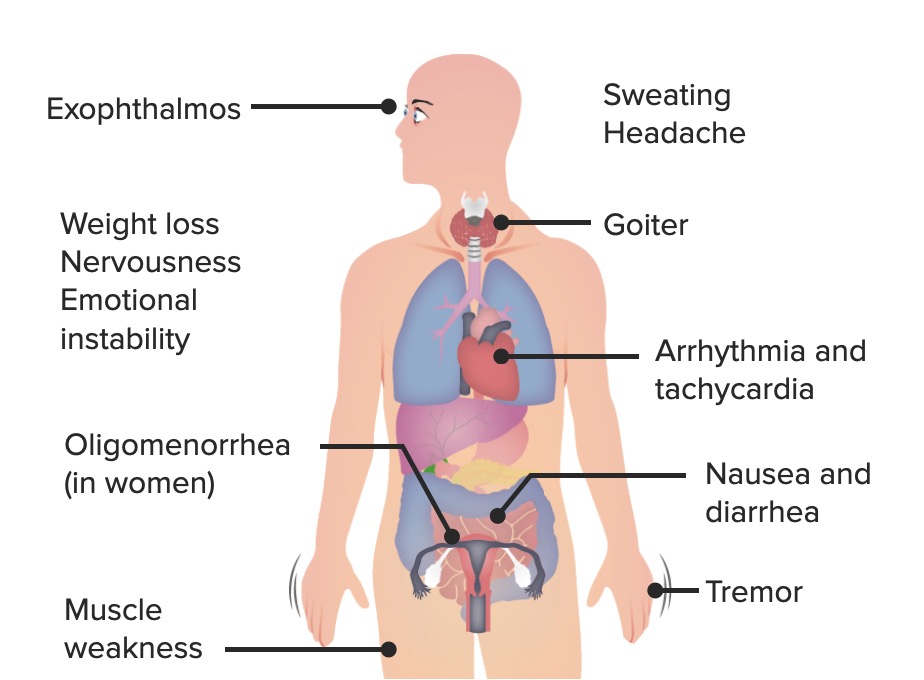
Hipertiroidismo y bocio

  • General (aumento de la tasa metabólica basal):
  • Dermatológico:
    • Piel cálida y húmeda (debido a la vasodilatación)
    • Cabello fino y onicolisis
  • Bocio:
    • Aumento de tamaño difuso e indoloro de la tiroides (2–3 veces de lo normal)
    • +/- soplo tiroideo
  • Cardíacos:
    • Taquicardia, palpitaciones, disnea, taquiarritmias
    • Aumento de la presión arterial, amplitud de la presión del pulso
    • Soplo sistólico aórtico
    • Insuficiencia cardíaca congestiva
  • Gastrointestinales:
    • Diarrea por aumento de la motilidad gastrointestinal
    • Náuseas
  • Músculo-esqueléticos:
    • Miopatía tirotóxica (proximal)
    • Osteoporosis Osteoporosis Osteoporosis refers to a decrease in bone mass and density leading to an increased number of fractures. There are 2 forms of osteoporosis: primary, which is commonly postmenopausal or senile; and secondary, which is a manifestation of immobilization, underlying medical disorders, or long-term use of certain medications. Osteoporosis, mayor tasa de fracturas
  • Reproductivo:
    • Oligomenorrea o amenorrea
    • Ginecomastia ( en EN Erythema nodosum is an immune-mediated panniculitis (inflammation of the subcutaneous fat) caused by a type IV (delayed-type) hypersensitivity reaction. It commonly manifests in young women as tender, erythematous nodules on the shins. Erythema Nodosum hombres)
    • Disminución de la libido e infertilidad.
  • Neuropsiquiátricos:
    • Hiperactividad, inquietud, ansiedad, insomnio
    • Temblores finos, reflejos hiperactivos
  • Pacientes de edad avanzada:
    • Comúnmente carecen de la mayoría de los LOS Neisseria signos y síntomas.
    • A menudo se presenta con fatiga, depresión o pérdida de peso (“hipertiroidismo apático”).

Orbitopatía y mixedema

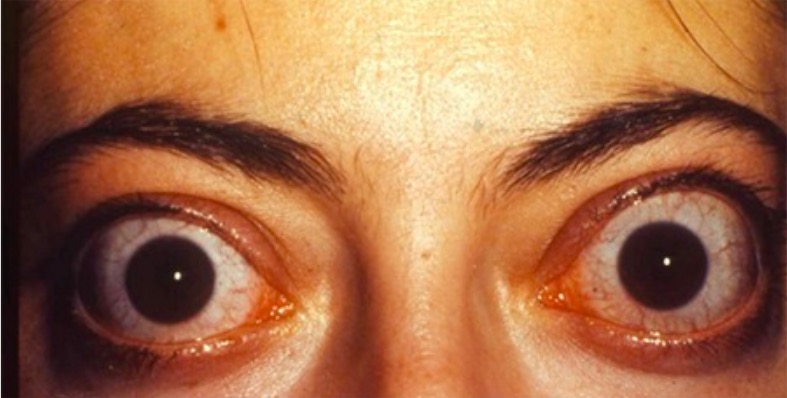
  • Oftalmopatía de Graves:
    • Inyección escleral
    • Edema Edema Edema is a condition in which excess serous fluid accumulates in the body cavity or interstitial space of connective tissues. Edema is a symptom observed in several medical conditions. It can be categorized into 2 types, namely, peripheral (in the extremities) and internal (in an organ or body cavity). Edema periorbitario
    • Retracción del párpado acompañada de retraso del párpado (si ≥ 2 mm MM Multiple myeloma (MM) is a malignant condition of plasma cells (activated B lymphocytes) primarily seen in the elderly. Monoclonal proliferation of plasma cells results in cytokine-driven osteoclastic activity and excessive secretion of IgG antibodies. Multiple Myeloma, clasificado como moderado a severo)
    • Exoftalmos/ proptosis Proptosis Retinoblastoma (si ≥ 3 mm MM Multiple myeloma (MM) is a malignant condition of plasma cells (activated B lymphocytes) primarily seen in the elderly. Monoclonal proliferation of plasma cells results in cytokine-driven osteoclastic activity and excessive secretion of IgG antibodies. Multiple Myeloma, clasificado como moderado a severo)
    • Diplopía (observada en EN Erythema nodosum is an immune-mediated panniculitis (inflammation of the subcutaneous fat) caused by a type IV (delayed-type) hypersensitivity reaction. It commonly manifests in young women as tender, erythematous nodules on the shins. Erythema Nodosum oftalmopatía de moderada a grave)
    • Exposición corneal grave, compresión del nervio óptico (amenaza para la vista)
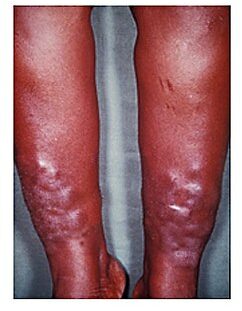
  • Mixedema:
    • Edema Edema Edema is a condition in which excess serous fluid accumulates in the body cavity or interstitial space of connective tissues. Edema is a symptom observed in several medical conditions. It can be categorized into 2 types, namely, peripheral (in the extremities) and internal (in an organ or body cavity). Edema sin fóvea
    • Pápulas y nódulos bien delimitados en EN Erythema nodosum is an immune-mediated panniculitis (inflammation of the subcutaneous fat) caused by a type IV (delayed-type) hypersensitivity reaction. It commonly manifests in young women as tender, erythematous nodules on the shins. Erythema Nodosum la zona afectada (pueden estar pigmentados)
    • Más común en EN Erythema nodosum is an immune-mediated panniculitis (inflammation of the subcutaneous fat) caused by a type IV (delayed-type) hypersensitivity reaction. It commonly manifests in young women as tender, erythematous nodules on the shins. Erythema Nodosum la parte inferior de las piernas/espinillas (área pretibial)
    • Puede afectar pies, brazos, codos, cara
  • Acropaquia tiroidea: edema Edema Edema is a condition in which excess serous fluid accumulates in the body cavity or interstitial space of connective tissues. Edema is a symptom observed in several medical conditions. It can be categorized into 2 types, namely, peripheral (in the extremities) and internal (in an organ or body cavity). Edema de los LOS Neisseria tejidos blandos de las manos y dedos en EN Erythema nodosum is an immune-mediated panniculitis (inflammation of the subcutaneous fat) caused by a type IV (delayed-type) hypersensitivity reaction. It commonly manifests in young women as tender, erythematous nodules on the shins. Erythema Nodosum palillo de tambor

Diagnóstico

Evaluación inicial

  • Hallazgos clínicos de la historia y el examen físico
  • Pruebas de laboratorio:
    • Pruebas de función tiroidea:
      • ↓ TSH
      • T3 T3 A T3 thyroid hormone normally synthesized and secreted by the thyroid gland in much smaller quantities than thyroxine (T4). Most T3 is derived from peripheral monodeiodination of T4 at the 5′ position of the outer ring of the iodothyronine nucleus. The hormone finally delivered and used by the tissues is mainly t3. Thyroid Hormones/ T4 T4 The major hormone derived from the thyroid gland. Thyroxine is synthesized via the iodination of tyrosines (monoiodotyrosine) and the coupling of iodotyrosines (diiodotyrosine) in the thyroglobulin. Thyroxine is released from thyroglobulin by proteolysis and secreted into the blood. Thyroxine is peripherally deiodinated to form triiodothyronine which exerts a broad spectrum of stimulatory effects on cell metabolism. Thyroid Hormones
    • Anticuerpos del receptor Receptor Receptors are proteins located either on the surface of or within a cell that can bind to signaling molecules known as ligands (e.g., hormones) and cause some type of response within the cell. Receptors de tirotropina (TRAb, por sus siglas en EN Erythema nodosum is an immune-mediated panniculitis (inflammation of the subcutaneous fat) caused by a type IV (delayed-type) hypersensitivity reaction. It commonly manifests in young women as tender, erythematous nodules on the shins. Erythema Nodosum inglés), particularmente inmunoglobulinas estimulantes de la tiroides:
      • Se encuentra en EN Erythema nodosum is an immune-mediated panniculitis (inflammation of the subcutaneous fat) caused by a type IV (delayed-type) hypersensitivity reaction. It commonly manifests in young women as tender, erythematous nodules on the shins. Erythema Nodosum el 90% de los LOS Neisseria pacientes
      • Las inmunoglobulinas estimulantes de la tiroides rara vez se observan en EN Erythema nodosum is an immune-mediated panniculitis (inflammation of the subcutaneous fat) caused by a type IV (delayed-type) hypersensitivity reaction. It commonly manifests in young women as tender, erythematous nodules on the shins. Erythema Nodosum otras enfermedades tiroideas autoinmunes.
    • Anticuerpos contra la peroxidasa tiroidea y la tiroglobulina:
      • Generalmente presentes
      • También se encuentra en EN Erythema nodosum is an immune-mediated panniculitis (inflammation of the subcutaneous fat) caused by a type IV (delayed-type) hypersensitivity reaction. It commonly manifests in young women as tender, erythematous nodules on the shins. Erythema Nodosum otras enfermedades tiroideas autoinmunes (e.g., tiroiditis de Hashimoto)
  • Hallazgos de laboratorio inespecíficos:
    • Hemograma: anemia Anemia Anemia is a condition in which individuals have low Hb levels, which can arise from various causes. Anemia is accompanied by a reduced number of RBCs and may manifest with fatigue, shortness of breath, pallor, and weakness. Subtypes are classified by the size of RBCs, chronicity, and etiology. Anemia: Overview and Types normocítica
    • Lípidos: ↓ colesterol, ↓ triglicéridos

Imagenología

  • Pruebas de diagnóstico adicionales realizadas si la presentación es ambigua
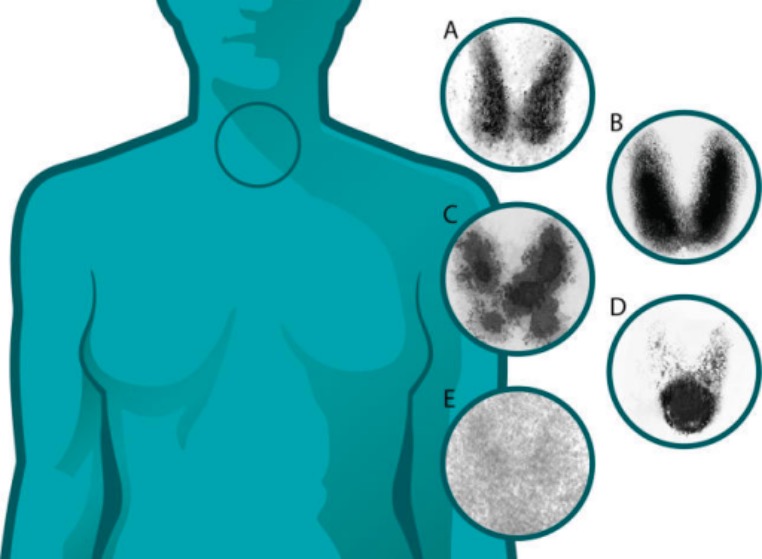
    • Captación de yodo radiactivo ( RAIU RAIU Thyrotoxicosis and Hyperthyroidism, por sus siglas en EN Erythema nodosum is an immune-mediated panniculitis (inflammation of the subcutaneous fat) caused by a type IV (delayed-type) hypersensitivity reaction. It commonly manifests in young women as tender, erythematous nodules on the shins. Erythema Nodosum inglés):
      • Se aumenta la captación.
      • La captación se distribuye de forma difusa por toda la glándula tiroides.
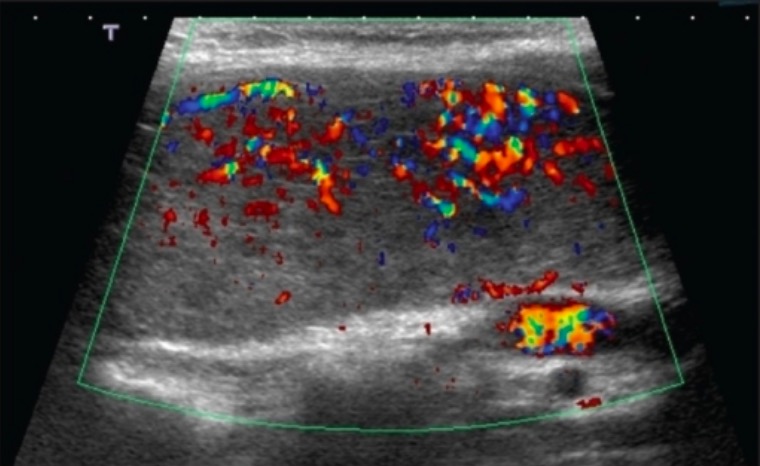
    • Ecografía de tiroides con Doppler Doppler Ultrasonography applying the doppler effect, with frequency-shifted ultrasound reflections produced by moving targets (usually red blood cells) in the bloodstream along the ultrasound axis in direct proportion to the velocity of movement of the targets, to determine both direction and velocity of blood flow. Ultrasound (Sonography):
      • Utilizado si RAIU RAIU Thyrotoxicosis and Hyperthyroidism está contraindicado (e.g., embarazo)
      • Alto flujo sanguíneo de la tiroides en EN Erythema nodosum is an immune-mediated panniculitis (inflammation of the subcutaneous fat) caused by a type IV (delayed-type) hypersensitivity reaction. It commonly manifests in young women as tender, erythematous nodules on the shins. Erythema Nodosum la enfermedad de Graves
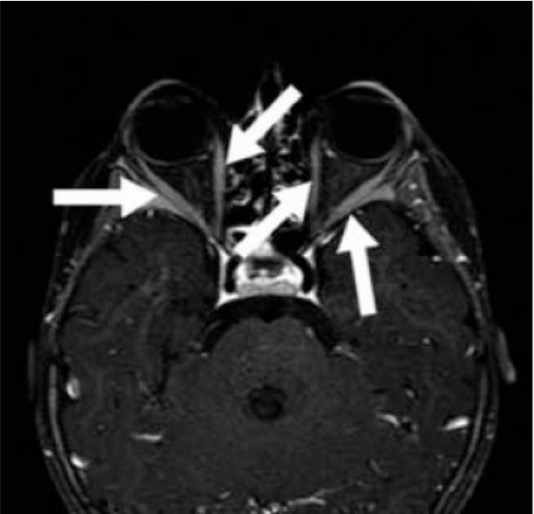
  • TC o RM de las órbitas obtenidas en EN Erythema nodosum is an immune-mediated panniculitis (inflammation of the subcutaneous fat) caused by a type IV (delayed-type) hypersensitivity reaction. It commonly manifests in young women as tender, erythematous nodules on the shins. Erythema Nodosum las siguientes situaciones:
    • En EN Erythema nodosum is an immune-mediated panniculitis (inflammation of the subcutaneous fat) caused by a type IV (delayed-type) hypersensitivity reaction. It commonly manifests in young women as tender, erythematous nodules on the shins. Erythema Nodosum oftalmopatía con pruebas tiroideas no diagnósticas
    • En EN Erythema nodosum is an immune-mediated panniculitis (inflammation of the subcutaneous fat) caused by a type IV (delayed-type) hypersensitivity reaction. It commonly manifests in young women as tender, erythematous nodules on the shins. Erythema Nodosum orbitopatía unilateral (para descartar lesiones ocupantes de espacio)
    • En EN Erythema nodosum is an immune-mediated panniculitis (inflammation of the subcutaneous fat) caused by a type IV (delayed-type) hypersensitivity reaction. It commonly manifests in young women as tender, erythematous nodules on the shins. Erythema Nodosum cambios orbitarios moderados a severos (para determinar complicaciones o riesgos de las mismas)

Tratamiento

Principios del tratamiento

  • Objetivos:
    • Alcanza el estado eutiroideo al AL Amyloidosis reducir la síntesis de hormonas tiroideas.
    • Control de síntomas y complicaciones.
  • Opciones para disminuir las hormonas tiroideas:
    • Mediamentos antitiroideos
    • Ablación con yodo radiactivo
    • Cirugía
  • Se pueden utilizar múltiples opciones con el mismo paciente para alcanzar los LOS Neisseria objetivos.
  • Elección de tratamiento(s) dependiendo de factores clínicos individuales y preferencia
  • El hipertiroidismo no tratado conlleva una tasa de mortalidad de hasta el 30%.

Medicamentos antitiroideos

  • Reducen la oxidación y la organificación del yodo al AL Amyloidosis inhibir la peroxidasa tiroidea
  • Puede usarse inicialmente para lograr el estado eutiroideo
  • La ingesta por hasta 2 años puede ayudar a alcanzar la remisión (tasa de remisión: 40%).
  • Puede ser seguido por ablación con yodo radiactivo o cirugía
  • Riesgos:
    • Teratogenicidad (metimazol > propiltiouracilo)
    • Hepatotoxicidad (propiltiouracilo > metimazol)
    • Agranulocitosis (¡compruebe el recuento de glóbulos blancos con cualquier signo de infección!)
  • Recuento del hemograma de referencia y panel hepático requerido
  • Opciones:
    • Metimazol:
      • Usualmente es la 1era opción
      • Efecto más prolongado
      • Menos efectos secundarios
      • Asociado con aplasia Aplasia Cranial Nerve Palsies cutis congénita
    • Propiltiouracilo:
      • Utilizado en EN Erythema nodosum is an immune-mediated panniculitis (inflammation of the subcutaneous fat) caused by a type IV (delayed-type) hypersensitivity reaction. It commonly manifests in young women as tender, erythematous nodules on the shins. Erythema Nodosum el 1er trimestre del embarazo y en EN Erythema nodosum is an immune-mediated panniculitis (inflammation of the subcutaneous fat) caused by a type IV (delayed-type) hypersensitivity reaction. It commonly manifests in young women as tender, erythematous nodules on the shins. Erythema Nodosum la tormenta tiroidea
      • Acción corta

Ablación con yodo radiactivo y cirugía

  • Ablación con yodo radiactivo:
    • Cápsula o solución de yodo sódico-131 (I-131) por vía oral
    • El I-131 se concentra en EN Erythema nodosum is an immune-mediated panniculitis (inflammation of the subcutaneous fat) caused by a type IV (delayed-type) hypersensitivity reaction. It commonly manifests in young women as tender, erythematous nodules on the shins. Erythema Nodosum la tiroides y conlleva a la destrucción progresiva de las células tiroideas.
    • La ablación se alcanza alrededor de las 6–18 semanas.
    • Algunos pacientes pueden requerir una segunda dosis.
    • El I-131 emite radiación (se debe evitar el contacto cercano y prolongado con otras personas, especialmente mujeres embarazadas y niños pequeños hasta por una semana).
    • Contraindicaciones:
      • Embarazo o lactancia
      • Pacientes con oftalmopatía de moderada a severa.
  • Cirugía (tiroidectomía):
    • Raramente realizada
    • Elección del tratamiento en EN Erythema nodosum is an immune-mediated panniculitis (inflammation of the subcutaneous fat) caused by a type IV (delayed-type) hypersensitivity reaction. It commonly manifests in young women as tender, erythematous nodules on the shins. Erythema Nodosum:
      • Oftalmopatía activa severa
      • Pacientes con bocios que causan síntomas obstructivos
      • Mujeres embarazadas con alergia a medicamentos antitiroideos
      • Casos con nódulo tiroideo sospechoso concomitante

Otras terapias

  • Para hipertiroidismo y bocio:
    • β-bloqueadores:
      • Antagoniza las acciones de las catecolaminas mediadas por el receptor Receptor Receptors are proteins located either on the surface of or within a cell that can bind to signaling molecules known as ligands (e.g., hormones) and cause some type of response within the cell. Receptors β
      • Mejora palpitaciones, temblores, taquicardia, ansiedad, intolerancia al AL Amyloidosis calor Calor Inflammation
    • Elixires de yodo (solución saturada de yoduro de potasio):
      • Usado antes de la cirugía
      • Reduce la vascularización de la glándula tiroides
  • Para la oftalmopatía:
    • Con el tratamiento del hipertiroidismo, la irritación y el edema Edema Edema is a condition in which excess serous fluid accumulates in the body cavity or interstitial space of connective tissues. Edema is a symptom observed in several medical conditions. It can be categorized into 2 types, namely, peripheral (in the extremities) and internal (in an organ or body cavity). Edema periorbitario suelen remitir; persisten la proptosis Proptosis Retinoblastoma y los LOS Neisseria trastornos de los LOS Neisseria músculos extraoculares.
    • Lágrimas artificiales para mejorar los LOS Neisseria síntomas oculares
    • El selenio puede ayudar.
    • Oftalmopatía de moderada a grave:
      • Terapia de pulso con metilprednisolona intravenosa
      • Descompresión quirúrgica o radiación orbitaria externa
      • Teprotumumab
  • Para la dermopatía:
    • El mixedema pretibial puede persistir incluso cuando se alcanza la función tiroidea normal.
    • Uso de medias de compresión.
    • Fisioterapia para el linfedema
  • Recomendaciones adicionales:
    • Cesación de tabaquismo
    • Suplementos de calcio debido al AL Amyloidosis riesgo de osteoporosis Osteoporosis Osteoporosis refers to a decrease in bone mass and density leading to an increased number of fractures. There are 2 forms of osteoporosis: primary, which is commonly postmenopausal or senile; and secondary, which is a manifestation of immobilization, underlying medical disorders, or long-term use of certain medications. Osteoporosis

Diagnóstico Diferencial

  • Tiroiditis granulomatosa (síndrome de De Quervain) : inflamación de la tiroides generalmente asociada con una infección viral previa y la causa más común de dolor Dolor Inflammation de tiroides. La presentación incluye sensibilidad en EN Erythema nodosum is an immune-mediated panniculitis (inflammation of the subcutaneous fat) caused by a type IV (delayed-type) hypersensitivity reaction. It commonly manifests in young women as tender, erythematous nodules on the shins. Erythema Nodosum el cuello con bocio. El estudio muestra TSH baja, T4 T4 The major hormone derived from the thyroid gland. Thyroxine is synthesized via the iodination of tyrosines (monoiodotyrosine) and the coupling of iodotyrosines (diiodotyrosine) in the thyroglobulin. Thyroxine is released from thyroglobulin by proteolysis and secreted into the blood. Thyroxine is peripherally deiodinated to form triiodothyronine which exerts a broad spectrum of stimulatory effects on cell metabolism. Thyroid Hormones libre elevada, velocidad de eritrosedimentación aumentada y una absorción de yodo radiactivo baja o nula. A menudo, cursa de forma autolimitada que puede pasar por un estado hipertiroideo y luego un estado eutiroideo seguido de hipotiroidismo. La recuperación de la función tiroidea normal lleva meses.
  • Tiroiditis linfocítica subaguda (tiroiditis indolora): una enfermedad autoinmune con agrandamiento difuso de la glándula tiroides. El mismo proceso ocurre en EN Erythema nodosum is an immune-mediated panniculitis (inflammation of the subcutaneous fat) caused by a type IV (delayed-type) hypersensitivity reaction. It commonly manifests in young women as tender, erythematous nodules on the shins. Erythema Nodosum la tiroiditis posparto. Las pruebas de laboratorio dependen de la fase de la enfermedad, pero el hipertiroidismo inicial muestra TSH baja y T4 T4 The major hormone derived from the thyroid gland. Thyroxine is synthesized via the iodination of tyrosines (monoiodotyrosine) and the coupling of iodotyrosines (diiodotyrosine) in the thyroglobulin. Thyroxine is released from thyroglobulin by proteolysis and secreted into the blood. Thyroxine is peripherally deiodinated to form triiodothyronine which exerts a broad spectrum of stimulatory effects on cell metabolism. Thyroid Hormones elevada. La condición está asociada con una baja absorción de yodo radiactivo. El patrón de la enfermedad es un estado transitorio de hipertiroidismo y luego hipotiroidismo seguido de recuperación. Sin embargo, algunos casos no se vuelven eutiroideos.
  • Bocio tóxico multinodular: múltiples nódulos en EN Erythema nodosum is an immune-mediated panniculitis (inflammation of the subcutaneous fat) caused by a type IV (delayed-type) hypersensitivity reaction. It commonly manifests in young women as tender, erythematous nodules on the shins. Erythema Nodosum una glándula tiroides agrandada, que producen un exceso de hormonas tiroideas. Se encuentra comúnmente en EN Erythema nodosum is an immune-mediated panniculitis (inflammation of the subcutaneous fat) caused by a type IV (delayed-type) hypersensitivity reaction. It commonly manifests in young women as tender, erythematous nodules on the shins. Erythema Nodosum pacientes de edad avanzada en EN Erythema nodosum is an immune-mediated panniculitis (inflammation of the subcutaneous fat) caused by a type IV (delayed-type) hypersensitivity reaction. It commonly manifests in young women as tender, erythematous nodules on the shins. Erythema Nodosum áreas con deficiencia de yodo. El estudio demuestra niveles elevados de hormonas tiroideas con una captación alta de yodo radiactivo que muestra múltiples puntos de concentración de yodo.
  • Adenoma tóxico: una afección en EN Erythema nodosum is an immune-mediated panniculitis (inflammation of the subcutaneous fat) caused by a type IV (delayed-type) hypersensitivity reaction. It commonly manifests in young women as tender, erythematous nodules on the shins. Erythema Nodosum la que la glándula tiroides contiene un nódulo solitario que secreta activamente hormonas tiroideas. Las pruebas son consistentes con hipertiroidismo, con captación de yodo radiactivo que muestra 1 punto de concentración de yodo.
  • Tirotoxicosis facticia: ocurre con la ingesta de cantidades excesivas de hormona tiroidea (la preparación más común es la levotiroxina). Brotes separados de la llamada tiroiditis de hamburguesa, que fue causada por la ingestión de tejido tiroideo bovino (es decir, músculo del cuello molido), ocurrieron en EN Erythema nodosum is an immune-mediated panniculitis (inflammation of the subcutaneous fat) caused by a type IV (delayed-type) hypersensitivity reaction. It commonly manifests in young women as tender, erythematous nodules on the shins. Erythema Nodosum 1984-85 en EN Erythema nodosum is an immune-mediated panniculitis (inflammation of the subcutaneous fat) caused by a type IV (delayed-type) hypersensitivity reaction. It commonly manifests in young women as tender, erythematous nodules on the shins. Erythema Nodosum Minnesota, Dakota del Sur y Nebraska. Las manifestaciones muestran hipertiroidismo sin exoftalmos ni bocio. Las características incluyen TSH baja, T4 T4 The major hormone derived from the thyroid gland. Thyroxine is synthesized via the iodination of tyrosines (monoiodotyrosine) and the coupling of iodotyrosines (diiodotyrosine) in the thyroglobulin. Thyroxine is released from thyroglobulin by proteolysis and secreted into the blood. Thyroxine is peripherally deiodinated to form triiodothyronine which exerts a broad spectrum of stimulatory effects on cell metabolism. Thyroid Hormones normal/elevada, nivel bajo de tiroglobulina y captación baja de yodo radiactivo.

Referencias

  1. Davies, T., Burch, H. (2020). Treatment of Graves’ orbitopathy (ophthalmopathy). UpToDate. Retrieved February 11, 2021, from https://www.uptodate.com/contents/treatment-of-graves-orbitopathy-ophthalmopathy
  2. Davies, T., Burch, H. (2020). Clinical features and diagnosis of Graves’ orbitopathy (ophthalmopathy). UpToDate. Retrieved February 10, 2021, from https://www.uptodate.com/contents/clinical-features-and-diagnosis-of-graves-orbitopathy-ophthalmopathy
  3. Davies, T. (2019). Pretibial myxedema (thyroid dermopathy) in autoimmune thyroid disease. UpToDate. Retrieved February 10, 2021, from https://www.uptodate.com/contents/pretibial-myxedema-thyroid-dermopathy-in-autoimmune-thyroid-disease
  4. Fitzgerald P.A. (2021). Hyperthyroidism (thyrotoxicosis). Papadakis M.A., & McPhee S.J., & Rabow M.W. (Eds.). Current Medical Diagnosis & Treatment 2021. McGraw-Hill. 
  5. Jameson J, & Mandel S.J., & Weetman A.P. (2018). Hyperthyroidism. Jameson J, & Fauci A.S., & Kasper D.L., & Hauser S.L., & Longo D.L., & Loscalzo J(Eds.). Harrison’s Principles of Internal Medicine, 20e. McGraw-Hill.
  6. Maitra, A. (2021). The Endocrine System. Kumar V., Abbas, A., Aster, J. , Robbins & Cotran Pathologic Basis of Disease, 10e. Elsevier.
  7. Smith M.A. (2019). Graves disease and goiter. Usatine R.P., & Smith M.A., & Mayeaux, Jr. E.J., & Chumley H.S. (Eds.). The Color Atlas and Synopsis of Family Medicine, 3e. McGraw-Hill.
  8. Ross, D. (2020). Graves’ hyperthyroidism in nonpregnant adults: Overview of treatment. UpToDate. Retieved February 10, 2021, from https://www.uptodate.com/contents/graves-hyperthyroidism-in-nonpregnant-adults-overview-of-treatment
  9. Yeung, S., Habra, M. (2020). Graves Disease. Medscape. Retrieved January 24, 2021, from https://emedicine.medscape.com/article/120619-overview

¡Crea tu cuenta gratis o inicia una sesión para seguir leyendo!

Regístrate ahora y obtén acceso gratuito a Lecturio con páginas de concepto, videos médicos y cuestionarios para tu educación médica.

User Reviews

Que tengas una sesión de estudio alegre y navideña 🎁 Ahorra 50% en todos los planes >>

Details