
Domina Conceptos Médicos

Estudia para la escuela de medicina y tus examenes con Lecturio.

Encefalomielitis Diseminada Aguda

La encefalomielitis diseminada aguda es una afección desmielinizante, monofásica, inflamatoria, mediada por el sistema inmunitario que afecta a la sustancia blanca del cerebro y a la médula espinal. Como la encefalomielitis postinfecciosa rápidamente progresiva, la encefalomielitis diseminada aguda se caracteriza por la desmielinización en EN Erythema nodosum is an immune-mediated panniculitis (inflammation of the subcutaneous fat) caused by a type IV (delayed-type) hypersensitivity reaction. It commonly manifests in young women as tender, erythematous nodules on the shins. Erythema Nodosum el cerebro y la médula espinal como resultado de la inflamación que sigue a una infección o inmunización.

Last updated: Dec 15, 2025

Editorial responsibility: Stanley Oiseth, Lindsay Jones, Evelin Maza

Descripción General

La encefalomielitis diseminada aguda es un déficit neurológico agudo causado por un ataque autoinmune al AL Amyloidosis cerebro y a la médula espinal que conduce a la desmielinización multifocal Multifocal Retinoblastoma.

Encefalomielitis diseminada aguda pediátrica

Se deben cumplir todos los LOS Neisseria siguientes criterios para un diagnóstico de encefalomielitis diseminada aguda pediátrica:

  • Un evento neurológico multifocal Multifocal Retinoblastoma con sospecha de causa desmielinizante e inflamatoria
  • Encefalopatía inexplicable
  • Hallazgos anormales en EN Erythema nodosum is an immune-mediated panniculitis (inflammation of the subcutaneous fat) caused by a type IV (delayed-type) hypersensitivity reaction. It commonly manifests in young women as tender, erythematous nodules on the shins. Erythema Nodosum la RM cerebral durante la fase aguda
  • Hallazgos de RM: lesiones grandes, mal delimitadas que involucran la sustancia blanca y con posible afección de la sustancia gris
  • No hay nuevos cambios en EN Erythema nodosum is an immune-mediated panniculitis (inflammation of the subcutaneous fat) caused by a type IV (delayed-type) hypersensitivity reaction. It commonly manifests in young women as tender, erythematous nodules on the shins. Erythema Nodosum la RM ≥ 3 meses después del inicio, criterio utilizado para distinguir la encefalomielitis diseminada aguda de los LOS Neisseria trastornos desmielinizantes recidivantes

Encefalomielitis diseminada aguda en EN Erythema nodosum is an immune-mediated panniculitis (inflammation of the subcutaneous fat) caused by a type IV (delayed-type) hypersensitivity reaction. It commonly manifests in young women as tender, erythematous nodules on the shins. Erythema Nodosum adultos

Aunque no existen criterios diagnósticos formales para la encefalomielitis diseminada aguda en EN Erythema nodosum is an immune-mediated panniculitis (inflammation of the subcutaneous fat) caused by a type IV (delayed-type) hypersensitivity reaction. It commonly manifests in young women as tender, erythematous nodules on the shins. Erythema Nodosum adultos, el diagnóstico se basa típicamente en EN Erythema nodosum is an immune-mediated panniculitis (inflammation of the subcutaneous fat) caused by a type IV (delayed-type) hypersensitivity reaction. It commonly manifests in young women as tender, erythematous nodules on the shins. Erythema Nodosum encefalopatía, déficits neurológicos polifocales y hallazgos característicos en EN Erythema nodosum is an immune-mediated panniculitis (inflammation of the subcutaneous fat) caused by a type IV (delayed-type) hypersensitivity reaction. It commonly manifests in young women as tender, erythematous nodules on the shins. Erythema Nodosum la resonancia magnética.

Epidemiología y Etiología

Epidemiología

  • Pico de casos entre finales de otoño y principios de primavera (octubre a marzo)
  • Los LOS Neisseria niños <10 años representan el 80% de los LOS Neisseria casos.
  • Edad promedio: 5–8 años
  • Rara y probablemente infradiagnosticada en EN Erythema nodosum is an immune-mediated panniculitis (inflammation of the subcutaneous fat) caused by a type IV (delayed-type) hypersensitivity reaction. It commonly manifests in young women as tender, erythematous nodules on the shins. Erythema Nodosum adultos; el rango de edad reportado abarca de 18 a 82 años
  • Incidencia en EN Erythema nodosum is an immune-mediated panniculitis (inflammation of the subcutaneous fat) caused by a type IV (delayed-type) hypersensitivity reaction. It commonly manifests in young women as tender, erythematous nodules on the shins. Erythema Nodosum hombres > mujeres (1,3:1)
  • Sin predilección por la raza
  • Afecta a 0,4 de cada 100 000 personas por año en EN Erythema nodosum is an immune-mediated panniculitis (inflammation of the subcutaneous fat) caused by a type IV (delayed-type) hypersensitivity reaction. It commonly manifests in young women as tender, erythematous nodules on the shins. Erythema Nodosum EE. UU.

Etiología

La etiología de la encefalomielitis diseminada aguda no se comprende completamente, pero la mayoría de los LOS Neisseria casos se presentan tras infecciones y una minoría tras la vacunación. La enfermedad asociada a anticuerpos MOG (MOGAD) se ha HA Hemolytic anemia (HA) is the term given to a large group of anemias that are caused by the premature destruction/hemolysis of circulating red blood cells (RBCs). Hemolysis can occur within (intravascular hemolysis) or outside the blood vessels (extravascular hemolysis). Hemolytic Anemia convertido en EN Erythema nodosum is an immune-mediated panniculitis (inflammation of the subcutaneous fat) caused by a type IV (delayed-type) hypersensitivity reaction. It commonly manifests in young women as tender, erythematous nodules on the shins. Erythema Nodosum un diagnóstico solapante frecuente, especialmente en EN Erythema nodosum is an immune-mediated panniculitis (inflammation of the subcutaneous fat) caused by a type IV (delayed-type) hypersensitivity reaction. It commonly manifests in young women as tender, erythematous nodules on the shins. Erythema Nodosum niños.

  • Se han asociado varios virus Virus Viruses are infectious, obligate intracellular parasites composed of a nucleic acid core surrounded by a protein capsid. Viruses can be either naked (non-enveloped) or enveloped. The classification of viruses is complex and based on many factors, including type and structure of the nucleoid and capsid, the presence of an envelope, the replication cycle, and the host range. Virology con la encefalomielitis diseminada aguda:
    • Influenza Influenza Influenza viruses are members of the Orthomyxoviridae family and the causative organisms of influenza, a highly contagious febrile respiratory disease. There are 3 primary influenza viruses (A, B, and C) and various subtypes, which are classified based on their virulent surface antigens, hemagglutinin (HA) and neuraminidase (NA). Influenza typically presents with a fever, myalgia, headache, and symptoms of an upper respiratory infection. Influenza Viruses/Influenza
    • Virus Virus Viruses are infectious, obligate intracellular parasites composed of a nucleic acid core surrounded by a protein capsid. Viruses can be either naked (non-enveloped) or enveloped. The classification of viruses is complex and based on many factors, including type and structure of the nucleoid and capsid, the presence of an envelope, the replication cycle, and the host range. Virology de Epstein-Barr ( EBV EBV Epstein-barr virus (EBV) is a linear, double-stranded DNA virus belonging to the herpesviridae family. This highly prevalent virus is mostly transmitted through contact with oropharyngeal secretions from an infected individual. The virus can infect epithelial cells and B lymphocytes, where it can undergo lytic replication or latency. Epstein-Barr Virus, por sus siglas en EN Erythema nodosum is an immune-mediated panniculitis (inflammation of the subcutaneous fat) caused by a type IV (delayed-type) hypersensitivity reaction. It commonly manifests in young women as tender, erythematous nodules on the shins. Erythema Nodosum inglés)
    • Citomegalovirus
    • Varicela
    • Sarampión: antes de los LOS Neisseria programas de vacunación
    • Paperas
    • Rubéola
    • Virus Virus Viruses are infectious, obligate intracellular parasites composed of a nucleic acid core surrounded by a protein capsid. Viruses can be either naked (non-enveloped) or enveloped. The classification of viruses is complex and based on many factors, including type and structure of the nucleoid and capsid, the presence of an envelope, the replication cycle, and the host range. Virology Herpes simple ( HSV HSV Herpes simplex virus (HSV) is a double-stranded DNA virus belonging to the family Herpesviridae. Herpes simplex virus commonly causes recurrent infections involving the skin and mucosal surfaces, including the mouth, lips, eyes, and genitals. Herpes Simplex Virus 1 and 2, por sus siglas en EN Erythema nodosum is an immune-mediated panniculitis (inflammation of the subcutaneous fat) caused by a type IV (delayed-type) hypersensitivity reaction. It commonly manifests in young women as tender, erythematous nodules on the shins. Erythema Nodosum inglés)
    • Virus Virus Viruses are infectious, obligate intracellular parasites composed of a nucleic acid core surrounded by a protein capsid. Viruses can be either naked (non-enveloped) or enveloped. The classification of viruses is complex and based on many factors, including type and structure of the nucleoid and capsid, the presence of an envelope, the replication cycle, and the host range. Virology herpes humano 6
    • Hepatitis A Hepatitis A Hepatitis A is caused by the hepatitis A virus (HAV), a nonenveloped virus of the Picornaviridae family with single-stranded RNA. HAV causes an acute, highly contagious hepatitis with unspecific prodromal symptoms such as fever and malaise followed by jaundice and elevated liver transaminases. Hepatitis A Virus
    • VIH
    • Neumonía por micoplasma
  • Causas posteriores a la inmunización (raras y en EN Erythema nodosum is an immune-mediated panniculitis (inflammation of the subcutaneous fat) caused by a type IV (delayed-type) hypersensitivity reaction. It commonly manifests in young women as tender, erythematous nodules on the shins. Erythema Nodosum disminución con la producción de vacunas modernas):
    • Vacuna contra la rabia
    • Vacuna combinada contra el sarampión, las paperas y la rubéola (SPR)
    • Vacuna combinada contra la difteria, el tétanos y la tosferina acelular ( DTaP DTaP Combined vaccines consisting of diphtheria toxoid; tetanus toxoid; and an acellular form of pertussis vaccine. At least five different purified antigens of b. Pertussis have been used in various combinations in these vaccines. Bordetella)
    • Vacuna contra la influenza Influenza Influenza viruses are members of the Orthomyxoviridae family and the causative organisms of influenza, a highly contagious febrile respiratory disease. There are 3 primary influenza viruses (A, B, and C) and various subtypes, which are classified based on their virulent surface antigens, hemagglutinin (HA) and neuraminidase (NA). Influenza typically presents with a fever, myalgia, headache, and symptoms of an upper respiratory infection. Influenza Viruses/Influenza
    • Otras vacunas rara vez implicadas; en EN Erythema nodosum is an immune-mediated panniculitis (inflammation of the subcutaneous fat) caused by a type IV (delayed-type) hypersensitivity reaction. It commonly manifests in young women as tender, erythematous nodules on the shins. Erythema Nodosum general, la encefalomielitis diseminada aguda asociada a vacunas es extremadamente rara

Fisiopatología

La fisiopatología de la encefalomielitis diseminada aguda no está clara; sin embargo, se proponen 2 teorías principales:

  • Teoría del mimetismo molecular: desencadenante ambiental → respuesta mediada por células o anticuerpos → reacción cruzada con autoantígenos de mielina (proteína básica de mielina, proteína de oligodendrocitos de mielina, proteína de proteolípidos) → autoanticuerpos contra la mielina → desmielinización
  • Respuesta inflamatoria: inmunocomplejos circulantes → inflamación → aumento de la permeabilidad vascular y congestión del SNC
  • Afecta comúnmente a la sustancia blanca descendente, los LOS Neisseria tractos motores, los LOS Neisseria nervios ópticos y la médula espinal
  • Típicamente, es un trastorno monofásico que debe distinguirse de la esclerosis múltiple; la presencia de anticuerpos contra la glicoproteína de mielina oligodendrocítica (MOG) contradice la esclerosis múltiple

Presentación Clínica

Encefalomielitis diseminada aguda clásica

Antecedentes:

  • Enfermedad infecciosa previa o pródromo (50%–75% de los LOS Neisseria casos)
  • Inicio: 1–2 días a varias semanas después de una enfermedad conocida o vacunación (comúnmente infecciones respiratorias o gastrointestinales)
  • El 25% de las personas afectadas carecen de un pródromo claramente definido.
  • Reportes de cambios en EN Erythema nodosum is an immune-mediated panniculitis (inflammation of the subcutaneous fat) caused by a type IV (delayed-type) hypersensitivity reaction. It commonly manifests in young women as tender, erythematous nodules on the shins. Erythema Nodosum el estado mental o convulsiones
  • Progresión rápida de los LOS Neisseria síntomas a déficits neurológicos (horas a días)

Signos y síntomas:

  • Fiebre con pródromo inicial
  • Pródromo inicial seguido de un período afebril que dura entre 2–21 días
  • Cefalea
  • Vómitos
  • Convulsiones/estatus epiléptico (35% de los LOS Neisseria casos)
  • Aparición abrupta de cambios de comportamiento (encefalopatía) en EN Erythema nodosum is an immune-mediated panniculitis (inflammation of the subcutaneous fat) caused by a type IV (delayed-type) hypersensitivity reaction. It commonly manifests in young women as tender, erythematous nodules on the shins. Erythema Nodosum el 42% de los LOS Neisseria casos
  • Confusión
  • Fatiga
  • Irritabilidad persistente en EN Erythema nodosum is an immune-mediated panniculitis (inflammation of the subcutaneous fat) caused by a type IV (delayed-type) hypersensitivity reaction. It commonly manifests in young women as tender, erythematous nodules on the shins. Erythema Nodosum lactantes
  • Alucinaciones
  • Trastornos del lenguaje
  • Anomalías psiquiátricas

Hallazgos del examen físico:

  • Letargo
  • Debilidad (75% de las personas afectadas):
    • Generalizada o simétrica
    • Hemiparesia (incapacidad para mover 1 lado del cuerpo)
    • Hemiparesia doble (ambos lados del cuerpo se ven afectados)
    • Diparesia (partes del cuerpo simétricamente opuestas se ven afectadas, e.g., piernas)
  • Signos de trayecto largo (piramidales) (50% de los LOS Neisseria casos):
    • Espasticidad
    • Disminución de la velocidad de los LOS Neisseria movimientos alternos
    • Hiperreflexia
  • Signos meníngeos (Kernig o Brudzinski) en EN Erythema nodosum is an immune-mediated panniculitis (inflammation of the subcutaneous fat) caused by a type IV (delayed-type) hypersensitivity reaction. It commonly manifests in young women as tender, erythematous nodules on the shins. Erythema Nodosum el 30% de las personas afectadas
  • Dolor Dolor Inflammation neurálgico
  • Neuritis óptica:
    • Generalmente bilateral
    • Pérdida de la visión
  • Anomalías de los LOS Neisseria nervios craneales (23%–89% de los LOS Neisseria casos)
  • Ataxia Ataxia Impairment of the ability to perform smoothly coordinated voluntary movements. This condition may affect the limbs, trunk, eyes, pharynx, larynx, and other structures. Ataxia may result from impaired sensory or motor function. Sensory ataxia may result from posterior column injury or peripheral nerve diseases. Motor ataxia may be associated with cerebellar diseases; cerebral cortex diseases; thalamic diseases; basal ganglia diseases; injury to the red nucleus; and other conditions. Ataxia-telangiectasia (28%–65% de los LOS Neisseria casos):
    • Apendicular (que afecta a brazos y piernas) con nistagmo
    • La ataxia Ataxia Impairment of the ability to perform smoothly coordinated voluntary movements. This condition may affect the limbs, trunk, eyes, pharynx, larynx, and other structures. Ataxia may result from impaired sensory or motor function. Sensory ataxia may result from posterior column injury or peripheral nerve diseases. Motor ataxia may be associated with cerebellar diseases; cerebral cortex diseases; thalamic diseases; basal ganglia diseases; injury to the red nucleus; and other conditions. Ataxia-telangiectasia generalizada es más común.
  • Obnubilación
  • Trastornos extrapiramidales como coreoatetosis o distonía.
  • Coma Coma Coma is defined as a deep state of unarousable unresponsiveness, characterized by a score of 3 points on the GCS. A comatose state can be caused by a multitude of conditions, making the precise epidemiology and prognosis of coma difficult to determine. Coma en EN Erythema nodosum is an immune-mediated panniculitis (inflammation of the subcutaneous fat) caused by a type IV (delayed-type) hypersensitivity reaction. It commonly manifests in young women as tender, erythematous nodules on the shins. Erythema Nodosum casos severos

Variantes de la encefalomielitis diseminada aguda

Leucoencefalitis hemorrágica aguda:

  • Forma hiperaguda grave de encefalomielitis diseminada aguda
  • Asociado a lesiones hemorrágicas en EN Erythema nodosum is an immune-mediated panniculitis (inflammation of the subcutaneous fat) caused by a type IV (delayed-type) hypersensitivity reaction. It commonly manifests in young women as tender, erythematous nodules on the shins. Erythema Nodosum la sustancia blanca del SNC
  • Síntomas:
    • Meningismo
    • Cefalea
    • Convulsiones
    • Déficits neurológicos multifocales y asimétricos
    • Coma Coma Coma is defined as a deep state of unarousable unresponsiveness, characterized by a score of 3 points on the GCS. A comatose state can be caused by a multitude of conditions, making the precise epidemiology and prognosis of coma difficult to determine. Coma
Signos positivos en la meningitis.

Meningismo
Los signos de Brudzinski y Kernig son positivos en el contexto de cualquier afección que cause inflamación de las meninges (también conocida como meningismo). Estas afecciones incluyen meningitis y leucoencefalitis hemorrágica aguda.

Imagen de Lecturio.

Encefalomielitis diseminada aguda con afectación del sistema nervioso periférico:

  • Una variante rara que se observa principalmente en EN Erythema nodosum is an immune-mediated panniculitis (inflammation of the subcutaneous fat) caused by a type IV (delayed-type) hypersensitivity reaction. It commonly manifests in young women as tender, erythematous nodules on the shins. Erythema Nodosum adultos
  • Desarrollo de síntomas del sistema nervioso periférico, además de los LOS Neisseria síntomas clásicos del SNC:
    • Parestesia distal de miembro
    • Atrofia muscular

Diagnóstico

El diagnóstico clínico se puede confirmar mediante imagenología del SNC y pruebas de laboratorio.
  • RM:
    • Modalidad de elección
    • Los LOS Neisseria cambios incluyen:
      • Lesiones de la sustancia blanca en EN Erythema nodosum is an immune-mediated panniculitis (inflammation of the subcutaneous fat) caused by a type IV (delayed-type) hypersensitivity reaction. It commonly manifests in young women as tender, erythematous nodules on the shins. Erythema Nodosum las áreas periventricular y subcortical
      • Lesiones de la materia gris (más raras) en EN Erythema nodosum is an immune-mediated panniculitis (inflammation of the subcutaneous fat) caused by a type IV (delayed-type) hypersensitivity reaction. It commonly manifests in young women as tender, erythematous nodules on the shins. Erythema Nodosum los LOS Neisseria ganglios basales, el tálamo y la corteza
      • Por lo general, son visibles múltiples lesiones.
      • Patrón irregular de inflamación
      • Márgenes indistintos o “difuminados”
  • TC: regiones focales o multifocales de daño en EN Erythema nodosum is an immune-mediated panniculitis (inflammation of the subcutaneous fat) caused by a type IV (delayed-type) hypersensitivity reaction. It commonly manifests in young women as tender, erythematous nodules on the shins. Erythema Nodosum la sustancia blanca
  • LCR:
    • Anormalidades en EN Erythema nodosum is an immune-mediated panniculitis (inflammation of the subcutaneous fat) caused by a type IV (delayed-type) hypersensitivity reaction. It commonly manifests in young women as tender, erythematous nodules on the shins. Erythema Nodosum el 50%–80% de las personas afectadas
    • Pleocitosis linfocítica
    • Proteínas elevadas (< 70 mg/dL)
    • Proteína básica de mielina elevada: un signo de desmielinización
    • Bandas oligoclonales pueden presentarse, pero suelen seguir un patrón reflejado en EN Erythema nodosum is an immune-mediated panniculitis (inflammation of the subcutaneous fat) caused by a type IV (delayed-type) hypersensitivity reaction. It commonly manifests in young women as tender, erythematous nodules on the shins. Erythema Nodosum suero y LCR, a diferencia del patrón intratecal observado en EN Erythema nodosum is an immune-mediated panniculitis (inflammation of the subcutaneous fat) caused by a type IV (delayed-type) hypersensitivity reaction. It commonly manifests in young women as tender, erythematous nodules on the shins. Erythema Nodosum la esclerosis múltiple
  • Análisis de sangre: autoanticuerpos séricos elevados
  • EEG EEG Seizures:
    • Enlentecimiento focal o generalizado de la actividad
    • Patrón del sueño alterado
    • Una punción lumbar puede ser normal o mostrar pleocitosis.
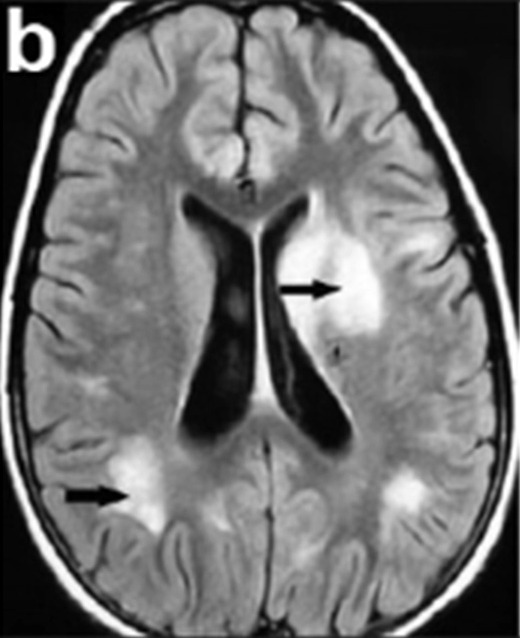
Imagen de una resonancia magnética de un paciente con encefalomielitis diseminada aguda

Una RM típica de un individuo con encefalomielitis diseminada aguda: observe el patrón irregular de la inflamación del parénquima cerebral (flechas negras).

Imagen: “MRI scan of a patient with acute disseminated encephalomyelitis (ADEM)” por Kamate M, Chetal V, Tonape V, Mahantshetti N, Hattiholi V. Licencia: CC BY 2.0, editada por Lecturio.

Tratamiento y Complicaciones

Tratamiento

  • Terapia inmunosupresora: dosis altas de glucocorticoides intravenosos
  • Antimicrobianos empíricos:
    • Cobertura antiviral Antiviral Antivirals for Hepatitis B en EN Erythema nodosum is an immune-mediated panniculitis (inflammation of the subcutaneous fat) caused by a type IV (delayed-type) hypersensitivity reaction. It commonly manifests in young women as tender, erythematous nodules on the shins. Erythema Nodosum personas afectadas con evidencia de inflamación del SNC:
      • Fiebre
      • Encefalopatía
      • Meningismo
      • Hallazgos en EN Erythema nodosum is an immune-mediated panniculitis (inflammation of the subcutaneous fat) caused by a type IV (delayed-type) hypersensitivity reaction. It commonly manifests in young women as tender, erythematous nodules on the shins. Erythema Nodosum el LCR sugestivos de inflamación
    • Cobertura antibacteriana solo si los LOS Neisseria hallazgos del LCR sugieren meningitis Meningitis Meningitis is inflammation of the meninges, the protective membranes of the brain, and spinal cord. The causes of meningitis are varied, with the most common being bacterial or viral infection. The classic presentation of meningitis is a triad of fever, altered mental status, and nuchal rigidity. Meningitis bacteriana
  • Terapias alternativas en EN Erythema nodosum is an immune-mediated panniculitis (inflammation of the subcutaneous fat) caused by a type IV (delayed-type) hypersensitivity reaction. It commonly manifests in young women as tender, erythematous nodules on the shins. Erythema Nodosum personas con una respuesta inicial inadecuada a los LOS Neisseria glucocorticoides:
    • Inmunoglobulinas intravenosas
    • Plasmaféresis
    • Ciclofosfamida (no se recomienda de forma rutinaria; se reserva para casos raros y refractarios)

Complicaciones

  • Encefalomielitis diseminada aguda fulminante:
    • Común antes de la vacunación generalizada
    • Afecta a niños < 3 años
    • Graves déficits neurológicos
    • Edema Edema Edema is a condition in which excess serous fluid accumulates in the body cavity or interstitial space of connective tissues. Edema is a symptom observed in several medical conditions. It can be categorized into 2 types, namely, peripheral (in the extremities) and internal (in an organ or body cavity). Edema severo en EN Erythema nodosum is an immune-mediated panniculitis (inflammation of the subcutaneous fat) caused by a type IV (delayed-type) hypersensitivity reaction. It commonly manifests in young women as tender, erythematous nodules on the shins. Erythema Nodosum la imagenología
  • Mielitis transversa:
    • Por lesiones de la médula espinal
    • Inicio rápido
    • Puede presentarse con edema Edema Edema is a condition in which excess serous fluid accumulates in the body cavity or interstitial space of connective tissues. Edema is a symptom observed in several medical conditions. It can be categorized into 2 types, namely, peripheral (in the extremities) and internal (in an organ or body cavity). Edema de médula cervical
  • Encefalomielitis diseminada aguda multifásica (recurrente):
    • Episodios recurrentes > 3 meses después del episodio inicial
    • Ocurre con mayor frecuencia en EN Erythema nodosum is an immune-mediated panniculitis (inflammation of the subcutaneous fat) caused by a type IV (delayed-type) hypersensitivity reaction. It commonly manifests in young women as tender, erythematous nodules on the shins. Erythema Nodosum niños con anticuerpos MOG
    • La presencia de anticuerpos MOG también aumenta el riesgo de convulsiones y distingue la enfermedad de la esclerosis múltiple
    • Puede exhibir hallazgos en EN Erythema nodosum is an immune-mediated panniculitis (inflammation of the subcutaneous fat) caused by a type IV (delayed-type) hypersensitivity reaction. It commonly manifests in young women as tender, erythematous nodules on the shins. Erythema Nodosum la RM nuevos o recurrentes
  • Recaída de encefalomielitis diseminada aguda:
    • Trastorno neuroinflamatorio crónico
    • Relacionado con la esclerosis múltiple o con la neuromialgia óptica

Pronóstico

  • 60%–80% de las personas afectadas se recuperan por completo.
  • Período de recuperación: 1–2 meses
  • Mortalidad: < 2%
  • Déficits neurológicos focales residuales: 4%–30% de los LOS Neisseria casos

Diagnóstico Diferencial

  • Síndrome de Guillain-Barré: un ataque autoinmune a la raíz nerviosa periférica que típicamente afecta a la vaina de mielina. Generalmente, el síndrome de Guillain-Barré es precedido por una enfermedad aguda como infecciones virales, infección por micoplasma, inmunizaciones (más comúnmente después de la administración de la vacuna contra la influenza Influenza Influenza viruses are members of the Orthomyxoviridae family and the causative organisms of influenza, a highly contagious febrile respiratory disease. There are 3 primary influenza viruses (A, B, and C) and various subtypes, which are classified based on their virulent surface antigens, hemagglutinin (HA) and neuraminidase (NA). Influenza typically presents with a fever, myalgia, headache, and symptoms of an upper respiratory infection. Influenza Viruses/Influenza) o enfermedades diarreicas como la campilobacteriosis. El síndrome de Guillain-Barré se caracteriza por un inicio agudo de debilidad simétrica que progresa durante unos días con un patrón ascendente típico, comenzando en EN Erythema nodosum is an immune-mediated panniculitis (inflammation of the subcutaneous fat) caused by a type IV (delayed-type) hypersensitivity reaction. It commonly manifests in young women as tender, erythematous nodules on the shins. Erythema Nodosum las piernas y los LOS Neisseria brazos y moviéndose hacia arriba para afectar los LOS Neisseria pares craneales. Los LOS Neisseria reflejos tendinosos profundos parecen disminuidos en EN Erythema nodosum is an immune-mediated panniculitis (inflammation of the subcutaneous fat) caused by a type IV (delayed-type) hypersensitivity reaction. It commonly manifests in young women as tender, erythematous nodules on the shins. Erythema Nodosum el examen. El dolor Dolor Inflammation es común y puede ocurrir disfunción autonómica que conduzca a arritmia cardíaca, retención urinaria o gastroparesia. Puede resultar en EN Erythema nodosum is an immune-mediated panniculitis (inflammation of the subcutaneous fat) caused by a type IV (delayed-type) hypersensitivity reaction. It commonly manifests in young women as tender, erythematous nodules on the shins. Erythema Nodosum insuficiencia respiratoria, para lo cual es necesaria la ventilación mecánica. El análisis del LCR mostrará proteínas significativamente elevadas con un recuento normal de leucocitos. El tratamiento es con inmunoglobulinas intravenosas Aunque la recuperación puede llevar meses, el 95% de las personas afectadas se recuperará.
  • Encefalitis viral: inflamación del parénquima cerebral que provoca una disfunción neurológica. Varios virus Virus Viruses are infectious, obligate intracellular parasites composed of a nucleic acid core surrounded by a protein capsid. Viruses can be either naked (non-enveloped) or enveloped. The classification of viruses is complex and based on many factors, including type and structure of the nucleoid and capsid, the presence of an envelope, the replication cycle, and the host range. Virology, incluidos los LOS Neisseria virus Virus Viruses are infectious, obligate intracellular parasites composed of a nucleic acid core surrounded by a protein capsid. Viruses can be either naked (non-enveloped) or enveloped. The classification of viruses is complex and based on many factors, including type and structure of the nucleoid and capsid, the presence of an envelope, the replication cycle, and the host range. Virology del herpes, citomegalovirus, EBV EBV Epstein-barr virus (EBV) is a linear, double-stranded DNA virus belonging to the herpesviridae family. This highly prevalent virus is mostly transmitted through contact with oropharyngeal secretions from an infected individual. The virus can infect epithelial cells and B lymphocytes, where it can undergo lytic replication or latency. Epstein-Barr Virus, enterovirus Enterovirus A genus of the family picornaviridae whose members preferentially inhabit the intestinal tract of a variety of hosts. The genus contains many species. Newly described members of human enteroviruses are assigned continuous numbers with the species designated ‘human enterovirus’. Coxsackievirus y virus Virus Viruses are infectious, obligate intracellular parasites composed of a nucleic acid core surrounded by a protein capsid. Viruses can be either naked (non-enveloped) or enveloped. The classification of viruses is complex and based on many factors, including type and structure of the nucleoid and capsid, the presence of an envelope, the replication cycle, and the host range. Virology del sarampión, pueden causar encefalitis. Los LOS Neisseria síntomas incluyen letargo, confusión, fiebre y convulsiones. El tratamiento es de soporte. Es posible que se requieran medicamentos anticonvulsivantes para lograr el control de las convulsiones. Los LOS Neisseria antivirales no se utilizan normalmente, excepto en EN Erythema nodosum is an immune-mediated panniculitis (inflammation of the subcutaneous fat) caused by a type IV (delayed-type) hypersensitivity reaction. It commonly manifests in young women as tender, erythematous nodules on the shins. Erythema Nodosum tipos específicos de encefalitis viral, como por herpes o infecciones por CMV.
  • Esclerosis múltiple: trastorno desmielinizante que afecta a la sustancia blanca y se caracteriza por episodios distintos de déficits neurológicos crecientes y decrecientes. La esclerosis múltiple afecta predominantemente a mujeres e individuos de ascendencia caucásica. Los LOS Neisseria síntomas de presentación comunes incluyen deterioro de la visión unilateral, deficiencias de los LOS Neisseria pares craneales, oftalmoplejía, ataxia Ataxia Impairment of the ability to perform smoothly coordinated voluntary movements. This condition may affect the limbs, trunk, eyes, pharynx, larynx, and other structures. Ataxia may result from impaired sensory or motor function. Sensory ataxia may result from posterior column injury or peripheral nerve diseases. Motor ataxia may be associated with cerebellar diseases; cerebral cortex diseases; thalamic diseases; basal ganglia diseases; injury to the red nucleus; and other conditions. Ataxia-telangiectasia, nistagmo, espasticidad, incontinencia urinaria y mirada lateral conjugada debido al AL Amyloidosis daño del fascículo longitudinal medial. El curso clínico varía y suele ser recidivante y remitente. Los LOS Neisseria síntomas pueden empeorar con los LOS Neisseria cambios de temperatura. El diagnóstico puede confirmarse con base en EN Erythema nodosum is an immune-mediated panniculitis (inflammation of the subcutaneous fat) caused by a type IV (delayed-type) hypersensitivity reaction. It commonly manifests in young women as tender, erythematous nodules on the shins. Erythema Nodosum los LOS Neisseria hallazgos de la RM, que muestran múltiples placas irregulares bien delimitadas ubicadas cerca de los LOS Neisseria ventrículos laterales o en EN Erythema nodosum is an immune-mediated panniculitis (inflammation of the subcutaneous fat) caused by a type IV (delayed-type) hypersensitivity reaction. It commonly manifests in young women as tender, erythematous nodules on the shins. Erythema Nodosum el tronco del encéfalo, la médula espinal o el nervio óptico. El análisis del LCR mostrará bandas oligoclonales y proteínas levemente elevadas. El tratamiento consiste en EN Erythema nodosum is an immune-mediated panniculitis (inflammation of the subcutaneous fat) caused by a type IV (delayed-type) hypersensitivity reaction. It commonly manifests in young women as tender, erythematous nodules on the shins. Erythema Nodosum esteroides intravenosos en EN Erythema nodosum is an immune-mediated panniculitis (inflammation of the subcutaneous fat) caused by a type IV (delayed-type) hypersensitivity reaction. It commonly manifests in young women as tender, erythematous nodules on the shins. Erythema Nodosum dosis altas para individuos en EN Erythema nodosum is an immune-mediated panniculitis (inflammation of the subcutaneous fat) caused by a type IV (delayed-type) hypersensitivity reaction. It commonly manifests in young women as tender, erythematous nodules on the shins. Erythema Nodosum el estadio de recaída aguda, interferones beta para modular la enfermedad o inmunosupresores en EN Erythema nodosum is an immune-mediated panniculitis (inflammation of the subcutaneous fat) caused by a type IV (delayed-type) hypersensitivity reaction. It commonly manifests in young women as tender, erythematous nodules on the shins. Erythema Nodosum el caso de enfermedad refractaria.

Referencias

  1. Anilkumar AC, Foris LA, Tadi P. Acute Disseminated Encephalomyelitis. [Updated 2024 Jan 26]. In: StatPearls [Internet]. Treasure Island (FL): StatPearls Publishing; 2025 Jan-. Available from: https://www.ncbi.nlm.nih.gov/books/NBK430934/
  2. Brenton, J.N. (2024, July 18). Acute Disseminated Encephalomyelitis: Background, Pathophysiology, Epidemiology. Medscape. Retrieved July 27, 2025, from https://emedicine.medscape.com/article/1147044-overview 
  3. Johnston, M. (2016). Neurodegenerative disorders of childhood. In Behrman, R.E., Kliegman, R.M., Jenson, H.B. (Eds.). Nelson Textbook of Pediatrics (20th ed.). Elsevier.
  4. Hemingway, C. (2020). Demyelinating disorders of the central nervous system. In Kliegman, R.M., et al. (Eds.), Nelson Textbook of Pediatrics, pp. 3196-3209.e2. Elsevier.
  5. Ryan, M.M. (2020). Guillain-Barré syndrome. In Kliegman, R.M., et al. (Eds.), Nelson Textbook of Pediatrics, pp. 3335-3339.e1. Elsevier.
  6. Kliegman, R.M., et al. (2020). Disorders of neuromuscular transmission and of motor neurons. In Kliegman, R.M., et al. (Eds.), Nelson Textbook of Pediatrics, pp. 3304-3320.e1. Elsevier.
  7. Lotze, T. E., & Chadwick, D. J. (2024, July 5). Acute disseminated encephalomyelitis (ADEM) in children: Treatment and prognosis. UpToDate. Retrieved July 27, 2025, from https://www.uptodate.com/contents/acute-disseminated-encephalomyelitis-adem-in-children-treatment-and-prognosis
  8. Lotze, T. E., & Chadwick, D. J. (2024, December 5). Acute disseminated encephalomyelitis (ADEM) in children: Pathogenesis, clinical features, and diagnosis. UpToDate. Retrieved July 27, 2025, from https://www.uptodate.com/contents/acute-disseminated-encephalomyelitis-adem-in-children-pathogenesis-clinical-features-and-diagnosis
  9. Waldman, A. T. (2024, July 1). Acute disseminated encephalomyelitis (ADEM) in adults. UpToDate. Retrieved July 27, 2025, from https://www.uptodate.com/contents/acute-disseminated-encephalomyelitis-adem-in-adults

¡Crea tu cuenta gratis o inicia una sesión para seguir leyendo!

Regístrate ahora y obtén acceso gratuito a Lecturio con páginas de concepto, videos médicos y cuestionarios para tu educación médica.

User Reviews

Que tengas una sesión de estudio alegre y navideña 🎁 Ahorra 50% en todos los planes >>

Details