
Domina Conceptos Médicos

Estudia para la escuela de medicina y tus examenes con Lecturio.

Coronavirus

Los LOS Neisseria coronavirus Coronavirus Coronaviruses are a group of related viruses that contain positive-sense, single-stranded RNA. Coronavirus derives its name from "κορώνη korṓnē" in Greek, which translates as "crown," after the small club-shaped proteins visible as a ring around the viral envelope in electron micrographs. Coronavirus son un grupo de virus Virus Viruses are infectious, obligate intracellular parasites composed of a nucleic acid core surrounded by a protein capsid. Viruses can be either naked (non-enveloped) or enveloped. The classification of viruses is complex and based on many factors, including type and structure of the nucleoid and capsid, the presence of an envelope, the replication cycle, and the host range. Virology relacionados que contienen ácido ribonucleico (ARN) monocatenario de sentido positivo. El coronavirus Coronavirus Coronaviruses are a group of related viruses that contain positive-sense, single-stranded RNA. Coronavirus derives its name from "κορώνη korṓnē" in Greek, which translates as "crown," after the small club-shaped proteins visible as a ring around the viral envelope in electron micrographs. Coronavirus deriva su nombre de “κορώνα” en EN Erythema nodosum is an immune-mediated panniculitis (inflammation of the subcutaneous fat) caused by a type IV (delayed-type) hypersensitivity reaction. It commonly manifests in young women as tender, erythematous nodules on the shins. Erythema Nodosum griego, que se traduce como “corona”, por las pequeñas proteínas en EN Erythema nodosum is an immune-mediated panniculitis (inflammation of the subcutaneous fat) caused by a type IV (delayed-type) hypersensitivity reaction. It commonly manifests in young women as tender, erythematous nodules on the shins. Erythema Nodosum forma de mazo visibles como un anillo alrededor de la envoltura viral en EN Erythema nodosum is an immune-mediated panniculitis (inflammation of the subcutaneous fat) caused by a type IV (delayed-type) hypersensitivity reaction. It commonly manifests in young women as tender, erythematous nodules on the shins. Erythema Nodosum micrografías electrónicas. Los LOS Neisseria coronavirus Coronavirus Coronaviruses are a group of related viruses that contain positive-sense, single-stranded RNA. Coronavirus derives its name from "κορώνη korṓnē" in Greek, which translates as "crown," after the small club-shaped proteins visible as a ring around the viral envelope in electron micrographs. Coronavirus tienen genomas grandes, son propensos a la mutación y frecuentes eventos de recombinación que han dado lugar a una diversidad de especies. Estas nuevas especies son capaces de adaptarse rápidamente a nuevos huéspedes y entornos ecológicos, lo que las hace HACE Altitude Sickness muy resistentes y difíciles de combatir. Han aparecido nuevas infecciones por coronavirus Coronavirus Coronaviruses are a group of related viruses that contain positive-sense, single-stranded RNA. Coronavirus derives its name from "κορώνη korṓnē" in Greek, which translates as "crown," after the small club-shaped proteins visible as a ring around the viral envelope in electron micrographs. Coronavirus tanto en EN Erythema nodosum is an immune-mediated panniculitis (inflammation of the subcutaneous fat) caused by a type IV (delayed-type) hypersensitivity reaction. It commonly manifests in young women as tender, erythematous nodules on the shins. Erythema Nodosum humanos como en EN Erythema nodosum is an immune-mediated panniculitis (inflammation of the subcutaneous fat) caused by a type IV (delayed-type) hypersensitivity reaction. It commonly manifests in young women as tender, erythematous nodules on the shins. Erythema Nodosum animales. Se sabe que los LOS Neisseria coronavirus Coronavirus Coronaviruses are a group of related viruses that contain positive-sense, single-stranded RNA. Coronavirus derives its name from "κορώνη korṓnē" in Greek, which translates as "crown," after the small club-shaped proteins visible as a ring around the viral envelope in electron micrographs. Coronavirus son la causa de algunos casos de resfriado común, síndrome respiratorio agudo severo (SARS, por sus siglas en EN Erythema nodosum is an immune-mediated panniculitis (inflammation of the subcutaneous fat) caused by a type IV (delayed-type) hypersensitivity reaction. It commonly manifests in young women as tender, erythematous nodules on the shins. Erythema Nodosum inglés), síndrome respiratorio de Oriente Medio (MERS, por sus siglas en EN Erythema nodosum is an immune-mediated panniculitis (inflammation of the subcutaneous fat) caused by a type IV (delayed-type) hypersensitivity reaction. It commonly manifests in young women as tender, erythematous nodules on the shins. Erythema Nodosum inglés) y enfermedad por coronavirus Coronavirus Coronaviruses are a group of related viruses that contain positive-sense, single-stranded RNA. Coronavirus derives its name from "κορώνη korṓnē" in Greek, which translates as "crown," after the small club-shaped proteins visible as a ring around the viral envelope in electron micrographs. Coronavirus 2019 ( COVID-19 COVID-19 Coronavirus disease 2019 (COVID-19) is an infectious disease caused by the severe acute respiratory syndrome coronavirus 2 (SARS-CoV-2) that mainly affects the respiratory system but can also cause damage to other body systems (cardiovascular, gastrointestinal, renal, and central nervous systems). , por sus siglas en EN Erythema nodosum is an immune-mediated panniculitis (inflammation of the subcutaneous fat) caused by a type IV (delayed-type) hypersensitivity reaction. It commonly manifests in young women as tender, erythematous nodules on the shins. Erythema Nodosum inglés).

Last updated: Dec 15, 2025
Editorial responsibility: Stanley Oiseth, Lindsay Jones, Evelin Maza

Clasificación

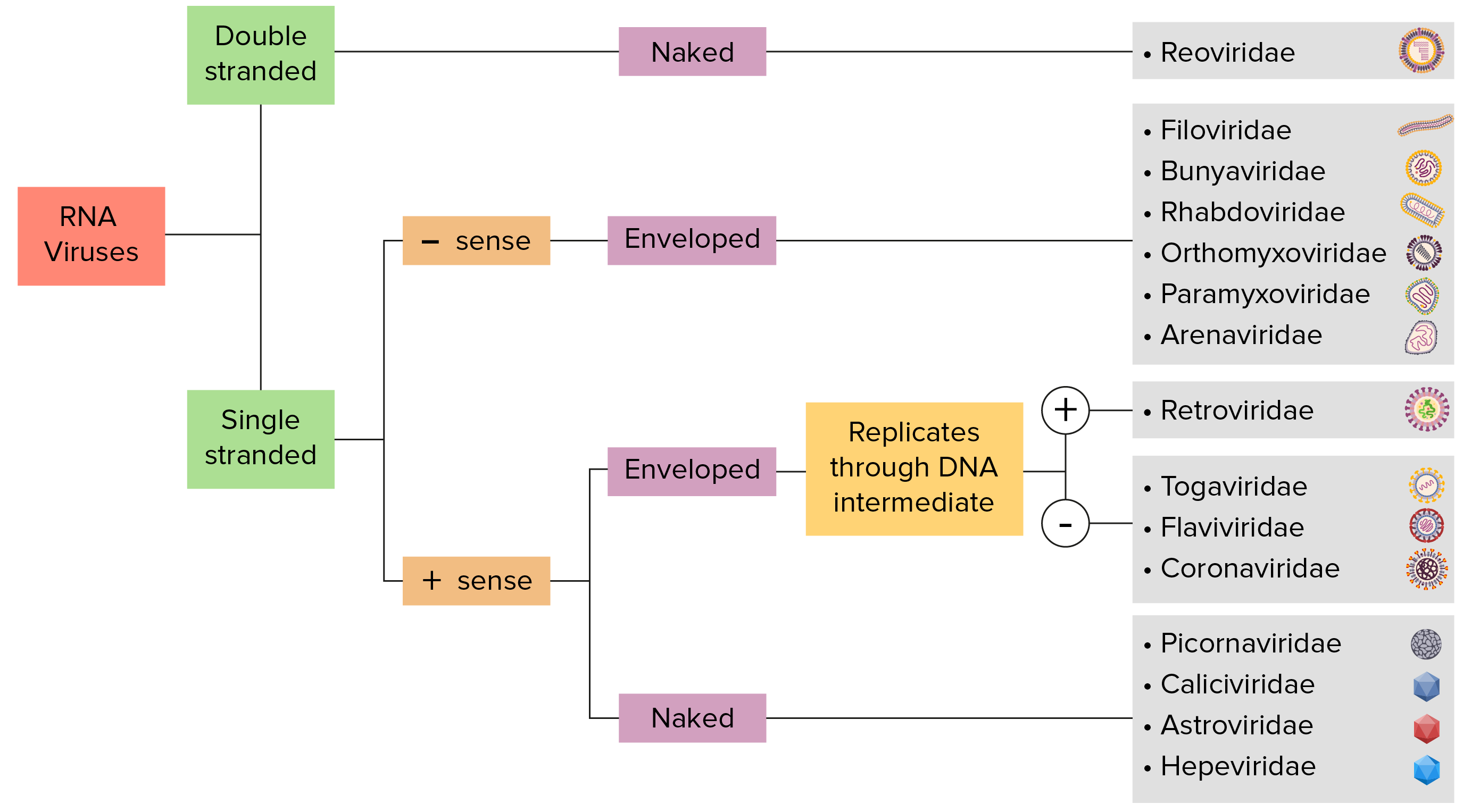
Diagrama de flujo de la clasificación de virus de ARN

Identificación de virus de ARN:
Los virus se pueden clasificar de muchas formas. La mayoría de los virus, sin embargo, tendrán un genoma formado por ácido desoxirribonucleico (ADN) o ARN. Los virus del genoma de ARN pueden caracterizarse además por ARN monocatenario o bicatenario. Los virus “envueltos” están cubiertos por una fina capa de membrana celular (generalmente extraída de la célula huésped). Si la envoltura está ausente, los virus se denominan virus “desnudos”. Los virus con genomas monocatenarios son virus de “sentido positivo” si el genoma se emplea directamente como ARN mensajero (ARNm), que se traduce en proteínas. Los virus monocatenarios de “sentido negativo” emplean la ARN polimerasa dependiente de ARN, una enzima viral, para transcribir su genoma en ARN mensajero.
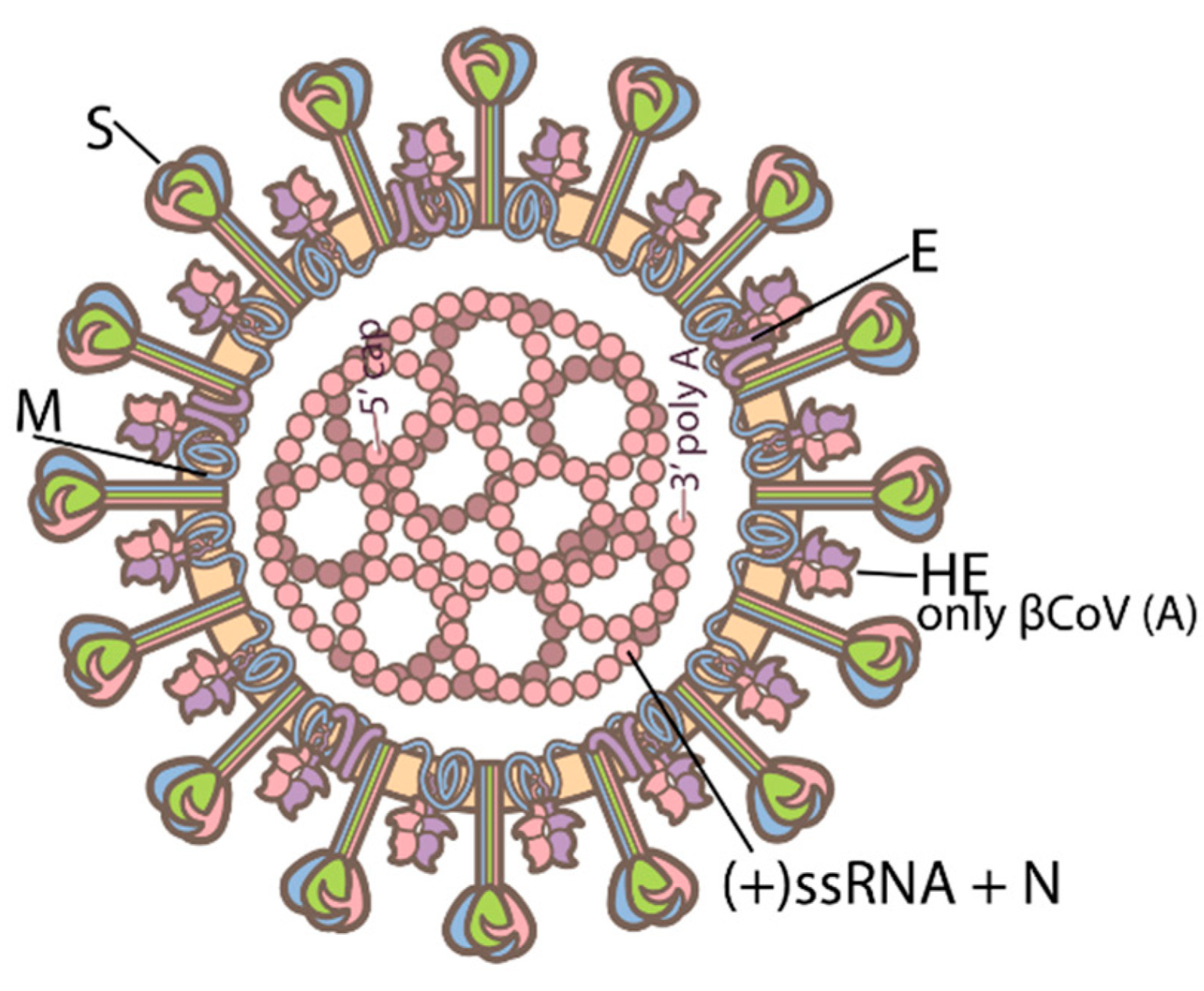
Imagen por Lecturio. Licencia: CC BY-NC-SA 4.0

Características Generales

Estructura

  • Esférico
  • 120 nm de diámetro
  • Generalmente, se distingue por sus proteínas de superficie en EN Erythema nodosum is an immune-mediated panniculitis (inflammation of the subcutaneous fat) caused by a type IV (delayed-type) hypersensitivity reaction. It commonly manifests in young women as tender, erythematous nodules on the shins. Erythema Nodosum forma de mazo o en EN Erythema nodosum is an immune-mediated panniculitis (inflammation of the subcutaneous fat) caused by a type IV (delayed-type) hypersensitivity reaction. It commonly manifests in young women as tender, erythematous nodules on the shins. Erythema Nodosum forma de “corona”
  • Envuelto, con la envoltura viral que contiene las siguientes proteínas:
    • Proteína de la espícula (S)
    • Proteína de hemaglutinina esterasa (HE)
    • Proteína de membrana (M)
    • Proteína de envoltura (E)
  • La nucleocápside es grande y tiene simetría helicoidal.
  • Tiene un genoma de ARN monocatenario, sentido positivo, de aproximadamente 26–31 kilobases
Las proteínas de la envoltura se denominan Coronavirus.

Las proteínas de la envoltura se denominan:
S: espícula
HE: hemaglutinina esterasa
M: membrana
E: envoltura
N: nucleocápside
(+)ssRNA: ARN monocatenario de sentido positivo

Imagen: “Structure of coronavirus” por Nongluk S et al. Licencia: CC BY 4.0

Especies clínicamente relevantes

  • La familia Coronaviridae Coronaviridae Spherical RNA viruses, in the order nidovirales, infecting a wide range of animals including humans. Transmission is by fecal-oral and respiratory routes. Mechanical transmission is also common. There are two genera: coronavirus and torovirus. Coronavirus comprende 3 subfamilias:
    • Letovirinae Letovirinae Coronavirus (no tiene especies de relevancia médica)
    • Pitovirinae (no tiene especies de relevancia médica)
    • Orthocoronavirinae Orthocoronavirinae Coronavirus se divide en EN Erythema nodosum is an immune-mediated panniculitis (inflammation of the subcutaneous fat) caused by a type IV (delayed-type) hypersensitivity reaction. It commonly manifests in young women as tender, erythematous nodules on the shins. Erythema Nodosum 4 géneros:
      • Alphacoronavirus Alphacoronavirus A genus of the family coronaviridae which causes respiratory or gastrointestinal disease in a variety of mammals. Human alphacoronaviruses include human coronavirus 229e and nl63. All members share the identical core transcription regulatory sequences of 5′-cuaaac-3′ and most have 1 to 2 orfs downstream to the n protein gene. Coronavirus y Betacoronavirus Betacoronavirus A genus of the family coronaviridae which causes respiratory or gastrointestinal disease in a variety of mostly mammals. Human betacoronaviruses include human enteric coronavirus; human coronavirus oc43; mers virus; and sars virus. Members have either core transcription regulatory sequences of 5′-cuaaac-3′ or 5′-cuaaac-3′ and mostly have no orf downstream to the n protein gene. Coronavirus (infectan mamíferos)
      • Gammacoronavirus Gammacoronavirus A genus of the family coronaviridae that causes respiratory or gastrointestinal disease in avian species (or birds). The type species, avian coronavirus, includes the previously separate species turkey coronavirus; and infectious bronchitis virus. Coronavirus y Deltacoronavirus Deltacoronavirus A genus of coronavirus that occurs primarily in birds and pigs. Coronavirus (infectan principalmente aves)
  • La mayoría de las especies de coronavirus Coronavirus Coronaviruses are a group of related viruses that contain positive-sense, single-stranded RNA. Coronavirus derives its name from “κορώνη korṓnē” in Greek, which translates as “crown,” after the small club-shaped proteins visible as a ring around the viral envelope in electron micrographs. Coronavirus que infectan a los LOS Neisseria humanos se encuentran dentro del género Betacoronavirus Betacoronavirus A genus of the family coronaviridae which causes respiratory or gastrointestinal disease in a variety of mostly mammals. Human betacoronaviruses include human enteric coronavirus; human coronavirus oc43; mers virus; and sars virus. Members have either core transcription regulatory sequences of 5′-cuaaac-3′ or 5′-cuaaac-3′ and mostly have no orf downstream to the n protein gene. Coronavirus. Los LOS Neisseria más relevantes incluyen:
    • Coronavirus Coronavirus Coronaviruses are a group of related viruses that contain positive-sense, single-stranded RNA. Coronavirus derives its name from “κορώνη korṓnē” in Greek, which translates as “crown,” after the small club-shaped proteins visible as a ring around the viral envelope in electron micrographs. Coronavirus humanos ( HCoV-OC43 HCoV-OC43 A species in the genus coronavirus causing the common cold and possibly nervous system infections in humans. It contains hemagglutinin-esterase. Coronavirus, HCoV-HKU1 HCoV-HKU1 Coronavirus, HCoV-2293)
    • Coronavirus Coronavirus Coronaviruses are a group of related viruses that contain positive-sense, single-stranded RNA. Coronavirus derives its name from “κορώνη korṓnē” in Greek, which translates as “crown,” after the small club-shaped proteins visible as a ring around the viral envelope in electron micrographs. Coronavirus causante del síndrome respiratorio agudo severo ( SARS-CoV SARS-CoV A viral disorder characterized by high fever, dry cough, shortness of breath (dyspnea) or breathing difficulties, and atypical pneumonia. A virus in the genus Coronavirus is the suspected agent. Coronavirus, por sus siglas in inglés)
    • Coronavirus Coronavirus Coronaviruses are a group of related viruses that contain positive-sense, single-stranded RNA. Coronavirus derives its name from “κορώνη korṓnē” in Greek, which translates as “crown,” after the small club-shaped proteins visible as a ring around the viral envelope in electron micrographs. Coronavirus relacionado con el síndrome respiratorio de Oriente Medio (MERS-CoV, por sus siglas en EN Erythema nodosum is an immune-mediated panniculitis (inflammation of the subcutaneous fat) caused by a type IV (delayed-type) hypersensitivity reaction. It commonly manifests in young women as tender, erythematous nodules on the shins. Erythema Nodosum inglés)
    • Síndrome respiratorio agudo severo causado por coronavirus Coronavirus Coronaviruses are a group of related viruses that contain positive-sense, single-stranded RNA. Coronavirus derives its name from “κορώνη korṓnē” in Greek, which translates as “crown,” after the small club-shaped proteins visible as a ring around the viral envelope in electron micrographs. Coronavirus 2 (SARS-CoV-2, por sus siglas en EN Erythema nodosum is an immune-mediated panniculitis (inflammation of the subcutaneous fat) caused by a type IV (delayed-type) hypersensitivity reaction. It commonly manifests in young women as tender, erythematous nodules on the shins. Erythema Nodosum inglés)

Patogénesis

Transmisión

  • Reservorios:
    • Se cree que los LOS Neisseria quirópteros (murciélagos) son el hospedador de origen de todos los LOS Neisseria alfacoronavirus y betacoronavirus Betacoronavirus A genus of the family coronaviridae which causes respiratory or gastrointestinal disease in a variety of mostly mammals. Human betacoronaviruses include human enteric coronavirus; human coronavirus oc43; mers virus; and sars virus. Members have either core transcription regulatory sequences of 5′-cuaaac-3′ or 5′-cuaaac-3′ and mostly have no orf downstream to the n protein gene. Coronavirus y, por lo tanto, de todos los LOS Neisseria coronavirus Coronavirus Coronaviruses are a group of related viruses that contain positive-sense, single-stranded RNA. Coronavirus derives its name from “κορώνη korṓnē” in Greek, which translates as “crown,” after the small club-shaped proteins visible as a ring around the viral envelope in electron micrographs. Coronavirus humanos.
    • Los LOS Neisseria camellos también pueden ser un reservorio para MERS.
    • Las aves son los LOS Neisseria reservorios y huéspedes naturales de todos los LOS Neisseria gammacoronavirus Gammacoronavirus A genus of the family coronaviridae that causes respiratory or gastrointestinal disease in avian species (or birds). The type species, avian coronavirus, includes the previously separate species turkey coronavirus; and infectious bronchitis virus. Coronavirus y deltacoronavirus Deltacoronavirus A genus of coronavirus that occurs primarily in birds and pigs. Coronavirus.
  • Vías de transmisión:
    • Fecal–oral
    • Gotas respiratorias y propagación aérea
    • Contacto con superficies infectadas y fómites
    • Se ha HA Hemolytic anemia (HA) is the term given to a large group of anemias that are caused by the premature destruction/hemolysis of circulating red blood cells (RBCs). Hemolysis can occur within (intravascular hemolysis) or outside the blood vessels (extravascular hemolysis). Hemolytic Anemia documentado transmisión vertical del SARS-CoV-2, aunque es relativamente poco frecuente.

Factores de virulencia

La mayoría de coronavirus Coronavirus Coronaviruses are a group of related viruses that contain positive-sense, single-stranded RNA. Coronavirus derives its name from “κορώνη korṓnē” in Greek, which translates as “crown,” after the small club-shaped proteins visible as a ring around the viral envelope in electron micrographs. Coronavirus tienen 4 proteínas estructurales: S, E, M y N.
  • Las proteínas S, E y M crean la envoltura viral.
  • La proteína N (nucleocápside) forma un complejo con el ARN (nucleocápside) y ayuda a regular Regular Insulin la síntesis del ARN viral.
  • La proteína M (membrana) se proyecta sobre la superficie externa de la envoltura y es importante para el ensamblaje viral.
  • La proteína E (envoltura) tiene una función poco clara, aunque puede ayudar en EN Erythema nodosum is an immune-mediated panniculitis (inflammation of the subcutaneous fat) caused by a type IV (delayed-type) hypersensitivity reaction. It commonly manifests in young women as tender, erythematous nodules on the shins. Erythema Nodosum la liberación del virus Virus Viruses are infectious, obligate intracellular parasites composed of a nucleic acid core surrounded by a protein capsid. Viruses can be either naked (non-enveloped) or enveloped. The classification of viruses is complex and based on many factors, including type and structure of the nucleoid and capsid, the presence of an envelope, the replication cycle, and the host range. Virology.
  • La proteína S (espícula) es una proyección de superficie en EN Erythema nodosum is an immune-mediated panniculitis (inflammation of the subcutaneous fat) caused by a type IV (delayed-type) hypersensitivity reaction. It commonly manifests in young women as tender, erythematous nodules on the shins. Erythema Nodosum forma de mazo que le da al AL Amyloidosis virus Virus Viruses are infectious, obligate intracellular parasites composed of a nucleic acid core surrounded by a protein capsid. Viruses can be either naked (non-enveloped) or enveloped. The classification of viruses is complex and based on many factors, including type and structure of the nucleoid and capsid, the presence of an envelope, the replication cycle, and the host range. Virology su característica apariencia de corona en EN Erythema nodosum is an immune-mediated panniculitis (inflammation of the subcutaneous fat) caused by a type IV (delayed-type) hypersensitivity reaction. It commonly manifests in young women as tender, erythematous nodules on the shins. Erythema Nodosum el microscopio electrónico y es responsable de la unión del receptor Receptor Receptors are proteins located either on the surface of or within a cell that can bind to signaling molecules known as ligands (e.g., hormones) and cause some type of response within the cell. Receptors y la fusión con la membrana de la célula huésped.

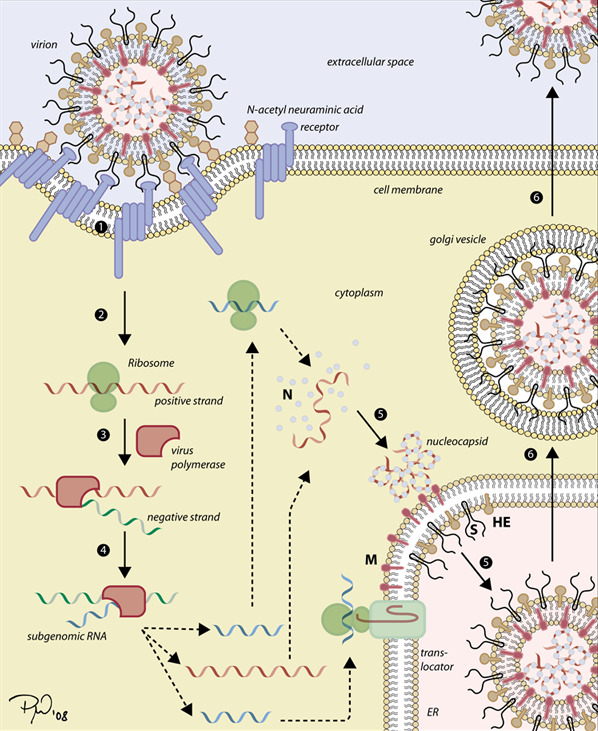
Ciclo de replicación

  1. Los LOS Neisseria coronavirus Coronavirus Coronaviruses are a group of related viruses that contain positive-sense, single-stranded RNA. Coronavirus derives its name from “κορώνη korṓnē” in Greek, which translates as “crown,” after the small club-shaped proteins visible as a ring around the viral envelope in electron micrographs. Coronavirus se unen a la superficie de la célula huésped a través de las proteínas S.
    • La entrada viral ocurre por endocitosis mediada por receptores o por fusión de membranas.
    • El virus Virus Viruses are infectious, obligate intracellular parasites composed of a nucleic acid core surrounded by a protein capsid. Viruses can be either naked (non-enveloped) or enveloped. The classification of viruses is complex and based on many factors, including type and structure of the nucleoid and capsid, the presence of an envelope, the replication cycle, and the host range. Virology escapa del entorno acidificado de los LOS Neisseria endosomas transportándose a los LOS Neisseria lisosomas.
  2. Los LOS Neisseria coronavirus Coronavirus Coronaviruses are a group of related viruses that contain positive-sense, single-stranded RNA. Coronavirus derives its name from “κορώνη korṓnē” in Greek, which translates as “crown,” after the small club-shaped proteins visible as a ring around the viral envelope in electron micrographs. Coronavirus tienen ARN monocatenario de sentido positivo que puede producir directamente las proteínas y nuevos genomas en EN Erythema nodosum is an immune-mediated panniculitis (inflammation of the subcutaneous fat) caused by a type IV (delayed-type) hypersensitivity reaction. It commonly manifests in young women as tender, erythematous nodules on the shins. Erythema Nodosum el citoplasma.
  3. Se produce el ARN molde de cadena de sentido negativo.
  4. Las nuevas proteínas virales son traducidas por los LOS Neisseria ribosomas del huésped.
  5. La proteína de la nucleocápside se une al AL Amyloidosis ARN genómico y la proteína M se integra en EN Erythema nodosum is an immune-mediated panniculitis (inflammation of the subcutaneous fat) caused by a type IV (delayed-type) hypersensitivity reaction. It commonly manifests in young women as tender, erythematous nodules on the shins. Erythema Nodosum la membrana del retículo endoplásmico junto con las proteínas S y HE.
  6. Una nucleocápside ensamblada que contiene el ARN se mueve hacia el retículo endoplásmico para ser envuelta y es liberada por exocitosis.
Replicación del coronavirus

Ciclo de replicación de los coronavirus:
1. Los coronavirus se unen a la superficie de la célula huésped a través de las proteínas S. La entrada viral ocurre por endocitosis mediada por receptores o por fusión de membranas. El virus escapa del entorno acidificado de los endosomas transportándose a los lisosomas.
2. Los coronavirus tienen ARN monocatenario de sentido positivo que puede producir directamente las proteínas y nuevos genomas en el citoplasma.
3. Se produce el ARN molde de cadena de sentido negativo.
4. Las nuevas proteínas virales son traducidas por los ribosomas del huésped.
5. La proteína de la nucleocápside se une al ARN genómico y la proteína M se integra en la membrana del retículo endoplásmico junto con las proteínas S y HE.
6. La nucleocápside ensamblada que contiene el ARN se mueve hacia el retículo endoplásmico para ser envuelta y es liberada por exocitosis.

Imagen: “The infection life cycle of coronavirus” por C. Michael Gibson et al. Licencia: CC BY-SA 3.0

Enfermedades Causadas por Coronavirus

  • Resfriado común:
    • El resfriado común generalmente es causado por rinovirus.
    • Sin embargo, los LOS Neisseria coronavirus Coronavirus Coronaviruses are a group of related viruses that contain positive-sense, single-stranded RNA. Coronavirus derives its name from “κορώνη korṓnē” in Greek, which translates as “crown,” after the small club-shaped proteins visible as a ring around the viral envelope in electron micrographs. Coronavirus causan el 15% de los LOS Neisseria resfriados comunes.
    • Período de incubación: 3 días
  • Infecciones gastrointestinales:
    • No son causadas comúnmente por coronavirus Coronavirus Coronaviruses are a group of related viruses that contain positive-sense, single-stranded RNA. Coronavirus derives its name from “κορώνη korṓnē” in Greek, which translates as “crown,” after the small club-shaped proteins visible as a ring around the viral envelope in electron micrographs. Coronavirus
    • Período de incubación: 3 días
    • Generalmente, se presenta como una infección muy leve que causa diarrea, dolor Dolor Inflammation abdominal difuso y vómitos.
    • En EN Erythema nodosum is an immune-mediated panniculitis (inflammation of the subcutaneous fat) caused by a type IV (delayed-type) hypersensitivity reaction. It commonly manifests in young women as tender, erythematous nodules on the shins. Erythema Nodosum raras ocasiones, puede provocar enterocolitis Enterocolitis Inflammation of the mucosa of both the small intestine and the large intestine. Etiology includes ischemia, infections, allergic, and immune responses. Yersinia spp./Yersiniosis necrosante neonatal
  • MERS:
    • Surgió en EN Erythema nodosum is an immune-mediated panniculitis (inflammation of the subcutaneous fat) caused by a type IV (delayed-type) hypersensitivity reaction. It commonly manifests in young women as tender, erythematous nodules on the shins. Erythema Nodosum 2012 en EN Erythema nodosum is an immune-mediated panniculitis (inflammation of the subcutaneous fat) caused by a type IV (delayed-type) hypersensitivity reaction. It commonly manifests in young women as tender, erythematous nodules on the shins. Erythema Nodosum Arabia Saudita a partir de camellos dromedarios.
    • Periodo de incubación: 2-14 días (mediana de 5 días)
    • La presentación clínica varía desde una infección asintomática hasta una enfermedad aguda de las vías respiratorias superiores.
    • Puede conducir a una neumonitis rápidamente progresiva, insuficiencia respiratoria, shock Shock Shock is a life-threatening condition associated with impaired circulation that results in tissue hypoxia. The different types of shock are based on the underlying cause: distributive (↑ cardiac output (CO), ↓ systemic vascular resistance (SVR)), cardiogenic (↓ CO, ↑ SVR), hypovolemic (↓ CO, ↑ SVR), obstructive (↓ CO), and mixed. Types of Shock séptico e insuficiencia multiorgánica, lo que resulta en EN Erythema nodosum is an immune-mediated panniculitis (inflammation of the subcutaneous fat) caused by a type IV (delayed-type) hypersensitivity reaction. It commonly manifests in young women as tender, erythematous nodules on the shins. Erythema Nodosum la muerte.
  • SARS:
    • Surgió en EN Erythema nodosum is an immune-mediated panniculitis (inflammation of the subcutaneous fat) caused by a type IV (delayed-type) hypersensitivity reaction. It commonly manifests in young women as tender, erythematous nodules on the shins. Erythema Nodosum 2003 en EN Erythema nodosum is an immune-mediated panniculitis (inflammation of the subcutaneous fat) caused by a type IV (delayed-type) hypersensitivity reaction. It commonly manifests in young women as tender, erythematous nodules on the shins. Erythema Nodosum el sur de China a partir de gatos de algalia.
    • Período de incubación: 4–6 días
    • La presentación clínica varía desde una enfermedad leve, similar a la gripe, con recuperación completa (25% de los LOS Neisseria casos), hasta una infección respiratoria grave (aproximadamente el 70%) y la muerte por insuficiencia respiratoria (aproximadamente el 10%).
    • Generalmente, se manifiesta como fiebre leve, dolor Dolor Inflammation muscular, letargo, tos TOS Thoracic outlet syndrome (TOS) is a broad term used for a spectrum of syndromes related to the general region of the thoracic outlet, which involves the compression or irritation of elements of the brachial plexus, subclavian artery, or subclavian vein. Thoracic Outlet Syndrome, dolor Dolor Inflammation de garganta y malestar general.
    • Puede progresar a disnea, neumonía, insuficiencia respiratoria y muerte
  • Enfermedad por coronavirus Coronavirus Coronaviruses are a group of related viruses that contain positive-sense, single-stranded RNA. Coronavirus derives its name from “κορώνη korṓnē” in Greek, which translates as “crown,” after the small club-shaped proteins visible as a ring around the viral envelope in electron micrographs. Coronavirus 2019 ( COVID-19 COVID-19 Coronavirus disease 2019 (COVID-19) is an infectious disease caused by the severe acute respiratory syndrome coronavirus 2 (SARS-CoV-2) that mainly affects the respiratory system but can also cause damage to other body systems (cardiovascular, gastrointestinal, renal, and central nervous systems). ):
    • Surgió a finales de 2019 en EN Erythema nodosum is an immune-mediated panniculitis (inflammation of the subcutaneous fat) caused by a type IV (delayed-type) hypersensitivity reaction. It commonly manifests in young women as tender, erythematous nodules on the shins. Erythema Nodosum Wuhan, China, con investigaciones en EN Erythema nodosum is an immune-mediated panniculitis (inflammation of the subcutaneous fat) caused by a type IV (delayed-type) hypersensitivity reaction. It commonly manifests in young women as tender, erythematous nodules on the shins. Erythema Nodosum curso sobre su origen exacto (ya sea por propagación natural de murciélagos u otras posibles fuentes).
    • El virus Virus Viruses are infectious, obligate intracellular parasites composed of a nucleic acid core surrounded by a protein capsid. Viruses can be either naked (non-enveloped) or enveloped. The classification of viruses is complex and based on many factors, including type and structure of the nucleoid and capsid, the presence of an envelope, the replication cycle, and the host range. Virology causó una pandemia mundial.
    • Periodo de incubación: 1-14 días (normalmente de 3 a 5 días para las variantes recientes)
    • Han surgido múltiples variantes desde la cepa original, incluyendo los LOS Neisseria linajes Alfa, Delta y Ómicron:
      • Las variantes descendientes de los LOS Neisseria linajes Ómicron (JN.1, KP.3.1.1, XEC, LP.8.1) se han vuelto predominantes a nivel mundial, con diferente transmisibilidad y menor gravedad clínica en EN Erythema nodosum is an immune-mediated panniculitis (inflammation of the subcutaneous fat) caused by a type IV (delayed-type) hypersensitivity reaction. It commonly manifests in young women as tender, erythematous nodules on the shins. Erythema Nodosum comparación con las variantes anteriores
    • La presentación clínica puede variar desde infecciones asintomáticas o leves con recuperación completa (mayoría de los LOS Neisseria casos), hasta infecciones respiratorias graves y enfermedad crítica con daño multiorgánico y muerte.
    • Las tasas de mortalidad han disminuido con el tiempo gracias al AL Amyloidosis aumento de la inmunidad de la población, mejores tratamientos y la evolución de variantes menos virulentas.
    • Generalmente, se presenta como tos TOS Thoracic outlet syndrome (TOS) is a broad term used for a spectrum of syndromes related to the general region of the thoracic outlet, which involves the compression or irritation of elements of the brachial plexus, subclavian artery, or subclavian vein. Thoracic Outlet Syndrome seca, malestar y fatiga, y puede estar asociado con hemoptisis, diarrea, vómitos, cefalea, anosmia Anosmia Complete or severe loss of the subjective sense of smell. Loss of smell may be caused by many factors such as a cold, allergy, olfactory nerve diseases, viral respiratory tract infections (e.g., COVID-19), aging and various neurological disorders (e.g., Alzheimer disease). Cranial Nerve Palsies, disgeusia y dolor Dolor Inflammation torácico.
    • Puede progresar a neumonía, síndrome agudo de dificultad respiratoria (ARDS, por sus siglas en EN Erythema nodosum is an immune-mediated panniculitis (inflammation of the subcutaneous fat) caused by a type IV (delayed-type) hypersensitivity reaction. It commonly manifests in young women as tender, erythematous nodules on the shins. Erythema Nodosum inglés) trombosis, sepsis Sepsis Systemic inflammatory response syndrome with a proven or suspected infectious etiology. When sepsis is associated with organ dysfunction distant from the site of infection, it is called severe sepsis. When sepsis is accompanied by hypotension despite adequate fluid infusion, it is called septic shock. Sepsis and Septic Shock, insuficiencia multiorgánica y muerte
Tabla: Epidemiología de las enfermedades respiratorias por coronavirus Coronavirus Coronaviruses are a group of related viruses that contain positive-sense, single-stranded RNA. Coronavirus derives its name from “κορώνη korṓnē” in Greek, which translates as “crown,” after the small club-shaped proteins visible as a ring around the viral envelope in electron micrographs. Coronavirus.
MERS-CoV SARS-CoV SARS-CoV A viral disorder characterized by high fever, dry cough, shortness of breath (dyspnea) or breathing difficulties, and atypical pneumonia. A virus in the genus Coronavirus is the suspected agent. Coronavirus SARS-CoV-2
Fecha del primer caso identificado Junio 2012 Noviembre 2002 Diciembre 2019
Localización del primer caso identificado Jeddah, Arabia Saudita Shunde, China Wuhan, China
Edad promedio 56 años 44 años 56 años
Proporción de sexos (M:F) 3,3:1 0,8:1 1,6:1
Tabla: Frecuencia de síntomas en EN Erythema nodosum is an immune-mediated panniculitis (inflammation of the subcutaneous fat) caused by a type IV (delayed-type) hypersensitivity reaction. It commonly manifests in young women as tender, erythematous nodules on the shins. Erythema Nodosum enfermedades respiratorias por coronavirus Coronavirus Coronaviruses are a group of related viruses that contain positive-sense, single-stranded RNA. Coronavirus derives its name from “κορώνη korṓnē” in Greek, which translates as “crown,” after the small club-shaped proteins visible as a ring around the viral envelope in electron micrographs. Coronavirus
MERS (causado por MERS-CoV) SARS (causado por SARS-CoV SARS-CoV A viral disorder characterized by high fever, dry cough, shortness of breath (dyspnea) or breathing difficulties, and atypical pneumonia. A virus in the genus Coronavirus is the suspected agent. Coronavirus) COVID-19 COVID-19 Coronavirus disease 2019 (COVID-19) is an infectious disease caused by the severe acute respiratory syndrome coronavirus 2 (SARS-CoV-2) that mainly affects the respiratory system but can also cause damage to other body systems (cardiovascular, gastrointestinal, renal, and central nervous systems). (causado por SARS-CoV-2)
Fiebre 98% 99%–100% 87,9%
Tos TOS Thoracic outlet syndrome (TOS) is a broad term used for a spectrum of syndromes related to the general region of the thoracic outlet, which involves the compression or irritation of elements of the brachial plexus, subclavian artery, or subclavian vein. Thoracic Outlet Syndrome seca 47% 29%–75% 67,7%
Disnea 72% 40%–42% 18,6%
Diarrea 26% 20%–25% 3,7%
Dolor Dolor Inflammation de garganta 21% 13%–25% 13,9%
Uso del ventilador 24,5% 14%–20% 4,1%
Pérdida del gusto/olfato Rara Rara 30–60%
Fatiga Desconocida 70% 50–70%

Comparación de Virus Similares

Tabla: Comparación de virus Virus Viruses are infectious, obligate intracellular parasites composed of a nucleic acid core surrounded by a protein capsid. Viruses can be either naked (non-enveloped) or enveloped. The classification of viruses is complex and based on many factors, including type and structure of the nucleoid and capsid, the presence of an envelope, the replication cycle, and the host range. Virology similares
Organismo SARS-CoV-2 Rinovirus Coxsackievirus Coxsackievirus Coxsackievirus is a member of a family of viruses called Picornaviridae and the genus Enterovirus. Coxsackieviruses are single-stranded, positive-sense RNA viruses, and are divided into coxsackie group A and B viruses. Both groups of viruses cause upper respiratory infections, rashes, aseptic meningitis, or encephalitis. Coxsackievirus
Características
  • Esférico
  • 120 nm de diámetro
  • Gran nucleocápside con simetría helicoidal.
  • +ssRNA
  • Proteínas S en EN Erythema nodosum is an immune-mediated panniculitis (inflammation of the subcutaneous fat) caused by a type IV (delayed-type) hypersensitivity reaction. It commonly manifests in young women as tender, erythematous nodules on the shins. Erythema Nodosum forma de mazo
  • Cápside icosaédrica
  • Sin envoltura
  • +ssRNA
  • Genomas de 7200 a 8500 nucleótidos de longitud
  • Cápside icosaédrica
  • Pequeño y sin envoltura
  • +ssRNA
Transmisión
  • Aerosoles
  • Gotas respiratorias
  • Fómites
  • Vertical
  • Aerosoles
  • Gotas respiratorias
  • Fómites
  • Fecal–oral
  • Aerosoles
  • Gotas respiratorias
  • Fómites
Clínica
  • Fiebre
  • Tos TOS Thoracic outlet syndrome (TOS) is a broad term used for a spectrum of syndromes related to the general region of the thoracic outlet, which involves the compression or irritation of elements of the brachial plexus, subclavian artery, or subclavian vein. Thoracic Outlet Syndrome seca
  • Dificultad para respirar
  • Anosmia Anosmia Complete or severe loss of the subjective sense of smell. Loss of smell may be caused by many factors such as a cold, allergy, olfactory nerve diseases, viral respiratory tract infections (e.g., COVID-19), aging and various neurological disorders (e.g., Alzheimer disease). Cranial Nerve Palsies
  • Hipoxia
  • Fiebre
  • Tos TOS Thoracic outlet syndrome (TOS) is a broad term used for a spectrum of syndromes related to the general region of the thoracic outlet, which involves the compression or irritation of elements of the brachial plexus, subclavian artery, or subclavian vein. Thoracic Outlet Syndrome
  • Estornudos
  • Mialgia
  • Fatiga
  • Fiebre
  • Tos TOS Thoracic outlet syndrome (TOS) is a broad term used for a spectrum of syndromes related to the general region of the thoracic outlet, which involves the compression or irritation of elements of the brachial plexus, subclavian artery, or subclavian vein. Thoracic Outlet Syndrome
  • Dolor Dolor Inflammation de garganta
  • Conjuntivitis
  • Herpangina Herpangina Acute types of coxsackievirus infections or echovirus infections that usually affect children during the summer and are characterized by vesiculoulcerative lesions on the mucous membranes of the throat; dysphagia; vomiting, and fever. Coxsackievirus
  • Erupción vesicular
Diagnóstico
  • Reacción en EN Erythema nodosum is an immune-mediated panniculitis (inflammation of the subcutaneous fat) caused by a type IV (delayed-type) hypersensitivity reaction. It commonly manifests in young women as tender, erythematous nodules on the shins. Erythema Nodosum cadena de polimerasa con transcriptasa inversa ( RT-PCR RT-PCR A variation of the pcr technique in which cDNA is made from RNA via reverse transcription. The resultant cDNA is then amplified using standard pcr protocols. Polymerase Chain Reaction (PCR), por sus siglas en EN Erythema nodosum is an immune-mediated panniculitis (inflammation of the subcutaneous fat) caused by a type IV (delayed-type) hypersensitivity reaction. It commonly manifests in young women as tender, erythematous nodules on the shins. Erythema Nodosum inglés)
  • Serología
Diagnóstico clínico Diagnóstico clínico
Tratamiento
  • Observación cuidadosa
  • Hospitalización
  • Corticosteroides
  • Anticuerpos monoclonales
  • Enfermedad autolimitada
  • Tratamiento sintomático
  • Enfermedad autolimitada
  • Tratamiento sintomático
Prevención
  • Observación cuidadosa
  • Hospitalización para casos de moderados a severos
  • Corticoesteroides
  • Antivirales
  • Inmunomoduladores
  • Distanciamiento social
  • Higiene respiratoria
  • Distanciamiento social
  • Higiene respiratoria
+ ssRNA: ARN monocatenario de sentido positivo

Referencias

  1. Carvajal, J. J., García-Castillo, V., Cuellar, S. V., Campillay-Véliz, C. P., Salazar-Ardiles, C., Avellaneda, A. M., Muñoz, C. A., Retamal-Díaz, A., Bueno, S. M., González, P. A., Kalergis, A. M., & Lay, M. K. (2024). New insights into the pathogenesis of SARS-CoV-2 during and after the COVID-19 pandemic. Frontiers in Immunology, 15, 1363572. https://doi.org/10.3389/fimmu.2024.1363572
  2. Clayton, E., Ackerley, J., Aelmans, M., Ali, N., Ashcroft, Z., Ashton, C., Ball, J., Barr, J., Bexton, S., Briggs, O., Charalambous, C., Davenport, R., Evans, D., Frew, A., Green, T., Horton, D., Hughes, J., Lean, F., Lee, J., … Banyard, A. C. (2022). Structural bases of zoonotic and zooanthroponotic transmission of SARS-CoV-2. Viruses, 14(2), 418. https://doi.org/10.3390/v14020418
  3. Delgado, S., Somovilla, P., Ferrer-Orta, C., Martínez-González, B., Vázquez-Monteagudo, S., Muñoz-Flores, J., de Ávila, A. I., Moreno, E., Perales, C., Gallego, I., García-Crespo, C., Soria, M. E., Gregori, J., Quer, J., García-González, N., Sanjuán, R., Domingo, E., & Verdaguer, N. (2024). Incipient functional SARS-CoV-2 diversification identified through neural network haplotype maps. Proceedings of the National Academy of Sciences of the United States of America, 121(17), e2317851121. https://doi.org/10.1073/pnas.2317851121
  4. Greene, C., Connolly, R., Brennan, D., Laffan, A., O’Keeffe, E., Zaporojan, L., Harkin, A., Ni Cheallaigh, C., Bourke, N. M., Doherty, C. P., Tristão-Pereira, C., Mukaetova-Ladinska, E. B., Cotter, D., Kehoe, P. G., & Cunha, C. (2024). Persistent blood-brain barrier dysfunction in long-COVID-related brain fog. Nature Neuroscience, 27(4), 488-495. https://doi.org/10.1038/s41593-024-01576-9
  5. Rabaan, A. A., Alenazy, M. F., Alshehri, A. A., Alshahrani, M. A., Al-Subaie, M. F., Alrasheed, H. A., Al Kaabi, N. A., Thakur, N., Bouafia, N. A., Alissa, M., Alsulaiman, A. M., AlBaadani, A. M., Alhani, H. M., Alhaddad, A. H., Alfouzan, W. A., Abu Ali, B. M., Al-Abdulali, K. H., Khamis, F., Bayahya, A., … Dhawan, M. (2023). An updated review on pathogenic coronaviruses (CoVs) amid the emergence of SARS-CoV-2 variants: A look into the repercussions and possible solutions. Journal of Infection and Public Health, 16(11), 1870-1883. https://doi.org/10.1016/j.jiph.2023.09.004
  6. Sparrer, M. N., Hodges, N. F., Sherman, T., Edwards, M., Reid, E., Spieker, A. J., Mullis, M., Bergeron, G., & Weese, J. S. (2023). Role of spillover and spillback in SARS-CoV-2 transmission and the importance of one health in understanding the dynamics of the COVID-19 pandemic. Journal of Clinical Microbiology, 61(7), e01610-22. https://doi.org/10.1128/jcm.01610-22
  7. Tebha, S. S., Tameezuddin, A., Bajpai, S., & Zaidi, A. K. (2024). SARS-CoV-2—virus structure and life cycle. Progress in Molecular Biology and Translational Science, 202, 1-23. https://doi.org/10.1016/bs.pmbts.2023.09.001
  8. Blaser, M. J., Cohen, J. I., & Holland, S. M. (2025). Mandell, Douglas, and Bennett’s principles and practice of infectious diseases (10th ed.). Elsevier
  9. Gandhi, R.T., Meyerowitz, E.A. (2025, April 10). COVID-19: Epidemiology, virology, and prevention. (M. S. Hirsch & A. Bloom, Eds.). UpToDate. Retrieved May 16, 2025, from https://www.uptodate.com/contents/covid-19-epidemiology-virology-and-prevention
  10. Centers for Disease Control and Prevention. (2024). SARS-CoV-2 variant XEC increases as KP.3.1.1 slows. https://www.cdc.gov/ncird/whats-new/sars-cov-2-variant-xec-increases-as-kp-3-1-1-slows.html
  11. Domachowske, J., & Suryadevara, M. (Eds.). (2021). Vaccines: A clinical overview and practical guide (1st ed.). Springer.
  12. European Centre for Disease Prevention and Control. (2025, March 28). SARS-CoV-2 variants of concern as of 25 April 2025. https://www.ecdc.europa.eu/en/covid-19/variants-concern
  13. Food and Agriculture Organization of the United Nations. (2024). MERS-CoV situation update. https://www.fao.org/animal-health/situation-updates/mers-coronavirus 
  14. Kahn, J. S. (2024). Common cold coronaviruses. UpToDate. Retrieved May 15, 2025, from https://www.uptodate.com/contents/common-cold-coronaviruses

¡Crea tu cuenta gratis o inicia una sesión para seguir leyendo!

Regístrate ahora y obtén acceso gratuito a Lecturio con páginas de concepto, videos médicos y cuestionarios para tu educación médica.

User Reviews

Que tengas una sesión de estudio alegre y navideña 🎁 Ahorra 50% en todos los planes >>

Details