Domina Conceptos Médicos

Estudia para la escuela de medicina y tus examenes con Lecturio.

Asma

El asma ASMA Autoimmune Hepatitis es una enfermedad respiratoria inflamatoria crónica caracterizada por la hiperreactividad bronquial y la obstrucción del flujo de aire. Se cree que es el resultado de la compleja interacción de factores del huésped y del medioambiente que aumentan la predisposición a la enfermedad, asociada a inflamación que provoca síntomas y cambios estructurales. Los LOS Neisseria pacientes suelen presentar sibilancias, tos TOS Thoracic outlet syndrome (TOS) is a broad term used for a spectrum of syndromes related to the general region of the thoracic outlet, which involves the compression or irritation of elements of the brachial plexus, subclavian artery, or subclavian vein. Thoracic Outlet Syndrome y disnea. El diagnóstico se confirma con una prueba de función pulmonar que muestra un patrón obstructivo reversible. El tratamiento, basado en EN Erythema nodosum is an immune-mediated panniculitis (inflammation of the subcutaneous fat) caused by a type IV (delayed-type) hypersensitivity reaction. It commonly manifests in young women as tender, erythematous nodules on the shins. Erythema Nodosum la gravedad de los LOS Neisseria síntomas, incluye broncodilatadores y corticosteroides inhalados para controlar la inflamación. Se han desarrollado agentes biológicos dirigidos a los LOS Neisseria mediadores inflamatorios para el asma ASMA Autoimmune Hepatitis persistente grave.

Last updated: Dec 15, 2025

Editorial responsibility: Stanley Oiseth, Lindsay Jones, Evelin Maza

Definición y Epidemiología

Definición

El asma ASMA Autoimmune Hepatitis es un trastorno inflamatorio crónico de las vías respiratorias:

  • Implica a muchas células y elementos celulares (mastocitos, eosinófilos, neutrófilos, linfocitos T, macrófagos y células epiteliales)
  • Se caracteriza por episodios recurrentes de tos TOS Thoracic outlet syndrome (TOS) is a broad term used for a spectrum of syndromes related to the general region of the thoracic outlet, which involves the compression or irritation of elements of the brachial plexus, subclavian artery, or subclavian vein. Thoracic Outlet Syndrome, sibilancias, disnea y opresión en EN Erythema nodosum is an immune-mediated panniculitis (inflammation of the subcutaneous fat) caused by a type IV (delayed-type) hypersensitivity reaction. It commonly manifests in young women as tender, erythematous nodules on the shins. Erythema Nodosum el pecho
  • Asociado a la obstrucción episódica del flujo de aire, que suele ser reversible (espontáneamente o con tratamiento)

Epidemiología

  • Afecta aproximadamente al AL Amyloidosis 8% de la población de Estados Unidos
  • Es la enfermedad crónica más frecuente en EN Erythema nodosum is an immune-mediated panniculitis (inflammation of the subcutaneous fat) caused by a type IV (delayed-type) hypersensitivity reaction. It commonly manifests in young women as tender, erythematous nodules on the shins. Erythema Nodosum la infancia, con un pico de presentación a los LOS Neisseria 3 años de edad
  • La proporción entre hombres y mujeres es de 2:1 en EN Erythema nodosum is an immune-mediated panniculitis (inflammation of the subcutaneous fat) caused by a type IV (delayed-type) hypersensitivity reaction. It commonly manifests in young women as tender, erythematous nodules on the shins. Erythema Nodosum la infancia, pero se invierte en EN Erythema nodosum is an immune-mediated panniculitis (inflammation of the subcutaneous fat) caused by a type IV (delayed-type) hypersensitivity reaction. It commonly manifests in young women as tender, erythematous nodules on the shins. Erythema Nodosum la adultez tardía.
  • Algunos casos de asma ASMA Autoimmune Hepatitis infantil se resuelven en EN Erythema nodosum is an immune-mediated panniculitis (inflammation of the subcutaneous fat) caused by a type IV (delayed-type) hypersensitivity reaction. It commonly manifests in young women as tender, erythematous nodules on the shins. Erythema Nodosum la adolescencia, pero en EN Erythema nodosum is an immune-mediated panniculitis (inflammation of the subcutaneous fat) caused by a type IV (delayed-type) hypersensitivity reaction. It commonly manifests in young women as tender, erythematous nodules on the shins. Erythema Nodosum los LOS Neisseria casos de asma ASMA Autoimmune Hepatitis grave, la enfermedad vuelve a aparecer en EN Erythema nodosum is an immune-mediated panniculitis (inflammation of the subcutaneous fat) caused by a type IV (delayed-type) hypersensitivity reaction. It commonly manifests in young women as tender, erythematous nodules on the shins. Erythema Nodosum la adultez.

Etiología

Factores predisponentes al AL Amyloidosis asma ASMA Autoimmune Hepatitis

  • Factores de riesgo del huésped:
    • Genéticos
      • Los LOS Neisseria estudios realizados en EN Erythema nodosum is an immune-mediated panniculitis (inflammation of the subcutaneous fat) caused by a type IV (delayed-type) hypersensitivity reaction. It commonly manifests in young women as tender, erythematous nodules on the shins. Erythema Nodosum familias muestran el patrón de herencia del asma ASMA Autoimmune Hepatitis.
      • La multiplicidad de genes Genes A category of nucleic acid sequences that function as units of heredity and which code for the basic instructions for the development, reproduction, and maintenance of organisms. DNA Types and Structure y la influencia del entorno complican los LOS Neisseria estudios genéticos.
    • Atopia
    • Factores perinatales (mayor riesgo de asma ASMA Autoimmune Hepatitis)
      • Prematuridad al AL Amyloidosis nacer
      • Anomalía de la función pulmonar neonatal o temprana
    • Sexo
      • El asma ASMA Autoimmune Hepatitis es más frecuente en EN Erythema nodosum is an immune-mediated panniculitis (inflammation of the subcutaneous fat) caused by a type IV (delayed-type) hypersensitivity reaction. It commonly manifests in young women as tender, erythematous nodules on the shins. Erythema Nodosum los LOS Neisseria varones antes de la pubertad.
      • La relación en EN Erythema nodosum is an immune-mediated panniculitis (inflammation of the subcutaneous fat) caused by a type IV (delayed-type) hypersensitivity reaction. It commonly manifests in young women as tender, erythematous nodules on the shins. Erythema Nodosum la adultez es de 1:1, siendo más afectadas las mujeres empezando los LOS Neisseria 40 años
      • No está claro si las hormonas sexuales están relacionadas con el desarrollo del asma ASMA Autoimmune Hepatitis
    • Obesidad: ↑ riesgo de asma ASMA Autoimmune Hepatitis
  • Factores maternos
    • Menor riesgo de asma ASMA Autoimmune Hepatitis:
      • Aumento de la edad materna en EN Erythema nodosum is an immune-mediated panniculitis (inflammation of the subcutaneous fat) caused by a type IV (delayed-type) hypersensitivity reaction. It commonly manifests in young women as tender, erythematous nodules on the shins. Erythema Nodosum el momento del parto (> 30 años)
      • Lactancia materna: ↓ sibilancias en EN Erythema nodosum is an immune-mediated panniculitis (inflammation of the subcutaneous fat) caused by a type IV (delayed-type) hypersensitivity reaction. It commonly manifests in young women as tender, erythematous nodules on the shins. Erythema Nodosum los LOS Neisseria primeros 2 años de vida
    • Mayor riesgo de asma ASMA Autoimmune Hepatitis:
      • Dieta materna: baja en EN Erythema nodosum is an immune-mediated panniculitis (inflammation of the subcutaneous fat) caused by a type IV (delayed-type) hypersensitivity reaction. It commonly manifests in young women as tender, erythematous nodules on the shins. Erythema Nodosum vitamina D y ácido graso poliinsaturado omega-3
      • Asma ASMA Autoimmune Hepatitis materna mal controlada
      • Exposición prenatal al AL Amyloidosis tabaquismo materno
  • Factores ambientales
    • Infecciones respiratorias en EN Erythema nodosum is an immune-mediated panniculitis (inflammation of the subcutaneous fat) caused by a type IV (delayed-type) hypersensitivity reaction. It commonly manifests in young women as tender, erythematous nodules on the shins. Erythema Nodosum los LOS Neisseria primeros años de vida:
      • El 40% tiene asma ASMA Autoimmune Hepatitis/sibilancias posteriormente en EN Erythema nodosum is an immune-mediated panniculitis (inflammation of the subcutaneous fat) caused by a type IV (delayed-type) hypersensitivity reaction. It commonly manifests in young women as tender, erythematous nodules on the shins. Erythema Nodosum la vida.
      • Comúnmente por el virus Virus Viruses are infectious, obligate intracellular parasites composed of a nucleic acid core surrounded by a protein capsid. Viruses can be either naked (non-enveloped) or enveloped. The classification of viruses is complex and based on many factors, including type and structure of the nucleoid and capsid, the presence of an envelope, the replication cycle, and the host range. Virology sincitial respiratorio, rinovirus humano
    • Contaminación: vivir cerca de una carretera importante y ↑ dióxido de nitrógeno → ↑ asma ASMA Autoimmune Hepatitis
    • Fumar (incluido el tabaquismo pasivo o de segunda mano)
    • Exposición ocupacional (incendios, pesticidas, agentes industriales)
    • Alérgenos (hongos, ácaros del polvo, alérgenos de las cucarachas)
    • Exposición temprana a alérgenos de mascotas:
      • Resultados variados
      • Protege al AL Amyloidosis disminuir la sensibilización a los LOS Neisseria alérgenos de las mascotas
      • En EN Erythema nodosum is an immune-mediated panniculitis (inflammation of the subcutaneous fat) caused by a type IV (delayed-type) hypersensitivity reaction. It commonly manifests in young women as tender, erythematous nodules on the shins. Erythema Nodosum algunas personas, se desarrolla asma ASMA Autoimmune Hepatitis, posiblemente influenciada por otras exposiciones (tabaco, contaminación).

Desencadenantes del asma ASMA Autoimmune Hepatitis

En EN Erythema nodosum is an immune-mediated panniculitis (inflammation of the subcutaneous fat) caused by a type IV (delayed-type) hypersensitivity reaction. It commonly manifests in young women as tender, erythematous nodules on the shins. Erythema Nodosum el asma ASMA Autoimmune Hepatitis establecida, existen diferentes desencadenantes que pueden exacerbar los LOS Neisseria síntomas. Estos incluyen los LOS Neisseria siguientes:
  • Ambientales e inducidos por medicamentos:
    • Alérgenos
    • Aire frío
    • Pinturas y humos
    • Gases irritantes
    • Contaminación del aire
    • Medicamentos (betabloqueadores y aspirina)
  • Endocrinológicos:
    • Hormonas premenstruales
    • Tirotoxicosis
    • Hipotiroidismo
  • Conductuales y psicológicos:
    • Ejercicio
    • Hiperventilación
    • Estrés
  • Otros desencadenantes:
    • Infecciones del tracto respiratorio superior
    • Reflujo gastroesofágico

Fisiopatología

Respuesta inflamatoria predominante

  • Exposición inicial al AL Amyloidosis antígeno:
    • Promueve la diferenciación de las células T naive a células T helper (Th) 2
    • Seguido de la producción de anticuerpos IgE IgE An immunoglobulin associated with mast cells. Overexpression has been associated with allergic hypersensitivity. Immunoglobulins: Types and Functions, que se unen a los LOS Neisseria mastocitos y basófilos (listos para responder a la reexposición al AL Amyloidosis antígeno)
  • Fase temprana: antígeno inhalado (presentado por las células dendríticas): los LOS Neisseria mastocitos y basófilos unidos a la IgE IgE An immunoglobulin associated with mast cells. Overexpression has been associated with allergic hypersensitivity. Immunoglobulins: Types and Functions degranulan (reacción de fase temprana) → liberación de mediadores (prostaglandina D₂, histamina, leucotrienos) → contracción del músculo liso de las vías respiratorias → estrechamiento de las vías respiratorias
  • Fase tardía: reclutamiento de células inflamatorias: células Th2 Th2 A subset of helper-inducer T-lymphocytes which synthesize and secrete the interleukins il-4; il-5; il-6; and il-10. These cytokines influence b-cell development and antibody production as well as augmenting humoral responses. T cells: Types and Functions → producción de mediadores y citoquinas
    • IL-5: ↑ diferenciación de los LOS Neisseria eosinófilos (que migran a los LOS Neisseria pulmones)
    • La IL-3, IL-4 y el factor estimulante de colonias de granulocitos y macrófagos ( GM-CSF GM-CSF An acidic glycoprotein of mw 23 kda with internal disulfide bonds. The protein is produced in response to a number of inflammatory mediators by mesenchymal cells present in the hemopoietic environment and at peripheral sites of inflammation. GM-CSF is able to stimulate the production of neutrophilic granulocytes, macrophages, and mixed granulocyte-macrophage colonies from bone marrow cells and can stimulate the formation of eosinophil colonies from fetal liver progenitor cells. GM-CSF can also stimulate some functional activities in mature granulocytes and macrophages. White Myeloid Cells: Histology, por sus siglas en EN Erythema nodosum is an immune-mediated panniculitis (inflammation of the subcutaneous fat) caused by a type IV (delayed-type) hypersensitivity reaction. It commonly manifests in young women as tender, erythematous nodules on the shins. Erythema Nodosum inglés) prolongan la supervivencia de los LOS Neisseria eosinófilos.
    • La IL-4 también contribuye a la diferenciación de las células T y a la producción de IgE IgE An immunoglobulin associated with mast cells. Overexpression has been associated with allergic hypersensitivity. Immunoglobulins: Types and Functions.
    • La IL-13 aumenta las glándulas mucosas, la fibrosis Fibrosis Any pathological condition where fibrous connective tissue invades any organ, usually as a consequence of inflammation or other injury. Bronchiolitis Obliterans de las vías respiratorias y la remodelación.
    • Los LOS Neisseria eosinófilos (las células más predominantes) aumentan la liberación de mediadores inflamatorios.
  • Efectos:
    • Respuesta celular → inflamación de las vías respiratorias
    • Contracción del músculo liso de las vías respiratorias y edema Edema Edema is a condition in which excess serous fluid accumulates in the body cavity or interstitial space of connective tissues. Edema is a symptom observed in several medical conditions. It can be categorized into 2 types, namely, peripheral (in the extremities) and internal (in an organ or body cavity). Edema, con formación de tapones de moco → obstrucción de las vías respiratorias
    • Aumento de la histamina, de la masa del músculo liso de las vías respiratorias, de la sensibilidad de las vías neurales con constricción exagerada de las vías respiratorias → hiperreactividad de las vías respiratorias
    • Los LOS Neisseria cambios estructurales (hiperplasia e hipertrofia del músculo liso, aumento de la matriz extracelular) afectan la reversibilidad de la obstrucción → remodelación de las vías respiratorias
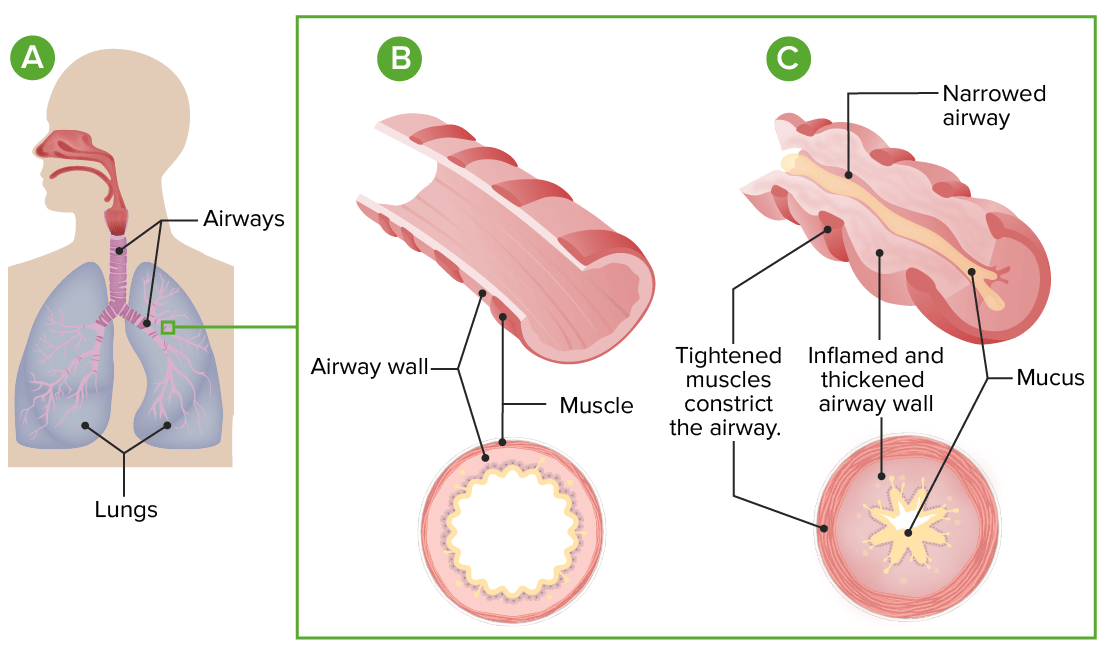
Asthma pathophysiology

Fisiopatología del asma:
A: Anatomía del pulmón y de las vías respiratorias
B: Sección transversal de una vía aérea normal
C: En el asma, la constricción exagerada de las vías respiratorias, la inflamación y el aumento de la producción de moco conducen a la restricción del flujo de aire.

Imagen por Lecturio.

Otro mecanismo

  • No eosinofílico
  • No implica a las células Th2 Th2 A subset of helper-inducer T-lymphocytes which synthesize and secrete the interleukins il-4; il-5; il-6; and il-10. These cytokines influence b-cell development and antibody production as well as augmenting humoral responses. T cells: Types and Functions
  • Factores ambientales (contaminación, tabaquismo, infecciones, alérgenos) → implican respuestas de las células Th1 Th1 A subset of helper-inducer T-lymphocytes which synthesize and secrete interleukin-2; interferon-gamma; and interleukin-12. Due to their ability to kill antigen-presenting cells and their lymphokine-mediated effector activity, th1 cells are associated with vigorous delayed-type hypersensitivity reactions. T cells: Types and Functions y Th17 Th17 A subset of helper-effector T-lymphocytes which synthesize and secrete interleukins il-17; il-17f; and il-22. These cytokines are involved in host defenses and tissue inflammation in autoimmune diseases. T cells: Types and Functions → inflamación neutrofílica e hiperreactividad de las vías respiratorias
  • Inflamación neutrofílica:
    • Recuento elevado de neutrófilos en EN Erythema nodosum is an immune-mediated panniculitis (inflammation of the subcutaneous fat) caused by a type IV (delayed-type) hypersensitivity reaction. It commonly manifests in young women as tender, erythematous nodules on the shins. Erythema Nodosum esputo
    • Asociado a exacerbaciones graves del asma ASMA Autoimmune Hepatitis
    • A menudo son difíciles de tratar y responden menos a los LOS Neisseria corticosteroides

Heterogeneidad del asma ASMA Autoimmune Hepatitis

  • Tipos de asma ASMA Autoimmune Hepatitis en EN Erythema nodosum is an immune-mediated panniculitis (inflammation of the subcutaneous fat) caused by a type IV (delayed-type) hypersensitivity reaction. It commonly manifests in young women as tender, erythematous nodules on the shins. Erythema Nodosum función de los LOS Neisseria desencadenantes y la etiología:
    • Asma ASMA Autoimmune Hepatitis alérgica (atópica) o extrínseca
      • Usualmente prevalente en EN Erythema nodosum is an immune-mediated panniculitis (inflammation of the subcutaneous fat) caused by a type IV (delayed-type) hypersensitivity reaction. It commonly manifests in young women as tender, erythematous nodules on the shins. Erythema Nodosum la infancia
      • Desencadenado por alérgenos ambientales
    • Asma ASMA Autoimmune Hepatitis no alérgica o intrínseca
      • Inicio en EN Erythema nodosum is an immune-mediated panniculitis (inflammation of the subcutaneous fat) caused by a type IV (delayed-type) hypersensitivity reaction. It commonly manifests in young women as tender, erythematous nodules on the shins. Erythema Nodosum la adultez
      • Diversos desencadenantes: infección, ejercicio, aspirina
  • Actualmente, se cree que el asma ASMA Autoimmune Hepatitis tiene más fenotipos, con una clasificación basada en EN Erythema nodosum is an immune-mediated panniculitis (inflammation of the subcutaneous fat) caused by a type IV (delayed-type) hypersensitivity reaction. It commonly manifests in young women as tender, erythematous nodules on the shins. Erythema Nodosum el mecanismo fisiopatológico subyacente:
    • Inflamación mediada por células Th2 Th2 A subset of helper-inducer T-lymphocytes which synthesize and secrete the interleukins il-4; il-5; il-6; and il-10. These cytokines influence b-cell development and antibody production as well as augmenting humoral responses. T cells: Types and Functions: asociada a la eosinofilia y a la respuesta a los LOS Neisseria esteroides
    • No asociada a las células Th2 Th2 A subset of helper-inducer T-lymphocytes which synthesize and secrete the interleukins il-4; il-5; il-6; and il-10. These cytokines influence b-cell development and antibody production as well as augmenting humoral responses. T cells: Types and Functions: sin eosinofilia, con neutrófilos en EN Erythema nodosum is an immune-mediated panniculitis (inflammation of the subcutaneous fat) caused by a type IV (delayed-type) hypersensitivity reaction. It commonly manifests in young women as tender, erythematous nodules on the shins. Erythema Nodosum el esputo (o eosinófilos y neutrófilos normales) y sin respuesta a los LOS Neisseria esteroides
  • Implicación: Hay opciones de tratamiento disponibles y en EN Erythema nodosum is an immune-mediated panniculitis (inflammation of the subcutaneous fat) caused by a type IV (delayed-type) hypersensitivity reaction. It commonly manifests in young women as tender, erythematous nodules on the shins. Erythema Nodosum desarrollo basadas en EN Erythema nodosum is an immune-mediated panniculitis (inflammation of the subcutaneous fat) caused by a type IV (delayed-type) hypersensitivity reaction. It commonly manifests in young women as tender, erythematous nodules on the shins. Erythema Nodosum la fisiopatología.

Presentación Clínica

Síntomas

  • Sibilancias recurrentes
  • Disnea: opresión/sensación de pesadez en EN Erythema nodosum is an immune-mediated panniculitis (inflammation of the subcutaneous fat) caused by a type IV (delayed-type) hypersensitivity reaction. It commonly manifests in young women as tender, erythematous nodules on the shins. Erythema Nodosum el pecho
  • Tos TOS Thoracic outlet syndrome (TOS) is a broad term used for a spectrum of syndromes related to the general region of the thoracic outlet, which involves the compression or irritation of elements of the brachial plexus, subclavian artery, or subclavian vein. Thoracic Outlet Syndrome:
    • Puede ser seca o productiva
    • Empeora por la noche y en EN Erythema nodosum is an immune-mediated panniculitis (inflammation of the subcutaneous fat) caused by a type IV (delayed-type) hypersensitivity reaction. It commonly manifests in young women as tender, erythematous nodules on the shins. Erythema Nodosum las primeras horas de la mañana
  • Episódicos, pueden resolverse espontáneamente o con tratamiento
  • Los LOS Neisseria síntomas aparecen con los LOS Neisseria desencadenantes característicos (i.e., alérgenos, aire frío).

Signos

  • Asintomático cuando está controlado
  • Cuando es sintomático:
    • Taquipnea, taquicardia
    • Sibilancias espiratorias ± inspiratorias y roncus
    • Fase espiratoria de la respiración prolongada

Clasificación del asma ASMA Autoimmune Hepatitis en EN Erythema nodosum is an immune-mediated panniculitis (inflammation of the subcutaneous fat) caused by a type IV (delayed-type) hypersensitivity reaction. It commonly manifests in young women as tender, erythematous nodules on the shins. Erythema Nodosum función de la gravedad

Componente Clasificación
Intermitente Persistente: leve Persistente: moderada Persistente: grave
Síntomas ≤ 2 días/semana > 2 pero < 7 días/semana Diario Varias veces al AL Amyloidosis día
Uso de broncodilatadores de acción corta ≤ 2 días/semana > 2/semana Diario Varias veces/día
Despertares nocturnos ≤ 2 / mes 3-4 / mes ≥ 1 / semana Nocturno
Limitación de actividad Ninguno Menor Algunos Extremo
Función pulmonar FEV1 > 80% FEV1 > 80% FEV1 60 %–80% FEV1 <60%
Exacerbaciones que requieren corticoesteroides sistémicos 0–1/año ≥ 2/año
FEV1: volumen espiratorio forzado en 1 segundo

Diagnóstico

Hallazgos clínicos

  • Se presentan episodios recurrentes de obstrucción del flujo aéreo o hiperreactividad de las vías respiratorias.
  • La obstrucción del flujo de aire es al AL Amyloidosis menos parcialmente reversible.
  • Se excluyen los LOS Neisseria diagnósticos alternativos.

Pruebas de función pulmonar

  • Espirometría:
    • Inhalación máxima seguida de una exhalación rápida y forzada (de al AL Amyloidosis menos 6 segundos)
    • Medidas:
      • FEV1 (volumen espiratorio forzado en EN Erythema nodosum is an immune-mediated panniculitis (inflammation of the subcutaneous fat) caused by a type IV (delayed-type) hypersensitivity reaction. It commonly manifests in young women as tender, erythematous nodules on the shins. Erythema Nodosum 1 segundo)
      • CVF (capacidad vital forzada o el volumen máximo exhalado con un esfuerzo máximo)
    • ↓ FEV1 y relación FEV1/CVF < 0,70 (sugiere obstrucción de las vías respiratorias)
  • Respuesta al AL Amyloidosis broncodilatador:
    • Se administran nebulizaciones o 2–4 inhalaciones de broncodilatador (e.g., albuterol Albuterol A short-acting beta-2 adrenergic agonist that is primarily used as a bronchodilator agent to treat asthma. Sympathomimetic Drugs), y se vuelve a comprobar la espirometría después de 15 minutos
    • Aumento del FEV1 > 12% y 200 ml (respuesta al AL Amyloidosis broncodilatador)
  • Flujo espiratorio máximo (FEM):
    • Inhalación máxima, luego exhalación rápida y forzada (< 2 segundos) en EN Erythema nodosum is an immune-mediated panniculitis (inflammation of the subcutaneous fat) caused by a type IV (delayed-type) hypersensitivity reaction. It commonly manifests in young women as tender, erythematous nodules on the shins. Erythema Nodosum el medidor de flujo espiratorio máximo
    • Se obtiene un único flujo máximo durante los LOS Neisseria síntomas.
    • Los LOS Neisseria resultados son comparados con los LOS Neisseria valores medios normales (basados en EN Erythema nodosum is an immune-mediated panniculitis (inflammation of the subcutaneous fat) caused by a type IV (delayed-type) hypersensitivity reaction. It commonly manifests in young women as tender, erythematous nodules on the shins. Erythema Nodosum la altura y la edad)
    • Después de la administración de broncodilatadores, una mejoría de > 20 % sugiere una obstrucción reversible de las vías respiratorias (favorece el diagnóstico de asma ASMA Autoimmune Hepatitis)
    • Se utiliza más para el control que para el diagnóstico
  • Prueba de broncoprovocación:
    • Se prueba un estímulo (metacolina, ejercicio, histamina, manitol inhalado) para desencadenar la broncoconstricción.
    • ≥ 20% de reducción del VEF1 con una prueba de provocación (hiperreactividad de las vías respiratorias)
  • Oscilometría de impulsos (OSI):
    • Para niños < 5 años o aquellos que no pueden realizar una espirometría
    • Medición pasiva de la mecánica pulmonar
    • Requiere una cooperación mínima del paciente, pero no está al AL Amyloidosis alcance de muchos médicos

Óxido nítrico exhalado

  • Medición de óxido nítrico en EN Erythema nodosum is an immune-mediated panniculitis (inflammation of the subcutaneous fat) caused by a type IV (delayed-type) hypersensitivity reaction. It commonly manifests in young women as tender, erythematous nodules on the shins. Erythema Nodosum el aire exhalado del paciente
  • Bases Bases Usually a hydroxide of lithium, sodium, potassium, rubidium or cesium, but also the carbonates of these metals, ammonia, and the amines. Acid-Base Balance de la prueba: la inflamación eosinofílica de las vías respiratorias regula al AL Amyloidosis alza la óxido nítrico sintasa → ↑ cantidad de fracción de óxido nítrico exhalado (FENO, por sus siglas en EN Erythema nodosum is an immune-mediated panniculitis (inflammation of the subcutaneous fat) caused by a type IV (delayed-type) hypersensitivity reaction. It commonly manifests in young women as tender, erythematous nodules on the shins. Erythema Nodosum inglés)
  • FENO > 50 partes por billón:
    • Indica inflamación eosinofílica de las vías respiratorias
    • Mejora con corticoides inhalados (ICS, por sus siglas en EN Erythema nodosum is an immune-mediated panniculitis (inflammation of the subcutaneous fat) caused by a type IV (delayed-type) hypersensitivity reaction. It commonly manifests in young women as tender, erythematous nodules on the shins. Erythema Nodosum inglés)
  • Limitaciones:

Radiografía de tórax

  • Excluye otros diagnósticos (neumotórax o neumonía en EN Erythema nodosum is an immune-mediated panniculitis (inflammation of the subcutaneous fat) caused by a type IV (delayed-type) hypersensitivity reaction. It commonly manifests in young women as tender, erythematous nodules on the shins. Erythema Nodosum las exacerbaciones)
  • Normal en EN Erythema nodosum is an immune-mediated panniculitis (inflammation of the subcutaneous fat) caused by a type IV (delayed-type) hypersensitivity reaction. It commonly manifests in young women as tender, erythematous nodules on the shins. Erythema Nodosum el asma ASMA Autoimmune Hepatitis leve
  • Puede evidenciar hiperinflación en EN Erythema nodosum is an immune-mediated panniculitis (inflammation of the subcutaneous fat) caused by a type IV (delayed-type) hypersensitivity reaction. It commonly manifests in young women as tender, erythematous nodules on the shins. Erythema Nodosum el asma ASMA Autoimmune Hepatitis grave (diafragma aplanado, espacios intercostales amplios)
  • Indicado para la presentación atípica del asma ASMA Autoimmune Hepatitis (fiebre, crepitaciones, hipoxemia)

Exámenes adicionales

  • Ningún análisis de sangre puede confirmar el diagnóstico de asma ASMA Autoimmune Hepatitis.
  • Hemograma: puede reportar eosinofilia (que sugiere asma ASMA Autoimmune Hepatitis atópica)
  • Nivel de IgE IgE An immunoglobulin associated with mast cells. Overexpression has been associated with allergic hypersensitivity. Immunoglobulins: Types and Functions:
    • Asma ASMA Autoimmune Hepatitis de moderada–grave
    • Cuando se considera el tratamiento con anticuerpos monoclonales anti-IgE
  • Pruebas de alergia: pueden determinar los LOS Neisseria desencadenantes alérgicos y ayudar a determinar las medidas necesarias para la prevención de alérgenos
  • Nivel de alfa-1 antitripsina: detecta la deficiencia de alfa-1 antitripsina (para pacientes con obstrucción persistente de las vías respiratorias)
  • Biomarcadores:
    • Eosinófilos en EN Erythema nodosum is an immune-mediated panniculitis (inflammation of the subcutaneous fat) caused by a type IV (delayed-type) hypersensitivity reaction. It commonly manifests in young women as tender, erythematous nodules on the shins. Erythema Nodosum esputo: puede utilizarse como biomarcador para el asma ASMA Autoimmune Hepatitis con predominio de respuesta Th2 Th2 A subset of helper-inducer T-lymphocytes which synthesize and secrete the interleukins il-4; il-5; il-6; and il-10. These cytokines influence b-cell development and antibody production as well as augmenting humoral responses. T cells: Types and Functions
    • Periostina: biomarcador de la inflamación eosinofílica a pesar del uso de corticosteroides
  • Prueba de cloruro en EN Erythema nodosum is an immune-mediated panniculitis (inflammation of the subcutaneous fat) caused by a type IV (delayed-type) hypersensitivity reaction. It commonly manifests in young women as tender, erythematous nodules on the shins. Erythema Nodosum el sudor:
    • En EN Erythema nodosum is an immune-mediated panniculitis (inflammation of the subcutaneous fat) caused by a type IV (delayed-type) hypersensitivity reaction. It commonly manifests in young women as tender, erythematous nodules on the shins. Erythema Nodosum niños con síntomas respiratorios persistentes, para descartar fibrosis Fibrosis Any pathological condition where fibrous connective tissue invades any organ, usually as a consequence of inflammation or other injury. Bronchiolitis Obliterans quística
    • Bajo umbral en EN Erythema nodosum is an immune-mediated panniculitis (inflammation of the subcutaneous fat) caused by a type IV (delayed-type) hypersensitivity reaction. It commonly manifests in young women as tender, erythematous nodules on the shins. Erythema Nodosum la realización de la prueba debido a las implicaciones de la enfermedad a largo plazo
  • Gasometría arterial ( en EN Erythema nodosum is an immune-mediated panniculitis (inflammation of the subcutaneous fat) caused by a type IV (delayed-type) hypersensitivity reaction. It commonly manifests in young women as tender, erythematous nodules on the shins. Erythema Nodosum la exacerbación del asma ASMA Autoimmune Hepatitis grave):
    • Realizar cuando la saturación de oxígeno es < 94%, no hay respuesta broncodilatadora, hay cambios en EN Erythema nodosum is an immune-mediated panniculitis (inflammation of the subcutaneous fat) caused by a type IV (delayed-type) hypersensitivity reaction. It commonly manifests in young women as tender, erythematous nodules on the shins. Erythema Nodosum el estado mental
    • Hallazgo(s) inicial(es): hipoxia (oxígeno reducido), hipocapnia (debido a la hiperventilación), ↑ pH pH The quantitative measurement of the acidity or basicity of a solution. Acid-Base Balance
    • Insuficiencia respiratoria: hipoxia, hipercapnia, pH pH The quantitative measurement of the acidity or basicity of a solution. Acid-Base Balance ↓ ( acidosis Acidosis A pathologic condition of acid accumulation or depletion of base in the body. The two main types are respiratory acidosis and metabolic acidosis, due to metabolic acid build up. Respiratory Acidosis respiratoria)
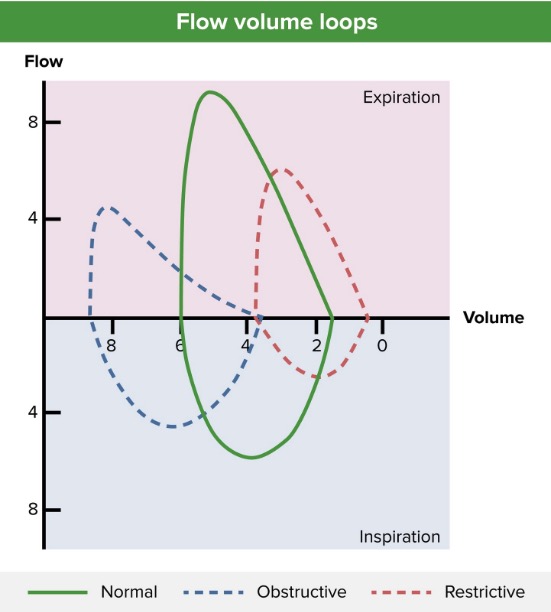
Volumen de flujo del asma

La curva de flujo-volumen (línea azul) que muestra un patrón obstructivo de espiración, un flujo espiratorio máximo reducido (aproximadamente 4 L/seg) y una hiperinflación pulmonar (aproximadamente 4 L en el volumen residual y > 8 L tras la inspiración completa). Se muestra un patrón normal (línea verde) y un patrón restrictivo (línea roja) para comparar.

Imagen por Lecturio.
Tratamiento

Tratamiento sin medicamentos

  • Educación del paciente:
    • Síntomas de asma ASMA Autoimmune Hepatitis
    • Indicaciones y técnica adecuada del uso de inhaladores con broncodilatadores y corticosteroides
    • Discutir el plan de acción contra el asma ASMA Autoimmune Hepatitis (seguimiento del FEM y la acción correspondiente)
  • Objetivos:
    • Control de los LOS Neisseria síntomas y desencadenantes
    • Reducir los LOS Neisseria riesgos y las complicaciones futuras
  • Cesación de tabaquismo
  • Reforzar las vacunas contra la influenza Influenza Influenza viruses are members of the Orthomyxoviridae family and the causative organisms of influenza, a highly contagious febrile respiratory disease. There are 3 primary influenza viruses (A, B, and C) and various subtypes, which are classified based on their virulent surface antigens, hemagglutinin (HA) and neuraminidase (NA). Influenza typically presents with a fever, myalgia, headache, and symptoms of an upper respiratory infection. Influenza Viruses/Influenza y el neumococo.

Tratamiento con medicamentos e invasivo

  • Para el tratamiento de rescate de la exacerbación aguda:
    • Agonistas beta2 de acción corta (SABA, por sus siglas en EN Erythema nodosum is an immune-mediated panniculitis (inflammation of the subcutaneous fat) caused by a type IV (delayed-type) hypersensitivity reaction. It commonly manifests in young women as tender, erythematous nodules on the shins. Erythema Nodosum inglés): para el asma ASMA Autoimmune Hepatitis inducida por el ejercicio o la exacerbación del asma ASMA Autoimmune Hepatitis
    • Agonistas beta2 de acción prolongada (LABA, por sus siglas en EN Erythema nodosum is an immune-mediated panniculitis (inflammation of the subcutaneous fat) caused by a type IV (delayed-type) hypersensitivity reaction. It commonly manifests in young women as tender, erythematous nodules on the shins. Erythema Nodosum inglés): corticosteroides inhalados de baja dosis; el formoterol Formoterol Asthma Drugs puede utilizarse como alivio de los LOS Neisseria síntomas agudos (directrices de la Global Initiative for Asthma Asthma Asthma is a chronic inflammatory respiratory condition characterized by bronchial hyperresponsiveness and airflow obstruction. The disease is believed to result from the complex interaction of host and environmental factors that increase disease predisposition, with inflammation causing symptoms and structural changes. Patients typically present with wheezing, cough, and dyspnea. Asthma)
  • Controladores:
    • Corticosteroides inhalados (ICS): los LOS Neisseria medicamentos antiinflamatorios más eficaces para el asma ASMA Autoimmune Hepatitis
    • Corticosteroides sistémicos:
      • Se recomienda el tratamiento a corto plazo (< 7 días)
      • Es necesario reducir la dosis si es mayor a 2 semanas
    • Antagonistas de los LOS Neisseria receptores de leucotrienos (LTRA, por sus siglas en EN Erythema nodosum is an immune-mediated panniculitis (inflammation of the subcutaneous fat) caused by a type IV (delayed-type) hypersensitivity reaction. It commonly manifests in young women as tender, erythematous nodules on the shins. Erythema Nodosum inglés) e inhibidor de la 5-lipoxigenasa:
  • Anticuerpos monoclonales para el asma ASMA Autoimmune Hepatitis grave:
    • Anti-IgE o anticuerpo IgE IgE An immunoglobulin associated with mast cells. Overexpression has been associated with allergic hypersensitivity. Immunoglobulins: Types and Functions: omalizumab Omalizumab An anti-ige, recombinant, humanized monoclonal antibody which specifically binds to the c epsilon3 domain of immunoglobulin e, the site of high-affinity ige receptor binding. It inhibits the binding of ige to mast cells and basophils to reduce the severity of the allergic response and is used in the management of persistent allergic asthma. Asthma Drugs
    • Antagonista de IL-5: mepolizumab Mepolizumab Asthma Drugs, reslizumab
    • Antagonista del receptor Receptor Receptors are proteins located either on the surface of or within a cell that can bind to signaling molecules known as ligands (e.g., hormones) and cause some type of response within the cell. Receptors de IL-5: benralizumab Benralizumab Asthma Drugs
    • Antagonista del receptor Receptor Receptors are proteins located either on the surface of or within a cell that can bind to signaling molecules known as ligands (e.g., hormones) and cause some type of response within the cell. Receptors de IL-4: dupilumab Dupilumab Asthma Drugs
  • Termoplastia bronquial:
    • Ablación de la musculatura lisa bronquial mediante la aplicación de calor Calor Inflammation durante la broncoscopia
    • Conlleva riesgos relacionados con el procedimiento; solo produce una modesta mejora del asma ASMA Autoimmune Hepatitis
    • Criterios estrictos de selección (incluidos los LOS Neisseria pacientes que no responden al AL Amyloidosis tratamiento máximo con medicamentos)
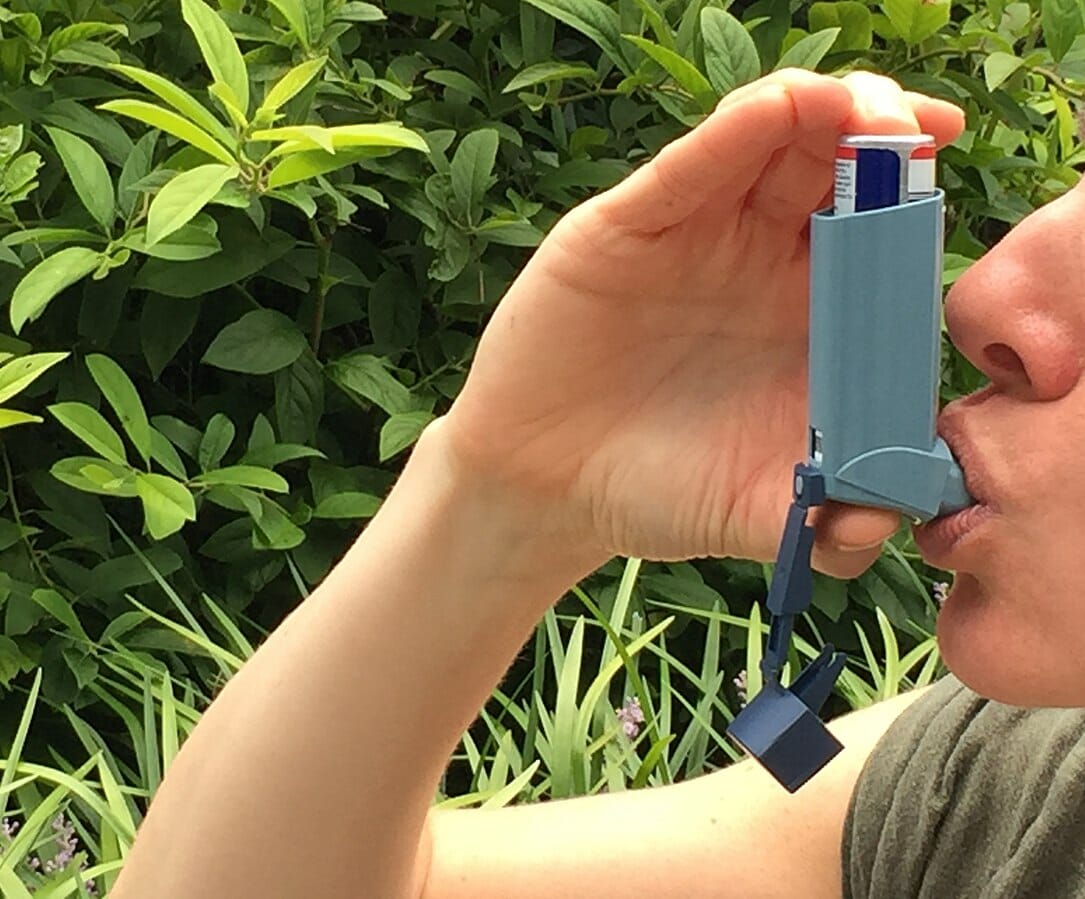
Adult using Asthma Inhaler

Una individuo que utiliza un inhalador para el asma (un método de administración de medicamentos inhalados).

Imagen: “Adult Using an Asthma Inhaler (29251369035)” por National Institute of Allergy and Infectious Diseases (NIAID). Licencia: CC BY 2.0

Tratamiento de emergencia

El tratamiento de emergencia es para la exacerbación severa del asma ASMA Autoimmune Hepatitis, no para el tratamiento inicial del paciente ambulatorio.
  • Objetivo de la oxigenoterapia: 93%-95% de saturación de oxígeno (adultos)
  • Terapia inhalada:
    • Dosis altas de SABA a través de un nebulizador o un espaciador
    • Ipratropio nebulizado si no hay respuesta a los LOS Neisseria agonistas beta2
    • Dosis altas de ICS administrados en EN Erythema nodosum is an immune-mediated panniculitis (inflammation of the subcutaneous fat) caused by a type IV (delayed-type) hypersensitivity reaction. It commonly manifests in young women as tender, erythematous nodules on the shins. Erythema Nodosum la 1ra hora
  • Medicamento(s) intravenoso(s):
    • Corticosteroides IV:
      • Si el asma ASMA Autoimmune Hepatitis no mejora sistemáticamente tras el tratamiento con SABA
      • Si se produce una exacerbación a pesar del tratamiento diario con esteroides orales
      • Si la exacerbación es recurrente después de la interrupción reciente de los LOS Neisseria esteroides sistémicos
    • Considere el sulfato de magnesio IV (1 dosis):
      • Se ha HA Hemolytic anemia (HA) is the term given to a large group of anemias that are caused by the premature destruction/hemolysis of circulating red blood cells (RBCs). Hemolysis can occur within (intravascular hemolysis) or outside the blood vessels (extravascular hemolysis). Hemolytic Anemia comprobado que reduce los LOS Neisseria ingresos hospitalarios en EN Erythema nodosum is an immune-mediated panniculitis (inflammation of the subcutaneous fat) caused by a type IV (delayed-type) hypersensitivity reaction. It commonly manifests in young women as tender, erythematous nodules on the shins. Erythema Nodosum algunos pacientes
      • No es para usar de forma rutinaria en EN Erythema nodosum is an immune-mediated panniculitis (inflammation of the subcutaneous fat) caused by a type IV (delayed-type) hypersensitivity reaction. It commonly manifests in young women as tender, erythematous nodules on the shins. Erythema Nodosum exacerbaciones de asma ASMA Autoimmune Hepatitis
      • Contraindicado en EN Erythema nodosum is an immune-mediated panniculitis (inflammation of the subcutaneous fat) caused by a type IV (delayed-type) hypersensitivity reaction. It commonly manifests in young women as tender, erythematous nodules on the shins. Erythema Nodosum casos de insuficiencia renal
  • Intubación endotraqueal y ventilación mecánica en EN Erythema nodosum is an immune-mediated panniculitis (inflammation of the subcutaneous fat) caused by a type IV (delayed-type) hypersensitivity reaction. It commonly manifests in young women as tender, erythematous nodules on the shins. Erythema Nodosum caso de insuficiencia respiratoria inminente:
    • Cambios en EN Erythema nodosum is an immune-mediated panniculitis (inflammation of the subcutaneous fat) caused by a type IV (delayed-type) hypersensitivity reaction. It commonly manifests in young women as tender, erythematous nodules on the shins. Erythema Nodosum el estado mental (confusión, agitación o somnolencia)
    • Tórax silente en EN Erythema nodosum is an immune-mediated panniculitis (inflammation of the subcutaneous fat) caused by a type IV (delayed-type) hypersensitivity reaction. It commonly manifests in young women as tender, erythematous nodules on the shins. Erythema Nodosum la auscultación
    • Fatiga respiratoria (frecuencia respiratoria > 30/min, frecuencia cardíaca > 120/min, uso de músculos accesorios)
    • Acidosis Acidosis A pathologic condition of acid accumulation or depletion of base in the body. The two main types are respiratory acidosis and metabolic acidosis, due to metabolic acid build up. Respiratory Acidosis respiratoria con aumento de la hipercapnia
    • Baja saturación de oxígeno (< 92%) a pesar de un alto flujo de oxígeno
  • Mejora del flujo espiratorio máximo > 80% y resolución de los LOS Neisseria síntomas: alta
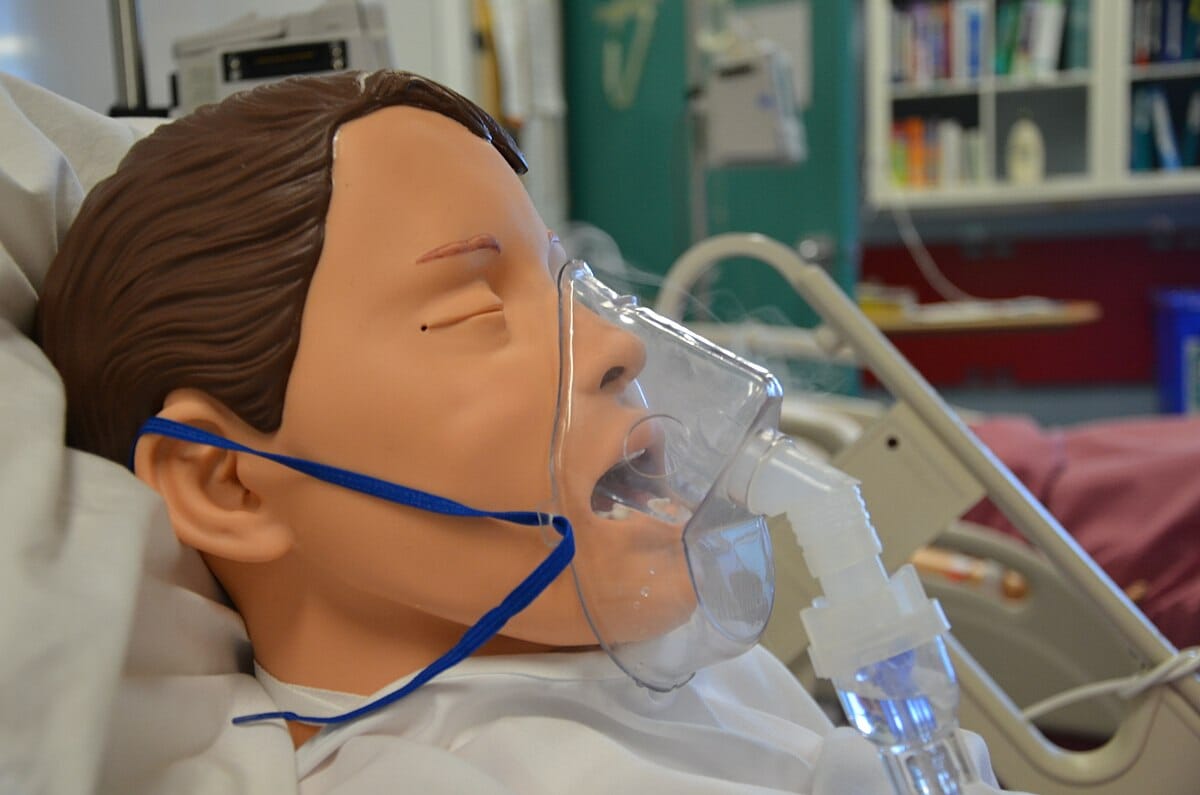
Administering inhaled medication

La administración de medicamentos inhalados a través de un nebulizador puede ser necesaria para el alivio emergente de los síntomas.

Imagen: “Administering inhaled medication” por British Columbia Institute of Technology (BCIT). Licencia: CC BY 4.0

Related videos

Directrices de Tratamiento

National Asthma Asthma Asthma is a chronic inflammatory respiratory condition characterized by bronchial hyperresponsiveness and airflow obstruction. The disease is believed to result from the complex interaction of host and environmental factors that increase disease predisposition, with inflammation causing symptoms and structural changes. Patients typically present with wheezing, cough, and dyspnea. Asthma Education and Prevention Program (NAEPP, por sus siglas en EN Erythema nodosum is an immune-mediated panniculitis (inflammation of the subcutaneous fat) caused by a type IV (delayed-type) hypersensitivity reaction. It commonly manifests in young women as tender, erythematous nodules on the shins. Erythema Nodosum inglés)

  • Actualización en EN Erythema nodosum is an immune-mediated panniculitis (inflammation of the subcutaneous fat) caused by a type IV (delayed-type) hypersensitivity reaction. It commonly manifests in young women as tender, erythematous nodules on the shins. Erythema Nodosum el 2020
  • Basado en EN Erythema nodosum is an immune-mediated panniculitis (inflammation of the subcutaneous fat) caused by a type IV (delayed-type) hypersensitivity reaction. It commonly manifests in young women as tender, erythematous nodules on the shins. Erythema Nodosum la severidad de la enfermedad:
    • Síntomas, limitación de la actividad, uso de SABA, función pulmonar
    • Incluye valores espirométricos para determinar la gravedad ( asma ASMA Autoimmune Hepatitis intermitente a persistente)
    • Enfoque escalonado (pasos 1-6) en EN Erythema nodosum is an immune-mediated panniculitis (inflammation of the subcutaneous fat) caused by a type IV (delayed-type) hypersensitivity reaction. It commonly manifests in young women as tender, erythematous nodules on the shins. Erythema Nodosum la iniciación y continuación de la medicación en EN Erythema nodosum is an immune-mediated panniculitis (inflammation of the subcutaneous fat) caused by a type IV (delayed-type) hypersensitivity reaction. It commonly manifests in young women as tender, erythematous nodules on the shins. Erythema Nodosum función de la gravedad
  • Resumen de los LOS Neisseria pasos:
    • Paso 1 (intermitente) comienza con SABA según necesidad.
    • Pasos 2-4:
      • El tratamiento de mantenimiento pasa de la monoterapia con corticoesteroides inhalados a corticoesteroides inhalados/ formoterol Formoterol Asthma Drugs.
      • En EN Erythema nodosum is an immune-mediated panniculitis (inflammation of the subcutaneous fat) caused by a type IV (delayed-type) hypersensitivity reaction. It commonly manifests in young women as tender, erythematous nodules on the shins. Erythema Nodosum caso necesario, se pasa de SABA a corticoesteroides inhalados/ formoterol Formoterol Asthma Drugs.
    • Los LOS Neisseria pasos 5-6 (persistente grave) incluyen medidas adicionales:
      • Aumentar la dosis de corticoesteroides inhalados/LABA.
      • Añadir un antagonista muscarínico de acción prolongada (LAMA, por sus siglas en EN Erythema nodosum is an immune-mediated panniculitis (inflammation of the subcutaneous fat) caused by a type IV (delayed-type) hypersensitivity reaction. It commonly manifests in young women as tender, erythematous nodules on the shins. Erythema Nodosum inglés)
      • Añadir corticosteroides sistémicos
  • SABA: tratamiento de 1era línea para la exacerbación aguda

Global Initiative for Asthma Asthma Asthma is a chronic inflammatory respiratory condition characterized by bronchial hyperresponsiveness and airflow obstruction. The disease is believed to result from the complex interaction of host and environmental factors that increase disease predisposition, with inflammation causing symptoms and structural changes. Patients typically present with wheezing, cough, and dyspnea. Asthma (GINA, por sus siglas en EN Erythema nodosum is an immune-mediated panniculitis (inflammation of the subcutaneous fat) caused by a type IV (delayed-type) hypersensitivity reaction. It commonly manifests in young women as tender, erythematous nodules on the shins. Erythema Nodosum inglés)

  • Actualizado en EN Erythema nodosum is an immune-mediated panniculitis (inflammation of the subcutaneous fat) caused by a type IV (delayed-type) hypersensitivity reaction. It commonly manifests in young women as tender, erythematous nodules on the shins. Erythema Nodosum 2024 (según el Informe de Estrategia GINA de 2024)
  • Basada en EN Erythema nodosum is an immune-mediated panniculitis (inflammation of the subcutaneous fat) caused by a type IV (delayed-type) hypersensitivity reaction. It commonly manifests in young women as tender, erythematous nodules on the shins. Erythema Nodosum la severidad: nivel de tratamiento (pasos 1-5) necesario para controlar los LOS Neisseria síntomas y las exacerbaciones
  • Todos los LOS Neisseria pacientes reciben corticoesteroides inhalados a diario o según sus necesidades
  • Los LOS Neisseria adultos y adolescentes no deben recibir tratamiento solo con SABA; todas las estrategias de rescate deben incluir un corticoesteroide inhalado (ya sea corticoesteroide-formoterol, corticoesteroide-SABA o SABA administrado junto con un corticoesteroide).
  • Corticoesteroides inhalados-formoterol:
    • Terapia de 1ra línea (rescate y mantenimiento) para adultos y adolescentes > 12 años de edad
    • Se prefiere sobre los LOS Neisseria SABA para el alivio según necesidad (excepto para edad < 5 años)
  • Resumen de los LOS Neisseria pasos:
    • Paso 1-2 (intermitente/persistente leve): terapia según necesidad
      • Preferida: corticoesteroides inhalados-formoterol a dosis bajas según sea necesario
      • Alternativa: SABA usado corticoesteroides inhalados, ya sea como inhaladores separados o como un inhalador combinado de corticoesteroide-SABA (corticoesteroide de mantenimiento a dosis bajas añadido para el paso 2)
    • Pasos 3-4: Se utiliza terapia de mantenimiento y de rescate.
      • Preferida: terapia de mantenimiento y alivio con corticoesteroides inhalados-formoterol
      • Alternativa: Corticoesteroides inhalados/LABA de mantenimiento + SABA o Corticoesteroides inhalados/SABA de rescate
    • Paso 5 (grave persistente): Se consideran opciones adicionales.
      • Dosis altas de corticoesteroides inhalados/LABA ± LAMA ± biológico
      • Añadir un LAMA
      • Añadir terapia biológica (e.g., omalizumab Omalizumab An anti-ige, recombinant, humanized monoclonal antibody which specifically binds to the c epsilon3 domain of immunoglobulin e, the site of high-affinity ige receptor binding. It inhibits the binding of ige to mast cells and basophils to reduce the severity of the allergic response and is used in the management of persistent allergic asthma. Asthma Drugs)

Diagnóstico Diferencial

  • Obstrucción de las vías respiratorias superiores por tumor Tumor Inflammation o edema Edema Edema is a condition in which excess serous fluid accumulates in the body cavity or interstitial space of connective tissues. Edema is a symptom observed in several medical conditions. It can be categorized into 2 types, namely, peripheral (in the extremities) and internal (in an organ or body cavity). Edema laríngeo: provoca estridor en EN Erythema nodosum is an immune-mediated panniculitis (inflammation of the subcutaneous fat) caused by a type IV (delayed-type) hypersensitivity reaction. It commonly manifests in young women as tender, erythematous nodules on the shins. Erythema Nodosum lugar de sibilancias. La curva de flujo-volumen muestra una limitación del flujo en EN Erythema nodosum is an immune-mediated panniculitis (inflammation of the subcutaneous fat) caused by a type IV (delayed-type) hypersensitivity reaction. It commonly manifests in young women as tender, erythematous nodules on the shins. Erythema Nodosum las curvas inspiratoria y espiratoria. La broncoscopia confirma el diagnóstico.
  • Aspiración de cuerpo extraño: genera sibilancias localizadas o generalizadas. La radiografía de tórax puede ser normal o con hiperinflación o infiltrado unilateral. La broncoscopia es diagnóstica y terapéutica (extracción del cuerpo extraño).
  • Insuficiencia ventricular izquierda: las sibilancias se acompañan de crepitaciones. Los LOS Neisseria antecedentes, la exploración física con radiografía de tórax, el ecocardiograma y el ECG ECG An electrocardiogram (ECG) is a graphic representation of the electrical activity of the heart plotted against time. Adhesive electrodes are affixed to the skin surface allowing measurement of cardiac impulses from many angles. The ECG provides 3-dimensional information about the conduction system of the heart, the myocardium, and other cardiac structures. Electrocardiogram (ECG) ayudan a distinguir la insuficiencia cardíaca congestiva.
  • Disfunción de las cuerdas vocales: se presenta con sibilancias, tos TOS Thoracic outlet syndrome (TOS) is a broad term used for a spectrum of syndromes related to the general region of the thoracic outlet, which involves the compression or irritation of elements of the brachial plexus, subclavian artery, or subclavian vein. Thoracic Outlet Syndrome y disnea. La espirometría mostraría una curva de flujo inspiratorio aplanado que sugiere una obstrucción extratorácica variable Variable Variables represent information about something that can change. The design of the measurement scales, or of the methods for obtaining information, will determine the data gathered and the characteristics of that data. As a result, a variable can be qualitative or quantitative, and may be further classified into subgroups. Types of Variables. Se recomienda la laringoscopia (estándar de oro) para el diagnóstico.
  • Granulomatosis eosinofílica con poliangeítis: puede presentarse con tos TOS Thoracic outlet syndrome (TOS) is a broad term used for a spectrum of syndromes related to the general region of the thoracic outlet, which involves the compression or irritation of elements of the brachial plexus, subclavian artery, or subclavian vein. Thoracic Outlet Syndrome y sibilancias. La enfermedad es refractaria al AL Amyloidosis tratamiento habitual del asma ASMA Autoimmune Hepatitis y presenta manifestaciones periféricas de vasculitis Vasculitis Inflammation of any one of the blood vessels, including the arteries; veins; and rest of the vasculature system in the body. Systemic Lupus Erythematosus.
  • Enfermedad pulmonar obstructiva crónica (EPOC): se manifiesta con disnea, tos TOS Thoracic outlet syndrome (TOS) is a broad term used for a spectrum of syndromes related to the general region of the thoracic outlet, which involves the compression or irritation of elements of the brachial plexus, subclavian artery, or subclavian vein. Thoracic Outlet Syndrome y sibilancias. La enfermedad tiene una fuerte asociación con el antecedente de tabaquismo. La prueba de función pulmonar mostrará un patrón obstructivo sin reversibilidad significativa. El enfisema, una forma de EPOC, también presenta una reducción de la capacidad de difusión pulmonar para el monóxido de carbono ( DLCO DLCO Pulmonary Function Tests, por sus siglas en EN Erythema nodosum is an immune-mediated panniculitis (inflammation of the subcutaneous fat) caused by a type IV (delayed-type) hypersensitivity reaction. It commonly manifests in young women as tender, erythematous nodules on the shins. Erythema Nodosum inglés).

Referencias

  1. Barnes P.J. (2018). Asthma. Jameson J, & Fauci A.S., & Kasper D.L., & Hauser S.L., & Longo D.L., & Loscalzo J. (Eds.), Harrison’s Principles of Internal Medicine, 20e. McGraw-Hill.
  2. Bell, M., Busse, W. (2015). The biology of asthma. Grippi, M., Elias, J., Fishman, J., Kotloff, R., Pack, A., Senior, R., Siegel, M. Fishman’s Pulmonary Diseases and disorders (5th Ed). McGraw-Hill.
  3. Carr, T., Zeki, A., Kraft, M. (2018). Eosinophilic and Noneosinophilic Asthma. Am J Respir Crit Care Med 197 (1): 22–37. https://www.atsjournals.org/doi/pdf/10.1164/rccm.201611-2232PP
  4. Esteban-Gorgojo, I., Antolin-Amerigo, D., Dominguez-Ortega, J., Quirce, S. (2018). Non-eosinophilic asthma: current perspectives. J Asthma Allergy. 11: 267–281. doi: 10.2147/JAA.S153097
  5. Fanta, C., Wood, R., Bochner, B., Hollingsworth, H., TePas, E. (Eds.). (2020). An overview of asthma management. UpToDate. Retrieved 28 Oct 2020, from https://www.uptodate.com/contents/an-overview-of-asthma-management
  6. Fanta, C., Barnes, P., Bochner, B., Hollingsworth H. (2020). Asthma in adolescents and adults: Evaluation and diagnosis. UpToDate. Retrieved 7 Sept 2020, from https://www.uptodate.com/contents/asthma-in-adolescents-and-adults-evaluation-and-diagnosis
  7. Kuruvilla, M., Eun-Hyung Lee, F., Lee, G. (2019). Understanding asthma phenotypes, endotypes and mechanisms of disease. https://www.ncbi.nlm.nih.gov/pmc/articles/PMC6411459/
  8. National Asthma Education and Prevention Program: Expert Panel Report III: Guidelines for the diagnosis and management of asthma. Bethesda, MD. National Heart, Lung, and Blood Institute, 2007. (NIH publication no. 08-4051). www.nhlbi.nih.gov/guidelines/asthma/asthgdln.htm
  9. Global Initiative for Asthma. Global Strategy for Asthma Management and Prevention. (2020). Retrieved 28 Oct 2020, from www.ginasthma.org
  10. Morris, M., Pearson, D., Mosenifar, Z. (Ed.). (2019) Asthma. Medscape. Retrieved 6 Sept 2020, from https://emedicine.medscape.com/article/296301-overview
  11. Sinyor, B., Perez, L. (2020) Pathophysiology of Asthma. StatPearls. https://www.ncbi.nlm.nih.gov/books/NBK551579
  12. Sze, E., Bhalla, A., Nair, P. (2019). Mechanisms and therapeutic strategies for Non-T2 asthma. European Journal of Allergy and Clinical Immunology. https://doi.org/10.1111/all.13985

¡Crea tu cuenta gratis o inicia una sesión para seguir leyendo!

Regístrate ahora y obtén acceso gratuito a Lecturio con páginas de concepto, videos médicos y cuestionarios para tu educación médica.

User Reviews

Que tengas una sesión de estudio alegre y navideña 🎁 Ahorra 50% en todos los planes >>

Details