Domina Conceptos Médicos

Estudia para la escuela de medicina y tus examenes con Lecturio.

Aneurismas de la Aorta Torácica

El aneurisma de la aorta Aorta The main trunk of the systemic arteries. Mediastinum and Great Vessels: Anatomy torácica es la dilatación anormal de un segmento de la aorta Aorta The main trunk of the systemic arteries. Mediastinum and Great Vessels: Anatomy torácica, generalmente la aorta Aorta The main trunk of the systemic arteries. Mediastinum and Great Vessels: Anatomy ascendente. La mayoría de los LOS Neisseria aneurismas de la aorta Aorta The main trunk of the systemic arteries. Mediastinum and Great Vessels: Anatomy torácica se deben a trastornos aórticos degenerativos, comúnmente en EN Erythema nodosum is an immune-mediated panniculitis (inflammation of the subcutaneous fat) caused by a type IV (delayed-type) hypersensitivity reaction. It commonly manifests in young women as tender, erythematous nodules on the shins. Erythema Nodosum pacientes> 65 años de edad. Los LOS Neisseria aneurismas de la aorta Aorta The main trunk of the systemic arteries. Mediastinum and Great Vessels: Anatomy torácica genéticos representan el 20% de los LOS Neisseria casos y se encuentran con frecuencia en EN Erythema nodosum is an immune-mediated panniculitis (inflammation of the subcutaneous fat) caused by a type IV (delayed-type) hypersensitivity reaction. It commonly manifests in young women as tender, erythematous nodules on the shins. Erythema Nodosum pacientes más jóvenes. La mayoría de los LOS Neisseria aneurismas de la aorta Aorta The main trunk of the systemic arteries. Mediastinum and Great Vessels: Anatomy torácica son asintomáticos (se encuentran de forma incidental en EN Erythema nodosum is an immune-mediated panniculitis (inflammation of the subcutaneous fat) caused by a type IV (delayed-type) hypersensitivity reaction. It commonly manifests in young women as tender, erythematous nodules on the shins. Erythema Nodosum la imagenología), pero pueden presentar síntomas debido a sus efectos en EN Erythema nodosum is an immune-mediated panniculitis (inflammation of the subcutaneous fat) caused by a type IV (delayed-type) hypersensitivity reaction. It commonly manifests in young women as tender, erythematous nodules on the shins. Erythema Nodosum las estructuras circundantes. La ruptura aórtica es una emergencia potencialmente mortal. Entre los LOS Neisseria estudios de diagnóstico por imágenes, la angiografía por tomografía computarizada (TC) es la más utilizada. En EN Erythema nodosum is an immune-mediated panniculitis (inflammation of the subcutaneous fat) caused by a type IV (delayed-type) hypersensitivity reaction. It commonly manifests in young women as tender, erythematous nodules on the shins. Erythema Nodosum casos asintomáticos, se monitoriza la expansión aórtica. Se recomienda la reparación quirúrgica para aneurismas de la aorta Aorta The main trunk of the systemic arteries. Mediastinum and Great Vessels: Anatomy torácica sintomáticos y aumento del diámetro aórtico ( los LOS Neisseria criterios varían según la ubicación y la afección subyacente).

Last updated: Dec 15, 2025

Editorial responsibility: Stanley Oiseth, Lindsay Jones, Evelin Maza

Descripción General

Definiciones

Aneurisma de la aorta Aorta The main trunk of the systemic arteries. Mediastinum and Great Vessels: Anatomy torácica

Tipos
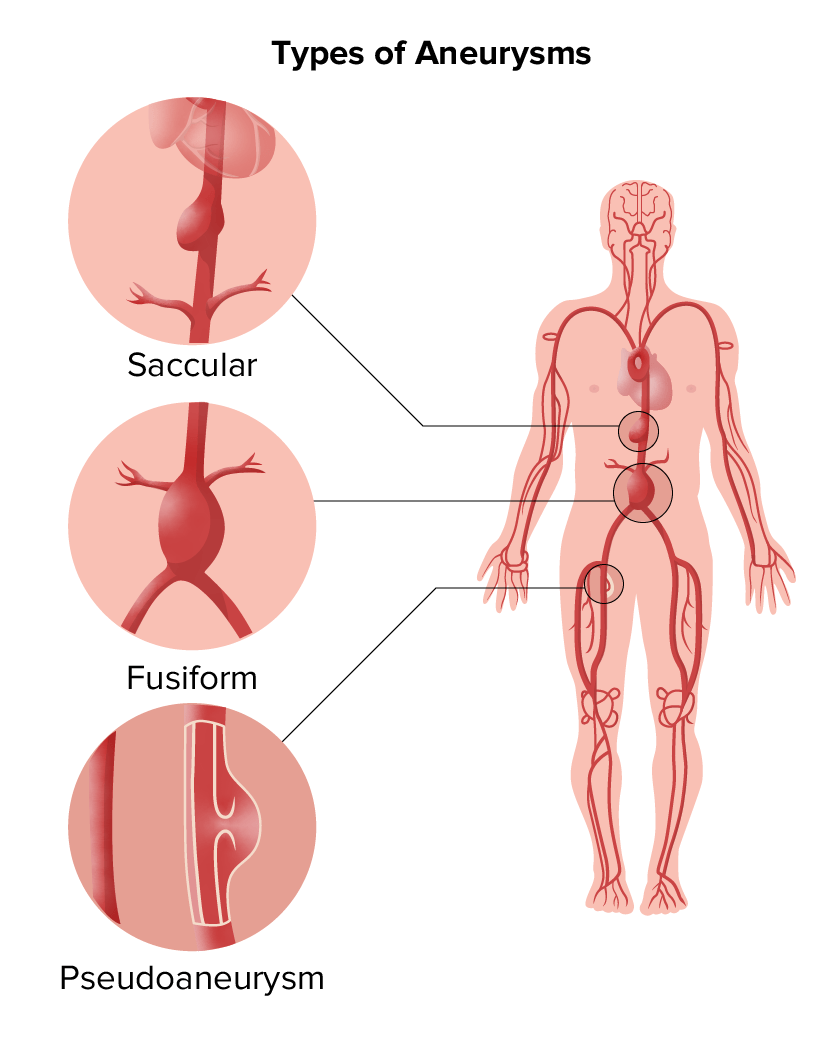
  • Aneurisma verdadero: dilatación de la aorta Aorta The main trunk of the systemic arteries. Mediastinum and Great Vessels: Anatomy > 50% del diámetro normal, involucrando las 3 capas (íntima, media, adventicia)
    • Forma fusiforme: protuberancias en EN Erythema nodosum is an immune-mediated panniculitis (inflammation of the subcutaneous fat) caused by a type IV (delayed-type) hypersensitivity reaction. It commonly manifests in young women as tender, erythematous nodules on the shins. Erythema Nodosum todos los LOS Neisseria lados de la aorta Aorta The main trunk of the systemic arteries. Mediastinum and Great Vessels: Anatomy (más común)
    • Forma sacular: protuberancias en EN Erythema nodosum is an immune-mediated panniculitis (inflammation of the subcutaneous fat) caused by a type IV (delayed-type) hypersensitivity reaction. It commonly manifests in young women as tender, erythematous nodules on the shins. Erythema Nodosum un lado
  • Pseudoaneurisma:
    • Dilatación causada por una alteración de la pared aórtica
    • Sangre extravasada contenida por el tejido conjuntivo periarterial, no por todas las capas de la pared
    • Hematoma Hematoma A collection of blood outside the blood vessels. Hematoma can be localized in an organ, space, or tissue. Intussusception extravascular comunicado con el espacio intravascular.
Thoracic aortic aneuryms

Tipos de aneurismas:
Los aneurismas saculares y fusiformes pertenecen a la categoría de aneurismas verdaderos; el pseudoaneurisma es otro tipo.

Imagen por Lecturio.

Localización

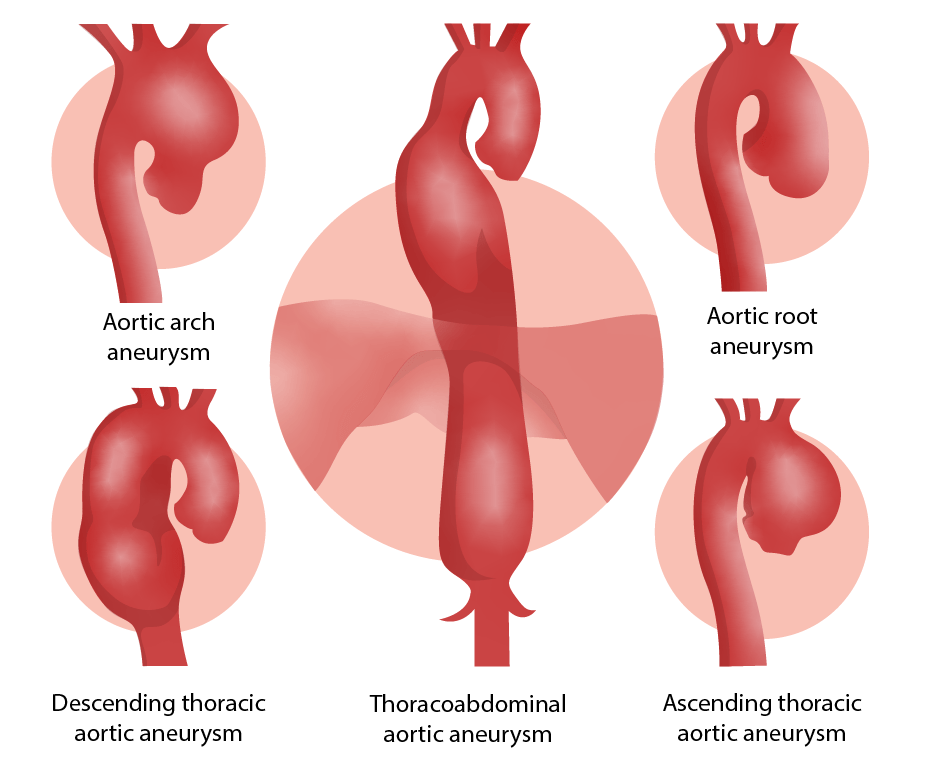
Thoracic aortic aneuryms

Localizaciones de aneurismas aórticos

Imagen por Lecturio.

Epidemiología

  • Aneurismas de la aorta Aorta The main trunk of the systemic arteries. Mediastinum and Great Vessels: Anatomy torácica: 15ta causa de muerte en EN Erythema nodosum is an immune-mediated panniculitis (inflammation of the subcutaneous fat) caused by a type IV (delayed-type) hypersensitivity reaction. It commonly manifests in young women as tender, erythematous nodules on the shins. Erythema Nodosum pacientes > 65 años
  • Los LOS Neisseria aneurismas de la aorta Aorta The main trunk of the systemic arteries. Mediastinum and Great Vessels: Anatomy torácica son menos comunes que los LOS Neisseria AAA AAA An aortic aneurysm is the abnormal dilation of a segment of the aorta. Abdominal aortic aneurysm is the most common aortic aneurysm, occurring frequently in the infrarenal area. Most aneurysms are asymptomatic, but can cause compression of surrounding structures or rupture, which is a life-threatening emergency. Abdominal Aortic Aneurysms.
  • El 60% de los LOS Neisseria aneurismas de la aorta Aorta The main trunk of the systemic arteries. Mediastinum and Great Vessels: Anatomy torácicase localizan en EN Erythema nodosum is an immune-mediated panniculitis (inflammation of the subcutaneous fat) caused by a type IV (delayed-type) hypersensitivity reaction. It commonly manifests in young women as tender, erythematous nodules on the shins. Erythema Nodosum la aorta Aorta The main trunk of the systemic arteries. Mediastinum and Great Vessels: Anatomy ascendente
  • La mayoría de los LOS Neisseria aneurismas de la aorta Aorta The main trunk of the systemic arteries. Mediastinum and Great Vessels: Anatomy torácica son degenerativos, por lo que los LOS Neisseria factores de riesgo incluyen el hábito tabáquico, hipertensión e hipercolesterolemia.
  • Más frecuente en EN Erythema nodosum is an immune-mediated panniculitis (inflammation of the subcutaneous fat) caused by a type IV (delayed-type) hypersensitivity reaction. It commonly manifests in young women as tender, erythematous nodules on the shins. Erythema Nodosum hombres y en EN Erythema nodosum is an immune-mediated panniculitis (inflammation of the subcutaneous fat) caused by a type IV (delayed-type) hypersensitivity reaction. It commonly manifests in young women as tender, erythematous nodules on the shins. Erythema Nodosum personas de edad avanzada.

Etiología

  • Trastornos degenerativos:
    • Causa más común de AAA AAA An aortic aneurysm is the abnormal dilation of a segment of the aorta. Abdominal aortic aneurysm is the most common aortic aneurysm, occurring frequently in the infrarenal area. Most aneurysms are asymptomatic, but can cause compression of surrounding structures or rupture, which is a life-threatening emergency. Abdominal Aortic Aneurysms y aneurismas de la aorta Aorta The main trunk of the systemic arteries. Mediastinum and Great Vessels: Anatomy torácica
    • Factores de riesgo:
      • Aterosclerosis
      • Hipertensión
      • Edad avanzada
      • Hipercolesterolemia
      • Hábito tabáquico
  • Trastornos genéticos o del desarrollo:
    • Causa más frecuente de aneurismas de la aorta Aorta The main trunk of the systemic arteries. Mediastinum and Great Vessels: Anatomy torácica en EN Erythema nodosum is an immune-mediated panniculitis (inflammation of the subcutaneous fat) caused by a type IV (delayed-type) hypersensitivity reaction. It commonly manifests in young women as tender, erythematous nodules on the shins. Erythema Nodosum pacientes < 65 años
    • Trastornos:
      • Síndrome de Marfan
      • Síndrome de Turner
      • Síndrome de Ehlers-Danlos
      • Válvula aórtica bicúspide
      • Síndrome de Loeys-Dietz
      • Aneurisma y disección de la aorta Aorta The main trunk of the systemic arteries. Mediastinum and Great Vessels: Anatomy torácica familiar
  • Vasculitis Vasculitis Inflammation of any one of the blood vessels, including the arteries; veins; and rest of the vasculature system in the body. Systemic Lupus Erythematosus
    • Arteritis de células gigantes (causa inflamatoria más común de aneurismas de la aorta Aorta The main trunk of the systemic arteries. Mediastinum and Great Vessels: Anatomy torácica)
    • Arteritis de Takayasu
    • Artritis reumatoide
    • Espondiloartritis
    • Enfermedad de Behçet
  • Infección
    • Sífilis (terciaria)
    • Tuberculosis Tuberculosis Tuberculosis (TB) is an infectious disease caused by Mycobacterium tuberculosis complex bacteria. The bacteria usually attack the lungs but can also damage other parts of the body. Approximately 30% of people around the world are infected with this pathogen, with the majority harboring a latent infection. Tuberculosis spreads through the air when a person with active pulmonary infection coughs or sneezes. Tuberculosis
    • Aneurisma micótico ( Salmonella Salmonella Salmonellae are gram-negative bacilli of the family Enterobacteriaceae. Salmonellae are flagellated, non-lactose-fermenting, and hydrogen sulfide-producing microbes. Salmonella enterica, the most common disease-causing species in humans, is further classified based on serotype as typhoidal (S. typhi and paratyphi) and nontyphoidal (S. enteritidis and typhimurium). Salmonella, estafilococos, estreptococos, infección por hongos)
  • Trauma

Fisiopatología

Factores contribuyentes

  • Embriología:
  • Genética:
    • 20% por síndromes genéticos (síndrome de Marfan, síndrome de Ehlers-Danlos)
  • Estructura y crecimiento de la arteria:
    • El grosor de la pared de la aorta Aorta The main trunk of the systemic arteries. Mediastinum and Great Vessels: Anatomy disminuye desde el área torácica hasta la aorta Aorta The main trunk of the systemic arteries. Mediastinum and Great Vessels: Anatomy distal
    • Aorta Aorta The main trunk of the systemic arteries. Mediastinum and Great Vessels: Anatomy torácica:
      • Mayor contenido de elastina y colágeno que AAA AAA An aortic aneurysm is the abnormal dilation of a segment of the aorta. Abdominal aortic aneurysm is the most common aortic aneurysm, occurring frequently in the infrarenal area. Most aneurysms are asymptomatic, but can cause compression of surrounding structures or rupture, which is a life-threatening emergency. Abdominal Aortic Aneurysms
      • Tiene zonas avasculares y vasculares en EN Erythema nodosum is an immune-mediated panniculitis (inflammation of the subcutaneous fat) caused by a type IV (delayed-type) hypersensitivity reaction. It commonly manifests in young women as tender, erythematous nodules on the shins. Erythema Nodosum la media
      • Crece en EN Erythema nodosum is an immune-mediated panniculitis (inflammation of the subcutaneous fat) caused by a type IV (delayed-type) hypersensitivity reaction. It commonly manifests in young women as tender, erythematous nodules on the shins. Erythema Nodosum ↑ número de unidades lamelares (elastina, colágeno, células musculares lisas vasculares): más unidades lamelares
  • Aterosclerosis:
    • El aneurisma de la aorta Aorta The main trunk of the systemic arteries. Mediastinum and Great Vessels: Anatomy tóracica puede ocurrir sin depósito de placa.
    • En EN Erythema nodosum is an immune-mediated panniculitis (inflammation of the subcutaneous fat) caused by a type IV (delayed-type) hypersensitivity reaction. It commonly manifests in young women as tender, erythematous nodules on the shins. Erythema Nodosum el aneurisma de la aorta Aorta The main trunk of the systemic arteries. Mediastinum and Great Vessels: Anatomy tóracica: baja probabilidad de progresión de estría grasa a ateroma
  • Inflamación:
    • Afecta tanto al AL Amyloidosis aneurisma de la aorta Aorta The main trunk of the systemic arteries. Mediastinum and Great Vessels: Anatomy tóracica como al AL Amyloidosis AAA AAA An aortic aneurysm is the abnormal dilation of a segment of the aorta. Abdominal aortic aneurysm is the most common aortic aneurysm, occurring frequently in the infrarenal area. Most aneurysms are asymptomatic, but can cause compression of surrounding structures or rupture, which is a life-threatening emergency. Abdominal Aortic Aneurysms
    • Predominantemente células T y macrófagos; se ha HA Hemolytic anemia (HA) is the term given to a large group of anemias that are caused by the premature destruction/hemolysis of circulating red blood cells (RBCs). Hemolysis can occur within (intravascular hemolysis) or outside the blood vessels (extravascular hemolysis). Hemolytic Anemia observado que el aneurisma de la aorta Aorta The main trunk of the systemic arteries. Mediastinum and Great Vessels: Anatomy torácica tiene citocinas proinflamatorias
  • Proteólisis por metaloproteinasas de matriz:
    • ↑ Degradación de la matriz extracelular
    • En EN Erythema nodosum is an immune-mediated panniculitis (inflammation of the subcutaneous fat) caused by a type IV (delayed-type) hypersensitivity reaction. It commonly manifests in young women as tender, erythematous nodules on the shins. Erythema Nodosum el aneurisma de la aorta Aorta The main trunk of the systemic arteries. Mediastinum and Great Vessels: Anatomy tóracica: MMP-9 (de fibroblastos y células de músculo liso)

Patogénesis

  • La remodelación vascular regular Regular Insulin (síntesis, degradación y reparación) de los LOS Neisseria componentes de la matriz extracelular mantiene la integridad funcional y estructural de la arteria.
  • Los LOS Neisseria factores anteriores, en EN Erythema nodosum is an immune-mediated panniculitis (inflammation of the subcutaneous fat) caused by a type IV (delayed-type) hypersensitivity reaction. It commonly manifests in young women as tender, erythematous nodules on the shins. Erythema Nodosum combinación con la edad y el entorno (es decir, tabaquismo, infección, traumatismo) → dan como resultado la degradación de la matriz extracelular → degeneración de la media arterial → pared vascular debilitada → dilatación
  • La dilatación + expansión rápida de aorta Aorta The main trunk of the systemic arteries. Mediastinum and Great Vessels: Anatomy: ↑ riesgo de ruptura o disección aórtica
  • El ensanchamiento del vaso interrumpe el flujo sanguíneo laminar → turbulencia + inflamación → posible formación de trombos dentro del vaso (con riesgo de embolia)

Presentación Clínica

Síntomas

  • Comúnmente asintomático (debido a la expansión lenta)
  • A menudo se descubre en EN Erythema nodosum is an immune-mediated panniculitis (inflammation of the subcutaneous fat) caused by a type IV (delayed-type) hypersensitivity reaction. It commonly manifests in young women as tender, erythematous nodules on the shins. Erythema Nodosum un ecocardiograma o una tomografía computarizada (TC)
  • Los LOS Neisseria síntomas indican expansión del aneurisma → ↑ riesgo de ruptura o disección
  • Aneurisma de aorta Aorta The main trunk of the systemic arteries. Mediastinum and Great Vessels: Anatomy ascendente:
    • Compresión del nervio laríngeo recurrente izquierdo: voz ronca
    • Compresión del nervio frénico: parálisis hemidiafragmática → dificultad respiratoria
    • Compresión del árbol traqueobronquial: tos TOS Thoracic outlet syndrome (TOS) is a broad term used for a spectrum of syndromes related to the general region of the thoracic outlet, which involves the compression or irritation of elements of the brachial plexus, subclavian artery, or subclavian vein. Thoracic Outlet Syndrome, sibilancias, disnea y hemoptisis
    • Compresión esofágica: disfagia
    • Compresión de venas centrales o vena cava superior: tromboembolismo o síndrome de vena cava superior
    • Insuficiencia aórtica por dilatación de la raíz aórtica, distorsión del anillo: insuficiencia cardíaca
    • Compresión coronaria: dolor Dolor Inflammation torácico (infarto de miocardio)
    • Compresión del vaso de la rama del arco aórtico: síntomas neurológicos de tromboembolismo cerebrovascular
  • Aneurisma de aorta Aorta The main trunk of the systemic arteries. Mediastinum and Great Vessels: Anatomy descendente:
  • Ruptura aneurismática:
    • ¡Emergencia mortal!
    • Ruptura del aneurisma de la aorta Aorta The main trunk of the systemic arteries. Mediastinum and Great Vessels: Anatomy torácica, a menudo en EN Erythema nodosum is an immune-mediated panniculitis (inflammation of the subcutaneous fat) caused by a type IV (delayed-type) hypersensitivity reaction. It commonly manifests in young women as tender, erythematous nodules on the shins. Erythema Nodosum el tórax izquierdo o el pericardio: dolor Dolor Inflammation torácico intenso, hipotensión, shock Shock Shock is a life-threatening condition associated with impaired circulation that results in tissue hypoxia. The different types of shock are based on the underlying cause: distributive (↑ cardiac output (CO), ↓ systemic vascular resistance (SVR)), cardiogenic (↓ CO, ↑ SVR), hypovolemic (↓ CO, ↑ SVR), obstructive (↓ CO), and mixed. Types of Shock

Signos

  • Signos vitales:
    • Presión arterial normal si el aneurisma de la aorta Aorta The main trunk of the systemic arteries. Mediastinum and Great Vessels: Anatomy torácica no aumenta de tamaño
    • Taquicardia, hipotensión en EN Erythema nodosum is an immune-mediated panniculitis (inflammation of the subcutaneous fat) caused by a type IV (delayed-type) hypersensitivity reaction. It commonly manifests in young women as tender, erythematous nodules on the shins. Erythema Nodosum ruptura o disección
  • Síndrome de vena cava superior: edema Edema Edema is a condition in which excess serous fluid accumulates in the body cavity or interstitial space of connective tissues. Edema is a symptom observed in several medical conditions. It can be categorized into 2 types, namely, peripheral (in the extremities) and internal (in an organ or body cavity). Edema de la cara, el cuello o las extremidades superiores (por distensión venosa)
  • Puede haber soplo de regurgitación aórtica (soplo diastólico temprano en EN Erythema nodosum is an immune-mediated panniculitis (inflammation of the subcutaneous fat) caused by a type IV (delayed-type) hypersensitivity reaction. It commonly manifests in young women as tender, erythematous nodules on the shins. Erythema Nodosum descrescendo)
  • Déficit de pulso; pulsos periféricos disminuidos en EN Erythema nodosum is an immune-mediated panniculitis (inflammation of the subcutaneous fat) caused by a type IV (delayed-type) hypersensitivity reaction. It commonly manifests in young women as tender, erythematous nodules on the shins. Erythema Nodosum la ruptura aneurismática
  • Déficits neurológicos focales en EN Erythema nodosum is an immune-mediated panniculitis (inflammation of the subcutaneous fat) caused by a type IV (delayed-type) hypersensitivity reaction. It commonly manifests in young women as tender, erythematous nodules on the shins. Erythema Nodosum evento tromboembólico cerebrovascular

Diagnóstico

Antecedentes

  • Antecedentes familiares de patología aórtica
  • Factores de riesgo (hipertensión, tabaquismo, hipercolesterolemia)
  • Antecedentes conocidos de aneurisma en EN Erythema nodosum is an immune-mediated panniculitis (inflammation of the subcutaneous fat) caused by a type IV (delayed-type) hypersensitivity reaction. It commonly manifests in young women as tender, erythematous nodules on the shins. Erythema Nodosum otras áreas (e.g., aneurisma cerebral)
  • Disección aórtica previa
  • Enfermedad de la válvula aórtica, válvula aórtica bicúspide
  • Otras condiciones: síndrome de Marfan, síndrome de Loeys-Dietz, síndrome de Ehlers-Danlos y otras enfermedades del tejido conectivo
  • Trauma torácico

Pruebas diagnósticas

  • Radiografía de tórax:
  • Angiografía por tomografía computarizada o por resonancia magnética (AngioTC/AngioRM):
    • TC: prueba más utilizada para aneurismas de la aorta Aorta The main trunk of the systemic arteries. Mediastinum and Great Vessels: Anatomy torácica
    • Para diagnóstico y planificación preoperatoria
    • Detecta diámetro aórtico, anatomía de vasos, disección, ruptura, trombo
    • En EN Erythema nodosum is an immune-mediated panniculitis (inflammation of the subcutaneous fat) caused by a type IV (delayed-type) hypersensitivity reaction. It commonly manifests in young women as tender, erythematous nodules on the shins. Erythema Nodosum pacientes sintomáticos agudos, se utiliza TC.
    • RM: sin radiación ionizante ni contraste, pero no fácilmente disponible en EN Erythema nodosum is an immune-mediated panniculitis (inflammation of the subcutaneous fat) caused by a type IV (delayed-type) hypersensitivity reaction. It commonly manifests in young women as tender, erythematous nodules on the shins. Erythema Nodosum algunos centros
  • Ecocardiograma transesofágico o transtorácico:
    • Evalúa la válvula aórtica/otras enfermedades cardíacas, ya que el movimiento cardíaco afecta la TC/RM
    • Ecocardiograma transtorácico para el estudio inicial pero el ecocardiograma transesofágico preferido en EN Erythema nodosum is an immune-mediated panniculitis (inflammation of the subcutaneous fat) caused by a type IV (delayed-type) hypersensitivity reaction. It commonly manifests in young women as tender, erythematous nodules on the shins. Erythema Nodosum síntomas agudos con hipotensión
  • Arteriografía:
    • Muestra la extensión y la afectación de la rama del aneurisma; no puede definir el tamaño
    • Tiene riesgo de reacciones secundarias al AL Amyloidosis contraste y radiación

Tratamiento

Tratamiento no quirúrgico de los LOS Neisseria aneurismas de aorta Aorta The main trunk of the systemic arteries. Mediastinum and Great Vessels: Anatomy

  • Reducir el riesgo cardiovascular:
    • Cesación de tabaquismo
    • Control de la hipertensión:
      • Se recomienda el control de la presión arterial en EN Erythema nodosum is an immune-mediated panniculitis (inflammation of the subcutaneous fat) caused by a type IV (delayed-type) hypersensitivity reaction. It commonly manifests in young women as tender, erythematous nodules on the shins. Erythema Nodosum todos los LOS Neisseria aneurismas de aorta Aorta The main trunk of the systemic arteries. Mediastinum and Great Vessels: Anatomy
      • En EN Erythema nodosum is an immune-mediated panniculitis (inflammation of the subcutaneous fat) caused by a type IV (delayed-type) hypersensitivity reaction. It commonly manifests in young women as tender, erythematous nodules on the shins. Erythema Nodosum los LOS Neisseria aneurismas de la aorta Aorta The main trunk of the systemic arteries. Mediastinum and Great Vessels: Anatomy torácica: bloqueadores beta/inhibidores de la enzima convertidora de angiotensina (IECA) o antagonistas de los LOS Neisseria receptores de angiotensina (ARA)
      • En EN Erythema nodosum is an immune-mediated panniculitis (inflammation of the subcutaneous fat) caused by a type IV (delayed-type) hypersensitivity reaction. It commonly manifests in young women as tender, erythematous nodules on the shins. Erythema Nodosum el síndrome de Marfan:
        • Se debe administrar bloqueadores beta (para ↓ la dilatación de la raíz aórtica) a menos que esté contraindicado
        • Otra opción: ARA
    • Control de lípidos con estatinas (objetivo de lipoproteínas de baja densidad (LDL) < 70 mg/dL)
  • Evitar las fluoroquinolonas (pueden ↑ el riesgo de disección o ruptura)
  • Vigilancia (ver tabla)
Tratamiento de pacientes asintomáticos Aneurisma degenerativo de raíz aórtica o aorta Aorta The main trunk of the systemic arteries. Mediastinum and Great Vessels: Anatomy ascendente Aneurisma de aorta Aorta The main trunk of the systemic arteries. Mediastinum and Great Vessels: Anatomy descendente
AngioTC/AngioRM anual
(ecocardiograma para seguimiento de la enfermedad valvular si es necesario)
3,5–4,4 cm 4–4,9 cm
Semestral (cada 6 meses) AngioTC/AngioRM
(ecocardiograma para seguimiento de la enfermedad valvular si es necesario)
4–4,9 cm 5–6 cm
Considerar la reparación electiva ≥ 5,5 cm
Expansión rápida (> 0,5 cm/año)
≥ 4,5 cm si se necesita cirugía de válvula aórtica o derivación coronaria
≥ 5,5 cm, considerar reparación endovascular torácica;
≥ 6 cm (la reparación endovascular torácica no es técnicamente posible) para cirugía abierta;
Expansión rápida (> 0,5 cm/año)

Tratamiento quirúrgico

Indicaciones para la reparación quirúrgica

  • Ruptura de aneurisma de aorta Aorta The main trunk of the systemic arteries. Mediastinum and Great Vessels: Anatomy torácica: reparación de emergencia
  • Aneurisma de aorta Aorta The main trunk of the systemic arteries. Mediastinum and Great Vessels: Anatomy torácica sintomático
  • Aneurisma de aorta Aorta The main trunk of the systemic arteries. Mediastinum and Great Vessels: Anatomy torácica ascendente asintomático
    • El diámetro de la aorta Aorta The main trunk of the systemic arteries. Mediastinum and Great Vessels: Anatomy (arco aórtico y ascendente) es ≥ 5,5 cm
    • Pacientes sometidos a reparación/reemplazo de válvula aórtica o bypass de arteria coronaria: diámetro aórtico > 4,5 cm
    • Los LOS Neisseria pacientes con síndrome de Marfan u otros trastornos de origen genético con un aneurisma de aorta Aorta The main trunk of the systemic arteries. Mediastinum and Great Vessels: Anatomy torácica ascendente de 4–5 cm (según el estado) deben someterse a una operación electiva.
  • Aneurisma de aorta Aorta The main trunk of the systemic arteries. Mediastinum and Great Vessels: Anatomy torácica descendente asintomático:
    • Se debe considerar la reparación endovascular de la aorta Aorta The main trunk of the systemic arteries. Mediastinum and Great Vessels: Anatomy torácica cuando sea quirúrgicamente posible.
    • Cuando el diámetro es ≥ 5,5 cm, se considera la reparación endovascular de la aorta Aorta The main trunk of the systemic arteries. Mediastinum and Great Vessels: Anatomy torácica.
    • Si la reparación endovascular de la aorta Aorta The main trunk of the systemic arteries. Mediastinum and Great Vessels: Anatomy torácica no es posible, se considera cirugía abierta cuando el diámetro es ≥ 6 cm
    • Cuando está indicada la intervención en EN Erythema nodosum is an immune-mediated panniculitis (inflammation of the subcutaneous fat) caused by a type IV (delayed-type) hypersensitivity reaction. It commonly manifests in young women as tender, erythematous nodules on the shins. Erythema Nodosum casos de síndrome de Marfan u otras elastopatías (4–6 cm según el estado), se considera la cirugía abierta.
  • Tasa de crecimiento del aneurisma > 0,5 cm/año, en EN Erythema nodosum is an immune-mediated panniculitis (inflammation of the subcutaneous fat) caused by a type IV (delayed-type) hypersensitivity reaction. It commonly manifests in young women as tender, erythematous nodules on the shins. Erythema Nodosum una aorta Aorta The main trunk of the systemic arteries. Mediastinum and Great Vessels: Anatomy < 5 cm

Opciones quirúrgicas

  • Reparación quirúrgica abierta:
    • La cirugía depende de la ubicación (el aneurisma de la aorta Aorta The main trunk of the systemic arteries. Mediastinum and Great Vessels: Anatomy torácica ascendente implica derivación cardiopulmonar completa y cardioplejia)
    • Indicaciones generales:
      • Síndromes genéticamente mediados
      • Aneurismas en EN Erythema nodosum is an immune-mediated panniculitis (inflammation of the subcutaneous fat) caused by a type IV (delayed-type) hypersensitivity reaction. It commonly manifests in young women as tender, erythematous nodules on the shins. Erythema Nodosum arco aórtico y aorta Aorta The main trunk of the systemic arteries. Mediastinum and Great Vessels: Anatomy ascendente; disección crónica/ hematoma Hematoma A collection of blood outside the blood vessels. Hematoma can be localized in an organ, space, or tissue. Intussusception intramural en EN Erythema nodosum is an immune-mediated panniculitis (inflammation of the subcutaneous fat) caused by a type IV (delayed-type) hypersensitivity reaction. It commonly manifests in young women as tender, erythematous nodules on the shins. Erythema Nodosum aorta Aorta The main trunk of the systemic arteries. Mediastinum and Great Vessels: Anatomy ascendente
      • Válvula aórtica bicúspide
      • Para aneurismas de aorta Aorta The main trunk of the systemic arteries. Mediastinum and Great Vessels: Anatomy descendente cuando la reparación endovascular de la aorta Aorta The main trunk of the systemic arteries. Mediastinum and Great Vessels: Anatomy torácica no es técnicamente posible
    • No para pacientes con alto riesgo operatorio
    • Complicaciones: sangrado postoperatorio, perfusión reducida (accidente cerebrovascular, paraplejia/paresia, isquemia visceral/renal/de extremidades)
    • Vigilancia: antes del alta, obtener AngioTC/AngioRM; repetir a intervalos de 1, 6 y 12 meses
  • Reparación endovascular de la aorta Aorta The main trunk of the systemic arteries. Mediastinum and Great Vessels: Anatomy torácica:
    • Colocación de injerto a través de las arterias ilíaca o femoral
    • Requiere áreas aórticas normales para la unión del injerto (zonas de apoyo proximal y distal para el injerto de stent)
    • Indicación(es): aneurisma aórtico descendente degenerativo; también para lesión aórtico torácica contusa, disección aórtica, úlcera penetrante
    • Menor morbilidad y mortalidad perioperatorias; a la mayoría se le da de alta a las 24 horas post cirugía
    • Posibles complicaciones:
      • Isquemia de médula espinal/cerebro/extremidad/víscera
      • Resultados tardíos relacionados al AL Amyloidosis dispositivo (fuga interna, migración, mala posición, lesión a otras estructuras)
    • Requiere vigilancia del endoinjerto (AngioTC) al AL Amyloidosis mes, a los LOS Neisseria 6 meses postoperatorios, después anualmente (más frecuentemente según indicación)

Diagnóstico Diferencial

Los LOS Neisseria diagnósticos diferenciales de los LOS Neisseria aneurismas de la aorta Aorta The main trunk of the systemic arteries. Mediastinum and Great Vessels: Anatomy torácica incluyen las siguientes condiciones:

  • Disección aórtica: ocurre cuando la capa interna (túnica íntima) de la pared aórtica desarrolla una fisura que hace HACE Altitude Sickness que la sangre ingrese a la capa media de la pared para formar un canal de sangre. La presión hace HACE Altitude Sickness que las capas se separen y provoca un dolor Dolor Inflammation intenso, conocido como dolor Dolor Inflammation desgarrador. La angiografía mediante tomografía computarizada diferenciará la disección de la ruptura de la aorta Aorta The main trunk of the systemic arteries. Mediastinum and Great Vessels: Anatomy.
  • Pericarditis Pericarditis Pericarditis is an inflammation of the pericardium, often with fluid accumulation. It can be caused by infection (often viral), myocardial infarction, drugs, malignancies, metabolic disorders, autoimmune disorders, or trauma. Acute, subacute, and chronic forms exist. Pericarditis aguda: una inflamación del pericardio que puede ser idiopática o causada por infección, enfermedad autoinmune, radiación, cirugía, infarto de miocardio, neoplasias o medicamentos. La pericarditis Pericarditis Pericarditis is an inflammation of the pericardium, often with fluid accumulation. It can be caused by infection (often viral), myocardial infarction, drugs, malignancies, metabolic disorders, autoimmune disorders, or trauma. Acute, subacute, and chronic forms exist. Pericarditis aguda es el tipo más común y se manifiesta como fiebre, dolor Dolor Inflammation torácico pleurítico que aumenta con el decúbito supino y roce pericárdico audible.
  • Insuficiencia cardíaca: incapacidad del corazón de suministrar al AL Amyloidosis cuerpo un gasto cardíaco normal para satisfacer las necesidades metabólicas. Los LOS Neisseria factores de riesgo incluyen hipertensión, diabetes Diabetes Diabetes mellitus (DM) is a metabolic disease characterized by hyperglycemia and dysfunction of the regulation of glucose metabolism by insulin. Type 1 DM is diagnosed mostly in children and young adults as the result of autoimmune destruction of β cells in the pancreas and the resulting lack of insulin. Type 2 DM has a significant association with obesity and is characterized by insulin resistance. Diabetes Mellitus mellitus y enfermedad arterial coronaria. La ecocardiografía puede confirmar la fracción de eyección reducida.
  • Endocarditis Endocarditis Endocarditis is an inflammatory disease involving the inner lining (endometrium) of the heart, most commonly affecting the cardiac valves. Both infectious and noninfectious etiologies lead to vegetations on the valve leaflets. Patients may present with nonspecific symptoms such as fever and fatigue. Endocarditis infecciosa: una enfermedad inflamatoria del revestimiento interior del corazón, generalmente causada por estafilococos, estreptococos y enterococos. Afecta más comúnmente a las válvulas cardíacas. El diagnóstico se basa en EN Erythema nodosum is an immune-mediated panniculitis (inflammation of the subcutaneous fat) caused by a type IV (delayed-type) hypersensitivity reaction. It commonly manifests in young women as tender, erythematous nodules on the shins. Erythema Nodosum los LOS Neisseria antecedentes, hemocultivos y ecocardiograma.
  • Infarto de miocardio: isquemia del tejido miocárdico debido a una obstrucción completa o constricción drástica de la arteria coronaria. Suele ir acompañado de un aumento de las enzimas cardíacas, cambios típicos en EN Erythema nodosum is an immune-mediated panniculitis (inflammation of the subcutaneous fat) caused by a type IV (delayed-type) hypersensitivity reaction. It commonly manifests in young women as tender, erythematous nodules on the shins. Erythema Nodosum el electrocardiograma ( ECG ECG An electrocardiogram (ECG) is a graphic representation of the electrical activity of the heart plotted against time. Adhesive electrodes are affixed to the skin surface allowing measurement of cardiac impulses from many angles. The ECG provides 3-dimensional information about the conduction system of the heart, the myocardium, and other cardiac structures. Electrocardiogram (ECG)) y dolor Dolor Inflammation torácico.
  • Embolia pulmonar: condición clínica potencialmente mortal que se produce como resultado de la obstrucción mecánica de la arteria pulmonar o sus ramas por un trombo, aire o grasa. El diagnóstico se establece por angiografía pulmonar por TC.
  • Síndrome de vena cava superior: una condición causada por la Obstrucción del flujo sanguíneo a través de la vena cava superior. La mayoría de las veces se manifiesta en EN Erythema nodosum is an immune-mediated panniculitis (inflammation of the subcutaneous fat) caused by a type IV (delayed-type) hypersensitivity reaction. It commonly manifests in young women as tender, erythematous nodules on the shins. Erythema Nodosum pacientes con una neoplasia torácica maligna que produce compresión sobre el vaso, o un trombo.

Referencias

  1. Black, J., Burke, C., Hoekstra, J. , Aldea, G. & Collins, K. (Eds.). (2020). Epidemiology, risk factors, pathogenesis and natural history of thoracic aortic aneurysm. UpToDate. Retrieved 28 Aug 2020, from https://www.uptodate.com/contents/epidemiology-risk-factors-pathogenesis-and-natural-history-of-thoracic-aortic-aneurysm
  2. Burke, C., Hoekstra, J., Connolly, H., Aldea, G., Verrier, E., Collins, K. (Eds). (2020). Management of thoracic aortic aneurysm. UpToDate. Retrieved 30 Aug 2020, from https://www.uptodate.com/contents/management-of-thoracic-aortic-aneurysm-in-adults
  3. Erbel R, Aboyans V, Boileau C, et al. (2014). ESC Guidelines on the diagnosis and treatment of aortic diseases: Document covering acute and chronic aortic diseases of the thoracic and abdominal aorta of the adult. The Task Force for the Diagnosis and Treatment of Aortic Diseases of the European Society of Cardiology (ESC). Eur Heart J .35:2873. https://www.escardio.org/Guidelines/Clinical-Practice-Guidelines/Aortic-Diseases
  4. Guoledge, J, Guo-Ping, S., Norman, P., Fitridge, R., Thompson, M. (2011). Pathogenesis of aortic aneurysm in Mechanisms of Vascular disease: A Reference Book for Vascular Specialists. Adelaide (AU): University of Adelaide Press. https://www.ncbi.nlm.nih.gov/books/NBK534278/
  5. Hiratzka LF, Bakris GL, Beckman JA, Bersin RM, Carr VF, Casey DE Jr, Eagle KA, Hermann LK, Isselbacher EM, Kazerooni EA, Kouchoukos NT, Lytle BW, Milewicz DM, Reich DL, Sen S, Shinn JA, Svensson LG, Williams, DM. (2010) ACCF/AHA/AATS/ACR/ASA/SCA/SCAI/SIR/STS/SVM Guidelines for the Diagnosis and Management of Patients With Thoracic Aortic Disease.  Circulation.121:e266. https://www.ahajournals.org/doi/10.1161/CIR.0b013e3181d4739e
  6. Mitchell, R., Halushka, M. (2020). In Kumar, V.; Abbas, A.; Aster, J.; Turner, J. (Eds.) Robbins and Cotran Pathologic Basis of Disease(10th ed., pp.485-525). Elsevier, Inc.
  7. Munden, R., Carter, B., Chiles, C., MacMahon, H., Black, W., Ko, J., McAdams, H., Rossi, S., Leung, A., Boiselle, P., Kent, M., Brown, K., Dyer, D., Hatman, T., Goodman, E., Naidich, D., Kazerooni, E., Berland, L., Pandharipande, P. (2018). Managing Incidental findings on Thoracic CT: Mediastinal and Cardiovascular findings. Journal of the American College of Radiology; JACR. https://www.jacr.org/article/S1546-1440(18)30530-1/fulltext#secsectitle0080
  8. Ruddy, J., Jones, J., Ikonomidis, J. (2013). Pathophysiology of Thoracic Aortic Aneurysm. Prog Cardiovasc Dis.  56(1): 68–73. https://www.ncbi.nlm.nih.gov/pmc/articles/PMC3759819/
  9. Ruddy, J., Jones, J., Spinale, F., Ikonomidis, J.(2008). Regional Heterogeneity within the Aorta: relevance to Aneurysm disease. J Thorac Cardiovasc Surg. 136(5): 1123–1130. https://www.ncbi.nlm.nih.gov/pmc/articles/PMC2679174/
  10. Tseng, E., Mancini, M. (Ed.).(2019). Thoracic Aortic aneurysm. Medscape. https://emedicine.medscape.com/article/424904-overview
  11. Tseng, E., Bush, E., Talavers, F., Karwande, S. & Mancini, M. (Eds.). (2019). What are the guidelines for surgery for thoracic aortic aneurysm? Medscape. https://www.medscape.com/answers/424904-68907/what-are-the-guidelines-for-surgery-in-thoracic-aortic-aneurysm-taa

¡Crea tu cuenta gratis o inicia una sesión para seguir leyendo!

Regístrate ahora y obtén acceso gratuito a Lecturio con páginas de concepto, videos médicos y cuestionarios para tu educación médica.

User Reviews

Que tengas una sesión de estudio alegre y navideña 🎁 Ahorra 50% en todos los planes >>

Details