



Vírus da Encefalite de St. Louis

O vírus da encefalite de Saint Louis ( SLEV SLEV A viral encephalitis caused by the St. Louis encephalitis virus, a flavivirus. It is transmitted to humans and other vertebrates primarily by mosquitoes of the genus culex. The primary animal vectors are wild birds and the disorder is endemic to the midWestern and southeastern United States. Infections may be limited to an influenza-like illness or present as an aseptic meningitis or encephalitis. Clinical manifestations of the encephalitic presentation may include seizures, lethargy, myoclonus, focal neurologic signs, coma, and death. St. Louis Encephalitis Virus, pela sigla em inglês) é um membro do género Flavivirus Flavivirus A genus of flaviviridae containing several subgroups and many species. Most are arboviruses transmitted by mosquitoes or ticks. The type species is yellow fever virus. Tick-borne Encephalitis Virus e é a causa da encefalite de St. Louis. Este vírus constituído por RNA RNA A polynucleotide consisting essentially of chains with a repeating backbone of phosphate and ribose units to which nitrogenous bases are attached. RNA is unique among biological macromolecules in that it can encode genetic information, serve as an abundant structural component of cells, and also possesses catalytic activity. RNA Types and Structure de cadeia simples, pequeno, com invólucro e sentido positivo é transmitido por espécies de mosquitos Culex e é prevalente nos Estados Unidos. A maioria das infeções são assintomáticas. Os indivíduos sintomáticos podem ter várias apresentações clínicas, nomeadamente, com sintomas semelhantes aos da gripe, meningite assética, encefalite ou meningoencefalite. O diagnóstico é confirmado por serologia. Não existe um tratamento antivírico eficaz, portanto, este é de suporte. A prevenção visa o controlo local da presença dos mosquitos e a proteção individual com repelente de insetos e roupas protetoras.

Last updated: Dec 15, 2025
Editorial responsibility: Stanley Oiseth, Lindsay Jones, Evelin Maza

Classificação

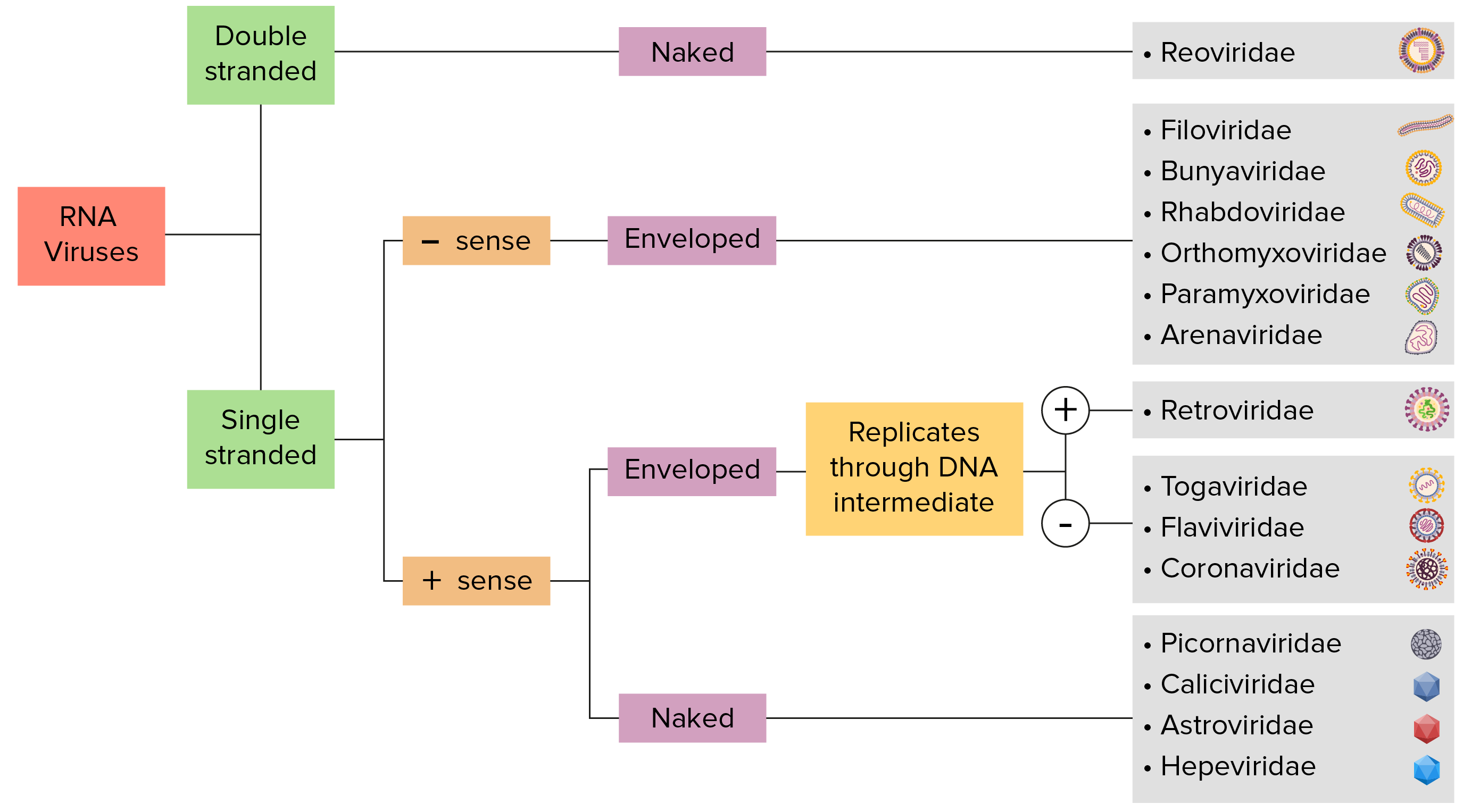
Classificação do fluxograma de vírus de RNA

Identificação do RNA vírico:
Os vírus podem ser classificados de várias formas. No entanto, a maioria destes tem um genoma constituído por ADN ou RNA. Os vírus cujo genoma é de RNA podem ser ainda caracterizados em RNA de cadeia simples ou dupla. Os vírus com invólucro são cobertos por uma fina camada de membrana celular (geralmente da célula hospedeira). Na ausência desta camada, são apelidados de vírus “nus”. Os vírus com genomas de cadeia simples são chamados de vírus de “sentido positivo” se o genoma puder ser diretamente utilizado como RNA mensageiro (mRNA, pela sigla em inglês), que é traduzido em proteínas. Os de “sentido negativo” necessitam da RNA polimerase dependente de RNA, uma enzima vírica, para transcrever o seu genoma em RNA mensageiro.
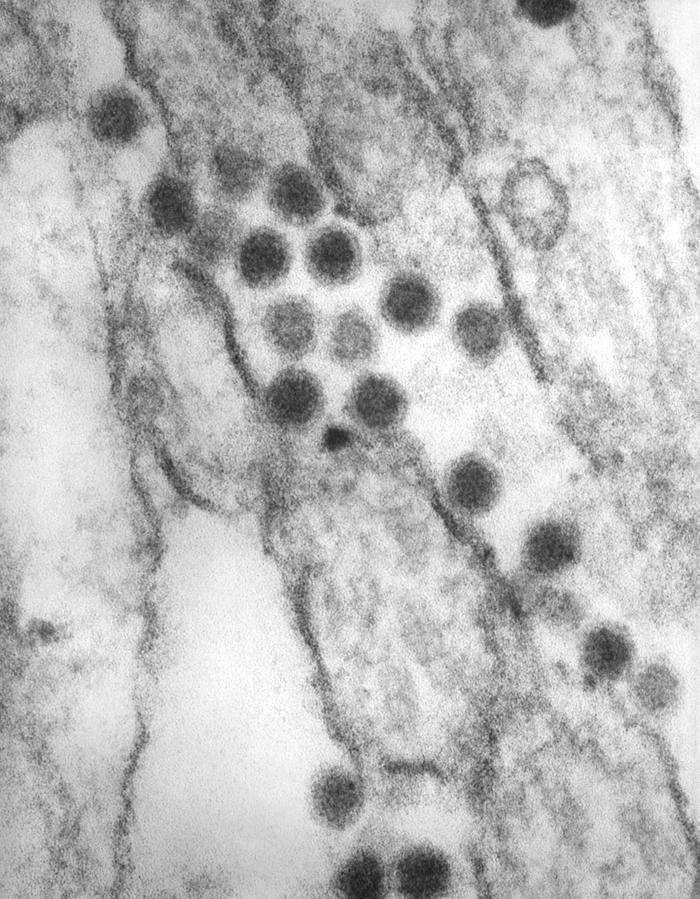
Imagem por Lecturio. Licença: CC BY-NC-SA 4.0

Características Gerais e Epidemiologia

Características gerais do vírus da encefalite de St. Louis ( SLEV SLEV A viral encephalitis caused by the St. Louis encephalitis virus, a flavivirus. It is transmitted to humans and other vertebrates primarily by mosquitoes of the genus culex. The primary animal vectors are wild birds and the disorder is endemic to the midWestern and southeastern United States. Infections may be limited to an influenza-like illness or present as an aseptic meningitis or encephalitis. Clinical manifestations of the encephalitic presentation may include seizures, lethargy, myoclonus, focal neurologic signs, coma, and death. St. Louis Encephalitis Virus, pela sigla em inglês)

  • Taxonomia:
    • Família: Flaviviridae Flaviviridae A family of RNA viruses, many of which cause disease in humans and domestic animals. There are three genera flavivirus; pestivirus; and hepacivirus, as well as several unassigned species. Hepatitis C Virus
    • Género: Flavivirus Flavivirus A genus of flaviviridae containing several subgroups and many species. Most are arboviruses transmitted by mosquitoes or ticks. The type species is yellow fever virus. Tick-borne Encephalitis Virus
  • Vírus de RNA RNA A polynucleotide consisting essentially of chains with a repeating backbone of phosphate and ribose units to which nitrogenous bases are attached. RNA is unique among biological macromolecules in that it can encode genetic information, serve as an abundant structural component of cells, and also possesses catalytic activity. RNA Types and Structure
    • Cadeia simples
    • Sentido positivo
    • Linear
  • Esférico
  • Simetria icosaédrica
  • Com invólucro
  • Tamanho: Aproximadamente 50 nm
  • Núcleo de ssRNA de sentido positivo
Os vírus da encefalite de St. Louis Flaviviridae

Imagem de microscopia eletrónica de transmissão de múltiplos virions de encefalite de St. Louis numa amostra de tecido não identificada:
Este vírus é um membro do género Flavivirus.

Imagem: “Numerous St. Louis encephalitis (SLE) virions that were contained within an unidentified tissue sample” por CDC. Licença: Public Domain

Doença associada

O vírus da encefalite de St. Louis causa a encefalite de St. Louis (LES, pela sigla em inglês).
Epidemiologia

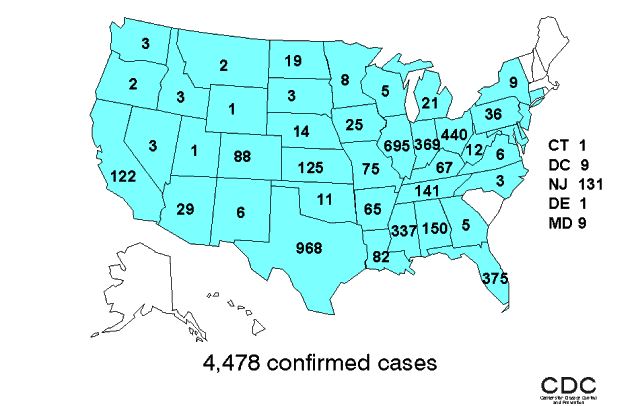
Mapa da encefalite de St. Louis Flaviviridae

Casos de encefalite de St. Louis nos Estados Unidos (1964–1998):
Nesta imagem observa-se a distribuição dos casos. Esta doença é mais frequente no vale do Rio Mississippi, ao longo da costa do Golfo e no sudoeste do país.
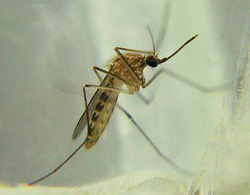
Imagem: “Human incidence of Saint Louis encephalitis in the United States, 1964-1998” por CDC. Licença: Public Domain

Patogénese

Reservatório

  • Hospedeiros principais: aves
  • Hospedeiros acidentais:
    • Humanos
    • Outros mamíferos

Transmissão

  • Vetor:
    • Espécies de mosquitos Culex
    • Requer 7-10 dias de incubação no mosquito antes de passar a infeção ao hospedeiro humano
  • Transplante de órgão sólido (raro)
Culex mosquito vírus da encefalite de St. Louis Flaviviridae

Foto em grande plano de um mosquito Culex, o vetor do vírus da encefalite de St. Louis.

Imagem: “Close-up photo of a Culex mosquito” por CDC. Licença: Public Domain

Fatores de risco do hospedeiro

Fatores de risco para o desenvolvimento de infeção por SLEV SLEV A viral encephalitis caused by the St. Louis encephalitis virus, a flavivirus. It is transmitted to humans and other vertebrates primarily by mosquitoes of the genus culex. The primary animal vectors are wild birds and the disorder is endemic to the midWestern and southeastern United States. Infections may be limited to an influenza-like illness or present as an aseptic meningitis or encephalitis. Clinical manifestations of the encephalitic presentation may include seizures, lethargy, myoclonus, focal neurologic signs, coma, and death. St. Louis Encephalitis Virus:

  • Idade mais MAIS Androgen Insensitivity Syndrome avançada (o mais MAIS Androgen Insensitivity Syndrome importante)
  • Realização de atividades ao ar AR Aortic regurgitation (AR) is a cardiac condition characterized by the backflow of blood from the aorta to the left ventricle during diastole. Aortic regurgitation is associated with an abnormal aortic valve and/or aortic root stemming from multiple causes, commonly rheumatic heart disease as well as congenital and degenerative valvular disorders. Aortic Regurgitation livre em regiões endémicas
  • Comorbilidades:
    • Doença cardiovascular
    • Hipertensão arterial
    • Imunossupressão

Fisiopatologia

  • O SLEV SLEV A viral encephalitis caused by the St. Louis encephalitis virus, a flavivirus. It is transmitted to humans and other vertebrates primarily by mosquitoes of the genus culex. The primary animal vectors are wild birds and the disorder is endemic to the midWestern and southeastern United States. Infections may be limited to an influenza-like illness or present as an aseptic meningitis or encephalitis. Clinical manifestations of the encephalitic presentation may include seizures, lethargy, myoclonus, focal neurologic signs, coma, and death. St. Louis Encephalitis Virus é inoculado no humano através da picada de um mosquito
  • A replicação ocorre nos tecidos locais → disseminação para os gânglios regionais
  • Disseminação do vírus através dos vasos linfáticos e da corrente sanguínea
  • Entrada no SNC (mecanismo pouco esclarecido) → afeta predominantemente a substância cinzenta
  • Inflamação e lesão neuronal → sintomas neurológicos

Apresentação Clínica

A maioria dos indivíduos infetados são assintomáticos. O período de incubação nos indivíduos sintomáticos é de 4 a 21 dias, e a doença varia na apresentação e gravidade.

Pródromo

Sintomas gerais:

  • Febre
  • Cefaleia
  • Mal-estar
  • Mialgias

Sintomas respiratórios:

  • Tosse
  • Odinofagia

Sintomas urinários:

  • Disúria
  • Urgência miccional
  • Incontinência

Sinais e sintomas neurológicos

Os doentes podem apresentar meningite, encefalite ou uma combinação destes 2 (meningoencefalite).

Meningite assética (a mais MAIS Androgen Insensitivity Syndrome comum):

  • Cefaleia
  • Febre
  • Rigidez da nuca
  • Fotofobia
  • Náuseas e vómitos

Encefalite:

  • Alteração do estado mental
    • Desorientação
    • Agitação
    • Coma Coma Coma is defined as a deep state of unarousable unresponsiveness, characterized by a score of 3 points on the GCS. A comatose state can be caused by a multitude of conditions, making the precise epidemiology and prognosis of coma difficult to determine. Coma
  • Tremores com acometimento dos seguintes:
    • Pálpebras
    • Língua
    • Lábios
    • Extremidades
  • Disfunção de nervos cranianos
  • Paralisia espástica
  • Ataxia Ataxia Impairment of the ability to perform smoothly coordinated voluntary movements. This condition may affect the limbs, trunk, eyes, pharynx, larynx, and other structures. Ataxia may result from impaired sensory or motor function. Sensory ataxia may result from posterior column injury or peripheral nerve diseases. Motor ataxia may be associated with cerebellar diseases; cerebral cortex diseases; thalamic diseases; basal ganglia diseases; injury to the red nucleus; and other conditions. Ataxia-telangiectasia
  • Convulsão (raro)

Diagnóstico e Tratamento

Diagnóstico

Pode suspeitar-se do diagnóstico com a história clínica e o exame objetivo.

  • Avaliação diagnóstica: serologia ( ELISA ELISA An immunoassay utilizing an antibody labeled with an enzyme marker such as horseradish peroxidase. While either the enzyme or the antibody is bound to an immunosorbent substrate, they both retain their biologic activity; the change in enzyme activity as a result of the enzyme-antibody-antigen reaction is proportional to the concentration of the antigen and can be measured spectrophotometrically or with the naked eye. Many variations of the method have been developed. St. Louis Encephalitis Virus) sanguínea e do LCR
  • Avaliação de apoio ao diagnóstico:
    • Possíveis achados laboratoriais:
      • Leucócitos normais ou ↑
      • Hiponatremia → SIADH SIADH Syndrome of inappropriate antidiuretic hormone secretion (SIADH) is a disorder of impaired water excretion due to the inability to suppress the secretion of antidiuretic hormone (ADH). SIADH is characterized by impaired water excretion leading to dilutional hyponatremia, which is mainly asymptomatic but may cause neurologic symptoms. S Syndrome of Inappropriate Antidiuretic Hormone Secretion (SIADH) pela encefalite
    • Análise do LCR:
      • Pressão de abertura normal ou ↑
      • ↑ Proteínas
      • Glicose normal
      • Ligeiro ↑ dos leucócitos (na fase inicial predominam os neutrófilos e, de seguida, existe predominância monocítica ou linfocítica)

Tratamento

Não existem tratamentos antivíricos eficazes para o SLEV SLEV A viral encephalitis caused by the St. Louis encephalitis virus, a flavivirus. It is transmitted to humans and other vertebrates primarily by mosquitoes of the genus culex. The primary animal vectors are wild birds and the disorder is endemic to the midWestern and southeastern United States. Infections may be limited to an influenza-like illness or present as an aseptic meningitis or encephalitis. Clinical manifestations of the encephalitic presentation may include seizures, lethargy, myoclonus, focal neurologic signs, coma, and death. St. Louis Encephalitis Virus, portanto, o tratamento é de suporte.

  • Monitorização do balanço hídrico e dos eletrólitos
  • Restrição hídrica na presença de SIADH SIADH Syndrome of inappropriate antidiuretic hormone secretion (SIADH) is a disorder of impaired water excretion due to the inability to suppress the secretion of antidiuretic hormone (ADH). SIADH is characterized by impaired water excretion leading to dilutional hyponatremia, which is mainly asymptomatic but may cause neurologic symptoms. S Syndrome of Inappropriate Antidiuretic Hormone Secretion (SIADH)
  • Tratamento sintomático
    • Antieméticos
    • Antipiréticos
  • Suporte ventilatório na presença de insuficiência respiratória ou incapacidade de proteger a via aérea

Prevenção

  • Controlo local da presença dos mosquitos
  • Repelente de insetos
  • Roupa protetora
  • Evicção de águas paradas.
  • Não existem vacinas contra o SLEV SLEV A viral encephalitis caused by the St. Louis encephalitis virus, a flavivirus. It is transmitted to humans and other vertebrates primarily by mosquitoes of the genus culex. The primary animal vectors are wild birds and the disorder is endemic to the midWestern and southeastern United States. Infections may be limited to an influenza-like illness or present as an aseptic meningitis or encephalitis. Clinical manifestations of the encephalitic presentation may include seizures, lethargy, myoclonus, focal neurologic signs, coma, and death. St. Louis Encephalitis Virus.

Comparação de Espécies Semelhantes de Flavivírus

Tabela: Características e doenças causadas por várias espécies de Flavivirus Flavivirus A genus of flaviviridae containing several subgroups and many species. Most are arboviruses transmitted by mosquitoes or ticks. The type species is yellow fever virus. Tick-borne Encephalitis Virus
Organismo Vírus da encefalite transmitida por carraça Vírus da encefalite Japonesa Vírus da encefalite de St. Louis Vírus do Nilo Ocidental
Características As características estruturais são quase idênticas.
Região
  • Europa
  • Sibéria
  • Ásia
  • Ásia
  • Pacífico Ocidental
América do Norte
  • África
  • Médio Oriente
  • Europa
  • Sul da Ásia
  • Austrália
  • América do Norte
Transmissão Carraça Mosquito Mosquito Mosquito
Clínica
  • A maioria dos doentes são assintomáticos.
  • Inicialmente com sintomas inespecíficos
  • Fase neurológica:
    • Meningite
    • Encefalite
    • Meningoencefalite
  • Doença febril inespecífica
  • Meningite
  • Encefalite
  • Paralisia flácida aguda
  • Síndrome de Guillain-Barré
  • A maioria dos doentes são assintomáticos.
  • Doença febril inespecífica
  • Meningite
  • Encefalite
  • Meningoencefalite
  • A maioria dos doentes são assintomáticos.
  • Febre do Nilo Ocidental
  • Doença neuroinvasiva:
    • Meningite
    • Encefalite
    • Paralisia flácida aguda
Diagnóstico
  • Serologia
  • PCR PCR Polymerase chain reaction (PCR) is a technique that amplifies DNA fragments exponentially for analysis. The process is highly specific, allowing for the targeting of specific genomic sequences, even with minuscule sample amounts. The PCR cycles multiple times through 3 phases: denaturation of the template DNA, annealing of a specific primer to the individual DNA strands, and synthesis/elongation of new DNA molecules. Polymerase Chain Reaction (PCR) – reação em cadeia da polimerase
Serologia Serologia
  • Serologia
  • PCR PCR Polymerase chain reaction (PCR) is a technique that amplifies DNA fragments exponentially for analysis. The process is highly specific, allowing for the targeting of specific genomic sequences, even with minuscule sample amounts. The PCR cycles multiple times through 3 phases: denaturation of the template DNA, annealing of a specific primer to the individual DNA strands, and synthesis/elongation of new DNA molecules. Polymerase Chain Reaction (PCR) – reação em cadeia da polimerase
Tratamento Suporte Suporte Suporte Suporte
Prevenção
  • Medidas para evitar picadas de carraças
  • Vacinação (nas áreas endémicas)
  • Medidas para evitar picadas de mosquitos
  • Vacinação
Medidas para evitar picadas de mosquitos Medidas para evitar picadas de mosquitos

Diagnóstico Diferencial

  • Doença de Lyme: infeção causada pela espiroqueta gram-negativa Borrelia burgdorferi Borrelia burgdorferi A specific species of bacteria, part of the borrelia burgdorferi group, whose common name is lyme disease spirochete. Borrelia, transmitida por carraças. A apresentação desta doença varia consoante o estadio da mesma e pode incluir o eritema migratório característico, que não é observado com SLEV SLEV A viral encephalitis caused by the St. Louis encephalitis virus, a flavivirus. It is transmitted to humans and other vertebrates primarily by mosquitoes of the genus culex. The primary animal vectors are wild birds and the disorder is endemic to the midWestern and southeastern United States. Infections may be limited to an influenza-like illness or present as an aseptic meningitis or encephalitis. Clinical manifestations of the encephalitic presentation may include seizures, lethargy, myoclonus, focal neurologic signs, coma, and death. St. Louis Encephalitis Virus. Nas fases tardias, também são comuns as manifestações neurológicas, cardíacas, oculares e articulares. O diagnóstico baseia-se nos achados clínicos e exposição a carraças e é apoiado por testes Testes Gonadal Hormones serológicos. O tratamento é com antibioterapia.
  • Erliquiose e anaplasmose: infeções causadas por Ehrlichia chaffeensis Ehrlichia chaffeensis A species of gram-negative bacteria that is the causative agent of human ehrlichiosis. This organism was first discovered at fort chaffee, arkansas, when blood samples from suspected human ehrlichiosis patients were studied. Ehrlichiosis and Anaplasmosis e Anaplasmosis Anaplasmosis Anaplasmosis is a tick-borne bacterial infection. The most common causative species include Anaplasma phagocytophilum, which infect and multiply within granulocytes. The clinical presentation can vary widely, but often includes fever, malaise, headache, myalgia, and arthralgias. Ehrlichiosis and Anaplasmosis phagocytophilum, respectivamente, transmitidas por carraças. Os sintomas de erliquiose e anaplasmose incluem febre, cefaleia e mal-estar. Na doença grave pode ocorrer meningoencefalite. O diagnóstico é feito por PCR PCR Polymerase chain reaction (PCR) is a technique that amplifies DNA fragments exponentially for analysis. The process is highly specific, allowing for the targeting of specific genomic sequences, even with minuscule sample amounts. The PCR cycles multiple times through 3 phases: denaturation of the template DNA, annealing of a specific primer to the individual DNA strands, and synthesis/elongation of new DNA molecules. Polymerase Chain Reaction (PCR). O tratamento de ambas as doenças é com doxiciclina.
  • Febre maculosa das Montanhas Rochosas: uma doença causada por Rickettsia rickettsii Rickettsia rickettsii A species of gram-negative, aerobic bacteria that is the etiologic agent of rocky mountain spotted fever. Its cells are slightly smaller and more uniform in size than those of rickettsia prowazekii. Rickettsia. A apresentação clínica inclui febre, fadiga, cefaleia e rash Rash Rocky Mountain Spotted Fever após a picada de uma carraça. O diagnóstico é estabelecido com base nas características clínicas, biópsia do rash Rash Rocky Mountain Spotted Fever e testes Testes Gonadal Hormones serológicos. O tratamento inclui antibióticos, nomeadamente a doxiciclina.
  • Encefalite por Herpes simplex Herpes Simplex A group of acute infections caused by herpes simplex virus type 1 or type 2 that is characterized by the development of one or more small fluid-filled vesicles with a raised erythematous base on the skin or mucous membrane. It occurs as a primary infection or recurs due to a reactivation of a latent infection. Congenital TORCH Infections: uma infeção grave do SNC causada por vírus herpes simplex Herpes Simplex A group of acute infections caused by herpes simplex virus type 1 or type 2 that is characterized by the development of one or more small fluid-filled vesicles with a raised erythematous base on the skin or mucous membrane. It occurs as a primary infection or recurs due to a reactivation of a latent infection. Congenital TORCH Infections. Os doentes desenvolvem rapidamente sintomas, que incluem febre, cefaleia, alteração do nível de consciência, défices neurológicos focais e convulsões. O diagnóstico é confirmado com o teste de PCR PCR Polymerase chain reaction (PCR) is a technique that amplifies DNA fragments exponentially for analysis. The process is highly specific, allowing for the targeting of specific genomic sequences, even with minuscule sample amounts. The PCR cycles multiple times through 3 phases: denaturation of the template DNA, annealing of a specific primer to the individual DNA strands, and synthesis/elongation of new DNA molecules. Polymerase Chain Reaction (PCR) do LCR. Lesões hiperintensas nos lobos temporais podem ser visualizadas na ressonância magnética. O tratamento de escolha é o aciclovir IV.
  • Vírus da encefalite equina: arbovírus transmitido por mosquitos da família Togaviridae Togaviridae A family of RNA viruses, mainly arboviruses, consisting of two genera: alphavirus (group A arboviruses), and rubivirus. Virions are spherical, 60-70 nm in diameter, with a lipoprotein envelope tightly applied to the icosahedral nucleocapsid. Rubella Virus. Os sintomas iniciais incluem febre, cefaleia e vómitos. A maioria dos doentes recupera, no entanto, a doença pode progredir para encefalite grave. O diagnóstico é realizado com base nos achados clínicos e na avaliação do LCR, com serologia ou PCR PCR Polymerase chain reaction (PCR) is a technique that amplifies DNA fragments exponentially for analysis. The process is highly specific, allowing for the targeting of specific genomic sequences, even with minuscule sample amounts. The PCR cycles multiple times through 3 phases: denaturation of the template DNA, annealing of a specific primer to the individual DNA strands, and synthesis/elongation of new DNA molecules. Polymerase Chain Reaction (PCR). Não existe um tratamento específico, sendo este maioritariamente de suporte.
  • Meningite bacteriana: uma infeção aguda das meninges Meninges The brain and the spinal cord are enveloped by 3 overlapping layers of connective tissue called the meninges. The layers are, from the most external layer to the most internal layer, the dura mater, arachnoid mater, and pia mater. Between these layers are 3 potential spaces called the epidural, subdural, and subarachnoid spaces. Meninges: Anatomy. Os doentes apresentam cefaleia, febre, rigidez da nuca e uma rápida deterioração clínica. Para estabelecer o diagnóstico realiza-se uma punção lombar. Ao contrário da meningite vírica, a avaliação do LCR mostrará um líquido turvo, baixa glicose e uma contagem alta de leucócitos com predominância neutrofílica. A coloração de Gram e a cultura determinam as bactérias causadoras. O tratamento inclui antibióticos e corticoides.

Referências

  1. Laurido-Soto O, Brier MR, Simon LE, McCullough A, Bucelli RC, Day GS. (2019). Patient characteristics and outcome associations in AMPA receptor encephalitis. J Neurol 266:450–460. https://www.ncbi.nlm.nih.gov/pubmed/30560455
  2. Auguste AJ, Pybus OG, Carrington CV. (2009). Evolution and dispersal of St. Louis encephalitis virus in the Americas. Infect Genet Evol 9:709–715. 
  3. Diaz A, Coffey LL, Burkett-Cadena N, Day JF. (2018). The reemergence of St. Louis encephalitis virus in the Americas. Emerg Infect Dis 24:2150–2147. https://www.ncbi.nlm.nih.gov/pubmed/30457961
  4. Curren EJ, Lindsey NP, Fischer M, Hills SL. (2018). St. Louis encephalitis virus disease in the United States, 2003-2017. Am J Trop Med Hyg 99:1074–1079. https://www.ncbi.nlm.nih.gov/pubmed/30182919
  5. Soung A, Klein RS. (2018). Viral encephalitis and neurologic diseases: focus on astrocytes. Trends Mol Med 24:950–962. https://www.ncbi.nlm.nih.gov/pubmed/30314877
  6. Centers for Disease Control and Prevention. (2024).  About St. Louis encephalitis. U.S. Department of Health and Human Services. Retrieved October 14, 2025, from https://www.cdc.gov/sle/about/
  7. Simon, L. V., Kong, E. L., Graham, C. (2023). St. Louis encephalitis. StatPearls Publishing. https://www.ncbi.nlm.nih.gov/books/NBK470426/
  8. Simon LV, Kong EL, Graham C. (2023). St. Louis encephalitis. StatPearls. Retrieved October 14, 2025, from https://www.ncbi.nlm.nih.gov/books/NBK470426/
  9. Howes, D. S. (2024). Encephalitis. In B. E. Brenner (Ed.), Medscape. Retrieved October 14, 2025, from  https://emedicine.medscape.com/article/791896-overview

Crie sua conta gratuita ou faça login para continuar lendo!

Cadastre-se agora e tenha acesso grátis ao Lecturio, com páginas de conceitos, vídeos de medicina e questões para sua educação médica.

Aprende mais com a Lecturio:

Multiple devices displaying human anatomy and health education content.

Complementa o teu estudo da faculdade com o companheiro de estudo tudo-em-um da Lecturio, através de métodos de ensino baseados em evidência.

Estuda onde quiseres

Two iPhones display medical education apps, one showing anatomy, the other Bookmatcher.

A Lecturio Medical complementa o teu estudo através de métodos de ensino baseados em evidência, vídeos de palestras, perguntas e muito mais – tudo combinado num só lugar e fácil de usar.

User Reviews

Have a holly, jolly study session 🎁 Save 50% on all plans now >>

Que tengas una sesión de estudio alegre y navideña 🎁 Ahorra 50% en todos los planes >>

Details