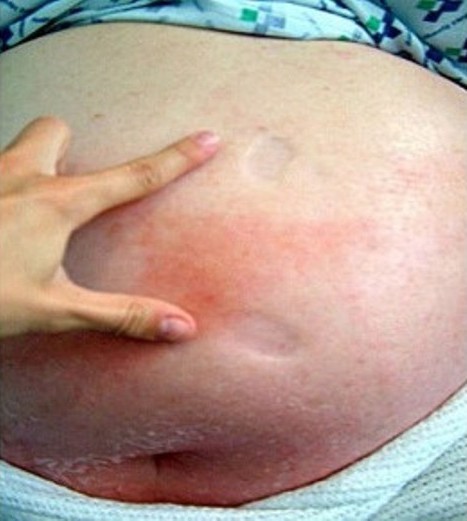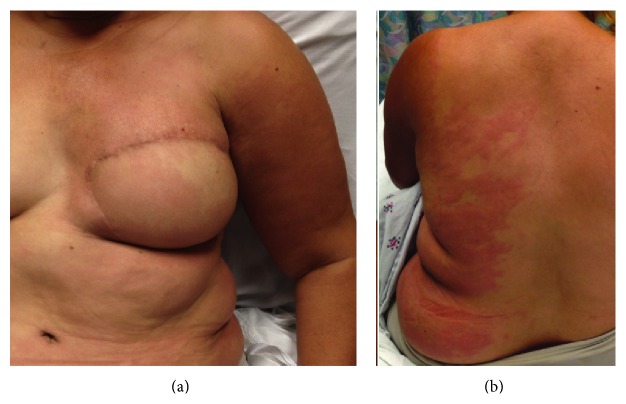



Celulite

A celulite é uma infeção comum causada por bactérias que afeta a derme e o tecido subcutâneo da pele. É frequentemente causada por Staphylococcus aureus Staphylococcus aureus Potentially pathogenic bacteria found in nasal membranes, skin, hair follicles, and perineum of warm-blooded animals. They may cause a wide range of infections and intoxications. Brain Abscess e Streptococcus Streptococcus Streptococcus is one of the two medically important genera of gram-positive cocci, the other being Staphylococcus. Streptococci are identified as different species on blood agar on the basis of their hemolytic pattern and sensitivity to optochin and bacitracin. There are many pathogenic species of streptococci, including S. pyogenes, S. agalactiae, S. pneumoniae, and the viridans streptococci. Streptococcus pyogenes. A infeção da pele apresenta-se como uma área eritematosa e edemaciada com dor e calor Calor Inflammation. Os limites da infeção não são bem delineados. Os membros inferiores são o local mais MAIS Androgen Insensitivity Syndrome frequente de infeção, mas a celulite pode ocorrer em qualquer parte do corpo. O diagnóstico é geralmente clínico e o tratamento passa por antibióticos orais e/ou parentéricos. A cobertura para MRSA MRSA A strain of Staphylococcus aureus that is non-susceptible to the action of methicillin. The mechanism of resistance usually involves modification of normal or the presence of acquired penicillin binding proteins. Staphylococcus pode ter de ser adicionada, dependendo da presença de fatores de risco.

Last updated: Dec 15, 2025

Editorial responsibility: Stanley Oiseth, Lindsay Jones, Evelin Maza

Descrição Geral

Definição

A celulite é definida pela inflamação da pele e do tecido subcutâneo. Frequentemente é devido a infeção.
Epidemiologia e etiologia

  • Incidência: 200 casos por 100.000 pacientes/ano
  • Mais MAIS Androgen Insensitivity Syndrome comum em populações de meia-idade e idosos
  • Membros inferiores: local mais MAIS Androgen Insensitivity Syndrome comum
  • Agentes mais MAIS Androgen Insensitivity Syndrome comuns:
    • Staphylococcus aureus Staphylococcus aureus Potentially pathogenic bacteria found in nasal membranes, skin, hair follicles, and perineum of warm-blooded animals. They may cause a wide range of infections and intoxications. Brain Abscess :
      • MSSA
      • MRSA MRSA A strain of Staphylococcus aureus that is non-susceptible to the action of methicillin. The mechanism of resistance usually involves modification of normal or the presence of acquired penicillin binding proteins. Staphylococcus
    • Streptococcus Streptococcus Streptococcus is one of the two medically important genera of gram-positive cocci, the other being Staphylococcus. Streptococci are identified as different species on blood agar on the basis of their hemolytic pattern and sensitivity to optochin and bacitracin. There are many pathogenic species of streptococci, including S. pyogenes, S. agalactiae, S. pneumoniae, and the viridans streptococci. Streptococcus do grupo A ( Streptococcus Streptococcus Streptococcus is one of the two medically important genera of gram-positive cocci, the other being Staphylococcus. Streptococci are identified as different species on blood agar on the basis of their hemolytic pattern and sensitivity to optochin and bacitracin. There are many pathogenic species of streptococci, including S. pyogenes, S. agalactiae, S. pneumoniae, and the viridans streptococci. Streptococcus pyogenes)
  • Agentes menos comuns:
    • Pasteurella multocida (mordeduras de animais)
    • Aeromonas hydrophila Aeromonas hydrophila A species of gram-negative, facultatively anaerobic, rod-shaped bacteria that may be pathogenic for frogs, fish, and mammals, including man. In humans, cellulitis and diarrhea can result from infection with this organism. Cellulitis e Vibrio vulnificus Vibrio vulnificus A species of halophilic bacteria in the genus vibrio, which lives in warm seawater. It can cause infections in those who eat raw contaminated seafood or have open wounds exposed to seawater. Vibrio (após exposição à água)
    • Espécies de Clostridium (mionecrose)
    • Pseudomonas aeruginosa Pseudomonas aeruginosa A species of gram-negative, aerobic, rod-shaped bacteria commonly isolated from clinical specimens (wound, burn, and urinary tract infections). It is also found widely distributed in soil and water. P. Aeruginosa is a major agent of nosocomial infection. Pseudomonas (em pacientes imunocomprometidos)
    • Erysipelothrix Erysipelothrix A genus of gram-positive, facultatively anaerobic, rod-shaped bacteria that has a tendency to form long filaments. Its organisms are widely distributed in nature and are found in mammals; birds; and fishes. Erysipelothrix may appear gram-negative because they decolorize easily. Cellulitis rhusiopathiae (exposição ocupacional em talhos, trabalhadores de matadouros, agricultores, veterinários)

Fatores de risco

  • Destruição da barreira cutânea (feridas, úlceras, picadas de insetos/animais)
  • Inflamação da pele (psoríase, eczema Eczema Atopic dermatitis, also known as eczema, is a chronic, relapsing, pruritic, inflammatory skin disease that occurs more frequently in children, although adults can also be affected. The condition is often associated with elevated serum levels of IgE and a personal or family history of atopy. Skin dryness, erythema, oozing, crusting, and lichenification are present. Atopic Dermatitis (Eczema))
  • Lesões contaminadas com terra ou água do mar
  • Infeção preexistente (tinea, varicela)
  • História prévia de celulite
  • Lesões por esmagamento
  • Queimaduras de segundo e terceiro graus
  • Queimadura por frio
  • Linfedema ou qualquer obstrução da drenagem linfática
  • Imunodeficiência
  • Diabetes Diabetes Diabetes mellitus (DM) is a metabolic disease characterized by hyperglycemia and dysfunction of the regulation of glucose metabolism by insulin. Type 1 DM is diagnosed mostly in children and young adults as the result of autoimmune destruction of β cells in the pancreas and the resulting lack of insulin. Type 2 DM has a significant association with obesity and is characterized by insulin resistance. Diabetes Mellitus mellitus
  • Obesidade
  • Insuficiência venosa

Fisiopatologia e Apresentação Clínica

Fisiopatologia

  • As bactérias entram na barreira da pele que foi destruída:
    • Através de pequenos cortes ou ferimentos
    • Pode ser secundária a um foco distante ou infeção sistémica
    • Em alguns casos, a porta de entrada não é evidente.
  • A invasão da derme e do tecido subcutâneo desencadeia a liberação de citocinas, recrutando neutrófilos e outras células inflamatórias para o local.
  • Fatores bacterianos intrínsecos permitem que o microorganismo escape Escape With constant immune mechanisms holding unstable tumor cells in equilibrium, tumor-cell variants may emerge. These cancer cells may express fewer antigens on their surfaces or lose their MHC class I expression.Variants may also protect themselves from T-cell attack via expression of IC molecules on their surfaces, like normal cells.Creation of an immunosuppressive state in the microenvironment is another way to grow without immunologic interference. Cancer Immunotherapy das defesas iniciais do hospedeiro, causando eritema, dor e inchaço local da pele ( edema Edema Edema is a condition in which excess serous fluid accumulates in the body cavity or interstitial space of connective tissues. Edema is a symptom observed in several medical conditions. It can be categorized into 2 types, namely, peripheral (in the extremities) and internal (in an organ or body cavity). Edema).
  • Em pacientes imunocomprometidos, a infeção é eventualmente limitada à área de invasão.
  • Se o microorganismo patogénico ultrapassar as defesas imunológicas, ocorrerá uma disseminação adicional (infeção mais MAIS Androgen Insensitivity Syndrome profunda e/ou contígua e bacteremia Bacteremia The presence of viable bacteria circulating in the blood. Fever, chills, tachycardia, and tachypnea are common acute manifestations of bacteremia. The majority of cases are seen in already hospitalized patients, most of whom have underlying diseases or procedures which render their bloodstreams susceptible to invasion. Glycopeptides na imunodeficiência).
  • O controle reduzido da infeção ocorre em:
    • Diminuição da vascularização e oxigenação do tecido
    • Aumento da estase de fluidos periféricos
    • Pouca capacidade de combater infeções (por exemplo, diabetes Diabetes Diabetes mellitus (DM) is a metabolic disease characterized by hyperglycemia and dysfunction of the regulation of glucose metabolism by insulin. Type 1 DM is diagnosed mostly in children and young adults as the result of autoimmune destruction of β cells in the pancreas and the resulting lack of insulin. Type 2 DM has a significant association with obesity and is characterized by insulin resistance. Diabetes Mellitus)

Achados clínicos

  • Sintomas sistémicos prodrómicos:
    • Pode apresentar sinais de toxicidade (febre > 100,5 ℉ (38 ℃), arrepios e taquicardia)
    • Dores musculares e articulares
    • Cefaleia
  • Sinais/sintomas locais:
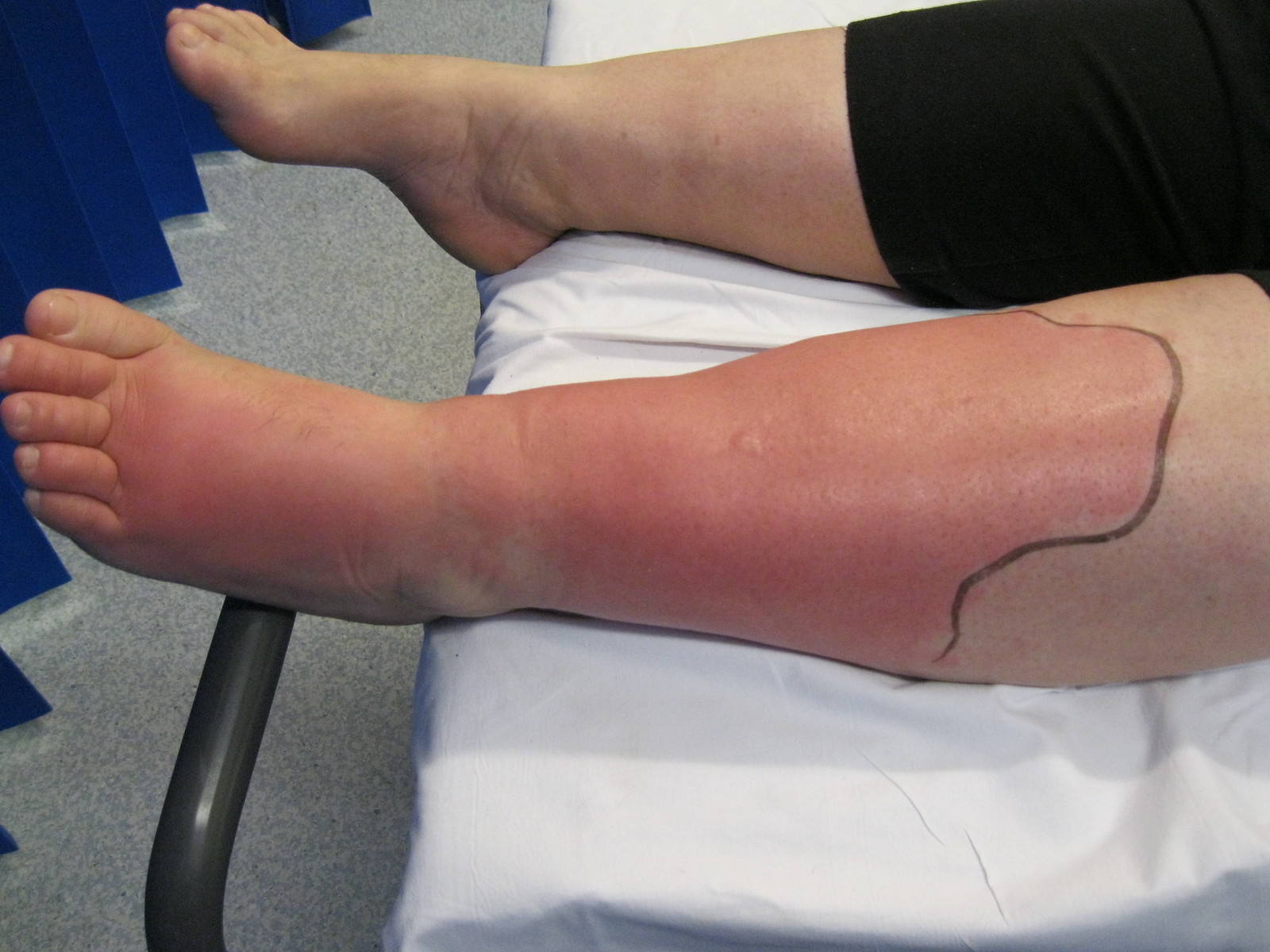
    • Lesões endurecidas ou área edemaciada com eritema e limites mal definidos
    • Rubor Rubor Inflammation ou lesões que se vão expandido
    • Dor e sensibilidade na área afetada
    • Pele tensa, brilhante e inchada ou com depressões (observadas no edema Edema Edema is a condition in which excess serous fluid accumulates in the body cavity or interstitial space of connective tissues. Edema is a symptom observed in several medical conditions. It can be categorized into 2 types, namely, peripheral (in the extremities) and internal (in an organ or body cavity). Edema ao redor dos folículos pilosos)
    • Pode apresentar-se com exsudado purulento (geralmente associado a S. aureus S. aureus Potentially pathogenic bacteria found in nasal membranes, skin, hair follicles, and perineum of warm-blooded animals. They may cause a wide range of infections and intoxications. Staphylococcus)
    • Pode também estar presente um abcesso (coleção de pus na derme ou na camada subcutânea).
  • Sinais e sintomas associados:
    • Inchaço e sensibilidade dos nódulos linfáticos locais (linfadenite)
    • Infeções graves:
      • Pode apresentar mal-estar geral, fadiga, tontura, confusão, dores musculares e articulares e sudorese
      • Pode ter lesões vesiculares ou formação de bolhas

Diagnóstico

  • O diagnóstico da celulite é clínico:
    • Edema Edema Edema is a condition in which excess serous fluid accumulates in the body cavity or interstitial space of connective tissues. Edema is a symptom observed in several medical conditions. It can be categorized into 2 types, namely, peripheral (in the extremities) and internal (in an organ or body cavity). Edema
    • Eritema
    • Calor Calor Inflammation
    • Dor
    • Linfadenopatia associada
  • Sintomas, fatores de risco e progressão da lesão cutânea auxiliam na exclusão de diagnósticos diferenciais.
  • Os exames laboratoriais são inespecíficos:
    • Leucocitose (comum em todas as infeções)
    • ↑ Marcadores inflamatórios:
      • Velocidade de sedimentação eritrocitária ( ESR ESR Soft Tissue Abscess, pela sigla em inglês)
      • Valores de PCR PCR Polymerase chain reaction (PCR) is a technique that amplifies DNA fragments exponentially for analysis. The process is highly specific, allowing for the targeting of specific genomic sequences, even with minuscule sample amounts. The PCR cycles multiple times through 3 phases: denaturation of the template DNA, annealing of a specific primer to the individual DNA strands, and synthesis/elongation of new DNA molecules. Polymerase Chain Reaction (PCR)
  • Estudos microbiológicos:
    • Cultura de feridas: usada para identificar microorganismo patogénicos e orientar a antibioterapia
    • Hemocultura: obtida em casos sugestivos de bacteremia Bacteremia The presence of viable bacteria circulating in the blood. Fever, chills, tachycardia, and tachypnea are common acute manifestations of bacteremia. The majority of cases are seen in already hospitalized patients, most of whom have underlying diseases or procedures which render their bloodstreams susceptible to invasion. Glycopeptides e/ou em pacientes com imunodeficiência grave
  • Imagiologia:
    • A ecografia é usada para descartar abcesso.
    • Infeções complicadas de pele e tecidos moles Moles Primary Skin Lesions precisam ser mais MAIS Androgen Insensitivity Syndrome bem avaliadas.
      • TC orbital e sinusal para determinar a extensão da celulite orbitária e a presença de um abcesso
      • Ressonância magnética e/ou cintigrafia óssea podem ser realizadas em casos de dor articular intensa para confirmar/descartar artrite séptica ou osteomielite.

Tratamento e Complicações

Abordagem terapêutica

  • Cuidados de suporte:
    • Tratamento sintomático para febre e dor local
    • Hidratação adequada e elevação do membro inferior afetado
  • A terapia empírica abrange Streptococcus Streptococcus Streptococcus is one of the two medically important genera of gram-positive cocci, the other being Staphylococcus. Streptococci are identified as different species on blood agar on the basis of their hemolytic pattern and sensitivity to optochin and bacitracin. There are many pathogenic species of streptococci, including S. pyogenes, S. agalactiae, S. pneumoniae, and the viridans streptococci. Streptococcus do grupo A e MSSA.
  • Determinação de fatores de risco e necessidade de terapêutica parentérica:
    • Fatores de risco de MRSA MRSA A strain of Staphylococcus aureus that is non-susceptible to the action of methicillin. The mechanism of resistance usually involves modification of normal or the presence of acquired penicillin binding proteins. Staphylococcus:
      • Hospitalização ou cirurgia recente (≤ 2 meses)
      • Hemodiálise
      • Residência em instituição de longa permanência
      • Infeção por VIH
      • Episódio anterior de MRSA MRSA A strain of Staphylococcus aureus that is non-susceptible to the action of methicillin. The mechanism of resistance usually involves modification of normal or the presence of acquired penicillin binding proteins. Staphylococcus
      • Uso recente de antibióticos sem cobertura de MRSA MRSA A strain of Staphylococcus aureus that is non-susceptible to the action of methicillin. The mechanism of resistance usually involves modification of normal or the presence of acquired penicillin binding proteins. Staphylococcus
      • Dispositivo médico permanente
    • Necessidade de terapêutica parentérica:
      • Incapacidade de tolerar a ingestão oral
      • Sinais sistémicos de toxicidade
      • Rápida progressão do eritema
      • Celulite sobre um dispositivo médico (enxerto vascular ou articulação protésica)
      • Falha na resposta a antibióticos orais prévios

Base do tratamento

  • Sem fatores de risco de MRSA MRSA A strain of Staphylococcus aureus that is non-susceptible to the action of methicillin. The mechanism of resistance usually involves modification of normal or the presence of acquired penicillin binding proteins. Staphylococcus:
    • Terapêutica oral (infeção leve):
      • Dicloxacilina
      • Amoxicilina
      • Cefalexina
      • Clindamicina
    • Terapêutica parentérica:
      • Cefazolina
      • Nafcilina
      • Oxacilina
      • Clindamicina
  • Com fatores de risco de MRSA MRSA A strain of Staphylococcus aureus that is non-susceptible to the action of methicillin. The mechanism of resistance usually involves modification of normal or the presence of acquired penicillin binding proteins. Staphylococcus:
    • Terapêutica oral:
      • Trimetoprim-sulfametoxazol
      • Amoxicilina + doxiciclina
      • Amoxicilina + minociclina
      • Clindamicina
    • Terapêutica parentérica:
      • Vancomicina
      • Daptomicina
  • Outras considerações:
    • Feridas por mordida: adicionar cobertura anaeróbia
    • Hospitalização:
      • Geralmente necessário para lesões faciais devido ao alto risco de disseminação da infeção para o SNC (meningite, encefalite)
      • Para aqueles com condições concomitantes, como insuficiência hepática, renal ou cardíaca
    • Infeções progressivas graves: podem exigir desbridamento cirúrgico de tecido necrótico ou abcessos
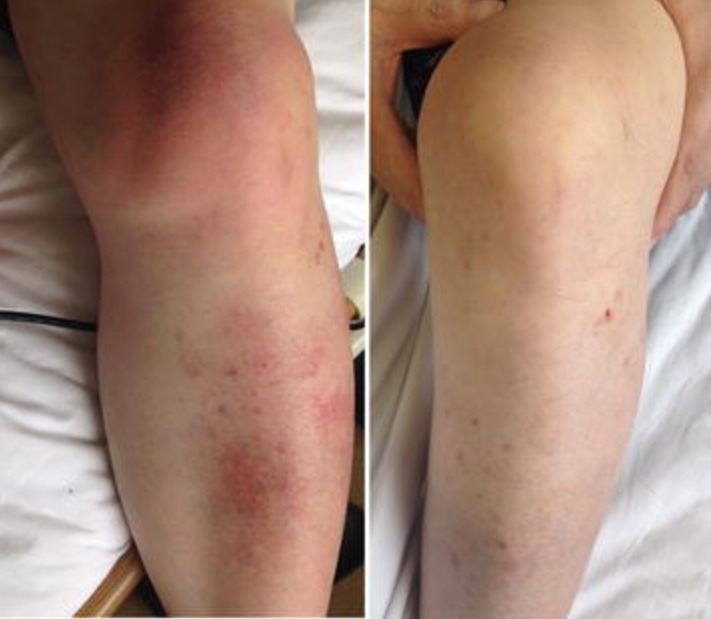
Perna esquerda e celulite no joelho

Celulite na perna e joelho esquerdos:
Esquerda: Edema local com descoloração da pele rosa-salmão e o calor local é evidente.
Direita: perna após 6 semanas de antibioterapia

Imagem: “Helicobacter cinaedi bacteremia with cellulitis in a living-donor kidney transplant recipient identified by matrix-assisted laser desorption ionization time-of-flight mass spectrometry: a case report” por BMC Research Notes. Licença: CC BY 4.0

Complicações

  • Abcesso:
    • Coleção de pus na derme ou tecido subcutâneo
    • Apresenta-se como um edema Edema Edema is a condition in which excess serous fluid accumulates in the body cavity or interstitial space of connective tissues. Edema is a symptom observed in several medical conditions. It can be categorized into 2 types, namely, peripheral (in the extremities) and internal (in an organ or body cavity). Edema doloroso, flutuante e eritematoso ou nódulo discreto
    • Tratamento: incisão e drenagem de abcesso drenável detetado ao exame objetivo ou na ecografia
  • Fasceíte necrotrizante:
    • Infeção profunda associada à rápida destruição e necrose da fáscia e tecidos subcutâneos
    • Com risco de vida
  • Artrite sética:
    • Infeção numa articulação, frequentemente secundária a bactérias
    • Desenvolve-se a partir de continuidade hematogénica, mas também pode surgir da extensão da infeção da pele/tecidos moles Moles Primary Skin Lesions
  • Osteomielite:
  • Sépsis:
    • Disfunção orgânica potencialmente fatal causada por uma resposta desregulada do hospedeiro à infeção
    • A apresentação pode incluir febre, taquicardia, taquipneia, hipotensão e/ou alteração do estado de consciência.
    • Pacientes imunocomprometidos com infeções de pele estão em risco para esta condição.

Related videos

Diagnóstico Diferencial

  • Erisipela: uma infeção superficial aguda da derme superior e vasos linfáticos, geralmente causada por Streptococcus Streptococcus Streptococcus is one of the two medically important genera of gram-positive cocci, the other being Staphylococcus. Streptococci are identified as different species on blood agar on the basis of their hemolytic pattern and sensitivity to optochin and bacitracin. There are many pathogenic species of streptococci, including S. pyogenes, S. agalactiae, S. pneumoniae, and the viridans streptococci. Streptococcus beta-hemolítico do grupo A: Esta condição apresenta-se como uma lesão cutânea com bordos elevados e bem delineada, com eritema, edema Edema Edema is a condition in which excess serous fluid accumulates in the body cavity or interstitial space of connective tissues. Edema is a symptom observed in several medical conditions. It can be categorized into 2 types, namely, peripheral (in the extremities) and internal (in an organ or body cavity). Edema e calor Calor Inflammation.
  • Fasceíte necrotizante: uma infeção rapidamente progressiva que resulta em extensa necrose do tecido subcutâneo, fáscia e músculo: A fasceíte necrotizante é mais MAIS Androgen Insensitivity Syndrome comumente causada por Streptococcus Streptococcus Streptococcus is one of the two medically important genera of gram-positive cocci, the other being Staphylococcus. Streptococci are identified as different species on blood agar on the basis of their hemolytic pattern and sensitivity to optochin and bacitracin. There are many pathogenic species of streptococci, including S. pyogenes, S. agalactiae, S. pneumoniae, and the viridans streptococci. Streptococcus do grupo A, mas geralmente envolve outros tipos de bactérias numa infeção mista. A condição apresenta-se com necrose, crepitação, enfisema subcutâneo e descoloração roxa da pele.
  • Dermatite: termo geral para erupção cutânea edematosa causada por uma reação alérgica, irritante ou infeção
  • Foliculite: uma inflamação localizada do folículo piloso ou glândulas sebáceas causada principalmente por S. aureus S. aureus Potentially pathogenic bacteria found in nasal membranes, skin, hair follicles, and perineum of warm-blooded animals. They may cause a wide range of infections and intoxications. Staphylococcus: A apresentação inclui eritema, pápulas, pústulas e sensibilidade da área afetada.
  • Impetigo Impetigo Impetigo is a highly contagious superficial bacterial infection typically caused by Staphylococcus aureus (most common) and Streptococcus pyogenes. Impetigo most commonly presents in children aged 2 to 5 years with lesions that evolve from papules to vesicles to pustules, which eventually break down to form characteristic “honey-colored” crusts. Impetigo: uma infeção da pele altamente contagiosa da epiderme superior: o impetigo Impetigo Impetigo is a highly contagious superficial bacterial infection typically caused by Staphylococcus aureus (most common) and Streptococcus pyogenes. Impetigo most commonly presents in children aged 2 to 5 years with lesions that evolve from papules to vesicles to pustules, which eventually break down to form characteristic “honey-colored” crusts. Impetigo geralmente afeta crianças < 5 anos de idade e é causada por S. aureus S. aureus Potentially pathogenic bacteria found in nasal membranes, skin, hair follicles, and perineum of warm-blooded animals. They may cause a wide range of infections and intoxications. Staphylococcus ou Streptococcus Streptococcus Streptococcus is one of the two medically important genera of gram-positive cocci, the other being Staphylococcus. Streptococci are identified as different species on blood agar on the basis of their hemolytic pattern and sensitivity to optochin and bacitracin. There are many pathogenic species of streptococci, including S. pyogenes, S. agalactiae, S. pneumoniae, and the viridans streptococci. Streptococcus do grupo A. Os pacientes apresentam uma área eritematosa coberta por pequenas vesículas, pústulas e/ou crostas cor de mel.
  • Síndrome da pele escaldada estafilocócica: um distúrbio da pele com bolhas mediado por toxina causado por S. aureus S. aureus Potentially pathogenic bacteria found in nasal membranes, skin, hair follicles, and perineum of warm-blooded animals. They may cause a wide range of infections and intoxications. Staphylococcus. A apresentação inclui eritema cutâneo difuso, dor, formação de bolhas e descamação superficial (descamação da camada superficial da pele, deixando uma aparência vermelha “escaldada”). As membranas mucosas são poupadas.

Referências

  1. Herchline T (2019). Cellulitis. Medscape. Retrieved February 26, 2021, from https://emedicine.medscape.com/article/214222-overview#a1
  2. Kalyanakrishnan R, Salinas R, Higuita N (2015). Skin and soft tissue infections. Am Fam Physician. 92(6),474–483.
  3. Klotz C, et al. (2019). Adherence to antibiotic guidelines for erysipelas or cellulitis is associated with a favorable outcome. Eur J Clin Microbiol Infect Dis. 38(4),703–709.
  4. Spelman D, Baddour LM (2020). Cellulitis and skin abscess in adults: Treatment. UpToDate. Retrieved January 30, 2021, from https://www.uptodate.com/contents/cellulitis-and-skin-abscess-in-adults-treatment
  5. Spelman D, Baddour LM (2020). Cellulitis and skin abscess: Epidemiology, microbiology, clinical manifestations, and diagnosis. UpToDate. Retrieved January 30, 2021, from https://www.uptodate.com/contents/cellulitis-and-skin-abscess-epidemiology-microbiology-clinical-manifestations-and-diagnosis
  6. Stevens DL, et al. (2014). Practice guidelines for the diagnosis and management of skin and soft tissue infections: 2014 update by the Infectious Diseases Society of America. Clin Infect Dis. 59(2),e10–52.

Crie sua conta gratuita ou faça login para continuar lendo!

Cadastre-se agora e tenha acesso grátis ao Lecturio, com páginas de conceitos, vídeos de medicina e questões para sua educação médica.

Aprende mais com a Lecturio:

Multiple devices displaying human anatomy and health education content.

Complementa o teu estudo da faculdade com o companheiro de estudo tudo-em-um da Lecturio, através de métodos de ensino baseados em evidência.

Estuda onde quiseres

Two iPhones display medical education apps, one showing anatomy, the other Bookmatcher.

A Lecturio Medical complementa o teu estudo através de métodos de ensino baseados em evidência, vídeos de palestras, perguntas e muito mais – tudo combinado num só lugar e fácil de usar.

User Reviews

Have a holly, jolly study session 🎁 Save 50% on all plans now >>

Que tengas una sesión de estudio alegre y navideña 🎁 Ahorra 50% en todos los planes >>

Details