


Asplenia

O baço desempenha um papel crucial no sistema imunitário, na filtração do sangue e no armazenamento de plaquetas. A asplenia Asplenia Asplenia is the absence of splenic tissue or function and can stem from several factors ranging from congenital to iatrogenic. There is a distinction between anatomic asplenia, which is due to the surgical removal of the spleen, and functional asplenia, which is due to a condition that leads to splenic atrophy, infarct, congestion, or infiltrative disease. Asplenia é definida como a ausência anatómica do baço ou a presença de uma função esplénica inadequada. Esta pode ter origem em diversos fatores, desde congénitos a iatrogénicos. Há uma distinção entre asplenia Asplenia Asplenia is the absence of splenic tissue or function and can stem from several factors ranging from congenital to iatrogenic. There is a distinction between anatomic asplenia, which is due to the surgical removal of the spleen, and functional asplenia, which is due to a condition that leads to splenic atrophy, infarct, congestion, or infiltrative disease. Asplenia anatómica, que se deve à remoção cirúrgica do baço, e asplenia Asplenia Asplenia is the absence of splenic tissue or function and can stem from several factors ranging from congenital to iatrogenic. There is a distinction between anatomic asplenia, which is due to the surgical removal of the spleen, and functional asplenia, which is due to a condition that leads to splenic atrophy, infarct, congestion, or infiltrative disease. Asplenia funcional, que se deve a uma doença que leva à atrofia esplénica, enfarte, congestão ou doença infiltrativa. Os corpos de Howell-Jolly estão normalmente presentes em esfregaços de sangue periférico. A imagiologia abdominal e a cintigrafia são utilizadas para o diagnóstico. O risco elevado de septicemia causada por bactérias encapsuladas requer o cumprimento de um regime rigoroso de vacinação e antibioterapia precoce quando se suspeita de uma infeção. Os eventos tromboembólicos são comuns.

Last updated: Dec 15, 2025

Editorial responsibility: Stanley Oiseth, Lindsay Jones, Evelin Maza

Descrição Geral

Definição

O baço é um dos órgãos linfáticos secundários cruciais para o sistema imunitário, sendo responsável pela filtragem do sangue e pela remoção de eritrócitos envelhecidos ou danificados. A asplenia Asplenia Asplenia is the absence of splenic tissue or function and can stem from several factors ranging from congenital to iatrogenic. There is a distinction between anatomic asplenia, which is due to the surgical removal of the spleen, and functional asplenia, which is due to a condition that leads to splenic atrophy, infarct, congestion, or infiltrative disease. Asplenia é definida como a ausência anatómica do baço ou a presença de uma função esplénica inadequada.

Etiologia

  • Congénito:
    • Parte integrante da síndrome de heterotaxia, que envolve órgãos do tórax e abdómen.
    • Hereditariedade autossómica dominante
  • Funcional:
    • Atrofia
    • Enfarte
    • Congestão
    • Infiltração
  • Adquirido:

Epidemiologia

A epidemiologia depende da etiologia.

  • Congénito:
    • Raro
    • A asplenia Asplenia Asplenia is the absence of splenic tissue or function and can stem from several factors ranging from congenital to iatrogenic. There is a distinction between anatomic asplenia, which is due to the surgical removal of the spleen, and functional asplenia, which is due to a condition that leads to splenic atrophy, infarct, congestion, or infiltrative disease. Asplenia decorrente de síndromes é predominante nos homens.
    • A doença celíaca, o procedimento de Whipple e a doença hepática alcoólica estão fortemente associados à disfunção esplénica parcial.
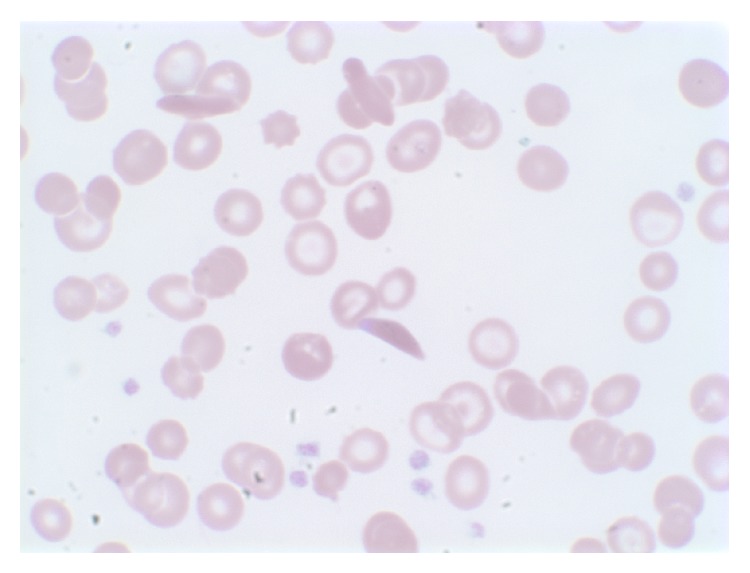
  • Asplenia Asplenia Asplenia is the absence of splenic tissue or function and can stem from several factors ranging from congenital to iatrogenic. There is a distinction between anatomic asplenia, which is due to the surgical removal of the spleen, and functional asplenia, which is due to a condition that leads to splenic atrophy, infarct, congestion, or infiltrative disease. Asplenia funcional: quase todos os pacientes com anemia Anemia Anemia is a condition in which individuals have low Hb levels, which can arise from various causes. Anemia is accompanied by a reduced number of RBCs and may manifest with fatigue, shortness of breath, pallor, and weakness. Subtypes are classified by the size of RBCs, chronicity, and etiology. Anemia: Overview and Types falciforme (e outras hemoglobinopatias) irão sofrer de asplenia Asplenia Asplenia is the absence of splenic tissue or function and can stem from several factors ranging from congenital to iatrogenic. There is a distinction between anatomic asplenia, which is due to the surgical removal of the spleen, and functional asplenia, which is due to a condition that leads to splenic atrophy, infarct, congestion, or infiltrative disease. Asplenia funcional.
  • Adquirido: A incidência de esplenectomia cirúrgica está a diminuir devido a novas técnicas cirúrgicas.

Fisiopatologia

  • A asplenia Asplenia Asplenia is the absence of splenic tissue or function and can stem from several factors ranging from congenital to iatrogenic. There is a distinction between anatomic asplenia, which is due to the surgical removal of the spleen, and functional asplenia, which is due to a condition that leads to splenic atrophy, infarct, congestion, or infiltrative disease. Asplenia funcional normalmente começa com o hiposplenismo:
    • Retenção de eritrócitos
    • Enfarte
    • Hiposplenismo
    • Autosplenectomia
  • Ausência de uma filtração correta de bactérias: aumento do risco de septicemia devido a bactérias encapsuladas
    • Haemophilus influenzae Haemophilus Influenzae A species of Haemophilus found on the mucous membranes of humans and a variety of animals. The species is further divided into biotypes I through viii. Haemophilus
    • Streptococcus Streptococcus Streptococcus is one of the two medically important genera of gram-positive cocci, the other being Staphylococcus. Streptococci are identified as different species on blood agar on the basis of their hemolytic pattern and sensitivity to optochin and bacitracin. There are many pathogenic species of streptococci, including S. pyogenes, S. agalactiae, S. pneumoniae, and the viridans streptococci. Streptococcus pneumoniae
    • Neisseria meningitidis Neisseria meningitidis A species of gram-negative, aerobic bacteria. It is a commensal and pathogen only of humans, and can be carried asymptomatically in the nasopharynx. When found in cerebrospinal fluid it is the causative agent of cerebrospinal meningitis. It is also found in venereal discharges and blood. There are at least 13 serogroups based on antigenic differences in the capsular polysaccharides; the ones causing most meningitis infections being a, b, c, y, and w-135. Each serogroup can be further classified by serotype, serosubtype, and immunotype. Neisseria
    • Escherichia coli Escherichia coli The gram-negative bacterium Escherichia coli is a key component of the human gut microbiota. Most strains of E. coli are avirulent, but occasionally they escape the GI tract, infecting the urinary tract and other sites. Less common strains of E. coli are able to cause disease within the GI tract, most commonly presenting as abdominal pain and diarrhea. Escherichia coli
    • Klebsiella Klebsiella Klebsiella are encapsulated gram-negative, lactose-fermenting bacilli. They form pink colonies on MacConkey agar due to lactose fermentation. The main virulence factor is a polysaccharide capsule. Klebsiella pneumoniae is the most important pathogenic species. Klebsiella
  • Aumento do risco de eventos vasculares:
    • Secundários à trombocitose
    • Aumento da circulação de eritrócitos danificados
Tabela: Causas de asplenia Asplenia Asplenia is the absence of splenic tissue or function and can stem from several factors ranging from congenital to iatrogenic. There is a distinction between anatomic asplenia, which is due to the surgical removal of the spleen, and functional asplenia, which is due to a condition that leads to splenic atrophy, infarct, congestion, or infiltrative disease. Asplenia por categoria
Categoria Doença/causa
Congénito
  • Síndrome de heterotaxia
  • Síndrome de Ivemark
Iatrogénico
  • Esplenectomia (após trauma)
  • Irradiação
Vascular
  • Trombose da artéria/veia esplénica
  • Trombose do tronco celíaco
Hematológico/oncológico
  • Anemia Anemia Anemia is a condition in which individuals have low Hb levels, which can arise from various causes. Anemia is accompanied by a reduced number of RBCs and may manifest with fatigue, shortness of breath, pallor, and weakness. Subtypes are classified by the size of RBCs, chronicity, and etiology. Anemia: Overview and Types falciforme
  • Esferocitose hereditária
  • Doenças mieloproliferativas
  • Doença de Enxerto vs Hospedeiro
  • Neoplasia (leucemia, linfoma, metástases)
Hepático
  • Doença hepática/cirrose alcoólica
  • Hepatite crónica
  • Hipertensão venosa portal
Autoimune
  • Lúpus eritematoso sistémico
  • Tiroidite
  • Sarcoidose
  • Artrite reumatóide
Gastrointestinal
  • Doença celíaca
  • Doenças inflamatórias intestinais
  • Doença de Whipple
Infecciosa
  • SIDA
  • Malária
  • Infeções bacterianas por Pneumococcus, Haemophilus influenzae Haemophilus Influenzae A species of Haemophilus found on the mucous membranes of humans and a variety of animals. The species is further divided into biotypes I through viii. Haemophilus, Neisseria Neisseria Neisseria is a genus of bacteria commonly present on mucosal surfaces. Several species exist, but only 2 are pathogenic to humans: N. gonorrhoeae and N. meningitidis. Neisseria species are non-motile, gram-negative diplococci most commonly isolated on modified Thayer-Martin (MTM) agar. Neisseria
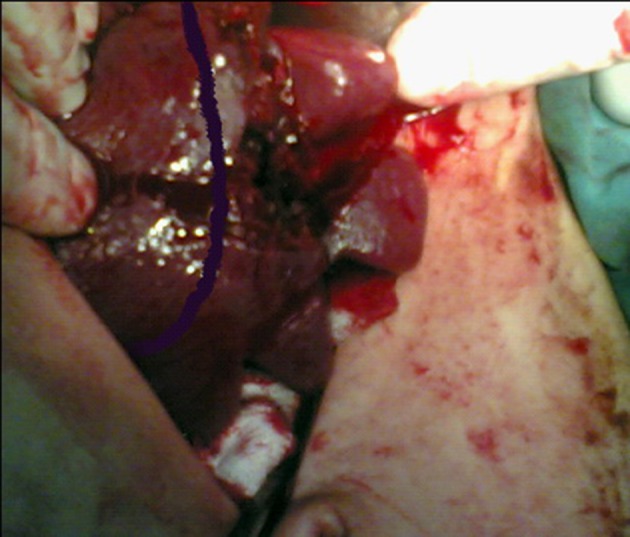
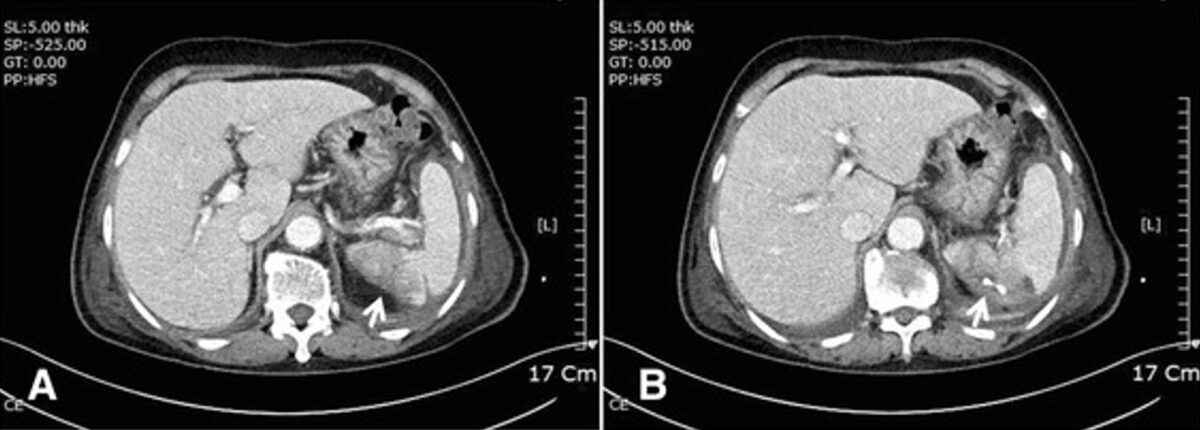
Stage IV splenic injury

Lesão esplénica em fase IV num paciente de 34 anos

Imagem: “Stage IV Splenic injury in a 34 Year Old Patient” por Eskandarlou, M., Derakhshanfar, A. Licença: CC BY 3.0
Diagnóstico

  • História clínica e exame objetivo:
    • Antecedentes de uma síndrome predisponente, patologia ou trauma
    • Antecedentes cirúrgicos
  • Testes Testes Gonadal Hormones laboratoriais:
    • Esfregaço de sangue:
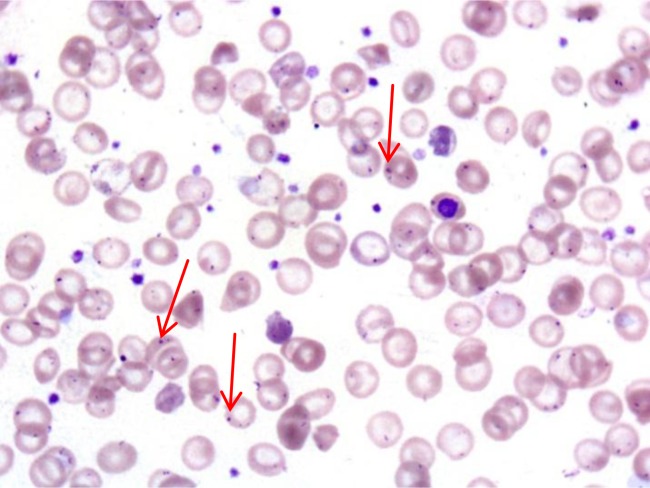
      • Os corpos de Howell-Jolly são patognomónicos
      • Os corpos de Heinz, eritrócitos em alvo ou codócitos e eritrócitos com vacúolos (pitted cells, em inglês) são comuns
    • CBC:
      • Neutrofilia
      • Trombocitose
  • Imagiologia:
    • Radiografia simples:
      • Observa-se a orientação anormal dos órgãos em síndromes heterotóxicas
      • Pode ser útil em pacientes com trauma
    • Ressonância magnética
    • Ecografia
    • Cintigrafia

Tratamento

O tratamento depende da causa subjacente, do grau de asplenia Asplenia Asplenia is the absence of splenic tissue or function and can stem from several factors ranging from congenital to iatrogenic. There is a distinction between anatomic asplenia, which is due to the surgical removal of the spleen, and functional asplenia, which is due to a condition that leads to splenic atrophy, infarct, congestion, or infiltrative disease. Asplenia e da idade. Os pacientes com mais MAIS Androgen Insensitivity Syndrome de 5 anos têm um melhor prognóstico. A prevenção da infeção é a base dos cuidados a longo prazo devido ao aumento do risco de septicemia de progressão rápida, fatal em 50% dos pacientes.

Prevenção de infeções

  • Esquema vacinal:
    • Pneumocócica
    • Meningocócica
    • H. influenzae H. influenzae A species of Haemophilus found on the mucous membranes of humans and a variety of animals. The species is further divided into biotypes I through VIII. Haemophilus (tipo B)
    • Influenza Influenza Influenza viruses are members of the Orthomyxoviridae family and the causative organisms of influenza, a highly contagious febrile respiratory disease. There are 3 primary influenza viruses (A, B, and C) and various subtypes, which are classified based on their virulent surface antigens, hemagglutinin (HA) and neuraminidase (NA). Influenza typically presents with a fever, myalgia, headache, and symptoms of an upper respiratory infection. Influenza Viruses/Influenza
  • Antibioterapia profilática:
    • Durante 1-3 anos após a esplenectomia
    • Até aos 5 anos
    • Procedimentos cirúrgicos que podem predispor à infeção por bactérias encapsuladas
    • Permanente (durante toda a vida), se história de sépsis pós-esplenectomia
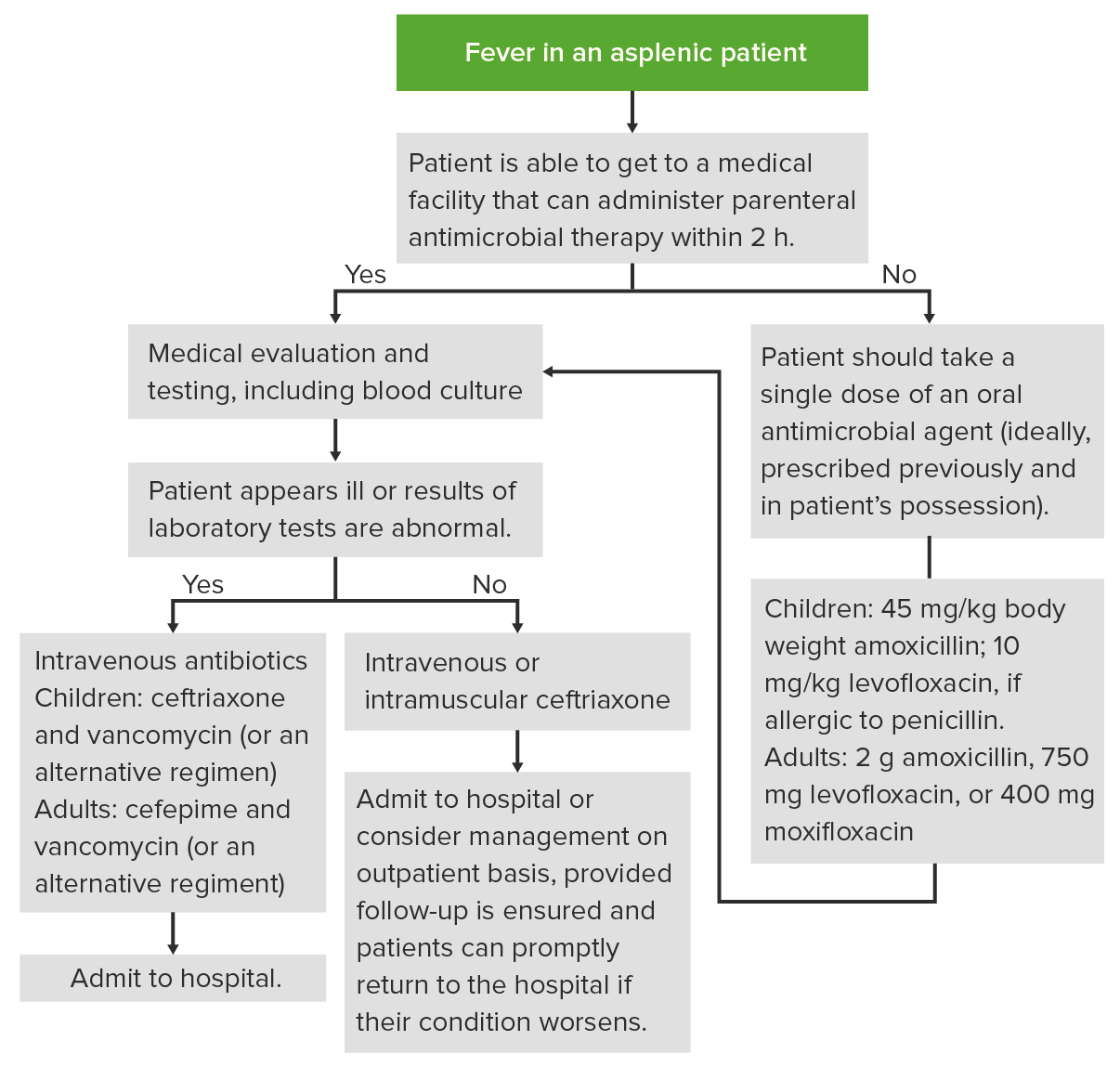
  • Antibioterapia empírica: indicada precocemente quando um doente apresenta febre ou outros sinais de infeção.

Infeção fulminante pós-esplenectomia

Septicemia de instalação rápida:

  • Infeção sem foco conhecido, acompanhada por coagulação intravascular disseminada
  • Taxa de mortalidade: 50%–70%
Abordagem de febre num doente com asplenia

Abordagem de um episódio febril num doente com asplenia

Imagem de Lecturio. Licença: CC BY-NC-SA 4.0

Relevância clínica

  • Traumatismo abdominal contuso e lesão abdominal penetrante: as lesões abdominais são classificadas como contusas ou penetrantes, conforme o mecanismo da lesão. Diversas estruturas, incluindo o duodeno, baço, fígado, rins e órgãos pélvicos podem ser lesadas. No caso de uma lesão esplénica grave, pode ser necessário efetuar uma esplenectomia, para remover o baço.
  • Mononucleose: também conhecida como “doença do beijo”, ou mononucleose infeciosa. A mononucleose é uma infeção viral altamente contagiosa causada pelo vírus Epstein–Barr (VEB). O nome popular para a mononucleose deriva do seu principal método de transmissão: a propagação pela saliva Saliva The clear, viscous fluid secreted by the salivary glands and mucous glands of the mouth. It contains mucins, water, organic salts, and ptyalin. Salivary Glands: Anatomy infetada através do beijo. Durante infecções agudas por VEB, o baço pode aumentar e romper-se espontaneamente (raramente) ou devido à sua maior vulnerabilidade a trauma.
  • Baço: órgão em forma de grão de café localizado no abdómen superior esquerdo posterior (hipocôndrio esquerdo) e pesando cerca de 150 gramas. O baço é composto por um tecido muito mole Mole Nevi (singular nevus), also known as “moles,” are benign neoplasms of the skin. Nevus is a non-specific medical term because it encompasses both congenital and acquired lesions, hyper- and hypopigmented lesions, and raised or flat lesions. Nevus/Nevi preenchido com sangue, que circula pelo parênquima, filtrando quaisquer eritrócitos e leucócitos antigos ou anormais. O baço também desempenha um papel no sistema imunitário ao remover agentes patogénicos e ao contribuir para a produção de anticorpos. Devido à sua natureza frágil e alta vascularização, o baço pode romper-se facilmente com traumatismos abdominais, particularmente quando está aumentado.
  • Esplenomegália: aumento maciço do baço, tornando-o palpável sob o rebordo costal esquerdo. A ecografia abdominal demonstra uma forma saliente e arredondamento das extremidades usualmente pontiagudas. Qualquer tecido ectópico, como baços acessórios, também estará hipertrofiado. O aumento do baço pode ocorrer por diversas razões, incluindo infeção, hemorragia interna ou sequestro de células sanguíneas anormais. O aumento do baço coloca-o em risco de rutura aquando trauma.

Referências

  1. Lee, G. M. (2020). Preventing infections in children and adults with asplenia. Hematology: American Society of Hematology Education Program, 2020(1), 328–335. https://doi.org/10.1182/hematology.2020000117
  2. Stiehm, E. R. (Ed.). (2020). Asplenia. In Stiehm’s Immune Deficiencies (2nd ed.). Elsevier. Retrieved April 11, 2025, from https://www.sciencedirect.com/topics/immunology-and-microbiology/asplenia
  3. Quinti, I., Paganelli, R. (2014). Chapter 45. In Sullivan, K., and Stiehm, R. (Ed.), Stiehm’s Immune Deficiencies Inborn Errors of Metabolism. 1st ed. pp. 835–844. Retrieved April 12, 2021, from https://doi.org/10.1016/B978-0-12-405546-9.00045-5
  4. Chen, M.J., Huang, M.J., et al. (2005). Ultrasonography of splenic abnormalities. World Journal of Gastroenterology. 11(26), 4061–4066. Retrieved April 11, 2025, from http://dx.doi.org/10.3748/wjg.v11.i26.4061
  5. Rubin, L., Schaffner, W. (2014). Care of the asplenic patient. New England Journal of Medicine. 371, 349–356. Retrieved April 11, 2025, from https://doi.org/10.1056/NEJMcp1314291
  6. Pasternack, M. S. (2025, March 25). Prevention of infection in patients with impaired splenic function. In D. Spelman, M. S. Edwards, & N. White (Eds.), UpToDate. Retrieved April 11, 2025, from https://www.uptodate.com/contents/prevention-of-infection-in-patients-with-impaired-splenic-function

Crie sua conta gratuita ou faça login para continuar lendo!

Cadastre-se agora e tenha acesso grátis ao Lecturio, com páginas de conceitos, vídeos de medicina e questões para sua educação médica.

Aprende mais com a Lecturio:

Multiple devices displaying human anatomy and health education content.

Complementa o teu estudo da faculdade com o companheiro de estudo tudo-em-um da Lecturio, através de métodos de ensino baseados em evidência.

Estuda onde quiseres

Two iPhones display medical education apps, one showing anatomy, the other Bookmatcher.

A Lecturio Medical complementa o teu estudo através de métodos de ensino baseados em evidência, vídeos de palestras, perguntas e muito mais – tudo combinado num só lugar e fácil de usar.

User Reviews

Have a holly, jolly study session 🎁 Save 50% on all plans now >>

Que tengas una sesión de estudio alegre y navideña 🎁 Ahorra 50% en todos los planes >>

Details