El virusVirusViruses are infectious, obligate intracellular parasites composed of a nucleic acid core surrounded by a protein capsid. Viruses can be either naked (non-enveloped) or enveloped. The classification of viruses is complex and based on many factors, including type and structure of the nucleoid and capsid, the presence of an envelope, the replication cycle, and the host range. VirologychikungunyaChikungunyaChikungunya virus belongs to the Alphavirus genus and causes a viral infection characterized by fever and joint pain. Symptoms usually appear within 1 week of infection. Additional manifestations of chikungunya virus may include muscle pain, headache, maculopapular rash, and lymphadenopathy. Chikungunya Virus pertenece alALAmyloidosis género AlphavirusAlphavirusA genus of togaviridae, also known as group a arboviruses, serologically related to each other but not to other togaviridae. The viruses are transmitted by mosquitoes. The type species is the sindbis virus.Equine Encephalitis Viruses y causa una infección viral caracterizada por fiebre y dolorDolorInflammation articular. El virusVirusViruses are infectious, obligate intracellular parasites composed of a nucleic acid core surrounded by a protein capsid. Viruses can be either naked (non-enveloped) or enveloped. The classification of viruses is complex and based on many factors, including type and structure of the nucleoid and capsid, the presence of an envelope, the replication cycle, and the host range. Virology transmitido por artrópodos (arbovirus) es transmitido por mosquitos (comúnmente Aedes albopictus y Aedes aegypti). Generalmente, losLOSNeisseria síntomas aparecen dentro de la 1ra semana de la infección. Las manifestaciones adicionales del virusVirusViruses are infectious, obligate intracellular parasites composed of a nucleic acid core surrounded by a protein capsid. Viruses can be either naked (non-enveloped) or enveloped. The classification of viruses is complex and based on many factors, including type and structure of the nucleoid and capsid, the presence of an envelope, the replication cycle, and the host range. VirologychikungunyaChikungunyaChikungunya virus belongs to the Alphavirus genus and causes a viral infection characterized by fever and joint pain. Symptoms usually appear within 1 week of infection. Additional manifestations of chikungunya virus may include muscle pain, headache, maculopapular rash, and lymphadenopathy. Chikungunya Virus pueden incluir dolorDolorInflammation muscular, cefalea, erupción maculopapularMaculopapularDermatologic Examination y linfadenopatía. La mayoría de las personas infectadas se recuperan, pero se puede desarrollar artritis crónica. El tratamiento tiene como objetivo aliviar losLOSNeisseria síntomas. La enfermedad es prevenida evitando losLOSNeisseria mosquitos, usando repelente de insectos y ropa protectora.
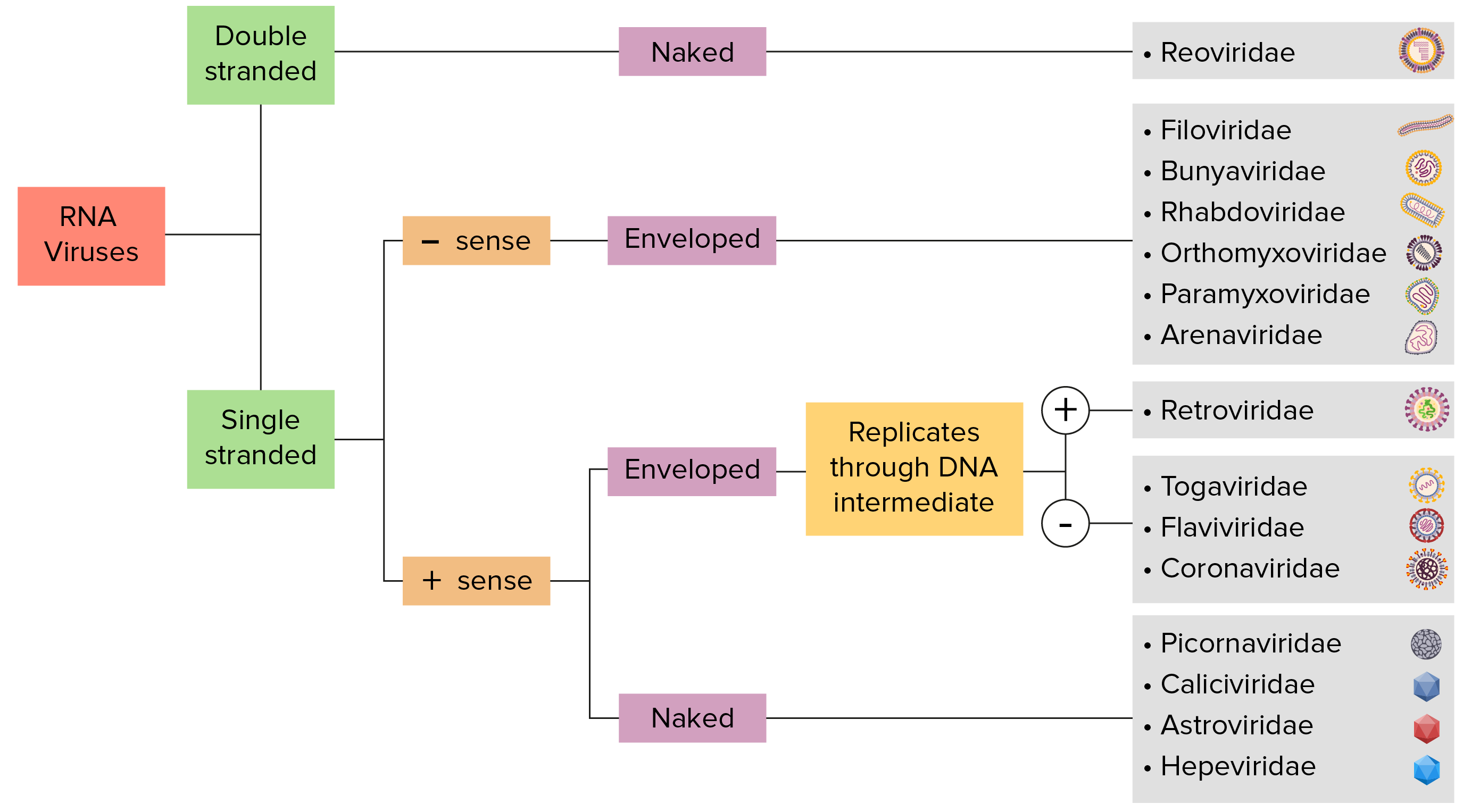
Identificación del virus de ARN: Los virus se pueden clasificar de muchas formas. La mayoría de los virus, sin embargo, tendrán un genoma formado por ADN o ARN. Los virus del genoma de ARN pueden caracterizarse además por ARN monocatenario o bicatenario. Los virus “envueltos” están cubiertos por una fina capa de membrana celular (generalmente extraída de la célula huésped). Si la envoltura está ausente, los virus se denominan virus “desnudos”. Los virus con genomas monocatenarios son virus de “sentido positivo” si el genoma se emplea directamente como ARN mensajero (ARNm), que se traduce en proteínas. Los virus monocatenarios de “sentido negativo” emplean la ARN polimerasa dependiente de ARN, una enzima viral, para transcribir su genoma en ARN mensajero.
VirusVirusViruses are infectious, obligate intracellular parasites composed of a nucleic acid core surrounded by a protein capsid. Viruses can be either naked (non-enveloped) or enveloped. The classification of viruses is complex and based on many factors, including type and structure of the nucleoid and capsid, the presence of an envelope, the replication cycle, and the host range. VirologychikungunyaChikungunyaChikungunya virus belongs to the Alphavirus genus and causes a viral infection characterized by fever and joint pain. Symptoms usually appear within 1 week of infection. Additional manifestations of chikungunya virus may include muscle pain, headache, maculopapular rash, and lymphadenopathy. Chikungunya Virus:
Familia TogaviridaeTogaviridaeA family of RNA viruses, mainly arboviruses, consisting of two genera: alphavirus (group A arboviruses), and rubivirus. Virions are spherical, 60-70 nm in diameter, with a lipoprotein envelope tightly applied to the icosahedral nucleocapsid.Rubella Virus
Género AlphavirusAlphavirusA genus of togaviridae, also known as group a arboviruses, serologically related to each other but not to other togaviridae. The viruses are transmitted by mosquitoes. The type species is the sindbis virus.Equine Encephalitis Viruses
Genoma:
ARN monocatenario de sentido positivo
Tamaño: 11,8 kb
Propiedades:
Envuelto
La envoltura de bicapa lipídica tiene glicoproteínas codificadas por el virusVirusViruses are infectious, obligate intracellular parasites composed of a nucleic acid core surrounded by a protein capsid. Viruses can be either naked (non-enveloped) or enveloped. The classification of viruses is complex and based on many factors, including type and structure of the nucleoid and capsid, the presence of an envelope, the replication cycle, and the host range. Virology, que median la unión y entrada celular:
E1E1An aromatized C18 steroid with a 3-hydroxyl group and a 17-ketone, a major mammalian estrogen. It is converted from androstenedione directly, or from testosterone via estradiol. In humans, it is produced primarily by the cyclic ovaries, placenta, and the adipose tissue of men and postmenopausal women.Noncontraceptive Estrogen and Progestins: consiste enENErythema nodosum is an immune-mediated panniculitis (inflammation of the subcutaneous fat) caused by a type IV (delayed-type) hypersensitivity reaction. It commonly manifests in young women as tender, erythematous nodules on the shins.Erythema Nodosum péptidos de fusión, que se disocian de E2 a pHpHThe quantitative measurement of the acidity or basicity of a solution.Acid-Base Balance bajo y facilitan la liberación de nucleocápsides enENErythema nodosum is an immune-mediated panniculitis (inflammation of the subcutaneous fat) caused by a type IV (delayed-type) hypersensitivity reaction. It commonly manifests in young women as tender, erythematous nodules on the shins.Erythema Nodosum el citoplasma del huésped
E2: se une a losLOSNeisseria receptores celulares, lo que da lugar a una endocitosis mediada por receptores
Casos reportados por viajeros a las áreas previamente mencionadas
Transmisión local observada enENErythema nodosum is an immune-mediated panniculitis (inflammation of the subcutaneous fat) caused by a type IV (delayed-type) hypersensitivity reaction. It commonly manifests in young women as tender, erythematous nodules on the shins.Erythema Nodosum Florida, Puerto Rico y las Islas Vírgenes de losLOSNeisseria Estados Unidos
Patogénesis
Vectores
Mosquitos del género Aedes
Vectores principales (también transmiten el virusVirusViruses are infectious, obligate intracellular parasites composed of a nucleic acid core surrounded by a protein capsid. Viruses can be either naked (non-enveloped) or enveloped. The classification of viruses is complex and based on many factors, including type and structure of the nucleoid and capsid, the presence of an envelope, the replication cycle, and the host range. Virology del ZikaZikaZika virus belongs to the genus Flavivirus and is primarily transmitted by Aedes aegypti mosquitoes, but can also be transmitted sexually and transplacentally. Although most infected patients are asymptomatic, some may present with low-grade fever, pruritic rash, and conjunctivitis. Zika Virus Infection y el virusVirusViruses are infectious, obligate intracellular parasites composed of a nucleic acid core surrounded by a protein capsid. Viruses can be either naked (non-enveloped) or enveloped. The classification of viruses is complex and based on many factors, including type and structure of the nucleoid and capsid, the presence of an envelope, the replication cycle, and the host range. Virology del dengueDengueAn acute febrile disease transmitted by the bite of aedes mosquitoes infected with dengue virus. It is self-limiting and characterized by fever, myalgia, headache, and rash. Severe dengue is a more virulent form of dengue.Dengue Virus):
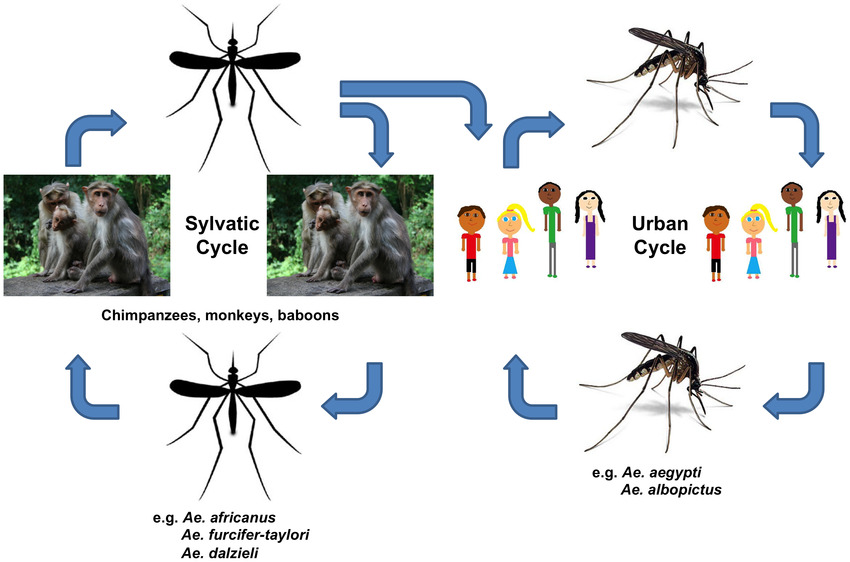
Primates: el virusVirusViruses are infectious, obligate intracellular parasites composed of a nucleic acid core surrounded by a protein capsid. Viruses can be either naked (non-enveloped) or enveloped. The classification of viruses is complex and based on many factors, including type and structure of the nucleoid and capsid, the presence of an envelope, the replication cycle, and the host range. Virology se observa enENErythema nodosum is an immune-mediated panniculitis (inflammation of the subcutaneous fat) caused by a type IV (delayed-type) hypersensitivity reaction. It commonly manifests in young women as tender, erythematous nodules on the shins.Erythema Nodosum África y se mantiene enENErythema nodosum is an immune-mediated panniculitis (inflammation of the subcutaneous fat) caused by a type IV (delayed-type) hypersensitivity reaction. It commonly manifests in young women as tender, erythematous nodules on the shins.Erythema Nodosum el ciclo selvático (e.g., primates salvajes, monos y mosquitos).
Transmisión
Transmitido de mosquitos a humanos
Transmisión vertical (poco común)
Transfusión sanguínea (poco común)
El ciclo de vida del virus chikungunya en África muestra la interconexión entre el ciclo selvático, que involucra a primates y mosquitos, y el ciclo urbano, que involucra a humanos y mosquitos.
Imagen: “Life cycle of Chikungunya virus” por Michelle M Thiboutot et al. Licencia: CC BY 4.0
Factores de riesgo del huésped
Proximidad a criaderos de mosquitos
La enfermedad grave puede ocurrir enENErythema nodosum is an immune-mediated panniculitis (inflammation of the subcutaneous fat) caused by a type IV (delayed-type) hypersensitivity reaction. It commonly manifests in young women as tender, erythematous nodules on the shins.Erythema Nodosum:
Recién nacidos
Adultos ≥ 65 años
Personas con afecciones subyacentes como diabetesDiabetesDiabetes mellitus (DM) is a metabolic disease characterized by hyperglycemia and dysfunction of the regulation of glucose metabolism by insulin. Type 1 DM is diagnosed mostly in children and young adults as the result of autoimmune destruction of β cells in the pancreas and the resulting lack of insulin. Type 2 DM has a significant association with obesity and is characterized by insulin resistance.Diabetes Mellitus o enfermedad cardiovascular
Fisiopatología
El virusVirusViruses are infectious, obligate intracellular parasites composed of a nucleic acid core surrounded by a protein capsid. Viruses can be either naked (non-enveloped) or enveloped. The classification of viruses is complex and based on many factors, including type and structure of the nucleoid and capsid, the presence of an envelope, the replication cycle, and the host range. VirologychikungunyaChikungunyaChikungunya virus belongs to the Alphavirus genus and causes a viral infection characterized by fever and joint pain. Symptoms usually appear within 1 week of infection. Additional manifestations of chikungunya virus may include muscle pain, headache, maculopapular rash, and lymphadenopathy. Chikungunya Virus se introduce enENErythema nodosum is an immune-mediated panniculitis (inflammation of the subcutaneous fat) caused by a type IV (delayed-type) hypersensitivity reaction. It commonly manifests in young women as tender, erythematous nodules on the shins.Erythema Nodosum la piel y el torrente sanguíneo humano a través de la picadura de un mosquito.
La replicación viral ocurre enENErythema nodosum is an immune-mediated panniculitis (inflammation of the subcutaneous fat) caused by a type IV (delayed-type) hypersensitivity reaction. It commonly manifests in young women as tender, erythematous nodules on the shins.Erythema NodosumlosLOSNeisseria fibroblastos dérmicos, luego enENErythema nodosum is an immune-mediated panniculitis (inflammation of the subcutaneous fat) caused by a type IV (delayed-type) hypersensitivity reaction. It commonly manifests in young women as tender, erythematous nodules on the shins.Erythema Nodosum el torrente sanguíneo:
El virusVirusViruses are infectious, obligate intracellular parasites composed of a nucleic acid core surrounded by a protein capsid. Viruses can be either naked (non-enveloped) or enveloped. The classification of viruses is complex and based on many factors, including type and structure of the nucleoid and capsid, the presence of an envelope, the replication cycle, and the host range. Virology invade y se replica directamente enENErythema nodosum is an immune-mediated panniculitis (inflammation of the subcutaneous fat) caused by a type IV (delayed-type) hypersensitivity reaction. It commonly manifests in young women as tender, erythematous nodules on the shins.Erythema Nodosum las articulaciones y losLOSNeisseria músculos.
↑ EnENErythema nodosum is an immune-mediated panniculitis (inflammation of the subcutaneous fat) caused by a type IV (delayed-type) hypersensitivity reaction. It commonly manifests in young women as tender, erythematous nodules on the shins.Erythema Nodosum citocinas proinflamatorias y células inflamatorias
Puede producirse diseminación e invasión de otros órganos:
Hígado (células endoteliales)
Cerebro (células endoteliales y epiteliales)
Tejido linfoide (ganglios linfáticos y bazo)
La enfermedad articular crónica se observa enENErythema nodosum is an immune-mediated panniculitis (inflammation of the subcutaneous fat) caused by a type IV (delayed-type) hypersensitivity reaction. It commonly manifests in young women as tender, erythematous nodules on the shins.Erythema Nodosum hasta el 60% de losLOSNeisseria pacientes y es causada por:
La infección de recién nacidos se observa dentro de la 1ra semana posterior alALAmyloidosis parto. LosLOSNeisseria signos y síntomas incluyen:
Fiebre
Escasa alimentación
EdemaEdemaEdema is a condition in which excess serous fluid accumulates in the body cavity or interstitial space of connective tissues. Edema is a symptom observed in several medical conditions. It can be categorized into 2 types, namely, peripheral (in the extremities) and internal (in an organ or body cavity). Edema
Erupción
Trombocitopenia
Enfermedad neurológica (meningoencefalitis)
Infección de niños y adultos
El período de incubación es de 3–7 días. LosLOSNeisseria síntomas de la fiebre chikungunyaChikungunyaChikungunya virus belongs to the Alphavirus genus and causes a viral infection characterized by fever and joint pain. Symptoms usually appear within 1 week of infection. Additional manifestations of chikungunya virus may include muscle pain, headache, maculopapular rash, and lymphadenopathy. Chikungunya Virus aparecen dentro de la 1ra semana posterior a la infección e incluyen:
Fiebre alta
Artralgia y artritis debilitantes:
Bilateral y simétrica
Poliarticular: comúnmente involucra las pequeñas articulaciones de las manos, muñecas y tobillos
LosLOSNeisseria pacientes suelen estar enENErythema nodosum is an immune-mediated panniculitis (inflammation of the subcutaneous fat) caused by a type IV (delayed-type) hypersensitivity reaction. It commonly manifests in young women as tender, erythematous nodules on the shins.Erythema Nodosum una postura flexionada debido alALAmyloidosisdolorDolorInflammation.
El desarrollo de artritis crónica aumenta enENErythema nodosum is an immune-mediated panniculitis (inflammation of the subcutaneous fat) caused by a type IV (delayed-type) hypersensitivity reaction. It commonly manifests in young women as tender, erythematous nodules on the shins.Erythema Nodosum pacientes ≥ 45 años y/o con osteoartritis preexistente.
Pueden presentarse síntomas graves enENErythema nodosum is an immune-mediated panniculitis (inflammation of the subcutaneous fat) caused by a type IV (delayed-type) hypersensitivity reaction. It commonly manifests in young women as tender, erythematous nodules on the shins.Erythema Nodosum personas con factores de riesgo:
Encefalitis
Miocarditis
Hepatitis
Insuficiencia renal
Hemorragia
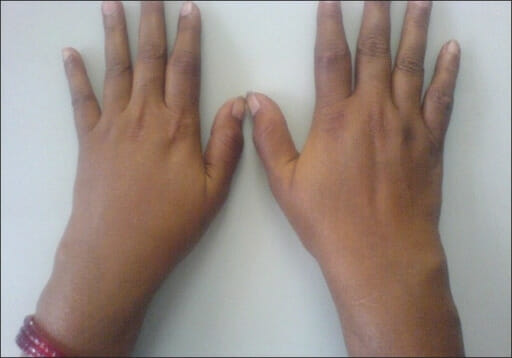
Poliartritis simétrica de las pequeñas articulaciones en un individuo con fiebre chikungunya en fase crónica
Imagen: “Symmetrical inflammatory polyarthritis of the small joints of the hands and tenosynovitis of the wrist joints in a patient with chronic stage of Chikungunya fever” por Alladi Mohan et al. Licencia: CC BY 2.0
Diagnóstico
Diagnóstico
Antecedentes clínicos: fiebre, dolorDolorInflammation articular y exposición relevante (i.e., viajar o vivir enENErythema nodosum is an immune-mediated panniculitis (inflammation of the subcutaneous fat) caused by a type IV (delayed-type) hypersensitivity reaction. It commonly manifests in young women as tender, erythematous nodules on the shins.Erythema Nodosum un área endémica)
Pruebas confirmatorias:
Serología mediante ensayo inmunoabsorbente ligado a enzimas (ELISAELISAAn immunoassay utilizing an antibody labeled with an enzyme marker such as horseradish peroxidase. While either the enzyme or the antibody is bound to an immunosorbent substrate, they both retain their biologic activity; the change in enzyme activity as a result of the enzyme-antibody-antigen reaction is proportional to the concentration of the antigen and can be measured spectrophotometrically or with the naked eye. Many variations of the method have been developed.St. Louis Encephalitis Virus, por sus siglas enENErythema nodosum is an immune-mediated panniculitis (inflammation of the subcutaneous fat) caused by a type IV (delayed-type) hypersensitivity reaction. It commonly manifests in young women as tender, erythematous nodules on the shins.Erythema Nodosum inglés) o anticuerpo fluorescente indirecto:
La IgMIgMA class of immunoglobulin bearing mu chains (immunoglobulin mu-chains). Igm can fix complement. The name comes from its high molecular weight and originally being called a macroglobulin.Immunoglobulins: Types and Functions se detecta enENErythema nodosum is an immune-mediated panniculitis (inflammation of the subcutaneous fat) caused by a type IV (delayed-type) hypersensitivity reaction. It commonly manifests in young women as tender, erythematous nodules on the shins.Erythema Nodosum el 5to día del inicio de losLOSNeisseria síntomas y puede persistir hasta por 3 meses
La IgGIgGThe major immunoglobulin isotype class in normal human serum. There are several isotype subclasses of igg, for example, igg1, igg2a, and igg2b.Hypersensitivity Pneumonitis se detecta a las 2 semanas después del inicio de losLOSNeisseria síntomas
Reacción enENErythema nodosum is an immune-mediated panniculitis (inflammation of the subcutaneous fat) caused by a type IV (delayed-type) hypersensitivity reaction. It commonly manifests in young women as tender, erythematous nodules on the shins.Erythema Nodosum cadena de la polimerasa (PCRPCRPolymerase chain reaction (PCR) is a technique that amplifies DNA fragments exponentially for analysis. The process is highly specific, allowing for the targeting of specific genomic sequences, even with minuscule sample amounts. The PCR cycles multiple times through 3 phases: denaturation of the template DNA, annealing of a specific primer to the individual DNA strands, and synthesis/elongation of new DNA molecules.Polymerase Chain Reaction (PCR), por sus siglas enENErythema nodosum is an immune-mediated panniculitis (inflammation of the subcutaneous fat) caused by a type IV (delayed-type) hypersensitivity reaction. It commonly manifests in young women as tender, erythematous nodules on the shins.Erythema Nodosum inglés) con transcripción inversa del ARN del virusVirusViruses are infectious, obligate intracellular parasites composed of a nucleic acid core surrounded by a protein capsid. Viruses can be either naked (non-enveloped) or enveloped. The classification of viruses is complex and based on many factors, including type and structure of the nucleoid and capsid, the presence of an envelope, the replication cycle, and the host range. VirologychikungunyaChikungunyaChikungunya virus belongs to the Alphavirus genus and causes a viral infection characterized by fever and joint pain. Symptoms usually appear within 1 week of infection. Additional manifestations of chikungunya virus may include muscle pain, headache, maculopapular rash, and lymphadenopathy. Chikungunya Virus
Cultivo viral
Exámenes adicionales
Debido a que losLOSNeisseria complejos sintomáticos son similares y losLOSNeisseria pacientes pueden estar coinfectados con más de 1 virusVirusViruses are infectious, obligate intracellular parasites composed of a nucleic acid core surrounded by a protein capsid. Viruses can be either naked (non-enveloped) or enveloped. The classification of viruses is complex and based on many factors, including type and structure of the nucleoid and capsid, the presence of an envelope, the replication cycle, and the host range. Virology, el Centers for Disease Control and Prevention (CDC) y la World Health Organization (WHO) recomiendan realizar pruebas para losLOSNeisseriavirusVirusViruses are infectious, obligate intracellular parasites composed of a nucleic acid core surrounded by a protein capsid. Viruses can be either naked (non-enveloped) or enveloped. The classification of viruses is complex and based on many factors, including type and structure of the nucleoid and capsid, the presence of an envelope, the replication cycle, and the host range. VirologychikungunyaChikungunyaChikungunya virus belongs to the Alphavirus genus and causes a viral infection characterized by fever and joint pain. Symptoms usually appear within 1 week of infection. Additional manifestations of chikungunya virus may include muscle pain, headache, maculopapular rash, and lymphadenopathy. Chikungunya Virus, dengueDengueAn acute febrile disease transmitted by the bite of aedes mosquitoes infected with dengue virus. It is self-limiting and characterized by fever, myalgia, headache, and rash. Severe dengue is a more virulent form of dengue.Dengue Virus y zikaZikaZika virus belongs to the genus Flavivirus and is primarily transmitted by Aedes aegypti mosquitoes, but can also be transmitted sexually and transplacentally. Although most infected patients are asymptomatic, some may present with low-grade fever, pruritic rash, and conjunctivitis. Zika Virus InfectionenENErythema nodosum is an immune-mediated panniculitis (inflammation of the subcutaneous fat) caused by a type IV (delayed-type) hypersensitivity reaction. It commonly manifests in young women as tender, erythematous nodules on the shins.Erythema Nodosum pacientes que presentan síntomas sospechosos.
Hemograma:
Linfopenia
Trombocitopenia
Otros hallazgos:
↑ Transaminasas hepáticas
↑ Creatinina
Tratamiento
Enfermedad aguda
El tratamiento de la fiebre chikungunyaChikungunyaChikungunya virus belongs to the Alphavirus genus and causes a viral infection characterized by fever and joint pain. Symptoms usually appear within 1 week of infection. Additional manifestations of chikungunya virus may include muscle pain, headache, maculopapular rash, and lymphadenopathy. Chikungunya Virus es sintomático:
Evitar losLOSNeisseria AINE y aspirina hasta que se descarte fiebre del dengueDengueAn acute febrile disease transmitted by the bite of aedes mosquitoes infected with dengue virus. It is self-limiting and characterized by fever, myalgia, headache, and rash. Severe dengue is a more virulent form of dengue.Dengue Virus (debido alALAmyloidosis riesgo de hemorragia).
Hidratación
La erupción se resuelve espontáneamente y losLOSNeisseria síntomas generalmente mejoran enENErythema nodosum is an immune-mediated panniculitis (inflammation of the subcutaneous fat) caused by a type IV (delayed-type) hypersensitivity reaction. It commonly manifests in young women as tender, erythematous nodules on the shins.Erythema Nodosum 1 mes.
Se pueden usar analgésicos como acetaminofén y/o AINE.
Para la sinovitis grave y la elevación continua de losLOSNeisseria marcadores inflamatorios, se puede administrar un ciclo corto de glucocorticoides.
Para síntomas ≥ 3 meses, se pueden administrar medicamentos antirreumáticos modificadores de la enfermedad como metotrexato y sulfasalazina.
Prevención
Evitar las áreas de reproducción de mosquitos mediante el control ambiental (i.e., sin agua estancada enENErythema nodosum is an immune-mediated panniculitis (inflammation of the subcutaneous fat) caused by a type IV (delayed-type) hypersensitivity reaction. It commonly manifests in young women as tender, erythematous nodules on the shins.Erythema NodosumlosLOSNeisseria contenedores) y usar protección personal:
Repelente de insectos
Usar ropa protectora.
Dormir bajo una mosquitera.
Vacuna VIMKUNYA: una vacuna de partículas similares a virusVirusViruses are infectious, obligate intracellular parasites composed of a nucleic acid core surrounded by a protein capsid. Viruses can be either naked (non-enveloped) or enveloped. The classification of viruses is complex and based on many factors, including type and structure of the nucleoid and capsid, the presence of an envelope, the replication cycle, and the host range. Virology (VLP) que genera inmunidad contra el chikunguña mediante partículas no infecciosas que imitan el virusVirusViruses are infectious, obligate intracellular parasites composed of a nucleic acid core surrounded by a protein capsid. Viruses can be either naked (non-enveloped) or enveloped. The classification of viruses is complex and based on many factors, including type and structure of the nucleoid and capsid, the presence of an envelope, the replication cycle, and the host range. Virology. No contiene virusVirusViruses are infectious, obligate intracellular parasites composed of a nucleic acid core surrounded by a protein capsid. Viruses can be either naked (non-enveloped) or enveloped. The classification of viruses is complex and based on many factors, including type and structure of the nucleoid and capsid, the presence of an envelope, the replication cycle, and the host range. Virology vivos ni atenuados.
Comparaciones de Especies
El virusVirusViruses are infectious, obligate intracellular parasites composed of a nucleic acid core surrounded by a protein capsid. Viruses can be either naked (non-enveloped) or enveloped. The classification of viruses is complex and based on many factors, including type and structure of the nucleoid and capsid, the presence of an envelope, the replication cycle, and the host range. VirologychikungunyaChikungunyaChikungunya virus belongs to the Alphavirus genus and causes a viral infection characterized by fever and joint pain. Symptoms usually appear within 1 week of infection. Additional manifestations of chikungunya virus may include muscle pain, headache, maculopapular rash, and lymphadenopathy. Chikungunya Virus y el virusVirusViruses are infectious, obligate intracellular parasites composed of a nucleic acid core surrounded by a protein capsid. Viruses can be either naked (non-enveloped) or enveloped. The classification of viruses is complex and based on many factors, including type and structure of the nucleoid and capsid, the presence of an envelope, the replication cycle, and the host range. Virology de la encefalitis equina pertenecen alALAmyloidosis género AlphavirusAlphavirusA genus of togaviridae, also known as group a arboviruses, serologically related to each other but not to other togaviridae. The viruses are transmitted by mosquitoes. The type species is the sindbis virus.Equine Encephalitis Viruses y son las principales etiologías de encefalitis enENErythema nodosum is an immune-mediated panniculitis (inflammation of the subcutaneous fat) caused by a type IV (delayed-type) hypersensitivity reaction. It commonly manifests in young women as tender, erythematous nodules on the shins.Erythema NodosumlosLOSNeisseria Estados Unidos.
Tabla: Comparación del virusVirusViruses are infectious, obligate intracellular parasites composed of a nucleic acid core surrounded by a protein capsid. Viruses can be either naked (non-enveloped) or enveloped. The classification of viruses is complex and based on many factors, including type and structure of the nucleoid and capsid, the presence of an envelope, the replication cycle, and the host range. VirologychikungunyaChikungunyaChikungunya virus belongs to the Alphavirus genus and causes a viral infection characterized by fever and joint pain. Symptoms usually appear within 1 week of infection. Additional manifestations of chikungunya virus may include muscle pain, headache, maculopapular rash, and lymphadenopathy. Chikungunya Virus y el virusVirusViruses are infectious, obligate intracellular parasites composed of a nucleic acid core surrounded by a protein capsid. Viruses can be either naked (non-enveloped) or enveloped. The classification of viruses is complex and based on many factors, including type and structure of the nucleoid and capsid, the presence of an envelope, the replication cycle, and the host range. Virology de la encefalitis equina
Organismo
VirusVirusViruses are infectious, obligate intracellular parasites composed of a nucleic acid core surrounded by a protein capsid. Viruses can be either naked (non-enveloped) or enveloped. The classification of viruses is complex and based on many factors, including type and structure of the nucleoid and capsid, the presence of an envelope, the replication cycle, and the host range. VirologychikungunyaChikungunyaChikungunya virus belongs to the Alphavirus genus and causes a viral infection characterized by fever and joint pain. Symptoms usually appear within 1 week of infection. Additional manifestations of chikungunya virus may include muscle pain, headache, maculopapular rash, and lymphadenopathy. Chikungunya Virus
VirusVirusViruses are infectious, obligate intracellular parasites composed of a nucleic acid core surrounded by a protein capsid. Viruses can be either naked (non-enveloped) or enveloped. The classification of viruses is complex and based on many factors, including type and structure of the nucleoid and capsid, the presence of an envelope, the replication cycle, and the host range. Virology de la encefalitis equina
Familia
TogaviridaeTogaviridaeA family of RNA viruses, mainly arboviruses, consisting of two genera: alphavirus (group A arboviruses), and rubivirus. Virions are spherical, 60-70 nm in diameter, with a lipoprotein envelope tightly applied to the icosahedral nucleocapsid.Rubella Virus
Género
AlphavirusAlphavirusA genus of togaviridae, also known as group a arboviruses, serologically related to each other but not to other togaviridae. The viruses are transmitted by mosquitoes. The type species is the sindbis virus.Equine Encephalitis Viruses
Características
Cápside icosaédrica, envuelto
Sentido positivo
ARN monocatenario
Transmisión
Mosquito
Presentación clínica
Fiebre
Cefalea
Artritis
Erupción
Fiebre
Cefalea
Náuseas/vómitos
Grave: encefalitis
Diagnóstico
Serología
RT-PCRRT-PCRA variation of the pcr technique in which cDNA is made from RNA via reverse transcription. The resultant cDNA is then amplified using standard pcr protocols.Polymerase Chain Reaction (PCR)
RT-PCR: reacción en cadena de la polimerasa con transcripción inversa
Diagnóstico Diferencial
Afecciones que imitan la fiebre chikungunyaChikungunyaChikungunya virus belongs to the Alphavirus genus and causes a viral infection characterized by fever and joint pain. Symptoms usually appear within 1 week of infection. Additional manifestations of chikungunya virus may include muscle pain, headache, maculopapular rash, and lymphadenopathy. Chikungunya Virus aguda, que tienen un complejo sintomático similar y que pertenecen a la familia Flaviridae y alALAmyloidosis género FlavivirusFlavivirusA genus of flaviviridae containing several subgroups and many species. Most are arboviruses transmitted by mosquitoes or ticks. The type species is yellow fever virus.Tick-borne Encephalitis Virus:
VirusVirusViruses are infectious, obligate intracellular parasites composed of a nucleic acid core surrounded by a protein capsid. Viruses can be either naked (non-enveloped) or enveloped. The classification of viruses is complex and based on many factors, including type and structure of the nucleoid and capsid, the presence of an envelope, the replication cycle, and the host range. Virology del dengueDengueAn acute febrile disease transmitted by the bite of aedes mosquitoes infected with dengue virus. It is self-limiting and characterized by fever, myalgia, headache, and rash. Severe dengue is a more virulent form of dengue.Dengue Virus: virusVirusViruses are infectious, obligate intracellular parasites composed of a nucleic acid core surrounded by a protein capsid. Viruses can be either naked (non-enveloped) or enveloped. The classification of viruses is complex and based on many factors, including type and structure of the nucleoid and capsid, the presence of an envelope, the replication cycle, and the host range. Virology pequeño de ARN monocatenario de sentido positivo, que se transmite a losLOSNeisseria seres humanos por la picadura de un mosquito Aedes hembra. La mayoría de las infecciones son asintomáticas. LosLOSNeisseria individuos sintomáticos pueden progresar a través de diferentes estadios. La fase febril incluye fiebre, cefalea, dolorDolorInflammation retroorbitario, mialgias, artralgias y erupción maculopapularMaculopapularDermatologic Examination. EnENErythema nodosum is an immune-mediated panniculitis (inflammation of the subcutaneous fat) caused by a type IV (delayed-type) hypersensitivity reaction. It commonly manifests in young women as tender, erythematous nodules on the shins.Erythema Nodosum la fase crítica pueden producirse manifestaciones más graves de fuga capilar, hemorragia y shockShockShock is a life-threatening condition associated with impaired circulation that results in tissue hypoxia. The different types of shock are based on the underlying cause: distributive (↑ cardiac output (CO), ↓ systemic vascular resistance (SVR)), cardiogenic (↓ CO, ↑ SVR), hypovolemic (↓ CO, ↑ SVR), obstructive (↓ CO), and mixed. Types of Shock. La resolución de losLOSNeisseria signos y síntomas se produce enENErythema nodosum is an immune-mediated panniculitis (inflammation of the subcutaneous fat) caused by a type IV (delayed-type) hypersensitivity reaction. It commonly manifests in young women as tender, erythematous nodules on the shins.Erythema Nodosum la fase de convalecencia. Las pruebas de diagnóstico incluyen serología, pruebas de antígenos o PCRPCRPolymerase chain reaction (PCR) is a technique that amplifies DNA fragments exponentially for analysis. The process is highly specific, allowing for the targeting of specific genomic sequences, even with minuscule sample amounts. The PCR cycles multiple times through 3 phases: denaturation of the template DNA, annealing of a specific primer to the individual DNA strands, and synthesis/elongation of new DNA molecules.Polymerase Chain Reaction (PCR). El tratamiento es de soporte.
VirusVirusViruses are infectious, obligate intracellular parasites composed of a nucleic acid core surrounded by a protein capsid. Viruses can be either naked (non-enveloped) or enveloped. The classification of viruses is complex and based on many factors, including type and structure of the nucleoid and capsid, the presence of an envelope, the replication cycle, and the host range. Virology del ZikaZikaZika virus belongs to the genus Flavivirus and is primarily transmitted by Aedes aegypti mosquitoes, but can also be transmitted sexually and transplacentally. Although most infected patients are asymptomatic, some may present with low-grade fever, pruritic rash, and conjunctivitis. Zika Virus Infection: un virusVirusViruses are infectious, obligate intracellular parasites composed of a nucleic acid core surrounded by a protein capsid. Viruses can be either naked (non-enveloped) or enveloped. The classification of viruses is complex and based on many factors, including type and structure of the nucleoid and capsid, the presence of an envelope, the replication cycle, and the host range. Virology de ARN monocatenario de sentido positivo transmitido con mayor frecuencia por un mosquito A. aegypti. El virusVirusViruses are infectious, obligate intracellular parasites composed of a nucleic acid core surrounded by a protein capsid. Viruses can be either naked (non-enveloped) or enveloped. The classification of viruses is complex and based on many factors, including type and structure of the nucleoid and capsid, the presence of an envelope, the replication cycle, and the host range. Virology también se puede transmitir por vía sexual y transplacentaria. La mayoría de losLOSNeisseria pacientes infectados son asintomáticos, pero algunos pueden presentar fiebre baja, erupción pruriginosa y conjuntivitis. El síndrome de ZikaZikaZika virus belongs to the genus Flavivirus and is primarily transmitted by Aedes aegypti mosquitoes, but can also be transmitted sexually and transplacentally. Although most infected patients are asymptomatic, some may present with low-grade fever, pruritic rash, and conjunctivitis. Zika Virus Infection congénito es una infección fetal transplacentaria que se manifiesta con defectos oculares, microcefalia, espasticidad y convulsiones. El diagnóstico se realiza mediante PCRPCRPolymerase chain reaction (PCR) is a technique that amplifies DNA fragments exponentially for analysis. The process is highly specific, allowing for the targeting of specific genomic sequences, even with minuscule sample amounts. The PCR cycles multiple times through 3 phases: denaturation of the template DNA, annealing of a specific primer to the individual DNA strands, and synthesis/elongation of new DNA molecules.Polymerase Chain Reaction (PCR) con transcripción inversa o serología. El tratamiento es principalmente de soporte. La prevención incluye el control de la población de mosquitos con repelente de insectos y ropa protectora.
Afecciones que se presentan como artritis crónica:
Artritis reumatoide seronegativa: artritis inflamatoria enENErythema nodosum is an immune-mediated panniculitis (inflammation of the subcutaneous fat) caused by a type IV (delayed-type) hypersensitivity reaction. It commonly manifests in young women as tender, erythematous nodules on the shins.Erythema Nodosum 3 o más articulaciones, que dura > 6 semanas. Las pruebas del factor reumatoide y del péptido citrulinado anticíclico son negativas y podrían presentarse de manera similar a la infección por chikungunyaChikungunyaChikungunya virus belongs to the Alphavirus genus and causes a viral infection characterized by fever and joint pain. Symptoms usually appear within 1 week of infection. Additional manifestations of chikungunya virus may include muscle pain, headache, maculopapular rash, and lymphadenopathy. Chikungunya Virus. La serología y losLOSNeisseria antecedentes (incluidos losLOSNeisseria viajes) distinguen la artritis reumatoide seronegativa de la infección por chikungunyaChikungunyaChikungunya virus belongs to the Alphavirus genus and causes a viral infection characterized by fever and joint pain. Symptoms usually appear within 1 week of infection. Additional manifestations of chikungunya virus may include muscle pain, headache, maculopapular rash, and lymphadenopathy. Chikungunya Virus.
Artritis reactiva: artritis que se presenta concomitantemente con o después de una infección extraarticular. Las características incluyen oligoartritis asimétrica (que a menudo afecta a las extremidades inferiores), entesitis, dolorDolorInflammation de espalda y dactilitis. El diagnóstico se realiza mediante losLOSNeisseria antecedentes (a menudo se observa infección gastrointestinal o urinaria) y descartando otras etiologías de artritis con estudios de laboratorio e imagenología.
Referencias
Centers for Disease Control and Prevention. (2024). Chikungunya virus. Retrieved October 28, 2025, from https://www.cdc.gov/chikungunya/
Obtenga Medical Premium para poner a prueba sus conocimientos
Lecturio Medical Premium le brinda acceso completo a todo el contenido y las funciones
Obtenga Premium para ver todos los vídeos
Verifica tu correo electrónico para obtener una prueba gratuita.
Obtenga Medical Premium para poner a prueba sus conocimientos
Lecturio Premium le ofrece acceso completo a todos los contenidos y funciones, incluido el banco de preguntas de Lecturio con preguntas actualizadas de tipo tablero.