Domina Conceptos Médicos

Estudia para la escuela de medicina y tus examenes con Lecturio.

Tumores Hepáticos Malignos Poco Frecuentes

Aunque el carcinoma hepatocelular es, con diferencia, el tumor Tumor Inflammation hepático maligno más frecuente, existen varios tumores malignos poco frecuentes que es importante tener en EN Erythema nodosum is an immune-mediated panniculitis (inflammation of the subcutaneous fat) caused by a type IV (delayed-type) hypersensitivity reaction. It commonly manifests in young women as tender, erythematous nodules on the shins. Erythema Nodosum cuenta a la hora de realizar un diagnóstico diferencial. Estos tumores incluyen el colangiocarcinoma; el hepatoblastoma Hepatoblastoma A malignant neoplasm occurring in young children, primarily in the liver, composed of tissue resembling embryonal or fetal hepatic epithelium, or mixed epithelial and mesenchymal tissues. Rare Malignant Liver Tumors y los LOS Neisseria tumores mesenquimales, como el hemangioendotelioma epitelioide; y el angiosarcoma. Aunque estas condiciones difieren en EN Erythema nodosum is an immune-mediated panniculitis (inflammation of the subcutaneous fat) caused by a type IV (delayed-type) hypersensitivity reaction. It commonly manifests in young women as tender, erythematous nodules on the shins. Erythema Nodosum su etiología y patología, a menudo se presentan de forma similar, con síntomas inespecíficos como fatiga, pérdida de peso y malestar abdominal. El diagnóstico se realiza mediante imagenología, que pueden apoyarse en EN Erythema nodosum is an immune-mediated panniculitis (inflammation of the subcutaneous fat) caused by a type IV (delayed-type) hypersensitivity reaction. It commonly manifests in young women as tender, erythematous nodules on the shins. Erythema Nodosum una biopsia. La escisión quirúrgica es el único tratamiento curativo para estos tumores.

Last updated: Dec 15, 2025

Editorial responsibility: Stanley Oiseth, Lindsay Jones, Evelin Maza

Colangiocarcinoma

Epidemiología y etiología

  • Segundo tumor Tumor Inflammation hepático primario maligno más frecuente
  • Representa el 7.6% de las muertes por cáncer en EN Erythema nodosum is an immune-mediated panniculitis (inflammation of the subcutaneous fat) caused by a type IV (delayed-type) hypersensitivity reaction. It commonly manifests in young women as tender, erythematous nodules on the shins. Erythema Nodosum el mundo y el 3% de las muertes por cáncer en EN Erythema nodosum is an immune-mediated panniculitis (inflammation of the subcutaneous fat) caused by a type IV (delayed-type) hypersensitivity reaction. It commonly manifests in young women as tender, erythematous nodules on the shins. Erythema Nodosum los LOS Neisseria Estados Unidos
  • Es muy común en EN Erythema nodosum is an immune-mediated panniculitis (inflammation of the subcutaneous fat) caused by a type IV (delayed-type) hypersensitivity reaction. It commonly manifests in young women as tender, erythematous nodules on the shins. Erythema Nodosum los LOS Neisseria países del sudeste asiático debido a la mayor prevalencia de la infestación por la duela del hígado:
    • Tailandia
    • Laos
    • Camboya

Patogénesis y factores de riesgo

Trastornos genéticos:

  • Síndrome de Lynch (cáncer colorrectal hereditario no polipósico)
  • Fibrosis Fibrosis Any pathological condition where fibrous connective tissue invades any organ, usually as a consequence of inflammation or other injury. Bronchiolitis Obliterans quística
  • Papilomatosis biliar múltiple

Toxinas:

El colangiocarcinoma se asocia con trabajar en EN Erythema nodosum is an immune-mediated panniculitis (inflammation of the subcutaneous fat) caused by a type IV (delayed-type) hypersensitivity reaction. It commonly manifests in young women as tender, erythematous nodules on the shins. Erythema Nodosum las siguientes industrias:

  • Automóviles
  • Caucho
  • Química
  • Acabados de madera

Lesiones precursoras/pre-malignas:

  • Neoplasia intraepitelial biliar: puede convertirse en EN Erythema nodosum is an immune-mediated panniculitis (inflammation of the subcutaneous fat) caused by a type IV (delayed-type) hypersensitivity reaction. It commonly manifests in young women as tender, erythematous nodules on the shins. Erythema Nodosum colangiocarcinoma
  • Tumores del sistema hepatobiliar productores de mucina, tipos no invasivos e invasivos

Otras causas:

  • Las condiciones inflamatorias crónicas que afectan a los LOS Neisseria conductos biliares → la lesión y la reacción promueven la adquisición de mutaciones conductoras del cáncer
  • Colangitis esclerosante primaria
  • Infestación por duelas del hígado (Opisthorchis y Clonorchis spp.)
  • Hepatolitiasis (colangitis piógena recurrente)
  • Enfermedades hepáticas crónicas que predisponen al AL Amyloidosis carcinoma hepatocelular:
    • Hepatitis B Hepatitis B Hepatitis B virus (HBV) is a partially double-stranded DNA virus, which belongs to the Orthohepadnavirus genus and the Hepadnaviridae family. Most individuals with acute HBV infection are asymptomatic or have mild, self-limiting symptoms. Chronic infection can be asymptomatic or create hepatic inflammation, leading to liver cirrhosis and hepatocellular carcinoma (HCC). Hepatitis B Virus y C
    • Enfermedad de hígado graso no alcohólico

Patología

  • Surge de las células epiteliales de los LOS Neisseria conductos biliares intra y extrahepáticos
  • Masa o masas firmes, de color blanco grisáceo
  • Tumor Tumor Inflammation de Klatskin: tumor Tumor Inflammation extrahepático en EN Erythema nodosum is an immune-mediated panniculitis (inflammation of the subcutaneous fat) caused by a type IV (delayed-type) hypersensitivity reaction. It commonly manifests in young women as tender, erythematous nodules on the shins. Erythema Nodosum la unión de los LOS Neisseria conductos hepáticos derecho e izquierdo; representa el 60%–70% de los LOS Neisseria tumores extrahepáticos
  • Conducto biliar común: 30%–40% de los LOS Neisseria tumores extrahepáticos
    • Se descubren antes porque provocan ictericia obstructiva de forma precoz
    • La morfología varía: sólida, infiltrativa o papilar
  • Aspecto microscópico:
    • Adenocarcinoma, bien a moderadamente diferenciado
    • Estroma fibroso abundante
    • La invasión linfovascular y perineural son comunes.
    • También se produce un carcinoma hepatocelular-colangiocarcinoma combinado.

Presentación clínica

  • Síntomas relacionados con la obstrucción biliar (ictericia, prurito)
  • Pérdida de peso
  • Masa hepática sintomática: Malestar en EN Erythema nodosum is an immune-mediated panniculitis (inflammation of the subcutaneous fat) caused by a type IV (delayed-type) hypersensitivity reaction. It commonly manifests in young women as tender, erythematous nodules on the shins. Erythema Nodosum el cuadrante superior derecho

Diagnóstico

El colangiocarcinoma puede detectarse fortuitamente en EN Erythema nodosum is an immune-mediated panniculitis (inflammation of the subcutaneous fat) caused by a type IV (delayed-type) hypersensitivity reaction. It commonly manifests in young women as tender, erythematous nodules on the shins. Erythema Nodosum la imagenología o puede presentarse con síntomas.

Estudios de laboratorio:

  • Evaluar la colestasis:
    • Fosfatasa alcalina
    • Gamma-glutamiltransferasa ( GGT GGT An enzyme, sometimes called ggt, with a key role in the synthesis and degradation of glutathione; (gsh, a tripeptide that protects cells from many toxins). It catalyzes the transfer of the gamma-glutamyl moiety to an acceptor amino acid. Alcoholic Liver Disease)
    • Bilirrubina (total, directa e indirecta)
  • La AST AST Enzymes of the transferase class that catalyze the conversion of l-aspartate and 2-ketoglutarate to oxaloacetate and l-glutamate. Liver Function Tests y la ALT ALT An enzyme that catalyzes the conversion of l-alanine and 2-oxoglutarate to pyruvate and l-glutamate. Liver Function Tests pueden ser normales o estar mínimamente elevadas.
  • Biomarcadores:
    • Antígeno de carbohidratos ( CA CA Condylomata acuminata are a clinical manifestation of genital HPV infection. Condylomata acuminata are described as raised, pearly, flesh-colored, papular, cauliflower-like lesions seen in the anogenital region that may cause itching, pain, or bleeding. Condylomata Acuminata (Genital Warts) 19-9, por sus siglas en EN Erythema nodosum is an immune-mediated panniculitis (inflammation of the subcutaneous fat) caused by a type IV (delayed-type) hypersensitivity reaction. It commonly manifests in young women as tender, erythematous nodules on the shins. Erythema Nodosum inglés)
    • Antígeno carcinoembrionario ( CEA CEA A glycoprotein that is secreted into the luminal surface of the epithelia in the gastrointestinal tract. It is found in the feces and pancreaticobiliary secretions and is used to monitor the response to colon cancer treatment. Serum Tumor Markers, por sus siglas en EN Erythema nodosum is an immune-mediated panniculitis (inflammation of the subcutaneous fat) caused by a type IV (delayed-type) hypersensitivity reaction. It commonly manifests in young women as tender, erythematous nodules on the shins. Erythema Nodosum inglés)
    • Ambos suelen estar elevados.

Imagenología:

  • Ultrasonido para excluir una causa benigna de la obstrucción
  • Colangiopancreatografía por resonancia magnética:
    • Colangiocarcinoma extrahepático distal: dilatación ductal intrahepática y extrahepática
    • Colangiocarcinoma perihiliar: dilatación ductal intrahepática con conductos extrahepáticos de calibre normal
    • Colangiocarcinoma intrahepático: lesión de masa
  • Biopsia: si la imagenología no es concluyente
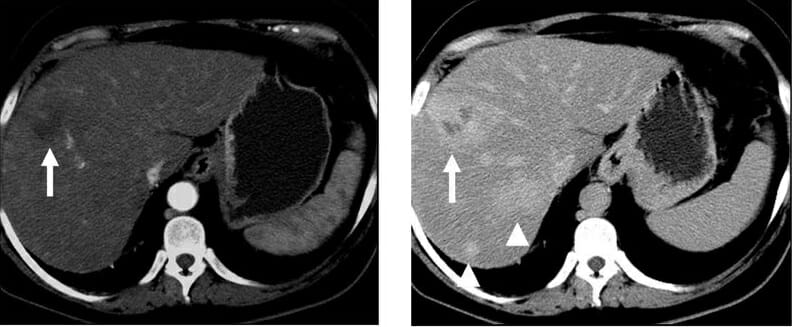
Arterial and portal venous phase CT of cholangiocarcinoma

TC en fase arterial y venosa portal del colangiocarcinoma

Imagen: “Arterial and portal venous phase CT of cholangiocarcinoma” por Kristie Guite, Louis Hinshaw and Fred Lee. Licencia: CC BY 3.0
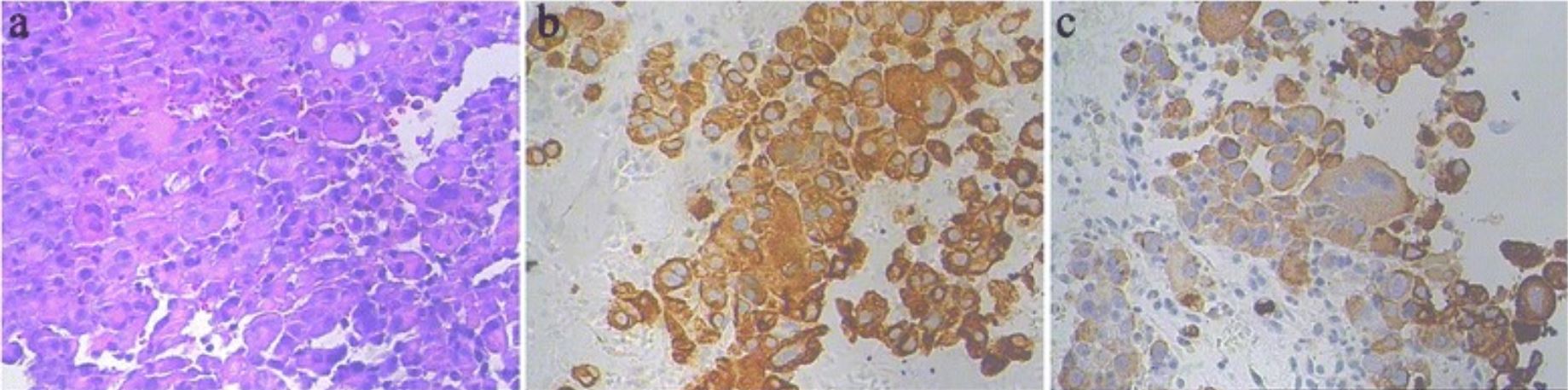
Fotomicrografías de colangiocarcinoma intrahepático

Fotomicrografías del colangiocarcinoma intrahepático:
a: células epiteliales marcadamente atípicas (H&E, 200x)
b y c: tinciones inmunohistoquímicas para las citoqueratinas CK7 (b) y CK19 (c), apoyando el diagnóstico de colangiocarcinoma (inmunohistoquímica, 200x)

Imagen: “Photomicrographs of intrahepatic cholangiocarcinoma” por Liu ZY, Sun JJ, He KW, Zhuo PY, Yu ZY. Licencia: CC BY 4.0

Tratamiento

  • Resección quirúrgica
  • Quimioterapia neoadyuvante o adyuvante

Pronóstico

  • El pronóstico global es malo: 20%–40% de supervivencia tras la resección quirúrgica
  • La enfermedad metastásica está presente en EN Erythema nodosum is an immune-mediated panniculitis (inflammation of the subcutaneous fat) caused by a type IV (delayed-type) hypersensitivity reaction. It commonly manifests in young women as tender, erythematous nodules on the shins. Erythema Nodosum el 50%–60% de los LOS Neisseria pacientes en EN Erythema nodosum is an immune-mediated panniculitis (inflammation of the subcutaneous fat) caused by a type IV (delayed-type) hypersensitivity reaction. It commonly manifests in young women as tender, erythematous nodules on the shins. Erythema Nodosum el momento de la presentación.
  • Las recidivas son comunes después de la cirugía.
  • Favorable si los LOS Neisseria márgenes de resección quirúrgica son negativos y no hay afectación de los LOS Neisseria ganglios linfáticos.

Hepatoblastoma

Epidemiología y etiología

  • La neoplasia hepática primaria más frecuente en EN Erythema nodosum is an immune-mediated panniculitis (inflammation of the subcutaneous fat) caused by a type IV (delayed-type) hypersensitivity reaction. It commonly manifests in young women as tender, erythematous nodules on the shins. Erythema Nodosum la primera infancia
  • 1% de todas las neoplasias infantiles
  • Proporción niños:niñas de 2:1
  • La mayoría se produce en EN Erythema nodosum is an immune-mediated panniculitis (inflammation of the subcutaneous fat) caused by a type IV (delayed-type) hypersensitivity reaction. It commonly manifests in young women as tender, erythematous nodules on the shins. Erythema Nodosum los LOS Neisseria dos primeros años de vida.
  • Surge de las células primitivas

Patogénesis y factores de riesgo

  • Prematuridad con muy bajo peso al AL Amyloidosis nacer
  • Exposición temprana a la infección por hepatitis B Hepatitis B Hepatitis B virus (HBV) is a partially double-stranded DNA virus, which belongs to the Orthohepadnavirus genus and the Hepadnaviridae family. Most individuals with acute HBV infection are asymptomatic or have mild, self-limiting symptoms. Chronic infection can be asymptomatic or create hepatic inflammation, leading to liver cirrhosis and hepatocellular carcinoma (HCC). Hepatitis B Virus
  • Atresia Atresia Hypoplastic Left Heart Syndrome (HLHS) biliar
  • Condiciones genéticas:
    • Síndrome de Beckwith-Wiedemann
    • Poliposis adenomatosa familiar
    • Trisomía 21

Patología

  • Lesiones únicas o múltiples bien circunscritas, de hasta 20 cm (8 pulgadas)
  • Hemorragia y necrosis Necrosis The death of cells in an organ or tissue due to disease, injury or failure of the blood supply. Ischemic Cell Damage debido al AL Amyloidosis rápido crecimiento
  • Microscópicamente:
    • Células hepáticas malignas, en EN Erythema nodosum is an immune-mediated panniculitis (inflammation of the subcutaneous fat) caused by a type IV (delayed-type) hypersensitivity reaction. It commonly manifests in young women as tender, erythematous nodules on the shins. Erythema Nodosum distintas fases de maduración
    • Componentes mesenquimales dispersos, incluyendo hueso y cartílago

Presentación clínica

  • A menudo son asintomáticos en EN Erythema nodosum is an immune-mediated panniculitis (inflammation of the subcutaneous fat) caused by a type IV (delayed-type) hypersensitivity reaction. It commonly manifests in young women as tender, erythematous nodules on the shins. Erythema Nodosum su presentación
  • Distensión abdominal, masa abdominal de rápido crecimiento
  • Anorexia Anorexia The lack or loss of appetite accompanied by an aversion to food and the inability to eat. It is the defining characteristic of the disorder anorexia nervosa. Anorexia Nervosa, pérdida de peso
  • Fatiga
  • La enfermedad está avanzada para el momento del diagnóstico en EN Erythema nodosum is an immune-mediated panniculitis (inflammation of the subcutaneous fat) caused by a type IV (delayed-type) hypersensitivity reaction. It commonly manifests in young women as tender, erythematous nodules on the shins. Erythema Nodosum el 40% de los LOS Neisseria pacientes, con metástasis pulmonares en EN Erythema nodosum is an immune-mediated panniculitis (inflammation of the subcutaneous fat) caused by a type IV (delayed-type) hypersensitivity reaction. It commonly manifests in young women as tender, erythematous nodules on the shins. Erythema Nodosum el 20% de los LOS Neisseria casos.
  • La muerte puede ocurrir por la ruptura del tumor Tumor Inflammation, y puede ser la 1era manifestación de la enfermedad.

Diagnóstico

  • Los LOS Neisseria niveles séricos de alfa-fetoproteína son notablemente elevados.
  • Imagenología: Se pueden utilizar todas las modalidades.
    • Ultrasonido
    • TC
    • RM
    • Gammagrafía ósea con radionúclidos
    • Tomografía por emisión de positrones ( PET PET An imaging technique that combines a positron-emission tomography (PET) scanner and a ct X ray scanner. This establishes a precise anatomic localization in the same session. Nuclear Imaging, por sus siglas en EN Erythema nodosum is an immune-mediated panniculitis (inflammation of the subcutaneous fat) caused by a type IV (delayed-type) hypersensitivity reaction. It commonly manifests in young women as tender, erythematous nodules on the shins. Erythema Nodosum inglés)
  • Biopsia: se prefiere la biopsia quirúrgica abierta (si no se reseca el tumor Tumor Inflammation) debido a la alta vascularidad del tumor Tumor Inflammation

Tratamiento

  • Resección quirúrgica
  • Quimioterapia neoadyuvante o adyuvante
  • Puede utilizarse la radioterapia adyuvante.

Pronóstico

La tasa de supervivencia global ha HA Hemolytic anemia (HA) is the term given to a large group of anemias that are caused by the premature destruction/hemolysis of circulating red blood cells (RBCs). Hemolysis can occur within (intravascular hemolysis) or outside the blood vessels (extravascular hemolysis). Hemolytic Anemia mejorado mucho en EN Erythema nodosum is an immune-mediated panniculitis (inflammation of the subcutaneous fat) caused by a type IV (delayed-type) hypersensitivity reaction. It commonly manifests in young women as tender, erythematous nodules on the shins. Erythema Nodosum las últimas 4 décadas y ahora se sitúa en EN Erythema nodosum is an immune-mediated panniculitis (inflammation of the subcutaneous fat) caused by a type IV (delayed-type) hypersensitivity reaction. It commonly manifests in young women as tender, erythematous nodules on the shins. Erythema Nodosum el 81%.
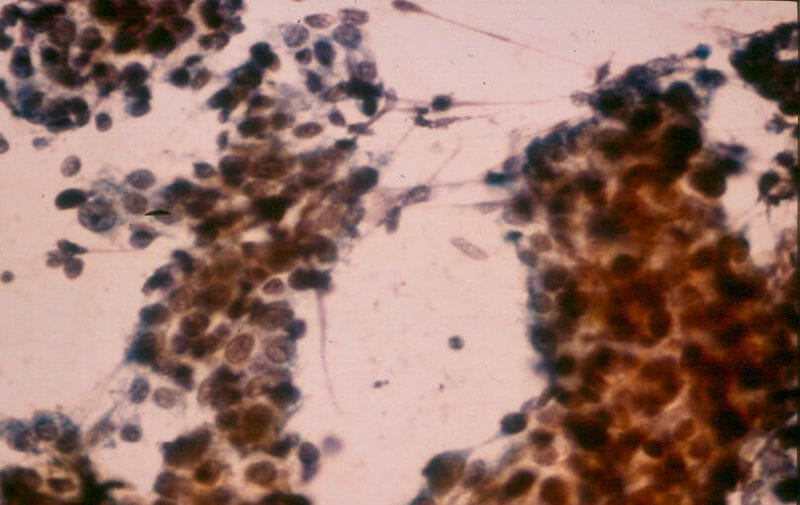
Hepatoblastoma

Hepatoblastoma:
characteristic of the embryonal cell type, fine-needle biopsy aspirate consists of small, oval-to-spindle shaped cells with a small amount of cytoplasm and prominent nucleoli

Image: “Hepatoblastoma” by David C Chhieng. License: CC BY 2.0

Tumores Mesenquimales

Hemangioendotelioma epitelioide

El hemangioendotelioma epitelioide es una neoplasia vascular maligna de bajo grado.

  • Epidemiología: más frecuente en EN Erythema nodosum is an immune-mediated panniculitis (inflammation of the subcutaneous fat) caused by a type IV (delayed-type) hypersensitivity reaction. It commonly manifests in young women as tender, erythematous nodules on the shins. Erythema Nodosum mujeres que en EN Erythema nodosum is an immune-mediated panniculitis (inflammation of the subcutaneous fat) caused by a type IV (delayed-type) hypersensitivity reaction. It commonly manifests in young women as tender, erythematous nodules on the shins. Erythema Nodosum hombres
  • Patología:
    • El tumor Tumor Inflammation surge alrededor de las venas de tamaño mediano y grande.
    • Los LOS Neisseria canales vasculares son discretos; +/- calcificación, fibrosis Fibrosis Any pathological condition where fibrous connective tissue invades any organ, usually as a consequence of inflammation or other injury. Bronchiolitis Obliterans
    • Las células neoplásicas son regordetas y a menudo cúbicas.
  • Presentación clínica:
  • Tratamiento:
    • La escisión quirúrgica es curativa en EN Erythema nodosum is an immune-mediated panniculitis (inflammation of the subcutaneous fat) caused by a type IV (delayed-type) hypersensitivity reaction. It commonly manifests in young women as tender, erythematous nodules on the shins. Erythema Nodosum la mayoría de los LOS Neisseria casos
    • Tasa de recurrencia del 40%.
    • El 20%–30% de los LOS Neisseria hemangioendoteliomas epitelioides hacen metástasis.
    • El 15% de los LOS Neisseria pacientes fallecerá a causa de su tumor Tumor Inflammation.

Angiosarcoma

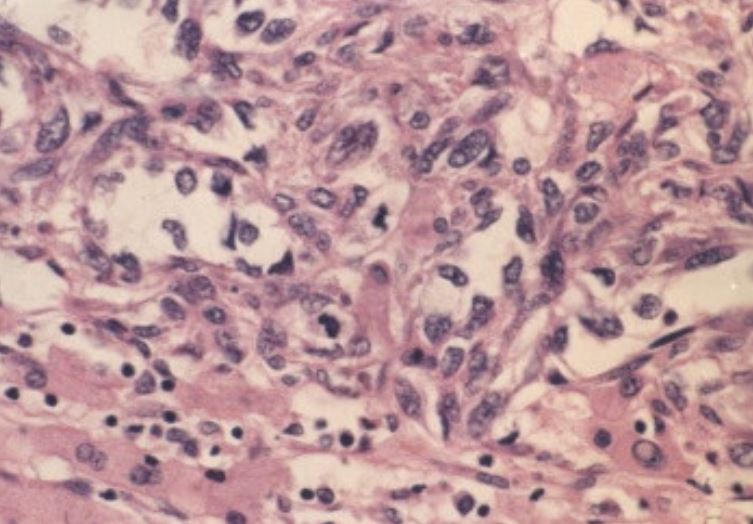
El angiosarcoma es una neoplasia vascular maligna de alto grado.
  • Epidemiología:
    • Es el sarcoma más común que surge en EN Erythema nodosum is an immune-mediated panniculitis (inflammation of the subcutaneous fat) caused by a type IV (delayed-type) hypersensitivity reaction. It commonly manifests in young women as tender, erythematous nodules on the shins. Erythema Nodosum el hígado
    • La mayoría de los LOS Neisseria pacientes son de edad avanzada (> 60 años)
    • Hombres > mujeres
  • Etiología: varios factores de riesgo son responsables del 25% de los LOS Neisseria casos, e incluyen:
    • Cloruro de vinilo
    • Arsénico (e.g., en EN Erythema nodosum is an immune-mediated panniculitis (inflammation of the subcutaneous fat) caused by a type IV (delayed-type) hypersensitivity reaction. It commonly manifests in young women as tender, erythematous nodules on the shins. Erythema Nodosum pesticidas)
    • Esteroides anabólicos
    • Anticonceptivos orales
    • Radiación
    • Dióxido de torio
  • Patología:
    • La morfología varía de tumores bien diferenciados que se asemejan a los LOS Neisseria hemangiomas hasta las lesiones anaplásicas.
    • Forma varios nódulos hemorrágicos de tamaño variable Variable Variables represent information about something that can change. The design of the measurement scales, or of the methods for obtaining information, will determine the data gathered and the characteristics of that data. As a result, a variable can be qualitative or quantitative, and may be further classified into subgroups. Types of Variables
    • A menudo se ve VE Ventilation: Mechanics of Breathing afectado todo el hígado.
    • Invade y crece en EN Erythema nodosum is an immune-mediated panniculitis (inflammation of the subcutaneous fat) caused by a type IV (delayed-type) hypersensitivity reaction. It commonly manifests in young women as tender, erythematous nodules on the shins. Erythema Nodosum los LOS Neisseria sinusoides y las ramas de la vena porta y hepática
    • La inmunotinción muestra positividad para los LOS Neisseria marcadores vasculares.
  • Presentación clínica:
    • Dolor Dolor Inflammation abdominal
    • Fatiga
    • Ictericia
    • Ascitis
    • Pérdida de peso
    • Hepatomegalia, +/- esplenomegalia
    • Trombocitopenia
  • Tratamiento: escisión quirúrgica
  • Pronóstico:
    • Las metástasis ocurren de manera frecuente y rápida en EN Erythema nodosum is an immune-mediated panniculitis (inflammation of the subcutaneous fat) caused by a type IV (delayed-type) hypersensitivity reaction. It commonly manifests in young women as tender, erythematous nodules on the shins. Erythema Nodosum el bazo, los LOS Neisseria ganglios linfáticos, los LOS Neisseria pulmones, los LOS Neisseria huesos y las glándulas suprarrenales.
    • La insuficiencia hepática y la hemorragia intraabdominal debidas a la ruptura hepática son causas comunes de muerte.
    • La supervivencia a los LOS Neisseria 5 años es de aproximadamente el 30%.

Mnemotecnia

Los factores de riesgo del angiosarcoma hepático pueden recordarse como “VAT” ( en EN Erythema nodosum is an immune-mediated panniculitis (inflammation of the subcutaneous fat) caused by a type IV (delayed-type) hypersensitivity reaction. It commonly manifests in young women as tender, erythematous nodules on the shins. Erythema Nodosum inglés):

  • V Vinyl chloride Vinyl chloride A gas that has been used as an aerosol propellant and is the starting material for polyvinyl resins. Toxicity studies have shown various adverse effects, particularly the occurrence of liver neoplasms. Rare Malignant Liver Tumors (Cloruro de vinilo)
  • A Arsenic Arsenic A shiny gray element with atomic symbol as, atomic number 33, and atomic weight 75. It occurs throughout the universe, mostly in the form of metallic arsenides. Most forms are toxic. According to the fourth annual report on carcinogens, arsenic and certain arsenic compounds have been listed as known carcinogens. Metal Poisoning (Lead, Arsenic, Iron) (Arsénico)
  • T – Thorium dioxide (Dióxido de torio)

Diagnóstico Diferencial

Las siguientes condiciones abarcan las lesiones benignas más importantes incluidas en EN Erythema nodosum is an immune-mediated panniculitis (inflammation of the subcutaneous fat) caused by a type IV (delayed-type) hypersensitivity reaction. It commonly manifests in young women as tender, erythematous nodules on the shins. Erythema Nodosum el diagnóstico diferencial de una masa sólida en EN Erythema nodosum is an immune-mediated panniculitis (inflammation of the subcutaneous fat) caused by a type IV (delayed-type) hypersensitivity reaction. It commonly manifests in young women as tender, erythematous nodules on the shins. Erythema Nodosum el hígado:

  • Hemangioma Hemangioma A vascular anomaly due to proliferation of blood vessels that forms a tumor-like mass. The common types involve capillaries and veins. It can occur anywhere in the body but is most frequently noticed in the skin and subcutaneous tissue. Imaging of the Liver and Biliary Tract hepático ( hemangioma Hemangioma A vascular anomaly due to proliferation of blood vessels that forms a tumor-like mass. The common types involve capillaries and veins. It can occur anywhere in the body but is most frequently noticed in the skin and subcutaneous tissue. Imaging of the Liver and Biliary Tract cavernoso): la lesión hepática benigna más frecuente. Es más común en EN Erythema nodosum is an immune-mediated panniculitis (inflammation of the subcutaneous fat) caused by a type IV (delayed-type) hypersensitivity reaction. It commonly manifests in young women as tender, erythematous nodules on the shins. Erythema Nodosum las mujeres que en EN Erythema nodosum is an immune-mediated panniculitis (inflammation of the subcutaneous fat) caused by a type IV (delayed-type) hypersensitivity reaction. It commonly manifests in young women as tender, erythematous nodules on the shins. Erythema Nodosum los LOS Neisseria hombres. Suele ser asintomática y tiene un excelente pronóstico.
  • Hiperplasia nodular focal: proliferación de hepatocitos hiperplásicos que rodean una cicatriz estrellada central. Es más común en EN Erythema nodosum is an immune-mediated panniculitis (inflammation of the subcutaneous fat) caused by a type IV (delayed-type) hypersensitivity reaction. It commonly manifests in young women as tender, erythematous nodules on the shins. Erythema Nodosum las mujeres que en EN Erythema nodosum is an immune-mediated panniculitis (inflammation of the subcutaneous fat) caused by a type IV (delayed-type) hypersensitivity reaction. It commonly manifests in young women as tender, erythematous nodules on the shins. Erythema Nodosum los LOS Neisseria hombres. El tratamiento incluye la embolización transarterial, la ablación por radiofrecuencia y la resección quirúrgica.
  • Adenoma hepatocelular (adenoma hepático): se desarrolla en EN Erythema nodosum is an immune-mediated panniculitis (inflammation of the subcutaneous fat) caused by a type IV (delayed-type) hypersensitivity reaction. It commonly manifests in young women as tender, erythematous nodules on the shins. Erythema Nodosum un hígado normal. Es una lesión solitaria que afecta principalmente a mujeres jóvenes que utilizan medicamentos que contienen estrógenos y a pacientes con enfermedad del almacenamiento de glucógeno o síndrome metabólico. El tratamiento incluye la observación y la vigilancia, la embolización transarterial y la resección quirúrgica.
  • Nódulos regenerativos: suelen verse en EN Erythema nodosum is an immune-mediated panniculitis (inflammation of the subcutaneous fat) caused by a type IV (delayed-type) hypersensitivity reaction. It commonly manifests in young women as tender, erythematous nodules on the shins. Erythema Nodosum la cirrosis como respuesta a una lesión hepática; consisten en EN Erythema nodosum is an immune-mediated panniculitis (inflammation of the subcutaneous fat) caused by a type IV (delayed-type) hypersensitivity reaction. It commonly manifests in young women as tender, erythematous nodules on the shins. Erythema Nodosum proliferaciones de hepatocitos y estroma.

Referencias

  1. Gill, R.M., Kakar S. (2020). Liver and Gallbladder. In Kumar, V., Abbas, A. K., Aster, J.C., (Eds.), Robbins & Cotran Pathologic Basis of Disease. 10th ed. pp. 868–872. Elsevier, Inc.
  2. Ranganathan, S., Lopez-Terrada, D., & Alaggio, R. (2020). Hepatoblastoma and Pediatric Hepatocellular Carcinoma: An Update. Pediatric and Developmental Pathology. 23(2), 79–95. https://doi.org/10.1177/1093526619875228
  3. Yasir, S., Torbenson, M. S. (2019). Angiosarcoma of the Liver: Clinicopathologic Features and Morphologic Patterns. The American Journal of Surgical Pathology. 43(5), 581–590. https://doi.org/10.1097/PAS.0000000000001228
  4. Rosenberg, A., Agulnik, M. (2018). Epithelioid Hemangioendothelioma: Update on Diagnosis and Treatment. Current Treatment Options in Oncology. 19(4), 19. https://doi.org/10.1007/s11864-018-0536-y
  5. El-Diwany, R., Pawlik, T. M., & Ejaz, A. (2019). Intrahepatic Cholangiocarcinoma. Surgical Oncology Clinics of North America. 28(4), 587–599. https://pubmed.ncbi.nlm.nih.gov/31472907/

¡Crea tu cuenta gratis o inicia una sesión para seguir leyendo!

Regístrate ahora y obtén acceso gratuito a Lecturio con páginas de concepto, videos médicos y cuestionarios para tu educación médica.

User Reviews

Que tengas una sesión de estudio alegre y navideña 🎁 Ahorra 50% en todos los planes >>

Details