Domina Conceptos Médicos

Estudia para la escuela de medicina y tus examenes con Lecturio.

Torsión Ovárica

La torsión ovárica es una urgencia clínica en EN Erythema nodosum is an immune-mediated panniculitis (inflammation of the subcutaneous fat) caused by a type IV (delayed-type) hypersensitivity reaction. It commonly manifests in young women as tender, erythematous nodules on the shins. Erythema Nodosum la que un ovario, con o sin las trompas de Falopio, se tuerce a lo largo de su eje, lo que provoca una obstrucción parcial o total de su riego sanguíneo. También se denomina torsión anexial o tubo-ovárica, especialmente si la trompa de Falopio también está implicada. Los LOS Neisseria ovarios se tuercen a lo largo del ligamento suspensorio del ovario y del ligamento utero-ovárico, que sostienen los LOS Neisseria ovarios y los LOS Neisseria fijan a las paredes pélvicas internas y al AL Amyloidosis útero, respectivamente. Se produce con mayor frecuencia en EN Erythema nodosum is an immune-mediated panniculitis (inflammation of the subcutaneous fat) caused by a type IV (delayed-type) hypersensitivity reaction. It commonly manifests in young women as tender, erythematous nodules on the shins. Erythema Nodosum mujeres en EN Erythema nodosum is an immune-mediated panniculitis (inflammation of the subcutaneous fat) caused by a type IV (delayed-type) hypersensitivity reaction. It commonly manifests in young women as tender, erythematous nodules on the shins. Erythema Nodosum edad reproductiva y cuando el ovario mide más de 5 cm. La torsión corta la irrigación sanguínea a los LOS Neisseria ovarios, lo que provoca una acumulación de sangre, edema Edema Edema is a condition in which excess serous fluid accumulates in the body cavity or interstitial space of connective tissues. Edema is a symptom observed in several medical conditions. It can be categorized into 2 types, namely, peripheral (in the extremities) and internal (in an organ or body cavity). Edema y dolor Dolor Inflammation intenso. Al AL Amyloidosis tratarse de una urgencia clínica, debe tratarse rápidamente con una intervención quirúrgica para evitar la necrosis Necrosis The death of cells in an organ or tissue due to disease, injury or failure of the blood supply. Ischemic Cell Damage de los LOS Neisseria ovarios y otras complicaciones.

Last updated: Dec 15, 2025

Editorial responsibility: Stanley Oiseth, Lindsay Jones, Evelin Maza

Descripción General

Definición

La torsión ovárica es la torsión de los LOS Neisseria ovarios a lo largo de su eje, la cual puede o no incluir las trompas de Falopio y, si lo hace HACE Altitude Sickness, se denomina torsión anexial.
Anatomía

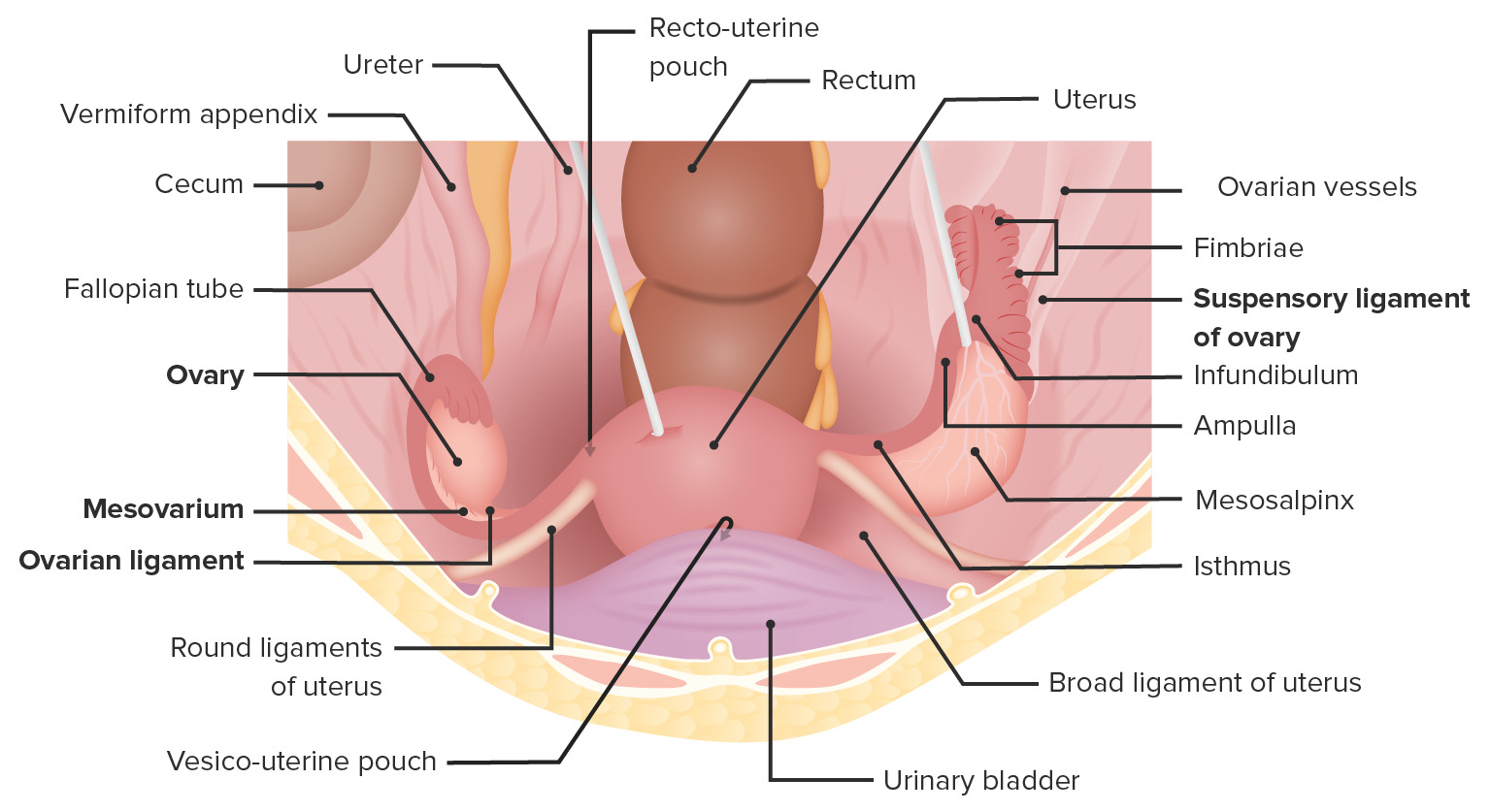
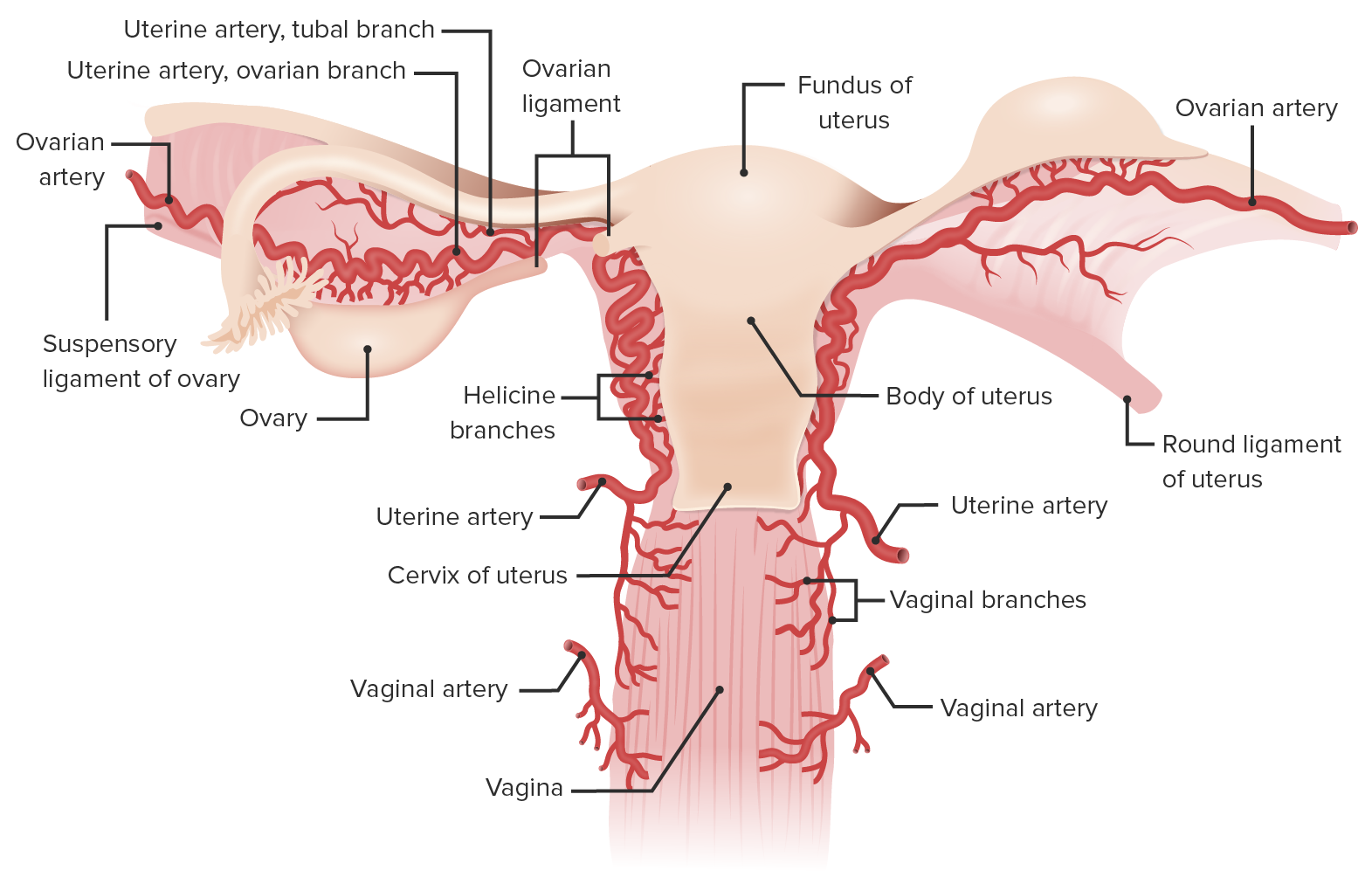
  • Los LOS Neisseria ovarios son órganos glandulares pares que se encuentran dentro de la pelvis Pelvis The pelvis consists of the bony pelvic girdle, the muscular and ligamentous pelvic floor, and the pelvic cavity, which contains viscera, vessels, and multiple nerves and muscles. The pelvic girdle, composed of 2 “hip” bones and the sacrum, is a ring-like bony structure of the axial skeleton that links the vertebral column with the lower extremities. Pelvis: Anatomy menor.
  • Soporte ovárico e irrigación sanguínea:
    • Ligamento suspensorio del ovario (también conocido como ligamento infundibulopélvico):
      • Une el ovario a la pared lateral de la superficie interna de la pelvis Pelvis The pelvis consists of the bony pelvic girdle, the muscular and ligamentous pelvic floor, and the pelvic cavity, which contains viscera, vessels, and multiple nerves and muscles. The pelvic girdle, composed of 2 “hip” bones and the sacrum, is a ring-like bony structure of the axial skeleton that links the vertebral column with the lower extremities. Pelvis: Anatomy
      • Contiene la arteria ovárica
    • Ligamento útero-ovárico (también conocido como el ligamento ovárico)
      • Une el ovario medialmente al AL Amyloidosis útero
      • Contiene ramas de la arteria uterina
      • Es el principal responsable de evitar la torsión de los LOS Neisseria ovarios
  • Los LOS Neisseria ovarios tienen una doble irrigación sanguínea, ya que reciben sangre de los LOS Neisseria vasos sanguíneos ováricos y uterinos.

Epidemiología

  • Más común en EN Erythema nodosum is an immune-mediated panniculitis (inflammation of the subcutaneous fat) caused by a type IV (delayed-type) hypersensitivity reaction. It commonly manifests in young women as tender, erythematous nodules on the shins. Erythema Nodosum mujeres en EN Erythema nodosum is an immune-mediated panniculitis (inflammation of the subcutaneous fat) caused by a type IV (delayed-type) hypersensitivity reaction. It commonly manifests in young women as tender, erythematous nodules on the shins. Erythema Nodosum edad reproductiva, debido a la formación más común de quistes fisiológicos.
  • También puede ocurrir en EN Erythema nodosum is an immune-mediated panniculitis (inflammation of the subcutaneous fat) caused by a type IV (delayed-type) hypersensitivity reaction. It commonly manifests in young women as tender, erythematous nodules on the shins. Erythema Nodosum fetos femeninos, neonatos, mujeres prepúberes y posmenopáusicas, aunque es menos común
  • Afecta más comúnmente a mujeres con ovarios > 5 cm, lo que es más frecuente en EN Erythema nodosum is an immune-mediated panniculitis (inflammation of the subcutaneous fat) caused by a type IV (delayed-type) hypersensitivity reaction. It commonly manifests in young women as tender, erythematous nodules on the shins. Erythema Nodosum:
    • Quistes y tumores ováricos (encontrados en EN Erythema nodosum is an immune-mediated panniculitis (inflammation of the subcutaneous fat) caused by a type IV (delayed-type) hypersensitivity reaction. It commonly manifests in young women as tender, erythematous nodules on the shins. Erythema Nodosum > 85% de los LOS Neisseria casos)
    • Mujeres sometidas a tratamientos de fertilidad
    • Síndrome de ovario poliquístico (SOP)
    • Embarazo
  • La torsión del ovario izquierdo es menos frecuente porque se apoya en EN Erythema nodosum is an immune-mediated panniculitis (inflammation of the subcutaneous fat) caused by a type IV (delayed-type) hypersensitivity reaction. It commonly manifests in young women as tender, erythematous nodules on the shins. Erythema Nodosum el colon Colon The large intestines constitute the last portion of the digestive system. The large intestine consists of the cecum, appendix, colon (with ascending, transverse, descending, and sigmoid segments), rectum, and anal canal. The primary function of the colon is to remove water and compact the stool prior to expulsion from the body via the rectum and anal canal. Colon, Cecum, and Appendix: Anatomy sigmoide.
  • La fijación de los LOS Neisseria ovarios disminuye el riesgo de torsión, y puede verse con:
    • Adherencias de cirugías anteriores
    • Endometriosis Endometriosis Endometriosis is a common disease in which patients have endometrial tissue implanted outside of the uterus. Endometrial implants can occur anywhere in the pelvis, including the ovaries, the broad and uterosacral ligaments, the pelvic peritoneum, and the urinary and gastrointestinal tracts. Endometriosis
    • Malignidad
    • Absceso tubo-ovárico previo

Patogénesis

La torsión ovárica o anexial implica la siguiente secuencia de eventos:

  1. Giro a lo largo del eje ovárico (ligamento suspensorio y/o ligamento útero-ovárico)
  2. Compresión/bloqueo del drenaje venoso y linfático de los LOS Neisseria ovarios
  3. Edema Edema Edema is a condition in which excess serous fluid accumulates in the body cavity or interstitial space of connective tissues. Edema is a symptom observed in several medical conditions. It can be categorized into 2 types, namely, peripheral (in the extremities) and internal (in an organ or body cavity). Edema local del ovario, las trompas de Falopio y los LOS Neisseria ligamentos de soporte
  4. Compresión/bloqueo del suministro arterial de los LOS Neisseria ovarios
  5. Isquemia, seguida de necrosis Necrosis The death of cells in an organ or tissue due to disease, injury or failure of the blood supply. Ischemic Cell Damage del tejido ovárico
  6. Hemorragia local por tejido necrótico friable

Presentación Clínica

  • El síntoma más común es un dolor Dolor Inflammation abdominal bajo/pélvico intenso y súbito.
    • Generalmente unilateral, puede ser difuso
    • Puede irradiarse al AL Amyloidosis resto del abdomen, espalda y costado
  • Hallazgos al AL Amyloidosis examen físico:
    • Signos de abdomen agudo
    • Masa anexial dolorosa unilateral
    • Dolor Dolor Inflammation a la movilización cervical
  • Náuseas y vómitos:
    • Comunes
    • Pueden ser continuos o aparecer en EN Erythema nodosum is an immune-mediated panniculitis (inflammation of the subcutaneous fat) caused by a type IV (delayed-type) hypersensitivity reaction. It commonly manifests in young women as tender, erythematous nodules on the shins. Erythema Nodosum oleadas
  • Se puede ver fiebre en EN Erythema nodosum is an immune-mediated panniculitis (inflammation of the subcutaneous fat) caused by a type IV (delayed-type) hypersensitivity reaction. It commonly manifests in young women as tender, erythematous nodules on the shins. Erythema Nodosum casos en EN Erythema nodosum is an immune-mediated panniculitis (inflammation of the subcutaneous fat) caused by a type IV (delayed-type) hypersensitivity reaction. It commonly manifests in young women as tender, erythematous nodules on the shins. Erythema Nodosum que el ovario sufre necrosis Necrosis The death of cells in an organ or tissue due to disease, injury or failure of the blood supply. Ischemic Cell Damage o ruptura.
  • La hemorragia y la secreción vaginales anormales pueden estar presentes de asociarse con una ruptura o un absceso.

Diagnóstico y Tratamiento

Se sospecha torsión anexial basándose en EN Erythema nodosum is an immune-mediated panniculitis (inflammation of the subcutaneous fat) caused by a type IV (delayed-type) hypersensitivity reaction. It commonly manifests in young women as tender, erythematous nodules on the shins. Erythema Nodosum los LOS Neisseria síntomas típicos, respaldada por imagenología con ultrasonido transvaginal o ultrasonido Doppler Doppler Ultrasonography applying the doppler effect, with frequency-shifted ultrasound reflections produced by moving targets (usually red blood cells) in the bloodstream along the ultrasound axis in direct proportion to the velocity of movement of the targets, to determine both direction and velocity of blood flow. Ultrasound (Sonography) color, y se confirma durante la cirugía exploratoria inmediata.

Pruebas de laboratorio

  • Hemograma para detectar anemia Anemia Anemia is a condition in which individuals have low Hb levels, which can arise from various causes. Anemia is accompanied by a reduced number of RBCs and may manifest with fatigue, shortness of breath, pallor, and weakness. Subtypes are classified by the size of RBCs, chronicity, and etiology. Anemia: Overview and Types y leucocitosis:
    • Se observan anemia Anemia Anemia is a condition in which individuals have low Hb levels, which can arise from various causes. Anemia is accompanied by a reduced number of RBCs and may manifest with fatigue, shortness of breath, pallor, and weakness. Subtypes are classified by the size of RBCs, chronicity, and etiology. Anemia: Overview and Types y leucocitosis en EN Erythema nodosum is an immune-mediated panniculitis (inflammation of the subcutaneous fat) caused by a type IV (delayed-type) hypersensitivity reaction. It commonly manifests in young women as tender, erythematous nodules on the shins. Erythema Nodosum casos de hemorragia.
    • Se observa leucocitosis en EN Erythema nodosum is an immune-mediated panniculitis (inflammation of the subcutaneous fat) caused by a type IV (delayed-type) hypersensitivity reaction. It commonly manifests in young women as tender, erythematous nodules on the shins. Erythema Nodosum casos de ruptura.
  • Prueba de embarazo en EN Erythema nodosum is an immune-mediated panniculitis (inflammation of the subcutaneous fat) caused by a type IV (delayed-type) hypersensitivity reaction. It commonly manifests in young women as tender, erythematous nodules on the shins. Erythema Nodosum orina es importante para descartar un embarazo ectópico.

Imagenología

  • Se puede realizar un ultrasonido junto con Doppler Doppler Ultrasonography applying the doppler effect, with frequency-shifted ultrasound reflections produced by moving targets (usually red blood cells) in the bloodstream along the ultrasound axis in direct proportion to the velocity of movement of the targets, to determine both direction and velocity of blood flow. Ultrasound (Sonography) pélvico; a menudo no diagnósticos, pero pueden mostrar:
    • Un ovario asimétricamente aumentado de tamaño
    • Una masa anexial, lo que incrementa el riesgo de torsión
    • Signo del remolino: torsión del pedículo vascular; se ve VE Ventilation: Mechanics of Breathing como una masa redonda hiperecoica con rayas hipoecoicas
    • Puede haber líquido libre en EN Erythema nodosum is an immune-mediated panniculitis (inflammation of the subcutaneous fat) caused by a type IV (delayed-type) hypersensitivity reaction. It commonly manifests in young women as tender, erythematous nodules on the shins. Erythema Nodosum la cavidad pélvica.
  • Nota: un Doppler normal no excluye una torsión.
  • RM: no se realiza de rutina, pero puede considerarse si los LOS Neisseria hallazgos ultrasonográficos son inconclusos
  • La TC puede descartar otras afecciones abdominales, como la apendicitis.

Confirmación quirúrgica

La laparoscopia/laparotomía es el estándar de oro para el diagnóstico de la torsión ovárica, ya que el cirujano puede visualizar directamente el ovario torcido.

Tratamiento

  • Debe intentarse una resolución quirúrgica rápida y precoz de la torsión para salvar el ovario.
    • Abordaje preferido: laparoscopia
    • Alternativa: laparotomía
  • El cirujano evalúa la viabilidad del ovario.
    • La necrosis es rara cuando la torsión se trata adecuadamente → la mayoría de los ovarios pueden simplemente “desenroscarse” y salvarse.
    • Debe extirparse el tejido necrótico.
  • La quistectomía suele estar indicada si hay un quiste benigno.
  • En EN Erythema nodosum is an immune-mediated panniculitis (inflammation of the subcutaneous fat) caused by a type IV (delayed-type) hypersensitivity reaction. It commonly manifests in young women as tender, erythematous nodules on the shins. Erythema Nodosum mujeres posmenopáusicas, se prefiere la salpingooforectomía.
  • Si se sospecha malignidad, se recomienda consultar a un ginecólogo oncólogo.

Diagnóstico Diferencial

  • Embarazo ectópico: implantación del embrión fecundado fuera de la cavidad uterina, generalmente en EN Erythema nodosum is an immune-mediated panniculitis (inflammation of the subcutaneous fat) caused by a type IV (delayed-type) hypersensitivity reaction. It commonly manifests in young women as tender, erythematous nodules on the shins. Erythema Nodosum una trompa de Falopio. El embarazo ectópico se presenta con dolor Dolor Inflammation abdominal repentino y severo. Cuando ocurre una rotura, el embarazo ectópico puede presentarse con fiebre, sepsis Sepsis Systemic inflammatory response syndrome with a proven or suspected infectious etiology. When sepsis is associated with organ dysfunction distant from the site of infection, it is called severe sepsis. When sepsis is accompanied by hypotension despite adequate fluid infusion, it is called septic shock. Sepsis and Septic Shock y peritonitis Peritonitis Inflammation of the peritoneum lining the abdominal cavity as the result of infectious, autoimmune, or chemical processes. Primary peritonitis is due to infection of the peritoneal cavity via hematogenous or lymphatic spread and without intra-abdominal source. Secondary peritonitis arises from the abdominal cavity itself through rupture or abscess of intra-abdominal organs. Penetrating Abdominal Injury. Generalmente, hay antecedentes de falta de un período menstrual. Los LOS Neisseria hallazgos incluyen una prueba de embarazo positiva y dolor Dolor Inflammation con la manipulación cervical (examen pélvico). El diagnóstico se confirma con ultrasonido pélvico.
  • Rotura de quiste ovárico: un quiste ovárico es un saco lleno de líquido dentro de un ovario o en EN Erythema nodosum is an immune-mediated panniculitis (inflammation of the subcutaneous fat) caused by a type IV (delayed-type) hypersensitivity reaction. It commonly manifests in young women as tender, erythematous nodules on the shins. Erythema Nodosum su superficie, que puede formarse como resultado de la ovulación. La rotura de un quiste puede causar dolor Dolor Inflammation intenso y hemorragia interna. Los LOS Neisseria hallazgos de diagnóstico pueden incluir una masa anexial y líquido libre dentro de la pelvis Pelvis The pelvis consists of the bony pelvic girdle, the muscular and ligamentous pelvic floor, and the pelvic cavity, which contains viscera, vessels, and multiple nerves and muscles. The pelvic girdle, composed of 2 “hip” bones and the sacrum, is a ring-like bony structure of the axial skeleton that links the vertebral column with the lower extremities. Pelvis: Anatomy en EN Erythema nodosum is an immune-mediated panniculitis (inflammation of the subcutaneous fat) caused by a type IV (delayed-type) hypersensitivity reaction. It commonly manifests in young women as tender, erythematous nodules on the shins. Erythema Nodosum el ultrasonido, junto con una prueba de embarazo negativa. El tratamiento incluye vigilancia expectante para quistes no complicados y cirugía para quistes asociados con hemorragia.
  • Enfermedad inflamatoria pélvica: ETS que afecta a los LOS Neisseria órganos reproductivos internos, generalmente en EN Erythema nodosum is an immune-mediated panniculitis (inflammation of the subcutaneous fat) caused by a type IV (delayed-type) hypersensitivity reaction. It commonly manifests in young women as tender, erythematous nodules on the shins. Erythema Nodosum una mujer adulta joven. Esta enfermedad se presenta con dolor Dolor Inflammation abdominal inferior (generalmente bilateral) y, en EN Erythema nodosum is an immune-mediated panniculitis (inflammation of the subcutaneous fat) caused by a type IV (delayed-type) hypersensitivity reaction. It commonly manifests in young women as tender, erythematous nodules on the shins. Erythema Nodosum particular, dolor Dolor Inflammation de órganos pélvicos al AL Amyloidosis examen pélvico, fiebre y secreción vaginal. El diagnóstico se establece con un examen pélvico y un ultrasonido.
  • Apendicitis: inflamación aguda del apéndice vermiforme y la emergencia quirúrgica abdominal más frecuente a nivel mundial. Los LOS Neisseria rasgos característicos de la apendicitis incluyen dolor Dolor Inflammation abdominal periumbilical que migra al AL Amyloidosis cuadrante inferior derecho, fiebre, anorexia Anorexia The lack or loss of appetite accompanied by an aversion to food and the inability to eat. It is the defining characteristic of the disorder anorexia nervosa. Anorexia Nervosa, náuseas y vómitos. Con frecuencia, el diagnóstico se puede establecer clínicamente, pero se usa TC en EN Erythema nodosum is an immune-mediated panniculitis (inflammation of the subcutaneous fat) caused by a type IV (delayed-type) hypersensitivity reaction. It commonly manifests in young women as tender, erythematous nodules on the shins. Erythema Nodosum casos de incertidumbre. El tratamiento estándar es una apendicectomía, pero las perforaciones localizadas con frecuencia se tratan en EN Erythema nodosum is an immune-mediated panniculitis (inflammation of the subcutaneous fat) caused by a type IV (delayed-type) hypersensitivity reaction. It commonly manifests in young women as tender, erythematous nodules on the shins. Erythema Nodosum un principio de manera no quirúrgica con antibióticos.
  • Diverticulitis Diverticulitis Inflammation of a diverticulum or diverticula. Diverticular Disease: inflamación de los LOS Neisseria divertículos colónicos. Generalmente, la diverticulitis Diverticulitis Inflammation of a diverticulum or diverticula. Diverticular Disease se desarrolla en EN Erythema nodosum is an immune-mediated panniculitis (inflammation of the subcutaneous fat) caused by a type IV (delayed-type) hypersensitivity reaction. It commonly manifests in young women as tender, erythematous nodules on the shins. Erythema Nodosum el lado izquierdo, pero también puede presentarse en EN Erythema nodosum is an immune-mediated panniculitis (inflammation of the subcutaneous fat) caused by a type IV (delayed-type) hypersensitivity reaction. It commonly manifests in young women as tender, erythematous nodules on the shins. Erythema Nodosum el lado derecho, especialmente en EN Erythema nodosum is an immune-mediated panniculitis (inflammation of the subcutaneous fat) caused by a type IV (delayed-type) hypersensitivity reaction. It commonly manifests in young women as tender, erythematous nodules on the shins. Erythema Nodosum pacientes jóvenes y en EN Erythema nodosum is an immune-mediated panniculitis (inflammation of the subcutaneous fat) caused by a type IV (delayed-type) hypersensitivity reaction. It commonly manifests in young women as tender, erythematous nodules on the shins. Erythema Nodosum poblaciones asiáticas. Los LOS Neisseria pacientes presentan dolor Dolor Inflammation abdominal, fiebre y cambios en EN Erythema nodosum is an immune-mediated panniculitis (inflammation of the subcutaneous fat) caused by a type IV (delayed-type) hypersensitivity reaction. It commonly manifests in young women as tender, erythematous nodules on the shins. Erythema Nodosum los LOS Neisseria hábitos intestinales. El diagnóstico se realiza por TC.
  • Infección del tracto urinario (ITU): infección bacteriana del tracto urinario en EN Erythema nodosum is an immune-mediated panniculitis (inflammation of the subcutaneous fat) caused by a type IV (delayed-type) hypersensitivity reaction. It commonly manifests in young women as tender, erythematous nodules on the shins. Erythema Nodosum forma de cistitis (infección de la vejiga) o pielonefritis aguda (afectación de los LOS Neisseria riñones). Las ITU se presentan con dolor Dolor Inflammation suprapúbico y disuria (cistitis) o sensibilidad en EN Erythema nodosum is an immune-mediated panniculitis (inflammation of the subcutaneous fat) caused by a type IV (delayed-type) hypersensitivity reaction. It commonly manifests in young women as tender, erythematous nodules on the shins. Erythema Nodosum el ángulo costovertebral y fiebre (pielonefritis). El diagnóstico se realiza mediante análisis de orina y TC.

Referencias

  1. Guile SL, Mathai JK. (2023). Ovarian torsion. StatPearls. Retrieved June 19, 2025, from https://www.ncbi.nlm.nih.gov/books/NBK560675/
  2. Laufer, MR. (2025). Ovarian and fallopian tube torsion. UpToDate. Retrieved June 19, 2025, from https://www.uptodate.com/contents/ovarian-and-fallopian-tube-torsion
  3. Kilpatrick, CC. (2023). Adnexal torsion. MSD Manual Professional Version. Retrieved June 19, 2025, from https://www.msdmanuals.com/professional/gynecology-and-obstetrics/miscellaneous-gynecologic-disorders/adnexal-torsion

¡Crea tu cuenta gratis o inicia una sesión para seguir leyendo!

Regístrate ahora y obtén acceso gratuito a Lecturio con páginas de concepto, videos médicos y cuestionarios para tu educación médica.

User Reviews

Que tengas una sesión de estudio alegre y navideña 🎁 Ahorra 50% en todos los planes >>

Details