Domina Conceptos Médicos

Estudia para la escuela de medicina y tus examenes con Lecturio.

Tiroiditis de Hashimoto

La tiroiditis de Hashimoto, o tiroiditis linfocítica crónica, es la causa más común de hipotiroidismo en las regiones donde el aporte de yodo es suficiente. Se trata de un trastorno autoinmune que conduce a la destrucción de las células tiroideas y a la insuficiencia tiroidea. El curso clínico progresivo de la tiroiditis de Hashimoto comienza con un estado hipertiroideo transitorio ("hashitoxicosis") seguido de hipotiroidismo subclínico. Con el tiempo, se produce una progresión hacia el hipotiroidismo clínico, que es permanente. Los LOS Neisseria pacientes pueden tener un bocio indoloro, pero en EN Erythema nodosum is an immune-mediated panniculitis (inflammation of the subcutaneous fat) caused by a type IV (delayed-type) hypersensitivity reaction. It commonly manifests in young women as tender, erythematous nodules on the shins. Erythema Nodosum etapas posteriores, la glándula es atrófica. El diagnóstico se realiza mediante pruebas de laboratorio que muestran una elevación de la hormona estimulante del tiroides (TSH), un nivel bajo de tiroxina libre ( T4 T4 The major hormone derived from the thyroid gland. Thyroxine is synthesized via the iodination of tyrosines (monoiodotyrosine) and the coupling of iodotyrosines (diiodotyrosine) in the thyroglobulin. Thyroxine is released from thyroglobulin by proteolysis and secreted into the blood. Thyroxine is peripherally deiodinated to form triiodothyronine which exerts a broad spectrum of stimulatory effects on cell metabolism. Thyroid Hormones) y anticuerpos positivos contra la tiroglobulina y la peroxidasa tiroidea. En EN Erythema nodosum is an immune-mediated panniculitis (inflammation of the subcutaneous fat) caused by a type IV (delayed-type) hypersensitivity reaction. It commonly manifests in young women as tender, erythematous nodules on the shins. Erythema Nodosum los LOS Neisseria casos dudosos, se requiere la realización de imágenes. La captación de yodo radiactivo mostrará una baja captación de yodo y el ultrasonido demuestra un agrandamiento simétrico difuso. La biopsia muestra una infiltración linfocítica con células de Hurthle. El tratamiento es la sustitución de la hormona tiroidea de por vida.

Last updated: Dec 15, 2025

Editorial responsibility: Stanley Oiseth, Lindsay Jones, Evelin Maza

Descripción General

Definición

La tiroiditis de Hashimoto es una enfermedad tiroidea autoinmune que provoca la destrucción y el fallo de la glándula tiroidea.

Epidemiología

  • La edad de aparición suele estar entre los LOS Neisseria 30 y los LOS Neisseria 50 años.
  • Más común en EN Erythema nodosum is an immune-mediated panniculitis (inflammation of the subcutaneous fat) caused by a type IV (delayed-type) hypersensitivity reaction. It commonly manifests in young women as tender, erythematous nodules on the shins. Erythema Nodosum las mujeres que en EN Erythema nodosum is an immune-mediated panniculitis (inflammation of the subcutaneous fat) caused by a type IV (delayed-type) hypersensitivity reaction. It commonly manifests in young women as tender, erythematous nodules on the shins. Erythema Nodosum los LOS Neisseria hombres: proporción 10-20:1
  • Es la causa más común de hipotiroidismo en EN Erythema nodosum is an immune-mediated panniculitis (inflammation of the subcutaneous fat) caused by a type IV (delayed-type) hypersensitivity reaction. It commonly manifests in young women as tender, erythematous nodules on the shins. Erythema Nodosum las regiones con insuficiencia de yodo
  • Es la segunda causa más común de hipotiroidismo a nivel mundial, después de la deficiencia de yodo.

Etiología

Se desconoce la causa exacta, aunque los LOS Neisseria factores genéticos y ambientales desempeñan un papel importante:

  • Factores de riesgo genéticos:
    • ↑ Riesgo con polimorfismos en EN Erythema nodosum is an immune-mediated panniculitis (inflammation of the subcutaneous fat) caused by a type IV (delayed-type) hypersensitivity reaction. It commonly manifests in young women as tender, erythematous nodules on the shins. Erythema Nodosum genes Genes A category of nucleic acid sequences that function as units of heredity and which code for the basic instructions for the development, reproduction, and maintenance of organisms. DNA Types and Structure inmunorreguladores, incluyendo CTLA4, PTPN22, IL2RA (todos ellos codifican respuestas reguladoras de células T)
    • Asociado a HLA-DR3, DR4 y DR5
    • Los LOS Neisseria grupos de enfermedades encontrados en EN Erythema nodosum is an immune-mediated panniculitis (inflammation of the subcutaneous fat) caused by a type IV (delayed-type) hypersensitivity reaction. It commonly manifests in young women as tender, erythematous nodules on the shins. Erythema Nodosum las familias sugieren una susceptibilidad genética.
    • ↑ Incidencia en EN Erythema nodosum is an immune-mediated panniculitis (inflammation of the subcutaneous fat) caused by a type IV (delayed-type) hypersensitivity reaction. It commonly manifests in young women as tender, erythematous nodules on the shins. Erythema Nodosum pacientes con síndrome de Down y síndrome de Turner.
  • Los LOS Neisseria factores de riesgo no genéticos que pueden desencadenar la enfermedad:
    • Embarazo
    • Yodo y amiodarona
    • Estrés
    • Irradiación
    • Esteroides sexuales
  • Asociada a otras enfermedades autoinmunes:
    • Diabetes Diabetes Diabetes mellitus (DM) is a metabolic disease characterized by hyperglycemia and dysfunction of the regulation of glucose metabolism by insulin. Type 1 DM is diagnosed mostly in children and young adults as the result of autoimmune destruction of β cells in the pancreas and the resulting lack of insulin. Type 2 DM has a significant association with obesity and is characterized by insulin resistance. Diabetes Mellitus mellitus tipo 1
    • Lupus eritematoso sistémico
    • Enfermedad de Addison

Fisiopatología

Inmunología

Cuando se induce la autoinmunidad tiroidea, se produce un agotamiento progresivo de las células epiteliales tiroideas.

Destrucción de células tiroideas mediada por:

  • Citotoxicidad mediada por células T: Las células T citotóxicas CD8+ destruyen las células tiroideas.
  • Producción local de citoquinas:
    • El factor de necrosis Necrosis The death of cells in an organ or tissue due to disease, injury or failure of the blood supply. Ischemic Cell Damage tumoral y el interferón-ɣ perjudican la función celular.
    • Reclutamiento de macrófagos
  • Anticuerpos contra la tiroglobulina ( Tg Tg Thyroid Hormones) y la peroxidasa tiroidea (TPO, por sus siglas en EN Erythema nodosum is an immune-mediated panniculitis (inflammation of the subcutaneous fat) caused by a type IV (delayed-type) hypersensitivity reaction. It commonly manifests in young women as tender, erythematous nodules on the shins. Erythema Nodosum inglés): papel secundario en EN Erythema nodosum is an immune-mediated panniculitis (inflammation of the subcutaneous fat) caused by a type IV (delayed-type) hypersensitivity reaction. It commonly manifests in young women as tender, erythematous nodules on the shins. Erythema Nodosum la muerte de las células tiroideas, pero son marcadores de autoinmunidad tiroidea

Infiltración linfocítica y fibrosis Fibrosis Any pathological condition where fibrous connective tissue invades any organ, usually as a consequence of inflammation or other injury. Bronchiolitis Obliterans de las células tiroideas → los LOS Neisseria folículos se rompen y liberan hormonas tiroideas:
  • ↑ Transitorio de tiroxina (T4) y triyodotironina (T3): “hashitoxicosis”
  • ↓ Compensatoria de la hormona estimulante de la tiroides (TSH, por sus siglas en EN Erythema nodosum is an immune-mediated panniculitis (inflammation of the subcutaneous fat) caused by a type IV (delayed-type) hypersensitivity reaction. It commonly manifests in young women as tender, erythematous nodules on the shins. Erythema Nodosum inglés) → las reservas de T3 T3 A T3 thyroid hormone normally synthesized and secreted by the thyroid gland in much smaller quantities than thyroxine (T4). Most T3 is derived from peripheral monodeiodination of T4 at the 5′ position of the outer ring of the iodothyronine nucleus. The hormone finally delivered and used by the tissues is mainly t3. Thyroid Hormones/ T4 T4 The major hormone derived from the thyroid gland. Thyroxine is synthesized via the iodination of tyrosines (monoiodotyrosine) and the coupling of iodotyrosines (diiodotyrosine) in the thyroglobulin. Thyroxine is released from thyroglobulin by proteolysis and secreted into the blood. Thyroxine is peripherally deiodinated to form triiodothyronine which exerts a broad spectrum of stimulatory effects on cell metabolism. Thyroid Hormones disminuyen gradualmente
  • Resultado final: ↑ TSH + hipotiroidismo (a menudo permanente)
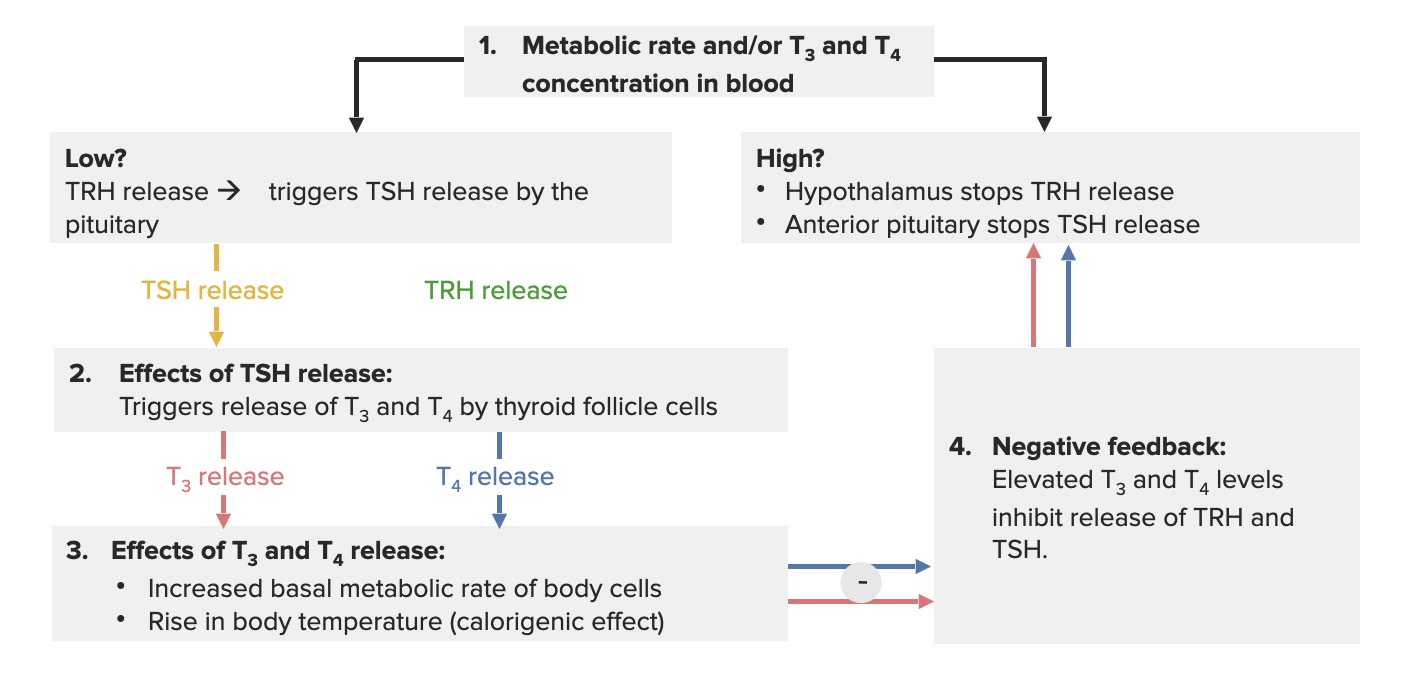
Eje de retroalimentación negativa clásico en Hashimoto
Eje de retroalimentación hipotálamo-hipófisis-tiroides: Cuando las hormonas tiroideas son bajas, el hipotálamo libera la hormona liberadora de tirotropina (TRH, por sus siglas en inglés), que desencadena la secreción de TSH por parte de la hipófisis. El efecto de este proceso es que la glándula tiroides produce tiroxina (T4) y triyodotironina (T3) (se produce más T4, ya que se convierte en T3). Un aumento de las hormonas tiroideas (T3/T4 libres o no unidas) crea una retroalimentación negativa, inhibiendo la liberación de TRH y TSH. Imagen: “Classic Negative Feedback Loop” por OpenStax College. Licencia: CC BY 3.0, editado por Lecturio.

Patología

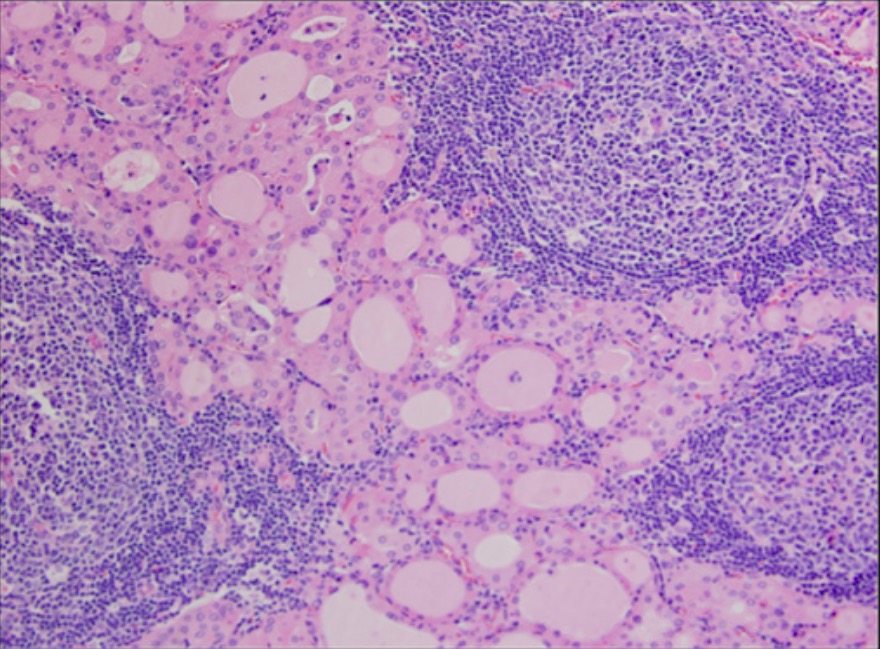
Respuesta inmunológica vista histológicamente como:

  • Infiltrados linfocíticos y células plasmáticas
  • Centros germinales bien desarrollados

Destrucción de células tiroideas:

  • Folículos tiroideos atróficos
  • Células Hurthle:
    • Células oncocíticas con abundante citoplasma granular eosinófilo
    • Cambio metaplástico resultante de una lesión crónica
  • Aumento del tejido conectivo/ fibrosis Fibrosis Any pathological condition where fibrous connective tissue invades any organ, usually as a consequence of inflammation or other injury. Bronchiolitis Obliterans (limitado dentro de la cápsula)
Tejido linfático Hashimoto
Tiroiditis de Hashimoto florida: tejido linfoide reactivo con centro germinal (tinción de hematoxilina y eosina, aumento de 200x) Image: “Florid Hashimoto’s thyroiditis” por Division of Endocrinology and Metabolism, University of Connecticut Health Center, 263 Farmington Avenue, Farmington, CT 06030, USA. Licencia: CC BY 2.0

Presentación Clínica

Cuadro clínico

  • La tiroiditis suele presentar un curso clínico trifásico.
  • La tiroiditis de Hashimoto se presenta de forma similar, sin la fase final eutiroidea.
  • Fases:
    • Hashitoxicosis Hashitoxicosis Hashimoto’s Thyroiditis: hipertiroidismo transitorio inicial
    • Hipotiroidismo subclínico:
      • Pérdida gradual de la función tiroidea
      • Asintomático
    • Hipotiroidismo clínico

Manifestaciones

Síntomas comunes del hipotiroidismo:

  • Fatiga, intolerancia al AL Amyloidosis frío, aumento de peso
  • Piel seca, pérdida de cabello
  • Dificultad para concentrarse y mala memoria
  • Voz ronca, problemas de audición
  • Estreñimiento
  • Irregularidades menstruales (menorragia, luego oligomenorrea o amenorrea)
  • Parestesia

Signos comunes del hipotiroidismo:

  • +/- Bocio (algunas glándulas son atróficas en EN Erythema nodosum is an immune-mediated panniculitis (inflammation of the subcutaneous fat) caused by a type IV (delayed-type) hypersensitivity reaction. It commonly manifests in young women as tender, erythematous nodules on the shins. Erythema Nodosum etapas posteriores)
  • Piel seca y áspera; alopecia Alopecia Alopecia is the loss of hair in areas anywhere on the body where hair normally grows. Alopecia may be defined as scarring or non-scarring, localized or diffuse, congenital or acquired, reversible or permanent, or confined to the scalp or universal; however, alopecia is usually classified using the 1st 3 factors. Alopecia; extremidades frías
  • Cara, manos y pies hinchados ( edema Edema Edema is a condition in which excess serous fluid accumulates in the body cavity or interstitial space of connective tissues. Edema is a symptom observed in several medical conditions. It can be categorized into 2 types, namely, peripheral (in the extremities) and internal (in an organ or body cavity). Edema sin fóvea/mixedema)
  • Bradicardia
  • Relajación retardada de los LOS Neisseria reflejos tendinosos
  • Síndrome del túnel carpiano

Diagnóstico

Evaluación inicial

  • Los LOS Neisseria niveles de la hormona tiroidea serán diferentes en EN Erythema nodosum is an immune-mediated panniculitis (inflammation of the subcutaneous fat) caused by a type IV (delayed-type) hypersensitivity reaction. It commonly manifests in young women as tender, erythematous nodules on the shins. Erythema Nodosum cada fase:
    • Hashitoxicosis Hashitoxicosis Hashimoto’s Thyroiditis: ↓ TSH + ↑ T3 T3 A T3 thyroid hormone normally synthesized and secreted by the thyroid gland in much smaller quantities than thyroxine (T4). Most T3 is derived from peripheral monodeiodination of T4 at the 5′ position of the outer ring of the iodothyronine nucleus. The hormone finally delivered and used by the tissues is mainly t3. Thyroid Hormones/ T4 T4 The major hormone derived from the thyroid gland. Thyroxine is synthesized via the iodination of tyrosines (monoiodotyrosine) and the coupling of iodotyrosines (diiodotyrosine) in the thyroglobulin. Thyroxine is released from thyroglobulin by proteolysis and secreted into the blood. Thyroxine is peripherally deiodinated to form triiodothyronine which exerts a broad spectrum of stimulatory effects on cell metabolism. Thyroid Hormones libre
    • Hipotiroidismo subclínico: ↑ TSH + T3 T3 A T3 thyroid hormone normally synthesized and secreted by the thyroid gland in much smaller quantities than thyroxine (T4). Most T3 is derived from peripheral monodeiodination of T4 at the 5′ position of the outer ring of the iodothyronine nucleus. The hormone finally delivered and used by the tissues is mainly t3. Thyroid Hormones/ T4 T4 The major hormone derived from the thyroid gland. Thyroxine is synthesized via the iodination of tyrosines (monoiodotyrosine) and the coupling of iodotyrosines (diiodotyrosine) in the thyroglobulin. Thyroxine is released from thyroglobulin by proteolysis and secreted into the blood. Thyroxine is peripherally deiodinated to form triiodothyronine which exerts a broad spectrum of stimulatory effects on cell metabolism. Thyroid Hormones libre normal.
    • Hipotiroidismo clínico: ↑ TSH + ↓ T3 T3 A T3 thyroid hormone normally synthesized and secreted by the thyroid gland in much smaller quantities than thyroxine (T4). Most T3 is derived from peripheral monodeiodination of T4 at the 5′ position of the outer ring of the iodothyronine nucleus. The hormone finally delivered and used by the tissues is mainly t3. Thyroid Hormones/ T4 T4 The major hormone derived from the thyroid gland. Thyroxine is synthesized via the iodination of tyrosines (monoiodotyrosine) and the coupling of iodotyrosines (diiodotyrosine) in the thyroglobulin. Thyroxine is released from thyroglobulin by proteolysis and secreted into the blood. Thyroxine is peripherally deiodinated to form triiodothyronine which exerts a broad spectrum of stimulatory effects on cell metabolism. Thyroid Hormones libre
  • Anticuerpos positivos contra la peroxidasa tiroidea (TPO) y contra la tiroglobulina ( Tg Tg Thyroid Hormones):
    • Se observa en EN Erythema nodosum is an immune-mediated panniculitis (inflammation of the subcutaneous fat) caused by a type IV (delayed-type) hypersensitivity reaction. It commonly manifests in young women as tender, erythematous nodules on the shins. Erythema Nodosum > 95% de los LOS Neisseria casos de tiroiditis de Hashimoto
    • Los LOS Neisseria anticuerpos pueden predecir la progresión hacia el hipotiroidismo clínico.

Estudios adicionales

  • Pruebasdelaboratorio:
    • ↑ Colesterol, triglicéridos
    • El hemograma muestra anemia Anemia Anemia is a condition in which individuals have low Hb levels, which can arise from various causes. Anemia is accompanied by a reduced number of RBCs and may manifest with fatigue, shortness of breath, pallor, and weakness. Subtypes are classified by the size of RBCs, chronicity, and etiology. Anemia: Overview and Types normocítica.
  • Imágenes diagnósticas:
    • No es necesario para el diagnóstico
    • Obtenido en EN Erythema nodosum is an immune-mediated panniculitis (inflammation of the subcutaneous fat) caused by a type IV (delayed-type) hypersensitivity reaction. It commonly manifests in young women as tender, erythematous nodules on the shins. Erythema Nodosum casos de bocio asimétrico y/o + sospecha de nódulos
    • Pruebas:
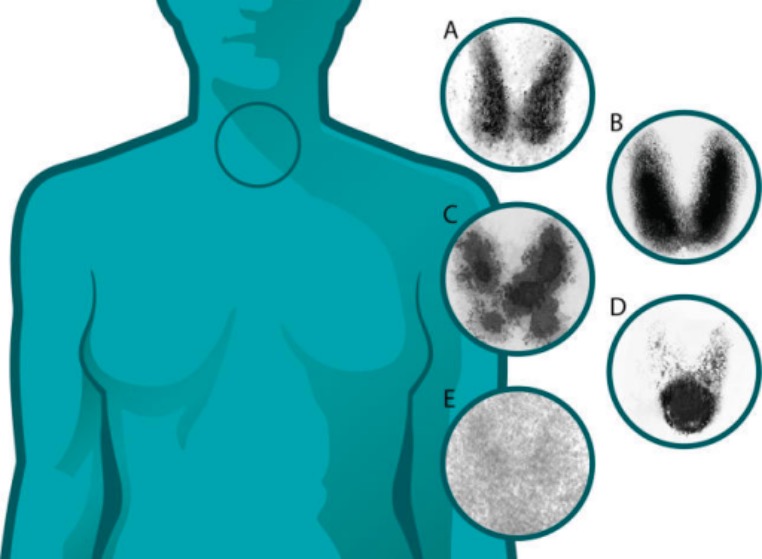
      • Captación de yodo radiactivo ( RAIU RAIU Thyrotoxicosis and Hyperthyroidism, por sus siglas en EN Erythema nodosum is an immune-mediated panniculitis (inflammation of the subcutaneous fat) caused by a type IV (delayed-type) hypersensitivity reaction. It commonly manifests in young women as tender, erythematous nodules on the shins. Erythema Nodosum inglés): baja captación (tiroides fría)
      • Ultrasonido: agrandamiento hipertrófico o reducción atrófica según el tipo y la fase.
  • Aspiración con aguja fina:
    • Si hay un nódulo dominante o sospecha de malignidad
    • Muestra células de Hurthle e infiltración linfocítica con centros germinales
Gammagrafía de captación tiroidea
Captación tiroidea (tiroiditis frente a otras enfermedades tiroideas): A: normal B: Enfermedad de Graves: aumento difuso de la captación en ambos lóbulos tiroideos C: bocio multinodular tóxico: zonas “calientes” y “frías” de captación desigual D: adenoma tóxico: aumento de la captación en un solo nódulo con supresión del tiroides circundante E: tiroiditis: disminución o ausencia de captación Imagen: “Technetium 99” por Endocrine Unit, Freeman Hospital, Newcastle upon Tyne, United Kingdom. Licencia: CC BY 4.0

Tratamiento y Complicaciones

Terapia de reemplazo tiroideo

  • Levotiroxina: forma sintética de T4 T4 The major hormone derived from the thyroid gland. Thyroxine is synthesized via the iodination of tyrosines (monoiodotyrosine) and the coupling of iodotyrosines (diiodotyrosine) in the thyroglobulin. Thyroxine is released from thyroglobulin by proteolysis and secreted into the blood. Thyroxine is peripherally deiodinated to form triiodothyronine which exerts a broad spectrum of stimulatory effects on cell metabolism. Thyroid Hormones que se convierte periféricamente en EN Erythema nodosum is an immune-mediated panniculitis (inflammation of the subcutaneous fat) caused by a type IV (delayed-type) hypersensitivity reaction. It commonly manifests in young women as tender, erythematous nodules on the shins. Erythema Nodosum T3 T3 A T3 thyroid hormone normally synthesized and secreted by the thyroid gland in much smaller quantities than thyroxine (T4). Most T3 is derived from peripheral monodeiodination of T4 at the 5′ position of the outer ring of the iodothyronine nucleus. The hormone finally delivered and used by the tissues is mainly t3. Thyroid Hormones
  • Dosificación:
    • 1,6 mcg/kg de peso corporal al AL Amyloidosis día en EN Erythema nodosum is an immune-mediated panniculitis (inflammation of the subcutaneous fat) caused by a type IV (delayed-type) hypersensitivity reaction. It commonly manifests in young women as tender, erythematous nodules on the shins. Erythema Nodosum pacientes jóvenes y sanos
    • Dosis inicial de 25 mcg al AL Amyloidosis día en EN Erythema nodosum is an immune-mediated panniculitis (inflammation of the subcutaneous fat) caused by a type IV (delayed-type) hypersensitivity reaction. It commonly manifests in young women as tender, erythematous nodules on the shins. Erythema Nodosum los LOS Neisseria ancianos
    • Dosis diferentes para la población pediátrica
  • Duración: de por vida
  • Absorción reducida por antiácidos, hierro, calcio
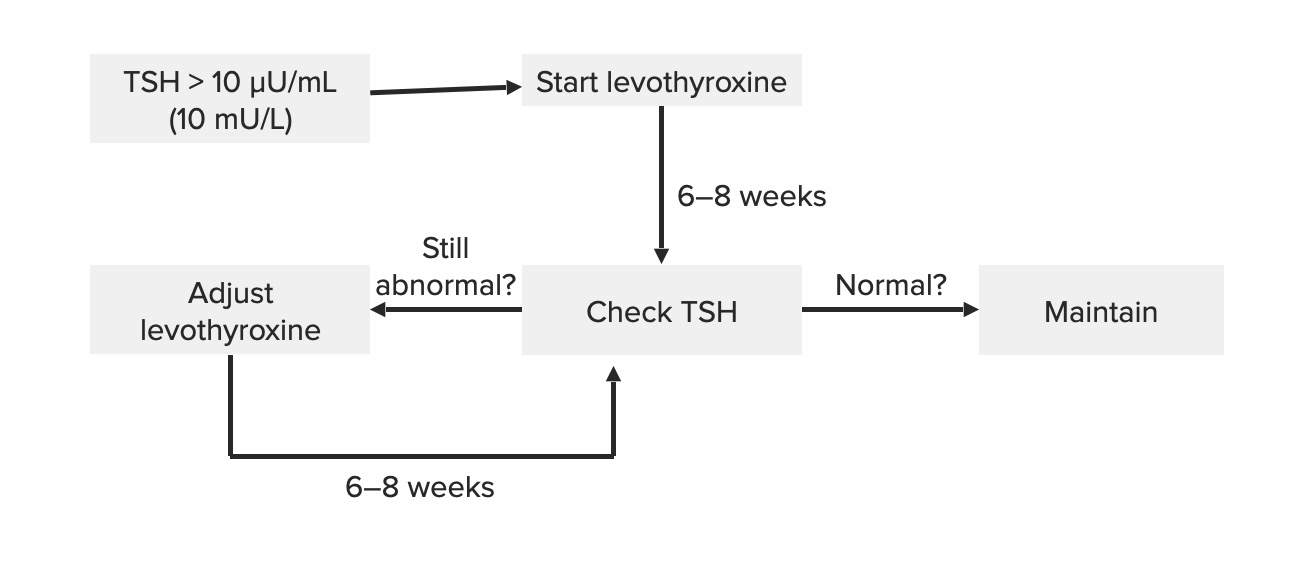
  • Mida la TSH después de 6 semanas y ajuste la dosis.
Algoritmo de manejo de la Tiroiditis de Hashimoto
Diagrama esquemático del tratamiento de la tiroiditis de Hashimoto: Tenga en cuenta que los ajustes dependen de los niveles de TSH.
Imagen por Lecturio.

Complicaciones

  • Coma Coma Coma is defined as a deep state of unarousable unresponsiveness, characterized by a score of 3 points on the GCS. A comatose state can be caused by a multitude of conditions, making the precise epidemiology and prognosis of coma difficult to determine. Coma mixedematoso: hipotiroidismo severo caracterizado por el enlentecimiento de la función de múltiples órganos
    • Se considera una emergencia médica
    • Puede provocar shock Shock Shock is a life-threatening condition associated with impaired circulation that results in tissue hypoxia. The different types of shock are based on the underlying cause: distributive (↑ cardiac output (CO), ↓ systemic vascular resistance (SVR)), cardiogenic (↓ CO, ↑ SVR), hypovolemic (↓ CO, ↑ SVR), obstructive (↓ CO), and mixed. Types of Shock y la muerte (tasa de mortalidad de hasta el 50%)
  • Los LOS Neisseria pacientes con tiroiditis de Hashimoto tienen mayor riesgo de:
    • Otras enfermedades autoinmunes (e.g., diabetes Diabetes Diabetes mellitus (DM) is a metabolic disease characterized by hyperglycemia and dysfunction of the regulation of glucose metabolism by insulin. Type 1 DM is diagnosed mostly in children and young adults as the result of autoimmune destruction of β cells in the pancreas and the resulting lack of insulin. Type 2 DM has a significant association with obesity and is characterized by insulin resistance. Diabetes Mellitus mellitus tipo 1, adrenalitis autoinmune)
    • Linfoma de células B de la glándula tiroides

Diagnósticos Diferenciales

  • Tiroiditis granulomatosa (síndrome de De Quervain): inflamación de la glándula tiroides generalmente asociada a una infección vírica previa y la causa más común de dolor Dolor Inflammation de tiroides. La presentación incluye dolor Dolor Inflammation en EN Erythema nodosum is an immune-mediated panniculitis (inflammation of the subcutaneous fat) caused by a type IV (delayed-type) hypersensitivity reaction. It commonly manifests in young women as tender, erythematous nodules on the shins. Erythema Nodosum el cuello con bocio. Los LOS Neisseria análisis muestran una TSH baja, una T4 T4 The major hormone derived from the thyroid gland. Thyroxine is synthesized via the iodination of tyrosines (monoiodotyrosine) and the coupling of iodotyrosines (diiodotyrosine) in the thyroglobulin. Thyroxine is released from thyroglobulin by proteolysis and secreted into the blood. Thyroxine is peripherally deiodinated to form triiodothyronine which exerts a broad spectrum of stimulatory effects on cell metabolism. Thyroid Hormones libre elevada, un aumento de la velocidad de eritrosedimentación y una captación de yodo radiactivo baja o inexistente. Suele ser un curso autolimitado que puede pasar por un estado hipertiroideo y luego por un estado eutiroideo seguido de hipotiroidismo. La recuperación de la función tiroidea normal lleva meses.
  • Tiroiditis linfocítica subaguda (tiroiditis indolora): enfermedad autoinmune con agrandamiento difuso de la glándula tiroides. El mismo proceso ocurre en EN Erythema nodosum is an immune-mediated panniculitis (inflammation of the subcutaneous fat) caused by a type IV (delayed-type) hypersensitivity reaction. It commonly manifests in young women as tender, erythematous nodules on the shins. Erythema Nodosum la tiroiditis posparto. Las pruebas de laboratorio dependen de la fase de la enfermedad, pero el hipertiroidismo inicial muestra una TSH baja y una T4 T4 The major hormone derived from the thyroid gland. Thyroxine is synthesized via the iodination of tyrosines (monoiodotyrosine) and the coupling of iodotyrosines (diiodotyrosine) in the thyroglobulin. Thyroxine is released from thyroglobulin by proteolysis and secreted into the blood. Thyroxine is peripherally deiodinated to form triiodothyronine which exerts a broad spectrum of stimulatory effects on cell metabolism. Thyroid Hormones elevada. La enfermedad está asociada a una baja captación de yodo radiactivo. El patrón de la enfermedad es un estado hipertiroideo transitorio y luego hipotiroideo, seguido de una recuperación. Sin embargo, algunos casos no llegan a ser eutiroideos.
  • Tiroiditis de Riedel: forma rara de tiroiditis caracterizada por una extensa fibrosis Fibrosis Any pathological condition where fibrous connective tissue invades any organ, usually as a consequence of inflammation or other injury. Bronchiolitis Obliterans de la glándula tiroides y de la zona del cuello. La tiroiditis de Riedel difiere de la tiroiditis de Hashimoto, en EN Erythema nodosum is an immune-mediated panniculitis (inflammation of the subcutaneous fat) caused by a type IV (delayed-type) hypersensitivity reaction. It commonly manifests in young women as tender, erythematous nodules on the shins. Erythema Nodosum que la fibrosis Fibrosis Any pathological condition where fibrous connective tissue invades any organ, usually as a consequence of inflammation or other injury. Bronchiolitis Obliterans no se extiende más allá de la cápsula. El examen mostrará una glándula tiroidea dura y fija, que se asocia con otros sitios de fibrosis Fibrosis Any pathological condition where fibrous connective tissue invades any organ, usually as a consequence of inflammation or other injury. Bronchiolitis Obliterans en EN Erythema nodosum is an immune-mediated panniculitis (inflammation of the subcutaneous fat) caused by a type IV (delayed-type) hypersensitivity reaction. It commonly manifests in young women as tender, erythematous nodules on the shins. Erythema Nodosum el cuerpo.
  • Hipopituitarismo: trastorno caracterizado por una deficiencia en EN Erythema nodosum is an immune-mediated panniculitis (inflammation of the subcutaneous fat) caused by a type IV (delayed-type) hypersensitivity reaction. It commonly manifests in young women as tender, erythematous nodules on the shins. Erythema Nodosum la producción de hormonas hipofisarias, que resulta de una enfermedad del hipotálamo o de la propia hipófisis. La hipofunción se traduce en EN Erythema nodosum is an immune-mediated panniculitis (inflammation of the subcutaneous fat) caused by a type IV (delayed-type) hypersensitivity reaction. It commonly manifests in young women as tender, erythematous nodules on the shins. Erythema Nodosum una reducción de la secreción de la hormona del crecimiento, la TSH, las gonadotropinas, la prolactina y la hormona adrenocorticotrópica, lo que produce un síndrome complejo en EN Erythema nodosum is an immune-mediated panniculitis (inflammation of the subcutaneous fat) caused by a type IV (delayed-type) hypersensitivity reaction. It commonly manifests in young women as tender, erythematous nodules on the shins. Erythema Nodosum función de las hormonas afectadas.

Referencias

  1. Davies, T. (2020). Pathogenesis of Hashimoto’s thyroiditis (chronic autoimmune thyroiditis). UpToDate. Retrieved February 11, 2021, from https://www.uptodate.com/contents/pathogenesis-of-hashimotos-thyroiditis-chronic-autoimmune-thyroiditis
  2. Lee, S., Nagelberg, S. (2020). Hashimoto Thyroiditis. Medscape. Retrieved January 25, 2021, from https://emedicine.medscape.com/article/120937-overview
  3. Maitra, A. (2021). The Endocrine System. Kumar V., Abbas, A., Aster, J. , Robbins & Cotran Pathologic Basis of Disease, 10e. Elsevier.

¡Crea tu cuenta gratis o inicia una sesión para seguir leyendo!

Regístrate ahora y obtén acceso gratuito a Lecturio con páginas de concepto, videos médicos y cuestionarios para tu educación médica.

User Reviews

Que tengas una sesión de estudio alegre y navideña 🎁 Ahorra 50% en todos los planes >>

Details